Ali Nuhu

Bashir Ahmad faults The Herd for “dangerous” stereotyping of Fulani herders

By Muhammad Abubakar

Former presidential aide Bashir Ahmad has criticised the newly released Netflix film The Herd, arguing that it reinforces harmful stereotypes about Fulani herders and the wider Arewa region. In a post shared on social media, Ahmad said the problem is not the film’s focus on banditry, which he acknowledged is a tragic reality, but its “dangerously inaccurate” portrayal of an entire ethnic group.

Ahmad pointed to a scene in the movie’s teaser in which herders suddenly pull out guns and abduct travellers, describing it as a misleading depiction that paints all Fulani herders as violent criminals. He stressed that while some bandits are indeed Fulani, the vast majority are innocent and among the worst affected by insecurity, having lost their cattle, livelihoods and loved ones.

He warned that such portrayals in international films risk shaping global perceptions in damaging ways, fuelling suspicion and discrimination against innocent people. “That is how stigma is created,” he said, noting that millions of viewers may come to believe that every Fulani herder is a terrorist.

Ahmad faulted the filmmakers for failing to conduct adequate research or engage stakeholders, security experts, victims and pastoralist groups before tackling such a sensitive national issue. He also suggested that the Nigerian Film Corporation, led by Ali Nuhu, should have provided better guidance to avoid what he described as “damaging portrayals.”

He concluded by calling for responsible storytelling that condemns criminals without casting “a shadow of suspicion over millions of innocent herders,” warning that Nigeria’s fragile security situation should not be worsened by divisive media content.

Nigerian Film Corporation, Plateau Gov’t to deepen partnership in film development

By Hadiza Abdulkadir

The Managing Director of the Nigerian Film Corporation (NFC), Ali Nuhu, has met with the Executive Governor of Plateau State, His Excellency Caleb Manasseh Mutfwang, to discuss strengthening collaboration between the Corporation and the state government.

During the meeting in Jos, the Plateau State capital where the NFC is headquartered, both parties explored ways to expand their long-standing partnership in promoting film production, nurturing local talents, and positioning Plateau as a central hub for Nigerian and African cinema.

Ali Nuhu noted that the discussion centered on the shared belief in the power of storytelling to shape perception, promote unity, and drive development. He emphasized that Plateau State, with its stunning landscapes and rich cultural heritage, has long been a home for some of Nigeria’s most compelling stories.

“Our goal,” he said, “is to ensure that those stories are not only told but also seen, heard, and celebrated across the world.”

Kannywood Movie Review: Dr. Halima

  • Company: Mai Kwai Movies
  • Director: Abubakar A.S Mai Kwai
  • Producer: Abdul Dan Small
  • Language: Hausa
  • Cast: Ali Nuhu, Aminu Sharif (Momo), Maryam Ceeter, Baballe Hayatu, Hafsat Idris, etc.
  • Year: 2018

The question of whether married women should be allowed to work remains contentious in Hausa society. Modern people support the idea, while traditionalists continue to frown upon it. As the debate continues, a Kannywood production company, Mai Kwai Movies, weighs in with their film Dr. Halima.

The story revolves around the eponymous character (played by Maryam Ceeter), a PhD holder whose husband, Yusuf (Ali Nuhu), allows her to work at a construction company. Dr. Halima takes pride in her appearance and enjoys being complimented on her looks, but her husband is a rigid alpha male who dismisses that as frivolous and never cares to praise her. Instead, she receives attention and admiration from her male colleagues, whom she openly welcomes despite being married. As a modern woman, Dr. Halima doesn’t see anything wrong with dressing fashionably and being appreciated by others.

However, jealousy consumes Halima’s husband when he realises she has become the centre of attention at her workplace. He reacts by neglecting her and sleeping separately. Despite her attempts to address the issue, he turns a deaf ear, leading to growing tension and a deterioration in their marriage. Meanwhile, Halima’s colleague, Dags (Aminu Shareef Momoh), who has long harboured feelings for her, gets an opportunity to intrude into her life. He eventually succeeds in his pursuit, taking advantage of her vulnerability.

Thanks to its powerful story, the film generally captivates despite having a limited narrative hook. It succeeds in delivering its central message: that the problem with married women working is mostly not from the work itself, but from the behaviour of the women involved. When a married woman respects herself, she repels temptation, and when she doesn’t, the opposite occurs. We see how Dr. Halima attracts indecent colleagues with her scanty dress, but repels them later when she begins to dress modestly.

The film also underlines the need for effective communication in marriage and the dangers attached to neglectful relationships. We see how cold communication leads Yusuf and Halima to neglect each other and sleep separately for over three months. This emotional distance is what plays a key role in Halima’s decision to commit adultery with her colleague, as shown in the movie.

Additionally, the film introduces a moderate Fatwa that a marriage does not necessarily have to end if a wife has committed adultery. What matters most is sincere repentance and seeking Allah’s forgiveness. Ultimately, Dr. Halima repents without revealing her transgression to her husband, and they continue to live happily ever after.

On the other hand, the film falls slightly short in its technical aspects. Both sound design and editing are poorly handled. The continuity and costume use are also noticeably flawed. For instance, in one sequence, a messenger is seen meeting Dr. Halima on the company premises. However, moments later, the same messenger appears wearing a different outfit when she enters the office.

Regarding the actors, Maryam Ceeter, with her mature presence, is perfectly cast as Dr. Halima. She brings emotional depth, portraying both the confidence and vulnerability of her character. Ali Nuhu excels as Halima’s rigid husband. He gives a realistic performance, with his love for Halima subtly evident even as he distances himself from her. Aminu Momoh fully inhabits his dubious character, as he often does, using his charm and great comic timing.

Other supporting actors, including Baballe Hayatu and Hafsat Idris, are equally well-cast and perform commendably.

Overall, Dr. Halima is a compelling family drama that does full justice to its serious subject matter. While it may not be suitable for children, it is a must-watch for adult audiences. Rating: 3.5/5

Habibu Maaruf Abdu wrote from Kano via habibumaaruf11@gmail.com.

Top 7 Kannywood Series of 2024

By Habibu Maaruf Abdu

For the Kannywood film industry, 2024 has been a remarkable year filled with unprecedented achievements and historic milestones. These include Ali Nuhu’s appointment as the Managing Director of the Nigerian Film Corporation and Rahama Sadau becoming part of the federal government’s Investment in Digital and Creative Enterprise Program (iDICE).

However, while the year was marred by the losses of veteran actress Saratu Gidado (Daso) and singer El-Muaz Birniwa, it also witnessed the emergence of fresh talent and a notable improvement in film quality. Big-budget productions like Nanjala and Mai Martaba achieved significant feats; Nanjala debuted in Turkey and the United States, and Mai Martabawas selected as Nigeria’s official entry for the 97th Academy Awards. Moreover, Sadau’s film Mamah was screened at the prestigious Red Sea Film Festival in Saudi Arabia.

Interestingly, despite the above-mentioned films’ successes, television and web series topped the charts in popularity throughout the year. Established series, such as Labarina and Manyan Mata, continue to reign supreme, with the latter’s instalment (Season 8, Episode 6) amassing over 1 million views on YouTube within 24 hours of its release in January. This success has paved the way for numerous new series. The following are the top 7 among them. Please note that the established series were not considered for this list.

1. Garwashi

Garwashi is arguably the most topical and stimulating series of the year. It confronts critical social issues such as widowhood, moral decay, reckless marriages and irresponsible parenting. The story mainly centres on Asmau/Ma’u (Fiddausi Yahaya), a widow who faces unrelenting adversity due to the cruelty of her in-laws. Her situation is further exacerbated by the greed and heartbreaking indifference of her father. The series is captivating and deserves praise for its engaging writing, intense drama, and realistic portrayal of everyday life. The actors deliver convincing performances, particularly Abubakar Waziri (alias Bado), who plays Asmau’s irresponsible father. His rendition of the Sokoto Hausa dialect is ultimately impressive. 

Additionally, the roles of Baba Lami (Balaraba Abdullahi), Gaddafi (Kabiru Sani), and Sameera (Aisha Humaira), among others, are outstanding. Co-produced by Umar UK and Fauziyya D. Sulaiman and directed by Yaseen Auwal, Garwashihas garnered widespread acclaim, generated buzz, and trended on social media. Other cast members include Yakubu Muhammad, Maryam Yahaya, Isa Adam, Hadiza Muhammad, Sabira Mukhtar, and Rukayya Sharada.

2. Gidan Sarauta

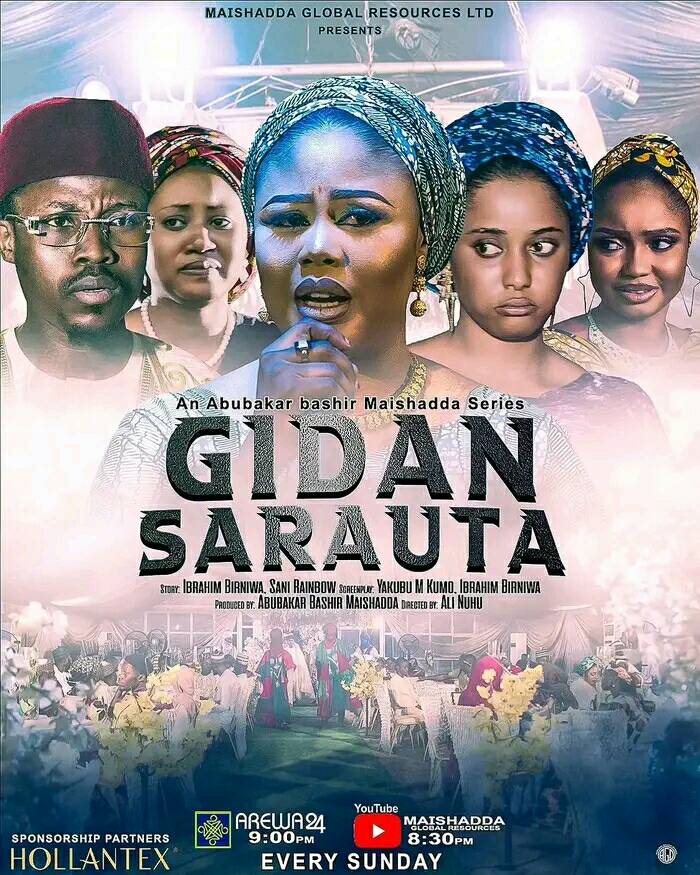
Premiered in 2023, Gidan Sarauta achieved greater popularity in 2024, becoming one of the year’s top series. This is because its episodes get no less than 600,000 views on YouTube weekly. The story follows a complicated love triangle involving two royal brothers, Prince Bello (Umar M. Shareef) and Prince Mu’azzam (Garzali Miko), and a poor daughter, Bintu (Mommy Gombe). Prince Bello initially hides his feelings for Bintu, treating her like a sister and even arranging her marriage to his brother Mu’azzam. Meanwhile, he marries Gimbiya Fa’iza (Aisha Najamu), his cousin whose father (also his uncle) holds the throne. The two couples live together in the royal household, where Bello and Bintu’s bond deepens despite being married to different partners. The drama escalates as Mu’azzam discovers their secret romantic exchanges, leading to intense confrontations and emotional fallout. The series features other compelling characters, such as Alhaji Mai Dala (Rabi’u Rikadawa), his wayward son Kaka (Daddy Hikima), and Tafida (Bashir Bala Ciroki), among others. It was produced by Abubakar Bashir Maishadda and directed by Ali Nuhu.

3. Allura Cikin Ruwa 

2 Effects Media’s Allura Cikin Ruwa revolves around Na’imatu (Ruky Alim), a charming young woman at the centre of attention with numerous men vying for her love. These include Maina (Yakubu Muhammad), Sadiq (Isah Feroz Khan), Dr Hashim (Adam A. Zango) and Alhaji Hadi Makama (Sani Danja). As the title suggests, Na’imatu is like a needle in a vast ocean, which Hausa wisdom says “only the fortunate can find”. Alhaji Hadi is that fortunate one, but he divorces her two days after marriage, adding complexity to the plot. Other characters in the series, such as Maina and his former wife (Fiddausi Yahaya), have interesting backstories that add depth to the narrative. The series features an ensemble cast, stunning visuals and evocative background music. It is also packed with twists and turns, which may hook the audience despite some minor flaws. Sani Danja produced the series, while Yakubu Muhammad directed it. Other casts include Aisha Najamu, Tijjani Faraga, Daddy Hikima, Amal Umar, Ramadan Booth, etc.

4. Darasi

Produced by Sadiq Shanawa and directed by Abubakar S. Shehu, Darasi stands out for its relatable themes, strong performances, and reasonable production quality. The series follows the lives of fresh graduates: Kabiru (Ibrahim Yamu Baba), Marwan (Shamsu Dan Iya), Sadiq (Sadik Shanawa), and Salma (Mommy Gombe), each navigating the challenges of life after graduation. However, Kabiru’s story turns dark after being heartbroken by his love interest, Rabi (Amal Umar), who leaves him for a wealthy son, Shehu Hutu (Abdul S. Tynkin). This betrayal drives him to join a secret cult, aligning himself with powerful influencers such as the corrupt politician Alhaji Audu Maye (Ali Nuhu) and the immoral tycoon Alhaji Maliya (Tanimu Akawu). As the story expands, events become intricately woven. The series is quite popular. It garnered widespread pre-release buzz thanks to promotional photos of Mommy Gombe and other cast members wearing NYSC attire.

5. Wata Rana a Kano 

Wata Rana A Kano is a 5-episode mini-series that addresses the pressing issues of thuggery and phone snatching, which have recently surged in certain areas of Kano State. It is exclusive to Arewa24 TV, unlike many other series that are also available on YouTube. The series exposes the heartlessness of corrupt politicians and their role in fuelling gang violence. It also explores the importance of community involvement in aiding security operatives in combating the problem. Besides its timely thematic relevance, Wata Rana A Kano stands out for its top-notch production quality. The cinematography is exceptional, with realistic portrayals of violence and bloodshed that leave a lasting emotional impact. Many viewers have confessed to crying during a particular scene where the character of Abba Jago (Daddy Hikima) kills Hassan (Adam A. Zango). Produced by Abubakar Bashir Mai Shadda and directed by Kamal S. Alkali, the series also features Mommy Gombe, Umar M. Shareef, Abdurrazak Sultan, Alhassan Kwalle, Abba El-Mustapha, Ali Nuhu, and others.

6. Zafin Nema

Sadik Sani Sadik and Tahir I. Tahir, known for their iconic roles in the Mati franchise as Mati and Lado, respectively, reunite in the topical comedy-drama titled Zafin Nema. The series explores themes of materialism and ambition through the story of two young men, Ilu (Sadik Sani Sadik) and Rabe (Tahir I. Tahir), from a poor background. The duo faces humiliation in their village, Tungan Barau, due to their poverty. Rabe’s father attempts to arrange his son’s marriage to Tala (Mommy Gombe), but her father rejects the proposal despite their familial ties. Similarly, Ilu loses his love, Saude (Maryam Yahaya), to the wealthy Alhaji Dangana (Shehu Hassan Kano). Driven by a desire for wealth, respect, and revenge, Ilu and Rabe embark on a journey to the city. Their misadventures unfold as they foolishly pursue get-rich-quick businesses. The series seamlessly weaves together humour and substance. The actors also deliver excellent performances. It was co-produced by Abdul Amart and Tahir I. Tahir and directed by Yaseen Auwal. Other casts include Al’amin Buhari, Jamila Nagudu, Minal Ahmad, Bello Mohammed Bello, Hajara Usman, Alhassan Kwalle, etc.

7. Umarni 

The series Umarni primarily deals with the issue of wife-mother-in-law relations in Hausaland. It explores the complex and often tense relationships, including jealousy and conflicts between them. In the series, Hajiya Binta (Saratu Daso) reveals her jealousy when her son Ahmad (Bilal Mustapha) prepares to marry his beloved Madina (Bilkisu Safana). She reduces the substantial trousseau he plans to take for the wedding and forbids him from living with his wife in their newly built home. Her intimidation continues while the couple lives with her in the family household. On the other hand, Salma (Sameera Sister) treats her mother-in-law (Asma’u Sani) poorly. Her husband, Sadik (Garzali Miko), initially sides with his mother but is eventually convinced to see her faults. The story evolves as new themes, characters, and conflicts are introduced. The series is generally enjoyable.

Umarni is likely the last film to feature the late veteran actress Saratu Daso. However, the rest of the cast comprises mostly rising stars who nonetheless deliver satisfactory performances. Seikh Isa Alolo directed it, while Naziru Dan Hajiya is the producer. Its second season, which runs during the writing of this review, was co-directed by Tijjani Mai jama’a.
A feminist reading of Jammaje’s Nanjala

  • Production:    Jammaje production
  • Producer:       Abubakar Bashir Maishadda
  • Director:        Ali Nuhu
  • Cast:               Sani Mu’azu, Ali Nuhu, Nancy Isime, Enyinna Ngwige, Rabi’u Rikadawa, Segun Arzine, Abba Al-Mustapha, Asabe Madak, Abba Zaki.

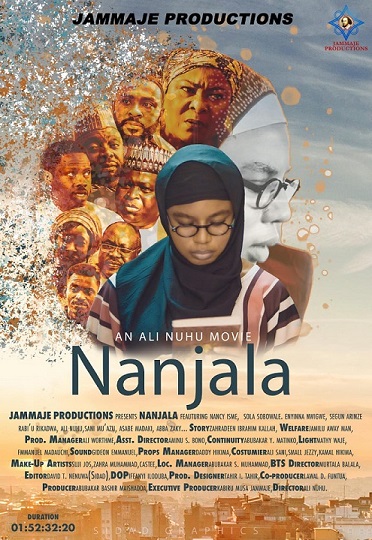
Nanjala, an eponymous and one of the most expensive movies in the Kannywood industry by Jammaje Production, is a breathtaking movie that explores and thematises patriarchal power, domination and mistreatment towards women gender. Nanjala, a leading character, is victimised by her chauvinistic father, who disbands her for being a female in favour of a male child, Dititi (Abba Zaki). Captain Jimmoh (Rikadawa) becomes her adopted father and helps to actualise her dream of becoming a renowned journalist.

Furthermore, Captain Sembene’s family is set on fire as his beloved son, Ditit, becomes a spoiled child, drug addict, thief and clubgoer. Plus, his other female daughter, Jarry, takes a leave from home for her father’s chauvinistic mistreatment. Falmata, another victim of Captain Sembene’s chauvinism, befriends her biological brother, Ditit, with a view to wed him.

Nanjala becomes a renowned and influential journalist who tirelessly fights and exposes corruption in the government. She encounters obstacles along the way from the authority. She is detained in cells for exposing corruption. Finally, she appears triumphant.

Mistreatment and domination are long-held traditions shown to women by a patriarchal world. Women, as chauvinists maintain, are disaster and second-class citizens who can’t contribute to one iota of life. In those days, women had to cancel their identities to have their voices heard—the same as Nanjala has to take a leave from a patriarchal home to attain her potential. 

Thomas Aquinas (1274) opines, “A woman is really an imperfect man… an incidental being … a botched man’’. Nanjala’s treatment by her father affirms Aquinas’s stance that women are imperfect and a botched to her male brother, Dititi. Plus, according to Baudelaire, “woman is natural, that is abominable’’ Some men consider women disgusting. This perception runs through Nanjala’s father, who finds the female gender abominable – divorcing Falmata’s mother for carrying a female unborn child, making life unbearable to Majuma (Asabe Madaki) and causing a great aspersion on Nanjal and Jarry, whom all are females. They have to leave their homes to feel at home.

The belief that women are nothing but second-class citizens, abominable and sex machines for men to exploit became prevalent during the Victorian period (1837-1901) and also in plenty of their literature. We see the fate of Susan Henchad, who is auctioned in Thomas Hardy’s The Mayor of Caster Bridge (1886), women who are sexually exploited by men at Sixa in Mango Beti’s Poor Christ of Bomba (1956) and Firdaus’s sexual abuse by men in Women at Point Zero (1975). Likewise, patriarchal domination doesn’t put a halt here but tries to silence any emerging powerful female voice. 

Women like Gorge Eliat (1919-1880), Gorge Sand (1904-1876), Charlotte Bronte (1816-1855), etc., succumb to patriarchal pressure and accept defeat to vie with men intellectually and literarily. Comparatively, Nanjala encounters the same treatment, where patriarchs try to silence her intellect and voice. They envy her fame, success, and education. Men are jealous of women’s successes, but Nanjala struggles and succeeds. 

For women to succeed in the patriarchal world, they have to be educated, pushed, and struggled. We see how women break the bonds. Li succeeds in The Stillborn (1984) via struggle and education, as Ada in Second-class Citizens(1974). Also, we see in the Kannywood movies- Hauwa Kulu (2019) where Hauwa (Hasana Muhammad) and Laila (Hadiza Gabon) in Manyan Mata (2023 succeed through education. However, Firdaus in Women at Point Zero (1975) and Nnu Egu in The Joys of Motherhood (1980) fail because they are illiterate or barely educated.

Meanwhile, Simone De Beauvoir (1908-1986) asserts that “males define what it means to be human, including what to be female. Since the female is not male”. Beauvoir maintains, “She becomes another”. Indeed, this derogatory portrayal has been born by females throughout many centuries. In the film, Nanjala’s father has this perception run in his blood. He evidently defines who a human being is to him, his male child, Ditti.  He loathes all his three daughters – Nanjala, Jarry, Falmata and Majuma because they are “others”. Women become secondary or non-existent players. 

Finally, Beauvoir asserts, “Women must break the bonds of their patriarchal society and define themselves if they wish to be a significant human”. This is what Nanjala does, and she becomes a “being” in the patriarchal society. Meanwhile, Kate Millet (1970) says, “A female is born, but a woman is created”. As Nanjala defines herself as a true human being, discarding the notion of femaleness in her, she creates womanness, as Millet (1970) puts it, through hard work, education, struggle, and boldness.

By way of conclusion, Nanjala mirrors patriarchal society and uncovers stereotypical portrayal of women as “others”, Second-Class Citizens, incidental beings, imperfect men, and abominable and other derogatory names forced women to accept by men. The film depicts the power of education and struggles as the only means for women to break the long-held tradition enjoyed by men and bury women’s intellect.

If not for education, Nanjala would have been buried alive like other female characters. The film is a clarion call to women to be educated, to disown being relegated to non-existent players or “others”. Nanjala succeeds and becomes a “human being”, whereas Majuma, Jarry and Falmata become second-class citizens.

Reviewed by Abba Musa Ibrahim. He can be reached via abbamusa6888@gmail.com.

Kannywood/Nollywood film review: NANJALA (the Right Choice)

Company: Jammaje Productions

Director: Ali Nuhu

Producer: Abubakar Bashir Maishadda

Language: English

Cast: Nancy Isime, Sani Muazu, Sola Sabowale, Ali Nuhu, Enyinna Nwigwe, Rabi’u Rikadawa, Segun Arinze, Abba el-Mustapha, Asabe Madaki, Abba Zaki, etc.

Release date (Nigeria): 16-6-2024

After successful screenings in Turkey and the United States, the reportedly most expensive Kannywood movie, Nanjala, has finally hit our domestic screens. The movie is a groundbreaking attempt to bridge the gap between Northern Nigeria’s Kannywood and “mainstream” Nollywood by bringing actors from both industries together in a neutral setting and on an equal footing.

The film narrates the story of Nanjala (Nancy Isime), whose father, Captain Sembene (Sani Muazu), harbors a deep-seated disdain for female children. He, therefore, neglects his three daughters, focusing his care only on his son, Dititi (Abba Zaki). Nanjala has been a voracious reader with dreams of becoming a journalist since her childhood. However, her father’s constant discouragement makes his friend, Captain Jammoh Jummoh (Rabi’u Rikadawa), adopt her to help her realize her dreams.

Years later, Captain Sembene’s family falls apart. His favorite son, Dititi, becomes a drug addict, and his daughter, Jarry, leaves home, fed up with his mistreatment. Meanwhile, Nanjala achieves her dream of becoming a journalist but encounters problems with people in authority who want her to stop exposing their corrupt government.

How does the story unfold from there? Find out for yourself at Platinum Cinema.

The film addresses themes of women’s empowerment, the endurance of the human spirit, corruption, and moral decadence. It debunks the chauvinistic belief that female children are mere burdens to their parents and incapable of achieving greatness. We see how Nanjala suffers, initially at the hands of her chauvinistic father and later as a journalist hunted by a corrupt government. Despite these challenges, she overcomes her fears and insecurities to eventually emerge triumphant.

Nanjala is indeed a compelling film that has enough to hold viewers’ attention throughout its runtime. However, while it may lack attention-grabbing twists and turns, the wonderfully constructed screenplay and perfect use of flashbacks make it an enjoyable experience that you wish would never end. The cinematography is also spectacular, fully doing justice to the film’s scale. I haven’t enjoyed any Kannywood movie as much as this one recently. One must applaud the makers for their courage and financial strength in bringing such a big project to life.

The eponymous character seems to be inspired by Kenyan political analyst and activist Nanjala Nyabola. She also shares similarities with a character played by actress Miriam Osimbo in the Kenyan comedy series Hullaballoo Estate. Therefore, the film is likely to resonate with a broad African audience for that reason, and for its setting (a fictitious East African country), casting, character names, and universally relevant thematic preoccupations.

The film also deserves distinction marks for its English dialogue. The diction and flow of words are exceptional. What is even more interesting is how the Kannywood actors deliver their lines as flawlessly as their Nollywood counterparts in the cast. Thanks to Mallam Kabiru Musa Jammaje, the executive producer who pioneered the trend of “Kannywood films in English.”

In terms of performances, Nancy Isime fully immerses herself in the character of Nanjala and plays it exceptionally well. Sani Mu’azu is excellent as her chauvinistic father, delivering his dialogue with expressions that prove his acting skills. Rabi’u Rikadawa will win your heart as Nanjala’s foster father, who stands by her through thick and thin.

Asabe Madaki (Majuma), the character of Jarry, and Abba Zaki (Dititi) are first-rate as Nanjala’s siblings, but their mother, played by Sola Sobowale, does not live up to expectations. However, Enyinna Nwigwe is admirable as an accomplished author who later becomes Nanjala’s love interest. Segun Arinze, Ali Nuhu, and Abba el-Mustapha all shine in their brief roles. But it’s Hajara Haidar (Falmata) who will impress you with her adorable looks and fluent English, giving her small role a huge impact.

In conclusion, Nanjala has opened a new page in Nigerian cinema. It is a “Pan-Nigerian” film that will resonate across the country and beyond. I strongly recommend this insightful and inspiring film to every parent, young ladies, and, of course, anyone who enjoys seeing Africans speaking English on screen.

Habibu Maaruf

Kano, Nigeria abduhabibumaaruf11@gmail.com.

Ali Nuhu: Shaping Kannywood with hard work and integrity

By Hussain Muhammad

In the tapestry of Kannywood’s illustrious legacy, one name shines with the brilliance of a thousand stars—Ali Nuhu.

His journey from a seasoned film actor to the Managing Director of the Nigerian Film Corporation is not only a testament to his hard work but also a narrative of how one individual can shape an entire industry.

Ali Nuhu’s career as an actor is marked by his ability to breathe life into characters, painting narratives that resonate with audiences across cultures and languages. Beyond his on-screen charisma, he remains untainted by the scandals that often beset the entertainment world, standing as a paragon of decency and grace.

His recent appointment as Managing Director further underscores his pivotal role in shaping Kannywood’s future. Through his leadership, he embodies the principles of excellence, integrity, and inclusivity, guiding the industry toward new horizons of success.

Ali Nuhu’s journey imparts invaluable lessons in perseverance and dedication. His unwavering commitment to his craft, coupled with his ability to navigate the pitfalls of fame gracefully, serves as an inspiration to aspiring artists and industry veterans alike.

As we celebrate Ali Nuhu’s accomplishments, we are reminded of the power of hard work, integrity, and humility in shaping not only individual careers but entire industries. His legacy will continue to inspire generations of filmmakers, actors, and enthusiasts, paving the way for a brighter, more inclusive future for Kannywood and beyond.

A critique of Ali Nuhu’s Gidan Sarauta

By Idris Ishaq Danwanka

The series Gidan Sarauta (“Royal House”), directed by Ali Nuhu, does not fully align with its title. The events portrayed in the series differ from what one would expect from a real Gidan Sarauta.

Let’s start with the characters: Ali Nuhu introduced Adam Abdullahi Adam (Abale), who played the role of a disrespectful son to a wealthy man named Rabiu Rikadawa, also known as Baba Dan Audu in Labarina. The character lacks a proper upbringing from his father and harbours a disdain for the less fortunate. While such behaviour may exist in certain places, it raises the question of why thuggery is associated with Gidan Sarauta. What message is Ali Nuhu trying to convey? 

Furthermore, would it be plausible for a devout Muslim on their deathbed to instruct their son not to show compassion towards the poor? Such teachings contradict the principles of Islam, where one is expected to seek forgiveness from Allah and reflect on their wrongdoings before passing away.

Additionally, I am not particularly pleased with the casting choices in the series. Umar M Sharif, who sometimes speaks femininely, is selected to portray a prince. While this may not bother me as much, it is concerning to see Garzali Miko, who lacks the necessary qualities for such a character, also playing the role of a prince.

Moreover, the series seems repetitive, with certain events unnecessarily repeated within the same scene. Additionally, Mommy Gombe, who is assigned a significant role, appears to be somewhat inadequate for the part.

In summary, I have several reservations regarding the direction, character choices, and portrayal of events in the Gidan Sarauta series directed by Ali Nuhu.

Idris Ishaq Danwanka studies English Language and Literature at Federal University Dutse.

Ali Nuhu advocates for quality in Nigerian filmmaking to restore country’s integrity

By Sabiu Abdullahi 

Ali Nuhu, director of the Nigerian Film Corporation, has stressed the importance of prioritising quality in Nigerian filmmaking, citing its potential to elevate the country’s reputation on the global stage. 

In an exclusive interview with BBC Hausa, Nuhu showed the need for a significant improvement in the quality of Nigerian films, revealing that only a fraction, approximately 30–35%, currently meet the desired standard.

He stated that the target should be much higher, aiming for at least 70–75% of films to attain the desired quality level. 

Addressing this concern, Nuhu pledged to spearhead efforts to enhance education within the industry and provide filmmakers with access to quality equipment.

He remarked, “We have an ambition of transforming Nigeria’s film industry into one of the best in the world because we don’t need quantity; what we need most is quality over quantity.” 

Acknowledging the negative perceptions of Nigeria perpetuated by some individuals, Nuhu expressed confidence in the transformative power of films to counteract such portrayals and restore the country’s integrity.

“Through these films, we will restore our integrity,” he affirmed, highlighting the positive impact of quality filmmaking on national image-building efforts. 

In a message of unity to both Kannywood and Nollywood, the two major film industries in Nigeria, Nuhu stated the importance of collective support in achieving shared objectives.

“I am a member of both; what I need most is support from all sides to achieve all our desired goals,” he concluded. 

As Ali Nuhu advocates for a paradigm shift towards quality-driven filmmaking, his vision resonates with industry stakeholders, paving the way for a renewed focus on excellence and innovation in Nigerian cinema.

Ali Nuhu’s appointment as MD of Nigerian Film Corporation is well-deserved 

By Habibu Ma’aruf Abdu

An interesting incident at the Awgu NYSC orientation camp, Enugu State, revealed to me the far-reaching popularity of Ali Nuhu in 2018. 

It was the early evening glow at the camp. As we strolled back from the training ground, a young Ijaw lady approached me with a cool smile on her face;

“Brother, may I ask you a few questions, please?” she inquired. 

“Why not?” I responded politely.

“Your platoon member, Oluwaseun, told me you are a Hausa from the North…”

I nodded my head in agreement: “Yes.”

“So, do you know Ali Nuhu?” she asked, her curiosity evident.

“Yes, I know him very well,” I affirmed.

Her face lit up with joy upon hearing my answer, and she muttered to herself: “No wonder!”

Curious, she continued, “Is he a brother to you…?”

Surprised, I responded, “Why this question? I know him as a famous actor. Nothing more. After all, who doesn’t know Ali Nuhu in the North? “

“Please don’t take offence; it’s just that I noticed a resemblance in your looks and actions…

“He is my favourite star. I love watching his films,” she added with enthusiasm.

From there, our conversation delved into a discussion about Nigerian cinema. I then discovered that the young lady knew no actor from Northern Nigeria besides him!

Ali Nuhu is probably the only Nigerian actor whose popularity transcends regional boundaries. His exceptional achievements in both Northern Nigeria’s Kannywood and mainstream Nollywood firmly established him as a pan-Nigerian superstar. 

I once encountered a young man in a faraway village in Igbo land wearing a T-shirt adorned with Ali Nuhu’s image. Again, when I visited Kebbi state in 2013, their most frequent question was, “Have you ever met Ali Nuhu?”

I, therefore, deemed his recent appointment as the Managing Director of the Nigerian Film Corporation by President Bola Ahmad Tinubu to be well-deserved. It is a testament to his dedication and significant contributions to the Nigerian film industry. Wishing the King of Kannywood continued success in this new position!

Habibu Maaruf Abdu wrote from Kano via habibumaaruf11@gmail.com