By Bilyamin Abdulmumin
Days ago, a picture of a beer advert on a bus with the caption: “ba barasa a cikin wannan giyar” dramatically attracted public attention. First, it appears the translation was outright flawed. The English direct translation may read thus: the alcohol doesn’t intoxicate.
Every native or one conversant with Hausa would find it difficult to wrap his head around this Hausa translation. So, some think it was out of the sheer cheap labour that the South African wine industry relied on the online translator to land them into the translation comatose. It might also be the usual case of giving the advert to the wrong agent or hiring a non-native to advertise the product.
Forget it; even if you are a professor in a particular language but happen to be not native or brought up in that typical language culture you will end up harming the advert than promoting it. One such advert that went wrong recently was that of one famous company, which read: “ko wanne zubawa, muhimmanci da ya wuce gwaji”. The equivalent English version read, “Every drop treasure beyond measure” What a rape to language!
As promoters of products, one can never dare associate the advert with alcohol in Hausa or any Islamic land; else, the result will be a mass exodus from the product. The brewing companies are still recuperating from the wound their Maltina product suffered because the same company is producing it as beer.
One factor that even fans the fire of controversy is that alcohol, beer/wine, and intoxicants are used interchangeably as the same thing: giya/barasa. So it becomes meaningless to try to separate one from another: that is to say, the beer contains no alcohol, alcohol is not intoxicated, or the alcohol is non-drunken. In the Hausa language, as long as it is alcohol there is nowhere to turn around.
Notwithstanding, are alcohol, ethanol, beer/wine, and intoxicants the same or different?
Alcohol is a general term referring to any organic compounds with OH functional groups. Therefore, any organic chemical with -OH in its makeup is alcohol. Examples of alcohol (alkane series) are methanol, ethanol, propanol, butanol, and the list goes on…. Alcohol has been a subject of controversy, no thanks to one of its family members: ethanol.
This controversial member: ethanol, is composed of two carbon, six hydrogens, and one oxygen; because of the presence of OH (hydrogen bonding) in its makeup, ethanol enjoys a wide range of applications. It is next to water as a global solvent. In addition, where water fails in industrial application, ethanol as an organic chemical (with carbon in its makeup) swoops in.
The industries where ethanol easily finds its way include Pharmaceuticals, several medicines you can’t do without today owe themselves to ethanol; Paint Industry, where your favourite paint can’t exist without ethanol; Fragrances, ethanol, not water is the solvent for making many perfumes; the Medicinal Properties, ethanol is a death sentence to microorganisms so when next used sanitiser, know that ethanol is that potent content; Bakery Industries, yeast is used in the bakery to give the bread desired quality as a result of ethanol and carbon dioxide as a by-product; Electrical Repair, ethanol is used as spirit, take your gadget for repairs they use ethanol for cleaning; Oil and Gas, perhaps the most economical part of ethanol use is when employing as fuel, depending on the purity, ethanol can be used as complement or substitution to transportation fuel (PMS); Brewing Industry, now the most controversial part of ethanol is when used as a drink, such as beer or wine. In beer, starch, e.g. corn or maize starch, is acted upon by appropriate enzymes and yeast industrially to produce beer. In a similar passion, fruit instead of starch is used in winemaking. Ethanol in brewing is the most dominant public knowledge, so it has become synonymous with alcohol (even among native English speakers).
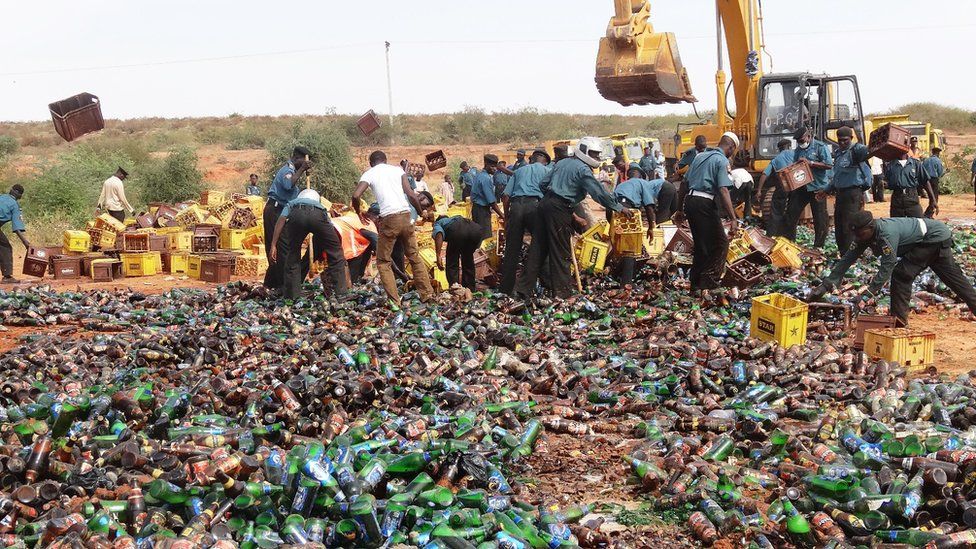
The beer and wine produced conventionally contain up to 15 per cent of ethanol. This percentage is quite enough to intoxicate the drinker. Islam has outrightly forbidden taking intoxicants, such as beer and wine. The consequence for the global brewing industries is that they can only bite their fingers to watch a market of a staggering 1.5 billion people impossible to penetrate. So this became the mystery brewing industry struggled to crack. They finally get a catch.
Because the prohibition in Islam said intoxicants, so by this view, the brewing industries can design beer and wines that contain quantities of ethanol that is not enough to intoxicate a drinker, making beer and wine halal. Some Islamic countries like Malaysia have already nodded to this explanation by setting 1 % ethanol as a limit. Perhaps this was the intention of the South African wine advert on the bus.
On the other hand, the ethanol prevalence is more than what we could imagine; we are as indispensable as ethanol is concerned. Because the enzymes, yeast, and starch/sugar necessary to make ethanol are ubiquitous and, by extension, the ethanol itself. The cups, plates, our hands, and system you are using currently to read this article are a community of microorganisms; among them are the saccharifying enzymes and yeast. So with food readily available in the form of rice (rice), kunu, zobo, pieces of bread, fruits, etc., the right contact is just required to get the ethanol. Fura is the breeding ground for ethanol. The longer the “fura da nono” takes (without refrigeration), the higher the quantity of ethanol will be in it. But this passive ethanol prevalence is non-intentional.
Bilyamin Abdulmumin is a Public Affairs commentator and a Doctoral candidate at the Department of Chemical Engineering, ABU Zaria.