2023 Elections

What next for Aishatu Binani?

By Zayyad I. Muhammad

Now that the storm in the drama-filled Adamawa gubernatorial election has been subdued, the two big contenders, Aishatu Dahiru Binani and Governor Ahmadu Umaru Fintiri, will have the opportunity to retrospect and strategize for their next steps. 

On Binani’s path, there are two junctions. First, stick to the moment. Second, make a U-turn to a new path. 

The fact is, the actions of the now-suspended Adamawa state Resident Electoral Commissioner (REC) Hudu Yunusa have ‘dented’ Binani’s public sympathy, especially outside Adamawa. The REC’s actions have put the APC on edge. So, Binani needs both ‘on-the-shelves’ and ‘off-the-shelves strategies, as her next moves may make and mar her political future. She has three (3) options.

First, continue to insist that she is the Governor-Elect, as declared by REC, Hudu Yunusa Ari. In this case, Binani will approach the tribunal with a sole demand – the court to proclaim her Governor-Elect,  based on Section 149 of the Electoral Act 2022, which states that: ‘Notwithstanding any other provisions of this Act, any defect or error arising from any actions taken by an official of the Commission in relation to any notice, form or document made or given or other things done by the official in pursuance of the provisions of the Constitution or of this Act, or any rules made thereunder remain valid, unless otherwise challenged and declared invalid by a competent court of law or tribunal.

The second option for Binani is to pursue her cause through the tribunal while completely ignoring Hudu’s bizarre actions. She can reinforce her case by hammering on the alleged irregularities in some local government areas during the 18th March 2023 gubernatorial election. Places like Governor Ahmadu Umaru’s village, Madagali LGA, which claimed a whopping 42.2% voter turnout

Binani’s third opposition is to retreat – congratulate Fintiri, discard the option of any litigation and move for the future.

These three options have implications for Binani, Adamawa politics, and Nigerian polity.

If Binani and her team decide to take the first option, she would be testing the effectiveness and the efficacy of section 149 of the Electoral Act 2023. While it will be good for democracy, as the court will interpret the section, INEC will do whatever possible to save its face.

The Bola Ahmed Tinubu government may be interested as well because it may want to distance itself from Hudu’s actions to show the international community and Nigerian ‘eagle eyes’ that the election which brought Tinubu to power was fair and that the umpiring was not jungle-like. Binani taking this option means that many heads will roll, as Hudu may spill the beans. Binani may also continue to lose support because Hudu’s actions were a ‘third-rate’ action in politics (elections are best won at the polling units). REC Hudu’s action has attracted many observers even outside Nigeria.

For the second option, Binani has good advantages over Fintiri if she can assemble an excellent legal team alongside experienced politicians, political experts, and intellectuals from Adamawa to provide data, facts and figures, and shreds of evidence to back up the claims of irregularities during the elections. Binani has a bright chance of winning the case based on technicalities, while Fintiri will face a lot of hurdles here. This option is very expensive and requires both political and individual commitment from Binani’s team.

The third option for Binani is to retreat, congratulate Fintiri, and move on. This is the most difficult option for her, in fact, for any politician who has come as far as she has. If Binani goes for this option, many of her supporters will be initially demoralized. But in the long run, she would relieve the entire polity of the suspense, uncertainty, and unknowns. In fact, the investigations on Hudu Yunusa, securities heads, and other people will be inconsequential.

Binani will rediscover herself, remove the dent of Hudu’s action on her political outlook, and technically trounces her adversaries in the Adamawa APC. She will create the road to becoming  Adamawa’s version of Kwankwasiya because of her well-known philosophical activities and for being an Iron Lady.

Furthermore, with this (third) option, Binani will ‘save the day’ for many people. But it is a very difficult option; only politicians operating with a complete mind of their own will opt for such an option. It requires foresight to see tomorrow from today.

 Binani may have depleted her arsenal, but she has had a good fight; Fintiri will not forget her in a jiffy.

Zayyad I. Muhammad writes from Abuja via zaymohd@yahoo.com.

Open Letter to President-Elect Bola Tinubu: A Golden Ticket to Presidency Success

By Group Captain Sadeeq Garba Shehu (rtd.)

When new executives with a change mandate take over an organisation, they typically invest time in reshaping its strategy and determining the kind of culture needed to succeed. Those choices guide other decisions, including who their senior managers will be and how the leaders will allocate their time. Sadly many neglect the key factor that will help determine their effectiveness: the administrative system that guides day-to-day operations in their offices. This system ensures that leaders make the most of their limited time, that information arrives at the right point in their decision-making process, and that follow-up happens without their having to check. Many new executives default to the system they’ve inherited. Often there’s a better way to handle the information flow necessary for a President to succeed—and very often, a chief of staff (CoS) can play an essential role.

The CoS to the President is a political appointee of the president who does not require Senate confirmation and who serves at the pleasure of the President. While not a legally required role, Since President Obasanjo, all Nigerian civilian presidents have appointed a chief of staff. President Obasanjo had Gen Abdullahi Mohammed, while President Umaru Musa Yar’Adua had Gbolade Osinowo. The position was temporarily absent between 18 September 2008 – 17 May 2010 when President Yaradua sacked Osinowo and never appointed a replacement. President Goodluck Jonathan had Mike Oghiadomhe and Jones Arogbofa. President Muhammadu Buhari had the late Abba Kyari, and after his demise, the current CoS Prof Ibrahim Gambari. The position of CoS to the President is widely recognised as one of great power and influence, owing to daily contact with the President and control of the Office of the President. Almost all, if not all, governors in Nigeria now have a Chief of Staff, and many ministers have them.    

The CoS role originated in the military and dated back centuries. Cicero, the Roman politician and orator, used a slave named Tiro, who, according to Cicero’s biographer Zach Bankston, served as a secretary, a financial overseer, and a political strategist. Andrew Roberts’s Napoleon: A Life describes the vital role that Louis-Alexandre Berthier played in assisting Napoleon at the height of his powers. The historians Ron Chernow and Joseph Ellis have described the CoS–like a role that Alexander Hamilton played for George Washington. These people aren’t to be confused with the personal secretaries or aides-de-camp that each leader also had. Rather, they were close advisers who handled the most-delicate strategic matters and became trusted confidants. While the Chief of staff is a role that started in the military, and now, we can see it in most industries and sectors.

WHAT DOES A CHIEF OF STAFF FOR THE PRESIDENT DO? 

While there is no one-size-fits-all when it comes to describing the duties of a CoS in Nigeria, and each incumbent had wielded / not wielded power according to his personality and the relationship he has with his principal, the President, or the style of the President, their primary duties are making time, information, and decision-making for Mr President more effective. In other words, a CoS to Presidents helps Presidents become the best version of themselves.

The role of the chief of staff is not about dealing with administrative tasks only as he is not a PA. A CoS does not manage the President’s day-to-day schedule. The chief of staff is a leader. He/she makes high-level decisions, strategizes processes, and sets policies by devising meaningful plans and generating useful ideas, anticipating problems, and coming up with new solutions.

Paraphrasing Patrick Aylward, who breaks down the job of any CoS into five categories, I would say the job of the CoS to the President can be summed up as:

1. An air traffic controller for the President and his cabinet controlling the flow of people into the President’s office. 

2. An integrator connecting MDAs’ work streams that would otherwise remain siloed, breeding inter-ministerial/inter-agency squabbles, duplication, overlap and fragmentation.

3. A communicator linking the Presidency team and the broader FG apparatus. 

4. An honest broker and truth-teller when the President needs a wide-ranging view without turf/mandate considerations.

5. A confidant without an organisational or personal agenda-His agenda being only that of Mr President.

An effective and successful CoS to the President should be able to translate the above five categories can be translated into tasks and duties.

REQUIREMENTS OF AN EFFECTIVE AND SUCCESSFUL CoS: SKILLS AND PERSONAL QUALITIES 

The main responsibility of CoS is to help the President stay organised, which will allow him to give time to more important A items. This requires a good understanding of the business of government, effective communication skills, and the ability to manage projects and relationships. It also requires the skill to anticipate and avoid problems, add value to the President’s vision, and be intelligent on the organisational and political levels. The CoS must be excellent in the management of important projects. The ability to simplify complicated tasks, strategic thinking and problem analysis is one of their strongest suits, and they should know how to see things through, from idea to execution, even when the President himself forgets.

The best skill one would have for any position is being effective in getting the right things done. In his book The Effective Executive, Peter Drucker argues that effectiveness derives from a set of five practices anyone can learn: managing time; focusing on results (what to contribute to an organisation); building on strengths; concentrating on top priorities; and making effective decisions. Experts are agreed that the above five skills or practices are extremely useful when it comes to the chief of staff position.

Managing time: When it comes to time, presidents find it challenging to have enough of their time at their disposal and available for important matters, which do make a difference. They can get easily distracted, and leaving little time to focus on strategy is usually the outcome. A good chief of staff helps presidents record, manage, and consolidate time and reallocating time through doing, delegating, and deferring non-urgent tasks and cuts unproductive demands on time. CoS helps diagnose time wastage (e.g., excess of meetings) and communicates where the President’s time should be spent to key stakeholders.

Focusing on results: Most executives focus on efforts rather than results.. An excellent CoS redirects the President’s attention towards contribution by focusing on direct results, building values, and developing people.

Building on strengths: Presidents might not be fully aware of all the available strength points (the strengths of associates, the strengths of individual ministers and cabinet members, and even the President’s own strengths). Excellent CoS helps the President conduct strength assessments to fully comprehend the team’s strengths and how to manage them best. CoS can help redesign jobs to attract and scout the right people and talents, recognise those with weak performances, especially managers, and initiate action plans.  

Concentrating on top priorities: The need to prioritise and focus on major opportunities is the very core of a President’s job. This is what delivers results. Successful Presidents need to eliminate anything that is not worth doing and concentrate on the tasks that, if done perfectly, will make a difference. A successful CoS prepares and facilitates strategic planning processes and encourages the President to drop processes before they begin to decline. CoS leads or co-leads strategic initiatives and aims for what makes a difference rather than what is easy and safe to do.

Reaching effective decisions: With the chief of staff handling a considerable number of tasks, the President will have more time to think through big decisions, with the CoS serving as a reliable sounding board by testing opinions against facts. Without the help of a quality CoS, the President may make rash decisions, will not study the consequences of a decision before making one, and may be indecisive most of the time. An effective CoS gathers different teams’ perspectives to help Mr President understand the implications and helps direct the President to make decisions only when there is a disagreement, test opinions against facts, and compare the effort done and the risk of not taking action versus taking action.

Managing Meetings: Holding meetings is an integral part of the chief of staff’s responsibilities. Meetings represent a great demand on the President’s time, and the role of the chief of staff is to help the President never allow meetings to become the main demand on his time. To effectively manage meetings is a crucial part of the role of a chief of staff, as this chief of staff must not only manage the meeting but the people, agenda, objective, goal, strategies, and measures. To do this, the CoS must ensure all relevant MDA representatives are in the room, at the table, and participating while ensuring that meetings are designed to move the business forward with timed actions against goals. So, effectively managing team meetings is an important job requirement for the role. 

The most sophisticated chiefs of staff also assist the President in thinking through and setting policies—and making sure they are implemented. They anticipate problems and are especially sensitive to issues that require diplomacy. They function as extra eyes and ears by pointing out political potholes their bosses may not recognise (especially if the bosses are new to the company). Importantly, a CoS acts with the implicit imprimatur of the President—something that calls for humility, maturity, and situational sensitivity.

Regardless of specific responsibilities, a CoS can help a leader achieve sharp gains in productivity and impact. The CEO to the President helps the leader become better organised, with more time for A items; Manages important projects well; Helps President and his Cabinet navigate through uncertainty and risk. Required capabilities include: Can do project management, Can manage relationships, Communicating well, Organising the President’s office, Can simplify complexity, Does strategic thinking and problem analysis, Can manage the process of idea to execution, Can anticipate and avert problems, Can grasp and adding value to the president’s vision, Has organisational and political intelligence, ability to research on a full range of topics. A good CoS knows which relationships are most important to the leader’s agenda. Being organised and disciplined, showing attention to detail, and following up doggedly to ensure the right results. Ability to see what pressures the leader faces in pushing for changes and to find ways to lessen them. Finally, communication skills are crucial because the CoS must help refine the leader’s message and ensure that it is understood by the right audiences. 

WHAT KIND OF CoS SHOULD THE PRESIDENT-ELECT LOOK FOR? 

So far in the CoS role , we have seen Gen Abdullahi Mohammed (OBJ), Gbolade Osinowo (Yaradua) Mike Oghiadomhe and Jones Arogbofa (GEJ) , Abba Kyari and Prof Ibrahim Gambari (PMB) , each with his different style , the powers he wielded , and based on the style of his Principal . With respect, the most enduring name, for good or bad (depending on who you ask) is that of late Abba Kyari. Many agree there were fewer inter-ministerial squabbles and less confusion in the Presidency when Kyari was around. He left a legacy and a reputation of a rigid gate-keeper for PMB, qualities that several analysts believe are required of a CoS to the President. During the last days of his presidency, Barack Obama observed: ‘One of the things I’ve learned is that the big breakthroughs are typically the result of a lot of grunt work—just a whole lot of blocking and tackling.’ Grunt work is what chiefs of staff do.” Richard Nixon’s first chief of staff, H. R. Haldeman, garnered a reputation in Washington for the iron hand he wielded in the position—famously referring to himself as “the president’s son-of-a-bitch”, he was a rigid gatekeeper who would frequently meet with administration officials in place of the president, and then report himself to Nixon on the officials’ talking points.

Everyone requires help to achieve his or her highest potential and to sustain the effort it takes to lead a complex organisation. The right chief of staff can be an important source of assistance to leaders who are pushing their organisations and themselves to ever better performance. President-elect Bola Ahmed Tinubu, in looking for a CoS, should look for all the qualities enumerated here but in addition, look for that person that also has the capacity and personality to be a rigid gatekeeper and, like Nixon’s CoS Haldeman and PMB’s CoS late Abba Kyari be “the president’s son-of-a-bitch”. But to be an effective CoS, the President must also empower the CoS. Both Nixon’s Haldeman and PMB’s Kyari have empowered CoS.

Group Captain Sadeeq Garba Shehu (rtd.) is a Private Security Consultant and member APC PCC Security Committee.
Senate Presidency and the politics of 2027; the facts

By Mahmud Dambazau

Despite being the ruling party; having the President, Vice president, majority in both the senate and the house of representatives, 21 state governors and majority of states houses of assembly, a formidable national spread and structure, adequate financing and financing opportunities, easy access to intelligence from the security (in addition to other privileges of the government), seasoned politicians and the political profile, political sagacity, connection, foresight, friendship across the divide for its presidential candidate, Asiwaju Bola Ahmed Tinubu, still All Progressive Congress (APC) had to take the risk of flying Muslim-Muslim ticket at a time when religion could be a sensitive factor than at any other election period.

The risk taken was, for obvious reasons, the most probable option for winning at the polls and most importantly, it has been successful. Similarly, the success or otherwise of the incoming administration is directly proportional to its success at the legislative arm. The 8th national assembly, despite being led by members of the ruling party, was adjudged by the party itself as part of the reasons for the low and abysmal performance of the outgoing administration of President Muhammadu Buhari. The ABAT administration therefore cannot afford to fail in the choice of the presiding officers of the national assembly and most importantly, the senate.

A brief analysis of the 2023 presidential election results indicates the APC got the highest votes from three of the six geopolitical zones; the north west, south west and north central with 2,652,824, 2,542,979 and 1,760,993 votes respectively with Lagos and Kano states being the only two states that had given the presidential candidate more than five hundred thousand votes. But despite the numbers from the northwest zone, the APC came first in only two of the seven states in the region; Jigawa and Zamfara but Zamfara has now aligned with the PDP. The APC therefore now more than ever, needs to be strategic in ensuring the northwest region, which has the highest number of votes and gave it the highest remain within its fold.

Now back to Kano, the most important state in the region which was before the election and since inception of the APC being under the party but now turned its support towards the NNPP, producing their only governor and most of the other elected positions from the party. The state governor, the deputy governor who also doubles as the governorship candidate of the APC in the state as well as the state party chairman who was heard in a widely circulated video boasting that they will win the elections no matter the consequences all lost their local governments to the NNPP during the presidential election. Senator Gaya, a former governor of the state who has also been at the senate since 2007 also lost his reelection bid to the NNPP candidate.

The story is the same for the son of the state governor, who contested for the house of representative’s seat at the governor’s constituency. Out of the 22 House of Representatives seats announced, the APC got only 5 with the rest lost to the NNPP. It wasn’t coincidence or surprising that all these five came from Kano north senatorial zone, where Senator Barau Jibrin hails from. It should also be noted that Sen.

Barau resoundingly defeated his major challenger, the NNPP candidate who is a staunch ally of Engr. Rabiu Kwankwaso and also a former Executive Secretary of TETFUND. Sen. Barau defied all odds and won with a very wide margin. In view of that, it is safe to say that the fate of APC in Kano solely depends on the political future of its most acceptable candidate as shown from the polls.

I believe the APC will agree that Kano is too important to be abandoned politically and the surest way of a comeback is undoubtedly through Barau. The fate of the PDP at both the presidential and governorship election in the state, despite having Senator Shekarau; a current senator, a former minister and a former two term governor of the state should be a case study.

The Senate president is not just the head of the senate but also the leader of the legislative arm of government as well as the chairman of the national assembly which comprises both the Senate and the House of Representatives. Among all the contenders, Senator Barau Jibrin is the only one who has been at both the house and the senate. He was not just a member of the House of Representatives, but also served as the chairman of the most important committee; that of appropriation. He has been at the senate for two terms and has headed the committees of petroleum downstream sector and that of tertiary education and TETFUND. He is currently the chairman of the appropriation committee of the senate under whose leadership, Nigeria has consistently maintained its budgets within the year circle. Despite all these successes, not once has he ever been accused of any act of corruption! His performance at his constituency (visible at all the nooks and crannies of the constituency and beyond) were what endeared him to his constituents.

Just recently, the President approved the appointment of the management of the newly established Federal Polytechnic Kabo, one of the fruits of the senator’s representation. His bills at the senate were more than those of the other contestants of the senate presidency combined. What more could we possibly ask for?

The first 8 years of the PDP from 1999-2007 produced five different senate presidents from the same region; Senators Evan Enwerem, Chuba Okadigbo, Anyim Pius Anyim, Adolphus Wabara and Ken Nnamani but they were unable to push for the construction of the Second Niger bridge. It was accomplished under a president from the northwest, a minister from the southwest, a senate president from the northeast and a chairman of the appropriations committee from the northwest. So, the jostling for the position might not particularly mean the dividends of democracy to the masses. However, their occupation of the position has ensured continued support of the PDP at the region within the period.

With the now overwhelming support of the Labour party in the region and the inability of any of the contestants from the region to secure 25% for the party at the presidential polls make it necessary for APC not to sacrifice its biggest support region, the northwest, in anticipation of an unlikely support from the southeast.

At a time in 2007, three of the four highest offices in the country; President, Vice president, Senate president and Speaker of the House of Representatives were held by occupants from the same religion. That has happened again from 2019-2023 and it has not religionized the country or stopped adherents of other religions from practicing their religion. Nigeria will certainly progress faster if we set aside religion or ethnic considerations in favor of competence.

Without an iota of doubt, Senator Barau Jibrin is the most competent among all the contestants for the senate presidency of the 10th senate. The facts are there and it is now left to the APC and the Asiwaju Bola Ahmed Tinubu’s incoming administration to decide how it will respond. However, any action taken will have its consequences in the 2027 election!

Mahmud wrote from Kano and can be reached on madambazau@gmail.com.

2023 elections most authentic since independence – FG

By Uzair Adam Imam

The Federal Government of Nigeria has described the recently concluded 2023 general elections as the most authentic ever held in Nigeria since independence.

The Minister of Information and Culture, Lai Mohammed, disclosed this yesterday while fielding questions from journalists after the FEC meeting.

He stated that despite efforts by the opposition parties to delegitimize the election, it was the most transparent, freest and authentic ever held in Nigeria.

Muhammed disclosed this as one of the reasons President Muhammadu Buhari refused to interfere with the Adamawa State poll debacle.

He added that the issue was strictly the responsibility of the Independent National Electoral Commission to sort out the matter

According to the Minister, it is not in Buhari’s character to micromanage the government’s institutions.

Mohammed said: “I don’t think that this government has ever intervened in the way the Independent National Electoral Commission conducts its elections.

“So, there’s no need for us to intervene. It was an entirely INEC matter, and INEC handled it.

“The chairman of INEC is in charge of all employees in INEC, and he’s handling it. So, what do you want the government to do?”

Kano needs more journalists

By Yakubu Nasiru Khalid

Journalists play a crucial role in the ruin of wrongdoings and corruption by reporting the news to the public through various media, research, interview sources, and writing accurate and balanced stories. They also hold those in power accountable by investigating and exposing wrongdoing and corruption. Journalists can simply be described as the voice of the voiceless. 

Moreover, Kano State is the second most populous state in Nigeria, with 44 local governments, and most local governments are outside of the Kano metro. As a result, the voice of the people living outside the metro is not heard. As a result of the lack of journalists that conduct rigorous investigations and research public problems, these rural areas remain neglected.

As gubernatorial elections and State Assembly were conducted in Nigeria on 18 March 2023, many polling units were declared inconclusive due to poor security operations, a snatch of ballot papers and arsons etc. This led to declaring some polling units as inconclusive.

Supplementary elections were held on 15 April 2023 in local governments like Tudun/Wada, Garko, and others. Unfortunately, a large number of thugs were brought into the respective polling units, and those that were legally and legitimately responsible for re-electing were denied and threatened by the thugs. But unfortunately, it is hard to get even a single journalist who eye-witnessed how the election was conducted. Most of these journalists only analysed reports based on their sentiments and opinions. 

In conclusion, journalists can positively impact rural areas by reporting objectively and accurately on public problems without pushing a partisan agenda. However, journalists must avoid promoting divisive rhetoric that pits rural communities against urban areas or different political factions. By investigating local government officials and other influential individuals, journalists can help ensure they act in the community’s best interests. However, this must be done responsibly and fairly without sensationalism or fear-mongering.

Declaration of guber election winner in Adamawa null and void, says INEC

By Muhammadu Sabiu

The Independent National Electoral Commission has declared null and void the declaration of Mrs Binani as the winner of the Adamawa supplementary gubernatorial election.

In a statement released through the commission’s verified social media handles, Barr. Festus Okoye, National Commissioner for Information and Voter Education, noted that the commission had suspended all the processes of the supplementary election.

The statement reads, “The attention of the Commission has been drawn to a purported declaration of winner in the Adamawa Governorship election by the Resident Electoral Commissioner (REC) even when the process has clearly not been concluded.

“The action of the REC is a usurpation of the power of the Returning Officer. It is null, void and of no effect.

“Consequently, the collation of results of the supplementary election is hereby suspended. The REC, Returning Officer and all involved are hereby invited to the Commission’s Headquarters in Abuja immediately.

The statement added that a “detailed statement” would follow shortly.

There is voter intimidation in Tudunwada/Doguwa supplementary election, group writes Kano CP

By Muhammadu Sabiu 
 
The Kano Civil Society (KCSF) notes that it has received complaints from community members in the Tudun Wada/Doguwa Federal Constituency, the same areas where there were alleged intimidation, oppression, killings, and property destruction during the two previous elections in the state.
 
This was made known in a letter addressed to the Kano State Commissioner of Police dated April 14 and signed by Ambassador Ibrahim Waiya, President and Peter Hassan Tijjani, General Secretary, respectively.
 
The letter reads, “The above ugly situation, has till date become a National and Global human rights violation issue, as well as made the global community, the National Human Rights Commission, International organizations, National and Local CSOs to beam their search light on Kano State, in the supplementary elections.”
 
“Here we are, with the long awaited supplementary elections, which is scheduled to be conducted by INEC in some Local Governments, including Doguwa/Tudun Wada Federal constituency.”
 
“It is against the foregoing, we call on your good office to uphold the best practices of professional conduct to proactively address any likely re-occurrence of the 25th February, 2023 ugly incidences, where innocent souls were allegedly burnt to ashes.”

Why Nigerians should thank Peter Obi

By Prof. Abdussamad Umar Jibia

The 2023 general elections have come and gone, and like every set of elections, there are winners and losers. Typical of Africans, those who lost alleged rigging and those who won hailed the process.

In addition to winners and losers, there are other people we should cheer for their roles in the elections. First, we should give credit to President Muhammadu Buhari for being true to his promise of organizing free, fair and credible elections. The President himself has observed that Nigerian voters have become more sophisticated. One manifestation of this is that voters no longer vote along party lines. It doesn’t matter if he is a card-carrying member of a political party; once a Nigerian voter sees a better candidate in another party, they go for them. That is the new normal if you like, and it is a good lesson for our politicians.

We must also hail the INEC Chairman. Just like his colleague Prof. Attahiru Jega, Prof. Mahmoud Yakubu has shown an uncommon tolerance in dealing with politicians, even in extreme cases in which an ordinary person would lose control.

My man of the day is His Excellency Peter Obi, a former Governor of Anambra State. I have never met Peter Obi, and he did not attract my attention until he began to claim that he wanted to become Nigeria’s president. From the way he started up to the time he crashed, I knew that Obi didn’t have a good understanding of the country he wanted to govern.

First, Obi wanted it under the PDP. Despite being a failed party, a PDP ticket would have earned Peter Obi a distant second regardless of the part of the country he is coming from. When he could not clinch its ticket, he jumped to the Labour Party. Then he started his campaign, the method of which we all saw.

The part of his political activity that we should thank Peter Obi for is his ability to solve one of the greatest puzzles of the Nigerian census. I mean the question of religion.

Nigeria is a big country with a Muslim majority and a minority that includes a good number of Christians and some pagans. Nigeria’s last census that collected data on religious affiliations was in 1963. According to the 1963 census results, there were 47.2 % Muslims, 34.3% Christians and 18.5% others. In the North, the ratio was 71.7% Muslims, 9.7% Christians and 18.6% others.

Talking about South West, the 1963 census figures identified the present-day Oyo, Lagos, Ogun and Osun as Muslim-majority states, with only Ondo and Ekiti as Christian-majority states.

Subsequent censuses either did not capture religion like the case of the 1991 and 2006 censuses or were cancelled due to controversies surrounding their conduct which was the case with the 1973 census.

Demographic experts make projections based on past trends, fertility and mortality rates and in the case of religious proselytization, migration, etc. The Ibrahim Badamasi Babangida administration decided to remove religion in the 1991 census due to bogus claims of being majority especially made by the church, and since then, the Nigerian Population Commission has avoided conducting standard projections involving religious affiliations.

Without a head count and/or unbiased, professionally made projections, Nigerians are continuously bombarded with unrealistic population figures. At one point in time, Christians claimed that they constituted more than 45% of the Northern Nigerian population, a claim ignored by Muslims for being ridiculous.

While ordinary Nigerians can be misled by propaganda, politicians looking for votes have always been calculative in their determination of who constitutes the majority and should attract their campaign and who is a liar.

And it is not difficult to figure out. Political affiliation in Nigeria is a good pointer to religious affiliation. For example, it is well known that Northern Christians do not vote for Muslims, whereas the former are in the majority. The examples are many and well-known. Thus, the number of Christian elected politicians in a particular state would approximately tell you the percentage of Christians in that state. In addition, the number of predominantly Muslim states with large populations like Kano and Katsina makes the population of the two Christian-majority states of Plateau and Benue a joke.

As a politician who needs votes of the majority to win a national election, Obi should have known all these figures and used them to gauge his level of preparedness. Unfortunately, he lost it and was going from one Church to another, vividly falling into the propaganda trap of the Church. He was carried away by the belief that the Middle Belt is Christian. But where is the Middle Belt? Is it North Central? Who, among the Governors of Niger, Kwara, Nasarawa, and Kogi, is a Christian? Obi was simply too naïve.

However, it is not bad at all. The clergy campaigned for him. Christians were mobilized nationwide. The outcome is what the NPC could not achieve in its censuses. Christians overwhelmingly voted for Obi. The number of Muslims who voted for him was simply insignificant, just like the number of Christians who voted for the Muslim-Muslim ticket of Tinubu-Shettima. The few Christians who did not vote for Obi were seen campaigning for PDP. Overall, more than 14 million voted for either Tinubu or Atiku, both of whom are Muslims. Even if we take 10% of that and add it to Obi, Christians are still a small minority.

As Muslims, we have avoided these arguments as we consider them unhealthy since, after all, our eternal prosperity in Islam is not dependent on whether or not Muslims are in the majority at a particular time or location. But we have been boxed into it, and it is helpful.

Professor Abdussamad Umar Jibia wrote from Kano. He can be reached via aujibia@gmail.com.

Now that he has clinched the Certificate of Return: Then what next?

By Abdulrahman Yunusa 

The fact that election is the major hallmark of democracy is enough to be an apparent reason for anyone that thinks they can cheat the process under a democratic state to make it to any political seat that requires such periodic election is but an outright implausible and wishful thought.

Meanwhile, unlike other affairs, elections are conducted across the nation occasionally (after every four years in the case of Nigeria). It’s an avenue upon which the political actors compete and make it to a particular political position in government. 

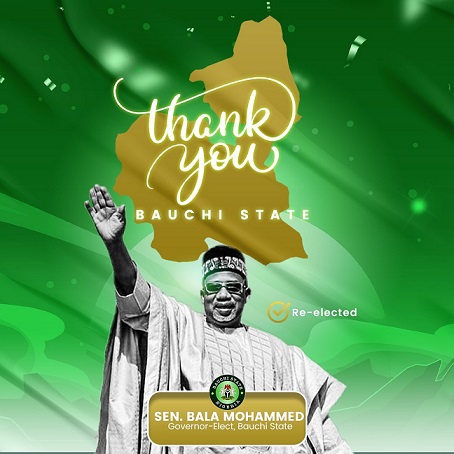
Therefore, the re-emergence of Governor Bala Muhammad for the second time as the Governor-elect of Bauchi state won’t be an exception since he passed all the above required constitutional procedures during this fierce political battle to emerge the champion of the 2023 governorship poll. 

Yet, this hasn’t come to me as a surprise, for he met all the prerequisite requirements needed to make it for the second term. His handworks are there, manifesting themselves from all angles of governance. But the hurdles he went through to make this task and yet glamorous journey possible is what left me befuddled. 

Once more, I congratulate His Excellency Governor Bala Muhammad of Bauchi state for making such a historical and spectacular political breakthrough against all odds. You have indeed shown how shrewd you are political. 

For muzzling, silencing, dismantling, and burying the politics of godfatherism in the state, I can’t relent in thanking you for such a magnificent job. Hence, permit me to boldly inform your detractors that you have set precedence upon which the future generation must care to imitate in their future respective political affairs in the state.

However, without impacting the lives of your people, this feat couldn’t have been achievable by you at this tragic moment. For you have gone through all the series of political threats from friends, masters and foes, and you dismayingly thrash them down, thereby making them irrelevance in the game once more time. 

Given that Governor Bala has received his certificate of return for the second time, shall we inquire about the shallow-minded gang who, over the past weeks, has been parading and making some baseless claims that their man is coming? Coming from where to where for God’s sake?  

Is this not enough for them to bury their face in shame? Is this not sufficient for them to retreat from making other gibberish in the name of mandate reclamation through the court of law upon baseless allegations? Why couldn’t they stop making themselves ridiculous objects in politics? 

Thank God for making such a rare move, throwing such a formidable political gang un to the dungeon of history amidst a critical moment. Thus this success has genuinely reflected the outcome of your tireless effort, resilience, hard work, perseverance, dedication and, above all, the incessant prayer you stick to. 

I hope you will maintain the tempo and make the state among the top infrastructurally and economically. I further pray that the second tenure will be more productive for the state’s citizens. And may the state’s resources be judiciously utilised for the benefit of all. 

May Bauchi succeed once again under the didactic watch of Governor Bala Muhammad Kauran Bauchi.

Abdulrahman Yunusa is a social and political affairs analyst. He writes from Bauchi and can be reached via abdulrahmanyunusa10@gmail.com.

A letter to Dr Dikko Radda, the Governor-elect of Katsina State

By Yusuf Murtala

With great delight, pleasure and excitement, I write to congratulate you on this marathon achievement of being elected Governor of Katsina State in the recently concluded election. Your success is a sign that Katsina state is on the verge of becoming a greater state again. I pray you to achieve your plans for Katsina state in sha Allah.

I write to inform or remind you about the current or sorry state of my dear town, Maska, which I believe is part of your plans to restore the good image of rural areas and carry them all along in your administration, which you stated in your blueprint that they could also contribute to the development of our dear State.

With a population of over 50,000, Maska is left behind by previous administrations/governments because they’re not informed about the abundant natural resources. It has, which can if carefully managed, generated a handsome amount of revenue for the state.

I Would not hesitate to remind you about the dirty Condition of our (Maska Community Comprehensive Hospital) which was built a long time ago by a patriotic citizen to save the town and its environs from the suffering they experience in an attempt to carry their patients to the local Government near them for treatment. It’s in a dirty condition as inadequate or lacking infrastructural development to treat patients. Female and male wards are left shattered that even animals will suffer to live therein. Toilets and maternity wards where our parents ( Pregnant women ) are received is also a thing to cry out for. I hope his excellency will consider us on this too.

Our local market (Maska Monday Market) is undoubtedly a hub of the economy, where millions of transactions are carried out every Monday. Thus, reconstructing it by providing or building newly constructed shops or stores will ensure much attendance, especially in the rainy season. This will also encourage investors or businessmen from and around the town to participate actively and hugely contribute to the economy of my dear state and the country at large.

I will not forget to remind you again about the Dam in my town which, if also given a concern, will save several unemployed youths from roaming the street. Moreover, reconstructing it will also create jobs for the teeming populace as it will be used to enhance dry season farming, popularly known as (Noman Rani) and encourage fishing farming which is also a means of generating income for the state.

Security issues of the state are among the top priorities you highly placed in your blueprint, and we firmly believe they will be drastically eradicated quickly.

Finally, your excellency, we hope and pray that this letter will reach you in good and sound health. We also pray that your administration will be smoothly carried out.

Yusuf Murtala can be reach via yusufmurtala595@gmail.com