


NEMA and the fight to curb Nigeria’s recurring flood disasters
By Abdulhamid Abdullahi Aliyu
Every rainy season in Nigeria, when the skies darken and rivers swell, millions brace for the inevitable. In states like Kogi, Benue, and Bayelsa, families keep bags packed, ready to flee at the first sign of danger. Flood season has become a season of exile, not a question of if disaster will strike, but when.
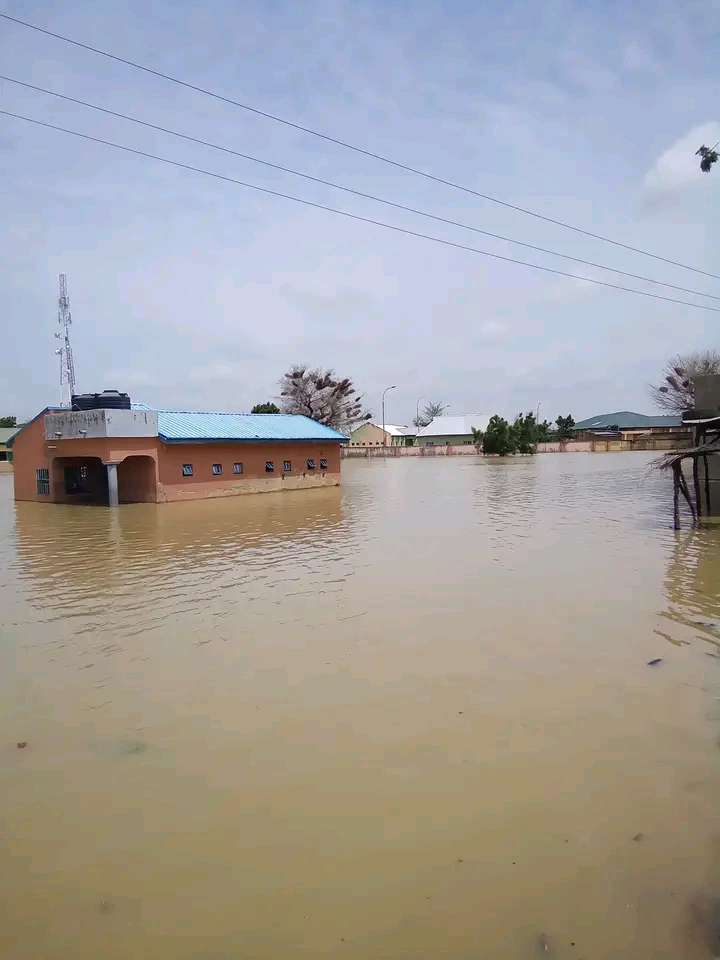
The devastation of 2022 serves as a poignant reminder of what is at stake. That year, floods claimed more than 600 lives, displaced over 1.4 million people, and destroyed livelihoods on a massive scale. Croplands vanished under water, homes crumbled, and dreams were swept away. Three years later, communities still carry those scars, and the new flood alerts for 2025 have revived fears of a repeat.
It is against this grim backdrop that the National Emergency Management Agency (NEMA) is repositioning itself. For years, the agency was primarily seen as the responder of last resort, arriving with relief materials after lives and property had already been lost. Today, under the leadership of its Director General, Mrs Zubaida Umar, NEMA is making a deliberate shift: from being merely reactive to becoming a driver of foresight and prevention.
“Emergency management must no longer be about sympathy after the tragedy,” Mrs Umar insists. “It should be about preparedness that saves lives before the waters rise.”
That vision is beginning to take root. NEMA now works more closely with the Nigerian Meteorological Agency (NiMet) and the Nigerian Hydrological Services Agency (NIHSA), ensuring that seasonal forecasts and dam release alerts are translated into action at the grassroots level. Through community training, simulations, and sensitisation, the agency is attempting to close the gap between warnings and response, a gap that has cost too many lives in the past.
Yet the challenge remains daunting. Nigeria’s geography makes it naturally vulnerable, with the Niger and Benue rivers cutting across states where millions depend on farming. Poor urban planning compounds the danger, as blocked drainage and informal settlements in flood-prone areas turn cities into ticking time bombs. Climate change, with its unpredictable rainfall patterns, only worsens the threat.
In Lokoja, often referred to as the “confluence of suffering” during flood season, traders recall markets transformed into lakes, while fishermen lament the cruel irony of drowning in abundance. In Borno, families already displaced by insurgency were uprooted again when torrential rains washed away their shelters. These stories underscore a sobering truth: floods in Nigeria are not just natural disasters, but also humanitarian emergencies that exacerbate existing vulnerabilities.
Still, there are signs of progress. NEMA has strengthened partnerships with state governments and agencies, such as the Hydroelectric Power Producing Areas Development Commission (N-HYPPADEC), to broaden the response framework. The agency has also invested in early warning systems, ensuring that flood alerts do not remain stuck in Abuja press briefings but reach local leaders, town criers, and community radio stations.
For NEMA, the real battle is not only about deploying relief materials but about changing mindsets. Preparedness must become a culture. Farmers adjusting their planting calendars to forecasts, families relocating from high-risk flood plains, and local leaders treating disaster drills as seriously as security meetings. These are the shifts that make prevention real.
But as Mrs Umar acknowledges, transformation takes time. Resources remain limited, and relief supplies can only go so far in a country where millions are at risk. Disaster management will therefore continue to be a delicate balance between urgent response and long-term prevention.
What is clear, however, is that the old model of waiting until floods wreak havoc before acting is no longer sustainable. With new alerts already issued for 2025, the real task is ensuring that early warnings translate into early action. The coming seasons must not repeat the mistakes of the past.
Floods will always come. The question is whether they remain an annual tragedy or become a manageable threat. For NEMA, the answer lies in standing not just as a responder to disaster, but as a shield against it. For the millions who live in the shadow of swollen rivers, that shift could mean the difference between despair and survival.
Abdulhamid Abdullahi Aliyu writes on disaster management, humanitarian response, and national development.

Tinubu vows fairness for all faiths, pledges to end insecurity
By Abdullahi Mukhtar Algasgaini
President Bola Tinubu has assured Christian communities in Northern Nigeria of his administration’s commitment to fairness and religious equity, while also pledging to decisively tackle the nation’s security challenges.
The President gave the assurance on Saturday during a visit to Jos, Plateau State, where he met with Christian leaders at the Headquarters of the Church of Christ in Nations (COCIN) and attended the funeral of Nana Lydia Yilwatda, the mother of the APC National Chairman.”
I have a mission to unite this country, ensure its prosperity, and we are making progress,” President Tinubu stated.
He emphasized his personal commitment to religious harmony, citing his own family as an example.
“In our family, we have a strong Muslim background, and I married a Christian, a pastor for that matter, and I have never forced her to change her religion.”
On the pressing issue of insecurity, the President was resolute.
“We are defeating bandits, and we will defeat them. We will deal with them and combat the farmers-herders clashes,” he declared.
The funeral service served as a platform for the President to pay tribute to the late Nana Lydia Yilwatda, whom he described as a devoted mother and humanitarian.
The event also featured remarks from her son, Professor Nantawe Yilwatda, the APC National Chairman, who thanked the President for his support.
Reverend Dr. Amos Mohzo, the President of COCIN, expressed gratitude for the appointment of Northern Christians like Senator George Akume, the Secretary to the Government of the Federation, into key government positions.
He also appealed to President Tinubu for increased assistance for victims of conflict in Benue, Plateau, and for Christian communities displaced from Borno and Adamawa into Cameroon.
The high-profile event was attended by a host of dignitaries, including Senate President Godswill Akpabio, several state governors, and top government officials.

Ulama Forum refutes claims of 500,000 Christian deaths in Nigeria
By Hadiza Abdulkadir
The Ulama Forum in Nigeria has condemned what it describes as false and inflammatory allegations by some international media outlets, including Fox News, Radio Genoa and American talk show host Bill Maher, claiming that 500,000 Christians were killed in Nigeria last year.
In a statement signed by Convener Aminu Inuwa Muhammad and Secretary Engr. Basheer Adamu Aliyu, the Forum described the claims as “entirely unfounded, reckless, and designed to misinform the international community.”
It added that Nigeria’s security challenges—terrorism, banditry, and farmer-herder clashes—affect both Muslims and Christians, not any single religious group.
The Forum noted that Muslim communities, particularly in the Northwest, have “suffered disproportionately,” with thousands killed in repeated attacks ignored by international coverage. It warned that spreading false genocide narratives could inflame tensions and undermine peace efforts.
Quoting the Qur’an, the Forum reaffirmed Islam’s prohibition of killing innocents and called for unity among Nigerians “to resist attempts by foreign actors to manipulate false narratives.”
It also urged the government to intensify security measures and advised international media to report responsibly and respect Nigeria’s diversity.

The parable of Mrs X and the health crisis of the nation
By Oladoja M.O
There’s a video, “Why did Mrs X die?” that is very popular in the public health sphere. At first, the video seemed like the tale of one woman, faceless, nameless, known only by a letter. But the more I analyse and reflect on it, the more it has dawned on me that Mrs X was never just one person. She was and still is the embodiment of Nigeria’s healthcare story. Her death was not a singular tragedy, but a parable. A mirror held up to a nation’s bleeding system.
Mrs X died, not simply because of childbirth complications, but because everything that could have worked didn’t. Everything that should have stood for her failed her. Her death was not a moment; it was a long, silent, accepted process. In her story, there was the collapse of planning, access, and empathy. She died from a slow national rot that had found flesh in her body.
The story of Mrs X began not with the bleeding, but with the absence of preventive orientation that characterises the experience of many Nigerian pregnant women. She went through pregnancy the way most Nigerians face illness, hoping it would not demand too much. She never considered going for checkups, not because she was reckless, but because the culture of prevention was never truly instilled in her.
In a society where survival itself is a daily hustle, prevention often feels like a luxury. There was a health facility, yes, but it was far, tired, and overstretched. The system had blood, but not enough. Staff, but overworked. Beds, but unclean. And behind it all were the silences of policymakers, the rust of forgotten community health centres, and the dust on abandoned government project files. So, when she finally needed help, it was already too late to start looking.
That story, the scramble at the end, is too familiar. We see it in Ekiti, Katsina, Owerri, and Makurdi. Patients running from one hospital to the next, files in hand, hope on lips, only to be turned back by bureaucracy, distance, or a quiet “we have no space.”
But beyond the infrastructure and logistics, Mrs X bore the weight of something heavier: culture. She was told, directly and indirectly, that her place was to endure. To cook. To clean. To birth. Her pain was duty. Her tiredness was weakness. To seek help was indulgent. So, she bore her cross in silence. Culture had taught her that a good woman asks for little, demands nothing, and dies quietly.
Gender inequality was not just in her home; it was in the policy rooms that never included her voice. It was in budgets that prioritised politics over health. It was in the subtle shrug of indifference that attends women’s complaints in clinics, especially poor women in rural areas. Her being female had already placed her lower on the ladder.
But perhaps what haunts me most is how everything seemed normal until someone opened the files. That day, long after she had gone, someone went back to the data room and began to look. Patterns emerged. Cases connected. Questions rose. “How many more like her?” they asked. “Could we have seen this coming?” It was research that awakened conscience. Data that pulled the curtain back. And isn’t that Nigeria’s truest shame that we often act only after counting the dead?
Mrs. X, for all her anonymity, is Nigeria. She is our health system in human form: underserved, overburdened, overlooked. Her blood loss is our policy hemorrhage. Her silence is our governance gap. Her death is our diagnosis.
It’s easy to talk about reforms. There have been many. Policies, papers, pilot schemes. But for every speech made in air-conditioned halls, there’s a Mrs X still sitting miles from care, still unsure if help will come. Nigeria does not lack ideas. It lacks continuity. It lacks compassion in implementation. It lacks the urgency that comes when you see the system as your own mother, your own sister, your own unborn child. We must stop planning in the abstract. We must stop building for applause and start building for impact.
Health must become a right, not a privilege wrapped in bureaucracy. We must fund primary health care not as a checkbox but as a foundation. We must decentralize emergency care so that help is never more than a few kilometers away. We must invest not only in infrastructure but in mindsets, teaching every citizen that prevention is not a scam, and that seeking help is not weakness.
And crucially, we must disaggregate our data and listen to it. Research must not be something we dust off only when we need donor funds. It must be lived, continuous, grounded in our local realities. Because without data, we’re only guessing in the dark, while more Mrs. Xs are buried under statistics that came too late.
So, no, the story of Mrs X is really not about maternal mortality. It is about us. All of us. It is the story of a system that watches a woman bleed and scrambles for gauze. That waits until the final breath before asking the first question. That blames culture, then feeds it. That builds hospitals without building access. That speaks to the importance of health equity while communities barter herbs in silence. I saw Mrs X die. But more than that, I saw Nigeria in her eyes; tired, forgotten, hoping someone would care enough to fix what’s broken.
Maybe, just maybe, if we learn to listen to her story, we won’t need another parable. Maybe her death won’t be in vain.
Oladoja M.O writes from Abuja and can be reached at: mayokunmark@gmail.com.

Troops arrest 450 suspects, rescue 180 civilians in September – DHQ
By Anwar Usman
The Defence Headquarters on Saturday said troops arrested about 450 terrorists, bandits, extremists and other criminals across the country last month.
This was disclosed in a statement by Maj. Gen. Markus Kangye, the Director of Defence Media Operations, he said 39 terrorists surrendered while 180 civilians were rescued during the operations.
He said 63 arms, 4,475 rounds of ammunition and 294 items including grenades, improvised explosive device materials, handheld radios, motorcycles and vehicles were recovered.
Kangye added that troops of Operation DELTA SAFE foiled oil theft valued at N112,175,220, consisting of 49,321 litres of crude oil, 6,970 litres of automotive gas oil, 1,900 litres of dual-purpose kerosene and 1,475 litres of premium motor spirit.
“For the month of September, about 450 terrorists, bandits, extremists and other criminals were arrested, 39 of them were surrendered, while 180 civilians were rescued. Quantity 63 arms, 4,475 ammunition were recovered, 294 items such as grenades, IED marking materials, handheld radios, motorcycles, vehicles and other items used in perpetrating crimes were also recovered.
“Operation DELTA SAFE foiled oil theft worth N112,175,220.00 representing 49,321 litres of crude oil, 6,970 litres of AGO, 1,900 litres of DPK and 1,475 litres of PMS. 41 Illegal refining sites were also destroyed” the statement reads.
He further stated that, troops also seized automatic rifles, rocket-propelled grenade tubes, machine guns, locally fabricated guns, live cartridges and assorted ammunition in different operations.
“Overall, troops recovered large quantities of various arms, such as automatic weapons, RPG tubes, machine guns, locally fabricated guns, and improvised explosive devices making material. Also, some cache of live cartridges and assorted ammunition were recovered” the statement concluded.
lGBTQ+: Netflix loses billions in market value after Elon Musk’s call for boycott
By Sabiu Abdullahi
Netflix has lost billions of dollars in market value after billionaire Elon Musk urged viewers to cancel their subscriptions, accusing the streaming giant of promoting what he described as excessive LGBTQ+ content — including in children’s shows.
Musk, in a post on X, said Netflix had become “unwatchable,” claiming it was “almost impossible to find a movie without an LGBTQ+ scene.”
The Tesla and SpaceX chief linked his criticism to his long-standing stance on gender and identity issues, particularly after his child, Vivian Wilson — formerly Xavier Musk — transitioned and publicly cut ties with him.
Following Musk’s comments, Netflix’s share price fell between 2% and 4% within a short period, resulting in an estimated loss of about $15 billion in market capitalization, according to reports from Investing.com and Anadolu Agency.
Analysts noted that while the drop coincided with Musk’s remarks, broader market movements may have also contributed.
However, some social media posts and blogs have claimed the loss exceeded $20 billion, a figure not supported by mainstream financial outlets or market data.
Financial experts caution that the online figure appears to be exaggerated or based on speculative estimates.
Musk’s criticism has sparked heated debate online. Supporters praised him for taking a stand against what they call “agenda-driven content,” while others accused him of intolerance and misinformation.
Netflix has not issued an official response to Musk’s remarks, but the company has previously defended its content diversity, saying it aims to reflect a wide range of human experiences.
While the exact financial impact of Musk’s boycott call remains unclear, the controversy once again highlights how powerful public figures can influence corporate reputation and market performance in the digital age.

Aggrievedness in the North: Four things Tinibu should do
By Zayyad I. Muhammad
Since February 6th, 2013, when the All Progressives Congress (APC) was formed, the party has been the darling of the North. In the 2015, 2019, and 2023 presidential elections, the North was instrumental in bringing and maintaining the APC in power at the centre. However, in President Bola Ahmed Tinubu’s just two years in power, there is widespread aggrievement against the Tinubu government in the North. This is surprising and unsurprising as well:
Out of the 8.7 million votes that brought President Ahmed Bola Tinubu to power, the North collectively contributed 5.6 million votes, accounting for approximately 64% of his total. In contrast, the South contributed 3.2 million votes, or 36%. Given this overwhelming support, it is surprising that the President has allowed the North to slip from his political grip so easily.
To be fair to Tinubu, every President seeks to reward close associates, loyalists, and political allies, including in his own way of governing. However, Tinubu appears to have gone too far in prioritising his inner circle, often at the expense of the region that gave him his strongest mandate.
The good news is that Tinubu still has ample time to regain the North’s confidence. But to succeed, he must act based on facts, not emotions, nor the filtered narratives he hears from those around him.
Broadly, Tinubu must focus on four urgent actions, grouped under two components: one political and three socioeconomic.
The President has made good progress in building elite consensus but must expand to persuade more politicians and elites. Some seek recognition, relevance, appointments, or contracts. Tinubu can quickly address this: by calling, offering appointments, or granting contracts. There’s room for more Advisers, Special Assistants, and ambassadorial positions.
Furthermore, he should establish a Presidential Advisory Council in each state, a small team of respected voices who can meet quarterly to brief him directly on the needs and aspirations of their people. This will give Northern leaders a sense of inclusion and shared ownership in governance.
The second component, socioeconomic, comprises three elements: Agriculture, Livestock, and security and infrastructure.
This is where Tinubu must be most deliberate. Socioeconomic issues directly affect the masses, the real voters. The August 16, 2025, by-election has already shown that money politics will have limited influence by 2027.
Tinubu has tried to stabilise food prices, but the cost of farm inputs has skyrocketed. The North urgently needs a dedicated agricultural recovery program. Past initiatives, such as the Anchor Borrowers’ Programme, the Presidential Fertiliser Initiative (PFI), Youth Farm Lab, Paddy Aggregation Scheme, Agricultural Trust Fund, PEDI, and the Food Security Council, were well-conceived. Yet implementation failures meant that benefits rarely reached genuine farmers.
For instance, under the PFI, fertiliser blenders made fortunes, but farmers, who should have been the real beneficiaries, still buy fertilisers at ₦45,000–₦52,000 per bag, far above the ₦5,000 target price.
Tinubu must ensure that agriculture is reconnected to ordinary farmers, not just middlemen. The Ministry of Agriculture should recalibrate its projects and programs to target real farmers directly.
The creation of the Federal Ministry of Livestock Development was a brilliant and forward-thinking step. Yet, it has made little impact so far.
With proper funding and direction, this ministry can: transform nomadic herders into more settled, educated, and productive citizens; address the farmer-herder conflict that has claimed thousands of lives; reduce cattle rustling, banditry, and kidnapping, which are often linked to herder communities.
If effectively managed, the ministry can become one of Tinubu’s most enduring legacies in the North.
Security remains the North’s most pressing concern. The kinetic and non-kinetic strategies being coordinated by the Office of the National Security Adviser (ONSA) are yielding some positive results, but much more is needed.
Tinubu should expand the non-kinetic approach through security communications, utilising massive public relations and grassroots outreach, particularly in the Hausa and Fulfulde languages. Talking directly to communities and even to at-risk groups will deepen trust, reduce misinformation, and weaken extremist recruitment.
Another way to rewin the North is through concerted efforts to make sure the ongoing and stalled infrastructure projects are fast-tracked, especially the ongoing rehabilitation of the Abuja-Kaduna expressway, some deplorable roads in the Northeast, especially along the Gombe-Adamawa axis, the Mambila hydroelectric project, Sokoto-Badagry Freeway/Highway, Kaduna-Kano Standard Gauge Rail Project, and Kano-Maradi Rail Link.
The North gave Tinubu his strongest mandate in the 2023 election. Losing its trust would be politically costly in 2027. To recover lost ground, the President must move beyond token gestures and adopt a deliberate, structured engagement strategy that balances elite consensus with grassroots socioeconomic transformation.
If Tinubu can act decisively on these four fronts, more political inclusion, agricultural recovery, livestock reform, enhanced security, and fast-track ongoing infrastructure projects, he will not only rewin the Northern confidence but also secure massive votes in 2027
Zayyad I. Muhammad writes from Abuja via zaymohd@yahoo.com.

Gov. Yusuf pays N5.6bn backlog to ex-councillors
By Muhammad Abubakar
Kano State Governor, Abba Kabir Yusuf, has disbursed N5.6 billion to 1,198 former councillors who served between 2018 and 2020 under the administration of ex-Governor Abdullahi Umar Ganduje.
The payment, which covers severance, gratuity, accommodation, and leave allowances, represents the second batch of liabilities inherited from the previous administration. In May, the governor released N1.8 billion to 903 councillors in the first phase of the settlement.
Speaking at the disbursement ceremony at Coronation Hall, Government House, Yusuf said his administration inherited a total of N15.6 billion in outstanding obligations to former councillors. He assured that the final tranche of N8.2 billion, covering 1,371 beneficiaries, would be cleared by the end of November.
“This is more than a financial settlement. It is about restoring dignity, fairness, and justice to those who sacrificed for grassroots governance,” the governor said.
The event was greeted with jubilation as beneficiaries, many of them members of the opposition APC, received instant payment alerts. Their leader commended Governor Yusuf for his fairness despite political differences, describing him as just and compassionate.

NERDC ES visits Northwest University Kano, VC awarded
The Executive Secretary of the National Educational Research and Development Council (NERDC), Professor Salisu Shehu, has paid a courtesy visit to Northwest University Kano on Thursday, 2 October 2025, where discussions were held on strengthening collaboration between the two institutions.
The visit, which took place at the office of the Vice Chancellor, Professor Mukhtar Atiku Kurawa, saw Professor Shehu—former Vice Chancellor of Istiqamah University Sumaila—reaffirming the Council’s commitment to advancing educational development nationwide.
Speaking during the engagement, Professor Shehu explained that NERDC, established in 1988, has 10 directorates with specific functions, with its primary mandate focused on curriculum development for both foundational and secondary school levels.
He emphasized the regulatory role of the Council in ensuring quality teaching materials, stating: “Every book written in Nigeria must be submitted to the NERDC for review before it can go through further necessary processes. This is crucial in safeguarding quality and uniformity in our education system.”
Professor Shehu appreciated the Vice Chancellor for creating the platform for the visit, adding that the synergy between NERDC and Northwest University Kano would be of immense benefit to both institutions.
In his welcome remarks, Vice Chancellor Professor Mukhtar Atiku Kurawa congratulated Professor Shehu on his appointment as Executive Secretary of NERDC, describing it as a proof to his distinguished service in the education sector.
While pledging the University’s readiness to collaborate, he highlighted recent reforms introduced by the institution. “We have amended our system to allow students to be part of entrepreneurship programs, where they will acquire practical skills during holidays. This is in line with global best practices in higher education,” he said.
Professor Kurawa, whose tenure as Vice Chancellor is nearing completion, assured the NERDC delegation that the incoming administration would sustain the partnership. “Though my time as Vice Chancellor is coming to an end, I will ensure that my successor continues with this collaboration,” he added.
The meeting was attended by the principal officers of the University, who joined the Vice Chancellor in receiving the NERDC team.On the same day, past and present staff of the Vice Chancellor’s office presented an award of excellence and gifts to Professor Kurawa in recognition of his leadership.
The event, held in his office, was filled with emotion as staff members expressed appreciation for his dedication and prayed for greater success in his future endeavors.
Responding to the gesture, Professor Kurawa said: “I am deeply touched by this show of love. Working with such a committed team has been one of the highlights of my tenure. I remain grateful for your support and prayers.”
In another development, on 30th September 2025, the Bursary Department of the University, under the leadership of the Bursar, Malam Salmanu Muhammad Kibiya, organized a send-forth ceremony in honor of Hajiya Amina Shehu Maimota, who retired after decades of meritorious service.
The event featured emotional speeches and presentation of gifts from colleagues and friends both within and outside the department.
The Bursar described her as a committed staff whose contributions greatly enriched the University’s financial administration.Speakers praised her professionalism, dedication, and commitment in service, while wishing her a peaceful and fulfilling retirement.

Phone snatchers tighten grip on Katsina metropolis — Authorities must respond swiftly
By Usman Salisu Gurbin Mikiya
Katsina, as the name resonates, is widely regarded as a home of hospitality — a land where people live in harmony and mutual respect. It is a place of comfort where the warmth of its people makes life pleasant and fulfilling.
Recently, however, the long history of relative peace has begun to fade; an uncharacteristic catastrophe once thought distant has started unfolding, becoming a major concern for residents of Katsina Metropolis and beyond, especially as it adds to the decade-long insecurity bedevilling the state.
The issue of phone snatching in Nigeria originated from wristwatch snatching in Southern Nigeria, particularly in Lagos and other highly populated state capitals. It often occurred in strategic areas with heavy traffic, and over time, it evolved into a practice of phone snatching.
In Northwestern Nigeria, phone snatching started in Kaduna State about eight years ago. I vividly recall my visit to Kaduna in 2020, when I was on assignment for my media organisation. A Keke Napep rider warned me to hide my phone from criminals after noticing me pressing it through his mirror.
What began as an alarming trend in Kaduna escalated into a catastrophic issue, with phone snatching syndicates extending their activities into Kano, creating panic and undermining public safety.
During one of my visits to Kano, two of my brothers, on different occasions, warned me not to use my phone while on a tricycle in certain areas. They cautioned that I could lose my life over a phone, as snatchers were everywhere, and even advised me to choose the Keke Napep I boarded carefully.
Indeed, what started as an alarming wave in Kaduna has gradually spread like wildfire, creeping into Kano and now reaching Katsina. Once considered a distant menace, the problem has arrived at the very doorstep of Katsinawa, turning a basic necessity —the mobile phone — into a source of constant fear. This epidemic of criminality is no longer a local crisis but a regional catastrophe demanding urgent attention.
In Katsina Metropolis, residents of Sabuwar Unguwa are no strangers to this menace, as multiple reported cases of phone snatching have occurred, particularly targeting visitors and strangers in the area.
During Governor Ibrahim Shehu Shema’s administration, wayward youths, popularly known as Kauraye, emerged in Katsina. They crippled businesses and created tension in the metropolis, especially in areas such as Sabuwar Unguwa, Inwala, Sabon Layi, and Tudun Ƴan Lahidda.
Their reckless activities frustrated Governor Shema to the point where he took decisive measures that restored sanity and ended the menace.
Similarly, during Governor Aminu Bello Masari’s administration, persistent attacks by delinquent youths, suspected to be from Inwala in the ATC area, forced the government to establish a special Civil Defence outpost. This step drastically reduced the menace.
In his first year in office, Governor Dikko Umaru Radda also faced resurging activities of wayward youths in Sabuwar Unguwa. He personally led security agents in night operations, which eventually restored peace in the area.
However, with three different phone snatching incidents recorded within just three days on major roads, it is clear that social vices are escalating in the city. If not urgently addressed, they risk crippling businesses and threatening public safety.
The first incident occurred on 20th September, when Mrs Sada Shu’aibu was attacked near Sabuwar Dan Marna graveyard, and the attackers attempted to snatch her phone and inflicted serious injuries on her body.
The following day, 21st September, during the grand finale of the Maulud procession, Usman Marwan was brutally attacked by phone snatchers at his business centre near the MTN office in Kofar Ƙaura.
Furthermore, on 26th September, another victim narrowly escaped death after being attacked by snatchers. This incident has heightened concerns among residents of the metropolis.
With insecurity already ravaging some local governments in Katsina State, the fact that the capital city is now battling phone snatching suggests that Katsina is increasingly under the control of thugs.
This menace has resurfaced under the leadership of Governor Radda, who had earlier recruited hundreds of youths to fight insecurity in the state. Many residents are now watching closely to see how he will respond to this rising threat.
Phone snatching can still be contained within a short period if several urgent measures are taken, including:
The government should initiate a law prescribing either the death penalty or life imprisonment for anyone convicted of phone snatching, alongside a shoot-on-sight order for fleeing offenders.
The government should declare a state of emergency on phone snatching so that the fight against this menace does not derail broader security efforts in the state.
Usman Salisu Gurbin Mikiya, M.Sc. student, Department of Mass Communication, Bayero University, Kano. He can be reached via his Email: usmangurbi@gmail.com.