Opinion

How Carlcare Nigeria almost cheated me

By Ishaka Mohammed

Carlcare Nigeria is the official customer care support for Infinix, TECNO, itel, and Oraimo users in Nigeria, offering after-sales service (repair, technical support, etc.).

I have known the company for a long time but only had a reason to seek its service on Saturday, June 8, 2024, when I realised that my Infinix SMART 5 phone lacks a particular feature: OTG. 

The USB On-The-Go (OTG) makes it easy to connect your smartphone with devices like flash drives, game pads, digital cameras, microphones, etc. Since my phone doesn’t support OTG, I couldn’t connect it with a wireless microphone.

Consequently, I made a reservation to visit a Carlcare service centre in Kaduna. While filling the online form, I wrote this: “My phone doesn’t support OTG, so I want to find out how I can still use it with a wireless microphone.” I screenshotted the reservation page, proceeded to the service centre and explained everything to a receptionist, who consulted an inner room and made me pay N4,700. 

After making the payment, I waited for over an hour before retrieving my phone. I tried to connect the microphone again, but nothing changed.

When I complained to the receptionist, she told me that the phone doesn’t support OTG. Then I asked her to explain why I had to pay to be told what I already knew, but she instead claimed I paid for “sub-board”.

As far as I was concerned, I didn’t know any sub-board. All I needed to know was the possibility of using my phone with a wireless microphone.

We kept exchanging words until it became clear that I wouldn’t get a refund, so I snapped the payment details and left.

I thereafter expressed my grievance to the company via Facebook, phone calls, email and X (formerly Twitter), but the responses were unfavourable. In fact, despite my explanation and supporting documents, I was told via X that I paid for the sub-board.

I thought of leaving the matter, but I couldn’t do that because the company could cheat me or another person in a similar manner in future.

I mentioned the issue to a patriotic Nigerian on X. He gave me his phone number, listened to me on the phone and warned Carlcare Nigeria in an X post to do the needful or be ready for action.

Within 20 hours after the post, I received calls from four different agents (of Carlcare). They all apologised, and the last one sent me my money.

You see, I made fruitless efforts for about six days (June 8 to 13), but Barrister Uthman Isa Tochukwu used a single X post to solve the problem within a day.

Although he clearly mentioned that legal consultation is not free, he helped me recover my money pro bono (without asking for payment).

I’m glad to have recovered my money but even thrilled that this encounter could deter the company from attempting to cheat other prospective customers.

The return of Sanusi II, Tinubu, the north, and 2027

By Zayyad I. Muhammad 

Emir Muhammadu Sanusi’s two ascensions to the throne of the ancient Kano Emirate have been deeply intertwined with local and national politics. On June 9, 2014, Sanusi was installed as the 14th Emir of Kano by then-Governor Rabiyu Musa Kwankwaso, seemingly to spite former President Goodluck Jonathan’s administration. Earlier that year, on February 2, Sanusi had been dismissed from his position as the Governor of the Central Bank of Nigeria for alleging that the Nigerian National Petroleum Company (NNPC) had failed to remit a $20 billion statutory fund to the federal government—a claim denied by Jonathan’s administration.

On March 9, 2020, Governor Abdullahi Umar Ganduje removed Sanusi from the throne, citing his alleged disregard for lawful directives. However, the primary motive behind Sanusi’s dethronement was political, as he had been openly critical of several policies and projects of the Ganduje administration. Ganduje was angered by Sanusi’s penchant to play a dual role as a revered Emir and a social critic, an untenable combination in the Nigerian context.

On May 23, 2024, Governor Abba Kabir Yusuf reinstated Sanusi as the Emir of Kano after signing a state assembly bill that dissolved the five emirates created by the Ganduje administration and dethroned the 15th Emir of Kano, Aminu Ado Bayero. Governor Yusuf’s decision to reinstate Sanusi Lamido Sanusi was also politically motivated, aimed at reversing Governor Ganduje’s actions and continuing the supremacy battle between former Governors Abdullahi Ganduje and Rabiyu Musa Kwankwaso.

Sanusi’s journey from being the Governor of the Central Bank of Nigeria (CBN) to his dismissal, his installation as the Emir of Kano, his subsequent dethronement, and finally, his reinstatement is marked by political intrigue. It begins with confusion and ends in confusion. His return as Emir of Kano on May 23, 2024, might seem straightforward, but it is anything but simple. It’s akin to a complex mathematical equation that appears simple on the surface but requires the application of numerous mathematical laws to solve. Sanusi’s reinstatement is a product of intricate local and national political manoeuvring, with an eye towards the 2027 elections from all the actors.

Senator Rabiyu Musa Kwankwaso is determined to erase any traces of Ganduje’s influence in Kano politics. Initially, this strategy worked for Kwankwaso without significant interference from the centre. However, it has now dawned on Tinubu and his handlers that allowing the Kwankwasiyya group to operate unhindered could lead to the loss of Ganduje’s group support without gaining substantial assurance from the Kwankwasiyya group. In the 2023 presidential and governorship elections, Kwankwaso garnered 997,279 votes, while Tinubu received 517,341 votes.

In the gubernatorial race, Abba Yusuf Kabir of the Kwankwasiyya group obtained 1,019,602 votes, whereas Nasir Yusuf Gawuna of the Ganduje group secured 890,705 votes, a difference of 188,897 votes. Maintaining this voting pattern is crucial for Tinubu and his team heading into 2027. Some members of the Ganduje group are discontent with the centre after narrowly losing the gubernatorial seat at the Supreme Court. If they continue to feel unprotected despite their connections at the centre, Tinubu’s prospects in Kano for 2027 could be jeopardized. Thus, the centre’s support for Aminu Ado Bayero is not surprising.

The calculations in Abuja, though not overtly confirmed, seem poised to influence Kano’s political landscape at a critical juncture. Giving the Kwankwasiyya group free hands to operate as they wish would be politically risky for the centre. Abuja needs to have some strong feet on the ground in Kano. Kano votes are crucial in the north.

The ongoing power struggle in Kano is straightforward: it’s an attempt to balance interests, strike a political equilibrium, and prepare the ground for future battles. For the common man, the advice is clear: do not take sides, as these are political manoeuvres made with future gains in mind. However, the implementation of these decisions will inevitably have collateral damage. In politics, there is no provision for a collateral damage estimate (CDE)—becoming collateral damage means being in the wrong place at the wrong time. No harm is intended personally.

What’s happening in Kano? It’s a fascinating and high-stakes game—a zero-sum game, to be precise. The same thing happened. On October 22, 1983, Governor Abubakar Rimi established four new emirates in Kano State to diminish Emir Ado Bayero’s power and influence. After his inauguration, his successor, Governor Sabo Bakinzuwo, revoked the law and restored the emirs to their previous positions as district heads.

Zayyad I. Muhammad writes from Abuja via zaymohd@yahoo.com.

FG must avoid fostering discord in Kano

By Dr. Mansur Hassan

In a concerning and unprecedented development in Nigeria’s history, the Federal Government is undermining the powers of the executive and legislative arms of government in Kano State. This dangerous attempt threatens to plunge the state into a form of insecurity akin to that which plagues northern Nigeria.

Recently, Kano State has emerged as a hotspot of political tension and potential unrest. Allegations have surfaced that the APC-led Federal Government is attempting to create a new breed of Boko Haram insurgents in Northern Nigeria. If these claims hold any truth, they represent not just a political maneuver but a potential security disaster that could destabilize the entire region.

Federal security agencies have been accused of providing undue support to the deposed Emir of Kano, Aminu Ado Bayero. Instead of ensuring peace and order, these agencies are perceived as undermining the authority of Kano’s state government. This situation sets a dangerous precedent and could lead to widespread unrest if not addressed promptly.

The people of Kano are ready to resist any attempts to undermine the constituted authority in the state. This resistance is deeply rooted in the belief that the NNPP administration is genuinely committed to serving the people—a commitment that resonates strongly with their mass followership. Without the peace-loving Kwankwasiyya administration, Kano might already have descended into chaos.

Certain individuals within Kano, who can be seen as enemies of the state and Northern Nigeria at large, are misleading the Federal Government. These individuals are pushing for a state of emergency in Kano, and the Federal Government must scrutinize these advisors’ motives and the potential consequences of their recommendations.

As the 2027 elections loom, the political stakes are higher than ever. It is imperative for the Federal Government to ensure that its actions and those of its agencies do not fuel political instability or violence. No amount of intimidation or political harassment will sway the people of Kano from their allegiance to the Kwankwasiyya Government.

The Federal Government must act swiftly and decisively to address these concerns. Avoiding any course of action that could plunge Kano into chaos is crucial. The state’s stability is essential not only for its residents but also for the broader peace and security of Northern Nigeria.

Mansur Hassan, PhD wrote from Kano

My journey to NYSC orientation camp and the fear of the unknown

By Haroon Aremu 

Upon graduating from university, I eagerly anticipated joining the mandatory one-year national service with the National Youth Service Corps (NYSC). I shared my excitement with friends, but not all were keen to join immediately. One friend said he needed to hustle and build his career first. However, I wanted to finish it quickly and move on to my next life phase. So, I registered and subsequently got mobilised for a three-week-long camping/orientation.

Embarking on the journey to join the NYSC is more than just a transition to adulthood; it is a rollercoaster ride filled with unexpected twists and turns. 

Call up letter came, and it stated that  I was to camp at Niger State, Paikoro local government, Paiko camp, but after that three weeks, I am to complete my service in Abuja. I was happy and prepared to travel, as I had never been to Niger State before. I learned that Niger State is one of the largest states in terms of landmass. I thought about how beneficial it would be for the federal government to collaborate with NYSC and invest in agriculture to empower graduates to develop their futures. This would surely boost the economy at both the federal and state levels.

Before setting off, a friend’s cautionary words lingered in my mind. He chose to prioritise his career over immediate service, urging me to hustle first. However, my eagerness to dive into the experience outweighed any apprehensions. NYSC is a mandatory scheme for all graduates, except those over thirty, who are usually issued an exemption letter.

The night before departure, a subtle warning on the NYSC documentation reminded us not to travel at night—a precaution that resonated deeply. Despite the allure of reaching our destination quickly, we chose safety over haste, breaking our journey when dusk fell. This lesson applies beyond NYSC, reminding us that vigilance is key even in seemingly safe spaces.

As we embarked on our journey, camaraderie filled the air. The sense of unity was palpable while travelling alongside fellow prospective corps members. From shared laughter to prayers for safe travels, each moment cemented the bonds of camaraderie that NYSC fosters. My journey was fascinating, especially with a friend assigned to the same state. “Corpers on board” was boldly written on our vehicle, and the people we passed hailed and prayed for our safe journey. We chatted and played music, making the trip memorable.

Yet, amidst the laughter and anticipation, a stark reality halted us. Amid lush landscapes, armed men appeared—a stark reminder of the world’s unpredictability. It was a wake-up call, underscoring the importance of vigilance even in seemingly serene surroundings. We stopped at a canteen to eat a sumptuous meal, enjoying the privileges of being a corps member. Continuing our journey, we enjoyed the natural beauty of Nigeria’s landscapes.

However, amidst the tension, there were glimmers of hope. Security checkpoints operated by dedicated officers reassured us of their commitment to our safety. Their professionalism and integrity stood as beacons of hope on an otherwise uncertain journey.

The most unexpected twist came when a seemingly menacing encounter turned into a moment of levity. Startled awake by a tap on the shoulder, I found myself face-to-face with an armed security officer, his stern demeanour giving way to a shared joke. In that moment, fear melted into laughter, reminding me that amidst life’s uncertainties, moments of joy abound.

The journey left an indelible mark as we finally arrived at our destination. From cautionary tales to unexpected camaraderie, each moment was a testament to the importance of preparation and vigilance. As I shared my story with my hustling friend, who had chosen a different path, I couldn’t help but wonder what adventures awaited him. For in the journey of NYSC, every twist and turn is a chapter waiting to be written, a testament to the resilience of the human spirit and the bonds that unite us all. This is the essence of NYSC, preaching national unity and peace.

Apart from the interesting aspects of NYSC, I believe numerous advantages will convince you to join the program. If you want to know the funny joke the officer cracked with me, I guess you should also prepare to go to your NYSC to experience how interesting and memorable the journey was. As long as we take the necessary security precautions and avoid rough driving, NYSC ensures our safety because we are all dear to the government.

Haroon Aremu Abiodun is a youth Corp Member with PRNigeria centre, Abuja and wrote in via exponentumera@gmail.com.

Umar Bush – unbelievable rise of a new celebrity

By Lawan Bukar Maigana

The rise of Umar Bush, a popular Hausa skitmaker notorious for insulting people, to stardom is unbelievably incomprehensible, justifying Allah’s incredible ability to enrich whom He wishes regardless of their decency or otherwise.

It is Allah alone who knows how he got there. Many people thought his popularity was going to be short-lived, like that of Alhaji Rufai, but that is not the case. He’s now targeted by skitmakers in the Southern part of Nigeria. God is great! New deals are underway.

His unimaginable progress reminds me of the time when an elderly man looked at me in our area during Ramadan and said that I would become a governor. However, a few of my closest friends, whom I thought would be the first to say ‘Insha Allah’, were the ones who contested against me. Indeed, life is greater than our sentiments, and it shall happen if He wills.

When he first came to the limelight comedically, many people thought he was a madman who needed intervention from a psychiatric hospital because of the way he speaks and relates to people. Some netizens even donated thousands of Naira, amounting to over a million Naira, which was later transparently given to his relatives after he had a misunderstanding with his manager, who is also from Kano, labelling it as ‘his end.’

A day later, his manager posted on his personal Facebook page announcing their resettlement with Umar Bush, assuring their audience of their continued efforts to reach stardom.

Ahmed Musa, a renowned Nigerian footballer who plays both in and outside Nigeria, saw Umar Bush’s comical clips trending on Instagram and Facebook and decided to host him at his residence in Kano. Inviting him was a big drama, as he had many misunderstandings and disagreements with all of them, insulting his managers and tagging one of them as his ‘enemy of progress.’

When given lots of Maltina and asked to extend it to one of the team members whom he perceived as an antagonist, he started a fresh drama, insulting him unstoppably until Ahmed Musa intervened and gave him one million naira.

A few days ago, he allegedly signed a ₦100m deal with Ziptol, a company that produces powder detergent, among other detergents. He’s now a millionaire, and I foresee bigger deals coming his way.

Perhaps it is my turn to be insulted comically when he sees this article, especially if he is told that I demanded he pay me for writing about his uncommon sagacious rise to stardom amidst all odds. If you know him or know anyone close to him, tell him that he should pay for this article; else, I will join Sadiq to disturb his life.

Lawan Bukar Maigana writes from Maiduguri and can be reached via email: lawanbukarmaigana@gmail.com.

In defence of loyalty: Standing with the speaker and his unwavering support for the governor

By Idris Ishaq Danwanka

I stand with my boss, the Bauchi State House of Assembly Speaker, Rt. Hon. Abubakar Y. Suleiman, when he described the Bauchi State Governor as his Boss, His leader, and His Direction. The governor has consistently demonstrated kindness to the people of Bauchi State, initiating and executing numerous critical projects since assuming office. His tireless collaboration with the legislative arm of the government ensures the smooth implementation of these projects, providing the state with essential resources for its development.

However, it has come to my attention that certain individuals, particularly from the opposition party, have been attacking the Speaker’s Facebook post, which featured a picture of the governor with the caption: “Wannan shine Uban Gidana, Jagorana, kuma Alkibla ta. Abinda kace shi zamuyi, dani da magoya bayana, in shaa Allah.” The English translation of this Hausa statement is: “The man in this picture is my boss, my leader, and my direction. We will follow whatever you say, knowing fully that you will never lead us to harm, my followers and I, Allah willing.”

There is absolutely nothing wrong with what the speaker said. Unfortunately, due to political differences and a lack of substantial critiques, some individuals who are clueless about the nuances of political discourse are baselessly accusing the speaker of compromising the duties of the legislative body.


The accusations against the speaker are unfounded. To those critics, I pose the following questions:


– In what specific ways has the speaker failed to discharge his duties?
– What are the explicit duties of the speaker and the members of the State Assembly?
– What is inherently wrong with the speaker’s praise for the governor?

Here are a few key points in response to the criticisms:


– In every speech he presents, the governor refers to the speaker as his boss. What wrong does it do when the speaker also refers to the governor as his boss?


– The Speaker’s loyalty to the governor does not impede his ability to perform his constitutional duties regarding the executive arm.


– As a citizen of Nigeria, the speaker is entitled to the same rights as everyone else, including the right to freedom of expression and the press, as provided in Section 39 of the Constitution.


– The Speaker is genuinely impressed with the governor’s leadership style and ability to implement beneficial policies and programs for the state.


– Recently, the governor has flagged off the dualisation of access road in Ningi, and work is in progress… the speaker’s local government, from GSS Ningi to Gudduba. This project, long sought after since the creation of the local government, was approved due to the harmonious relationship between the Executive and Legislative branches.


– ⁠Note that this is the speaker’s personal opinion and that of his supporters (constituents), to which he is constitutionally entitled.

These and many other reasons have prompted the speaker to laud the governor and refer to him as his boss. Ultimately, we are fully committed to following the speaker’s lead and hold no regrets, retreat, or surrender for following the speaker’s directions.


We will always follow his leads and instructions and obey his commands. Our loyalty to the speaker is uncompromising.

Sen. Idris Ishaq Danwanka wrote via idrisdanwanka@gmail.com.

My earliest memory of Eid

By Aisha Mohammed Danpullo

 We were sent to get cooking oil from a house nearby. My cousin and I wore a popular Malaysian Hijab with trimmed lace at the edges and a rope around the back. We were so excited to have a ram that year (I come from a humble background). 

We were eager to watch the ram we had crowded around for days, feeding, watering and cleaning its poo. Finally, we were going to watch as it got slaughtered. I, for one, was most excited for the blood that would come gushing out as it took its last breath.

We went to the oil merchant’s house and met the husband, the head of the house with his kids around him, about to make his sacrifice. He was about to slaughter three fat fish. He had it held down by his eldest son as it squirmed just the way one would slaughter a ram.

The kids were all excited; the wife was humbled and a little bit ashamed, probably because of our presence, spilling the oil she measured with beer bottles serving as a measurement for a litre. It’s quite ironic because beers are banned in our part of the country, but somehow, the bottles are always found in every oil merchant’s shop, and their origin is never questioned.

The family generously offered us some, but we wouldn’t take it because there wasn’t enough for them to share.

Every year during Eid, I think of that family, wondering how they are doing and hoping life has become better for them and that they get to eat ram some year.

Aisha Danpullo wrote from Kano via aishamohammaddanpullo@gmail.com.

National Anthem: Is Nigeria losing its patriotic spirit?

By Haroon Aremu

For nearly 50 years, we have sung “Arise, O Compatriots, Nigeria’s call obey……,” pledging our loyalty to one nation bound in freedom, peace, and unity. But now, we are directed to change our national anthem. Could it be a strategic way of following the popular saying  Changing Narrative to Change Society or does this mean as compatriots we are now handicapped and cannot listen and obey Nigeria’s call anymore? Does it mean there is no more strength, love, and faith to serve our fatherland? Does it mean the labor of our heroes past has been in vain? Are we no longer able to serve with heart and might?

These are the questions lingering in masses mind as the national anthem has been changed. Many Nigeria citizens are clamoring: of all the changes that needed to be made, why the national anthem, especially during such times of hardship? Has the message of the anthem adopted in 1978, created by the five members of the Nigerian Police Band, lost its relevance?

Some citizens have given up hope that Nigeria can ever be better. But should this be our attitude? Instead of succumbing to pessimism, we should strive to refurbish our nation with optimism and prayer. When Americans wake up, they say “God bless America.” When we wake up, we often curse our leaders and condemn our country, forgetting that such negativity can have repercussions bouncing back to us.

The compatriots who built this country are not here to witness its destabilization. If we do not want their labor to be in vain, we must practice the values preached by our new anthem. Nigeria’s growth concerns not only the government but all its citizens.

The legislature has said that the newly launched national anthem serves as a beacon of hope and reassurance, starting with “Nigeria, we hail thee.” Are we hailing our dear native land for enduring economic hardship and remaining patient as we face daily challenges?

Change begins with us, at the individual level. Why are we not standing in brotherhood, despite our different tribes and tongues? Are we truly proud to serve our sovereign motherland?

As a member of the NYSC, one of the core aims we are exposed to is to promote national peace, togetherness, rehabilitation, reconstruction, and reconciliation of a torn-up country. Part of the bedrock of good governance is for the citizens to be involved in governance and also promote it. 

The National Youth Service Corps has been a supportive system for good governance from inception till date and it will always be.  The NYSC stands as a strong pillar that advocate for  good government policy.  Despite the economic hardship and the challenges we face, the NYSC continues to instill a sense of optimism and duty among the youth. 

The NYSC’s role in promoting government policies, such as the change of the national anthem, is crucial since the youth are a very important tool for the promotion of government policy, and through the NYSC, people learn to practice the values of unity, peace, and justice, which are embedded in the anthem and are essential for national development.  

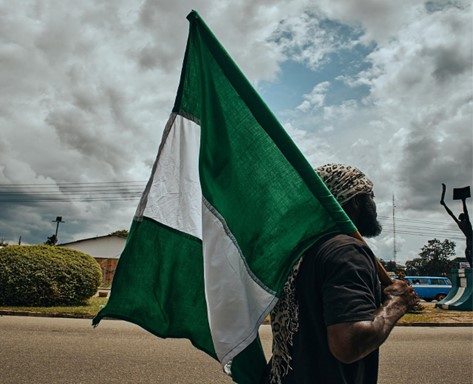
Recently, I watched an interview asking people in the diaspora about the laziest African flags, and some chose Nigeria, does our tendency to take our nation’s issues with a grain of salt and not take them seriously as a people have any thing to do with their choice? Should that be the case? They forgot that our flag’s colors represent something meaningful: the two green stripes symbolize natural wealth, and the white symbolizes peace and unity. We should be proud of our flag because it is our symbol that truth and justice reign. Let us strive to improve on truth and justice for our nation’s growth so that we can hand over a banner without stain to the next generation.

There is a saying that a river that forgets its source will dry up. Let us be hopeful that going back to our source anthem will be a turning point for Nigeria. We should continue to pray with this saying: “Oh God of creation, grant this our request, by helping us to build a nation where no man is oppressed, and so with peace and plenty, Nigeria may be blessed.”

Let us hope that in this era of renewed hope, we are on the path to greatness and prosperity in our dear country. Promoting togetherness, avoiding tribalism and religious nepotism, and coming together as one nation are essential. There is a glimpse of hope that Nigeria will be great again, but it starts with each of us doing our part, not by condemning others. The NYSC scheme fosters this spirit of togetherness and national pride, reinforcing that change begins with us at the individual level. 

Nigeria’s journey to greatness begins with every citizen committing to unity, peace, and justice. By working together and supporting each other, we can ensure that the labor of our heroes past was not in vain and build a prosperous future for generations to come. May Nigeria be blessed!!

Haroon Aremu Abiodun is a youth corp member with PRNigeria center, Abuja and wrote in via exponentumera@gmail.com.

OPEC Sec Gen: Peak oil demand not on the horizon

By Haitham Al Ghais 

In the 1990s and 2000s, the world regularly saw column inches devoted to the theory of peak oil supply, amplified by voices like Colin Campbell and Matthew Simmons. Decades later, however, it has still not come to pass, as enhanced economics and constant improvement in technology have helped lower costs and open up new frontiers to expand the resource base.

The past decade or so has witnessed a shift to talk of peak oil demand, with some forecasters increasingly pushing theoretical scenarios that have decided before any data is analysed that oil should not be part of a sustainable energy future.

This is evident in some net zero scenarios, with suggestions that oil demand will peak before 2030 or, more dramatically, that oil demand will drop by more than 25% by 2030 and calls to stop investing in new oil projects. 

This narrative was repeated only yesterday when the IEA published its Oil 2024 report, which once again stated that oil demand would peak before 2030. It is a dangerous commentary, especially for consumers, and will only lead to energy volatility on a potentially unprecedented scale.

We have also heard similar narratives before, ones that have proven to be wrong. The IEA suggested that gasoline demand had peaked in 2019, but gasoline consumption hit record levels in 2023 and continues to rise this year. It also stated that coal demand had peaked in 2014, but today, coal consumption continues to hit record levels. 

Many net zero futures focus almost exclusively on replacing hydrocarbons, which make up more than 80% of the global energy mix today. Rather than adding new energy sources to the mix, the focus is on substituting energy sources, which flies in the face of the history of supplying energy to the world. The emphasis is on rhetoric over reality and constraint over consumer choice.

Today, wind and solar supply around 4% of global energy, with electric vehicles (EVs) having a total global penetration rate of between 2% and 3%, even though the world has invested over $9.5 trillion in ‘transitioning’ over the past two decades. OPEC welcomes all the progress made in renewables and EVs, but it is nowhere near close enough to replace 80% of the energy mix. Furthermore, electricity grids, battery manufacturing capacity and access to critical minerals remain major challenges. 

We should also remember that the development of renewables and EVs requires some oil-related products. Their future expansion will increase oil demand.

Of course, we all want to lower emissions, but at the same time, we all need ample, reliable and affordable supplies of energy. The two cannot be decoupled. Instead, our energy futures must focus on the full picture and not on a partial, incomplete one. In this respect, three key facts are worth bearing in mind. 

Firstly, future energy and oil demand growth primarily lies within the non-OECD developing world, driven by increasing populations, an expanding middle class and growing economies. From now until 2045, non-OECD oil demand is set to expand by over 25 million barrels a day (mb/d), with China and India contributing over 10 mb/d alone.

We should also remember that billions of people in the developing world still lack access to modern energy services. For these people, their energy future is not about net zero, deciding on the purchase of an electric vehicle, or ruminating over the costs and benefits of energy sources. Instead, it is about achieving the energy basics that the developed world takes for granted, such as being able to turn on a light, cook on a clean stove or have motorised transport to move to and from work or school.

Secondly, oil demand continues to increase. At OPEC, we see oil demand growth of 4 mb/d over the two years of 2024 and 2025, with other forecasters also seeing an expansion of over 3 mb/d. Even the IEA sees growth of 2 mb/d over this period, followed by growth of 0.8 mb/d in 2026. It then dramatically drops off a cliff to almost no growth in the next four years through 2030. 

This is an unrealistic scenario, one that would negatively impact economies across the world. It is simply a continuation of the IEA’s anti-oil narrative. Given the real trends we see today, we do not see peak oil demand by the end of the decade.

Thirdly, many parts of the world are witnessing consumer pushback as populations comprehend the implications of ambitious and unrealistic net zero policy agendas. This, in turn, is prompting policymakers to re-evaluate their approaches to future energy pathways, for example, in the UK, with the government recently supporting new oil and gas licenses. 

These shifts, alongside developments in the economic landscape, have seen OPEC revise its oil demand expectations upwards to 116 mb/d by 2045, and there is potential for this level to be even higher. We do not foresee a peak in oil demand in our long-term forecast.

On the supply side, technological improvements are allowing us to continually add resources to the base to help meet demand growth. There are clearly enough resources for this century and beyond, with the world’s proven crude oil reserves standing at over 1.55 trillion barrels. Moreover, technologies are also enabling us to take huge strides in reducing emissions, as exemplified by the availability of cleaner fuels, much-improved efficiencies and technologies such as carbon capture, utilisation and storage, carbon dioxide removal and direct air capture.

Everyone is free to have an opinion, but it is important that this is based on the realities we see before us today. There is a clear need to prioritise energy security, utilise all available energies, deliver energy affordability, enhance sustainability, reduce emissions, and not limit our energy options in the face of expanding demand.

Oil can deliver on all those fronts, and as we look to the future, its versatility ensures that we do not see peak oil demand on the horizon. Just as peak oil supply has never transpired, predictions of peak oil demand are following a similar trend.

Against this backdrop, stakeholders need to recognise the need for continued oil industry investment today, tomorrow, and many decades into the future, given the products derived from crude oil are essential for our daily lives. Those who dismiss this reality are sowing the seeds for future energy shortfalls and increased volatility and opening the door to a world where the gap between the ‘energy haves’ and ‘energy have-nots’ grows even further. 

Haitham Al Ghais became OPEC Secretary General in 2022. He served as Kuwait’s OPEC governor from 2017–21 and was the inaugural chairman of the OPEC+ Joint Technical Committee in 2017. Al Ghais was already an oil and gas industry veteran, having held senior positions in key OPEC and OPEC+ bodies and committees, as well as at the Kuwait Petroleum Corporation.

Private school teachers and poverty: An insider’s view

By Ishaka Mohammed

I discussed in my last article why I don’t generally consider private school teachers victims of proprietors’ inhumanity. Many factors could be responsible for the seeming wickedness of some school owners. However, these teachers are mostly underpaid.

I understand that some private school teachers earn good salaries, but such usually come at the expense of their dignity and peace of mind. This is due to the presence of unruly students who are highly protected against reasonable corrective measures. A teacher must either tolerate their misbehaviour or be ready to quit.

In addition, schools that pay competitive salaries and have standard facilities often overlook other factors that might hinder learning aside from the teachers’ incompetence. Teachers’ efforts are hardly appreciated, as parents and proprietors judge everything based on the students’ scores in internal and external exams. As a result, teachers are usually under pressure to deliver near-perfect performance, hence sacrificing extra time and energy. 

Teachers in the above category are very few compared to those with meagre salaries. Based on my personal experience and interactions with colleagues and other stakeholders, a privileged private school teacher in Nigeria is one whose annual salary is enough to cover feeding, accommodation, clothing, toiletries, and transport expenses without attracting debts. I am talking about a person with perfect health conditions and no dependents.

I have seen instances where a teacher has to rely heavily on contributions (susu or adashi) for several months to be able to buy a new Android phone. 

Some people have questioned why anyone would choose to depend on such a job instead of finding additional sources of income.

Well, I don’t think anyone would decide to subject themselves to the life of penury that the job promises. 

Most private school teachers wish to have “side hustles,” but certain factors, such as time, location, information, capital, etc., block them.

We might think they should be able to access relevant information since they’re adults and educators, but life isn’t always like that. So, I believe that every individual, including you, the reader, can assist one or two teachers by occasionally sharing valuable information concerning alternative sources of income.

And if you own a school or are positioned to influence teachers’ well-being, I urge you to do your best to improve their economic status.

First, I appeal that you frequently review salaries based on economic realities and teachers’ efforts. Although salary increases largely depend on the organisation’s revenues, you must remember that a teacher’s failure to meet basic needs would adversely affect your organisation and education in general. 

Second, as much as possible, reveal dates on which your employees should expect salaries. This would allow them to plan how to use their money correctly. 

Lastly, strive to grant them access to interest-free business loans with flexible repayment terms. You can also organise workshops (for them) on managing multiple income streams.

I believe the implementation of the above suggestions would lead to win-win situations.