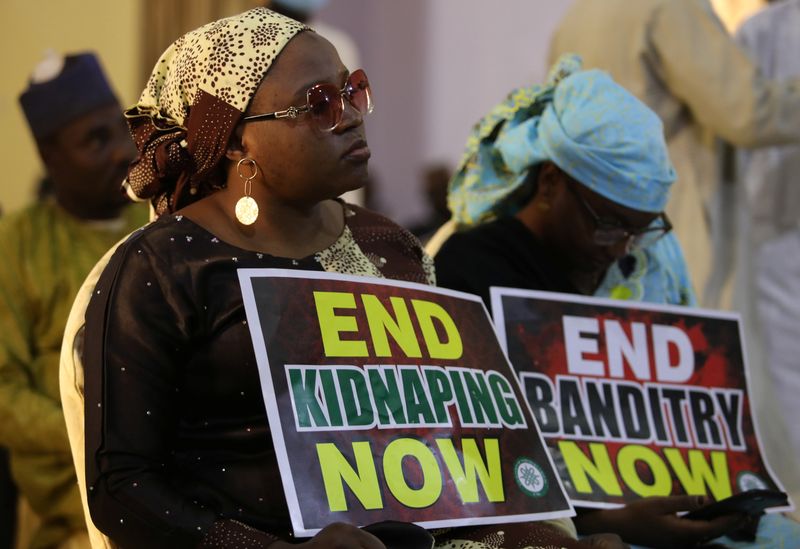
Security

Ribadu blames security personnel for arms sales to criminals

By Uzair Adam

The National Security Adviser (NSA), Nuhu Ribadu, has condemned policemen and soldiers for allegedly stealing and selling arms and ammunition from their units to criminal elements.

Speaking in Abuja on Thursday during the destruction of arms event organized by the National Centre for the Control of Small Arms and Light Weapons, Ribadu expressed concern over security agents involved in these activities, describing them as “worse human beings.”

He called for urgent measures to address the issue in order to restore peace and stability in the country.

Ribadu further denounced the actions of those facilitating the movement of weapons to terrorists, bandits, and other non-state actors, noting that many of the illicit arms used for crimes in Nigeria originally belonged to the government.

Nigeria continues to grapple with a range of security challenges, with insurgency, banditry, and violence affecting various parts of the country.

EFCC explains arrest of journalists at Enugu radio station

By Uzair Adam

On Monday, October 14, 2024, a team of officers from the Enugu Zonal Directorate of the Economic and Financial Crimes Commission (EFCC) visited Urban Radio 94.5FM, Enugu, to invite Favour Ekoh, the host of the station’s program Prime Time, for questioning.

Ekoh is under investigation for her alleged involvement in a N700 million Ponzi scheme that affected about 50 victims.

The victims claimed Ekoh enticed them to invest in “Life Trading,” a scheme run by Leverage Index Limited, where they were promised 10 percent returns on their capital after a set period.

However, after they invested, the company, located at No. 1 Colliery Street, Okpara Avenue, Enugu, shut down, leaving them without their capital or any promised returns.

The victims said Ekoh was their primary point of contact for the scheme.

Upon arriving at the radio station with an arrest warrant, EFCC officers identified themselves to the station’s Managing Director, Bamikole Owoyomi.

However, in an unexpected move, a staff member called the station’s Chairman, who ordered the gates to be locked, trapping the EFCC officers inside the building.

The officers then called for backup, which led to the arrest of Owoyomi, Ekoh, and two security guards for obstructing the EFCC’s duties.

Ekoh, who was trailed to the station as part of a sting operation to prevent her from evading arrest, was allowed to make a statement at the EFCC’s Enugu office and has since been released.

Owoyomi and the guards, who were initially detained for preventing the officers from carrying out their duties, also made statements and were later released.

In a statement, Dele Oyewale, Head of Media & Publicity for the EFCC, emphasized that the commission holds the media in high regard but criticized the actions of the station’s staff as unlawful and obstructive.

He called on the International Press Institute (IPI) and the Nigerian Union of Journalists (NUJ) to examine the station’s conduct and Ekoh’s professional ethics, given her involvement in the fraudulent scheme.

The EFCC clarified that no equipment at the station was damaged and that there was no disruption to the station’s lawful operations during the arrest.

Turji’s Accusations: Shocking truth or false claims? 

By Usman Abdullahi Koli, ANIPR 

In a dramatic move, Bello Turji, the notorious kidnapper and the most wanted bandit who has claimed responsibility for most prominent terrorist attacks in Northwest Nigeria, released a video clip where his deadly gang surrounded him and passed a vote of confidence in the Chief of Defense Staff (CDS), General Christopher Musa.

The terrorists described General Musa as their ‘leader’ “Shugaban mu mai albarka”, and suggested that he should grant Musa Asada (an Islamic scholar) a military or paramilitary appointment. Turji’s expression of loyalty to the military boss suggested an unofficial relationship between him and military insiders.

That aside, for now, Turji’s trending video clip is evidence of system failure, intelligence weakness, and political will to nail the enemies of the state. The military might be challenged, and a terrorist rubbished the ‘technological know-how’ of the giant.

His outlandish accusations sparked widespread debate and concern, with some on social media misinterpreting Turji’s words and using them to question the integrity of the Nigerian military, especially General Christopher Musa’s role in combating insecurity.

As a staunch advocate of good governance, I have long been calling on the government to take more decisive action against banditry, terrorism, and kidnapping. For the past five to six years, I have consistently raised awareness about the threats posed by these criminal elements to the safety and prosperity of Nigeria, particularly in the North. Unfortunately, much of this advocacy seems to have fallen on deaf ears as banditry continues to ravage communities. Nonetheless, I feel compelled to discuss the issue, especially to analyse the confusion and misinformation that Turji’s statements have caused.

Let it be clear that Turji’s claims are false, and the military has the responsibility of taming him. No evidence supportsthe insinuation that General Christopher Musa is associated with Turji or any criminal network. General Musa has been instrumental in Nigeria’s ongoing efforts to combat insecurity, including taking decisive action against high-profile criminals like Turji.

Since being appointed CDS, General Christopher Musa has demonstrated endless commitment to restoring peace and order in Nigeria. He has led several strategic military operations aimed at dismantling the networks of bandits, terrorists, and kidnappers that have terrorised communities across the country, especially in the Northwest. One of the most significant achievements under his leadership was the recent elimination of Halilu Sububu, a key figure in the banditry networks terrorising Zamfara and surrounding areas. Sububu’s death dealt a major blow to these criminal gangs, sending shockwaves through their ranks.

It is no coincidence that Turji, now cornered by relentless military pressure, has resorted to making baseless accusations against the institution that has been dismantling his operations. His statement is nothing more than a desperate attempt to divert attention from the military’s successes in combating his criminal activities. Turji, like other criminals of his kind, understands the power of propaganda and is trying to manipulate public perception by targeting prominent figures like General Musa.

Furthermore, Turji’s threats against notable voices such as Bulama Bukarti, Musa Asada, and Bello Yabo, three fearless advocates who have stood against his reign of terror, reflect his growing desperation. These individuals, alongside many others, have been instrumental in raising awareness about the accurate scale of banditry and advocating for more decisive government action to protect communities. Turji’s frustrations with these figures only further reveal the pressure he is under from public opinion and military action.

Despite these military gains, it is essential to recognise that Nigeria’s security challenges, particularly in the North, require more than just military action. The complexity of the insecurity crisis demands a comprehensive approach that includes social, economic, and political dimensions. The government must continue to invest in addressing the root causes of banditry, which include poverty, lack of education, and underdevelopment in many rural areas.

For the people of the Northwest, the situation has become unbearable. Many can no longer farm their lands, as bandits have taken control of vast territories, instilling fear in local communities. Despite having fertile land, farmers cannot plant crops because of the constant threat of violence. The government must prioritise providing immediate relief to these communities, ensuring they are protected and given the necessary resources to rebuild their lives.

In addition, efforts must be made to strengthen local intelligence networks, improve border security, and ensure that arms do not flow freely into the hands of bandits. Collaboration with neighbouring countries, particularly Niger and Chad, is crucial to stop the transnational flow of weapons and fighters. The government should also foster stronger partnerships with local vigilante groups, civil society organisations, and community leaders who have an intimate understanding of the terrain and the dynamics of banditry.

Nigerians must approach security issues with a balanced and informed perspective. We must avoid being swayed by the propaganda of criminals like Bello Turji, whose only objective is to sow discord and confusion. Rather than focusing on baseless accusations, we should channel our energy into supporting efforts to restore peace and security in affected regions.

General Christopher Musa and the entire military deserve our support as they continue to risk their lives to protect our nation. Their task is enormous, and while there may be challenges along the way, there is no doubt that significant progress is being made. The military’s recent successes, such as the killing of Halilu Sububu, prove that with the right strategy, it is possible to turn the tide against insecurity.

Bello Turji’s recent comments are nothing more than the desperate outbursts of a criminal whose days are numbered. His attempts to drag General Christopher Musa and other figures into his web of lies should be seen as a distraction. Under General Musa’s leadership, the Nigerian military has made notable strides in combating banditry and terrorism, and we must continue to support their efforts.

At the same time, we must recognise the urgency of the situation in the Northwest and other affected regions. A holistic approach that addresses both the security and developmental needs of these communities is essential for lasting peace. Only through a combination of military action, community engagement, and sustained government investment can we finally put an end to the scourge of banditry, terrorism, and kidnapping in Nigeria.

Usman Abdullahi Koli wrote via mernoukoli@gmail.com.

I Inherited Nigeria with damaged security from Buhari—Tinubu

By Abdullahi Mukhtar Algasgaini 

President Bola Tinubu says he inherited a country with damaged security from his predecessor, former President Muhammadu Buhari. 

In his Independence Day speech, Mr. Tinubu said he took over the leadership of Africa’s most populous country at a “critical juncture.” 

“My administration took over the leadership of our country 16 months ago at a critical juncture. The economy faced many headwinds, and our physical security was highly impaired,” Mr. Tinubu said. 

The president also said Nigeria was imbalanced when he assumed office on May 29, 2023.

However, his government decided to pursue reforms in both Nigeria’s economy and its security. 

“We found ourselves at a dizzying crossroads, where we must choose between two paths: reform for progress and prosperity or carry on business-as-usual and collapse. We decided to reform our political economy and defence architecture.” 

In the sixteen months since Mr. Tinubu took office, bandits and Boko Haram terrorists have continued their nefarious activities in the northern part of Nigeria, kidnapping for ransom and killing. 

Spiking food prices caused by economic inflation have forced Nigerians to hit the streets in protest as the unprecedented cost-of-living crisis takes a dreadful trajectory under Tinubu’s watch.

From love to labor: how relatives become oppressors

By Fatima Musa Yakubu

Family is often called the best gift of life, a place of love and care. Living with family should feel like a blessing, even when some members are so strict.

Parents, even when they are tough, love their children and want the best for their future. As the 12th child in a family of eighteen, I was surrounded by my brothers and sisters. We laughed, played, argued and shared meals together. It was very cheerful and happy moments which I didn’t fully value and appreciate—until I when lost it.

Everything changed when my aunt’s husband died. In Islam, a widow must stay inside her home for 4 months and 10 days, only leaving for exceptionally important excuses. Since my aunt had no children, my grandmother decided I should stay with her to keep her company. I was excited at first, imagining that I would be treated with kindness and have meals all to myself. I couldn’t have been more wrong.

One Saturday morning, after prayers, I wasn’t feeling well and decided to rest. Suddenly, a sharp slap landed on my face. My aunt, angry for reasons I didn’t know or understand, dragged me out of the bed and beat me badly. Then, she told me my new daily tasks: fetching water from a faraway well, washing dishes, clothes and her car, and sweeping the compound—all before 10am. I was only ten years old then.

According to a report by the International Labour Organization (ILO), more than 15 million children in Nigeria are forced into child labor. Many of these children, like me, are treated unfairly in their own homes by relatives. Instead of going to school, we do heavy chores and endure painful experiences. I was taken out of school for years and suffered in silence.

I wanted to tell my parents about my aunt’s behavior, but I was too afraid. She threatened me, and I feared what she would do if I spoke up. When I made her angry, she beat me with a copper wire, hit my head against the wall or dragged me across the floor. Sadly, this kind of abuses happen to many children living with relatives.

A UNICEF report says that nearly 60% of children in Nigeria who live with extended family face some kind of abuse, often hidden as “discipline.”

Life with my aunt wasn’t just about hard work—it was lonely. I felt isolated and scared all the time. Meanwhile, I watched other children in my neighborhood, also living with relatives, being treated like with kindness of a family. One girl, who I thought was living with her parents, was actually staying with her guardians. They treated her like a queen, sending her to the best school and giving her everything she needed. It was painful to see such a difference.

My suffering ended when I turned fifteen. My aunt, who had treated me like a servant, passed away after falling sick with typhoid. Even7though she hurt me, I felt sad when she died. Over time, I learned to forgive her. As Maya Angelou once said, “We often forgive those who have wronged us, not for their sake, but for our own peace.” This has been true for me.

Today, I am grateful to be alive and well. I am happily married, with two children, and I have returned to school to continue my studies. Looking back, I realize that after every hardship, relief eventually comes. My story is just one example of many.

In Nigeria, more than 7 million children live with extended family due to poverty, loss of parents, or other reasons. Many of them suffer, just like I did. Unfortunately, their stories often remain unheard. According to Human Rights Watch, abuse of children living with relatives is a big problem that needs more attention.

I am sharing my story to let others know that this issue is real and must be addressed. Children who live with relatives deserve the same love and care that their own parents would give them. The Nigerian government and organizations fighting for children’s rights must do more to protect these vulnerable children. Laws against child abuse need to be enforced, so no child has to suffer in silence like me.

To my readers, remember this: after every storm, there is calm. If you are going through a tough time, hold on, relief will come. And for those who can help, we must speak up for children who cannot defend themselves. Every child deserves a life without fear.

Fatima Musa Yakubu writes from the Department of Mass communication,
Bayero University, Kano, Nigeria.

Matawalle’s controversies and gains in the defence sector

By Haroon Aremu Abiodun

As they say, “Uneasy lies the head that wears the crown,” but Bello Matawalle, appointed by President Bola Ahmed Tinubu as Minister for State Defence in 2023, has risen to the challenge. His tenure in office so far is marked by a blend of persistent controversies and significant achievements, with the latter shining a bright light on his leadership and the impact of his decisions.

As Governor of Zamfara state, Matawalle was reported to have taken stringent measures against banditry and insurgency, which led to some success in the fight against terrorism in the Northwestern region.

As such, it is not surprising that he and Mohammed Badaru Abubakar, another former governor of Jigawa State, were appointed Ministers to supervise the defence sector.

This feat was accomplished through military precision and a strategic, forward-thinking focus on infrastructure revitalisation. Their joint efforts led to the rehabilitation of military barracks nationwide, improving the living conditions for soldiers and their families—a clear demonstration of their commitment to the military’s welfare and the future of Nigeria’s defence sector.

A recent major highlight of Matawalle’s leadership was his role in revitalising Nigeria’s defence infrastructure. He worked closely with the Defence Industries Corporation of Nigeria (DICON) and the National Agency for Science and Engineering Infrastructure (NASENI) to establish a domestic arms and ammunition production facility.

This initiative is projected to save Nigeria $60 million annually by reducing the need to import military hardware, marking a significant step towards self-reliance in defence production.

Matawalle’s focus on defence sector reforms to improve efficiency has also caught attention. His reforms are designed to build a more resilient military by streamlining procedures and holding the system accountable.

One of Matawalle’s standout initiatives was his hands-on approach to addressing the grievances of military personnel. His open engagement with soldiers about delayed allowances and welfare issues demonstrated a rare willingness to tackle the heart of the defence system’s morale, evoking empathy for the soldiers and their struggles.

Despite these accomplishments, Matawalle’s tenure has not been without its controversies. Allegations of corruption and mismanagement, along with disputes over his qualification to run the defence ministry, continue to cloud his leadership. Critics question whether these shadows will define his legacy or if his achievements will ultimately shine through.

Born on February 12, 1969, in Maradun, Zamfara State, Matawalle’s educational background includes studies at Yaba College of Technology and the University of West London. His journey from a teacher to a politician has been marked by resilience and a steadfast commitment to public service.

After a successful stint in the Zamfara State House of Assembly during the Abacha regime, he served as a state commissioner before being elected to the House of Representatives in 2003. His political career reached new heights in 2019 when he became the Governor of Zamfara State following a Supreme Court ruling that disqualified the supposed winner.

During his tenure as governor, Matawalle made efforts to address the rampant insecurity in Zamfara State, a region plagued by banditry and violence. He initiated dialogue with various armed groups and made efforts to implement infrastructural projects across the state, including constructing governor’s lodges in all 14 Local Government Areas (LGAs) of Zamfara.

Matawalle’s career reflects a blend of determined public service and significant scrutiny, particularly regarding his financial decisions as governor.

A fanatical loyalist of President Bola Ahmed Tinubu, Matawalle’s leadership in various capacities during this period laid the groundwork for his current role in national defence, where he continues to confront external threats and internal controversies.

Matawalle must prioritise transparency and communication to secure his legacy, ensuring the public understands his decisions and reforms. His continued focus on the welfare of soldiers and veterans, alongside his strategic defence initiatives, will be crucial in determining whether his story will be one of triumph or a missed opportunity.

The final chapter of Bello Matawalle’s legacy is still being written. The world watches as he walks the fine line between triumph and turmoil. Will he be remembered as a transformative leader, or will the crown’s weight prove too much?

His legacy teeters on the edge, and only time will reveal whether his story is one of greatness or missed opportunity.

Haroon Aremu Abiodun is a Mass Communication graduate and a corps member with PRNigeria Center, Abuja. He can be reached at exponentumera@gmail.com.

Alleged support of bandits: Time to investigate Bello Matawalle

By Prof. Abdussamad Umar Jibia

On the 10th of June 2020 at about 5 pm, armed bandits stormed Kadisau village of Faskari Local Government Area of Katsina State. The bandits, who came on dozens of motorcycles, opened fire on the villagers, killing anyone unable to escape alive. Fifty-seven people, including men, women and children, were killed in the operation that lasted four hours with no intervention from Federal security forces, who were said to be on the highway 5 kilometres away. The criminals later moved to nearby villages, where they killed an additional 30 people.

Ado Aleru, a well-known bandit commander in Zamfara state, led the bandits. Katsina state police command later declared Ado Aleru wanted and put a price of five million Naira on his head.

Two years later, precisely on Saturday, 16th July 2022, Nigerians were shocked to hear that the man responsible for the murder of innocent Nigerian women and children was turbaned with a traditional title in Zamfara state. 

The turbaning of Aleru was a gathering of some of the most deadly criminals responsible for acts of terror in the Northwestern and North central geopolitical zones of Nigeria. On the ground to witness the ceremony were officials of the Zamfara State Government, including the state Commissioner of internal security. In other words, the turbaning was done with the knowledge and approval of the State Government under Governor Bello Matawalle. Surprisingly, some senior police officers graced the occasion without arresting the person they declared wanted two years earlier.

Soon after the ceremony, the Katsina State Government under Aminu Bello Masari indicated its disapproval of the chieftaincy title conferred on the criminal. It maintained that it was still looking for Ado Aleru.

Years later, nothing changed. The centre remained weak, and life continued. However, the people of Zamfara did what was needed by voting Matawalle out of power in the 2023 election.

If the only atrocity the former Governor of Zamfara State committed was facilitating the conferment of a traditional title to such a deadly criminal, he deserves retirement from Nigerian politics and prosecution after office. Alas! He was rewarded with a ministerial position in the ministry that is supposed to rid Nigeria of terrorists like Ado Aleru. Only in Nigeria. Allah Ya sauwake.

Recently, additional allegations have been made about how the then-governor of Zamfara state hobnobbed with bandits and supported them with the lean resources of the Zamfara people. I am referring to a viral video of a Sokoto-based Islamic Scholar, Sheikh Murtala Bello Asada. Asada, who claimed that he had incontrovertible evidence on all his claims against the former Governor, challenged Matawalle to take him to court. 

Among the allegations Sheikh Asada made against Matawalle is his support of one Haruna Dole. According to Asada, Haruna, a famous bandit kingpin with more than 500 rifles under him, was arrested and taken to Police Headquarters Abuja. Sheikh Asada added that Bello Matawalle, as the Governor of Zamfara state, made a phone call and asked for Dole’s release. The criminal was released to one Bashar, who signed and received the bandit on behalf of Governor Matawalle. He said the document carrying Bashar’s signature and picture would still be available at the Force Headquarters.

According to Sheikh Asada, Matawalle is also a friend of the dreaded bandit Bello Turji. Asada mentioned a visit Turji paid to Zamfara State Government House when Matawalle was Governor. Turji had lunch with the governor, who served him personally. Later, the governor gave him an undisclosed amount of cash and allowed him to return to the bush to continue his criminal activities.

Another bandit kingpin who was friends with Matawalle was Chedi. According to Asada, Matawalle bought a house for Chedi in the Gidan Dutse quarters of Gusau. Uncomfortable with it, residents of Gusau protested and made a mob attack on Chedi and ended his life. Matawalle then ordered the arrest of several people. On the day of their arraignment, overwhelming crowds of Gusau people stormed the court, and Matawalle had no choice but to order the release of the people. It ended there.

In addition to all these, Sheikh Asada listed some criminals who allegedly received Hilux operational vehicles from Matawalle when he was Governor. They include Turji, Aleru and Halilu Sububu.

The allegations are weighty and sum up to one thing: the current Minister of State of Defence deployed to the North West by President Bola Ahmed Tinubu to fight banditry, an alleged friend of bandits who supports them financially.

The position of anybody interested in protecting the lives and property of Nigerians would be clear. Mr President should investigate these allegations and, if found true, prosecute the former Governor. Yes, allegations are allegations until they are investigated and found to be true. But if the Nigerian government refuses to conduct a transparent investigation, what would prevent Nigerians from believing them?

But even as investigations are carried out, Mr Matawalle has no business remaining in the Ministry of Defence. Maybe another ministry.

If the executive branch is not ready to take action, where is our National Assembly? Do they believe these allegations against a government official in charge of fighting security are not serious? Go figure!

Professor Abdussamad Umar Jibia wrote from Kano via aujibia@gmail.com.

NNPCL and Dangote refinery: whom will Nigerians trust?

By Ibrahim El-Caleel

This press release shows that Dangote Refinery is also enjoying the whole petroleum industry ruse and elongating it. NNPC said they bought your petrol at N898. Instead of this press statement to deny it, you simply tell the public the actual price you sold it to them.

For example, “We didn’t sell petrol at N898 to NNPC. We sold it to them at N619”. Is this too difficult to do or unethical?

When you do this, then let the NNPC come and deny it; then you take the next step by publicly sharing a sample of the invoice where they bought it at N619 from Dangote Refinery. This is what transparency means.

But how do you expect people to believe this? Why should people trust Dangote Refinery and not NNPC? Both DR and NNPC are only making statements; they go explain taya, no evidence. Where is the invoice?

The petroleum industry in Nigeria lacks transparency. Nobody wants to let Nigerians understand what is going on so that they can start asking the right questions. They are leaving everyone in the dark so that immediately you say anything, they will mock you that you don’t understand anything; you are a layman who doesn’t understand anything about the oil business! Yet, you are the same layman buying the petrol which fuels the industry.

What Dangote Refinery is doing at the moment is just a glorified, or let me say corporate “DM for price”. It’s the same “DM for price” that BUA Cement did one time saying it has reduced the price of cement without giving any details on how much was the initial price before they “reduced” it.

Hello DR, NNPC,

Price is not a trade secret, geniuses! If you are hiding the price of your product, then there is something shady you are doing. How can you be doing a “DM for price” strategy for a global commodity like petrol? It takes me just a click to know the price of a barrel of crude oil in the global market, same thing for an ounce of gold. What is so special about the price of the Nigerian refined petrol that you need to keep it a secret?

Anyway, lemme mind my business. You know over the last few weeks I decided to give up on my self-assigned goal of understanding the petroleum industry. I only drive into a filling station and buy petrol according to what I can afford at the time. How the petrol got there ain’t really any of my business any longer. I don’t care. When we all become tired of the nonsense going on in Nigeria one day, I am sure we will come and agree on the way forward. I am very sure this nonsense cannot continue to happen forever. It will end one day.

CDS Musa gifts N1m to troops for eliminating bandits’ leader in Zamfara

By Sabiu Abdullahi 

The Chief of Defence Staff, General Christopher Musa, has announced a cash reward of N1 million for the troops involved in a recent operation in Zamfara State that resulted in the elimination of notorious bandit leader Halilu Sububu Buzu. 

The operation, carried out by troops from the Joint Task Force Northwest Operation Hadarin Daji (OPHD), was a significant success, with the troops displaying bravery and precision in neutralizing Buzu and several of his fighters.

The operation also resulted in the recovery of weapons and motorcycles. General Musa praised the troops for their dedication and excellence, stating that the reward was a way to honor their service.

The operation is seen as a major blow to the bandit group’s operational capabilities and underscores the Nigerian military’s efforts to combat terrorism in the region. 

This success comes on the heels of a recent attack by the same group, which blocked the Gusau-Funtua highway in Zamfara State and abducted several travelers. The police are still working to determine the exact number of those kidnapped.

FG takes steps for return of Niger IDPs – Shettima

By Uzair Adam

The Vice President, Senator Kashim Shettima, has announced that the federal government is implementing measures to ensure the return of residents displaced by insecurity and floods in Niger State.

Speaking during a visit to an Internally Displaced Persons (IDP) camp in Gwada, Shiroro Local Government Area, Shettima expressed the administration’s commitment to alleviating the suffering of affected individuals.

He stated that his visit was a directive from President Bola Ahmed Tinubu to assess the conditions of the displaced residents and assure them of government support.

The Vice President also launched the distribution of relief materials at the camp, highlighting that each state had received N3 billion to address the impacts of floods and security challenges.

Shettima emphasized that states like Niger, Borno, Sokoto, Bayelsa, and Jigawa, which have been significantly affected by these crises, would receive additional support from the federal government.

He called on citizens and organizations to assist the government in providing relief to those affected by disasters across the country.

The Vice President was joined by other key officials, including the Minister of Information and National Orientation, Mohammed Idris, and the Minister of State for Agriculture, Senator Aliyu Sabi.

Niger State Governor, Mohammed Umaru Bago, disclosed that 14 out of the 25 local government areas in the state had experienced flooding this year, resulting in loss of lives and property.