News

BUK hosts NERDC executive secretary, scholars on curriculum, prospects of history’s return to schools

By Uzair Adam

Bayero University, Kano (BUK), on Thursday hosted a public lecture on the reintroduction of History into Nigerian schools, highlighting the issues, challenges and prospects associated with the subject’s return to the national curriculum.

The Daily Reality reports that the Executive Secretary of the Nigerian Educational Research and Development Council (NERDC), Professor Salisu Shehu, served as Chairman of the Occasion.

The lecture, titled “The Return of History in Nigerian Schools: Issues, Challenges and Prospects,” was organised by the Department of History under the Faculty of History and Development Studies.

Dr. Nanre Nafziger, an Assistant Professor of Black and African Studies at McGill University, Canada, delivered the lecture, offering a conceptual explanation of History and its relevance to human and societal development.

In her presentation, Nafziger said History extends beyond common assumptions that limit it to the narration of events, wars or prominent individuals, stressing that it examines how the past shapes the present and how the present influences the future.

She explained that historical knowledge is grounded in patterns and processes that emerge from human and societal evolution, adding that History addresses causation, time, space, consequences and the impact of both human and natural phenomena.

According to her, the discipline also encompasses peoples, communities, societies, geopolitical territories, empires, states and nationhood, as well as norms, values, cultures, traditions and civilizations.

Nafziger noted that History is closely connected to institutions such as politics, the economy, education and technological development, arguing that this interconnectedness makes it a fundamental component of educational content at designated levels.

She said the renewed emphasis on History in Nigerian schools was informed by these considerations, alongside the need to transform and update educational curricula.

Under the revised curriculum, Nafziger explained, History will be taught as a stand-alone subject at the primary level from Primary One to Six, as well as at Junior Secondary School levels One to Three.

At the senior secondary level, she added, History will be infused into compulsory subjects, including Citizenship and Heritage Studies.

She further stated that the new History curricula were developed using new approaches and feature elements that are development-focused, context-sensitive, competency- and outcome-based, thematic and spiral in structure, as well as aligned with 21st-century educational standards.

The public lecture attracted academics, students and other stakeholders, and formed part of ongoing discussions within the academic community on the role of History in national education and development.

Despite peace agreement, bandits raid Katsina community, burn down homes, vehicles

By Sabiu Abdullahi

Residents of Doma community in Faskari Local Government Area of Katsina State have been thrown into renewed fear after armed bandits carried out a fresh attack on the area, despite a peace and surrender agreement earlier reached between local authorities and armed groups operating there.

It was gathered on Tuesday that the attackers arrived in Doma in large numbers, opened fire on residents, and set several houses and vehicles on fire.

According to a report by an online Nigerian newspaper, SaharaReporters, the incident has unsettled the community, especially as it came after a reported peace agreement between stakeholders in Faskari Local Government Area and bandit leaders. The deal was expected to end hostilities and encourage displaced residents to return to their homes.

A Katsina-based security expert, Bakatsine, confirmed the development and warned that the attack was still ongoing in Doma and nearby communities within Faskari LGA.

Bakatsine raised concerns over the safety of civilians and appealed for immediate security intervention in the area.

“Urgent deployment of security forces is needed to Doma and surrounding communities in Faskari LGA to protect civilians, stop the ongoing violence, and prevent further loss of lives and property,” the alert stated. “Immediate action could save lives.”

At the time of filing this report, there were concerns that casualties may have been recorded. However, the exact number of those killed or injured could not be independently verified.

Faskari Local Government Area remains one of the areas most affected by insecurity in Katsina State, with years of persistent bandit attacks, kidnappings, cattle rustling, and large-scale displacement of residents.

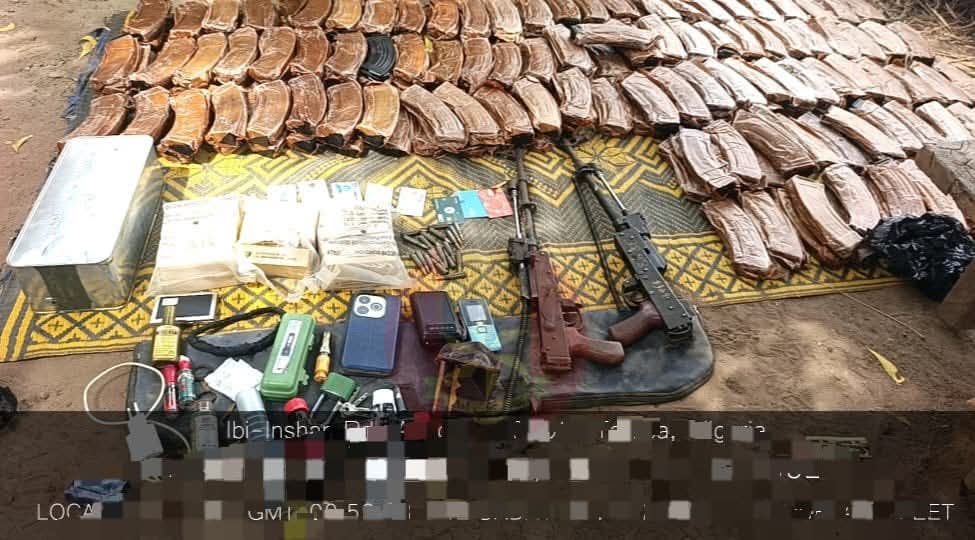
On September 17, 2025, SaharaReporters reported that a known bandit commander, Isya Akwashi Garwa, who was armed with an AK-47 and ammunition, released 28 abducted persons in the local government area after a peace arrangement.

Those released were mostly residents of Mairua, Kanen-haki, and Yar Dabaru communities, who had spent weeks in captivity.

Local authorities later confirmed that the release followed reconciliation efforts aimed at restoring peace and reducing violence in the area.

A security source, Zagazola Makama, also revealed on X that community leaders in Faskari welcomed the development and described it as a positive step. They urged all parties involved to sustain the “peace process.”

The leaders also appealed to the bandit commander to persuade other armed groups still carrying out attacks in the area to lay down their arms and embrace peace.

DSS arraigns ex-AGF Malami, son over terrorism financing, illegal firearms possession

By Sabiu Abdullahi

The Department of State Services (DSS) on Tuesday arraigned former Attorney General of the Federation and Minister of Justice, Abubakar Malami (SAN), alongside his son, Abdulaziz Abubakar Malami, at the Federal High Court in Abuja. They face allegations of terrorism financing, aiding and abetting terrorism, and unlawful possession of firearms and ammunition.

The defendants appeared before Justice Joyce Abdulmalik, who was presented with a five-count criminal charge filed by the DSS under the Terrorism (Prevention and Prohibition) Act, 2022, and the Firearms Act, 2004.

Court documents revealed that Malami, Nigeria’s chief law officer until 2023, was charged solely under Count One, while both he and his son were jointly charged under Counts Two to Five, all relating to illegal possession of firearms and ammunition.

Count One alleges that in November 2022, at the Federal Ministry of Justice in Abuja, Malami knowingly abetted terrorism financing by refusing to prosecute suspected terrorism financiers whose case files had been submitted to his office. The offence is said to violate Section 26(2) of the Terrorism (Prevention and Prohibition) Act, 2022.

Counts Two to Five accuse the father and son of preparatory acts of terrorism and illegal possession of firearms and ammunition without a licence. According to the DSS, in December 2025, at their residence in Gesse Phase II, Birnin Kebbi Local Government Area of Kebbi State, the defendants were found with a Sturm Magnum 17-0101 firearm, sixteen live Redstar AAA 5’20 cartridges, and twenty-seven expended Redstar AAA 5’20 cartridges.

Count Two states that the possession of the firearm and ammunition without a licence was preparatory to committing an act of terrorism, contrary to Section 29 of the Terrorism (Prevention and Prohibition) Act, 2022. Count Three alleges unlawful possession of the Sturm Magnum firearm without a licence, contrary to Section 3 of the Firearms Act, 2004. Counts Four and Five charge the defendants with illegal possession of sixteen live rounds and twenty-seven expended cartridges respectively, contrary to Section 8(1) of the Firearms Act, 2004.

When the charges were read in court, both Malami and his son pleaded not guilty to all five counts.

Following the plea, DSS counsel Dr. C.S. Eze requested that the defendants be remanded in DSS custody pending trial, citing the seriousness of the offences and the provisions of the relevant laws. Lead defence counsel S.A. Alua, SAN, applied orally for bail, arguing that the defendants were entitled to it pending trial.

Justice Abdulmalik declined the oral application, noting that the Federal High Court can only consider a properly filed written application for bail. The trial judge adjourned the matter to February 20 for hearing on the bail application and possible commencement of the trial.

The charges, as read in court, include:

“That you, Abubakar Malami of Gesse Phase II Area, Birnin Kebbi LGA, Kebbi State, Adult, male, sometime in November, 2022 at Federal Ministry of Justice, Maitama, Abuja, within the jurisdiction of this honourable court, did knowingly abet terrorism financing by refusing to prosecute terrorism financiers whose casefiles were brought to your office as the Attorney-General of the Federation, for prosecution, and thereby committed an offence contrary to and punishable under Section 26 (2) of Terrorism (Prevention and Prohibition) Act, 2022.”

“That you Abubakar Malami and Abdulaziz Abubakar Malami… did engage in a conduct in preparation to commit act of terrorism by having in your possession and without licence, a Sturm Magnum 17-0101 firearm, Sixteen (16) Redstar AAA 5°20 live rounds of Cartridges and Twenty-Seven (27) expended Redstar AAA 5’20 Cartridges, and thereby committed an offence contrary to and punishable under Section 29 of Terrorism (Prevention and Prohibition) Act, 2022.”

“That you… did have in your possession a Sturm Magnum 17-0101 firearm, sixteen (16) Redstar AAA 5’20 live rounds of cartridges, and twenty-seven (27) expended Redstar AAA 5’20 cartridges, all without licence, contrary to the Firearms Act, 2004, and punishable under Section 27 (1) of the same Act.”

US Congressman Riley meets Plateau governor, thanks him for “protecting Christians, other vulnerable population in Middle Belt”

By Sabiu Abdullahi

US Congressman Riley M. Moore on Wednesday expressed his honor at meeting with the Governor of Plateau State, Caleb Mutfwang, during a visit.

This is contained in a Facebook post by the congressman today Tuesday.

Moore described the meeting as “meaningful and productive,” highlighting discussions on strengthening the relationship between the United States and Nigeria.

The Congressman reiterated his commitment to collaborating with the Nigerian government to tackle security and economic challenges.

He specifically addressed the plight of Christian communities facing persecution in the region, saying, “God bless you, Governor, for what you do to protect Christians and other vulnerable populations in the Middle Belt.”

The visit comes amid recent debates in Nigeria over claims of a so-called “Christian genocide.” Critics of the term have pointed out that attacks in the country affect people of all religious backgrounds, and that the notion of genocide against Christians is misleading.

Analysts argue that violence in Nigeria’s Middle Belt is often driven by banditry, herder-farmer conflicts, and other socio-economic factors, rather than targeting any single religious group.

Moore’s engagement shows ongoing diplomatic interest in supporting communities facing violence, while navigating the complex realities of Nigeria’s multi-religious society.

French authorities raid X headquarters, summon Elon Musk for questioning

By Sabiu Abdullahi


French prosecutors have raided the Paris headquarters of Elon Musk’s social media platform, X, and summoned the tech billionaire and the company’s former chief executive for questioning as part of an expanded cybercrime investigation.

The Paris prosecutor’s office confirmed the development in a post on X on Tuesday, stating: “A search is under way by the cybercrime unit of the Paris prosecutor’s office, the national police cyber unit and Europol.” The office added that it would no longer publish content on the platform.

In a separate statement, prosecutors said Musk and former X chief executive Linda Yaccarino had been invited for voluntary questioning “in their capacity as de facto and de jure managers of the X platform at the time of the events.” Yaccarino stepped down from her role in July last year.

According to the prosecutor’s office, investigators are examining “alleged complicity” in several offences linked to activities on the platform. These include the spread of child abuse images and sexually explicit deepfakes, the denial of crimes against humanity, and the manipulation of an automated data processing system within an organised group.

The investigation began in January last year after a complaint was filed by a centre-right French MP, Éric Bothorel. He alleged that biased algorithms on the platform may have distorted its data processing system and influenced the type of content recommended to users.

Bothorel had earlier raised “deep concern” over “recent algorithm changes” and “apparent interference in [X’s] management” following Musk’s takeover of the company in 2022. Other complaints claimed the changes triggered an increase in what was described as “nauseating political content.”

Prosecutors later widened the scope of the inquiry after reports criticised the conduct of X’s artificial intelligence chatbot, Grok. The reports alleged that the chatbot engaged in Holocaust denial and circulated sexually explicit deepfakes.

X was approached for comment following Tuesday’s raid. The company had previously stated last summer that it did not plan to comply with the demands of French authorities linked to the inquiry, which it described as “politically motivated.” It also rejected claims of algorithm manipulation and “fraudulent data extraction.”

The platform further argued that the investigation was “distorting French law to serve a political agenda, and ultimately restrict free speech.” It said it remained committed to “defending its fundamental rights, protecting user data and resisting political censorship.”

Police in Sokoto arrest suspected bandits’ Informants, financiers

By Sabiu Abdullahi

The Sokoto State Police Command has arrested suspected informants and financiers linked to bandit activities during a security operation in parts of the state, with several rustled cattle recovered.

Details of the arrests were made public in a post shared on X on Tuesday by security analyst Zagazola Makama. According to the post, the operation took place in the early hours of Monday at about 1:00 a.m. in Sarma Village, Tangaza Local Government Area.

Makama said operatives of the Sokoto State Police Command, in collaboration with members of the community guard, carried out the intelligence-led raid, which led to the arrest of two suspects identified as Nura Dan Haruna, 20, and Buhari Salah, 18.

The suspects were found with seven cows suspected to have been stolen, as well as a motorcycle without a registration number.

Makama reported that preliminary findings showed the suspects were acting on instructions from two other individuals who remain at large.

“The suspects confessed they were sent by two individuals, Abdullahi Gulum and Dan Iko, who are currently on the run, to deliver the cows to Hamza Ibrahim, 56, of the Kara area in Illela,” Makama wrote.

He added that police later arrested Hamza Ibrahim in connection with the case.

“Hamza was later arrested by the police,” Makama wrote.

Further inquiries by the police also uncovered that Hamza Ibrahim admitted to selling two of the cows last month to Abubakar Muhammad, 31, from Gwadabawa Local Government Area. Police confirmed that Abubakar Muhammad has also been arrested.

Authorities said investigations into the case are continuing, while efforts have been stepped up to track down and arrest the remaining suspects linked to the alleged bandit network.

Wedding clash in Gombe leaves one dead, police launch manhunt for suspects

By Sabiu Abdullahi

One person has been confirmed dead while several others sustained injuries after a violent clash disrupted a wedding event in Tulmi, Akko Local Government Area of Gombe State.

Details of the incident emerged in a post shared on X on Tuesday by security analyst Zangozola Makama. According to the post, the violence broke out on Sunday at about 10:30 p.m. during a send-off ceremony organised in honour of a wedding by Godiya Mai Rai.

Makama stated that the fight involved a group of men from Garin Ardo Usman village and two other individuals at the venue.

“A group of men from Garin Ardo Usman village, including Wada Hussaini, Ganji Alhaji Idi, Yaya Hussaini, Mohammed Maikudi, Bello Alhaji Idi, and one Tijjani, reportedly clashed with Abubakar Usman, 35, and Bello Adamu, 19,” Makama wrote.

The confrontation resulted in the death of Abubakar Usman, while Bello Adamu and Wada Hussaini sustained varying degrees of injuries.

Sources said the injured victims were taken to Cottage Hospital Tulmi for medical attention. The body of the deceased was also deposited at the hospital’s mortuary.

Police authorities confirmed that the suspects escaped from the scene after the incident. They added that efforts are underway to track down and arrest those involved.

An investigation has also commenced to determine the circumstances that led to the deadly clash.

Clintons agree to testify as House moves toward contempt in Epstein probe

By Sabiu Abdullahi

Former U.S. President Bill Clinton and former Secretary of State Hillary Clinton have agreed to testify before the House Oversight Committee as part of its investigation into convicted sex offender Jeffrey Epstein, after lawmakers initiated steps to hold them in criminal contempt of Congress.

The development followed mounting pressure from the committee, which accused the Clintons of attempting to avoid accountability. In a post on X, the committee said the pair were “trying to dodge contempt by requesting special treatment,” while stressing that “The Clintons are not above the law.”

Confirmation of their appearance came from Angel Ureña, deputy chief of staff to Bill Clinton, who also posted on X.

“They negotiated in good faith. You did not,” Ureña wrote. “But the former president and former Secretary of State will be there and look forward to setting a precedent that applies to everyone.”

The House Oversight Committee is examining what the Clintons may have known about Epstein and his longtime associate, Ghislaine Maxwell. The inquiry also focuses on Hillary Clinton’s role in supervising U.S. efforts against international sex trafficking during her tenure as secretary of state.

According to a source familiar with the matter, the Clintons’ legal team sent an email to the committee confirming their willingness to testify under conditions outlined by Chairman James Comer of Kentucky.

“Please be advised, and please advise the Chairman, that my clients accept the terms of your letter and will appear for depositions on mutually agreeable dates,” the message stated. “As has been the Committee’s practice, please confirm the House will not move forward with contempt proceedings, as the Chairman stated in his letter this morning.”

Rep. Robert Garcia, the committee’s ranking Democrat, said the communication showed full compliance with the panel’s demands.

“I mean, they sent us and the Republicans affirmation that they’ve accepted every single term that James Comer has asked for, and that they’re willing to come in and testify,” Garcia said.

Chairman Comer, however, disagreed with that assessment. He told Fox News Digital that the response lacked clear details.

“The Clintons’ counsel has said they agree to terms, but those terms lack clarity yet again, and they have provided no dates for their depositions,” Comer said. “The only reason they have said they agree to terms is because the House has moved forward with contempt. I will clarify the terms they are agreeing to and then discuss next steps with my committee members.”

Following the Clintons’ decision, the House temporarily paused efforts to hold them in contempt. The House Rules Committee had been preparing to advance contempt resolutions but reversed course late Monday night. It remains uncertain when, or if, those proceedings will resume.

Democratic members of the committee have also criticized Comer, noting that he has not pursued contempt actions against other witnesses who failed to appear. They further pointed out that no similar threats were made against the Department of Justice, despite its failure to deliver all Epstein-related documents by a congressional deadline. So far, only a portion of the expected records has been released.

The investigation continues as the committee weighs its next steps in the high-profile case.

Report warns half of Nigerian hospitals cannot adequately treat snakebite victims

By Sabiu Abdullahi

A new global report has revealed that at least half of health facilities in Nigeria lack the capacity to properly treat snakebite envenoming, raising concerns over avoidable deaths and long-term disabilities across the country.

The report was released by the Strike Out Snakebite (SOS) initiative to mark World Neglected Tropical Diseases (NTDs) Day 2026, observed annually on January 30. It identified weak health systems, poor infrastructure and persistent shortages of life-saving antivenom as major drivers of snakebite deaths, particularly in high-burden countries such as Nigeria.

The findings were drawn from a survey involving 904 frontline healthcare workers in Nigeria, Brazil, India, Indonesia and Kenya, countries that account for a significant share of the global snakebite burden.

According to the report, 50 per cent of health workers said their facilities lack full capacity to manage snakebite cases, while 99 per cent reported difficulties administering antivenom, which the World Health Organisation recognises as the only essential treatment for snakebite care.

Nigeria’s situation was described as especially severe, with 98 per cent of surveyed healthcare workers reporting challenges in administering antivenom.

“Nigeria is home to 29 species of snakes, nearly 41 per cent of which are venomous, yet many victims still struggle to access timely medical care,” the report stated.

Healthcare workers surveyed identified urgent needs that include improved access to care, higher-quality antivenom, stronger regulation, expanded training and wider community education to reduce risky behaviour.

The report highlighted “delays in patients arriving at health facilities (57 per cent), poor infrastructure and inadequate equipment (56 per cent), and lack of training and clinical guidelines (42 per cent) as key factors contributing to avoidable deaths and disabilities.”

The findings come amid public outrage over the death of Abuja-based music talent, Ifunanya Nwangene, who reportedly visited two hospitals that could not administer antivenom before she died.

The report further showed that 35 per cent of healthcare workers experience daily shortages of antivenom, while more than 77 per cent reported life-threatening delays in treatment because victims often seek traditional remedies first.

In addition, 44 per cent of respondents said avoidable delays have led to amputations or major surgeries, outcomes that frequently push affected families into deeper poverty.

Snakebite envenoming was described as a disease of inequality, with rural communities, children and agricultural workers most affected due to long distances from well-equipped health facilities.

“Snakebite envenoming kills roughly one person every five minutes worldwide, yet remains severely underreported and underfunded despite being preventable and treatable,” the report said.

Commenting on the findings, Co-Chair of the Global Snakebite Taskforce and Chancellor of the London School of Hygiene and Tropical Medicine, Elhadj As Sy, said the data point to a global emergency.

“Snakebite envenoming causes up to 138,000 deaths every year — one person every five minutes — and leaves a further 400,000 with permanent disabilities,” he said.

He questioned why one of the deadliest neglected tropical diseases remains largely ignored by global decision-makers and donors.

“No one should be dying from snakebite envenoming,” he added, while calling for urgent action to end preventable deaths in Nigeria and other vulnerable regions.

Elhadj As Sy also said frontline health workers are fighting the disease within fragile and under-resourced systems.

“Too often, conversations on global health overlook those who shoulder the greatest burden — frontline healthcare workers. This report shines a light on the severe challenges they face. Many solutions exist, but political will and bold commitments from governments, partners and investors are needed to turn the tide on this preventable yet devastating disease,” he said.

The report noted that victims often face long journeys to care, limited infrastructure and scarce, costly antivenom, factors that turn a treatable condition into a medical emergency.

It also pointed to preventive measures such as wearing protective footwear, using mosquito nets, carrying torches at night and avoiding snake habitats as steps that could significantly reduce risk in rural areas.

Elhadj urged governments to act decisively.

“As Co-Chair of the GST, my mission is simple: to bring snakebite out of the shadows and demand the attention, action, and resources from the international community. The solutions exist. The deaths are preventable. Frontline healthcare workers have spoken. I invite you to listen. Stand with them,” he said.

Executive Secretary of the African Leaders Malaria Alliance, Joy Phumaphi, also stressed the urgency of action.

“Snakebite envenoming continues to take the lives of vulnerable people despite being preventable. On World NTD Day, ALMA reaffirms our commitment to strengthen prevention and control through advocacy and country-led solutions. Unite. Act. Eliminate NTDs,” she said.

The report called on governments, philanthropists, multilateral agencies and industry stakeholders to increase investment in research, expand access to affordable and quality antivenom, upgrade health infrastructure and integrate snakebite prevention and treatment into national health plans.

SOS warned that snakebite envenoming still receives only a small fraction of the funding required, despite causing up to 138,000 deaths and 400,000 permanent disabilities worldwide each year.

Petro heads to Washington for high-stakes meeting with Trump after months of tensions

By Sabiu Abdullahi

After months of sharp exchanges marked by insults, threats, tariffs and sanctions, United States President Donald Trump and Colombian President Gustavo Petro are set to meet in Washington on Tuesday in what appears to be an effort to ease a strained relationship.

Petro confirmed his attendance after accepting an invitation from Trump last month. The decision followed what both sides described as a cordial phone call that brought an abrupt end to a prolonged public feud.

The talks come at a critical time for the Colombian leader. His administration is seeking to convince Washington that it remains committed to fighting drug trafficking. This follows a recent US military operation in neighbouring Venezuela that led to the arrest of President Nicolás Maduro, whom Washington accused of links to drug cartels. Petro is also pushing for the lifting of US sanctions imposed on him.

Trump said on Monday that he was looking forward to a “good meeting” with his Colombian counterpart.

Petro arrived in Washington on Monday on a special visa. His previous visa had been revoked in September after a speech delivered to a pro-Palestinian audience, during which he urged American soldiers to disobey Trump.

The deterioration in relations began early in Trump’s second term in January 2025, despite Colombia’s reputation as one of Washington’s most reliable partners in the region, especially on security and defence matters.

Tensions flared after the Trump administration launched a mass deportation campaign that involved the use of military aircraft. Some deportees arrived in restraints, a move that angered Petro. He initially blocked two deportation flights and said he would “never allow Colombians to be brought back in handcuffs on flights.”

Later the same day, Petro reversed his decision after Washington threatened tariffs and sanctions. Colombian authorities announced that the country would accept “all” of Trump’s conditions, including the “unrestricted acceptance of undocumented immigrants” who entered the US.

The dispute deepened in March 2025 after US Homeland Security Secretary Kristi Noem claimed that Petro had described members of the Venezuelan criminal gang Tren de Aragua as “his friends” who only needed “more love and more understanding.” Petro denied the claim and blamed a possible misunderstanding on his limited English.

The Trump administration escalated matters in September by decertifying Colombia as a counternarcotics partner. US officials accused Bogotá of failing to meet its obligations, though they said funding would continue. Petro rejected the claim and argued that Colombia was doing its part, while drug consumption remained a US social problem.

“The US decertified us after dozens of deaths among police officers, soldiers, and civilians who were trying to disrupt cocaine trafficking,” Petro said.

Relations worsened further after Petro publicly called on American soldiers to disobey Trump during a visit to New York for the UN General Assembly. He also described Trump as an “accomplice to genocide” in Gaza. In response, the US revoked his visa, citing “reckless and incendiary actions.”

In October, Trump stepped up his criticism and described Petro as a “thug,” while blaming him for drugs reaching the United States. Soon after, the US Treasury imposed sanctions on Petro and several members of his family and cabinet.

“Since President Gustavo Petro came to power, cocaine production in Colombia has exploded to the highest rate in decades, flooding the United States and poisoning Americans,” Treasury Secretary Scott Bessent said.

Petro denied the allegations and vowed to challenge the sanctions. “On the contrary, my government has seized more cocaine than in the entire history of the world,” he said. In November, he made his bank accounts public to demonstrate, according to him, that he had no links to drug trafficking.

The standoff intensified again in December after Trump warned that countries involved in drug trafficking could be “subject to attack.” Petro responded by cautioning Trump against threatening Colombia’s sovereignty and invited him to visit the country.

A turning point came on January 3, 2026, when US forces carried out an operation in Venezuela that resulted in Maduro’s capture. Trump renewed his attacks on Petro soon after.

“He’s making cocaine and they’re sending it into the United States,” Trump said. “So, he does have to watch his ass.”

Trump later added that Petro was “a sick man who likes making cocaine and selling it to the United States, and he’s not going to be doing it very long.”

Petro rejected the remarks and spoke of “taking up arms” if necessary to defend Colombia’s sovereignty. Days later, Colombia’s foreign minister signalled readiness for dialogue with US officials.

On January 7, the two leaders held an unexpected phone call that eased tensions. Petro said the conversation helped calm relations, though he maintained that the US operation in Venezuela was “illegal.” Trump welcomed the exchange and invited Petro to the White House.

Ahead of the meeting, Trump said Petro’s attitude had changed in recent weeks. “He was certainly critical before that. But somehow after the Venezuelan raid he became very nice. He changed his attitude very much,” Trump told reporters.

Colombia’s presidency said the meeting would “define strategic priorities and strengthen lines of cooperation,” while describing Petro’s visit as a “milestone in bilateral relations.”

In addition to the White House talks, Petro’s schedule includes meetings with political, academic and business figures, as well as engagements with members of the Colombian diaspora in the United States.