News

Supreme Court voids Tinubu’s clemency, upholds death sentence for Maryam Sanda

By Uzair Adam

The Supreme Court on Friday upheld the death sentence earlier handed to Maryam Sanda, daughter-in-law of a former National Chairman of the Peoples Democratic Party (PDP), after finding her guilty of culpable homicide.

Sanda was sentenced to death by hanging by an Abuja High Court on January 27, 2020, for fatally stabbing her husband, Bilyamin Bello, at their Abuja home in 2017.

Despite spending about six years and eight months in Suleja prison, her sentence was reduced to 12 years after President Bola Tinubu granted her clemency under his executive powers.

Attorney-General of the Federation and Minister of Justice, Prince Lateef Fagbemi, SAN, had stated that the presidential pardon was based on “compassionate grounds and the best interest of the children,” noting her “good conduct, new lifestyle, role-modelling to other inmates, and remorse.”

However, in a split judgement of four to one, a five-member panel of the Supreme Court on Friday reaffirmed the original death sentence. The apex court dismissed Sanda’s appeal, holding that all issues she raised failed to challenge the earlier conviction.

Justice Moore Adumein, who delivered the lead judgement, ruled that the prosecution proved its case beyond reasonable doubt.

The court further described the earlier ruling of the Court of Appeal—which upheld her conviction—as sound and without error.

The Supreme Court also faulted President Tinubu’s decision to grant a pardon in a case of culpable homicide while an appeal was still pending, noting that such an action was inappropriate for an ongoing judicial matter.

Kano intensifies efforts to address water scarcity in hospitals with solar borehole projects

By Uzair Adam

Kano State Commissioner for Environment and Climate Change, Dr. Dahiru M. Hashim, has reaffirmed the state government’s commitment to improving water access in public hospitals amid growing concerns over climate-related water stress.

The commissioner made this known in a statement he personally signed on Wednesday.

Dr. Hashim, who has been at the forefront of the state’s environmental interventions, explained that many hospitals continue to face severe water shortages, which hinder sanitation, hygiene, and effective healthcare delivery.

He said Governor Abba Kabir Yusuf directed the installation of solar-powered boreholes in major hospitals to ensure a steady and sustainable supply of clean water.According to him, the measure is part of broader efforts to strengthen healthcare infrastructure.

“The governor’s directive aims to improve water security and the overall quality of care in our health facilities,” he noted in the statement.

The commissioner disclosed that he inspected the ongoing borehole installations at Sheikh Muhammad Jiddah General Hospital, the Kano State Hospital Management Board, Sir Muhammadu Sunusi Specialist Hospital, Gezawa General Hospital, and Minjibir General Hospital.

He said the visit was aimed at monitoring progress and ensuring that the work meets the standards set by the ministry.

Dr. Hashim added that water samples from the boreholes were submitted to the Kano State Pollution Control Laboratory for analysis.

He said the laboratory confirmed that the water meets acceptable standards for human consumption, describing the development as proof of the government’s commitment to providing safe, reliable water in public health institutions.

He urged the benefiting hospitals to ensure proper maintenance to sustain the facilities. He also appealed to borehole drillers in the state to prioritize water-quality testing.

“We encourage public and private borehole drillers to make use of our laboratory services to safeguard the health and wellbeing of residents,” he stated.

Deputy governor dies after sudden collapse

By Abdullahi Mukhtar Algasgaini

The Deputy Governor of Bayelsa State passed away suddenly on Thursday after collapsing at a private event. He was rushed to the Federal Medical Centre but was pronounced dead by doctors upon arrival.

The cause of death has not been officially disclosed. State officials are expected to release a formal statement shortly.

The unexpected death has sent shockwaves through the state, creating an immediate vacancy in the executive branch and prompting widespread mourning from colleagues and the public.

Senator Natasha Akpoti tops Google’s 2025 list of most-searched Nigerians

By Hadiza Abdulkadir

Google Trends has released its Year in Search 2025 report, revealing the Nigerians who drew the most online attention throughout the year. Leading the list is Senator Natasha Akpoti, whose political activities and rising national profile kept her at the centre of public conversation.

Natasha Akpoti, the recently reinstated senator, has remained at the centre of national attention following a turbulent political year marked by her suspension after accusations from the Senate President, Godswill Akpabio, and an ongoing defamation suit he has filed against her.

Sen. Akpoti’s return to the Senate coincides with a period of renewed visibility at home, where she celebrated her 46th birthday and launched several constituency projects, including a new maternity hospital. In a gesture that drew widespread public reaction, she also gifted houses to some of her aides, further solidifying her image as a polarising yet impactful political figure.

The second most-searched Nigerian is Eberechi Eze, the England-based football star of Nigerian descent, whose impressive performances and debates over his international future fueled widespread interest. Siminalayi Fubara, Governor of Rivers State, ranks third as developments in the state continued to dominate headlines.

In fourth place is Chika Ike, the acclaimed actress and filmmaker whose resurgence in Nollywood and strong social media presence kept her trending. Closing the top five is Mr Eazi, the Afrobeats musician and entrepreneur whose creative and business ventures sustained considerable public curiosity.

The 2025 search trends show Nigerians’ keen engagement with politics, entertainment, and global sports. It also offers insight into the personalities who shaped national discourse over the past year.

PSC, NPF begin recruitment of 50,000 constables

By Anwar Usman

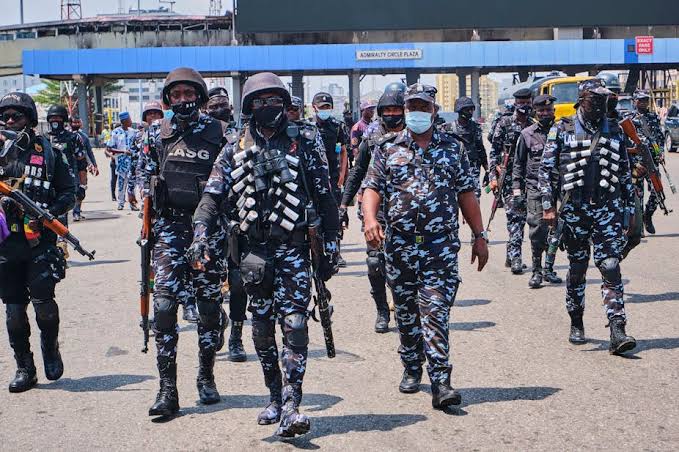
The Police Service Commission, in collaboration with the Nigeria Police Force, has announced the commencement of the recruitment of 50,000 police constables, as approved by President Bola Tinubu.

The recruitment process, according to the PSC, is in line with the President’s order to strengthen community policing, improve internal security and boost manpower within the police.

Recall that, on November 26, 2025, President Bola Tinubu declared a nationwide security emergency, ordering the Nigerian Police and Armed Forces to recruit additional personnel to tackle rising insecurity across the country.

The Head of Protocol and Public Affairs, Torty Kalu, in a statement on Thursday, said the Commission’s recruitment portal would open to eligible Nigerians from December 15, 2025, to January 25, 2026.

The statement in part read, “The PSC, in collaboration with the NPF is pleased to announce the commencement of recruitment of 50,000 Police Constables into the Nigeria Police Force, as directed by President Bola Tinubu. Following this Presidential directive aimed at strengthening community policing, enhancing internal security and expanding the manpower base of the Nigeria Police Force, the Commission has approved the opening of the recruitment portal for applications from eligible Nigerians.

“For the General Duty cadre, applicants are required to possess GCE Ordinary Level, SSCE/NECO or equivalent qualifications with at least five credits, including English Language and Mathematics, in no more than two sittings.

“Applicants for the Specialists cadre must possess a minimum of four credits, including English and Mathematics, also in no more than two sittings, and must have at least three years of experience and relevant trade test certifications.”

He added that “Candidates for General Duty must be between 18 and 25 years old, while those applying as Specialists must be between 18 and 28 years old. General Duty applicants must also meet minimum height requirements of 1.67m for men and 1.64m for women. All applications are to be submitted online via the portal.”

Student dies following alleged phone theft at UNN

By Anas Abbas

A student of the University of Nigeria, Nsukka (UNN) has died in tragic circumstances following an alleged assault by fellow students who accused him of involvement in a phone theft incident.

The incident occurred at the Eni Njoku Hall of Residence, where the undergraduate was reportedly confronted by other students over suspicions that he was connected to the disappearance of a mobile phone.

Sources say that the confrontation quickly escalated into a physical attack, with several students and hostel residents reportedly administering a severe beating.

The victim was said to have suffered critical injuries during the altercation and was later taken to a medical facility, where he was pronounced dead.

Details about the identity of the deceased, including his name and level of study, have not yet been officially released by the university or law enforcement, but various posts on social platforms refer to him as a UNN student who was allegedly beaten to death on suspicion alone.

The Enugu State Police Command has reportedly initiated an investigation into the matter to ascertain the exact sequence of events and whether criminal charges are warranted. Authorities are reviewing eyewitness testimony and security footage as part of the probe.

UNN management has not yet issued an official statement confirming the student’s death, but the incident has sparked concern among students and advocacy groups over rising cases of campus vigilante justice and the dangers of taking the law into one’s own hands.

Further updates are expected as police continue their investigation and as the university responds to queries from the press and the public.

Strict law enforcement would jail most Nigerians – ICPC

By Abdullahi Mukhtar Algasgaini

The Independent Corrupt Practices and Other Related Offences Commission (ICPC) has stated that corruption in Nigeria is so widespread that fully applying the law would imprison a vast majority of the population.

ICPC’s Resident Anti-Corruption Commissioner for Kaduna State, Mr. Sakaba Ishaku, issued the stark warning at a workshop on local government accountability in Kaduna on Wednesday.

“If the laws were to be applied to the letter, about 80 percent of the people you see walking the street freely will be in jail,” Ishaku declared.

He described corruption as “endemic and deeply entrenched,” driven by weak institutions and a lack of accountability, which diverts public resources and stalls development.

The commissioner challenged local government chairmen who leave office without visible achievements, questioning their legitimacy.

He also called for harsher penalties for graft, stating that current punishments are merely “a slap on the wrist.”

Echoing the concerns, the Kaduna State Commissioner for Local Government, Sadiq Mamman Legas, highlighted how public attitude compounds the problem.

He revealed that communities vandalized and stole from transformers after the state spent billions repairing rural electrification projects.

Both officials called for stronger public enlightenment and community ownership of assets to combat the deep-seated crisis.

Sultan warns NIREC risks irrelevance without honest leadership

By Uzair Adam

The Sultan of Sokoto and Co-Chair of the Nigeria Inter-Religious Council (NIREC), HRH Abubakar Sa’ad III, on Wednesday warned that the Council risks losing relevance unless religious leaders embrace sincerity, accountability and genuine engagement.

His remarks came as the Christian Association of Nigeria (CAN) renewed calls for stronger government action on insecurity, while the Federal Government dismissed global claims of religious persecution in the country.

These exchanges took place at NIREC’s Second Tri-Annual Meeting in Abuja, where the Sultan, CAN President Archbishop Daniel Okoh, and Secretary to the Government of the Federation (SGF), Senator George Akume, delivered some of their most direct assessments of Nigeria’s security challenges and interfaith relations.

Speaking candidly, the Sultan said NIREC had drifted from its founding vision, stressing the need to confront internal contradictions that undermine its credibility.

He lamented that some religious leaders preach unity during meetings but make divisive statements outside, a pattern he said weakens interfaith harmony.

“We sit down and say good things to one another, knowing God owns everything. Yet when we leave this room, we begin to say negative things. Are we really honest with ourselves?” he asked.

He urged the Council to decide whether to continue with its current approach, undergo reforms, or return fully to its founding principles. He also commended Cardinal John Onaiyekan for his consistency and sincerity since NIREC’s early days.

The Sultan noted that many members fail to communicate NIREC’s resolutions to their communities, leaving the public unaware of decisions that could reduce tension.

He emphasised that dialogue—rather than force—remains the surest path to peace.

Turning to security, CAN President Archbishop Okoh warned that Nigeria faces a dangerous phase of violence marked by mass abductions, banditry and extremist attacks.

“The daily loss of innocent lives is alarming and heartbreaking. Communities are being deserted and citizens are fearful,” he said.

While acknowledging existing government efforts, he urged President Bola Ahmed Tinubu to strengthen responses proportionate to the scale of the crisis. He also stressed that faith institutions remain vital to peacebuilding due to their grassroots influence.

He insisted that justice must underpin peace: “Those who perpetrate or finance violence must be held accountable, and victims must be supported.”

In his remarks, SGF Senator George Akume rejected global claims that Nigeria is experiencing religious genocide, arguing that such narratives misrepresent the country’s complex security issues. He noted that both Christian and Muslim communities have suffered devastating attacks.

He announced plans for a US–Nigeria Joint Working Group on Security, where religious leaders will contribute to policy discussions.Akume urged delegates to speak frankly and work in unity, saying: “Let us collectively silence the merchants of hatred and disunity.”

The meeting ended with a consensus that Nigeria’s fragile peace requires renewed honesty, deeper collaboration and a united moral front between religious leaders and the government.

Tinubu reiterates plan to withdraw Police officers from VIPs

By Anwar Usman

President Bola Tinubu on Wednesday said the directive to redeploy police officers working with VIPs, VVIPs and ministers was not negotiable urging all ministers to ensure immediate compliance.

This was revealed in a statement issued by the Presidential spokesperson, Bayo Onanuga.The president while speaking at the opening of the Federal Executive in Abuja warned all relevant stakeholders against non-compliance.

He noted that, “Police officers were trained to protect the lives and properties of citizens, particularly the most vulnerable in society not the protection of VIPs” adding that, the NCDC are trained for VIP protection, and they are armed too.

He also ordered the minister of interior Olubunmi Tunji-Ojo, for the immediate replacement of police officers by the civil defense corps.

“We face security challenges of kidnapping, banditry and terrorism. We need all forces utilized. I know some people are exposed; we will make exceptions. The Civil defense is very much around,” the president stated.

Tinubu directed the National Security Adviser, Nuhu Ribadu, Minister of Police Affairs, Sen. Ibrahim Gaidam and the Inspector General of Police to follow up on the implementation of the order.

The President also urged the Vice President Kashim Shettima, who is the chairman of the National Economic Council (NEC) to further sensitise governors and other stakeholders on the implementation of the reforms on ranching.

Bauchi State sets January 4 for full reopening of schools

By Sabiu Abdullahi

The Bauchi State Government has fixed Sunday, January 4, 2026, as the date for the resumption of all Basic, Senior Secondary and Tertiary Institutions across the state after an extended closure.

The announcement was contained in a statement issued by Jalaludeen Usman, ANIPR, Information and Public Relations Officer of the Ministry of Education.

He explained that the decision followed “extensive discussions with key stakeholders including School Principals, Managers of the Education Sector in the State and owners of Private Schools among others,” which led to a collective agreement.

Governor Bala Abdulkadir Mohammed subsequently approved the reopening.

The ministry said examinations that could not hold before the closure “will now be conducted within the first week of resumption,” while normal academic activities will continue afterwards.

The statement also revealed that “approval has been granted for the immediate re-opening of the three (3) Federal Government Unity Colleges as directed by the Federal Ministry of Education.”

Officials noted that the earlier shutdown was based on “advise received from security agencies relying on available information and following a spate of untoward incidences in schools across the country.”

However, the government said the situation has improved, which informed the decision to reopen all institutions.

Parents and guardians have been directed to return their children and wards to school without delay.

The government reassured the public that “additional security measures are being put in place to ensure the safety of students, teaching and non-teaching staff in the various schools and higher institutions in the state.”