National

You can add some category description here.

Old currency deadline: Queues, frustration at banking halls in Kaduna

By Sumayyah Auwal Ishaq

Almost all banks are now attending to long queues in their banking halls as the deadline for the use old currency by the Central Bank of Nigeria (CBN) draws closer, investigation by The Daily Reality has revealed.

The rush by customers to deposit old currency generated much chaos in and around banks premises across the Kaduna metropolis throughout the week. The queues at banks in Yakubu Gowon Way, Station Road, Kano Road and Sabon Tasha were characterized by commotion caused by slow speed of the deposit process and impatience by customers.

Some of the customers who spoke to TDR said they were scared of losing their monies as the CBN had warned that those who failed to remit their old currencies would lose it after the deadline.

Officials of these banks had a very hectic time controlling the huge crowd in their premises, even as customers complained of slow services by the banks. Some of the customers expressed frustration queueing in the sun and the difficulty in remitting their monies, suggesting that further extension of the deadline would ease their pain.

It would be recalled that the CBN had given all Nigerians up to the end of January, 2023 to remit their old currencies as it ceases to be a legal tender after the stipulated time.

Throat infection claims 25 in Kano

By Muhammadu Sabiu 

According to findings obtained by The Daily Reality, Kano State has been experiencing a diphtheria outbreak since last Friday, and as of Thursday, at least 25 people had died as a result.

It was discovered that the Murtala Muhammed Specialist Hospital and Aminu Kano Teaching Hospital in Kano are treating the killer disease, which was first discovered in the state in the late 2022.

Diphtheria infection is a dangerous infection of the nose and throat, according to medical professionals, and it is easily avoidable through immunisations.

Experts say that a sore throat, hoarseness, swollen glands (enlarged lymph nodes) in the neck, trouble breathing or quick breathing, nasal discharge, fever and fatigue are some of the signs and symptoms of diphtheria.

The state’s Ungogo Local Government Area is where the illness, which is thought to be communicable, was originally identified.

According to the state ministry of health’s records, at least 58 probable instances of the disease were recorded during the outbreak, six of them were admitted, and 25 patients had already passed away as of January 13, 2023.

The National Center for Disease Control (NCDC), according to our source, sent medical personnel to the state last week due to the severity of the outbreak.

Dangote Cement appoints new MD

By Aisar Fagge

The Dangote Cement Plc. has Thursday appointed Arvind Pathak as the group Managing Director with effect from 1st March, 2023.

The news was relayed to journalists in a corporate disclosure made available to the Nigerian Exchange Ltd. by Edward Imoedemhe, the company’s acting Secretary/General Counsel.

It was gathered that the Pathak appointment was prompted by the retirement of Michel Puchercos from from the group Managing Director/CEO.

The statement reads in part: “The appointment of Arvind Pathak will be included in the agenda at the next Annual General Meeting for ratification by the shareholders in accordance with the Companies and Allied Matters Act.

“The Board would like to thank Michel Puchercos for his commitment and contributions to the Board and wishes him well in his future endeavours, while welcoming Arvind Pathak back to the Dangote family and wishing him success in his new role,” the company said.

Before his appointment, Pathak worked as MD and CEO of Birla Corporation Ltd. and was described as the experienced and hardworking person.

It was gathered that Pathak is also the former Chief Operating Officer and Deputy Group Managing Director of Dangote Cement Plc.

Osinbajo chairs first 2023 cabinet meeting

By Ahmad Deedat Zakari

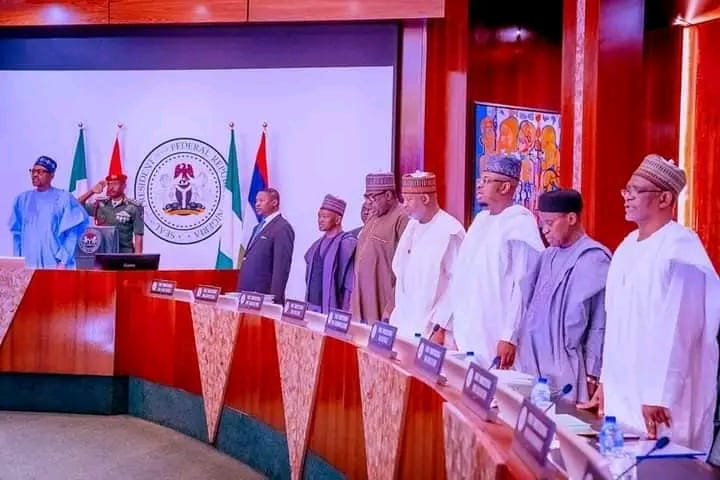
Nigeria’s Vice President, Professor Yemi Osinbajo, chaired the first Federal Executive Council (FEC) meeting for the year 2023 on Wednesday. 

The meeting was held at the Council Chamber of the Presidential Villa, Abuja.

Osinbajo stood in for his principal, President Muhammadu Buhari, who departed the country to Nouakchott, Mauritania, to participate in the Programme of the Third Forum of the African Conference for Peace on Monday.

In attendance are the Secretary to Government of the Federation (SGF), Boss Mustapha; the Head of the Civil Service of the Federation, Dr Folasade Yemi-Esan; and the Deputy Chief of Staff to the President, Dr Adeola Ipaye.

Most of the cabinet members were also physically in attendance for the first FEC meeting of the year. 

However, the Ministers of Foreign Affairs, Geoffrey Onyeama, Defence, Maj. Gen. Bashir Magashi and the National Security Adviser, Maj. Gen. Mohammed Monguno were absent as they were on the President’s entourage in Nouakchott.

The President and his entourage are expected to return to the country on Wednesday.

Naira policy: Nigerian governors summon CBN boss, Emefiele

By Muhammadu Sabiu 

The Governor of the Central Bank of Nigeria, Godwin Emefiele, has been summoned by the 36 state governors in relation to the withdrawal policy and the repainted naira notes.

The Nigeria Governors’ Forum, which embodies the governors, said on Tuesday that the scheduled meeting would take place on Thursday through its spokesperson, Abdulrazaque Bello-Barkindo.

Recall that Nigerians were instructed to deposit their old notes in banks by January 31, 2023, under the CBN’s naira redesign programme, which was implemented in October 2022 of last year.

The spokesperson noted that the virtual meeting would concentrate on the most recent apex bank withdrawal policy and currency redesign.

“For the virtual meeting, the agenda is the Economic and Security implications of naira redesign and withdrawal policy.

“The discussion promises to foster involvement and dialogue among various stakeholders, including governments and civil society organisations, to devise a solution to the lingering issue,” he said.

4 writers in Ilorin for Imodoye residency

By Umar Yogiza

The four writers are Tares Oburumu, Ruth Chidera Echewe, Sadiq Mustafa and Taiye Ojo, they arrived in the ancient town of Ilorin, Kwara State, for the first batch of the 2023 Imodoye Writers Residency programme. A statement issued by the residency manager said the writers are expected to be there for three weeks and an optional one week.

Tares Oburumu is a Bayelsa State-born poet and essayist, based in Warri, Delta State, Nigeria. He’s the author of 6 published chapbooks. Tares Oburumu is the winner of the GAP poetry prize 2018 and his chapbook ‘origin of the syma species’ won The Sillerman First Book prize for African poets 2022, to be published by Nebraska University Press, U.S., in fall 2023. Tares had been nominated for the Pushcart prize with Woven Tales Press 2019, and Ice Floes International literary journal 2021.

Tares Oburumu is in Imodoye residency to work and expand his three chapbooks: Erasure, Chatham House and Red: the love story of Annie Ernaux. As a child, Tares heard the nerve-racking stories of how brothers took to the Atlantic Ocean, going oversee, and it broke him to pieces hearing the manner they died in their attempt to escape the bedlam their country has become. His lens’ expositions focus on emigration and the attendant trauma not told by those who suffer from it. And to shine the light on how they ended, coffined in the dream of escaping Nigeria.

Ruth Chidera Echewe, (Unbreakable) is a writer, editor, media personality and professional blogger. She publishes potpourri of themes in unbreaky.comblog, her personal blog space is called UNBREAKABLE FEATURES. She’s a graduate of English and Literary Studies from the Federal University Lafia, Nasarawa State, Nigeria. An indigene of Abia State, Nigeria, but resides in Enugu State.

Ruth, Chidera Echewe is in Imodoye to complete her work: Sisters Series, prose, dealings with humans, certain bonds that sustained our existence and given us a different definition of life. She kindly follows various studies that have proven the strongest bonds emanated from the establishment of relationships. Ruth is motivated by her passion for creativity which has gone ahead to give birth to what she intends to manifest into a publishing, writing and editing firm in the nearest future.

Abubakar Sadiq Mustapha is a poet, art curator, documentary photographer, and community developer. He studied Geology and Mining at Ibrahim Badamasi Babangida University, and currently rounding up his master’s program at the same Ibrahim Badamasi Babangida University, Lapai, Niger State. Sadiq uses books, photography, and arts in driving social change from girl-child education, and gender-based violence to youth participation in politics and believes in the power of photography and how it can be used toward mental health, is in Imodoye to complete his manuscript: Home is my Mother’s Tongue.

Abubakar is also a photo columnist with Salamander ink magazine and the curator of the Abubakar Gimba literacy campaign. He’s the project lead for The Lapai Bookclub’s mobile library and school, a project that takes reading and arts to grassroots communities in Northern Nigeria aimed at increasing the literacy rate of the region and creating awareness in governance.

Ojo Taiye is a Delta base Nigerian eco-artist and writer who uses poetry as a handy tool to hide his frustration with society. He’s the winner of the Hay Writer’s Circle poetry prize, US, 2021, Calthalbui poetry prize, Ireland 2021. In 2020 Taiye Ojo was selected to participate in Capital City Film Poetry Festival, in Michigan and Poetry Introductory Series, in Ireland. His commissioned works include Belfast Photo Festival 2021, Winnipeg Fringe Festival and Leeds Poetry Festival.

Taiye’s recent works explore neocolonialism, institutionalized violence and ecological trauma in the oil-rich, polluted Niger Delta. His themes deal with the effects of climate change,
homelessness, migration, drought and famine, as well as a range of transversal issues arising from
racism, black identity and mental health. Taiye Ojo is in Imodoye to complete his poetry collection: Scoping Map.

Established by Dr Usman Ladipo Akanbi, the Imodoye Writers Residency is a private initiative for writers and visual artists keen on completing their ongoing work in a conducive environment at no cost. And as part of giving back to the community, during their stay in the residency, the writers are expected to mentor secondary school students in Ilorin in creative art/writing.

Philips Curve and Nigeria’s economic reality: a macroeconomic analysis.

By Muhammad Sagir Bauchi

Stabilization of prices and achieving full employment are among the core goals of every economy in their macroeconomic policies. In this case, there are two main approaches to curtail inflation, recession, unemployment and other negative macro-economic phenomena. These approaches are monetary and fiscal policies. While monetary policy refers to the central bank activities which are directed towards influencing the quantity of capital (money) and credit in an economy, fiscal policy refers to the government’s decisions on taxation and spending. Both monetary and fiscal policies are used to regulate economic activities over time. They can be used to accelerate growth when an economy starts to slow or to moderate growth and activity when an economy starts to overheat. In addition, fiscal policy can be used to redistribute income and wealth.

The overall goal of these monetary and fiscal policies is channelled to the creation of a healthy economic environment that could sustain economic growth, facilitate positive employment and stable inflation rate.

In a plain language, the main aim of these two policies is to steer an economy in the sense that the economy does not experience economic boom that could be followed by high period of low or negative growth, high level of unemployment and unstable price. In this situation, people can feel safe in their consumption, savings and investment decision and government could concentrate on economic decision making. And this is where the idea of Monetarist, Classical and Keynesian Schools of Economics come to play, where they have different views in respect to the effectiveness of the two policies.

PHILIPS CURVE FROM A SHORT GLANCE:

The issue of inflation and unemployment is not a new concept in the realm of economics and it’s one of the concepts that reflect the science of economics as a true reflection of reality, since that, almost everyone is feeling the impact of either of the two.

The history of Philips Curve can be traced to the research findings of A.W Philip, an economist who analyzed the relationship between unemployment and the rate of change of money wages in the United Kingdom in the years 1861-1957. At the end of his findings, he suggested that there is an inverse or negative relationship between wages and unemployment. In simple term, he meant that whenever there’s growth in unemployment, there would be a low level of inflation. And the rationale behind the justification of his idea is that wherein there’s employment, people have more money, which leads to high demand for goods and services, and eventually pushing prices up. On the other hand, when there’s a rise in unemployment, INFLATION will go down since there will be low demand for goods and services as there’s less money in circulation.

Philips and Other Economic Perspectives: there are different opinions with regards to the application of the curve and the measures to contain the phenomena.

According to Monetarist School, the issue of unemployment is a supply side phenomena, therefore, demand side measures cannot be used in curtailing them, and even if it occurs, it can be for a temporary and will accelerate price instability at the end. While to the Keynesian school, they argue that there can only be “demand deficient unemployment” And in the time of recession, demand side measures can reduce unemployment for long-term with little of inflation.

Nigeria’s Economic Reality:

In Nigeria, since its independence, unemployment and inflation are among the major distractions in the growth and development of the nation’s economy. This is evident as we are all witnessing a scenario where too much money is chasing few goods and another case of high supply of labor with low demand of it. According to data from the National Bureau of Statistics NBS), Nigeria’s inflation rate has been consistently high, averaging around 11% in the past decade. The high inflation rate can be attributed to a number of factors such as the devaluation of the Naira, increase in the cost of imports, and a rise in fuel prices.

In an effort to curb inflation, the Central Bank of Nigeria (CBN) has introduced and implemented a number of monetary policies, such as the recent cashless driven economy module; through daily and weekly money withdrawal limit, increasing interest rates, tightening liquidity, devaluing the Naira, etc. However, all these policies have not been entirely successful in bringing inflation under control. Additionally, the Nigerian government has also implemented fiscal and monetary policies such as capping government MDAs cash withdrawals limit to minimal amount, increasing taxes and cutting government spending to curb inflation, however, the effectiveness of these policies remains uncertain and challenging. Same goes to the apex bank ongoing monetary policy, especially the weekly withdrawals limit policy, which is an unprecedented threat to urban and rural businesses due to poor mobile/internet banking mechanisms in the country. As such, the apex bank must address these concerns through shifting the effective implementation date until all the proper mechanisms required to operate a cashless economy are put in place. This can be done if the CBN reasons and constitutes a committee that includes technocrats, bankers and internet service providers, which will make sure that effective moblie/internet services are made available to cover the whole country before the policy kicks off and kicks up.

In conclusion, the relationship between inflation and unemployment as represented by the Philips curve is a complex one that is influenced by a variety of factors. The Nigerian economy is facing significant challenges in terms of cashless economy application, high inflation and unemployment rates, and finding effective solutions to these issues will require a rigorous political will and careful consideration of both monetary and fiscal policies. It is important for the government and the central bank to continue to monitor and analyze economic data and make adjustments to policies as needed, in order to create a stable economic environment that supports growth and employment.

Muhammad Sagir Bauchi, is a graduate of Economics from Sa’adu Zungur University, Gadau, Bauchi State. He can be reached via ibrahimsagir1227@gmail.com

7 PDP supporters die, 32 injured in truck accident in Plateau

By Uzair Adam Imam

No fewer than 7 Peoples Democratic Party’s (PDP) supporters died and 32 others injured in a truck accident Saturday in Plateau state.

The victims were reportedly returning from a Zonal rally at Pankshin local government area, the headquarters of Plateau Central Senatorial zone.

Our reporters gathered that the truck, which conveyed the victims, crashed at Jwak village close to the Panyam bridge in the Mangu local government area.

The Director, Directorate of Media and Publicity, Atiku-Okowa/Mutfwang-Piyo Campaign Council, Yiljap Abraham, confirmed the traumatic incident to journalists in a statement.

Abraham in a statement said, “It has been confirmed that seven people lost their lives in the road accident on Saturday evening involving supporters of the Plateau State Chapter of the Peoples Democratic Party.

“They were returning from the PDP flag-off and zonal rally held at Pankshin when their truck crashed on a slope between Pushit and the Panyam bridge in Mangu Local Government Area.

“32 of the passengers sustained varying degrees of injuries. 21 have been taken to Nissi Dominus hospital Mangu, one is at Nanret clinic Mangu and 10 are at the Jos University Teaching Hospital, JUTH.

“Two have been adjudged to be in critical condition with one undergoing emergency surgery at Nissi Dominus hospital. Meantime, the corpses have been removed from the scene and deposited at Allah Na Kowa hospital, Nissi Dominus hospital, and Mangu Cottage hospital.

“The evacuations were coordinated by the Medical Team of the Campaign Council headed by Dr. Juryit, some personal staff of the PDP Governorship Candidate, Barr Caleb Mutfwang with the aid of many sympathizers.

“In his initial reaction, Barr Mutfwang expressed shock at the tragedy. He has asked for prayers and every support to be extended to the grieving families and healing for those injured,” he added.

Cerebrovascular accident and the fairy tales of “Garsa”

By Abba Muhammad Tawfiq

Garsa is a sinister superstition label ubiquitously attached to stroke patients particularly in some Hausa-Fulani community. The conception of cerebrovascular accident as demon-ridden problems is continuously denying its victims the pleasure of urgent medical intervention. This delay in appropriate medical care inevitably complicates the patients’ condition and make it even difficult to treat after all the efforts of traditional treatments have proved abortive.

The vagueness over which the accident is traditionally considered as “being possessed” ailment is refuted and cleared by sophisticated medicinal sciences. This piece will help to comprehensively elucidate more on what cerebrovascular accident and its management entail.

Adequate life sustaining nutrients and oxygen necessitate the survival of the building blocks of life. Hence, the circulatory system is primarily programmed to efficiently execute the function of meeting the fundamental requirements of body tissues and cells. This however can successfully be achieved by the way of transporting nutrients and metabolic wastes to and away from the body. Also, establishing a stable homeostatic state in all the tissue fluids by transporting biological chemicals called hormones from the part of its synthesis to where its effect is necessary in order to ensure an optimally continuous survival and robust function of the body tissues and cells through the means of blood and blood vessels.

Physical and organic pathology that disorient the rudimentary pattern of circulation that shape various tissues give rise to life threatening complications. And this conceptualizes the basis of “STROKE” with regards to brain.

Stroke otherwise known as cerebrovascular accident occurs as a result of an interruption to or loss of blood supply to a part of the brain from an assault to the concerned arterial supply to the brain. The American Heart Association defined stroke as “a disease that affects the arteries leading to and within the brain.

Globally, stroke is said to be the leading cause of morbidity and mortality. It is the No. 5 cause of death and a leading cause of disability in the United States. The current prevalence of stroke in Nigeria is 1.14 per 1000 while the 30-day case fatality rate is as high as 40%.

On pathological ground, the disease lends itself to two categorical divisions, namely; Ischemic stroke and haemorrhagic stroke.

The former is the most common type of stroke and associated with blocked or narrowing of the brain’s blood vessel caused by fatty plagues which build up in the blood vessels or by blood clots or other debris that travel through the bloodstream, most often from the heart, and lodge in the blood vessels in the brain. This consequently leads to the death of brain tissue from poor nutrients and oxygen supply to the brain.

However, the latter occurs due to a rupture or leakage in blood vessel in the brain. This is mainly associated with atherosclerosis or a local dilation of the blood vessel (aneurysm) which leads to the burst of the blood vessel hence leading to hemorrhagic stroke

The predisposing factors that lead to cerebrovascular accident can be categorized into modifiable and non modifiable factors. And the major modifiable risk factor for stroke is sedentary lifestyle. People’s manner of living exerts impact on their state of well-being. Obesity caused by unhealthy diet, excessive alcohol consumption and smoking may result in high blood pressure or deposition of fatty droplets in the arterial wall causing arterial narrowing or bursting, thus consequently leading to stroke. Others include uncontrolled hypertension, gestational or pregnancy hypertension and diabetes.

The non modifiable risk encompasses factors such as family history and ageing. Although stroke does not wreck havoc on any age or age group exclusively, but older individuals are at higher risk of having stroke than other individuals. This is because the complications of ageing are mainly associated with arterial narrowing and loss of elasticity. Hence the susceptibility of the arteries to be damaged by fatty droplets and other debris in circulation, thus; resulting in stroke is high.

History of severe idiopathic headache, dizziness and vomiting are being clinically associated with haemorrhagic stroke. Facial, arm, or leg weakness on either or especially one side of the body denotes the onset of stroke. Other symptoms include confusion or trouble in understanding other people, difficulty speaking, visionary problems, trouble with walking and coordination.

Obesity and or weight control by the means of lifestyle/dietary modification and exercises are the mainstay for the prevention of stroke. The revelation of the aforementioned symptoms of stroke should urgently be reported to a close healthcare facility for immediate care and complications minimization. Notable blood pressure should be regulated through exercises and medications.

Multidisciplinary approach is essential for the effective management of stroke. This comprises a team of a well trained healthcare professionals and most precisely doctors, speech therapist, occupational therapist and physiotherapists. Surgical procedures can also be employed to repair vascular damage in the case of haemorrhagic stroke, while obstruction of adequate blood flow and oxygen supply to the brain by clogged garbage in the vessels can be flushed out through the use of medication.

The physiotherapy specialty covers a wide scope in the management of patients with neurological conditions such as stroke and their aftermath on the body function. Following stroke, patients show and suffer from multiple complications such as muscles flabbiness, accumulation of secretion in the lungs and loss of speech, loss of balance and coordination, which may not be or difficult to manage by medication.

Various physiotherapy techniques are applied to improve muscle physiology, prevent deformity, improve coordination, facilitate airways clearance by removal of accumulated secretions in lungs and improvement of overall quality of life. Physiotherapists therefore bridge this gap by playing restorative and preventive role in restoring the lost function and preventing post stroke complications.

Abba Muhammad Tawfiq, graduate of Medical Rehabilitation, University of Maiduguri, Borno State, Nigeria.

Doctors threaten to shut down hospitals nationwide

By Ahmad Deedat Zakari

Doctors, under the auspices of the Nigerian Association of Resident Doctors (NARD), have threatened to embark on a nationwide strike if the Federal Government refuses to meet their demands. 

This was disclosed in a letter signed by NARD president, Dr Emeka Innocent Orji, on Monday. The letter, which was addressed to the Minister of Health, Dr Osagie Enahire, gave the Federal Government an ultimatum of two weeks to meet the demands of the union. 

Dr Orji said the strike would commence if the issues are not resolved before the union’s National Executive Council (NEC) meeting slated for January 24th to 28th. 

The letter read in part, “Sir, our January 2023 National Executive Council meeting has been scheduled for January 24th to 28th, 2023, and we can confirm very clearly feelers that if these issues are not sorted out before that meeting, our members will likely give us a mandate to immediately kick-start processes that will lead to a nationwide industrial disharmony in the health sector.”

The Daily Reality has observed that Nigeria is witnessing its worst brain drain among doctors recently; the poor working condition is mainly responsible for the situation.