Local

Eid-el-Kabir: Kaduna ram sellers decry low patronage

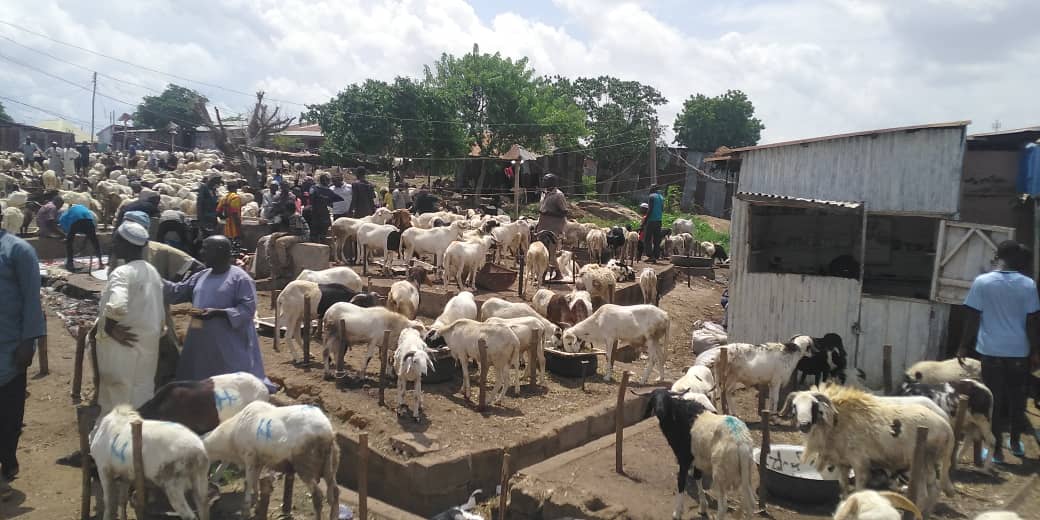
Ram sellers in Kaduna famous Zango Cattle Market on Monday decried low patronage barely 24 hours to the 2021 Eid-el-Kabir celebration. The ram sellers said that customers were not forthcoming, and their hope for a brisk business this year seems to have been dashed due to the poor state of the nation’s economy. According to some ram sellers, the situation has forced many of them to sell on credit.

A livestock dealer at the market, Malam Samaila, said that the ram business was not flourishing as before due to the economic and insecurity situations in the country.

Investigation reveals that a medium-size ram is sold at N40000 against its previous price of N25000, while a well-bred ram is sold for between N90000 and N150000. The prices of sheep and goats also indicate similar hikes as they are sold at N20,000 and N25000 against their previous prices of N15,000 and N10,000, respectively. 

‘It is our collective responsibility to protect Prophet Muhammad (SAW)’ – Prof. Salisu Shehu

With the ongoing discussions on Sheikh Abduljabbar Nasiru Kabara saga, Professor Salisu Shehu spoke to The Daily Reality (TDR) on why religious conflicts are pervasive in northern Nigeria.

‘The fact is our state governments are primarily responsible for this. They allow everybody to do what they like. If a state government can muster the necessary political will to exercise the necessary political authority to curtail these things, things like these must not be happening. The governments should be proactive; they should not act when issues are already or on the verge of going out of hand. Besides government, other factors include widespread ignorance and poverty. These and other factors are the facts we cannot dismiss.’

TDR asked Prof. Shehu to comment on the call to sensitise and regulate religious preaching. The call gain prominence since the devastation caused by Boko Haram religious organisation in North-East.

‘I believe something around that should be done by the respective state governments. People like these [Sheikh Abduljabbar and co.] should not be allowed to be saying whatever they want. Freedom of speech does not mean saying whatever you want to say, true or false; whether it could bring confusion in the society, create disaffection and cause bloodshed and so on. For me, the regulations should not be unilateral. The state government cannot just come out and hand down some rules and regulations without consultations. You know, there has to be a wide range of consultation with stakeholders, primarily the preachers and scholars. So, based on mutual understanding, something should be done,’ said Prof. Shehu.

Concerning the dialogue Kano State government organised after receiving series of complaints from religious scholars and other concerned citizens on the manner Sheikh Abduljabbar was preaching, Prof. reacts thus:

‘Actually, one of the reasons why the government organised this dialogue was because it wanted to bring peace. It wanted to avoid the situation that may degenerate into violence in Kano State. So now it is left for the government to take the necessary steps to ensure that this thing does not continue. It must take measures to ensure that this blasphemy against the person of the Prophet (S.A.W) stops. And whatever it takes, the governor should do that. Because it is collective interest to protect the honour, the nobility and the great position of the Prophet (S.A.W).’

Abduljabbar Dialogue: ‘My emergence as judge’ – Prof. Salisu Shehu

Prof. Salisu Shehu, who is the Director of the Centre for Islamic Civilization and Interfaith Dialogue of Bayero University, Kano, in an exclusive interview with The Daily Reality (TDR), described how he emerged as the presiding judge of the dialogue between Sheikh Abduljabbar Nasiru Kabara and some Islamic scholars in Kano state.

“I want to believe that it was made by the grace of God. I know that several senior, elderly and important personalities were pencilled down and contacted, but some of them declined while others, unfortunately, were out of town. My name was among those that were suggested as options. And, by the grace of Allah, my name was anonymously accepted by the committee and therefore was presented to the Kano State Government. I received my appointment letter a day before the fixed date for this dialogue. I, too, have actually tried to decline because there are many people that are more deserving and competent. Still, the committee insisted and persuaded me to accept this appointment since State Government has approved it.”

There were speculations that those who rejected the offer to chair the session or refused to participate did that due to the gravity of the blasphemous remarks on the person of Prophet Muhammad (S.A.W). They, thus, and see the whole issue as needless and a waste of time.

“Of course, these are terrible, sacrilegious statements and utterances. And it is disturbing listening to them because they are horrible and disrespectful to the Prophet (S.A.W). But from the perspective of a jurisdiction maxim: “Addarurat tubihul mahzurat“, we have to do something to bring an end to it. And I have seen how this person has been boasting and bragging that all his claims are valid and no one can face him. So I felt it was necessary to accept and participate in this capacity to bring an end to his misguidance That was how I convinced myself,” Prof. Shehu said.

Sheikh Abduljabbar has complained about the time given and has tried several times to provoke you. How did you manage his provocations?

“You see, dialogue should not just be conducted for an unlimited time. We don’t have to stay the whole day. Unless there is no orderliness and good organisation, he was the only one complaining about time. You have all seen how one of the participants open about five books or more in his ten minutes. Abduljabbar had a system [mobile phone or laptop] with him together with two of his disciples. What was their function? Why did he bring them there? Why they were not opening the pages of those books, he was asked to? It was obvious. So it was quite challenging in the sense that you have to control yourself. You have to exercise a great deal of patience because one can easily be provoked.”

I wish Abduljabbar will truly repent – Dr Muslim

A leading member of the Coalition of Kano Ulama and an academic, Dr Muhammad Muslim Ibrahim, who also attended the dialogue between Sheikh Abduljabbar Kabara and representatives of the Coalition, said in an interview with The Daily Reality that Kano Ulamas had done their parts. The rest was for the Kano State government to make the final decision.

Dr Muslim said, “The debate was well-organized and was just. Each contestant was allocated ten minutes to present their argument, followed by an additional five minutes for clarification, etc. Malam Abduljabbar was aware of the questions to be asked. They were nine questions formed from his blasphemous translations and utterances on Prophet Muhammad (S.A.W), his companions and famous Hadith books – Sahihul Bukhari and Muslim. He said all this in his lessons, preachings and sermons.”

In the dialogue held on July 10, 2021, Sheikh Abduljabbar persistently complained about insufficient time to answer questions. He further protested that he was not aware of the debate’s guidelines. However, Dr Muslim countered these claims.

“This is nothing but denial and a look for a way out. The questions had been with him for months, and he was the one who urged that this debate should be held. Thus, he had to be more prepared than any of these scholars. Similarly, nobody was aware of the specifics of the arrangement of the debate as everything was in the hand of the government. Of course, we also wanted to have equal time for both parties, but he had more.”

Dr Muslim emphatically added that “Our representatives should have more time than Abduljabbar because his task was to defend those blasphemous remarks, but the judge of the sitting outrightly rejected our demand.”

On his expectation as the dialogue was over now, the cleric responded thus, “There are many views. Some say the government intended to have a reasonable point with which Abduljabbar can be legally convicted for making those blasphemous statements. However, now that it has been confirmed that Abduljabbar fabricated all those statements, it is the Kano State government that will decide his fate. So though some say the punishment of blasphemy in Islam is killing, I don’t think it will be possible here in Nigeria. So we should not talk about it because we will end up wasting our time.

But what I expect from the Kano State government is to continue banning him from leading prayers, giving lessons and or posting on social media. It is none of our intent for Abduljabbar to be jailed; we are afraid that he will use this opportunity to corrupt the inmates. But, If we are to follow what Allah says, the only option for Abduljabbar is to either repent or be killed if he refused. How I wish he will repent,” concluded Dr Muslim.

Epistle: Letter to Arewa bandits and kidnappers

By Ibrahiym A. El-Caleel

Ideally, I should begin this letter with the epistolary salutation. “Dear brothers” would have been a good salutation, to begin with, but it would be deceptive. I am neither a bandit nor a kidnapper; neither do I have a rifle, nor do I live in the woods. I feel emotional when people die natural deaths. I feel depressed when people are killed. Even in my wild dreams at night, I have never seen a mirror image of myself with a gun. Thus, if I salute you as “Dear brothers”, it will be ungodly deceitful to both you and I.

The enigma in writing you this letter doesn’t end with my failure to find a befitting salutation. It furthers my lack of faith that this letter will reach you. Despite all its mighty capacity, the Nigerian government does not have your full address. Certainly, as a poor Nigerian, I also do not have your address to deliver this letter. In case this letter comes to you by accident, I appeal to you, kindly spare some minutes out of your busy schedule to read it.

Earlier today (9th July), residents of Maradun Local Government in Zamfara lowered 35 bodies into graves. These are the 35 people you killed yesterday. On Monday (5th July), you also ‘worked’ in Tsauwa village in Batsari LGA of Katsina State. You dispersed the villagers, running after them on your motorbikes and shooting them as they flee. You also burnt their houses and farm harvests. Anyway, on Wednesday, they also had to lower 19 bodies into their graves. About a month ago, precisely on Thursday 10th June 2021, you struck Kadawa village of Zurmi LGA in Zamfara State. There in Kadawa, after your bloodbath, they did the burial of the 93 people you successfully butchered. In this case, survivors narrated that you spoke French during the operation. This means you are also now operating as a Multinational organization.

I could go on to narrate your operations, from Zamfara to Kaduna, from Katsina to Niger States. You have become one of the most active and busiest workers in Nigeria today. Hardly does a day or two passes without your career activity making headlines in the national dailies. I am not being satirical. I am being euphemistic so that you become aware that we are feeling the pains. The agony! You have pierced a fat needle into our skins, aggressively drawing our blood. We are eager to know when will your syringe be full? How much volume of our blood can satiate your blood thirst? Does it have to be this cruel?

We have always wondered what is it you want with this ruthless bloodletting. It was only recently that people like Shaikh Dr Ahmad Gumi and journo Abdulaziz Abdulaziz took the courage of walking into the bushes to converse with you, to hear the reasons. Their reports centred around your bitterness with the Nigerian government’s neglect of you; also about how Nigerian security outfits have persecuted you, and how they couldn’t secure your cows from being rustled; also about how common Nigerians have abandoned you in the bushes without care. I honestly do find any cogent reason among all these claims.

Your dwelling in the bushes was by your own choice. Common Nigerians shouldn’t be your enemies on this. If the Nigerian government has maltreated you, what stops you from following a legal process via MACBAN to address this? How does killing innocent people and driving them out of their homes help you?

These innocent people you are killing on a daily basis are also victims of Nigerian state neglect. Had the Nigerian state not neglected term in terms of securing their lives, you won’t even have the chance to kill them in scores as you do. They are your partners in suffering from this bad leadership culture that has stayed for long in Nigeria. Killing them and destroying their properties is the height of your own injustice. Unlike you, these victims suffer a two-way transgression: one from the Nigerian government, then the second from bandits and kidnappers.

Even if you must transfer your aggression to these innocent people, what stops you from seizing their material wealth alone and leaving them with their lives? Your predecessors in this criminality (armed robbers and thieves) mostly kill only when they ask for money, and it’s not given. In your own case, you do not even ask for money or anything. You just ride your motorcycles into a random community and make bullets fly.

What specifically do you want to achieve?

What point do you want to prove?

What is it you all want, please?

How can we go back to a time when we could sleep with both eyes closed, please?

Yours dreadfully,
Ibrahiym.

Bandits demand food for their hostages

The armed bandits who kidnapped some school children in Kaduna have demanded the state to give them food for their hostages. It was gathered that the parents and management of the Bethel Baptist High School, which is located at Marabar Rido in Kaduna State, have already raised money to buy foodstuffs and every other thing as demanded by the abductors of the 121 students of the school.

Such kidnappings and killings have become commonplace in the North, where people are kidnapped and killed almost every day, especially in Zamfara, Katsina, Katsina, etc. The parents of the students are so scared and frightened over the recent threat and boldness of the kidnappers, pinning their children’s survival on their necks through the evil demand.

It can be recalled that the bandits forced themselves into the school on Monday around 2 am and kidnapped 121, who were said to be primarily senior students.

Flooding: As you make your bed, so you must lie on it

By Ibrahiym A. El-Caleel

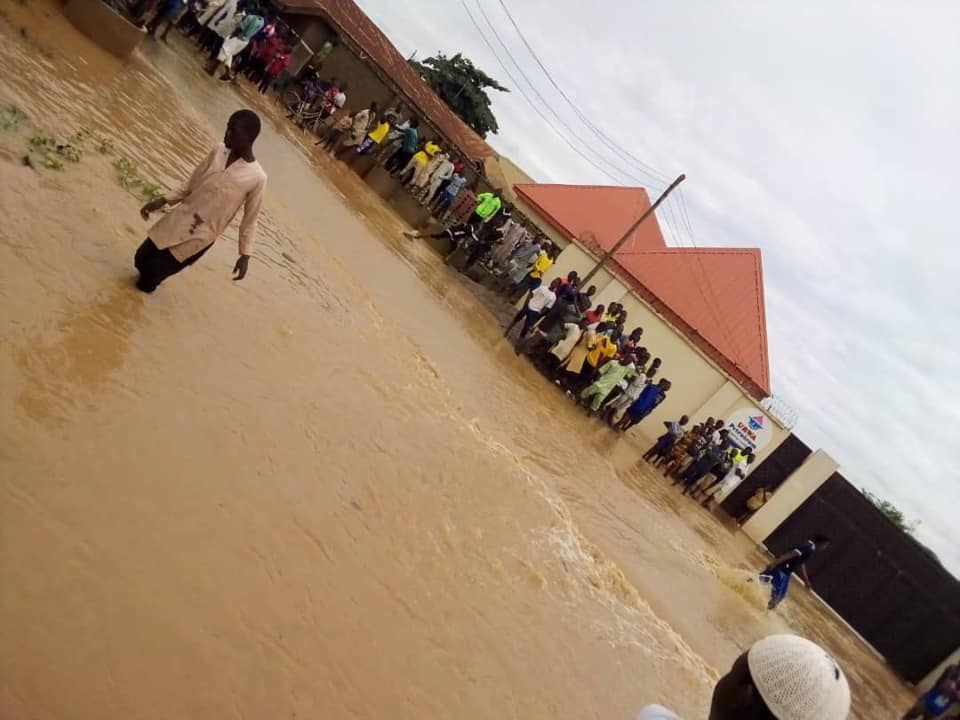
Flooding in this season is caused by heavy rainfalls. It happens because the excess water from a heavy rainfall is unable to find a drainage system with the capacity to contain it. Our local areas, called “ghettos” are fond of blocking the gutters. Household wastes are dumped in gutters instead of depositing them in refuse dump for proper incineration.The new extension areas mostly called “low-cost” also suffer from inadequate drainage system due to poor planning. People passionately build houses of N8-10 million, but comfortably neglect building a drainage that will cost them less than N300K.

I know a man whose neighbor refused to build a gutter for over 20 years, with much quarrel. Everyday, this man had to use a rake to collect the waste from his house to pass it to the next gutter because his immediate neighbor refused to let the gutter continue in front of his house. Of course it’s a semi-ghetto area, no one cared to reveal this to appropriate authorities. Rainfalls have no specific regards to the poor drainage system we have in our communities. We can continue to block the gutters with our household wastes. Lowcost residents can continue to build their fine houses without making provision for drainage. When the heavy rain eventually falls, it will not seek for a pathway. It will accumulate on the streets and find its way into our houses, living rooms and bedrooms. Eventually, we will then begin to have honest concerns with our lack of regards for drainage systems. It is true that we have governmental institutions for environmental health. Take Kaduna State for example. Kaduna has Kaduna Environmental Protection Authority (KEPA). Go to KEPA’s office on Old Jos Road in Zaria close to Kongo Campus and see the gutter there. A few years back when I was making a self-assigned field research on this issue, their gutter was also blocked with several plastic wastes and heap of sand! This is a regulatory agency that should drive residents compliance with environmental health systems like drainage. KASTELEA was also launched to enforce both state traffic laws and environmental laws. KASTELEA stands for “Kaduna State Traffic and Environmental Law Enforcement”. But today KASTELEA is obsessed with catching drivers with an expired “Road Worthiness Certificate” more than cracking on households with no drainage systems which leads to flooding of a community of 2,000 homes.

For prevention, people should not wait for KEPA or KASTELEA to come and enforce them to clean their gutters. They don’t have your time! If you like, don’t just dump your household wastes in the gutters. You may please seal the gutters with molten steel! When the community eventually floods, you will feel the pain more than anyone. The best thing SEMA will do is to give you 2 tiers each of rice as palliatives and then have NTA cover the story. The remaining wahala is yours to know how to solve. It is the usual way of manhandling everything that has to do with public good. I have seen someone who demolished a part of his house, and instead of transporting the red sand elsewhere, he spread it on the tarred road that is meant for public use. When rain fell, the red sand became sticky and everyone in that community had to suffer for this indiscipline. Yet no one cared to force this man to come and pack up his red sand. After all, he dumped it on a road that doesn’t belong to anyone. The road belongs to the government. Therefore, it is the government’s headache! Allah has been very merciful to us. We are not living in coastal areas that are susceptible to tropical cyclones that could lead to storm surges that will flood our communities. Now that we live in our areas that are free from this, why can’t we have good drainage systems that will contain heavy rainfalls? As we make our bed, so shall we lie on it.

Southern governors should prepare for boomerang

By Muhammad Mahmud

Even as the nation is struggling to bring an end to the Boko Haram crisis, which could’ve been effectively tamed but for the inane and complacent manner the leadership of some Northeastern states treated the issue initially, we could not but gape at the myopic decision of the Southern governors to fly the kite of moral support to their organized thugs who were recently suppressed by the authorities. 

At their meeting on Monday, July 5 2021, the southern governors “resolved that if for any reason security institutions need to undertake an operation in any State, the Chief Security Officer of the State MUST be duly informed.” (Emphasis mine).

It is unmistakable that the governors were referring to the recent success recorded by the nation’s security agencies in arresting many IPOB members, including their “supreme leader” Nnamdi Kanu, and the arrests at the residence of a tribal warlord, Sunday Igboho.

One cannot but wonder how on earth these governors will be so insensitive to the flights of their people. The gory stories emanating from the arrested members of IPOB, where 2000 fresh skulls of innocent southern girls were targeted and how lives of fellow southerners who never aligned themselves to the “cause” were to be wasted, are enough to galvanize the governors into taking stern action against those terrorists. But to the shock of the whole nation, these governors, who never even found it worth their time to give a one minute silence to mourn souls of the ten brutally killed girls, have the temerity to demand that they must be informed whenever the criminals are to be arrested. 

Perhaps the support for IPOB and Igboho militia by the southern governors has everything to do with what Rochas Okorocha said, in an interview with BBC, that it was the fear of what the IPOB boys could do to them that stops Igbo elders from speaking against them. This gives a picture of caged and gagged elders who have no option but to simply watch as the boys took their entire region into uncertainty. This means that Kanu’s group has evolved into a monster that no Igbo could dare criticize even from afar. 

Maybe the southeastern leaders fear that what happened to the four Ogoni chiefs could befall them if they dare oppose IPOB. On May 21 1994, four Ogoni chiefs were beaten to death by angry Ogoni youths. The victims’ names were Edward Kobani, Alfred Badey, Samuel Orage, and Theophilus Orage. Their crime was that they were suspected to be against the MOSOP. Perhaps the Igbo leaders fear the Ogoni chiefs’ treatment from IPOB; that’s why they are backing them. 

But suppose Igbo elders are so terrified with the IPOB to the extent that they are hypnotized into submission, or they are so emotionally sympathetic to the “cause”. In that case, it is very dumbfounding that the south-southern governors couldn’t see the danger of backing IPOB for the simple fact that they (IPOB) made it categorically clear that any non-Igbo will be, and shall remain, a third-class citizen in the region. Suppose the south-western governors found it strategically right to support IPOB in supporting their tribal warlord, Igboho; what exactly is in it for the south-southern region? Their governors seem to be either coerced/harangued into submission or too foolish to figure this out for their people.  I believe if a south-southerner like Reno Omokri is among the governors, he will object to this. 

It appears as if the southern leaders are no longer in control. They seem to be tele-guided by the prevailing emotions in their regions instead of playing the leadership role of directing towards a better future for their people. 

Notwithstanding some of their failures and the resentments of their people, Northern elders are more in control and seem to be leading. When some northern youths issued a quit notice to the Igbos, in a reaction to the IPOB’s agitation, the leaders of the north rebuffed them. Governor El-Rufa’i even ordered their arrest. When some northern youths initiated “Shege Ka Fasa” as an answer to south-western governors’ backed “Amotekun”, the leaders of the north stopped them, and they complied. Even Boko Haram, with their firepower, did not frighten northern leaders into opposing the federal government to support them!

If the southern leaders are publicly backing their criminals with a kind of moral encouragement by attacking the federal government’s crush on them, they should, rest assured, know that it will boomerang. They should have taken lessons from what happened during the early stage of Boko Haram in the northeast.

During the initial stage of Boko Haram, they enjoyed massive support from their people. This is partly because they appeal to their people’s sentiments. All they need is to list eloquently, in a highly sentimental manner, the ills and backwardness that bedevilled the people in addition to hunger, poverty, diseases etc. and finally quote relatively congruent verses of the Qur’an and sayings of the Messenger of Allah (peace be upon him) to drive home their point that “Jihad” is the only way out and they, as the conveyors of that message, are the ones to lead. It was full of promises of a utopian state that will replace the current dystopian state. And that appealed to many, more especially as most of the movement members were children of the elite. What a perfect gulp of toxic will that be on the gullible, the strata of his/her social status notwithstanding.

It was only after the actual road to Sambisa was taken that the people realized, albeit too late, how wrong they were and how naive they behaved.

Now the IPOB and the tribal warlord, Sunday Igboho, are getting the support of the southern governors because they appeal to the sentiments of regionalism and tribalism (or drum up support for their political agenda), only time will reveal the sour fruits that will shower down. I hope some leaders will be blunt enough to put aside political correctness and act appropriately before that happens.

Malam Muhammad writes from Kano. He can be reached via meinagge@gmail.com.
Tragedies: Like Zamfara, Fulani crises loom in Jigawa State

By Amir Muhammad Harbo

It is undeniable and physically known that Jigawa state is blessed with high fertile land suitable for farming and grazing. However, the clashes between Fulani herders, natives, traditional rulers and some government officials have almost encircled the state’s cities and villages in a wave of violence that resulted in many people losing their lives and their houses being razed.

Jigawa state purely depends on agriculture -so, I never see any impact on its disintegration. But, the emerging unrest has started shooting the single ball of its cherished unity and harmony. So, can you answer one question – how can the state build forward better from the current existential crisis plaguing it, especially that of pastoralists? 

These clashes and disputes are all over the land ownerships between these warring groups. It is for settlements and rearing fields to the herders as they’re there countless years back, while to the remaining groups, it is about farming for their economic gains.

The proprietorship of the lush land wants to take it from one of the parties. This has led to too many conflicts between the groups over the years in the state. It’s now more worrisome because there is an increase in skirmishes among the groups. Hostile exchanges have already started, and some people got stabbed. Many also were feared injured recently in some local government areas in the northeastern zone of the state.

Now, nonnatives residents have started coming from Zamfara, Yobe and other restive cities across the North, said a victim when I visited him. When I contacted Lutto, the chairman of Udawa (one of the sects of Fulani), he said they have been sitting with some stakeholders, but nothing has been implemented yet. A lot of sorrowful mysterious tales to tell. Yet, the government and community organisations for long don’t come with an active and formidable strategy to mitigate the conflicts.

These villagers are low-income earners; they know nothing but going to farm and cattle rearing. Taking advantage of their illiteracy in persecuting and duping them must be stopped now. They are seeing everyone as a contributor to the blockage of their future. Everyone must act before these parties start fleeing to take refuge in other places.

I hope this misfortune between heartless traditional rulers and politicians, Fulani herders and indigenous farmers bedevilling this state will finally come to an end and be over forever. But, to curtail this problem of insecurity, Jigawa has a long way to go and has a lot to do.

Amir Muhammad Harbo writes from Jigawa state. He can be reached via ameerharbo@gmail.com.