Local

Bandits storm Kaduna Palace, abduct Emir`s wife, 9 children

By Uzair Adam Imam

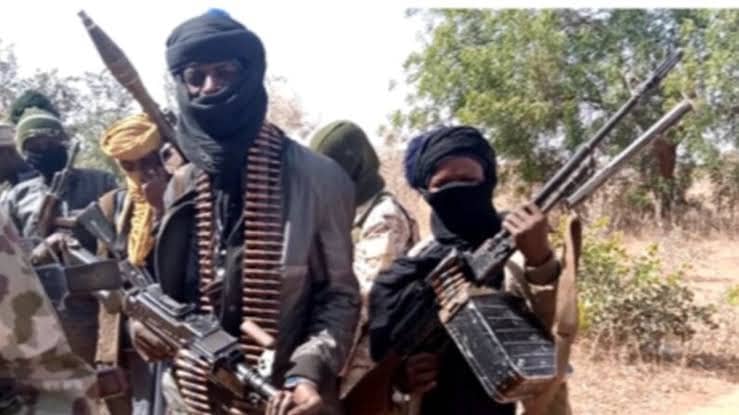
A terror struck on Kagarko area of southern Kaduna when bandits reportedly stormed the palace of the Emir of Kagarko and kidnapped nine of his children and his youngest wife.

Several reports from the state indicated that the bandits, who stormed the area around 11:15 pm, also took away the emir`s grand children and three other residents in the area.

An anonymous source revealed that no sooner had the bandits arrived at the area than they headed directly to the Emir`s residence.

He stated that, “They took away his youngest wife, nine children and grandchildren but the wife escaped and returned back home.

”The bandits also went ahead to kidnap a lady, three other young men and subsequently injured one Audu of Ungwan Pah.”

Meanwhile, The Daily Reality gathered that the victim has been taken to the hospital where he is receiving medical treatment.

“The bandits also killed one herdsman in Kuchimi village and looted seven shops in Janjala village (both in Kagarko LG) on their way back,” the source added.

DSP Muhammed Jalige, the Kaduna Police spokesman, could not be reached for a comment at of the time of filing this report.

My kids will choose their career – Ali Nuhu

By Muhammad Sabiu

The famous Hausa film star, Ali Nuhu, states why he would allow his own children to choose the career of their choice.
 
He added that he would like his son to succeed him in the Kannywood film industry.
 
However, in an interview he granted to the Hausa Section of the BBC, he says his son is more interested in football, which is why he supports him so that he can achieve his goal.
 
Ali Nuhu was quoted as saying, “What the modern age has brought is that if you see your son or daughter wanting something, as long as it is not against religion, then support him and give him encouragement to achieve his goals.”
 

Man kills biological mother in Kano

By Muhammadu Sabiu 
 
Ibrahim Musa, alias Iro Kwarangwal, 22, from Kano, allegedly killed his 50-year-old biological mother, Jummai, by stabbing her during an argument.
 
The unfortunate incident occurred on Wednesday at around 5:30 p.m. in the Karshen Kwalta and Rimin Kebe apartments in the Ungogo Local Government Area of the state.
 
An eyewitness said, “I was standing outside my house when I suddenly heard screaming from the deceased residence.”
 
He stated that when he ran in to see if he could help, he discovered the dead woman wailing for assistance in a pool of her own blood.
 
The culprit is said to have left the scene quickly after allegedly committing the horrible crime against his mother, according to the eyewitness.
 
The deceased was later brought to the hospital on a tricycle with blood all over her body, according to the witness, and was later declared dead there.
 
“She had since yesterday been buried in accordance with Islamic rites. May Allah forgive her and admit her to paradise,” the witness prayed.
 
When reached, Abdullahi Haruna Kiyawa, the Kano Police Command’s public relations officer, confirmed the incident.

DSP Kiyawa later added, via his verified Facebook page, that they arrested the suspect at a hideout in Dawakin Tofa, after which he (Iro) “confessed to the crime and also confessed to dealing in illicit drug abuse.

He will be charged to court upon completion of the investigation.”

The report was updated on 5.5.2023 at 12:50 pm.

Notes on Hadiza Bala Usman’s book, Stepping on Toes

By Abubakar Suleiman

The 200-page book with 17 Chapters titled, “Stepping on Toes: My odyssey at the Nigerian Ports Authority,” is a very interesting book with damning revelations. It is an inside story of Hadiza Bala Usman’s stewardship as the Managing Director of the Nigerian Ports Authority (NPA) and the mess that is the Nigerian public service.

The book is written in simple and straightforward English that even a high school student will comprehend so well. My interest is piqued and waxing stronger from one Chapter to another thereby making the book to be unputdownable.

The first two chapters of the book highlighted the events that summed up her closeness to the former Minister of Transportation, Rt. Hon. Rotimi Ameachi, his recommendation to President Muhammadu Buhari for her appointment as the Managing Director of the Nigerian Ports Authority and the President’s subsequent approval.

Chapters three, four and five discussed the status quo or context in which Hadiza met the top government officials, internal reforms and her steps toward turning the place around for the better. Her innovation or attempts at decongesting the ever tiring Apapa’s traffic was also captured here.

The rest chapters delved into the ‘stepping on toes,’ the root causes of her imbroglio with vested interests in the industry and her boss-cum-witch-hunter and eventually her ‘stepping aside.’ It was either a major player in the industry or contractor breaches the contract agreement with impunity or it was the Minister who wants an extension for a contractor after a procurement process has already commenced.

The final chapter, Chapter 17, was the icing on the cake. If you’re not given to reading books, try to read this last chapter titled “The lessons I learnt.” For anyone who eventually finds themselves in the public service. The chapter needs to be etched in our memories before we get carried away by the allure of wealth or the sweetness that comes with the corridors of power whenever we are called to serve. I implore everyone to read the book especially people who have a tinge of interest in the public service.

It is good that she documented her experiences and travails as the boss of the NPA. Her successor or anybody with an interest in public service will learn some lessons on the political scheming, politics, lobbying, vested interests, backstabbing, soft and tough decisions and, careless and honest mistakes that come with public office.

Some decisions taken by public office holders might seem awkward, insensitive or uninformed but we never could tell the context and variety of information and decision available to them. An autobiography will give us these insights. And I am particularly happy that politicians or public servants are toeing this path of detailing their experiences, thoughts and decisions making in their public service sojourn. We hope, some day, the former Minister of Transportation, Rt. Hon. Ameachi will also write a book so we could get his own version of the story. The revelations are indeed damning.

Without falling for the danger of a single story and without prejudices to Ameachi, Hadiza’s story is not unusual as far as the public service terrain is concerned. From Sanusi Lamido Sanusi to Yewande Sadiku to many other patriotic Nigerians who left the call to serve the nation somehow scathed; it has always been a case of being loyal to the truth and country or being uncritically loyal to your boss or some vested interests who call the shots with impunity and clear disregard for the rule of law and the country’s image and integrity.

The Nigeria’s public service is a very intriguing space and it would be difficult not to step on big toes especially when you really want to carry out reforms or bring about change or sanity in the system. The beginning of your suffering as a Nigerian, whether as a leader or the led, is to insist on following due process in your dealings. With this sole decision, you’ve kissed peace a goodbye.

A reformed minded person will always come onboard with disruptive decisions and vested interests who have enjoyed monopoly, formed cartels and compromised previous and existing civil servants don’t go down without a fight. They will pull all the strings available in the book and it could be done in the most harshest and dirtiest manner.

From getting a court order to restrain you from proceeding with a well planned and thought out process to employing hoodlums to attack you and to using dangerous politicians to fight you on their behalf. And these dangerous tendencies have pushed many intelligent and patriotic people away from public service.

Furthermore, when it comes to feasting or latching on the national cake, the collabo between politicians or vested interests knows no political party, ethnicity or religion. The most important thing for the interests is to just align and every other thing or person is just a chess pawn.

Public service is increasingly becoming a toxic and thorny path many reform-minded persons will not want to toe. Now, should we decline a call to serve our country? The definitive answer to that is no! Whenever you are called to serve the country don’t hesitate to oblige, it is an opportunity to make decent contributions for your country. The public service is too important to be left to the sharks. Go into the public service terrain, get your fair share of scars but make sure you leave an imprint of integrity, transparency and accountability. And in the end, publish your story.

Abubakar Suleiman writes from Kaduna and can be reached via abusuleiman06@gmail.com

Addressing Kano’s environmental challenge under Abba Kabir Yusuf

By Bashir Abdu Muzakkari, Ph.D.

Climate change and environmental control are critical issues that require urgent attention and action from policymakers and leaders around the world. The newly elected governor of Kano State, His Excellency Abba Kabir Yusuf, has outlined a comprehensive plan to address these challenges and promote sustainable environmental practices in Kano state.

One of the key commitments of Abba Kabir Yusuf is the development and implementation of a Kano drainage master plan. Flooding has been a recurrent issue in Kano State, causing damage to infrastructure, disrupting economic activities, and displacing communities. The incoming administration aims to tackle this problem through a well-designed drainage master plan that includes the modernization of existing drainage systems, the construction of new drains, and effective flood control measures. This plan will not only mitigate the impact of flooding but also enhance the resilience of Kano state to climate-related risks.

Another important aspect of Abba’s environmental plan is the reclamation of the Refuse Management and Sanitation Board (REMASAB) and the facilitation of waste-to-wealth initiatives. Proper waste management is crucial for maintaining a clean and healthy environment. The new government will revitalize REMASAB to ensure efficient waste collection, disposal and recycling.

Moreover, his new government to promote waste-to-wealth initiatives, such as composting, recycling, and upcycling, to transform waste into valuable resources, generate employment opportunities, and contribute to the circular economy.

Urban beautification is also a priority in Abba’s plan for climate change and environmental control. He recognizes that a clean, green, and visually appealing urban environment not only enhances the quality of life for residents but also attracts investments and tourism. He also plans to embark on urban beautification initiatives, including landscaping, tree planting, and public space development, to create a more sustainable and aesthetically pleasing urban environment in Kano State.

In addition to this, His Excellency, Abba Kabir Yusuf emphasizes the creation of oxygen banks as part of his environmental plan. Trees play a crucial role in mitigating climate change by absorbing carbon dioxide and releasing oxygen through the process of photosynthesis. He plans to implement a comprehensive tree planting program to combat desertification, enhance ecological control, and improve air quality in Kano State. This includes planting trees in urban areas, along highways and in degraded lands to restore the ecosystem and protect against the adverse effects of climate change.

Furthermore, the governor-elect recognizes the importance of environmental health practitioners in safeguarding public health and promoting environmental sustainability. He aims to reinvigorate the roles and capacities of environmental health practitioners in Kano State through capacity building, training and the provision of necessary tools and resources. This includes ensuring proper enforcement of environmental health regulations, monitoring compliance, and establishing partnerships with relevant stakeholders to enhance environmental governance.

Bashir Abdu Muzakkari writes from Kano

Danmodi and the burden of history in Jigawa

By Kabir Musa Ringim

Now that the election is won and lost, the winners are strategizing and restrategizing, the losers are grieving or heading to court, the politicians are politicking, lobbying, and cross-caperting to be invited to the dining table, the contractors and investors are hoping for their returns on investments, and the technocrats are lurking while the masses are waiting for the transition to start enjoying the dividends of democracy.

Jigawa, as the most peaceful and most homogenous state in the country, witnessed one of the best gubernatorial elections nationwide this year, characterized by being largely peaceful, free, and fair with little or no incident of violence or strife. Contrary to the presumptions prior to the poll, people shamed the rabble-rousers, the agents of disunity, and the promoters of strife with the intent to sow discord and instability by voting the most competent candidate all over the state without minding his zone. It is heartwarming that Mallam Umar Namadi Danmodi won in 26 out of 27 LGAs and got more than 30,000 votes in the remaining LGA; the figure is higher than that of most LGAs thought to be his bases or strongholds.

The result stopped a dangerous precedent that may be the cause of mayhem and instability in our dear state. A few weeks before the elections, both protagonists and antagonists latched onto the intense emotions of the gullible by fueling turmoil to score cheap political goals. It was reported that our hidden enemies with evil agendas were disappointed to learn that we’re still united, and we left no clue as to when and how they will see us divided. Jigawa people are united in every aspect: in faith, language, dress, houses, economy, education, etc. No amount of intrigue, espionage, or blackmail will make us lose our guard and allow the purveyors of hatred to cost us our peaceful coexistence, which was the envy of most states.

But as the transition date of May 29th approaches, I start to sympathize with the incoming governor. The vast expectations on him are far too many. The people are looking up to him as a messiah to rescue them from the pangs of poverty and hunger. The masses hope he will resuscitate the ailing educational sector and revive the falling health sector while maintaining the progress made in the economy, roads, and infrastructure championed by his immediate predecessor. I can say without any fear of contradiction that no Jigawa governor-elect in history has enjoyed the widespread support Danmodi is currently enjoying, to the extent that the opposition is almost crushed and driven into extinction. Thanks to his great personality, personal integrity, magnanimity, and charming character.

The first task of great priority facing the new governor is how to strengthen the peaceful atmosphere by being fair and just to all, irrespective of zone or political affiliation. He should strive to be the governor for all and sundry. Another urgent task of equal importance is that he should put an end to the recent widespread and politically motivated suspension of traditional rulers so as to save our traditional institutions and cultural heritage from mockery and extinction. More importantly, while deciding on his prospective cabinet members, he should consider the technocrats to work with him alongside the usual politicians; I believe he will do this by considering his speeches at the meetings he held with us, the Jigawa academics, at different times in Dutse.

The selection of cabinet members is what determines the success or failure of any administration. The composition of the cabinet will make or break any administration. Danmodi should exercise restraint and not reward political loyalty by imposing incompetence on Jigawa people. As Professor Sheikh Mansur Sokoto recently advised the Zamfara state governor-elect in a widely shared video clip, there are so many ways to reward politicians, not necessarily by appointing them to sensitive positions they are incapable of managing. My advice to Danmodi at this crucial stage is to consider professionalism, competence, capacity, and character when choosing his political appointees. A square peg in a round hole will result in nothing but disaster, and history will not be kind to Danmodi if he enables that.

Secondly, our governor-elect should build on the progress of his predecessors in all sectors and capitalize on their weak areas. Saminu Turaki’s ICT development, Sule Lamido’s institutions and infrastructure, free girl child education, and haihuwa lafiya, Badaru Abubakar’s gains in economy, revenue generation, and infrastructure, should be sustained or resuscitated. Recruitment of teachers and health workers should be treated as a matter of urgent attention. A state of emergency should be declared on poverty and unemployment among youth and women to arrest the sad situation of living in extreme poverty amidst abundance of wealth prospects and means of prosperity. Flood mitigation procedures should be employed so as not to exacerbate the already dire situation of perennial flood incidents.

Lastly, I wish the governor-elect all the best as he steers the affairs of our deer state in the next four years. I pray that he finds a way to deliver in this difficult terrain. The hopes are high, the expectations are immeasurable, and the politicians seeking relevance or appointments are numerous, but the mandate belongs to us, the masses and ordinary citizens, as we are by far the largest in number.

Kabir Musa writes from Ringim and can be reached via ringimkabir@bupoly.edu.ng

Celebrating Babayo Mustapha Charity Foundation

By Mallam Musbahu Magayaki

Humanity is the only language individuals of proven hospitality and character best understand; people with big hearts are the light of society. 

The star of our community has done it again, shining and brightening people’s lives. On March 25th, 2023, the Babayo Mustapha Charity Foundation, under the chairmanship of Bello Mustapha and Kogunan Katagum, distributed over 400 bags of rice, maize flour, and sugar to the economically disadvantaged individuals as Ramadan support for them to break their fast. 

This foundation has been positively impacting the lives of the less privileged for quite some time now, ranging from financial assistance to the downtrodden to academic support to undergraduate students in different higher institutions of learning.

Also, part of his community services is furnishing mosques with mini solar inverters, a gesture that the people of our community immensely appreciate. 

Koguna is the true replica of the late Mustapha Babayo (may he continue to rest in peace) in assisting the people and wearing smiles on commoners’ faces. 

Many, including those outside the Azare community, celebrate the Kogunan of Katagum, a man of the people, the son of the soil, and the most celebrated pillar of our community.

Mallam Musbahu Magayaki writes from Sabon Fegi, Azare, Bauchi State.

Dr Nasiru Yusuf Gawuna has paid his dues

By Ibrahim Siraj Adhama, Ph.D.

The governorship election in Kano has come and gone. The battle has finally been won and lost. No doubt it will go down as one of the most keenly contested guber elections in our State in recent history. At the end of it, a winner emerged in the person of NNPP’s Abba Kabir Yusuf, alias Abba Gida-Gida. While congratulating him, his party and his teeming supporters, it is our collective prayer that Almighty Allah will give him the courage, wisdom, guidance and tenacity to lead Kano to greater heights.

Not unexpectedly, the March 18th election has left in its wake several talking points that will continue to dominate public discussion and intrigues that may take years to unravel. Its outcome will go a long way in shaping the future of Kano politics for a long time to come. Questions will continue to be raised about the legality or otherwise of the returning officer’s result declaration when it appeared there were more registered voters affected by cancellations than the margin of lead between the two candidates with the highest number of votes against the provisions of the 2022 Electoral Act and INEC election guidelines. Not a few people will be tempted to suggest a spectre of legitimacy haunting governor-elect Abba’s declaration arising from that controversy until all doubts are justifiably cleared.

The purpose of this piece, however, is to x-ray the governorship contest vis-a-vis the heroic performance of His Excellency Nasiru Yusuf Gawuna, candidate of the ruling APC, who, despite not winning the big prize, has given a very good account of himself as a great and promising young leader and politician with immense rich and potential. All fair analysts will give it to him that he had fought a good fight.

It is safe to argue that no candidate of a ruling party has gone into an election with many odds working against him as Gawuna in the just-concluded election. From his living under the burdensome shadow of Governor Abdullahi Umar Ganduje to widespread disillusionment against his party, APC, across the levels, from Kwankwasiyya’s massive followership and unflinching determination to effect a change to highly biased and unfriendly media, Gawuna’s task of winning could not be more daunting.

Gawuna contested the election as Ganduje’s backed candidate and a possible successor. One needs to understand how unpopular Ganduje’s government has become to appreciate how much of a liability that was. Ganduje had been practically on a mission to cultivate as many enemies as possible for himself, his administration, his party, his family and everything associated with him. Ganduje had, for a better part of his administration, pressed the self-destruct button.

Ganduje’s controversial land grab and conversion policy, his poor handling of education and students’ welfare, the falling standard of healthcare and poor state of hospitals in the State, his mismanagement of A Daidaita Sahu cyclists, his apparent lack of empathy towards such vulnerable groups as junior workers, pensioners and retirees, his failure to provide leadership towards resolving his party’s internal wranglings thereby causing the defection of key members to opposition parties, among other terrible blunders and unforced errors, Governor Ganduje has made things a lot easier for the opposition NNPP.

With Ganduje, you needed no enemy; he was his government’s number one detractor and his party’s foremost de-campaigner. His largely self-inflicted injury had overshadowed his modest achievements, especially in peace and security, urban renewal, expansion of economic opportunities and general infrastructural development. Hardly do people take note of these achievements.

Consequently, the opposition succeeded in making every declaration of support for Nasiru Gawuna as an endorsement of Ganduje’s litany of “atrocities”. Efforts to prove that the Deputy Governor might not himself be happy with Ganduje’s ways and will almost certainly correct those mistakes, given a chance, were taken with a pinch of salt. Many who campaigned for him faced the daunting challenge of convincing other voters that he would act differently. It’s that difficult!

As the ruling party in control of the centre, the APC did not help matters either. In a move that had the potential of jeopardizing the chances of the party’s candidates nationwide, the Federal Government announced a plan to redesign the country’s currency ostensibly to curb vote-buying and payment of ransom to bandits and kidnappers. This policy, coming on the eve of general elections, fueled speculations within the ruling party itself that certain fifth columnists close to President Muhammadu Buhari were part of a plot to rock the ship of the APC, considering how unprecedented cash crunch riled up already suffering Nigerian masses against the ruling party. Though APC has somehow managed to win the Presidential election and maintain control in most States, the damage done by this ill-advised policy to the party’s electoral fortune could just be imagined.

That His Excellency, Deputy Governor Nasiru Yusuf Gawuna, was able to score nearly nine hundred thousand votes is no mean feat given these circumstances. For me, he should be grateful to Almighty Allah, who made it possible for him to harvest this massive figure in spite of all attempts to rubbish him or undermine his chances using Ganduje’s failures. This feat is majorly attributable to his ability to connect well with some key segments of society who stood by him.

In appreciating Gawuna’s performance, though, I pay little heed to reports of widespread vote-buying. This is due to the realization that both NNPP and APC were culprits; available evidence has shown that the two major parties had tried different tricks at voter inducement. And as experts would say, vote-buying itself works on nothing, and it mostly targets undecided voters.

Since his foray into politics 20 or so years ago, Gawuna has been rising and rising. The outcome of this election represents a temporary setback which does not in any way signify his downfall as naysayers would want to believe. For careful observers of his trajectory in politics, it’s just a matter of time before he recovers and continues to rise higher and higher. Let his detractors know that the man is not going down anytime soon.

With the highest number of votes obtained by an APC gubernatorial candidate anywhere in Nigeria, Gawuna looks set for something very great, especially with an APC federal government of Asiwaju Bola Tinubu in place. No doubt, Gawuna will be an invaluable asset in Jagaban’s cabinet, going by experience. After serving for 20 years as Local Government chairman, commissioner and deputy governor, who knows if Allah is preparing him for national service? Only time will tell, and our prayers are with him now and always!

Dr Ibrahim Siraj Adhama is a Senior Lecturer from the Department of Mass Communication, Bayero University, Kano and can be reached through isiraj.mac@buk.edu.ng.
FUA staff develops app to ease navigating buildings and offices

By Ahmad Deedat Zakari

A staff of Federal University, Kashere, has developed a moblie app to aid lecturers and visitors navigate their way in the university.

The genius staff, Usman Shehu Muhammad, hailed from Fagge, Kano revealed his technological exploitation in a Facebook post on Monday.

Mr Shehu created the Federal University of Kashere Mobile GIS, a mobile software that aids navigation in the university.

Muhammad said in a post: “I’m to introduce a newly developed Android Application, called FUK Mobile GIS. The purpose was to make it easy for visitors, students or lecturers to identify and navigate buildings within the University.

“The application interface is simple to use, it displays the University logo and gives a lists of drop down building names which you can click to search for a building.

Each search you make it displays the hole University buildings in the map highlighting the needed building also a fastest rout either by car or by foot is calculated, identified and drown on the searched map, the map also shows the picture and attribute information about the building like the name of the building, address, distance by foot or road taking.”

He also revealed that the said app would soon be uploaded to Playstore.

Towards addressing Kano’s decrepit health sector: A glimpse into Abba’s policy initiatives

By Bashir Abdu Muzakkari, Ph.D.

Kano State is the most populous state in Nigeria with a projection of over 20 million people. Access to quality and affordable healthcare services in Kano state have been a major challenge for many years which is due to various factors: inadequate healthcare facilities, shortage of healthcare professionals, poverty, and a lack of awareness and enlightenment among the people about the importance of healthcare. The incoming government under His Excellency, Abba K. Yusuf, has made a commitment to revive the healthcare system in the state through a range of initiatives.

One of the major initiatives is the recruitment of human resources for health sector. This is because, Kano has a shortage of healthcare professionals which has led to inadequate access to quality healthcare services. The government aims to attract more healthcare workers to work in the state by providing incentives and partnering with medical schools to train more healthcare experts locally.

The establishment of mobile clinics and ambulance services is also a key initiative of the government. These services will provide basic healthcare services to people living in remote areas who may not have access to healthcare otherwise. Ambulance services ensure that patients can be transported to hospitals quickly in case of an emergency, improving their chances of survival.

The free Maternal and Child Health (MNCH) program is another significant initiative. This program will provide free healthcare services to pregnant women and children under the age of five. This initiative will help in reducing maternal and child mortality rates in the state as more women will have access to free antenatal care and delivery services.

Primary healthcare services are also a priority for the government. The provision of basic healthcare services at the community level helps to reduce the burden on hospitals and clinics. This initiative will help people access healthcare services closer to their homes, especially those in remote areas.

Partnerships and donor coordination in the health sector are also critical. This initiative will lead to increased funding for healthcare services in the state and partnerships with international organizations and donors to improve healthcare infrastructure and services.

The renovation of major hospitals in the state will also be a crucial part of the incoming government’s efforts. This initiative will improve healthcare services and increase patient satisfaction. The government will also encourage private investment in the health sector to improve access to health services.

To make it easier for people, the government will set up a smart contributory health plan. The scheme is aimed at ensuring that people have access to healthcare services regardless of their income level. This initiative has helped poor and marginalized people all over the world to get better access to healthcare services.

Finally, the government will provide support for medical students and doctors in residency training. This ensures that healthcare professionals are adequately trained and prepared to provide high-quality healthcare services.

In conclusion, the incoming government under His Excellency Abba K. Yusuf’s leadership has shown a commitment to improving access to quality and affordable healthcare services in Kano state. If implemented by the government, the initiatives: recruitment of healthcare professionals, establishment of mobile clinics and ambulance services, free maternal and child health program, primary healthcare services, partnership and donor coordination in the health sector, renovation of major hospitals, private investment in the health sector, a contributory health scheme, doctor residency training and support for medical students will contribute to the improvement of healthcare services in Kano state. These initiatives have the potential to transform the healthcare system in the state and improve access to healthcare services for the people of Kano state.

Bashir A. Muzakkari, Ph.D. writes from Kano.