Lifestyle

You can add some category description here.

Let’s promote our culture

By Usama Abdullahi

It’s challenging that we are found wanting in our own culture. We don’t promote it simply because we don’t want to be looked down upon or mocked about it. Western culture has now substituted ours. We assimilate and worship anything western. Ironically, the West doesn’t force their culture on us; we rather westernise ourselves. 

Sometime in 2013, my uncle bought us pizzas. I used to see pizza as the best dish ever, but I was nauseous when I took my first bit. Being in the company of my cousins, I had to conceal my bitter feelings and fake some smiles to fit in. I was pretty low that day. 

For me, pizza is supremely overrated and not as delicious as I thought; it’s aromatic, though. Mind you, I’m not condemning the Italian dish in its entirety. But why do I bring this to light? I felt like sharing my experience, and I want my people to understand that not everything foreign is delectable.

As people with beautiful cultures, we have crazy good dishes that can excite and quench so many aliens’ appetites. Yet, we don’t promote that. We fault it instead. I have watched several western TV shows where the westerners expressed their liking for African culture, particularly their foods.

Arguably, most Nigerians tend to shun and dislike their culture because, to them, it’s worthless. The preference for western dishes leads to the decay of our cultural dishes. Sadly enough, most of the dishes are given western names, which has become difficult to catch on to. Those names don’t correspond and are mostly corrupt versions of the western ones.

Some of us, the so-called civilised ones, erroneously claim that most of our foods are detrimental to one’s health. Though I’m not medical personnel, the little I know tells me that foods like Tuwo provide the body with energy. Awara/Kosai, the most-avoided dishes by the corps d’elite, help build and repair tissues because they are “proteinaceous”. My claims are open to criticism because they are perhaps not well-grounded.

There are others too, which I guess could be harmless and good for consumption if thoroughly examined. It’s time we stopped self-hating or ridiculing ourselves merely because we want to look or sound different, say like the western. Until we promote our culture, our culture will go extinct someday.

Usama Abdullahi wrote from Abuja, Nigeria. Can be reached at usamagayyi@gmail.com.

Lagos declares end of COVID-19 fourth wave

By Muhammad Sabiu


Akin Abayomi, the Lagos State Commissioner for Health, claims that a steady decline in COVID-19 case positive has signalled the end of the state’s fourth wave.


On Saturday, Mr Abayomi made the announcement via his verified Twitter account @ProfAkinolaAbayomi, while presenting the state’s COVID-19 report for January 20.


According to the News Agency of Nigeria (NAN), the state notified the start of the fourth wave on December 7 as the virus’s daily infection rate increased.


According to Mr Abayomi, COVID-19 infection positivity rates have decreased from 29.3 percent on December 21 to 1.9 percent on January 20.


According to him, bed capacity utilization is currently at 2%, with a death rate of 0.71 percent.


On the reporting date, 46 additional infections were confirmed, bringing the total number of COVID-19 illnesses in the state to 98,284.


Since the start of the epidemic in the state, 1,023, 203 sample tests have been performed, he said.


To further minimize the transmission of the virus, Mr Abayomi recommended residents be vaccinated and continue to follow non-pharmaceutical approaches.

Positive and negative influences of cyberspace amongst today’s generation

By Mai-Nasara Muawiya Uzairu

It’s crystal clear that everything that exists on the Earth has a reason(s) for its existence. This is the reason behind our being here. We are now in an age where everything is computerised. Without social media, people would have to continue to live like in the Stone Age without knowing how the world rolls and how things change interchangeably. In my opinion, social media has a vast number of both the positive impacts it creates and the negativity it causes. Although it depends on how one holds and utilises it, the choice solely depends on the social media person.

Many people have recorded successes and achieved their dreams via social media, while others’ remain unfulfilled and stagnant. Social media affects and changes people’s minds about destructive behaviours or otherwise. On the other hand, it sends countless lives to their graves unprepared. Congratulations to those folks for whom social media becomes the reason for their smiles and achievements. May they continue to benefit from the dividends of social media. Best wishes in advance to the future ones who may stir social media with goodness. May they, too, achieve more than today’s beneficiaries achieved, amin. Hard luck to those for whom the reverse is the case.

You are not too late to change the dice rolling with solid hope and unflinching determinations. Many people believe in social media and take it as a means of chatting only with family and friends (FAF) and a means of becoming a nuisance to other people. It is fascinating that whichever group one chooses to belong to will definitely meet people of his ilk or even those who are pretty better than them in that regard. It consists of and explores everything depending on which one decides to choose. I advise you not to be among those who take social media for granted.

Learn, relearn from those great minds, and share your knowledge, experience, and skills with your friends. I call your attention not to share fake news on social platforms. It would be best to share only genuine and beneficial info with your friends, as fake news spreads faster than today’s dreaded virus of todayCOVID-19. Ride your tongue with care; it has a potent venom far better than that of a snake. Mind yourself what you write, share, like, react and comment. Steer clear of unnecessary arguments. Above all, never be addicted to social media impulsively. Manage your time judiciously.

Social media plays a significant role in sharing the development and advancement of today’s generation. Through it, many people make investments and become business tycoons and academic experts, particularly smartly witty ones. Moreover, it helps many connect with their customers and clients from far and distant environments. Without social media, many amongst our business tycoons would not have become what they are today, let alone be known around the world. These include Bill Gates, Otedola Warren Buffet, and Aliko Dangote. All and sundry know these great minds in business circles through cyberspace and their products exclusively. In this regard, we can unanimously say that social media plays a vital role in marketing and economic buoyancy for many of our successful business moguls.

Social media eases and simplifies most things that seem complex. Many people from far distant places have become as familiar and intimate as those with blood consanguinities. We, the generation of social media users, need to use it wisely to avoid hatching rotten eggs among the future generation. We need guidance and parameters to set our activities straight by our great minds who scaled through in life. Our manners need to be replicated for better growth and attainment of better opportunities in this twenty-first, digital century loaded with brouhaha and challenges. Had social media been fully sanitised and sensitised, I am sure the future would have been productive. But, alas! All around us, one can see how the havoc wreaked by people is floating and sinking in a massive wave.

To say a naked and plain truth, children who are yet to reach puberty should be banned from using social media. It is usually the causative factor of their rudeness and moral decadence in society. It is better not to have a child at all than to give a community a notorious child that could threaten the good habits observed by people. Many under-aged children learn to watch pornographic pictures and videos via these platforms.

Fornication, homosexuality and lesbianism could only be eradicated or diminished among our youths by enforcing laws and orders on how social media shall be used. Most parents are lackadaisical in peeping the ins and outs of their children on social media; some are only good at giving birth but very poor in giving moral standards to their children. Children’s phones need to be checked up frequently and unceremoniously. Parents should check to know the children’s friends because bad companies produce harmful products. Friends are the central processors in changing the behaviours of today’s generation, particularly females whose lives are at a zenith than that of males. By so doing, most social vices could reduce to the barest minimum or even be completely wiped away. 

Mai-Nasara Muawiya Uzairu wrote via newmainasara016@gmail.com.

Cultural heterogeneity: Where it comes from, how to confront it?

By Safwan Suhaib Ibrahim

Culture, just like science, is never static. As we read more, travel more and impinge more and more on one another through trade, schools, international and religious organizations, our culture and behaviour patterns become heterogeneous – more cosmopolitanised. As people who are committed to the acquirement of wealth and knowledge for the power and insight they give, we must accept the challenges (?) they come with, which is, “Cultural Dynamism”.

Culture, to put it in a mild way, does not only centre on customs and attitudes inherited from our predecessors or the circulation of folktales by word of mouth. It’s also a formal way of training the young in a body of knowledge or creed, borrowing techniques and fashions of others, adopting and selling new ideas or products. Thus, cultural homogeneity is our – everybody’s – way of life.


It’s often not realised, least of all by a layman, that culture is a step further from people’s traditional food, dress, language, music and ceremonies; rather, it’s the people themselves and the society they live in. The human being is an evolutionary animal who is always assimilating new changes brought about by the socioeconomic wind. As we live, we design our culture and we also get designed by it. The everyday flirtation of native dress, songs, dances and language, skin colour or faith are never what exactly our culture is; they only represent a wee portion of it. Our ideas, our ties, our standards and the logic we reflect on a specific problem that confronts us speak more about our culture. 


We – Hausa – have perpetually claimed to be a unique breed of people who despise, or claim to despise, copying others, especially the Western world, though our current moral attitudes and ceremonies are in no way different from theirs. We’re now men of two worlds. So, It’s, of course, a sheer delusion for some of us to pretend to reject everything they’ve acquired from foreign culture simply because it’s “foreign”, but it’s not foolish to rescue one’s culture from total extinction. There’s a need for the revival of awareness of Hausa culture with its great philosophy and epos of music and poetry, dress and language and its ancient literature, but not a total rejection of foreign or alien culture; for that’s as illusive as self-defeating. 


Lest I be misunderstood, I’m not denying that foreign culture or ideas cannot have a destabilising influence on us (of course they do), but I believe there are some that impart a new impulse that prods us to create a new method of organisation and new hope for development. Thus, before we start thinking of driving those alien cultures and ideologies away, we need to study our culture and our people well. We need to start from the basics. That’s, I think, there’s a wider conception of our culture which we give little or no particular emphasis that needs to be tapped now.

Our respect for elders, hospitality to strangers, our feeling of brotherhood and community, our mutual aid for the provision of support and development of services like health protection and education, our freedom of expression, our readiness to provide an economic surplus to neighbours which was so deep-rooted in us that none was allowed to starve, wander in the street or suffer when there’s anything could be done to help him out, and our democratic statecrafts are all but an adventure to us and our progeny. Don’t you think the fight should be on our abstract, not physical culture? 


Safwan Suhaib Ibrahim sent this article via bagwaisafwan@gmail.com.

Drop that certificate, go after your passion

By Aminu Mohammed

I must confess that I wrote this article due to a post made by a Facebook friend who just completed the NYSC scheme in Jigawa state. In the post made last week, he mentioned his readiness to fall back on his skill as an iron bender to fend for himself, pending when something better comes up.

I was impressed by his sense of reasoning and his zeal to drop his certificate and embrace a vocation to escape idleness and poverty. This has become apt given the current realities in Nigeria, where jobs are pretty limited and difficult to come by.

I know many people, especially recent graduates, will sneer at me for commending this young man for the courage to take responsibility for his own life. They may even wonder why I praised him for choosing to do a “menial job” below his status as a graduate.

But the reality today, coupled with the dwindling economy and limited opportunities for the teeming youths in the country, warranted me to write this article. The era of youths waiting for white-collar jobs is over. Many graduates are roaming the streets looking for elusive jobs. Typically, the few jobs available will be taken by the best candidates and those with a connection at the high places. Thus, most applicants are left with the option of either staying idle at home or embracing any vocation or skill to earn a living.

Let me clarify that I am not a motivational speaker, and neither do I claim to have a magic wand to turn silver to gold. But I believe in pragmatism, and the ability one has to achieve his goal if he has passion and works towards it. Passion is the only thing that can keep a man steadfast in his pursuit of success irrespective of the difficulties on his path. Your certificate will amount to nothing if you cannot shun pride and seek a means to earn a living.

I still recall my NYSC days nostalgically in the Numan, Adamawa state, 19 years ago. I did my primary assignment at Government Secondary School Pare, Numan, which gave me ample opportunity to engage in external activities. I kept myself busy outside school hours by selling clothes and shoes to augment the N7500 NYSC monthly allowance. I didn’t spend much out of my monthly stipend throughout the service year because my side business could cover my living expenses. I completed my NYSC in 2003 and engaged in various activities to earn a living for three years before I got my first job in August 2006.

During the service year in Adamawa state, I observed a stark difference in the mindset between some southern corps members that I interacted with and their northern counterparts. While some southern corps members engaged in all sorts of activities to earn income, some of their northern colleagues see those activities as demeaning to their status as graduates. Some of the southern corps members then decided to stay in Adamawa after the service year to continue their hustle, and many have prospered.

I still remember a friend we served in the same local government area, Mr Ifeanyi, a pharmacist from Anambra state. He did his primary assignment at the General Hospital, Numan and subsequently moved to Yola to set up a pharmacy after the service year. He was able to prosper a few years after the NYSC scheme due to his doggedness and zeal.

I decided to narrate this story to encourage our youth to shun pride and find a means or trade to improve their wellbeing. Acquiring education is just a means to enable you to unlock your potential. That you have a degree should not make you despise other vocations. Instead, find a work you are interested in and try to acquire the requisite skills to support yourself. Life after NYSC is tough, and the labour market is almost saturated due to many unemployed people seeking jobs.

I am not saying that our youth should focus only on entrepreneurship alone and abandon their certificate by not seeking jobs. Of course, not everybody has an inclination towards business and entrepreneurship. But for those that have no interest in entrepreneurship could learn other skills via the internet. Skills such as digital marketing, affiliate marketing, and web development are there for people interested in learning to earn an income.

In Germany, young people acquire skills in various fields through the vocational system popularly called “Ausbildung”. I admire the German Ausbildung system because a student attends school and works simultaneously. The student acquires theoretical and practical knowledge during the duration of the apprenticeship, which usually lasts three years. The training focuses on practical skills for actual work and includes several skills such as plumbing, software development, landscaping, mason, baking, painting, salesperson, nursing, care for the elderly, and electrician.

Those who completed the training earn very well just like their counterparts who obtained a degree in Germany. Ausbildung is highly valued in Germany, and the need for craftsmen is always on the rise here. German society has been structured so that virtually all jobs are accorded due respect. Nobody looks down on a painter, electrician, carpenter or mason in Germany, unlike what we do in Nigeria. Most of our youths, especially graduates from the North, shy away from doing those jobs as they see them as not befitting their status. Some prefer to remain idle at home while hoping to get a job. There is dignity in labour, and it is quite normal to see a female painter, mason or female plumber in cities across Germany.

Therefore, the onus is on the youth to follow their passion and strive to achieve their personal goals. Efforts should be placed on personal development through reading and skills acquisition. For instance, if you have an interest in baking, do not hesitate to go and learn it to support yourself, likewise any other skill. Life favours the meek and those who shun societal pressures and go after their passion and dream.

I will also urge our young men, especially new graduates, to leave their comfort zone. If you think that opportunities are very limited in your locality, there is no harm in moving to another city to take advantage of better opportunities there.

Do not hesitate to read good books, as it opens your mind to great possibilities. Scholarships are also available for those who are interested in studying abroad. You can use Google to search for scholarships in various universities across Europe, Asia, Canada and the United States. There are multiple scholarships worldwide for you to apply for, and there is no harm in trying. You could be lucky to get one if you meet the requirements and expectations even though it is highly competitive. Do not be discouraged if your application is rejected but continue to persevere and reapply to other scholarships. I also faced many rejections while seeking admission in Germany.

Take a look within your locality and find something to do. You can volunteer your time and energy to learn something new or even work on a farm. Don’t bother about what people will say; so far, you have a target and a dream of where you want to go. Try to get busy with something no matter how small it is, pending when you get the desired job. Remember that many big organisations and establishments that you see today started small several years ago. May Allah bless our hustle and efforts as we strive to achieve our goals this year.

Aminu Mohammed is at the school of Sustainability, Christian- Albrechts- Universität zu Kiel, Schleswig Holstein, Germany. He can be reached via gravity23n@gmail.com.

How tailoring saves my father

By Lawan Bukar Maigana 

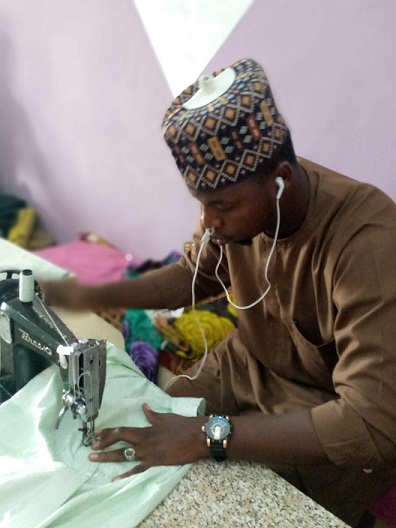
I learned tailoring before I finished secondary school. I can still remember when my patient father asked my mother to stop me from going to the tailoring shop. I begged her to beg him to allow me to continue going. Thus, she politely explained the importance of allowing me to be an entrepreneur. Luckily, she okayed everything she said and allowed me to continue learning.

I took myself to my boss Babakura Lawan. I was passing by and saw my friends working in his blessed shop. I stopped by, met him, and told him that, “You are my older brother’s friend. Thus, please, teach me how to tailor.”

I knew the way I talked to him wasn’t friendly at all. I was battling childhood at that time. He kindly responded, telling me that he agreed and would teach me if I genuinely wanted to learn it.

It was an unforgettable experience. Guess what! I started sewing in two weeks because of my commitment to learning it. It worked out for me. Tailoring has helped me a lot in both Polytechnic and the University. I would have disturbed my father with many monetary requests if I had been unskilled.

I can’t describe how much grateful I am to my boss. He helped me a lot. I can still remember the times I reported him to my father because he bombarded me with many works. He told me that he gives me more work than others in the shop because he trusts my work.

Graduates who are still unemployed and seeking jobs shouldn’t feel they are late to learn paying entrepreneurial skills such as tailoring and carpentry.

My brotherly advice to graduates is: do not allow arrogance to consume them. Whoever is arrogant may fail in life, especially if they are poor. It is not too late. Stop spending much time on social media. Learn some skills, hard or soft, online or offline.

Look for any learnable skills and learn. We all know that there are no available jobs for poor Nigerians. Only a few will have the opportunity to be employed. So kill the arrogance in you!

Babakura Lawan is a graduate of accountancy from the University of Maiduguri. He has trained more than 25 people in Bolori I, Maiduguri. I called on the federal and Borno State governments to please engage people like him to teach as many graduates as possible. We need many of his likes in Nigeria. 

Lawan Bukar Maigana wrote from Maiduguri and can be reached via lawanbukarmaigana@gmail.com.

Restructuring Northern Nigerian divorces’ mindsets

By Hussaina Sufyan Ahmed

We can categorically define a divorcee as someone unlucky in a specific marriage. I know that I will be in the minority if I say divorcees are given less chance to develop themselves personally before getting pressured into remarrying in the Northern part of Nigeria.

I understand and appreciate the concern with threading carefully regarding resuscitated emotions and intimate urges. However, a ‘decent’ society like Northern Nigeria expects that you abide by the rules of decency in ensuring that you either preserve yourself for your next spouse or remarry to avoid falling into the traps of indecency.

In this aspect, indecency refers to the lack of adhering to the control of urges for every culturally and religiously conscious person. These traits are seen as the signs of responsibility, including sustaining oneself; ready to take up self-evaluation, focusing on goodness, and maintaining dignity.

The pressure that comes from the family, society and whatnot is justifiable. However, the pressure that comes with engaging these divorcees in personal development is a progressive vacuum seat.

A divorcee can either be a man or a woman. But statistics show that a woman is more affected by divorce financially while a man is affected mentally. But, of course, this assertion is opinionated, as there can exist other varying opinions.

Let’s take Kano State as a case study. In 2020, Dr Sabo Dambazau, in an interview with Kano Focus, said 45% of divorces in Kano are caused by co-wife rivalry. Other causes he highlighted include forced marriage, fake identity by the men before marriage, lack of catering for family financial affairs succinctly, and suspicion from either the man or the woman.

For Dambazau, a lack of trust causes suspicion. And this distrust is seen in wives taking their husbands’ phones. Often, both check each other’s phones.

According to Dambazau, couples need counselling, personality development, and consciousness of Islamic teachings through the actual practice of the teachings to reduce divorce. This can be supported by enrolling in Islamic schools. He ended with advice on staying genuine and honest during the courtship before marriage.

My scope will be Personal Development for the Divorcee. It is essential to know that learning and seeking knowledge are the two fundamental processes that every human should consciously and intentionally be involved in.

As a divorcee, the first focus should be personal development. And this cannot be achieved without being intentional about self-development. So, how do you achieve personal development?

As someone who might have gone through emotional downturns or physical battles in their marriage,  self-development evaluation is a facet to help you check yourself and correct the mistakes you might have made. Every human is fallible. Hence the premise of every divorce is that both parties have a role to play in the faults. However, one side usually weighed in as more wrong than the other. Still, there is never a party devoid of guilt(s). So, you use the experience of a failed marriage to build your knowledge about marriage if you wish to be in it again.

In trying times, maintaining spirituality is crucial. In the North, an epitomic feature is the presence of religious rooms to learn from – while you rule in self-development. You cannot rule out upgrading your belief. For instance, there are many Islamic schools for Muslim divorcees in various Northern states. And seeking the appropriate knowledge through such schools enhance and contribute to the upliftment of morale.

This sums up an inference of a child’s upbringing in a typical Northern Muslim home. Thus, before reaching the age of five, recitation of verses from the Quran begins, opening the ability to read and recite rhymes and books in western schools. So, who says learning has a boundary or specific scope?

Another aspect of personal development is acquiring soft skills. For some female divorcees, one of the reasons their families or society has pressured them is usually due to self-sustenance. A woman in a non-secular community like the North has to either sustain herself financially, be under her parents or a man. You do not have to rush into another marriage to develop yourself personally. Instead, go out and learn soft skills such as MS Office, graphic design, Corel Draw, Digital marketing, social media management, online journalism, etc. You can acquire most of these skills online or offline for free or pay a token, especially if you desire to get the certificate.

Personal development stretches out to unlearning, learning and relearning, and in this, we cannot rule out upgrading education level to the next stage. If you are a primary school certificate holder, secure a secondary admission. If you are a secondary school certificate holder, try and acquire a UTME form, sit for the exams, and pursue admission, even if it’s a polytechnic or college of education. And for a bachelor’s degree holder, it is easier though costlier, which makes it essential to personally develop the self so as far as there is determination and hard work.

In all of these, I suggest that families and society give premium corporations to divorcees to see that they are helped towards self-development and not pressured to remarry. Of course, marriage can come later but having productive and oriented divorcees instead of a new payroll of reproductions will push the nation’s economy forward.

“Read. Read in the name of thy Lord who created; [He] created the human being from a blood clot. Read in the name of thy Lord who taught by the pen: [He] taught the human being what he did not know” (Quran, 96: 1-5).

Hussaina Sufyan Ahmed wrote from Kano. She can be reached via sufyanhussainaahmed@gmail.com.

My life, my choice: Why I rejected university job for catering (II)

By Aisha Musa Auyo 

Coursework lasted for four months. I enjoyed it as it’s Psychology, and got excellent results. But I couldn’t go back as planned, as I had already enrolled my kids in school. I complained to my parents about my lack of a job and how relatively boring it was to stay without my husband. They promised to do something about that. I ventured into the catering business full-time while my husband and I were still making plans to reunite. Fortunately, another transfer was by the corner, so the goal is to wait and see the posting. Living alone was getting harder for him and affecting his work productivity. No man wants to go home to an empty house. No man wants to be eating out every day; the inconveniences are just too numerous.

On my side, I felt empty and taking care of the home and raising the kids alone was taking a toll on me. He could only come once a month and spend two to three days. His kids saw him as a stranger. Although we were constantly on video calls, it’s not the same as being present.

An opportunity for a university job came, but I rejected the offer, explaining that we were leaving as soon as the transfer came out. The one and half years we did apart as couples have taught us never to try that again; I’ve changed my decision on work. I called my husband, told him about the offer, and made it clear I was not accepting it. He advised I should not do anything hasty, but I remained unshaken. Any job that would tie me to one place and make me apart from my husband is not worth it. At that time, the transfer came out, and the location was not travel-friendly. His workload too would not allow unnecessary travel, so the job is a big No for me. 

However, People judge from afar and couldn’t hide their disappointment of me not working in a cooperative world. A neighbour looked into my face and told me, ‘if you reject the job because of your husband, I swear you will regret this decision’.

 I was not saying I would not work outside my kitchen, but whatever my work is, it shouldn’t be the one that would split my family apart. One should not be surprised if they see me working outside home tomorrow if the work was within the place I stay and can offer transfer whenever we are made to leave the state. So, yes, my future work should revolve around my husband’s work state.

But for now, I choose catering, and I decide to do what works for me. Who knows it, feels it. Those who mattered have accepted and made peace with my decision. The challenge now is balancing the catering business with my PhD thesis.

Let me explain why my parents want us to pursue these degrees. They are university professors, have few kids, with guaranteed pension and gratuity. So, they don’t need any financial help from us. But they want us to be independent and financially stable. In addition, they want us to be highly educated and respected. As parents of girls, in this era of divorce, irresponsibility, and many life uncertainties, they know the best they could give us is this education.

Our parents often tell us that they’re not rich; they won’t leave us with mansions and millions when they die. This education is the only legacy they have, and I understand them. The University environment does that to its inhabitants. This is a general problem ‘we quarters’ children’ face.

A neighbour of mine whom we came from the same quarters made a similar decision not to work or further her education. She told me how her dad used to compare her to coursemates, that they’re all PhD holders now and doing great things in the university. Thus, he always begged her to at least further her education. To our parents, a bachelor’s degree is never enough.

To say I’m grateful to my parents is an understatement. Wallahi, I often cry, knowing I can never pay them for all they did to me. They’ve given and are still giving me the best of everything; we are over-pampered. We are the envy of our peers, and we have achieved so much at young ages due to their persistence and guidance. It’s not only Boko (Western education) they gave us; they also ensured all of us have memorised the Quran at young ages and have attended multiple Islamic schools and conferences.

Moreover, they have our best interests at heart; they are even overprotective. So I’m not only grateful, but I always feel indebted. All I do is pray for them to have the best of here and hereafter. Now, this story is history as I’ve eaten my cake and still have it. I’m doing my PhD while my family have been reunited. A postgraduate program is temporary and flexible. I’m glad I followed my parents’ advice, thanks to them, I’ll be a young Dr soon inshaAllah.

The lessons here are:

1. Allow, guide and encourage children to follow their dreams and passion. The result is a win-win, as parents won’t have to push the kids to work or study hard. Passion naturally breeds excellence.

2. Don’t make or set life goals too early. Be open-minded. The definition of success is very dynamic. Our dreams can change as we advance in age and transition from stage to stage in life.

3. Accept people’s decisions even if you have power over them. Just pray, and let them face the consequences. If it turns out good, that’s great. If it turns out bad, that’s a lesson, not a failure. All decisions are born from real-life experiences and or reading that change one’s line of thinking or learning an idea somewhere that sparks one’s interest in something.

4. When your passion is what you do for a living, your life will be happier thus healthier. The fulfilment and peace are on another level.

5. Diversify your knowledge and skill. Don’t just dwell on a single niche and plan your life around that. Don’t pigeonhole your thinking into believing that “I am a civil servant” or “I am a business person” and nothing else. It’s too dangerous. Life is dynamic; even if you chase degrees, learn a skill or trade. Government jobs are not guaranteed. Priorities also change, especially for women. For instance, my catering business has never been affected, even though I’ve been moving around. Cooperate jobs will not have been this flexible. 

6. Read, read, and read. Learn, unlearn, and relearn. Reading is an art that teaches one about life beyond their daily reality. Reading could help you avoid many problems, crises, and misunderstandings. Reading changes one’s outlook towards life makes one understand himself, those around him and the world better.

7. People should learn to mind their business and respect other people’s choices. Every individual is entitled to their decision. Making derogatory comments, asking personal questions, or judging based on half-baked information hurts. Many people think my husband, as an Ustaz, dictates my decision to be a housewife for now. On the contrary, he supports, pushes, and encourages me to work hard on my school projects. When I told him about the university job offer, he was willing to sacrifice. I single-handedly decided to reject it. He promotes my thesis and business on their tv channels. He pays for my air tickets whenever I need to see my supervisor and lots more.

8. Sometimes, one needs to stand firm on his decision, especially about his own life. Sometimes, one needs to put himself first; it’s not selfishness.

9. A married woman can actualise her dreams, career, and aspirations with a husband’s support.

10. To achieve greatness, one needs to make sacrifices. Success has never been achieved without struggle.

Finally, and most importantly, pray hard for God’s guidance on whatever decision or journey you want to embark upon. With a clean heart and good intentions, trust Allah to be always there for you.

Aisha Musa Auyo is the CEO of Auyo’s Cuisine and wrote from Abuja. She can be contacted via aishamuauyo@gmail.com.


My life, my choice: Why I rejected university job for catering (I)

By Aisha Musa Auyo 

Today, as a wife and mother, my definition of success is being an excellent homemaker that nourishes and nurtures my family in the best way possible. I want my topmost contribution to the world to be a set of individuals who are peaceful, loving, respectful, intelligent, honest and hardworking people. I want to be more successful as a homemaker than in school. I want to be always there for my family, not relying on others to discharge my primary responsibilities. Today, this is my priority!

In the world of academia, nothing counts better than degrees and working in the university. I was born and brought up in that world. My parents are academics, and their dream for us is to have as many degrees as possible and as early as possible. We know nothing but books. And lucky enough, the books love us.

I finish secondary school at 16 and my bachelor’s degree at 20. I wanted to be a doctor like every brilliant student, but life had it; I had a chronic ulcer in my teenage age. Thus, I was always in and out of the hospital. That ailment made my dad change his mind about letting me study medicine. He said he couldn’t stand seeing my dream and hard work being crushed by (University) Senate committees because I was sick and couldn’t write or pass medical school examinations. “I’m in the committee for years, and I know these things”, he told me.

That’s how I was advised to study education. It was not what I wanted, so I wrote exams to pass, not to fail. I graduated with a 3.46 CGPA, below almost everyone’s expectations. I’m always known for acing my exams. The least they expected from me was 2:1. I learned not to do what I didn’t want from that result, never again. It’s either “A” or nothing. 

I have a passion for cooking, and it’s known to everyone around me. So, after graduation, my mom enrolled me in a catering and hospitality management program –to ‘kill’ time before the mandatory National Youth Service Corps (NYSC) scheme. I gave that program my all and finished with an excellent result.

I got married a few days after my catering program. The plan was to live in our state, but my husband was transferred to another state two weeks after marriage. So, NYSC came, and I was posted to my home state as planned. However, I was alone, and my husband had to travel to and fro every week to his place of work and his new bride. It wasn’t easy on us, and we decided to stay together after service.

But before finishing my service, my parents advised me to register for a master’s degree. So, I started lectures a few days after my POP. Unfortunately, this delayed our decision to stay together with my husband, as we are constantly travelling to meet each other whenever we have a break in school and work, respectively. Fortunately, the master’s coursework is an 8-month program. So, I left the state immediately to settle with my husband, coming to school every month to see my supervisor. But this time around, I decided to study what I wanted.

I had to convince them that I couldn’t give it my all if it were something I didn’t like. Let’s negotiate; you want master’s, huh? Let it be something I like so that I’ll bring you the “As” you always want, I said to them. My parents wanted me to major in Biology, but I wanted Psychology, as it’s the only thing that caught my interest in education. It’s the only thing close to my medical career dream. Thus, I studied it with passion and graduated with First Class honours!

At 22, I was the youngest and the only one without a job in our class. The result proves to me passion breeds excellence. Kiyosaki’s Rich Dad, Poor Dad, and Angela Duckworth’s Grit taught and encouraged me to make employment out of what I love. They taught me how working on one’s passion can bring money effortlessly. I learned and practised making money out of what I love – cooking. Catering allows me to work in the comfort of my home, regardless of the location. People must eat anywhere, and many of them appreciate good food. Nonetheless, this passion of mine generates controversies.

Since I was young, those who have known me always thought this girl’s future was in academia. She’s a bookworm, brilliant, etc. So, they’re disappointed; such a waste of intelligence! Some bold ones even ask why I don’t work. Won’t your husband let you work? Why are you furthering your education since he will not let you work? Why continue wasting time, energy and resources on school if you don’t want to work? This and that.

Back to my academic life, I continued travelling from where I stayed to where I schooled, and vice-versa for my thesis until another transfer came – too far away location now. At that time, I was almost done with my master’s thesis as I was waiting for external defence. I had to wait for good eight months before I was called. Travelling from the new location to the university was far and stressful, as one had to travel by air.  So, there’s additional strain on travelling and financing. I had two kids then, and I travelled with them whenever school called.

We went for the viva, which was so relieving. At least now we can rest, I thought. A few weeks later, my parents advised me to register for a PhD. I tried to convince them that the distance was too much, promising them that I’d do that whenever I settled in one place, not now that I’m on the move. I also told them PhD was for those with a career in academia and that I was not working yet.

Moreover, a PhD is expensive, and I have never seen a self-sponsored unemployed candidate doing that. I even argued that at 26, I was too young for a PhD. But no, they would not hear me. I didn’t want to hurt them or make them think that I put my husband before them; I applied. They were delighted.

I went for the aptitude test, and my score was high. I was ranked the second-best; my admission number is 00001—the first to be given admission that year. But deep down, my husband and I were not comfortable with the decision. We thought it was too early to be living apart as our marriage was still young, less than ten years. Within me, I have this fear of what would happen to my marriage? Should I leave my husband and come to pursue worldly degrees? It’s not like he failed in any of his responsibilities. He is, in fact, the one sponsoring the PhD.

Being in the barracks has opened up my eyes to the realities of life. Sadly, gentlemen turned to womanisers due to a lack of family around. I have seen how northern Muslim men change or are lured and tempted by the evils of the world. I have seen many scary things that I had never thought could exist or happen. Even though living alone should not be an excuse for their behaviour, their bad behaviour couldn’t have escalated to that level. I vowed never to leave my man at the mercies of those home breakers, so I planned to go back immediately after coursework.

Aisha Musa Auyo is the CEO of Auyo’s Cuisine and wrote from Abuja. She can be contacted via aishamuauyo@gmail.com.

Are persons with disabilities rightless? An open letter to Jigawa North-East politicians

By Abubakar Umar Gbs

Dear Sirs/Madams,

Let me start with these questions: Who among you has ever included people with disabilities in their empowerment programs? Who among you has ever offered a single person with a disability a job? Who among you has ever appointed a person with a disability as his aide? Finally, who among you has ever sponsored their basic diploma, NCE, or undergraduate program?

Since the 2015 election, Persons with Disabilities (PwDs) in the said region have suffered negligence from you even though they voted for you like everyone else. You do not consider them for empowerment, job provisions, educational supports, and so on. For basic education, many of their parents cannot take them to the only deaf school in Hadejia because of their physical location. There is no school for the blinds in the region, making it difficult for parents of blind children to take their children to school. The cripples, too, suffer going to school because of the absence of tricycles or other accessibility measures.

Please note that their defects made them require special needs, which means they should be given ‘special’ consideration in all aspects. Their needs should equitably be granted. They require inclusion, equal treatment, but this is not the case in the region as “those not in need are given more than those in need” or “those not in need are given what those in need needed the most.”

At this time, we have many PwDs from all over the region who have qualifications doing some handwork and are expecting jobs because their impairment may affect them doing other self-employed jobs. Some want to start a business but do not have the capital to kickstart. Some have hidden talents but do not dare to put them into practice or are being discriminated against in government and private companies, making them wait for government jobs which you (politicians) have the opportunity to offer them. 

There is one disabled lady who completed her NCE 5 years ago, but until now, she hasn’t secured any job or any seed capital to start a business as she complained.

Where are all those offers you are giving your people? Where are all those empowerment packs you are giving to your people? Did you know how it feels to have a defect in any body part? What if one of your children has a defect?

Imagine the son of less privileged parents with physical defects. They are citizens who have equal rights to education, health, and human rights. Sometimes, you will ask for what belongs to you from a serving leader like you, but you will be labelled a beggar. How can someone beg for what belongs to him? You begged them for votes that don’t belong to you but themselves and took them for granted after that. Their exclusion in campaigns has reasons as we can’t expect crippled men to take their bikes or join campaigners to go far and campaign. In the meantime, you can expect a blind man to do so too, so the deaf has his limitations.

Every citizen, irrespective of disability, race, tribe, or religion, deserves to be treated equally as per the constitution. Also, traditionally, persons with disabilities have equal rights, even if not constitutional. They have 100% rights, and that should be respected.

We know how well you perform, but the ‘well’ is not enough until you put PwDs’ rights on top of the agenda because society needs them. If they are neglected, they retort to some odd jobs to survive life which I don’t see their mistakes.

Thank you

Abubakar Umar Gbs sent the letter via abubakargbs@gmail.com.