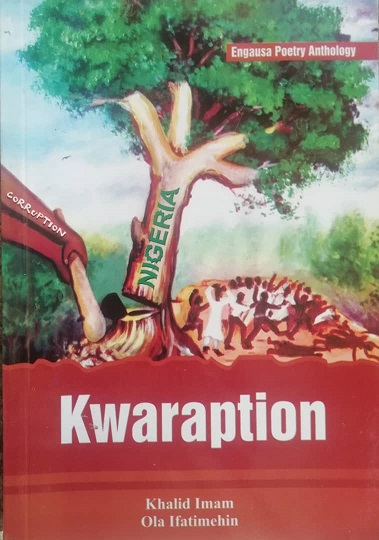
Book Title: Kwaraption
Editors: Khalid Imam and Ola Ifatimehin
Type: Anthology of poetry written in Engausa
Publisher: Whetstone Art and Information Service
Pages: 72
Year of publication: 2021
Introduction:
Although not simple to define, corruption is a major impediment and barrier to Nigeria’s progress. For many years the country suffers a lack of infrastructure and poor condition of living because of corruption, which not only stagnates the nation but also derails it from the path of progress. Although more endemic now than ever before, the story of corruption in Nigeria is at least very old.
A missionary teacher in Kano, Madam Ethel Daniel Miller (who came to Kano in 1917) in her book The change here in Kano complained of a prince from the emirate that gifted her a set of clothes for the simple reason that she is a sister to Dr Walter Miller, thinking that she could influence his choice as a successor to the throne.
Other examples can be found in fictional works such as Magana Jari Ce (1937), where Dan’iya bribed a police officer to deceive his friend, Daudu, in a story titled “An ƙi cin biri an ci dila.” The case of Obi Okonkwo in Achebe’s No longer at ease (1960) and that of The Incorruptible Judge (1962) by Olu Olagoke were just a few out of many similar cases. These are clear indications of how writers used their pen to expose and sometimes fight corruption since the beginning of Nigeria formation.
This anthology of poetry edited by indefatigable Khalid Imam and awesome Ola Ifatimehin contains 51 poems contributed by 45 poets. Nearly half of the contributors are female writers, which is a clear indication that females have come of age in terms of literature in northern Nigeria.
The title of the book “Kwaraption” is a Hausa and English attempt at pronouncing corruption. While the first, “kwara” part is just the Hausa sound of the first four letters, “corru” (in a word corruption), the second part was derived from the last for letters (ption) of the original word. In other words, kwaraption is a corrupt way of saying corruption. Instead of the editors using Hausa translation of the word corruption which is loosely translated as Cin-hanci or Rashawa, or just writing Hausa variant of corruption as kwarafshin, they decided to retain part of the original English words. This is to portray the uniqueness of the work as an anthology of poems written using Engausa which involves coding switch or mixing of languages (English and Hausa) with a view to achieving artistical beauty and increasing richness of literature.
An Appreciation of Some of the Poems in the Collection
Looking at the anthology, one can understand that the poems covered a wide range of issues of interest as far as corruption in Nigeria is concerned. Some of the issues covered are:
- Recognizing Nigeria as a rich country which is very blessed with both human and material resources, but whose citizens are poor because of corruption and other social vices.
“ƙasa mai albarka da albarkatu,
mai attajirai, masu ilmi da ‘yan siyasa” Hafsa Ja’afar in a poem titled Rashawa (p. 30).
- The state of the country as far as corruption is concern. For example, Ameer Nasir in Cutar Zamani described the country as one having expertise in corruption to the extent that it is difficult to separate us from corruption “tamkar jini da hanta” (p.17). Basheer Adam Gobir assumes that ‘almost everyone’ in the country is corrupt (p.23). Similarly, Farida Mohammed Shehuin Abin Takaice (p.24)and Khalid Imam (p.37) see corruption as a hazard whose impact is everywhere; mosque, church and in all places, and Khalid particularly described corruption as ‘flood’ that destroys (Corruption Everywhere, p.39). Khadija Hanga in her poem titled Despicable Diseases sees corruption as marriageable girl, however dubious whose main goal is to deceive “a fool”. In fact, as captured by Ola in his allegory, “Kukan Kurciya”, corruption is now “new education”. Because we are so accustomed to corruption that we are given it good names and the corrupt person were assumed to be philanthropist as captured in a poem Philanthropist na gangan (p.26) “barazanar ɗan ta’adda ba ta mayar da shi gwarzo”. Also, YZ Ya’u corroborates this in his “Sai Mai Taimako”. Umma Aliyu educates us on different forms of corruption that we don’t see as such due to level of societal decay.
- Looking at corruption as a cause to many problems this country witnesses. For example, in a poem “Tick” byAbubakar Isah Baba, corruption is responsible for poverty and insecurity;
It causes abubuwa masu yawa,
Poverty mai kashe gwiwa,
Insecurity mai karkatse rayuwa,
Ga misalan scandals nan da yawa.”
In “Lamentations for a Country,” Adesina Ajala blamed corruption for dividing the country along many social layers “Corruption is the common denominator that divides this land without fractions.” The division is along religious, ethnic, regional and even occupational strata. In “Gobarar Daji” Yahaya Abubakar sees corruption as “alpha and Omega”, hence, the chance of getting out of the current quagmire is very slim,
“ta yaya za mu yi rayuwa sustainable,
tattalin arziƙinmu disabled.”
Bashir Umar blames corruption for bankrolling the country such that it cannot meet its basic needs, he sees it as embarrassing that the country now relies on foreign aid for its development “wai yau ni ke neman aid from foreign organization”. The writers believed that Nigeria has taken a poisonous venom, whose effect transmitted to the children, making them engaged in killing one another “mun ɗauki kansakali, maimakon magani.” Ajuji in his “Bragging da Kayan Sata” captures an attribute of a corrupt person.
“there stand akimbo…
carrying pot belly,
like expected mother.”
- Trying to understand the dynamism and causes of corruption is one other focus of the poets in the anthology. Amatullah Saulawa in her “We shall not be afraid” boldly says:
“yes, it is our faults,
if dictators shift gears,
we bring them back” (p.15).
This is a similar submission of Maryam Baffer in the poem “Har da ni”. However, the politicians are most blamed in the collection because they stand for it
“ko da tsiya ko da tsiya tsiya
sun kasa
sun tsare,
sun raka,
sun rabe”
as stated by Hafsa Ja’afar in Rashawa (p. 30). Lynda Mustapha in her two poems “Write it down” and “Buhu-buhun Iskanc”i blamed politicians for perpetrating corruption in the country. Moses Odozie writes on corrupt civil servants whom he nicknamed “Ɓarawo mai Biro”. Murtala Uba Mohammed, in his poem “Corrupt Nation”, believed that corruption is not limited to politicians, there is also the police, court and parents (p.51).
- The writers are tense of corruption and eagerly want it to end. Adesina Ajala said;
“Yaushe zamu warke daga wannan ciwon ne?
Wa zai haska fitilar gaskiya cikin wannan duhun baƙi?”.
Corruption is here seen as a wound that needs to be cured and darkness of a night that should be put in the light. In “The Oak Tree”, Aliyu voices out; “yet we hope for betterment”
- The authors not only lamented over the problem, they also recommended some solutions to the problem. Madinah Abdussalam in his “Yours and Mine” sees the solution as public, that every person should do it himself. He says “who will end corruption in ba mu ba”.
In “Soyyayar Corruption” by Elizabeth Zephaniah, the public is seen as a solution, she metaphorically states “yaushe za mu ga eagle na fighting corruption”. Musa Adam was also having a similar view in his “My father’s 61st Rebirth”. Some of the poets expressed unity as an important factor in the fight against corruption, “dole we have to be united” as stated by Haneefa Musa Isah in her poem “Mu haɗa kai” (p 31). Also, Sani Abdullahi Salisu in his Kwarapshin (p.61).
Engausa
It was not surprising when I saw this anthology. This is because of my prior knowledge of the debate that started on the page of APNETi when Dr Ola began to release his poems in a fashion of code switch, mixing English with the Hausa language which Khalid and some other members called ENGAUSA and opined that it is new and welcomed development. Some members of the group, most especially Professor Yusuf Adamu objected to that saying that language blend and code switch is not new in poetry particularly among Hausa poets citing a popular line of late Nai’ibi Sulaiman Wali in his poem Damina
“… su yi kasuwa su yi kantuna,
kowa busy sai su damina.
Yaran gari ko sai bal suke,
kowa ka duba very happy…”.
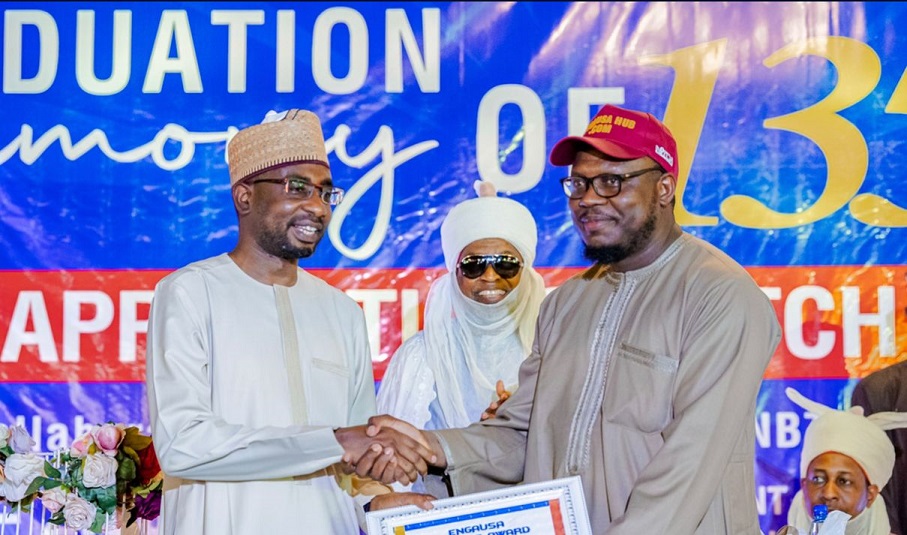
Khalid and his likes were not convinced arguing that the example given is INGAUSA, different from ENGAUSA. They said INGAUSA is a Hausa poem where words and phrases are used to complement the writer’s inability to come up with the right words based on context or meaning as opposed to ENGAUSA which is a poem written specifically with two languages blending and it is purely artistical. In the introduction of this book, the editors maintained this view indicating that they had not shifted their position, more so, in an interview conducted by Ola stated that this Engausa is almost his own daughter.
While this anthology may certainly be the first collection on the ENGAUSA poem, the view that the ‘new ENGAUSA’ is different from the ‘conventional INGAUSA’ is very weak. This is because language swap in Hausa poetry is not just triggered by weakness or inability to come up with the right phrase or word in a context, it is equally deliberate. Also, when we look at recent popular Hausa songs we can see Engausa. In particular hip-hop singers such as Billy’o in his song “Rainy Season” wherein he said:
“Mosoyiya, farkon ganinki na yo confusing,
sai da zuciyata tai ta squeezing,
sai da temperature ta tai rising,
jiri nake sai ka ce na sha poising,
ni ko so nake a san ina da reason”
is a good example of Engausa. In recent, northern Nigeria’s film series such as “Son of the Caliphate” and “Gidan Danja” are also full of Engausa. In addition, Aliyu Idris aka Abdurabbihi is another example, whose poems are in a mix of Hausa, English and Arabic languages even before seeing Ola’s “Sarauniyata” which appeared first in APNETi platform. Agreed, Ola and to some extent. Khalid can take the accolades of popularizing the Engausa and APNETi for holding the first workshop to teach it. It is another issue as to whether the new Engausa has a rule or not. But it is important to state that Engausa is an attempt to mimic how we (particularly the educated elite among us) talk at home and other places.
Finally, I wish to congratulate the editors for the first Engausa anthology and the All Poet Network International (APNETi) and Centre for Information Technology and Development (CITAD) for sponsoring the publication of important literary work that can help in Nigeria’s corruption crusade. The text is truly a noble of a kind. While wishing to see more literary work of this format, I wish the editors will do more in editing the Hausa language in the subsequent publications. I noticed many orthographic errors with respect to the Hausa language, which our indefatigable Imam will share the larger blame for his expertise in the area. I also conclude with the following lines:
Mai biɗar gane corruption,
To ya ɗau wannan collection,
Hausa tare da Englishin,
Sandwich kuma conjugation,
An zubo concatenation,
Kar ku ce contamination,
An yi ne don education,
Tun da Ola ya yi motion,
Ka ga Khalid zai yi action,
An yi don inganta nation,
Yau kwaraption mun rejection.
The reviewer, Dr Murtala Uba Mohammed, is with Geography Department, Bayero University Kano, and can be reached via murtalamuhammadu@gmail.com.