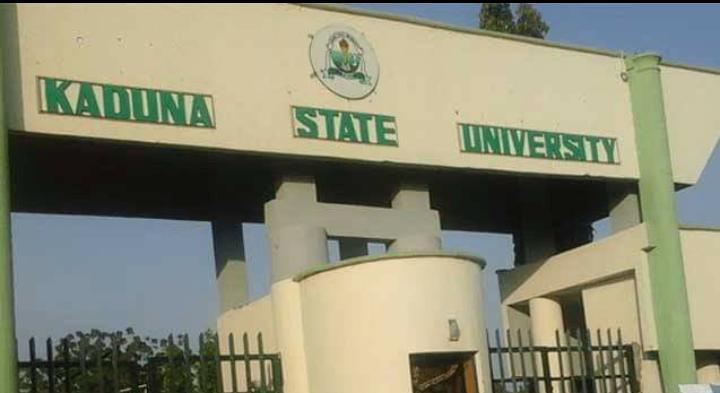
The Governing Council of the Kaduna State University, led by Mallam Hussaini Dikko, has approved the appointment of 6 senior academics to the rank of Professors and seven others to Associate Professors, respectively.
According to a statement by the university’s public relations officer, Mr Adamu Nuhu Bargo, those promoted are; Dr Matoh D. Dogara (Professor of Geophysics), Dr Gaius Jatau (Professor of Economic and Social History), Dr Peter Ayuba (Professor of Applied & Computational Mathematics), Dr Fu’ad Sirate Sheriff (Professor Arabic Language), Dr Tukur Abdulkadir (Professor of International Relations & Strategic Studies), and Dr Nasir Murtala Ibrahim (Professor of Arabic Literature)
Those promoted to the rank of Associate Professors are Dr Binta Kasim (Associate Professor in the Department of Mass Communication), Dr Bashir Kayode Sodipo (Associate Professor in the Department of Physics), Dr Ahmed Buba (Associate Professor in the Department of Political Science), Dr Aliyu Isa Suleiman (Associate Professor in the Department of Nigerian Languages and Linguistics), Dr Patrick Noah Okolo (Associate Professor in the Department of Mathematical Sciences), Dr Ahmed Bello (Associate Professor in the Department of Education) and Dr Ahmed Shehu( Associate Professor in the Department of Nigerian Languages and Linguistics).
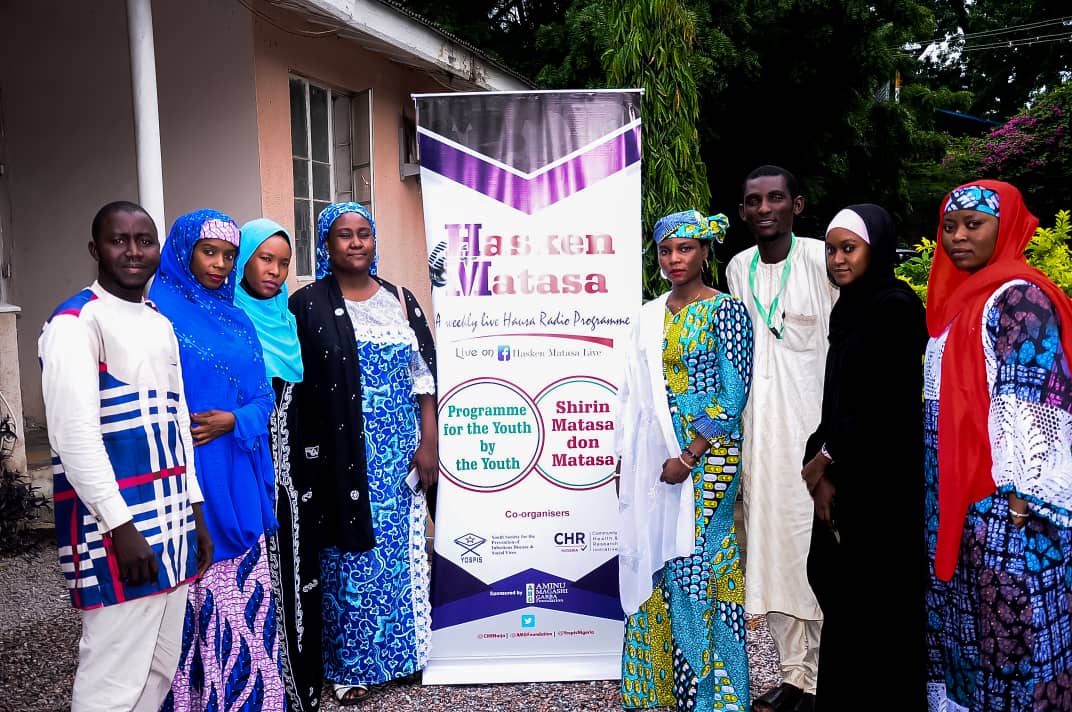
Dr Aminu Magashi Garba Foundation (AMG) has donated the sum of one million naira to a Youth Academy Initiative (YOSPIS) Tuesday, August 2nd, 2022.
Zainab Nasir Ahmad, the YOSPIS Executive Director, disclosed this during the first anniversary of the Youth Academy Initiative.
Speaking at the event, Ahmad unveiled some of the achievements they recorded so far to include a popular live radio program, Hasken Matasa, which targeted more than two million audience.
However, she added that it was part the achievements they so far recorded the collaborative empowerment of 150 women, celebrating World NGO Day in partnership with Kano State Special Adviser on Non-Governmental Organisations.
Other achievements include; Sensitizing 14 Communities in Kano on Menstrual Hygiene and donating sanitary pads to seven hundred adolescents girls in commemoration of World Menstrual Hygiene Day, initiating a monthly seminar series to the civil society organisations, supporting persons living with disability with sanitary pads at Tudun-Maliki Special Education School among others.
Yet, we have lot of challenges – Zainab
It is no longer bizarre that successes and challenges go hand in hand. Zainab also went on to mention some of the challenges she faced since her resuming duty as the Executive Director.
She decried inadequate source of funding, lack of permanent office space and official vehicle as part of the challenges faced by her organisation in the last year.
She added that YOSPIS is seriously engaged in writing and submitting proposals to potential donors, mobilise resources from members and other stakeholders.
Dr Aminu Magashi has also called on the stakeholders to engage and contribute more for youth development for the better Nigeria.
Chevening has started receiving applications from interested persons for its fully-funded one-year master’s scholarships programme, a Facebook post by the scholarship body stated.
Successful applicants will be given the scholarship opportunity to travel and study at a university in the United Kingdom to further their education.
Describing the scheme on its website, Chevening states: “Chevening is the UK government’s international scholarships programme. Funded by the Foreign, Commonwealth and Development Office and partner organisations, we offer awards to study in the UK for one year on a fully funded master’s degree course.
“Successful Chevening candidates come from a diverse range of countries and backgrounds, but they all demonstrate the passion, vision and skills needed to shape a better world.”
Interested persons are advised to click this link: www.chevening.org/apply in order to check their eligibility status and start their applications afterwards.
So, 10 years and 8 months ago, I met a little girl who challenged me, inspired me and eventually shaped my life and the lives of thousands of others. This week, we paid her a surprise visit in Abuja. I hope her story will inspire you.
In December 2011, we met a little girl in Makoko paddling a large canoe, 10 times her size. She was 8 years old and never been to school. We were overwhelmed by her strength, so we trailed her to her house by the waterside. Why is a smart girl like her not in school? We wondered!
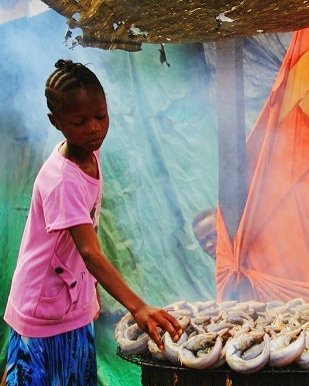
She jumped off the boat and went to the back of the hut where she was drying fish. She would later take the smoked fish to the market with her mum to sell. She was such an inspiration, but we knew she needed to be in school.
Sisianu drying fish
One of the conversations that challenged us was hearing that girls weren’t meant to go to school and this was a myth we had to dispel in the community. So, we asked her parents to give us a chance with her and that was how our journey began.
While we didn’t have a favorite child, Sisianu was smart, always happy and we took Sisianu as our special child. I genuinely wanted to see her succeed. We eventually got her family to allow us to enroll her into school. This was such a great win for us.
The negotiation process wasn’t easy, but we did it and that was one of our first recorded successes at Slum2School. This became our springboard, propelling us to speak to more families and eventually enrolling 114 kids into school in 2012. The community celebrated and so did we.
Sisianu was so passionate about being in school. She would arrive at school before 7am and help clean her classroom. She eventually became the best in her primary school class. She went on to win trophies in athletics and represented us at various sports competitions. We were so proud of her. “Can you see that girls can achieve great things?” We would brag about her during advocacy campaigns.
Her inspiring story inspired many caregivers to allow us enrol their kids in school. So in 2013 we enrolled 220 additional kids to school and 350 in 2014. Sisianu became our little ambassador and we didnt want to see her fail. But her journey from 2016 wasn’t linear, it was filled with ups and downs. She excelled at many points and also failed at some. What’s happening to Sisianu? We were very worried.
Being a girl isn’t easy, but being a girl having to take care of all your younger siblings while helping your mothers fish business, in an environment where education isn’t regarded as priority, is even more difficult. Sisianu’s education became threatened.
In 2016 her performance dropped and she started missing classes regularly. We got our counseling team to work with her and a lot was recommended. There were several distractions and responsibilities she had besides her education. In 2018, she lost the motivation to go to school.
That year her grades were reallly poor. She missed most mentorship sessions, and we observed several social patterns that led kids to eventually drop out of school. At this point we knew that she needed to leave her community and go far away where she could focus on her education.
We packed her bags, bought her a 1 way flight ticket and flew her to Abuja to join our kids on Scholarship at Word Of Faith Schools but she failed the scholarship exam.
The Athletic Sisianu
She scored 34% and was not offered a scholarship. We knew she would perform poorly but we had no alternatives. At this point our option was to either send her back to Makoko or pay the annual school fees which was about N1,000,000 per annum asides her upkeep and travel costs every quarter. In the end we would spend over N1.4m/year and this wasn’t something we had ever done.
We could also take her to a less expensive school but we didn’t want to isolate her from others and further damage her self esteem. But how do we pay such amount of fees for one child when it could support 30 other children? We were faced with a tough decision.
We had meetings and eventually decided to enroll her in Word of Faith School Abuja together with our other kids while working towards raising funds for her fees, travel expenses and her upkeep. It was a very tough decision but that was the only option we felt Sisianu truly deserved.
3 months later, she wrote her first term exams & from scoring 34% in her scholarship exam, Sisianu aced all her results with 8As and 4Bs. I was shocked and so was everyone. This was the first time since 2017 we saw the shining star that we had always known. How did this happen?
I remembered the day we all saw the results of her scholarship exam and she saw that she had failed. She cried bitterly. We also cried. She didn’t want to go back home so she promised that if she was given another chance she would do her best and make us proud. We trusted her!
In February this year, while I sat in the library preparing for my exams one snowy evening in Boston, I got a call from a random number on WhatsApp. It was very unlike me, but I picked up and I heard a voice screaming, “Uncle it is Sisianu”, “Oh how are you Sisianu” I responded.
She said, “I haven’t seen you since 2020 and you haven’t come to visit me since last year. You promised to visit us every year.” “I am in school and I haven’t been around since last year.” I responded “But you taught us to always keep to our promise.” She replied.
Those words felt quite heavy to respond to, so I paused and reminded her “but your mentors uncle Ekene, uncle Aaron, aunty Hauwa, aunty Ajibike and many others visit you often right? “Yes”, she replied, “we would be graduating from school this year, please try to visit us” “I am using my aunty’s phone to call you and I have to give it back to her. Goodbye Sir.” The phone went off.
It was so tough to continue reading so I packed my bags and walked out of the library. It was indeed a long walk back home that night as I had a lot to reflect on.
At that point I had so much going on, and wasn’t sure when I was going to be back but I promised myself that I would visit her and our other kids before they graduated. Last month Sisianu completed her WAEC, passed her JAMB and this Wednesday she completed her final NECO exams.
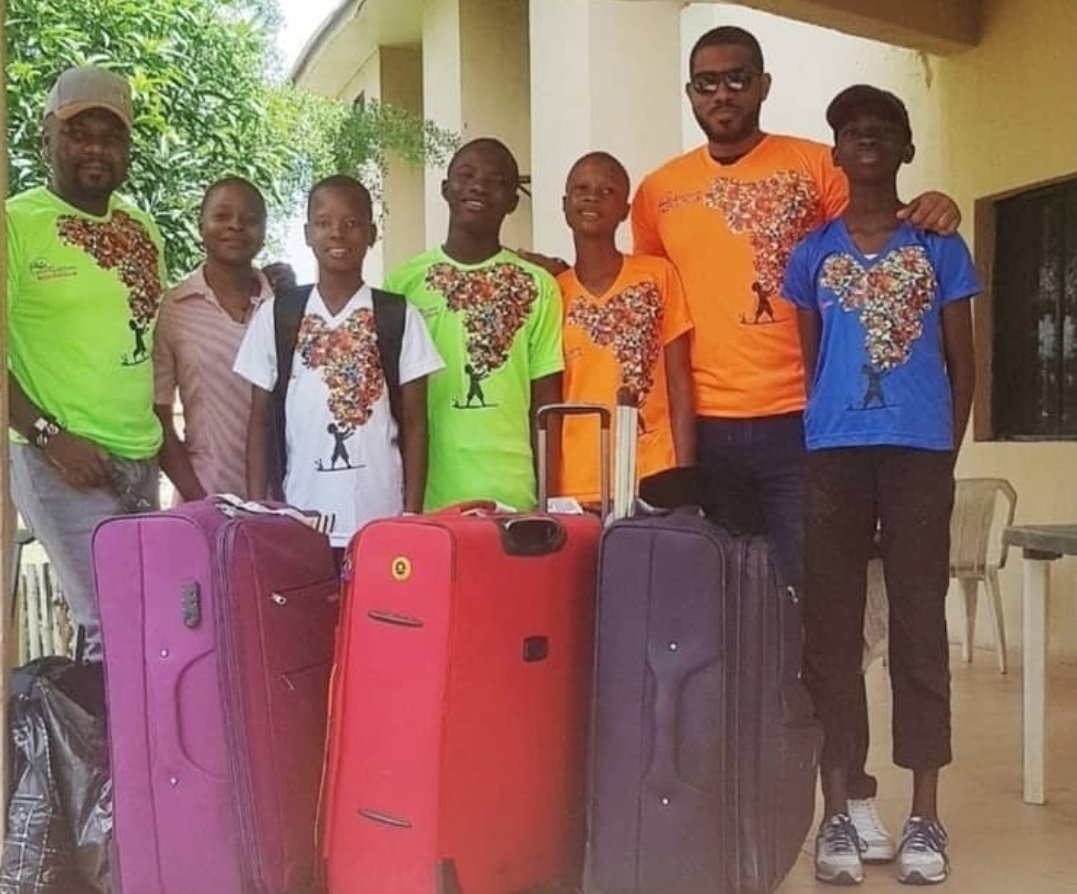
Together with our leadership team in Abuja, I paid her a surprise visit at her school right after her final NECO exam. She spotted us from afar and this was what her joy looked like. She told me that she is the General Secretary in her school and shared all her achievements.
She shared her plans for the University and her gratitude to everyone who supported her. Reflecting on her journey left me truly speechless and teary, seeing that through her we’ve made a complete circle.
I am so thankful that we didn’t give up on her throughout the last 10 years. I am thankful to everyone who believed in her and in us.
Since 2019 after we took 4 of them out of Lagos to Abuja, Deborah has graduated and is a first-year student in Benson Idahosa University. Mariam is the deputy senior prefect; Mustapha is one of the best graduating students and Sisianu, she remains our shining star, ready for a new journey in the University and continuously inspiring everyone across her community.
Our goal is that she attends one of the best Universities in the world we ask that you join us to make this dream possible for her.
Slum2School Students
Written by Otto Orondaam, the founder of Slum2school Africa.
I believe that the government are entirely to blame for the incessant ASUU strike. This is because it’s their responsibility to provide all that the ASUU members need and pay them handsomely. The government should look into this so long as they want the development of this country. It’s widely known that if there are no teachers in the nation, there will be nothing in that nation but quite a bunch of problems. And ignorance will continue to increase rapidly — which we are not praying for.
A popular saying has it that “Teachers are the backbone of the society”. So, if this is true, why won’t they be respected by all and sundry?
Whoever knows how negatively this strike affects the students (the biggest victims), he would sympathise with them.
“Education is the passport to the future, for tomorrow belongs to those who prepare for it today.” This Malcolm X’s saying implies how bleak our future is!
Truth be voiced out, I completely don’t know the specific role those politicians, who are elected as the leaders of our dear country play in their respective offices. This is because they reluctantly failed to offer a helping hand to the students of public universitie out of the mess they are in. Why are they acting like this? Is it because of the fact that most of their children are not studying here in Nigeria, but rather abroad? In other words, is it they are not part of the victims of all this menacing issue? The answer is ‘yes’ I guess!
Indeed, we should pay attention to this issue. It’s clear now that there is no any public university student that is not affected negatively. For example: a student who supposed to have graduated since last year, as written on his/her ID card, is unfortunately still in the same position. Although I’m a higher level student, frankly speaking, it baffles me whenever I think about this. Why is our country like this for goodness sake?
The government should, therefore, do the needful and fulfill the demands of the ASUU members for the strike to stop. We hold the government responsible for whatever happen to us, our behaviour, our wellbeing and our development. They should also remember that we are also their children and one day, we may become leaders of the country and their children and other family members may be under our care!
The saying, “when two elephants fight, the grass gets to suffer,” is nothing but a fact. But unfortunately, in the case of the Academic Staff Union of Universities (ASUU) and the federal government (FG), the students are always at the receiving end, and students suffer the consequences of the fight.
At last, ASUU members will get paid and return to classes. What then happens to the students?
In 2020, when ASUU embarked on a strike that lasted for a good nine months coupled with COVID19, what did the students get in return after everything? Nothing! We only got expired rent, a disrupted academic calendar, and some items stolen from our various lodges.
After the 2020 strike, we never knew that another bigger one would await us soon. However, on February 14, 2022, another strike loomed again with the same demands the government failed to fulfil for nine months. This time around, only God knows our fate; five months strike and still counting, yet no positive response.
The Federal Government does not care about whether the poor masses get a quality education. They deny us our right to education by not providing enough equipment that students are supposed to use, not enough classes for lectures, and the teachers do not get well paid.
The ASUU strike has done more harm than good to the students. Some students don’t always get to serve their father’s land due to the age limit placed on NYSC. Once a student is 30 years they can no longer go for the one-year compulsory service. So many disadvantages come with embarking on this strike.
Because of these endless strikes by ASUU and the negligence of the Federal Government, we now have more cybercrime everywhere (Yahoo-Yahoo!), and some girls are now into prostitution as a means of survival.
We want to be compensated too after everything by increasing the age limit one can do the one-year compulsory service if we can’t get other compensation. At least this should be done.
Fatima Usman is a 300-level student of mass communication at IBB University, Lapai. She can be reached via usmanfatima499@gmail.com.
The role of guidance, counselling, and mentoring in our interaction remains strategic and fundamental for achieving one’s goals and objectives. Doubtless, none of us is perfect enough not to be mentored, guided, counselled or nurtured at one point or another. Therefore, mentors, parents, counsellors, teachers and the likes are vested with the power of educating the teeming youth on the implication of age in one’s life.
Honestly, age is one of the problematic issues that need to be treated with extreme caution. But unfortunately, the problem appears to be common even among the students of tertiary institutions, civil servants, corp members and business people. Initially, the issue cannot be divorced entirely from ignorance, carelessness, poor mentorship, parental attitude toward learning, policy review and implementation, selfishness and what have you. Therefore, age is needed in every situation to meet a particular requirement for admission, job or anything.
In Nigeria, as we grow older, our services are no longer needed in some institutions. Accordingly, National Identity Management Commission (NIMC) has classified ‘date of birth’ as one of the fields in the data of a person to be non-updatable and non-modified unless an approved fee of ₦15,000 is paid. Meanwhile, the country’s birth certificate is issued to the citizens by the Nigeria National Population Commission. However, until recently, ‘date of birth’ has not received proper attention from the youth, parents, teachers, mentors, etc. UNICEF (2016) has reported that only 30 per cent of Nigerian children under the age of five (5) have their births registered. Meanwhile, the country had one of the highest average birth rates in the world between 2010 and 2015.
In the academic arena, date of birth has denied many people access to secure admission into higher learning institutions at national and international levels. For instance, a friend of mine was recently denied admission to an undergraduate programme in Sudan. The university management told him that was due to his age.
In addition, the National Examination Council (NECO) has reviewed its policy in 2020 and mandated that ‘date of birth’ be written on the candidates’ results. Furthermore, the National Youth Service Corps has introduced a new policy in the year 2020, which states that the date of birth must be written on the national certificate to guard against age falsification. Before this, the NYSC policy had mandated that graduates should not be or exceed 30 years of age to be enrolled on the scheme. Therefore, with this mandate, many graduates end up collecting exemption letters.
Returning to civil service, ‘date of birth’ has sent many civil servants to early retirement. I discussed with someone who lamented that he had unceremoniously and unduly retired from service due to the age written on his documents. In contrast, his colleagues are still in the system, for they have no problem with age. I trust you have a lot to say on this case. In Nigeria, for example, the retirement age of civil servants is 60 years by birth and 35 years in service. However, on January 20, 2021, the Federal Executive Council (FEC) approved a bill to increase teachers’ retirement age and service years. With the bill in effect, teachers are now to retire at 65 years by birth and 40 by service.
Furthermore, no one can deny that banks attach value to the topic of discussion, and due to this, many people, including the writer of this piece, have suffered the pain of having dual dates of birth. Without hesitation, I can attest that many accounts have been restricted and closed due to irregularities in age. Equally, many transactions have been denied, cancelled or withheld by the banks’ managements. I trust you can give an example of the victim of the problem.
In sum, the issue of ‘date of birth’ should not be treated slightly…Therefore, one will be at an advantage if one pays attention to the date of birth. Because of this, the following recommendations will be helpful:
One should ensure they have a unique and standard date of birth.
Parents should be cautious by avoiding anything that will jeopardise their children’s future, such as negligence to NIN enrollment.
Parents should endeavour to register the birth certificates of their children in time or right at a tender age.
Birth certificates or date of birth should be committed to memory so that forgetfulness and what have you will not strike between what is and what ought to be.
No reason, or whatsoever, will warrant you to allow your friends to use your dates of birth.
Nasiru Tijjani writes from Gwaram Tsohuwa, Jigawa State. Hecan be contacted through tijjaninasiru@gmail.com.
Speaker of Nigeria’s House of Representatives, Femi Gbajabiamila, has returned to the classroom.
In photos posted on Gbajabiamila’s Facebook page on Tuesday, July 26, he was seen in a classroom alongside other students at the Harvard Kennedy School in the United States of America.
However, the House of Representatives Speaker’s post did not go well with many Nigerians. Many opined that the Speaker should not be schooling abroad while Nigeria’s public universities are on strike.
“ASUU is on strike, and you’re there posting pictures of being in class. Shame on you,” Ibrahim Abubakar Musa commented.
“Aren’t you aware that university students back in your country are still at home? I don’t wish you luck.” Hassan Muhammad Yahaya, another Facebook user, commented.
The Academic Staff Union of Universities, ASUU, embarked on strike on February 14. This has crippled academic activities across Nigeria’s public universities.
It is with excruciating pain that one starts writing something of this nature. It is akin to the pain that hits an inmate upon the renewal of his terms of years in prison. Studying in a Nigerian public university comes with a series of frustrating issues. But for necessity, I seriously doubt if any student would wish to spend more than a year in these problems-wracked public universities.
ASUU has been on strike for about 200 days, and nothing seemed to be wrong until this week when loud voices started roaring in protest of the lingering strike. When ASUU embarked on strike in 2020, Nigerian students spent eight months at home, which sadly prolonged their stay in the university by one year. As ASUU called off the strike that year, students thought things had once again become normal because of the temporary stability of academic activities. On 14 February 2022, the strike news hit our ears while we were receiving lectures in our respective classes. The shock of that news is still in us!
The hope of the final year Law student in public university to make it to the Nigerian Law School this year reached its crescendo before the ASUU strike began. Some of us had already started writing our final year project, while others had even finished. One can imagine the pain of staying for additional two years in the university with no certainty of even rounding up in 2023. It is even more painful when we look at our school ID cards and realise they bear “2021”, our graduation year—seven years for a five-year programme.
As the new session of the Nigerian Law School begins in October this year, Law students in public universities have nothing to do except look at the graduates of private universities and foreign institutions marching into the Nigerian school, most of whom are the children of our leaders. Whether ASUU calls off the strike this month or even backdates it to June, public university students cannot make it to the Nigerian Law School. The year is a waste for us!
What if a miracle would make the public university students make it to the Nigerian Law School this year? And how can this miracle occur? The answer is multifaceted.
Firstly, the Federal Government must be unprecedentedly serious in negotiating with ASUU, showcasing strong sympathy for the condition of service of lecturers and utmost concern for the future of education in Nigeria.
Secondly, the Nigerian Law School’s management should extend its calendar to accommodate candidates from public universities.
Thirdly, after the strike is called off, the management of public universities should rushingly round up the session with some level of leniency to the students.
Lastly, the students must be relentlessly prayerful for the occurrence of this miracle. May these challenges become some form of blessing in disguise.
Musa Abubakar, 29, was born a full-sighted child in Daura, Katsina State. He came from a low-income family, though his mother teaches at a primary school. Her job helps her support a family that lost their breadwinner 18 years ago.
At 9, Musa started feeling some discomfort and strain in his eyes. When his mother took him to a hospital, he was diagnosed with “retinitis pigmentosa,” a rare inherited degenerative eye disease. Initially, he witnessed vision decrease and impairment, especially at night or in low light. While Musa went through this predicament, his father was bedridden with a terminal illness. So, he was loaded with the dice at a tender age.
At 11, he lost his father and, later, his sight. Life had taken its toll on him as he grappled with going to school, looking for a guide and contending with walking with a blind cane. Musa felt lonely, isolated and disillusioned; he needed a company that proved elusive. Sometimes he would want somebody beside him with a gentle nudge, but nobody was around to whom he could unburden and escape from his loneliness. So he started meditating on an escape route.
Later, Musa discovered that education was the only antidote against loneliness, boredom and disillusionment. So he went back to school. In the beginning, his classmates served as his guides. However, social stigma forced him to opt for a blind cane as his guides were insulted or maligned daily. Whenever he reached class, his classmates would take notes and dictate to him. His mother had attested to his precocious talent; he demonstrated extra guile and quick-wittedness during his childhood.
After his primary education, he also joined another conventional junior school, obtaining a junior school certificate with flying colours. His potential was realised when in 2015, he joined Katsina School for the Blind. He learned how to use his “embosser typewriter” to take braille (a form of written language for the blinds, in which the characters are represented by raised dots that are felt with the fingertips). He also learned to use his emboser printer to convert conventional texts into braille for easy manual reading. He artfully mastered the skill of manual reading. Whenever I visit him, I am bewitched by the power, beauty and manual dexterity of his tactile reading.
Musa Abubakar completed his ABU diploma in English Education at the College of Arabic and Islamic Studies, Daura, with a merit pass in 2020.
His academic activities were wonderfully exceptional; he didn’t only surpass many full-sighted coursemates, but he mastered a good command of English during class presentations.
While studying for his diploma, Musa proved exceptional and combined conventional and unique learning methods. He used the braille writer to take notes, a recorder to record the lecturer’s voice, and would later use the braille printer to write his notes and unorthodoxly use the braille writer to convert longer texts into braille for easy manual decoding.
Musa is currently a 200-level undergraduate of English at an NTI degree satellite centre in Daura. He weaves baskets and local chairs to earn his daily bread and support his education. He can teach and perfectly write on the board. He can also assess his students by converting their works into his embosser and grading them. He’s also computer literate.
Katsina State Government should not leave this talented blind man to waste. Instead, he should be employed so that his intellectual treasures are explored. His likes shouldn’t be left to beg. They should, like his braille, be converted to help the human cause.