Admin

Three killed, one injured in fresh violence in Zangon Kataf

By Sumayyah Auwal Usman

Three people died in Zangon Kataf, Monday, in an outbreak of fresh hostilities. The attack happened in Goran Gida, Gora District of Zangon Kataf LGA.

According to the Kaduna State Commissioner for Internal Security and Home Affairs, Mr. Samuel Aruwan, the unidentified attackers entered the village late last night, killed three people, and injured one.

The Acting Governor of Kaduna State, Dr Hadiza Balarabe, has condemned the mindless attack on innocent citizens. She sent condolences to the families of the deceased as she prayed for the repose of the departed.

Protest against insecurity in Katsina towns

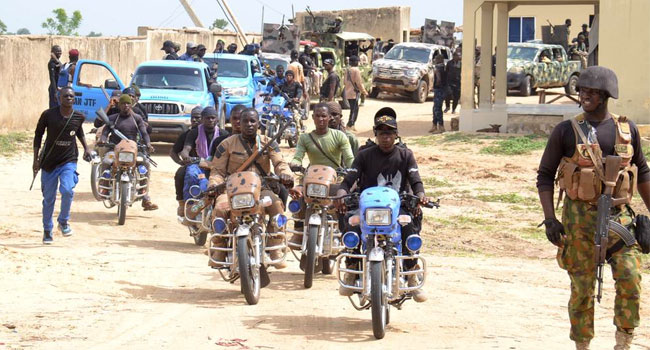
A traveller, Sadiq Tijjani Inuwa Bakori, wrote on his Facebook page that angry youths in Yantumaki town of Katsina State had blocked Kankara – Dutsinma federal highway in protest against insecurity in their areas.


Mr Bakori added that they tried to go back, but the next village also blocked the road. “We can’t proceed, and we can’t go back.”


Reports show that some of the irate youths have set tires on fire. Plumes of smoke could be seen from a distance.


According to Mr Bakori, military personnel and police have arrived at the chaotic scene, but they couldn’t do anything. Commuters were stranded.

There have been several kidnapping and bandit activities in the towns and villages of Katsina and other neighbouring states in the region. However, government and security personnel claim to have been doing their best to restore peace.

Plateau Massacre: Survivor recounts how Irigwe youths slain his 26 Muslim co-travelers

By Misbahu El-Hamza

When I was listening to the Annual Muhammadu Sanusi II Colloquium online at around noon on Saturday, a call from a Jos-based friend interrupted my network. His heart was panting as he told me about an attack on travellers in Jos. However, he said he had no additional information; he only added that corpses, drenched in blood, had been brought to the Jos Central Mosque.

I immediately began to make calls, hoping I could speak directly with some survivors if there were any. But, unfortunately, I could not get any until the early hours of Sunday when I received an SMS from my source in Jos with the phone number of one survivor named Haruna Muhammad.

Haruna, 36, was the only man from Ogun state who joined other 53 Ondo and Kogi states based Muslims to travel to Shaikh Dahiru Usman Bauchi, a renowned Islamic scholar of the Tijjaniya Sufi Order in his home in Bauchi state. The 54 Muslim faithful travelled in a convoy of 5 hummer busses from Ondo state through Jos and arrived at Bauchi in the early hours of Friday “for a Friday litany with the Shaikh,” said Haruna.

“We left Bauchi for Ondo at around 7 am through Jos.” The journey was peaceful until around 10 am when “we arrived at a place blocked by some youths searching every car passing by. And when it came to our turn, we were asked to all step down of the cars.”

The youths began asking the drivers questions about where the convoy was coming from and where they were heading. “It was obvious they didn’t trust us,” Haruna said, but above all, the youths were angry. Before Haruna or any of his brothers speaks, the youth began shouting, hitting them with sticks, and suddenly, all the convoy dispersed into the nooks of Rukuba for their lives. “None of us has any idea where he’s running to, but we had to try and save our lives,” Haruna recounted.

While in hiding, Haruna watched in dread how the youth used sticks and stones to massacre some of his co-travellers. A viral video shared online by an unknown perpetrator shows how they used to smash and shatter the victims’ heads on the road. Haruna also heard a gunshot but could not identify who was shot at the moment. Twenty-five people were butchered at the spot before the military came to rescue those in hiding, like Haruna and 25 others. One other sustained severe injuries and died later at Plateau Hospital, according to Haruna.

The State Director, Fityanul Islam of Nigeria, Mallam Adam Hamza, who supervised the preparation and burial of the deceased, confirmed that they buried 26 bodies at Dadin Kowa Cemetery of Jos South. The graveyard is a 19-minute drive from the Jos North Central Mosque. The other injured victims are still at the hospital receiving treatment.

I asked Haruna why they chose to follow Rukuba Road since that wasn’t the road they followed to Bauchi. “One of us proposed that Rukuba Road would be better,” he said, “and then one of the drivers said he too knows the road. So, he led the convoy.” None of the five drivers, however, sustained an injury. All 5 were non-Muslim Yorubas from Ondo state. Before the military arrived at the scene, Haruna confirmed that one of the cars was set on fire, and another driver luckily drove off his car to safety. As of this morning, that driver set off for Ondo. Haruna and other survivors are still in Plateau State, kept at a hotel under the protection of the state government. He assured me they are well taken care of under the supervision of Fityanul Islam of Nigeria.

All this appeared to come to the authorities with shock, according to Mallam Adam. Some government officials who attended the burial include Secretary to the state government, who was said to have represented the state governor, Simon Bako Lalong. Others include the state police commissioner, CP Edward Egbuka, and General Officer Commanding (GOC) of the Jos 3-Division, General Ibrahim Ali. The CP and GOC also visited the scene of the massacre on Saturday.

All efforts to speak with one of the government officials were not successful. However, in a press statement, the Plateau State Government, in response to the massacre and avoidance of counter-reprisal, imposed dusk-to-dawn (6 pm – 6 am) curfew in Bassa, Jos South and Jos North local governments at 3 am on Sunday. But unconfirmed reports coming from Jos North this morning indicate that the atmosphere is intense.

It’s no wonder that through its Director of Press, Dr Makut Simon Machan, the state government released another statement at exactly 11:02 am today that imposing a 24-hour curfew in Jos North “to contain further security threats”.

It could be recalled that on Wednesday, August 4, 2021, an attack on travellers was recorded where a truck full of animals was set ablaze at Gada Biyu, a trekking distance from Rukuba Road. That attack was said to be a reprisal as Fulanis were said to have attacked Irigwe houses and destroyed farms in other state villages.

Yesterday’s attack could also be a continuation of the previous reprisal. Survivors and locals call on the Plateau state government to look into the root cause of these killings as a matter of urgency and ensure justice is served. Any delay could return Jos North to its dark days when people get killed sporadically if they (mistakenly) entered territory belonging to another ethnicity or religion other than theirs.

Haruna Muhammad further urged the Federal and State government to ensure the arrest of all who were responsible for the merciless killings of his innocent brothers on August 14 2021. He said whatever misunderstanding is going on between the tribes in Plateau state, his brothers know nothing about it, and their killings shouldn’t be unchecked. The massacre yesterday left 26 people dead and 33 survivors, including the drivers.

Apex Muslim body, NSCIA, condemns butcher of Muslim travellers in Plateau, appeals for calm

By Muhammad Sabiu

The Nigerian Supreme Council for Islamic Affairs (NSCIA) on Sunday “unequivocally condemns” the attack and killing of over 22 Muslim travellers by a suspected Christian militia in Plateau State.

On Saturday, the Daily Reality newspaper reported the killing of the travellers who were returning from Bauchi to Ondo after attending a religious event.

In a statement, the NSCIA said, “The Nigerian Supreme Council for Islamic Affairs (NSCIA) under the leadership of its President-General Muhammad Sa’ad Abubakar, CFR, mni, unequivocally condemns the massacre of a group of innocent Muslims who were returning from Bauchi to Akure. Ondo State, on Saturday.”

The Muslim body appeals for calm and warns against reprisals, saying, “…the Council appeals to all Muslims to be calm and nobody should take laws into his or her hands. The Council re-emphasises that no human life deserves to be wasted on any ground, be it religious or ethnic.”

The Presidency also condemned the killing in a statement signed by the presidential spokesperson, Malam Garba Shehu.

Again, social media users took to their accounts to protest the killing by sharing photo and video content of the victims’ bodies and their funerals.

President Buhari condemns attack on Muslim travellers in Plateau, vows to fish out perpetrators

By Muhammadu Sabiu

The presidency has “strongly condemned” the attack on about ninety Muslim travellers, among whom over twenty-two were killed on Saturday Gada Biyu and Rukuba Road along the Jos-Zaria road in Jos North Local Government Area of Plateau State.

The condemnation is contained in a statement released Saturday by a presidential spokesperson, Malam Garba Shehu, via his Facebook account.

“The Presidency condemns the attack earlier Saturday on travellers from a religious event in Bauchi, passing through Jos, the Plateau State Capital and regrets the reported deaths of at least twenty-two persons with several others injured in that ambush on their travelling party.

“It is widely known that Plateau State has been one of the states affected by herder-farmer clashes, which have, in a significant way, been curtailed following the intense peace-building efforts of the administration of Governor Simon Lalong,” Garba Shehu said.

President Buhari has ordered security agencies to fish out the perpetrators of the attack.

Giving the order, Buhari was quoted as saying, “Make no mistake about it: in line with my commitment to protect all Nigerians, I have ordered our security agencies to fish out the perpetrators of this gruesome massacre of innocent travellers and bring them to justice.”

Recall that The Daily Reality newspaper has reported that police have confirmed the killing of at least twenty-two Muslim travellers.

However, reports coming from Plateau State afterwards have indicated that the death toll had risen from twenty-two to thirty as more corpses were recovered.

Police confirm killing of 22 Muslim travellers in Plateau

By Muhammad Sabiu

At least twenty two Muslim travellers have been confirmed dead after an attack on a convoy of their buses on Saturday in Rukuba Road along the Jos-Zaria road in Jos North Local Government Area of Plateau State.

Confirming the attack, Plateau State police spokesman, Ubah Ogaba, said, “At about 0928hrs (08:28 GMT) the Plateau State Police Command received a distress call that a group of attackers suspected to be Irigwe youths (predominantly Christian)… attacked a convoy of five buses with Muslim faithful.”

“Twenty-two persons were killed and 14 injured in the attack,” he added

However, according to Channels TV, “a local government representative said the toll was higher.”

“Twenty-five people are now confirmed killed,” said the state government representative Danladi Atu, who visited a hospital where victims have been admitted.

In a statement released by Governor Lalong’s spokesperson, Makut Simon Macham, the governor condemned the attack and said, “security has been beefed up around the area.”

Plateau State is known for ethno-religious violence, which leaves people in large numbers dead and injured.

The cow is not Fulani

By Ahmadu Shehu, PhD.

There is this misleading argument that the government should not support cattle breeding and animal husbandry and that public funds cannot, and must not be invested in any way, to develop the livestock sector in Nigeria. The protagonists of this opinion argue that livestock production is a private business, and as such government should not invest “taxpayer money” to develop the sector. They hold that other citizens provide everything to run their businesses, often citing examples with shop owners, mechanics, transporters, etc. Therefore, in their minds, livestock producers – and millions of Nigerians engaged in the sector – should not receive any form of incentives from the government – financial or material – to enhance their businesses. Well, I know that for most dispassionate and well-meaning Nigerians, the faults in this line of argument are crystal clear. However, as illogical, naïve and vividly absurd as this argument sounds, there’re still Nigerians who believe in and are continuously promoting it, hence the focus of this article.

The whole argument advanced in this line of thought is often faulty, funny, and absurd. For instance, the people fighting against this would be found complaining severely of the government’s failure to provide enabling environments, such as electricity, convenient shelters, and other critical facilities necessary for their trades and businesses. But, the same people deliberately refuse to accept that it is equally the responsibility of the same government to provide enabling environment for all sectors of the economy – including livestock – to thrive. That is the extent to which the Nigerian public discourse is polarised.

Such people feign ignorance of the fact that government spends billions of naira to subsidise and support crop production, which is in the same category as animal husbandry. For decades, the federal government has been sinking billions in fertiliser and agrochemical subsidies and providing single digit loans to farmers and stakeholders in the crop production sector. It is common knowledge that these sub-sectors complement each other and that they are not mutually exclusive. The serial failures of successive governments’ agricultural policies may not be unconnected with the dislocations caused by this partial approach, as the livestock sub-sector heavily influences the Nigerian agricultural sector. Interestingly, however, the self-acclaimed defenders of the free market do not agitate against the government involvement in a “private business” of farming, as if all the farms in Nigeria belong to the government.

Moreover, our darling oil and gas industry is, unfortunately, one of the cruellest beneficiaries of government interventions and subsidies. For many decades, Nigeria has provided a conduit for oil marketers to make billions out of public funds in the name of oil subsidy, without recourse to the economic (dis)advantage it portends. Similarly, the industrial sector engulfs billions under the Bank of Industry and CBN interventions, where producers, factories and businessmen and women are supported to do business. Similarly, the aviation industry consumes billions from the government every year and uses airports and facilities provided 100% from the public purse. Moreover, all Nigerian ports and rails on which business people feed fat are provided and maintained by the taxpayer money. We can go on and on. 

I assume that people adamant on this argument are not actually against the government’s intervention in any economic sector. Their actual grievances are the particular target sector and the perceived beneficiaries of such investments in Nigeria. It is motivated by the social ills of hatred, provincialism, ethnic, religious and regional chauvinism that define the Nigerian social space and the highest form of ignorance. If the hatred is for the cattle, the livestock sector is not all about cattle. Similarly, if the envy and malice are towards the Fulani – the perceived cattle owners – the cows are actually not Fulani. This line of thought is also evidently illogical, uninformed and oblivious of what an economy is all about. That is because it fails to recognise that a sector of an economy cannot exclusively benefit only a section of the population. It may be true that cattle are the central concentration of the Nigerian livestock and that they are identified mainly with the Fulani, but the truth of the matter is that the Fulani are not the most significant economic beneficiary of cattle. They are, in fact, at the bottom of the list. I will explain.     

The Fulani might be the initial owners of the cattle (assuming they are not just employee-herders), but they are not the dealers at the cattle market. While they had spent years growing cattle, day-in-day-out, a dealer trades off the cattle and earns a decent living. Another dealer buys and transports it to other parts of the country, such as the southeast, and makes a profit upon selling it to local cattle dealers, who also earn their living by selling to consumers. The Fulani do not own the trucks that transport these cattle; neither are they the drivers, or other employees working in the transportation sector, all of whom are beneficiaries of the cattle value chain.

The Fulani are not the local butchers whose livelihood depends on the cattle produced by the Fulani that they love to hate. While cattle are the source of the multibillion-naira leather industry in Nigeria, a Fulani has no business being a tanner, skin dealer or exporter. The Fulani produce cattle, but they do not sell bones, blood and other minerals derived from cattle. They are not the owners of the local companies in Port Harcourt, Warri, Enugu or Lagos that use the beef, dungs, skin and other raw materials extracted from cattle. In the dairy sector, the Fulani may produce milk and even sell it out, but they are not the owners of the dairy companies littered all around this country.

Yes, the Fulani love the cow, but they do not own the businesses within the cattle economy. They are unaware and genuinely do not care who makes what out of the cattle they spend many years growing. But for bigotry and subjectivity, these facts are not difficult to grasp. The whole scenario should not be too difficult to understand. Still, let me borrow the language of the cynics to boldly say that given the raw material and mineral resources inherent in cattle, and the role of the Fulani in cattle production, several sectors of the Nigerian economy as well as the billionaires controlling those sectors depend on the Fulani to thrive.

Furthermore, the Fulani provide a whole chain of employment, from the herders to the traders, transporters, butchers, restaurants, and other giant industries. Yet, they are erroneously assumed to be the only beneficiary of this endless economic chain. I do not know a single ethnic group in Nigeria that could match this contribution, and at the same time, bear the brunt of negligence, alienation and even aversion from the society they serve and the economy they support.   

When people argue against investing taxpayers’ money into this sector, I wonder what tax they are precisely talking about. If this is a result of ignorance, let me highlight the tax chain obtained within the livestock value chain. Apart from the taxes paid during herding, cattle are taxed at all markets by the governments; the cattle transporters pay taxes; butchers, tanneries, factories, etc., that deal in the value chain pay heavy taxes to the governments. There are very few sub-sectors that generate this kind of taxation within the Nigerian economy. Therefore, to argue that the livestock sector cannot be funded by “taxpayers’” money is to betray logic.

The preceding discussion shows that even though the Fulani are in love with the ancient traditional human occupation of herding, they do not do so because they are the biggest economic beneficiary of the trade. If anything, the Fulani subsidise the beef and dairy markets, create and sustain millions of jobs, and maintain an extensive value chain, which is crucial to the Nigerian economy. Therefore, if you hate the Fulani, please know that the cow is not Fulani. 

Dr Ahmadu Shehu is a nomad cum herdsman and an Assistant Professor at the American University of Nigeria, Yola. He is passionate about the Nigerian project.     

Skills Beyond School (II)

By Najib Ahmad, PhD

Some remote jobs require intermediate or advanced skills, such as machine learning, computer vision, and natural language processing. These need you to have a good understanding of some areas in mathematics to solve computational problems. Design and analysis skills in Electrical, Mechanical, Civil, Building and Architectural disciplines also require one to have adequate skill in learning-related software such as Matlab, Simulink, Ansys, Autodesk AutoCAD, StormCAD and ArcGIS, 3D Studio Max, Blender, among others. Besides all these, adequate knowledge of computer programming skills is essential. Always utilise the opportunity for an internship or industrial training or student industrial work experience schemes assigned by the school because they are good places for learning and engagement.

Skills acquisition does not only stop in science and tech-related areas, as I earlier mentioned. Whatever major you study in school, there is a skill to gain in it! So grab the opportunity while you still can. Everyone you admire now started somewhere. For instance, if you major in social sciences or arts and related disciplines, acquiring effective communication skills, excellent writing skills, and outstanding data analysis skills can take you to places you never anticipated.

And most importantly, from any discipline, you need to possess sound knowledge synthesis and critical thinking skills. There are good websites to look for a job that matches your skills, such as www.fiverr.com, www.upwork.com, www.freelancer.com, and www.flexjobs.com. The point is: whatever you study, there is a skill to add to it! Just be damn good! The ways to learn them are lengthy yet straightforward. For some, you may need up to six months of dedication or even a year or more to master a particular skill. What matters is, put your best effort as you usually do to pass your university/school courses exams.

In some cases, some people want to advance their careers, and these are all for you. And always remember that age does not matter in this journey. Even if you find yourself somewhere in mid-life, it’s not too late. So many people have had a rethink about their choices and goals in life much later and still make it.

Earlier I remarked that these skills are for everybody who wants to do good for himself. School education (higher education) and skills acquisition are not mutually exclusive; you can blend and achieve both at once. You may have seen that some people argue about which is better between the two, especially in times of uncertainty like now when jobs are scarce. Their point can only be substantiated when the goal was to compare learning a particular skill for a single purpose through extensive training or vocational training education and the school education system in Nigeria. However, you can begin to craft different skills at any level of your study because the current curriculum limits and is not in tune with the current reality about jobs. Hence, I titled this piece ‘Skills Beyond School’.

Arguably, most people wrongly perceive that skills, perhaps largely if not all, are intended only to be technical (Tech skills), and it is for technical people. That is a wrong, misleading impression. ANYONE can learn and master a skill in (or out of) their field of study. It is not rocket science. The energy you use elsewhere – or on social media – can be channelled to where you would surely benefit, even if not for financial gain, but knowledge gain.

For instance, anyone can learn entrepreneurial skills. But, in this case, do not seek short-term rewards! Even the owners of Microsoft, Google, Tesla, and Apple and most likely other ‘big names’ in this field you hear in your locality started their entrepreneurship journey by learning computer programming and other skills. So, begin something somewhere; no matter how little it might be, the change would surprise you one day.

And as you are reading this, I know you are thinking about the possibility of acquiring the skill desirable to get these kinds of jobs and finally be able to work for someone who didn’t even know you, especially outside Nigeria. The fear is normal – many people have shared this doubt at the beginning. I have friends (yes, my friends) who are currently doing remote jobs and cashing out monetary rewards in different fields of skills! Huh, I sound very promising. Because I believe you can also do it. One of these friends is managing a big project remotely. Isn’t that interesting? Imagine in this economic phase, and you have an extra job that provides you with additional benefits, considering that they are all employees of other sectors. FYI, students or graduates like you in southern Nigeria have been enjoying these remote jobs for ages. So, wake up.

What if you believe that everyone doing an online remote job is a potential criminal? In that case, the thing is, you are deceiving yourself. It is particularly irritating for me to see that we like to excuse our premeditated and comforting laziness (pardon the word). Besides, learning some skills can even give you an upper hand in applying for a master’s or PhD scholarship worldwide.

Finally, to reduce the gap or, in other words, to balance the economic growth between men and women, particularly in the North, we need to encourage girls to join the do-it-yourself kinds of skills acquisitions right from secondary school. If I am to be candid, I would tell you that we are left behind in everything. However, it is not too late for us to change the situation for the better. Don’t forget that life goes on even if you do nothing, and it is up to you to catch up. Just wake up!

Dr Najib Ahmad is a Postdoctoral Researcher at Shandong University, China. He can be contacted via namuhammad03@gmail.com.

Nigeria shuts UK High Commission as official test positive for COVID-19

By Muhammadu Sabiu

The office of the Nigerian High Commission in the United Kingdom has been shut following suspected cases of coronavirus infection at the building.

In a statement released on Thursday by the Commission, the office would be closed for ten working days.

“The Head of Immigration Section and two other officials went for a meeting at the Home Office.

“At the entrance, Coronavirus test was administered on them, and one of them tested positive to COVID-19. The affected officer immediately isolated while the other officials, who tested negative, will also isolate for the next 10 days.”

The Commission further indicated that all officials of the Mission would be compulsorily tested for COVID-19.

In the statement, it added, “In line with COVID-19 regulation and the need to adhere to the rules and regulation of the host country, the Mission will close down for the next 10 days, in order to observe the mandatory isolation of those who were in contact with the affected officials.”

Just-In: Renowned Nigerian administrator, Ahmed Joda is dead

Ahmed Joda, an elder statesman, was one of the finest administrators who held several positions in the Northern regional government and later, the Federal government of Nigeria.

Ahmed Joda, OFR, CON, CFR, rose through the administrative cadre of the Northern regional government and then the federal civil service. He retired as Permanent Secretary at the Ministry of Industries.

During the administration of the youthful General Yakubu Gowon, Malam Joda was considered to be among a group known as super Permanent Secretaries.

Details soon.