Admin

We will soon deploy 5G in Nigeria—FG

The Minister of Communications and Digital Economy, Dr Isa Ali Pantami, has said that the Federal Government would soon deploy the Five Generation (5G) network in Nigeria.

The minister made the disclosure in an interview with the News Agency of Nigeria in Abuja.

According to Pantami, the decision to deploy the 5G network followed an outcome of investigations, research and trial, making it clear that it wouldn’t pose any threat relating to security or health.

He stated that the national policy on 5G stands at 95 per cent done and will be presented to the Federal Executive Council (FEC) in due course.

The minister also refuted claims that COVID-19 was related to the deployment of the 5G communications network.

“I want to give you the assurance that 5G communication network is in the pipeline,” Pantami said.

Bichi Wedding Gathering: lessons to the discerning minds

By Adamu Bello Mai-Bodi

The wedding Fatiha of Yusuf Buhari and the daughter of Sarkin Bichi was held with pomp and pageantry. All roads led to Bichi on Friday, 18 August 2021. As many as 80 aircraft brought guests to kano to witness the first son’s tying the knot to a Bayero descendent princess. To the amazement of many, the guests were dignitaries and politicians of different persuasions from across the country, who, albeit their differences, gathered to bless the occasion while they wine, dine, and exchange banters with each other. 

The sportsmanship they exhibited was awe-inspiring and outlandish for Nigerian politicians. It may be unintentional, but it should be an eye-opener to Nigerians at the bottom of the ladder. It sent a strong message to the youths, especially bootlickers, sycophants and the so-called media warriors who are ever ready to insult, blackmail, curse, condemn, disrespect and assassinate the characters of their bosses’ supposed political enemies at the expense of their self-esteem. There is no point in attacking and counterattacking one another in defence of these pretenders who only follow their aggrandisements without definite ideology whatsoever.

On Friday, the cliche about “no permanent friend or enemy in politics” was in full gear at Bichi Emir’s palace. Buhari, Atiku and Jonathan were present. Many former and serving Ministers, Governors, Senators Representatives and many other shot callers bundled themselves in Bichi palace with no regard to PDP, APC, South, North or East etc. Everyone was eventually their brothers’ keepers. Most notable was the unexpected comradeship between the former Aviation Minister Femi Fani Kayode and Malam Isah Pantami, the current Minister of Communication and Digital Economy. Given the hostility shown by the former towards the latter, many people were shocked.

If these old guys can forget their bitter differences and mingle to celebrate and or commiserate with one another depending on the situation, I think the downtrodden, especially youth are in a better position to embrace the culture of tolerance and to desist from being the tool for political attacks between these dissemblers who would be at each other’s throats only when their whims and caprices differ and would befriend themselves when their path crosses.

Hopefully, many discerning minds would heed this event and free themselves from unnecessary hatred, criticism, and resentment. Let love, mutual respect and fair play lead the way in all endeavours regardless of affiliations, be it political, regional or religious. “Experience,” they say, “is the best teacher”. May we be guided.


Adamu Bello Mai-Bodi writes from Gidado Bombiyo residence, K/kaji Azare.

Pantami and bigoted traducers

By Adnan Mukhtar Tudunwada

In an ironic twist one of the most charismatic Ministers in Buhari’s administration, Dr Isa Ali Pantami has been receiving massive accolades for his outstanding performances from sincere citizens, as well as blind criticisms from blackmailing traducers for ulterior motives.

A few months ago, the traducers mounted aggressive media campaigns against him over a claim of alleged support of ideologies of insurgents over a decade ago. Even though, the Minister had defended himself and explained further that he was one of the Islamic scholars that have consistently attacked the ideologies of Boko Haram.

Meanwhile, videos and audios of Boko Haram leaders threatening the life of Dr Pantami emerged but that too could not persuade the critics from their reckless insinuations and criticism. In fact, some of the videos included those where Pantami challenged slain Boko Haram founder, Mohammed Yusuf, in a hot debate and another was the threat by terrorist leader, Abubakar Shekau to eliminate the Minister.

It is, therefore, not surprising that when Pantami is about to clock his second year in office, the sponsored critics thought they could distract him and teeming Nigerians by reinventing another campaign of calumny.

Though their intention is mischief, they could not stop the Minister from reeling out concrete achievements of his Ministry and its agencies in the last two years when they collectively generated a total of N1.05 trillion.

Dr Pantami disclosed the huge revenue during the 12th batch of virtual commissioning of eight projects by his Ministry and agencies.

He said that “The Ministry and its parastatals have generated over N1 trillion for the Federal Government in less than two years, this translates to an average of about N44 billion every month, or over N1.4 billion every day.

“The IT Projects Clearance Programme also saved over N5billion for the Federal Government.”

“I also urge them to redouble their efforts in ensuring that we keep up the good work of developing Nigeria’s digital economy,” he said.

The Minister also revealed that a total of 1,667 ICT projects have been completed while 455 others are ongoing across the country. In line with the general approach for locating projects, they are situated in all the six geopolitical zones of the country and the Federal Capital Territory.

Some of the projects he commissioned virtually included Emergency Communications Centre (ECC), Makurdi, Benue State (North Central); Virtual Examination Centre, College of Education, Argungu, Kebbi State (North West); E-Accessibility Centre, Alderstown Schools for the Deaf, Warri, Delta State (South-South).

Others are the E-Health/Data Sharing Project, Leko Abdulrahman Hospital, Daura, Katsina state (North West); Digital Economy Centre & E-Learning Facilities, Ogba Grammar School, Lagos state (South West); Digital Economy Centre & E-Learning Facilities, St Paul Secondary School, Eke, Enugu state (South East); Digital Economy Centre & E-Learning Facilities, Federal Character Commission, Abuja (North Central); and E-Accessibility Centre, Bauchi state; Orphans and Vulnerable Children School, Bauchi state (North East) among others.

These were apart from others that were commissioned last year.

My advice to Pantami on the antics of his traducers and blackmailers is to just ignore them.

As an IT guru and scholar of repute, he should realise that their antics expose their dispositions as sectional and religious irredentists and their hatred for his faith and the section of the country he comes from. Just recently some of them have the gut to mock the great prophet of Islam in their attempt to ridicule, Dr Pantami.

Though the bigoted and eccentric traducers seem to be faceless, they are not unknown going by digital footprints and the patrons of their platforms of blackmail and propaganda.

If their media platforms were used to scandalise former Presidents Obasanjo, Yar’adua, Jonathan and even Buhari, why should Pantami feel offended? They are better ignored.

It is obvious that they are over-pampered ethnic jingoists and over-tolerated fake activists who are overtly ignored because of their questionable integrity and dubious pedigrees.

Once again, I appeal to Sheikh Pantami to ignore them and focus on his national assignment which has enormous presidential endorsements and the support of Nigerian citizens who are beneficiaries of the digital economy.

Adnan Mukhtar is a Staff Writer with Politics Digest and writes from Kofar Famfo, Kano City.

Justice for murdered innocent travellers in Jos

Nigerians woke up on Saturday last week with the bad news of the gruesome murder of innocent travellers returning from the annual national Zikr in Bauchi. They were intercepted along Rukuba, Gada-Biyu axis of Jos-North local government by suspected Irigwe ethnic militias who killed them and burned their buses. Every peace-loving Nigerian should condemn the atrocity.

The killing of these innocent travellers came at a time when Plateau State, the epicentre of ethno-religious crises, had started enjoying relative peace courtesy of Governor Simon Bako Lalong’s commitment to bring lasting peace. The militias who carefully selected their victims have a hidden or ulterior motive. Some of their reasons are to set the State on fire and fuel retaliation across the country. The victims came from other states of the country and were only on transit. What did they do?

Even before the unfortunate killings, there have been reported cases of innocent travellers being killed on some roads, which are considered no-go-areas for certain faith. If this crude way of life displayed by the mobs can be adopted in other states, one imagines the dire consequences it will bring to the peace, unity and development of the country.

I learnt that the Nigerian army apprehended some suspects. This is a good development. However, the problem is not whether the perpetrators of the heinous crime are arrested or not. The question remains, are the culprits going to face justice according to the laws of the land? So long as the government continues to temper justice with mercy on those who commit grave offences against humanity, we should rule out any possible end to the unnecessary carnage.

Ibrahim Mustapha, Pambegua, Kaduna State. He can be contacted via imustapha650@gmail.com.

Fani-Kayode replies critics on photos with Pantami at Yusuf’s wedding

By Muhammad Sabiu


The former Nigerian Aviation Minister, Femi Fani-Kayode (FFK), has come under fire for posting pictures of him with Minister of Communications and Digital Economy, Dr Isa Ali Pantami, at the wedding of President Muhammadu Buhari’s son in Kano.

FFK, a staunch critic of President Buhari, had some months ago described Pantami as an “unrepentant jihadist, cold-blooded beast, a psychopathic and clearly insane individual.”

Attending President Buhari’s son’s wedding by Mr Fani-Kayode took many people by surprise.

Responding to his critics via his verified Facebook account, FFK said politics“is not war.”

“Buba Galadima with Ahmad Lawan, GEJ with PMB, GEJ with VP & Atiku with PMB. Politics is about bridge-building regardless of your differences.

“It is not war. You can be friends with your political adversary & still disagree. It’s called politics without bitterness & being civilised,” he wrote.

In Search of Solutions for Northern Nigeria

By Ahmadu Shehu, PhD.

The current situation in northern Nigeria is very discouraging, even depressing. But it is not hopeless. Daunting as the current challenges seem, they are far from insurmountable. Before sounding over-optimistic, let me admit that things can head south and that the danger ahead is by no means to be underestimated. The problems bedevilling this country have been dissected, analysed, revised and reviewed regularly. They are well-known to the extent that a curious baby could make a list of them; insecurity, poverty, joblessness, poor education, healthcare, lack of power, water, and all other social amenities. That is how obvious our problems are.

Unfortunately, although various solutions to the above problems have been proposed over time, few improvements are being recorded. On the contrary, things have become worse by the day. What this means is that either the proposed solutions are wrong, inadequate or that these solutions are not well-implemented. Regardless, we shall acknowledge that these problems have been with us throughout our recent history; they have been acerbating all through the decades of our independence, and that they are not going away on their own. Though, it is not as if nothing is being done to ameliorate this sorry situation; it is just not enough.

For instance, as people of faith and conscience, we have been encouraged to pray hard, submit to the true spiritual powers that create and sustain the universe. Luckily, Nigeria is reportedly the most religious country globally, and our attitude to religiosity attests to this claim. As a nation of faith, we have benefitted from our dedication to prayers and spirituality in many ways. However, the deteriorating state of our affairs shows that something is definitely wrong with this approach. We can see that as hard and as much as we pray, these problems are not going away – they have refused to disappear after the night vigils. The home truth is that they will not disappear because they are man-made and, therefore, require human solutions. Consequently, we have to undo them by matching our spirituality with the necessary practical actions.

As concerned and enlightened citizens, we have cried out as loudly as possible, written treatises, provided all the analyses in this world. Still, that is undoubtedly not going to do much in salvaging this precarious situation. This decay is beyond words. As individuals, each of us has a responsibility to this country. Therefore, some pundits claim that we shall quickly solve these problems if we do our parts as individuals. Well, yes and no. Resorting to self-help is itself a measure of failure in a cooperative society. We can only do so much as individuals, but not enough to correct the ills of this society. That is why human society is politically structured since time immemorial. We have never heard of a country, an entity – not even a family system – without a workable structure. As Femi Falana says, “there is indeed no republic of non-governmental organisations”. 

As citizens and subjects of a political structure, we have always pushed all the blame to the region’s political leadership. Indeed, the responsibility of a people is absolutely on the political leaders who have all the instruments of power, administrative and constitutional resources, privileges and responsibilities. But, this too is very much debatable. One undeniable truth is that while political leaders are responsible for the development of a society, the quality of followership has a significant stake in the success of public policy and programs.  Is leadership not the product of followership? Or is it the other way round? This is the case with chicken and egg. Your guess is as good as mine.

As a government, various laws, policies and programs have been formulated, enacted, assented, proposed, implemented, or use any vocabulary that suits your purpose. The bottom line is that we are sinking deeper, moving in reverse order, and things are getting worse. Governments at all levels adopt often conflicting policies and programs on various challenges facing the region. For instance, on insecurity, the Zamfara state government embraces negotiations and amnesty for criminals, while Katsina state adopts the often faulty stick and carrot approach. On the contrary, the Kaduna state government insists on non-negotiation with criminals, without any alternatives for the victims. The governments apply the same conflicting methods to other critical issues such as education, employment, poverty eradication, healthcare, etc. If results are to judge actions, we can loudly, albeit sadly, say that successive governments at all levels have failed in basically everything.

The evidence of the failure of these approaches lies in the fact that there is no sector – one aspect of life – that is better than it was years ago. But at the same time, this evidence is the same reason we should do more because our problems are bigger and more today than yesterday. It means, therefore, that the people of this region must continue brainstorming and inventing new, dynamic solutions in tandem with the current challenges facing it. Northern Nigeria is full of potentials and opportunities to get out of this mess and attain its developmental goals.

The best way to do this, in my opinion, is by focusing on the human capital of the region. The problems mainly result from neglecting the wealth of human resources, both in quality and quantity, by undermining critical social development issues, especially education and skills acquisition. Yes, this region might be rich in natural resources, such as gold, ore, iron, and other geological elements. Still, the truth of the matter is that no society has ever mined itself to greatness. In recent years, the federal government has been fond of oil exploration in the north to counter the southern narrative of “oil-producing states”. But, the essential truth is that the so-called oil-producing states are as underdeveloped as any other state of the federation, except that they alone have the environmental degradation of that magnitude. This tells us that our society cannot drill itself to development.

Likewise, we may argue that agriculture has sustained us for millennia, but the population explosion, waning natural resources, desert encroachment and other global factors mean that the current scale of subsistence farming does not feed us, let alone sustaining our economy. Thus, we cannot farm ourselves out of these troubles.  

I believe we can think and invent ourselves out of these problems. The surest way to development is education – education that develops the minds of the citizens to think, organise and prosper. Fundamentally, this is what only education (in its real sense[1]) can do. Many countries and societies have done this in recent decades. Nations are not born or produced by the roads, farms, bridges, mines, oil fields or industrial estates. They are born by the minds of citizens. The growth of societies is not measured and cannot be attained or sustained by the physical attributes, items and objects on the ground but by the enlightened minds of their citizens. Thus, learning from both our history and the history of nations worldwide, the north can and will be developed, but only through quality education and nothing else. If we can get this right, we will be able to think ourselves out of these problems.

Dr Ahmadu Shehu is an Assistant Professor at the American University of Nigeria, Yola. He writes from Yola, the capital of Adamawa state.


[1] My definition of education and the model that I believe can do this is explained in my article entitled Towards a Community-Based Model of Basic Education in Nigeria published in Chido Onuma’s Remaking Nigeria: Sixty years, sixty voices.

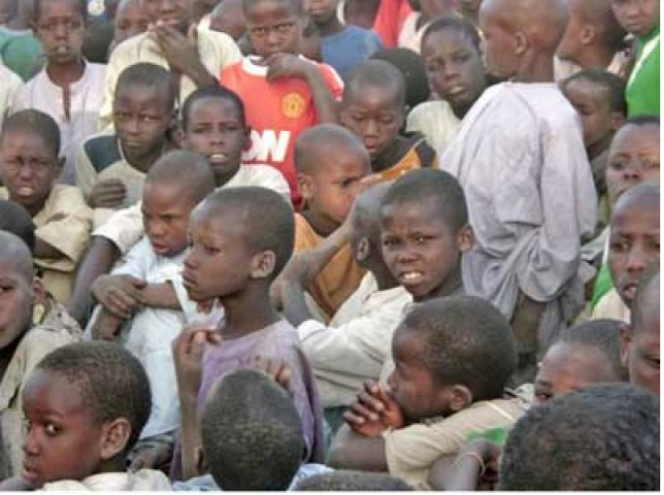
Education: Bauchi, other northern states have highest number of out-of-school kids

By Muhammad Sabiu

In a report released by a Lagos-based research firm, SB Morgen, Bauchi is the state with the highest number of out-of-school children in Nigeria, with figures rising to 1,239,759.

Figures in the report have indicated that Katsina State is second to Bauchi, with about 873,633 out-of-school children, who might have been prevented from going to school due to so many reasons.

Bringing the above figures, SB Morgen discussed recent occurrences in Kaduna State, which came fifth on the list and where schools remain closed until further notice due to the rising rate of kidnappings and other security challenges in the state.

“The Kaduna State Government has said that all primary and secondary schools will remain closed until the security situation improves across the state,” SB Morgen wrote.

It’s now apparent that one of the major factors that hinder the progress of education in northern Nigeria is kidnapping, which is not quotidian in only Kaduna. Most northwestern states have been witnessing kidnap of students in their hundreds, which usually forces authorities to order the suspension of school activities “until further notice.”

Not only northwestern states, recently, Niger State in the north-central part of Nigeria saw students in their hundreds kidnapped from their school, with many still being held by their abductors.

Officials also lament the general backwardness of education in Nigeria as there are approximately over 10 million out-of-school kids.

The Minister of State, Education, Chukwuemeka Nwajiuba, was in June 2021 quoted by the News Agency of Nigeria as saying, “The current challenges affecting the Nigerian education system has left much to be desired, the system is characterised by high illiteracy level, infrastructural decay and deficits.”

“We have inadequate number of qualified teachers, inadequate infrastructural facilities/resources and poor funding,” he added.

The figures, which are said to have been sourced from the Federal Ministry of Education, are presented as follows in order of the size of the number of out-of-school kids:

BAUCHI: 1,239,759

KATSINA: 873,633

KANO: 837,479

KADUNA: 652,990

GOMBE: 567,852

KEBBI: 484,702

ADAMAWA: 483,702

NIGER: 478,412

OYO: 463,280

SOKOTO: 462,164

YOBE: 405,100

ZAMFARA: 383,952

BENUE: 383,022

TARABA: 338,975

BORNO: 266,178

OSUN: 260,222

PLATEAU: 258,256

LAGOS: 229,264

NASARAWA: 204,771

RIVERS: 196,581

A’ IBOM: 194,018

DELTA: 181,995

KOGI: 169,316

OGUN: 158,797

EBONYI: 151,000

KWARA: 141,325

CROSS RIVER: 140,944

IMO: 125,414

FCT: 121,587

ENUGU: 117,091

ONDO: 113,746

EKITI: 99,778

ANAMBRA: 92,332

BAYELSA: 86,778

ABIA: 86,124

EDO: 79,446

Looking at the above statistics, out of the first 15 states on the list, only one is in the southern part of the country: Oyo.

Therefore, this calls for more effort and attention of stakeholders to put their shoulder to the wheel to curb this problem of the rising number of out-of-school children.

Gombe: Please, save Komi community healthcare, other infrastructures

By Muhammad Rabiu Jibrin (Mr. J)

Before his election victory in 2019, Governor Muhammadu Inuwa Yahaya and his team garnered at hand the nitty-gritty of the development needs and priorities of the masses across the state. This necessitated the conduction of a needs assessment study to evaluate the availability, functionality of basic infrastructure and services across the 114 wards of the state. The assessment outcome made the state government consider health, education, security, agriculture, and rural development as its core priority sectors. However, despite its strides that yielded remarkable developmental projects, some stones remain unturned at Komi village of Funakaye North constituency of Gombe State. Hence, the community people cry for the government’s intervention. 

The  Komi maternity health care has been in a state of despair. This will lead to an increase in the maternal mortality rate if it has not been addressed. The refurbishment of the maternity will surely ease the health-related hardship that stroke the community. Moreover, it will help towards the actualisation of goal three (3) of the Sustainable Development Goals (SDGs) that aspires to “ensure health and well-being for all”, seeing to the possibility of bringing to end tuberculosis, epidemics of AIDS, malaria and other infectious diseases etcetera by 2030.

Education remains the pillar upon which every roof of socioeconomic mobility of any nation rests. It is an exit from abject poverty. Any country that wants to prosper in it, it must invest. This includes the provision of a suitable atmosphere for learning, qualified teachers and infrastructural materials. 

With the current situation of the “Komi Primary School”, the “Quality Education” as the goal four (4) of the SDGs is not attainable. Learning is no longer possible. The zincs are no longer there, and the floor turned to carpet grass. As such, the government’s failure to rehabilitate the dilapidated building could be seen as a denial of education to the pupils, which is a form of “social Injustice” as Ibrahim Sulaiman once said: “A nation is unjust and tyrannical if it closes the door of academic and moral development to some children because their parents are poor and of no consequence. Denial of education to a child is perhaps the gravest and far-reaching of social injustices.”

The well water and earth dam were the only two sources that the Komi community rely on for survival. They only taste the taste of pure water (if it is) during the rainy season. Over decades, lack of drinking water has been a significant catastrophe bedevilling the area. As law-abiding subsistent farmers, they virtually sell off their farm produce during the dry season to buy water. A 25-litre jerrican costs them N70 to N100.

People from afar migrated to the area due to its fertile land for farming, but lack of drinking water forced them to leave. The wells dry up annually in early February, and they all shift to the earth dams for a month and some weeks before it goes off. The earth dams no longer hold water due to colluvium. In trying to solve their problems, they put all hands on deck and dug an earth dam using hoes, shelves, diggers, among others, at few steps out of the southern part of the village.

This has been the life circle of the Komi community. The pathetic thing is that they no longer look for boreholes and so on to see how neglected they have been. Instead, they clamour only for the government to desilt their earth dams to use them before the rainy season.  When should these people be rescued? When would their earth dams hold water throughout the dry season?

 Muhammad Rabiu Jibrin (Mr J) writes from Gombe. He can be reached via muhammadrabiujibrin@gmail.com.

Taliban Takeover: What you should know

By Muhammad Mahmud 

My fellow Muslim brothers and sisters, I think you will not support the US government’s atrocities meted on the Afghans over the years. However, I know that some of you see nothing wrong with anything western and nothing good with anything the West abhors. Therefore, let me address certain misconceptions and, at the same time, point out what some of YOU seem not to take into consideration. 

Of course, people rely on the West to define who a terrorist is. There is no doubt about that. Before the West labelled the Taliban, a terrorist who, in the whole world, regarded them as one? The western media dictates who is to blame and who is to be sympathised with. The Palestinian struggle with the Zionists’ forces of occupation is a prominent example. The Muslim Brotherhood is also labelled a terrorist group even as they chose to follow the democratic way to pursue Islamic sharia. The same happened to Algeria’s Islamic Salvation Front. 

But let’s use some reasons others deploy regarding the Taliban as a terrorist organisation to prove why people rely on the west to define who a terrorist is. Your argument is often that “many of us see them as terrorists because they are deliberately and indiscriminately killing Muslims and other innocent civilian population.” Now the question is, which of these atrocities hadn’t the US army meted to the “Muslims and other innocent civilian population”? So why do you think that the Taliban fighters are terrorists while you regard the US army as liberators? 

On the other hand, why would America’s violation of the practice of Prophet Muhammad’s rule of engagements not bother you people but the Taliban’s violation bother you to the extent of opposing them and (impliedly) supporting America? You are supposed to oppose both sides if that is the case. I think you are probably, struggling with some misconceptions here, and you are not alone. 

1- That Taliban, having declared that they are following the footpath of the Prophet, shouldn’t deviate from his teachings. This is entirely true. But are we only to oppose Muslims who violated Islamic teachings on the sanctity of lives, or is that also applicable to everyone?

2- Having violated the Prophet’s teachings on the rules of engagements by killing the innocents, the Taliban are to be opposed against the Americans who did not claim to be Muslims. Because the Taliban are portraying Islam in a bad image, this is a big misconception. 

First, it should be clearly noted that even if a Muslim group violated Islamic teachings on the rules of engagements, that does not entirely disrobe them of their status as Muslims. On the contrary, we condemn that act and disassociate ourselves and our religion from that very act and continue to consider them as Muslims. A few examples will suffice here. 

During the time of the Prophet Muhammad (SAW), Khalid Bn Walid (RA) violated the rules of engagements in one of the wars. It was so grave to the extent that when the report reached the Prophet, he openly condemned and disassociated himself from that act and even supplicated that “O Allah, I disassociate myself from what Khalid did.” But the Prophet did not declare him a terrorist or even ostracised him. 

In another incident, some Muslims killed someone during a war after declaring that he was now a Muslim. When the report reached the Prophet, he became outraged and rebuked them. However, he did not declare them as opponents for violating the rules of engagements; instead, he criticised that very act and chastised them for doing that. 

There were many reports of violations of Islamic rules of engagements even during the wars fought by the Ummah’s most pious generations, yet that is put into context, and a larger picture is considered.

During the Jihad of Dan Fodio, Sheikh Muhammad Bello narrated how some people violated the rules of engagements and how Sheikh Dan Fodio chastised them and disassociated himself from that act. Yet, they continued to be part of his army.

Therefore, from the Islamic perspective, we can condemn and accuse the Taliban of violating Islamic rules of engagement, but that doesn’t mean that we should support non-Muslim armies who perpetrated the same or worst atrocities on fellow Muslims. There is a stark difference between the two factions Islamically.

It is almost a consensus among the Muslim scholars that whenever non-Muslim armies invade any Muslim country, it is a wajib [compulsory] for all to fight and chase them out. 

Now a non-Muslim army invaded a Muslim country, some people jubilated, and the Muslim troops chased them out, we jubilated. Then those who jubilated the invasion started accusing us of supporting “terrorism”, how do you think we would respond?

Malam Muhammad writes from Kano. He can be reached via meinagge@gmail.com.

11 abducted persons rescued in Zamfara

Eleven abducted persons have been rescued by men of the Nigeria Police Force in Zamfara State.

The kidnap victims were taken away by their abductors on Thursday, 12 August.

Zamfara State police public relations officer, SP Mohammed Shehu, said, “The effort that led to the unconditional rescue was sequel to the report of abduction of 11 persons by some group of hoodlums suspected to be bandits at Yarkofoji community in Bakura Local Government Area of the state on 12th August, 2021.”

Also, in yet another rescue effort, the Chief Security Officer of the College of Health Technology, Tsafein, regained his freedom.

SP Shehu said, “The report of his abduction was reported to the police at the early hours of 18th August, 2021, when a group of hoodlums went to his house at around 0040hrs and abducted him. The police search and rescue team swung into action by combing the surrounding forest. Luckily enough, the victim was rescued safely.

“The search and rescue strategies employed by the Commissioner of Police Zamfara State Command, Mr. Ayuba Elkana, led to the successful rescue of the abducted victims without any ransom paid by the relations of the victims.

“The Commissioner congratulated the victims for regaining their freedom and urged them to always be conscious of their security and report any suspicious person to the Police or any nearest security outfit for the prompt response. All the victims have been taken to the hospital for medical checks. Later debriefed by the Police and reunited with their families.”

The police spokesperson further reiterated their readiness to protect the lives and property of people.

Zamfara is one of the northwestern states suffering from the activities of bandits and kidnappers, despite security agencies’ efforts and Governor Matawalle’s vow to bring an end to it.