Month: December 2025

Kano govt condemns arrest, transfer of former PCACC chairman Muhuyi Magaji

By Uzair Adam

The Kano State Government has expressed deep concern over the arrest and subsequent transfer of the former Chairman of the Public Complaints and Anti-Corruption Commission (PCACC), Muhuyi Magaji Rimin Gado, by operatives of the Nigeria Police Force.

This was disclosed in a statement signed by the Attorney General and Commissioner for Justice, Kano State, Abdulkarim Kabiru Maude, on Friday.

According to the state government, Magaji was arrested around 5:30 p.m. on Thursday at his law office along Zaria Road in Kano by heavily armed police officers who allegedly did not present any warrant of arrest or court order.

He was first taken to the Police Headquarters at Bompai before being moved to Abuja later that evening.

The statement noted that the development raises serious constitutional and legal concerns, particularly in relation to Sections 35, 36, and 46 of the 1999 Constitution, which guarantee personal liberty, fair hearing, and the right to seek enforcement of fundamental rights.

While acknowledging that the police have the authority to investigate and enforce the law, the Attorney General stressed that such powers must be exercised within the bounds of due process and respect for human dignity.

The government described the manner and timing of the arrest as worrisome, especially given the absence of any official notification to state authorities despite the sensitivity of the case.

It added that the operation appeared unnecessarily militarized, warning that the action could create tension, fear, and political misinterpretation within Kano State.

The government further alleged that some political actors outside the state might be attempting to exploit federal institutions in ways capable of destabilizing Kano and undermining the current environment of peace and good governance.

According to additional findings by the state government, Magaji’s arrest is believed to be connected to several ongoing investigations and prosecutions involving politically exposed persons in Kano.

The statement warned that the move could be aimed at obstructing or compromising these sensitive cases.

The government also described as alarming the alleged deployment of more than 40 armed police officers for the arrest despite a subsisting High Court order restraining security agencies from harassing or arresting Magaji.

It said the development raises concerns about abuse of power and misplaced security priorities at a time when the state and nation face significant security challenges.

The Kano State Government reaffirmed that the state remains peaceful and governed by the rule of law, stressing that any action capable of provoking public disorder or politicizing law enforcement must be firmly resisted.

It urged the police to publicly explain the legal basis for Magaji’s arrest and transfer to Abuja, while calling for full adherence to constitutional provisions and human rights standards.

The government reiterated its commitment to cooperating with all lawful security agencies but warned that it would take every constitutional step necessary to protect the rights of its citizens and safeguard public peace.

Residents were urged to remain calm and law-abiding as the situation continues to unfold.

The dilemma of negotiating with bandits: A path built on ashes?

By Aliyu Ya’u

His Excellency, Dikko Umar Radda’s position on rural banditry has provoked considerable reactions, with some questioning his resolve to confront bandits rather than seek a peace agreement.

Given that he lacks control over the paramilitary and armed forces present in the state, it is fair to say that he has taken commendable steps by establishing the state’s community policing group and encouraging the civilian population to engage in self-defence. 

I fully empathise with his frustration, especially in light of the constant criticisms and pleas from victims suffering due to the terror of rural banditry. Understandably, his excellency may feel disheartened and powerless to prevent these criminals from continuing their activities. 

Further, everyone, especially the civilian population, would welcome a peace accord in a real conflict situation. In such situations, all parties’ demands are tabled and deliberated, and sustainable solutions are found and implemented. 

However, in the case of an unorganised and unregulated group like rural bandits of the North-western and North-central Nigeria, who wreak havoc daily without reasonable justification. 

The question lies not in the society respecting the peace accord, but in the modalities employed to guide the peace settlement. Another question is whether the peace accord is sustainable, using historical parameters to assess the credibility and reliability of the commitment of the violent party involved. 

Any peace accord between a government, society, and an armed group should be based on disarmament, demobilisation, and reintegration (DDR). 

According to the United Nations Peacekeeping operation unit, DDR is “a process of removing weapons from the hands of members of armed groups, taking these combatants out of their groups and helping them to reintegrate as civilians into society.”

The question is whether the militias or bandits are ready to surrender all their weapons, demobilise from their dens, and reintegrate into the larger society. Unless the government can confirm these terms with the bandits’ leaders, mediators, and sureties, it will not be obligated to build a wall of ash blocks. 

Other questions include, How strong and convincing are the commitments laid down or presented by the militias? How committed is the leadership to the pact? What are the demands? How cogent and soluble are they? Do they have a unified command structure? Is the command structure capable of issuing an effective directive that will be respected by various dens and groups committing heinous bandit crimes? 

These armed groups are often small; in most cases, a group comprises 10 or fewer bandits who act autonomously, unless they need to cooperate against a sedentary enemy community. The absence of a centralised governing body makes it difficult to build an effective peace agreement with the groups. How could a peace accord with hundreds of bandit groups roaming the regions’ thick and interconnected forests that span hundreds of kilometres and access many states be possible? 

Another aspect deserving the government’s focus is the scope of Katsina state’s peace accord. What areas will it encompass? Will the armed bandits responsible for heinous crimes in Katsina state prevent others from neighbouring states from crossing into the area to commit banditry? It’s crucial to recognise that we are not dealing with an insurgent group, a separatist movement, or an ideological terror organisation; rather, the state is confronting multiple disorganised criminal entities. 

The focus should be on the following: The state’s primary concern is achieving lasting peace, not a temporary ceasefire. The bandits should establish a reliable leadership structure that is known and accessible, and willing to take full responsibility if they breach the agreement. They should clearly specify what sets their current commitments apart from those made with previous governments. Additionally, they should submit their complaints for the state’s review and assessment. The sureties must first confiscate or disarm the bandits before any peace accord is signed.

Aliyu Yau holds an M.Sc. in Defence and Strategic Studies and is a public policy and conflict analyst based in Kaduna.

Pregnant woman dies In Katsina hospital after cash-only policy blocks urgent treatment

By Sabiu Abdullahi

A pregnant woman identified as Aisha Najamu has died at the Turai Umaru Musa Yar’adua Maternity and Children Hospital in Katsina State after a health worker allegedly refused to accept a bank transfer for oxygen, insisting on cash payment.

The incident reportedly happened on Monday. The woman was said to have been rushed to the hospital in a life-threatening condition and required oxygen immediately.

A popular Nigerian TV station reported on Friday that an eyewitness claimed the cashier on duty declined to process the payment because the patient did not have cash.

The witness said the cashier told them that “the hospital’s internal rule” did not allow bank transfers.

A man who attempted to intervene allegedly begged the cashier to take a transfer since the woman needed urgent help.

According to the report, the cashier insisted that “hospital policy strictly forbade bank transfers and that staff must abide by the directive.”

The eyewitness added that he offered to add extra money out of sympathy. He later presented a $100 note to settle the bill, yet the cashier still refused to accept the payment. He described the moment as heartbreaking and said the woman cried for help until she passed away around 11:30 p.m.

Hospital authorities, when reached for comment, said they had not received a formal complaint from the public about the matter.

The hospital’s representative, Cashier Aminu Kofar-Bai, extended condolences to the family and stated that management would reach out to them.

He also promised an investigation into the conduct of any staff member who might be responsible.However, hospital officials defended their payment system.

They maintained that the Katsina State Government’s TSA guidelines prevent staff from accepting bank transfers into personal accounts. They also explained that the hospital lacks POS machines and operates strictly on cash transactions.

NERDC chief renews calls for wider AI adoption in Nigerian schools

By Sabiu Abdullahi

The Executive Secretary of the Nigerian Educational Research and Development Council (NERDC), Prof. Salisu Shehu, has renewed calls for a stronger embrace of Artificial Intelligence (AI) across the country’s education system.

Prof. Shehu made the appeal during the AI in-Practice Forum held in Lagos on Wednesday, 3rd December 2025.

He thanked the organizers and participants, saying the gathering showed a shared national resolve to upgrade teaching and learning through new technological tools.

He explained that NERDC has made notable progress in introducing AI-related skills and concepts into the updated Basic and Senior Secondary Education Curriculum.

He restated the Council’s commitment to expanding innovation driven by AI within the school system.

According to him, the revised curriculum now features vital digital knowledge areas such as coding, programming, artificial intelligence and robotics, among others.

He said these additions are aimed at preparing young Nigerians for opportunities in a fast-changing digital era.

Prof. Shehu also commended the Nigerian Information Technology Development Agency (NITDA) for its steady partnership with NERDC in producing the Digital Literacy Curriculum for Basic Education.

He praised NITDA for helping shape the country’s digital learning framework and stressed the need to strengthen this cooperation.

He appealed to NITDA to widen its collaboration with NERDC, especially as the Digital Literacy Curriculum and the Digital Technologies Curriculum move into the implementation phase.

He pointed out that developing a curriculum is a major step, but effective delivery calls for continuous teamwork, capacity enhancement, infrastructure and coordinated support at national level.

The Executive Secretary attended the forum with his Special Assistant (Technical), Dr. Garba Gandu, and the Head of the Policy and Programmes Unit, Dr. Oladiran Famade. Both officials were acknowledged for playing key roles in NERDC’s digital advancement efforts.

The AI in-Practice Forum brought together specialists, government representatives, educators and technology stakeholders.

The event focused on practical measures for expanding AI use in Nigerian schools and added to ongoing efforts to prepare learners for the demands of the future.

Tinubu swears in Christopher Musa as defence minister

By Uzair Adam

President Bola Tinubu has sworn in General Christopher Musa, the immediate past Chief of Defence Staff (CDS), as Nigeria’s new Minister of Defence following the resignation of Mohammed Badaru earlier this week.

The former Jigawa State governor stepped down amid worsening security challenges across the country.

Upon accepting his resignation, President Tinubu promptly nominated General Musa and sent his name to the National Assembly for screening and confirmation.

General Musa appeared before the Senate on Wednesday, where he was extensively questioned by lawmakers on security matters before being cleared and confirmed.

At a brief but solemn ceremony, President Tinubu urged the new minister to leverage his extensive operational experience, strategic depth, and institutional knowledge of the Armed Forces to strengthen Nigeria’s defence posture.

He emphasised that the ministry must prioritise synergy among the services, accelerate reforms, and sustain momentum in ongoing joint operations.

The President also highlighted the need for transparency in procurement, improved welfare for personnel, and deeper inter-agency cooperation.

General Musa, who served as Nigeria’s 18th Chief of Defence Staff until June, is widely regarded as one of the most experienced officers of his generation.

He commanded counterterrorism operations in the North-East and provided strategic oversight for nationwide military engagements.

He pledged total commitment to the President’s vision for a safer and more stable Nigeria, promising to work tirelessly to enhance operational efficiency, modernise defence capabilities, and strengthen partnerships with regional and international allies.

“We will not relent. We will sustain the pressure on the enemies of the state and ensure that peace returns to every community,” he said, stressing the importance of troop morale, intelligence-led operations, and collaboration with local communities.

Following the induction, senior government officials, including the National Security Adviser Mallam Nuhu Ribadu, service chiefs, and members of the Federal Executive Council, congratulated the new minister, expressing confidence that his appointment signals a new chapter in Nigeria’s security management.

General Musa is expected to hold inaugural briefings with service chiefs and top ministry officials in the coming days as he begins reshaping Nigeria’s defence priorities for the years ahead.

Troops rescue hundreds, destroy terror camps, illegal refineries nationwide

By Uzair Adam

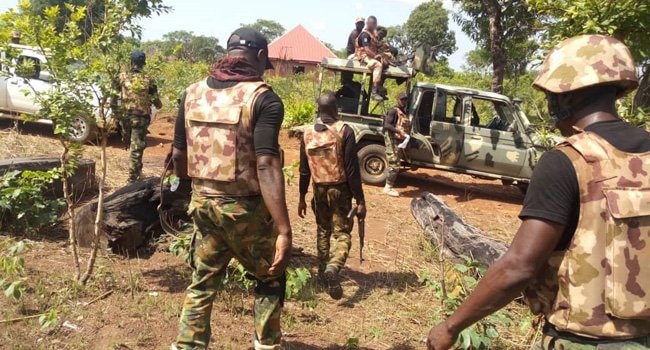
Nigerian troops have rescued 318 kidnapped victims, neutralized several terrorists, and arrested many others during coordinated operations across multiple regions in November, the Defence Headquarters (DHQ) has said.

A statement issued on Thursday explained that the operations also led to the deactivation of 16 illegal crude oil refining sites and the prevention of suspected oil theft valued at over N217.6 million.

Troops additionally recovered thousands of litres of crude oil and AGO during the raids.

The military assured that efforts are ongoing to secure the release of the students recently abducted in Niger State.

In the North East, troops of Operation Hadin Kai sustained pressure on Boko Haram, ISWAP, and JAS fighters through land and air offensives carried out in several local government areas of Borno and Adamawa States.

The operations resulted in the neutralization of terrorists, arrest of collaborators, rescue of kidnapped victims, and destruction of terrorist camps and equipment.

In the North West, troops under Operation Fansan Yamma carried out similar missions in Zamfara, Sokoto, Katsina, Kano, Jigawa, and Kebbi States. Several terrorists were neutralized, suspects arrested, and kidnapped victims rescued.

Air operations also targeted hideouts in Kankara and Faskari, destroying camps and disrupting logistics networks.

Troops operating in the North Central under Operation Enduring Peace conducted raids in Plateau and Kaduna States, neutralizing extremists, arresting suspects, and rescuing victims.

Additional missions under Operation Whirl Stroke in Benue, Nasarawa, and Taraba States led to more arrests, rescues, and recoveries of arms, vehicles, and livestock.

Operations extended to Kogi State and the FCT, where extremists were neutralized and more victims rescued.In the Niger Delta, troops under Operation Delta Safe intensified efforts against oil theft in Bayelsa, Delta, Imo, and Rivers States.

These operations thwarted theft valued in millions of naira, dismantled illegal refineries, and led to the arrest of oil thieves and other criminals.

Additional patrols also resulted in arrests and seizures of arms and ammunition.

In the South East, under Operation Udoka, troops conducted raids across Enugu, Ebonyi, Abia, and Cross River States.

The missions led to the neutralization of terrorists, arrests, rescues, and recovery of weapons and explosives. Air strikes in Ezeagu LGA destroyed terrorist camps and supply routes.

The military commended the troops for their bravery and urged Nigerians to continue providing credible information to support ongoing operations, while also calling for support for veterans through the Armed Forces Remembrance Day initiative launched on December 2, 2025.

According to DHQ, the Armed Forces remain committed to lawful operations aimed at restoring peace across all affected parts of the country.

Shari’ah in Nigeria: A response to Ebenezer Obadare’s U.S. congressional testimony

Dr Ebenezer Obadare, a Senior Fellow for Africa Studies at the Council on Foreign Relations (CFR), recently testified before a joint briefing of the United States Congress on the security crisis in Nigeria. Given CFR’s extraordinary influence on U.S. foreign policy, as its analysts brief the Congress, the State Department, and the White House, the accuracy and balance of Dr Obadare’s testimony matter significantly.

At the briefing, U.S. lawmakers and witnesses made one demand that every responsible Nigerian, Muslim or Christian, would be happy with: that Nigeria must disarm armed militias and prosecute attackers. The renewed commitment we are now seeing from the Nigerian government, including airstrikes against armed militias, the planned police and military recruitment, and the declaration of a national security emergency are all a response to the mounting U.S. pressure. On this point, American engagement has been productive.

However, Dr Obadare went far beyond the reasonable. After acknowledging the recent steps taken by President Tinubu, he nevertheless insisted that “Washington must keep up the pressure.” To him, U.S. leverage should not only be used to combat Boko Haram but to pressure the Nigerian president to abolish Sharia criminal law in twelve northern states and disband Hisbah commissions across the northern region. This framing is problematic on several counts.

First, it portrays Nigeria not as a sovereign state but as a dependent client whose legal and cultural system must be restructured via external coercion. This is not only intellectually careless; it is politically reckless. Nigeria’s constitutional debates, including the place of Sharia within a federal arrangement, cannot be resolved through directives from Washington. These are matters rooted in decades of negotiation, legal precedent, historical realities, and democratic choice. Such complexity cannot be wished away by foreign pressure or reduced to simplistic talking points about religious persecution. Sharia was introduced between 1999 and 2001 through public consultation and mass popular demand by the local citizens in northern Nigeria, who are Muslims. Subsequently, it was formalised and enacted into law by the various State Houses of Assembly.

Second, Obadare’s argument misdiagnoses the root causes of violence in the north. Boko Haram and ISWAP do not derive their ideology from the Sharia systems implemented by northern states since 1999. In fact, Boko Haram explicitly rejects these systems as insufficient, impure, and corrupted by democracy. They consider northern governors apostates precisely because they operate within a secular constitution. The group’s origins lie in violent extremism, socio-economic marginalisation, and the 2009 extrajudicial killing of the group’s founder, Mohammed Yusuf. It has nothing to do with the Sharia framework implemented by the twelve northern states. In fact, Boko Haram rejects and condemns these state Sharia systems as illegitimate, and this is why the majority of their victims are Muslims themselves. 

It is therefore analytically false to imply that Sharia criminal law fuels this insurgency. This narrative does not withstand even a basic historical timeline. The Maitatsine insurgency of the 1970s, whose ideology and violence closely resemble Boko Haram, predated the introduction of Sharia in the early 2000s by decades. To frame Sharia as the catalyst of terrorism is therefore a misreading of history and to locate causality where it does not exist.

Third, the call to disband Hisbah groups ignores their actual function and constitution. Hisbah institutions are state-established moral enforcement agencies regulated by local laws. They are not terrorist actors, militias, or insurgent organisations. They are contrary to Dr Obadare’s claims that they “impose extremist ideology, enforce forced conversions, and operate with near-total impunity.” These assertions either misrepresent the facts to unfairly tarnish their reputation or reflect intellectual laziness that risks misleading American policymakers. In doing so, they also demonise millions of peaceful Nigerian Muslims who regard Sharia as a legitimate component of their cultural and moral identity.

Finally, Dr Obadare’s testimony, intentionally or not, reinforces a narrative in Washington that sees Nigeria’s crisis primarily through the lens of religious conflict rather than the multi-dimensional reality it is, that is, a mixture of terrorism, banditry, state failure, local grievances, arms proliferation, and climate-driven resource conflicts in the form of farmer-herder crisis. Oversimplification of this serious problem does not aid victims. It distorts U.S. policy and encourages punitive measures that could destabilise fragile communities further and restrict the fundamental rights of millions of Muslims to exercise their faith and adhere to the guidance of Shari’a in their personal and communal lives. 

Nigeria faces serious security challenges amid years of leadership neglect. We genuinely need pressure to put the leaders on their toes, but not the kind rooted in calculated distortion. There is a need for leadership accountability, but not at the expense of Nigeria’s sovereignty. And we need a partnership with the United States in the areas of intelligence gathering, military capabilities and a mutually beneficial partnership. 

The United States should not base its engagement on flawed analyses made by experts such as Dr Ebenezer Obadare, which risk misrepresenting Nigeria’s realities, undermining local institutions, and prescribing solutions that could exacerbate rather than resolve the country’s complex security challenges. Partnering with the Nigerian government enables a tailor-made approach to effectively address these challenges, rather than relying on experts who have long been out of touch with Nigerian realities beyond what they read in media reports.

The Nigerian state must do more, no doubt. But analysts like Dr Obadare must also do better. Nigeria deserves policy analysis grounded in accuracy, proportionality, and respect for the complexities of a plural society; not sweeping prescriptions that collapse constitutional debate into counterterrorism and treat millions of northern Muslims as collateral in the process.

Ibrahiym A. El-Caleel writes from Nigeria and can be reached at caleel2009@gmail.com.

Troops rescue hundreds, destroy terror camps, illegal refineries nationwide

By Uzair Adam 

Nigerian troops have rescued 318 kidnapped victims, neutralised several terrorists, and arrested many others during coordinated operations across multiple regions in November, the Defence Headquarters (DHQ) has said.

A statement issued on Thursday explained that the operations also led to the deactivation of 16 illegal crude oil refining sites and the prevention of suspected oil theft valued at over N217.6 million. 

Troops additionally recovered thousands of litres of crude oil and AGO during the raids. The military assured that efforts are ongoing to secure the release of the students recently abducted in Niger State.

In the North East, troops of Operation Hadin Kai sustained pressure on Boko Haram, ISWAP, and JAS fighters through land and air offensives carried out in several local government areas of Borno and Adamawa States. 

The operations resulted in the neutralisation of terrorists, arrest of collaborators, rescue of kidnapped victims, and destruction of terrorist camps and equipment.

In the North West, troops under Operation Fansan Yamma carried out similar missions in Zamfara, Sokoto, Katsina, Kano, Jigawa, and Kebbi States. Several terrorists were neutralised, suspects arrested, and kidnapped victims rescued. 

Air operations also targeted hideouts in Kankara and Faskari, destroying camps and disrupting logistics networks.

Troops operating in the North Central under Operation Enduring Peace conducted raids in Plateau and Kaduna States, neutralising extremists, arresting suspects, and rescuing victims. 

Additional missions under Operation Whirl Stroke in Benue, Nasarawa, and Taraba States led to more arrests, rescues, and recoveries of arms, vehicles, and livestock. 

Operations extended to Kogi State and the FCT, where extremists were neutralised and more victims rescued.

In the Niger Delta, troops under Operation Delta Safe intensified efforts against oil theft in Bayelsa, Delta, Imo, and Rivers States. 

These operations thwarted theft valued in millions of naira, dismantled illegal refineries, and led to the arrest of oil thieves and other criminals. 

Additional patrols also led to arrests and the seizure of arms and ammunition.

In the South East, under Operation Udoka, troops conducted raids across Enugu, Ebonyi, Abia, and Cross River States. 

The missions led to the neutralisation of terrorists, arrests, rescues, and the recovery of weapons and explosives. Air strikes in Ezeagu LGA destroyed terrorist camps and supply routes.

The military commended the troops for their bravery. It urged Nigerians to continue providing credible information to support ongoing operations and to support veterans through the Armed Forces Remembrance Day initiative launched on December 2, 2025.

According to DHQ, the Armed Forces remain committed to lawful operations aimed at restoring peace across all affected parts of the country.

General Musa takes over Nigeria’s defence ministry after Senate’s confirmation

By Abdullahi Mukhtar Algasgaini

The Senate confirmed retired General Christopher Musa as Nigeria’s Minister of Defence on Wednesday. This appointment places the former Chief of Defence Staff at the head of the nation’s defence apparatus barely 40 days after his military retirement.

The confirmation followed a rigorous screening session where senators questioned the nominee on various security challenges facing the country.

The approval was ultimately secured through a voice vote.General Musa’s nomination moved swiftly through the executive and legislative branches.

President Bola Tinubu nominated him on Tuesday, with his name transmitted to the Senate for confirmation the same day.

Fact Check: Is Opay deducting users to service loan?

By Abdulsalam Alkali

Claim: 

Opay, a fintech microfinance bank, is deducting money from customer accounts to service COVID-19 Survival Fund loans. This claim has been circulating on social media since the beginning of the week.

Verification Process:

A rough search using the Tor browser and DuckDuckGo search engine found no evidence to support the claim. A deeper search traced the origin of the story to a social media page named “Ibadan Crush TV”, which appears to have been the first to publish it. Furthermore, Opay has used its verified official channels to refute the story, describing it as false, malicious, and fabricated. The company insists all customer accounts and deposits remain safe, intact, and fully accessible.

Findings:

Available data confirms that the circulating news is entirely misleading and false. No deductions for loan servicing have been made from Opay accounts. Opay insists that anyone with a genuine claim should come forward to register a complaint. The story originated from a non-credible source, a page focused on entertainment and lifestyle, not a legitimate news medium.

Verdict:

The claim that it is “fake and misleading” is consistent with the available evidence. There is no public traceable evidence that OPay deducts user funds for servicing any “COVID-19 Survival Fund” loan, and strong official statements from OPay denying both loan services and unauthorised withdrawals.