Month: April 2025

Two Kano men die in Niger mining pit collapse

By Uzair Adam

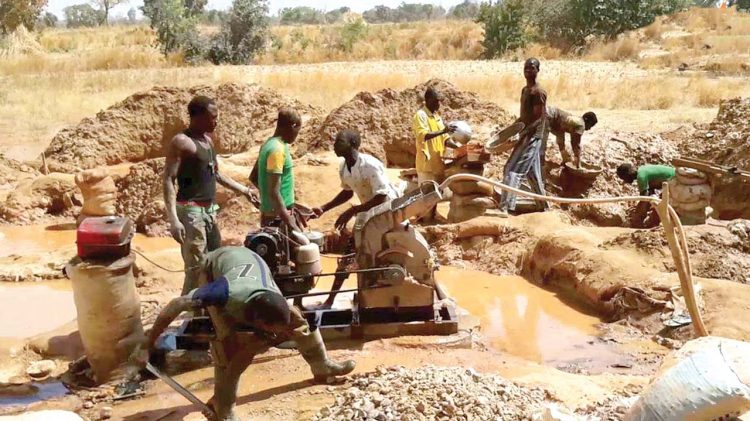
The police in Niger State have confirmed the death of two individuals following the collapse of a mining pit in the Farin-Doki area of Shiroro Local Government.

Police Public Relations Officer, SP Wasiu Abiodun, told journalists in Minna on Monday that the tragic incident occurred on Sunday night, trapping two miners later identified as Buhari Kano and Mallam Tasiu, both natives of Kano State.

He explained that officers from the Erena Division, alongside local residents, rushed to the scene and began rescue efforts.

However, the victims were eventually found dead and their remains were taken to the Zumba hospital for further examination.

Preliminary investigations revealed that the miners were operating illegally at the site at the time of the collapse.

Abiodun stated that a full investigation is currently underway to determine the exact cause of the incident.

Praise strengths, hide weaknesses in marriage and beyond

By Aisha Musa Auyo

I will begin my write-up with this Hadith: Prophet Muhammad (peace be upon him) said, “Nothing is heavier on the believer’s scale on the Day of Judgment than good character.” (Sunan al-Tirmidh).

If we pay attention and are fair to ourselves, I bet you will realise that none of us is perfect. We all have areas in our lives where we excel, and we all have areas where we do not excel – or even fail. This will be true in your marital life as well. So, let us try to upgrade our character based on this fact.

Marriages collapse for many reasons. Some marriages and relationships go wrong because people fail to praise each other’s strengths and tend to criticise each other’s weaknesses. 

Let me tell you from experience. I love getting praise when I do something good, but if I totally blow something, I am already critical and upset enough with myself that I do not need my mate coming in and twisting the knife, so to speak. I am pretty sure everyone out there would agree with me on this. 

If you want to approach marriage the right way, you must generously praise each other, particularly when one excels at something, and use criticism sparingly when one flounders. Pray about the challenges and allow Allah, the Most High, to handle the work. 

Crushing your spouse’s soul will only push them away and never pull them toward you. When you see your spouse has messed something up, this is a time to draw them into your arms, hug them tight, and assure them everything will be okay. 

Marriage is teamwork, not competition, so learn to support and encourage each other. If you discover that you have strengths in areas where your spouse is weaker, take the lead in those aspects of the relationship and allow your partner to excel in what they do best. This synergy is achievable only in a healthy, selfless, progressive marriage.

If you both struggle in an area, agree to collaborate to address it. Learning to use this key effectively will create tremendous harmony in your relationship.

This formula can be applied beyond marital relationships. Any type of relationship can benefit from it, including those between parents and children, teachers and students, siblings, coworkers, or employers.

In a world where you can be anything…. choose positivity, compassion, empathy, and kindness. Remember, people may forget how you look, but they may never forget how you made them feel.

One more reason to be kind, encouraging, and compassionate is the hadith that the Prophet Muhammad (peace be upon him) said: “The best among you are those who have the best manners and character” (Sahih al-Bukhari).

Aisha Musa Auyo is a Doctorate researcher in Educational Psychology. A wife, a mother, a homemaker, caterer, parenting, and relationship coach. She can be reached via aishamuauyo@live.co.uk.

Trending at any cost: TikTok fame and the rise of Kabeer 2Pack

By Hadiza Abdulkadir

In a striking example of how far young people are willing to go for online fame, a TikTok content creator known as Kabeer 2Pack has taken social media by storm with bizarre, often repulsive stunts—drawing the attention not only of millions of followers but also of serious academic inquiry.

Kabeer, dubbed the “April 2025 sensation,” has garnered over 5.2 million likes and 618,300 followers on TikTok by performing antics such as bathing himself in filthy gutter water and covering himself in dust and charcoal. His goal, he insists, is not madness but “glory”: “Ba hauka ba ne, ɗaukaka na ke nema,” he says—“I’m not mad, I seek glory.”

While his popularity soars—one of his videos reached 30.3 million views—critics question why such extreme behaviour overshadows respected Islamic scholars like Sheikh Aminu Daurawa, whose most viewed video stands at 2.4 million. In comparison, controversial influencer Murja Ibrahim Kunya boasts 3.1 million followers and 59.4 million likes.

Professor Abdalla Uba Adamu of Bayero University, Kano, argues that these influencers, despite their antics, are crucial subjects for academic study. “Influencers, trenders, even sickos and weirdos are all part of the data to harvest in order to fully understand contemporary society,” he wrote in a recent commentary.

According to Adamu, the phenomenon reflects what scholars now term the “Attention Economy,” where digital content, no matter how outrageous, is exchanged for social capital, influence, and often money. He compares this with global TikTok stars like Khaby Lame, who silently mocks life hacks and has amassed over 162 million followers—earning $20 million in 2024 alone.

“Even the most ridiculous trends can be read as resistance, escapism, or social commentary,” Adamu notes, urging researchers to see past the surface and explore the deeper meanings behind online behaviour.

In a digital age where clout is currency, young people like Kabeer 2Pack are not just chasing fame—they’re reshaping the culture, one like at a time.

State Department memo reveals lack of evidence against detained student

By Hadiza Abdulkadir

Rumeysa Öztürk, a 30-year-old Turkish doctoral student at Tufts University, was detained by U.S. Immigration and Customs Enforcement (ICE) agents on March 25 near her home in Somerville, Massachusetts. The arrest, captured on security footage, showed masked agents taking her into an unmarked vehicle without identifying themselves, leaving her screaming for help.

Öztürk, a Fulbright scholar pursuing a Ph.D. in Child Study and Human Development, had co-authored a 2024 op-ed in The Tufts Daily criticizing the university’s response to the Gaza conflict and calling for divestment from companies linked to Israel. Following the publication, her name and photo appeared on Canary Mission, a controversial website that profiles individuals accused of anti-Israel activism.

The Department of Homeland Security (DHS) accused Öztürk of supporting Hamas, though no public evidence has been provided. Her student visa was revoked, and she was transferred to a detention center in Louisiana, despite a court order requiring 48 hours’ notice before moving her out of Massachusetts.

Öztürk’s detention has sparked widespread protests and condemnation. More than 2,000 students rallied at Tufts University, and demonstrations have taken place in Boston and Washington, D.C. A coalition of 27 Jewish organizations filed a legal brief in her support, arguing that her arrest threatens free speech and academic freedom.

Tufts University President Sunil Kumar stated that the university has no information supporting the allegations against Öztürk and emphasized the importance of due process. Öztürk’s legal team, including the ACLU, is seeking her immediate release, citing violations of her constitutional rights.

A federal court hearing is scheduled to determine the jurisdiction of her case. Öztürk remains in ICE custody, facing possible deportation to Turkey.

The super bookseller; Tribute to Alaji Garba Mai Littafi.

By Muhammad Ahmad Iliasu

When Barr. Ammani recommended Hillary Clinton’s Autobiography ‘Living History’ to me back in 2018, I said to myself where could I find it? Because, among others, one thing was certain; books that are authored across the ocean are not easy to find. And if, in the rare case, they are available, a young student like me was most likely priced out of contention.

Then one day, during one of my trekking braggadocios between Kantin Kwari, Bata to Sabon Gari, I stumbled upon an intensely greying old man of modest stature, smiley and incredibly alert and mobile for a man of his age. What pulled my attention to his makeshift shop wasn’t him, but rather the large book carrying the face of Herbert Hoover – USA’s 31st President.

At that time, there were a lot of debates in our Macro class in BUK on Buhari’s Protectionist policy. And with Yanis Varoufakis’s dominance on my bookshelf, how protectionism backfired against Hoover as stated in his ‘Global Minotaur’ became of great interest to me. I didn’t only want to know all about protectionism in the 1930s but the whole lifetime of President Hoover and his administration.

Therefore I stepped to the old man, pointed at the book and asked ‘how much is that one, Baba?’ ‘It’s price is two-thousand five-hundred Naira, boy’ – he replied. I responded ‘what?’ – almost terrified by its incredible cheapness, even though I didn’t have that amount at the time. To which he incredibly remarked ‘if you are truly serious, I will leave it to you at one-thousand seven-hundred Naira’. I laughed and borrowed the money from my boss’s change to settle the payment. I asked him once again ‘do you by any chance have Living History?’ The old man smiled and said ‘That will be Hillary Clinton’s Autobiography. I sold it two days ago. But I have ‘Women in Charge’. He put my curiosity into perspective with that response. Because I didn’t think he would know that instantly. And from then my relationship with him became very close. I admired his familiarity with books, genres and authors. And he became fond of how much I was willing to spend on books.

Interestingly, we never exchanged contacts. I usually stopped by his place anytime my boss sent me to Sabon Gari. And whenever he had a book he knew I’d like, he would keep asking his customers if they knew one big lad from the core metropolis who is crazy about books – I knew that because he asked three people who knew me and passed the message.

Beyond the unbelievable cheapness of his books, what made Alaji Garba special wasn’t his eagerness to sell, but knowing what his customers wanted to buy. He had a way of profiling people’s interest perfectly. For example, anytime he had an autobiography of a famous leader or historical figure he would try his best to see me acquire it. I recall how he kept the biography of Joseph Stalin waiting for weeks even though many wanted to get it ahead of me. Funny enough, I didn’t know who Stalin was at that time. He just believed I would like it. And he was right.

From him I acquired more than 20 biographies of US presidents including those of Washington, Maddison, Jefferson, Lincoln, FDR and Reagan. I first heard about The Bourbons, House of Windsor and The Bolsheviks from him. Better yet, he supplied deep readings on them. I got classics authored by Rousseau, Locke, Homer, Byron, Marx, Calder, Orwell, Dante and Dumas from Alaji Garba.

He introduced me to the artistic savagery of Mario Puzo’s Mafia and the boiling horror of Stephen King. I know Jenni Calder and her father Angus Calder because of Alaji Garba, and thanks to that I know Thomas Carlyle and whoever he mentioned in his analysis of Heroes. I’ve forgotten to mention the book “Heroes” by Jenni which Alaji Garba gave me almost for free, the very book whose analytical dexterity formed the earliest foundation of my ability to conflate history with literature, personality with reality, and what an author seeks to achieve with every detail of his book.

On the afternoon I bought Eisenhower’s biography, Alaji Garba gave me ‘Thirty Centuries of Command’ for free. And beyond acquiring familiarity with the military-industrial complex, the misinformations in the Thirty Centuries of Command on Sultan Muhammad al-Fatih rattled me into reading the history of the Ottoman Empire since Sulayman Shah and Ertugrul up to Lawrence of Arabia and Mustafa Kemal Attaturk.

Indeed, I am nothing without my bookshelf, and my bookshelf would be nothing without Alaji Garba’s heavenly supply. There are five times more books on my shelf that were supplied by Alaji Garba than any other bookseller. And he’s probably only edged by Jakara City on the quantity of my readings supplied. The poor man, whom I truly loved, probably had no idea what he was doing jumping from one shadow to another under a bridge with those small sacks of old treatises. He was probably just trying to put food on his table, unsure of who next will buy, and whether that will be enough to pay the fare home. But he was more than that. And I wish he knew it. I wish he knew how many lives he changed with that materially unrewarding trade. I wish he can get recognition for the volume of knowledge he worked very hard to put into the hands of people who otherwise would never have gotten the chance to get.

I wish he knew how much I loved him and how much I understood his efforts and how much I admired him and his trade. I wish he knew how people like him inspire me to be great despite having no independent ambition to be so, just so that when I tell their story to the people who should’ve known them it will bear some weight. I write, partially, so I could tell the stories that may never be told. And Alaji Garba’s is truly one of a kind. May Allah rest him in His eternal peace. May ‘Iqra’a’ rescues him from the wrath on the day of judgement. For certainly very few have dedicated more to the love of reading.

Muhammad Ahmad Iliyasu is Strategic Communications Officer at the Center for Fiscal Transparency and Public Integrity. He can be reached via his email: Muhada102@gmail.com

South-East youths shunning military recruitment, says Army

By Anwar Usman

The Nigerian Army has expressed serious concern over the scanty number of applications from Southeastern states for its 2025 recruitment exercise.

This was revealed by Brigadier-General Chima Ekeator, leading the recruitment enlightenment team on Sunday, inEnugu stating that Kaduna State has seen over 3,000 applications, while Enugu has only around a hundred, a trend observed across the region.

He urged Southeast youths to apply in greater numbers to fill their allocated quotas.Ekeator said that, “Our people are losing what rightly belongs to them. Each year, whenever a slot is being allocated to our people, we keep noticing that the number of applicants from our side is usually very poor.

“Take for example, Enugu State was given about 200 slots, but the people who made it were never up to 100 due to poor application. This has also become a recurring decimal in other states in the South East.

He further stated that “Today’s statistics on the number of applicants show that Kaduna has about 3,000 applicants, while Enugu is still battling with about a hundred; and by the time we are through with screening, you will not have enough to recruit from the state.”

He disclaimed the allegation that people of South East origin were being killed in their numbers in the Army because they were the first to be sent to the battle fronts.

He added that the region was also holding strategic positions in the Army presently.

Earlier, the Commissioner for Youths and Sports Development, Barr. Lloyd Ekweremadu regretted that the problem had persisted despite the collective efforts to reverse the trend and called for a review of modes of advertising the opportunities and the need to provide more details about the benefits of serving in the Army.

He stated that, “While seated here, I was just trying to conduct very quick research and it appears this same problem is happening worldwide and militaries across the world are deploying more cutting-edge strategies for recruitment because we are talking about the new generation that you communicate in a different way from the past”.

He stated Governor Peter Mbah’s readiness to ensuring that the state filled its quota, describing the military as a noble and highly respected profession across the world.

Brice Oligui Nguema elected president of Gabon in landmark post-coup election

By Muhammad Abubakar

Brice Clotaire Oligui Nguema has been elected president of Gabon, securing more than 90% of the vote in the country’s first election since the 2023 military coup that brought him to power.

General Oligui Nguema, who led the ousting of longtime leader Ali Bongo Ondimba in August 2023, had been serving as transitional president. His victory marks a significant milestone in Gabon’s political transition following the end of the Bongo family’s 56-year rule.

The provisional results, announced by electoral authorities, indicate overwhelming support for Oligui Nguema, though opposition figures have raised concerns about the fairness of the process.

The election is seen as a pivotal moment for the central African nation as it seeks to restore democratic governance and stability.

Comrade Gwarzo is really Gwarzo

By Murtala Sani

The challenge faced by Comrade Aminu Abdussalam Gwarzo during 2023 gubernatorial election was big.

The opponents that rose against him included the former Deputy Governor of Kano State who was also the first APC Chairman of the State, Eng. Abdullahi Tijjani Muhammad Gwarzo, the grassroot politician that adopted Jehovah Witness-like door to door political campaign in order to win against the Comrade during the election.

Three powerful incumbent commissioners from different powerful wards waged war against the Comrade. Commissioner of Environment who is also a good friend of Ganduje’s daughter, Dr.Kabiru Ibrahim Getso, used his power to ensure the downfall of the Comrade during the election. Commissioner of Youths and Sports, Kabiru Ado Lakwaya, who was also the President of NYCN Kano State Chapter, mobilized his aluta boys to articulate APC agenda before the election just to bring down the Comrade. Commissioner of Budget and Planning, Alhaji Ibrahim Dan’azumi Gwarzo, a master strategist, used his old political wisdom and wits in fighting the Comrade during the election.

Three Managing Directors were not left behind in hacking the Comrade with their political axes:

1) MD. REMASSAB, Abdullahi Mu’azu (Babangandu) who is now the member representing Gwarzo/Kabo at the Federal House of Representatives, the APC moniepoint, made sure that money was circulating all over Gwarzo local government to pin down the Comrade during the election.

    2) MD. WRECA, Mallam Munir Ahmad, decided to persuade voters with his Ibrahim Shekarau’s type of style of politics by using spiritual quotations to persuade voters to turn down the Comrade during the election.

    3) MD. Zoo, Alhaji Sa’idu Gwadabe, used his political connections to smash down the Comrade during the election.

    Former member Kano State House of Assembly representing Gwarzo Constituency, Hon. Sa’idu Kutama was conspiring against the Comrade during the election. Former as well as current member representing Gwarzo Constituency at Kano State House of Assembly, Hon. Haruna Kayyu, was busy castigating the Comrade during the election.

    The Chairman of Gwarzo Local Government, Eng.Bashir Kutama, engineered all the ten elected councillors and the surpervisory councillors along with his appointed special advisers from various wards of Gwarzo Local Government to tear apart the Comrade during the election.

    On the other hand, the four times Senator representing Kano North Constituency in the Senates, Senator Bello Hayatu Gwarzo who manned the seat of Chief of Whip in the Senate,was mercilessly whipping the Comrade with his PDP-APC laced political party to bend down the Comrade during the election.

    From the outside, Murtala Sule Garo, the influencial Commissioner of Local Government Affairs and Deputy Gubernatorial candidate of Kano State was throwing political bombs on the Comrade through his political soldiers during the election in order to crush down the Comrade during the election.

    Again, the two times Senator representing Kano North Constituency as well as the present Deputy Senate President of the Federal Republic of Nigeria, Senator Barau Jibril, was pouring palliatives to the electorates in order to dig a political grave for the Comrade during the election.

    Still, his opponents had to add with tearing votes and smashing polling boxes to see his end during the election. At that moment, the highest political figure behind the Comrade was two times former member representing Gwarzo Constituency at Kano State House of Assembly, Hon.Rabi’u Saleh.

    Yet, like a legendary Dramendra of the Bollywood, the Comrade dispersed all of them to become legally elected Deputy Governor of Kano State along with Eng.Abba Kabir Yusuf as the elected Governor of Kano State.

    Comrade Gwarzo is really Gwarzo.

    Murtala Sani writes from Gwarzo, Kano State.

    Tribute to Prof. Khurshīd Aḥmad (1932–2025): A pioneer of contemporary Islamic economics and finance

    Innā li-Llāhi wa-innā ilayhi rājiʿūn.

    The passing of Prof. Khurshīd Aḥmad marks the end of an era in the intellectual development of contemporary Islamic thought, particularly in the fields of al-Iqtiṣād al-Islāmī (Islamic economics) and al-Mālīyyah al-Islāmiyyah (Islamic finance). 

    A polymath, visionary, and tireless reformer, Prof. Khurshīd Aḥmad was one of the most distinguished Muslim thinkers of the 20th and 21st centuries. His scholarship, activism, and public service bridged the worlds of theory and practice, faith and governance, tradition and modernity.

    Born in Delhi in 1932 and later migrating to Pakistan following the partition, he pursued higher education in economics and law. He eventually earned a Master’s in Islamic Studies and a PhD in Economics from the University of Leicester, United Kingdom. He was not merely an academic in the conventional sense; he was an intellectual activist whose writings and public engagements profoundly shaped the global discourse on Islam and economic justice.

    His Legacy in Islamic Finance

    Among his many contributions, Prof. Khurshī Aḥmad’s most outstanding intellectual work in the field of Islamic finance is arguably his foundational role in articulating and systematising the theoretical framework of an Islamic economic order, particularly through his seminal work: Islam: Its Meaning and Message (edited by Khurshīd Aḥmad, first published 1976).

    This edited volume contains his essay  “The Islamic Way of Life”, which not only presents the ethical foundations of Islam but also outlines the spiritual, social, and economic dimensions of Islamic governance.

    More specifically related to economics is his earlier and pioneering treatise: Islamic Economic System: A Socio-Economic and Political Analysis (1970). This work laid down the theoretical underpinnings of al-Niẓām al-Iqtiṣādī al-Islāmī and served as a cornerstone for the subsequent emergence of Islamic banking and financial institutions.

    In Islamic Economic System, Prof. Khurshīd Aḥmad delineates a clear moral and functional distinction between the capitalist, socialist, and Islamic paradigms, advocating a system well entrenched in tawḥīd, ʿadl, and mashwarah.

    He was also instrumental in the formation of the International Institute of Islamic Economics (IIIE) at the International Islamic University, Islamabad. He advised several governments and Islamic financial institutions in conceptualising and implementing Sharīʿah-compliant economic policies. His influence continues to shape policies in countries like Pakistan, Malaysia, and Sudan, and in global institutions such as the Islamic Development Bank (IsDB).

    Prof. Khurshī Aḥmad’s intellectual legacy transcends geographical and disciplinary boundaries. He championed a vision of Islamic economics and finance not merely as an alternative system but as a holistic worldview embedded in divine guidance and aimed at achieving justice, equity, and human dignity.

    May Allāh (Subḥānahu wa Taʿālā) forgive his shortcomings, reward him with Jannah al-Firdaws, and accept his works as ṣadaqah jāriyah. His writings will continue enlightening scholars, guiding policymakers, and inspiring future generations.

    Dr. Oyekolade Sodiq OYESANYA wrote from the Department of Religious Studies, Tai Solarin University of Education, Ijagun, Ogun State, Nigeria.

    APC, PDP, and the rest: A three-way battle for 2027

    By Zayyad I. Muhammad

    As politicking for the 2027 elections gradually gains momentum, both new and familiar scenarios will inevitably emerge. Nigeria’s political landscape is dynamic and often shaped by geopolitical factors, and 2027 will be no exception.

    The truth is, despite its internal wranglings and historical baggage, any coalition that does not have the PDP as its central pillar is unlikely to achieve the kind of national spread required to win a presidential election in Nigeria. The PDP, with its extensive grassroots network and long-standing presence across all six geopolitical zones, remains the only opposition party with a truly nationwide structure, even if its influence has somewhat waned in recent years.

    Peter Obi and Rabiu Musa Kwankwaso, notable third-force figures from the 2023 elections, lack enthusiasm for any clearly defined coalition. Obi appears ready to pursue the presidency again, but the conditions that fueled his surprising 2023 performance- particularly the support from urban youth and disenchanted Christian voters— have significantly waned. This support was initially driven by fear over Tinubu’s Muslim-Muslim ticket, which caused concerns among Christians. Today, that fear has faded, and ironically, the Muslim-Muslim arrangement includes more Christian participation in government than anticipated.

    Kwankwaso, on the other hand, appears to have adopted a more pragmatic, localised approach- ‘ state capture. Kwankwaso’s posture suggests a strategy of quiet autonomy: “I have Kano; let me control it. I won’t interfere with you, and don’t interfere with me.” This ‘state capture’ mentality may give him relevance at the regional level but severely limits his national appeal.

    President Tinubu, meanwhile, has carelessly  or perhaps inadvertently squandered the political capital that the APC enjoyed in the North from 2015 to 2023. During that period, the APC could count on overwhelming support from northern voters , often to the extent that votes from a single state could nearly cancel out those from entire geopolitical zones elsewhere. That dominance was largely tied to a geopolitical strongholds strategy . Tinubu’s failure to maintain and galvanize this strategy will eat up the APC’s traditional votes in the North, which are very key for the APC’s return to a second term.

    Furthermore, Tinubu has, whether knowingly or not, revitalised the dormant CPC bloc — a faction of the APC that once represented the ideological and political base of Buhari’s loyalists. Now, with the central leadership perceived as disconnected from northern interests, the CPC bloc sees an opportunity to reassert itself. In regions like the Northwest, particularly, this could lead to a realignment of loyalties, with Tinubu’s influence weakening in favor of those viewed as more authentically representing northern interests. 

    Nepotism is nepotism. While Buhari’s nepotism was largely regional and driven by northern priorities, Tinubu’s appears more ethnic and focused on Lagos, which could prove politically costly if not urgently recalibrated. That said, Tinubu still has time and political tools to course-correct before 2027, if he chooses to use them wisely.

    The current coalition promoters, however, appear to be relying on an outdated strategy. The 2015-style bandwagon movement, built around the idea of ‘change,’ is unlikely to resonate with voters in 2027. Buhari’s eight-year presidency has left a mixed legacy, with many citizens feeling disillusioned by the unmet expectations. The old formula simply won’t work again.

    In 2027, two key elements will determine electoral success, not only at the center but also in the states: substantial resources, both financial and structural , and science. The days when charisma and rhetoric alone could deliver victory are over. Any political group serious about winning must adopt a data-driven strategy. This entails conducting thorough research into voter behavior, turnout patterns, demographic shifts, and regional voting strengths. 

    It also requires understanding the psychology of the electorate, particularly among young voters, who now constitute a decisive segment. Apolitical political scientists, data analysts, and behavioural experts will play a more vital role than ever before. Without this approach, even the best-funded campaign could fall flat.

    Finally, it is important to accept that the coalition model of 2015 and the voting behavior of 2023 are not likely to repeat themselves. Nigeria’s political terrain has evolved, so to speak . As of today , although tomorrow is uncertain, the three major blocs heading into the 2027 elections appear to be Tinubu’s APC, the PDP, and the rest . It is shaping up to be a near-zero-sum game. 

    Zayyad I. Muhammad writes from Abuja via zaymohd@yahoo.com.