Month: July 2024

ACAGL backs out of nationwide demonstration over security, economic concerns

By Uzair Adam

The Arewa Citizens Action for Good Leadership (ACAGL) has announced its withdrawal from the planned nationwide protest against hunger and economic woes in Nigeria, citing potential risks and security consequences.

During a press briefing on Monday at the Sarina Suites and Apartments in Kano, ACAGL Spokesperson, Comrade Saeed Sulaiman Umar, explained that the decision was made after careful and thorough consideration.

Umar stated that ACAGL had initially been active in mobilizing people for the upcoming protest due to the prevailing conditions of insecurity, hunger, and starvation in the country.

He expressed concern about the widespread economic hardship, noting, “This is alarming as many hardworking people can no longer deliver on their basic responsibilities to their families.”

Explaining the reason for the withdrawal, Umar said, “This decision is borne out of the desire to prioritize the peace and stability of our dear Kano State and the northern region. We have witnessed the devastating effects of protests in some countries, where initially peaceful demonstrations escalated into violent conflicts, resulting in loss of lives, destruction of property, and long-term instability.”

Despite their withdrawal, ACAGL emphasized the ongoing suffering due to insecurity, hunger, and starvation.

“The economic situation in the country has worsened, leaving many without access to basic necessities,” Umar added.

Umar also called on the government at all levels to address these pressing issues urgently.

He urged the Kano State government to take immediate action to alleviate the unprecedented economic challenges facing the people.

Additionally, ACAGL called on President Bola Ahmed Tinubu to address the issues of Boko Haram attacks promptly, to find innovative solutions to end the current hardship in Nigeria as quickly as possible, to revitalize refineries, and to reduce petrol prices to an affordable and sustainable level.

The organization also urged the government to reverse electricity tariffs and indefinitely suspend any increments, revert tertiary institution fees to their previous rates, reduce the cost of governance and the salaries and allowances of all political office holders, starting with President Tinubu, and to refrain from foreign loans that could mortgage Nigeria’s future.

Umar reiterated ACAGL’s commitment to prioritizing the peace and stability of Kano and the northern region, and to working towards a brighter, violence-free future for all.

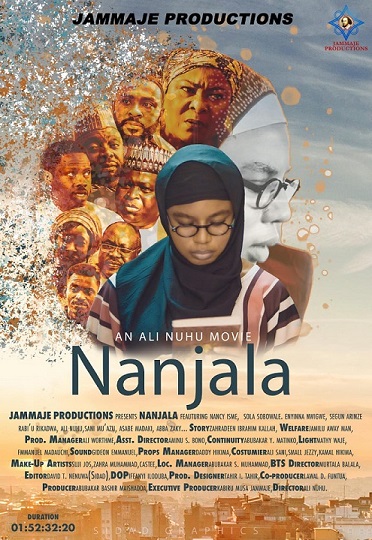
A feminist reading of Jammaje’s Nanjala

  • Production:    Jammaje production
  • Producer:       Abubakar Bashir Maishadda
  • Director:        Ali Nuhu
  • Cast:               Sani Mu’azu, Ali Nuhu, Nancy Isime, Enyinna Ngwige, Rabi’u Rikadawa, Segun Arzine, Abba Al-Mustapha, Asabe Madak, Abba Zaki.

Nanjala, an eponymous and one of the most expensive movies in the Kannywood industry by Jammaje Production, is a breathtaking movie that explores and thematises patriarchal power, domination and mistreatment towards women gender. Nanjala, a leading character, is victimised by her chauvinistic father, who disbands her for being a female in favour of a male child, Dititi (Abba Zaki). Captain Jimmoh (Rikadawa) becomes her adopted father and helps to actualise her dream of becoming a renowned journalist.

Furthermore, Captain Sembene’s family is set on fire as his beloved son, Ditit, becomes a spoiled child, drug addict, thief and clubgoer. Plus, his other female daughter, Jarry, takes a leave from home for her father’s chauvinistic mistreatment. Falmata, another victim of Captain Sembene’s chauvinism, befriends her biological brother, Ditit, with a view to wed him.

Nanjala becomes a renowned and influential journalist who tirelessly fights and exposes corruption in the government. She encounters obstacles along the way from the authority. She is detained in cells for exposing corruption. Finally, she appears triumphant.

Mistreatment and domination are long-held traditions shown to women by a patriarchal world. Women, as chauvinists maintain, are disaster and second-class citizens who can’t contribute to one iota of life. In those days, women had to cancel their identities to have their voices heard—the same as Nanjala has to take a leave from a patriarchal home to attain her potential. 

Thomas Aquinas (1274) opines, “A woman is really an imperfect man… an incidental being … a botched man’’. Nanjala’s treatment by her father affirms Aquinas’s stance that women are imperfect and a botched to her male brother, Dititi. Plus, according to Baudelaire, “woman is natural, that is abominable’’ Some men consider women disgusting. This perception runs through Nanjala’s father, who finds the female gender abominable – divorcing Falmata’s mother for carrying a female unborn child, making life unbearable to Majuma (Asabe Madaki) and causing a great aspersion on Nanjal and Jarry, whom all are females. They have to leave their homes to feel at home.

The belief that women are nothing but second-class citizens, abominable and sex machines for men to exploit became prevalent during the Victorian period (1837-1901) and also in plenty of their literature. We see the fate of Susan Henchad, who is auctioned in Thomas Hardy’s The Mayor of Caster Bridge (1886), women who are sexually exploited by men at Sixa in Mango Beti’s Poor Christ of Bomba (1956) and Firdaus’s sexual abuse by men in Women at Point Zero (1975). Likewise, patriarchal domination doesn’t put a halt here but tries to silence any emerging powerful female voice. 

Women like Gorge Eliat (1919-1880), Gorge Sand (1904-1876), Charlotte Bronte (1816-1855), etc., succumb to patriarchal pressure and accept defeat to vie with men intellectually and literarily. Comparatively, Nanjala encounters the same treatment, where patriarchs try to silence her intellect and voice. They envy her fame, success, and education. Men are jealous of women’s successes, but Nanjala struggles and succeeds. 

For women to succeed in the patriarchal world, they have to be educated, pushed, and struggled. We see how women break the bonds. Li succeeds in The Stillborn (1984) via struggle and education, as Ada in Second-class Citizens(1974). Also, we see in the Kannywood movies- Hauwa Kulu (2019) where Hauwa (Hasana Muhammad) and Laila (Hadiza Gabon) in Manyan Mata (2023 succeed through education. However, Firdaus in Women at Point Zero (1975) and Nnu Egu in The Joys of Motherhood (1980) fail because they are illiterate or barely educated.

Meanwhile, Simone De Beauvoir (1908-1986) asserts that “males define what it means to be human, including what to be female. Since the female is not male”. Beauvoir maintains, “She becomes another”. Indeed, this derogatory portrayal has been born by females throughout many centuries. In the film, Nanjala’s father has this perception run in his blood. He evidently defines who a human being is to him, his male child, Ditti.  He loathes all his three daughters – Nanjala, Jarry, Falmata and Majuma because they are “others”. Women become secondary or non-existent players. 

Finally, Beauvoir asserts, “Women must break the bonds of their patriarchal society and define themselves if they wish to be a significant human”. This is what Nanjala does, and she becomes a “being” in the patriarchal society. Meanwhile, Kate Millet (1970) says, “A female is born, but a woman is created”. As Nanjala defines herself as a true human being, discarding the notion of femaleness in her, she creates womanness, as Millet (1970) puts it, through hard work, education, struggle, and boldness.

By way of conclusion, Nanjala mirrors patriarchal society and uncovers stereotypical portrayal of women as “others”, Second-Class Citizens, incidental beings, imperfect men, and abominable and other derogatory names forced women to accept by men. The film depicts the power of education and struggles as the only means for women to break the long-held tradition enjoyed by men and bury women’s intellect.

If not for education, Nanjala would have been buried alive like other female characters. The film is a clarion call to women to be educated, to disown being relegated to non-existent players or “others”. Nanjala succeeds and becomes a “human being”, whereas Majuma, Jarry and Falmata become second-class citizens.

Reviewed by Abba Musa Ibrahim. He can be reached via abbamusa6888@gmail.com.

Media owners seek presidential intervention to protect indigenous TV channels

By Abdullahi Mukhtar Algasgaini

The Northern Broadcast Media Owners Association (NBMOA) has called on President Bola Ahmed Tinubu to intervene in what they describe as unfair practices by foreign TV channels. They allege that these channels operate without proper licensing from the National Broadcasting Commission (NBC).

In an open letter, Dr Ahmed Tijjani Ramalan, Chairman BOT of NBMOA, outlined the severe challenges facing indigenous private TV channels in Nigeria.

He highlighted issues such as inadequate facilities, stringent government regulations, high operational costs, and declining advertising revenues, which are exacerbating the struggles of local broadcasters.

The letter pointed out that the Broadcasting Organisation of Nigeria (BON) recently expressed similar concerns, noting that harsh economic conditions threaten the survival of many broadcast media houses.

BON called for a presidential media support initiative to provide concessions on tariffs and rates to prevent widespread shutdowns.

Ramalan criticized the alleged preferential treatment given to foreign channels which he claims operate without adherence to Nigerian broadcasting regulations and siphon significant advertising revenue that should have supported local channels.

He urged regulatory bodies like NBC and the Advertising Practitioners Council of Nigeria (APCON) to enforce laws equitably and ensure that all broadcasters, local and foreign, play by the same rules.

Ramalan appealed to President Tinubu to address the regulatory lapses and protect Nigerian broadcast media from unfair competition.

We humbly beg for Mr President to intervene to stop the illegalities by regulators and advertising agencies for the survival of indigenous television channels in Nigeria,” the letter

We’ll militarily intervene if Gaza conflict is not resolved—Erdogan

 By Sabiu Abdullahi 

Turkish President Recep Tayyip Erdogan has warned that his country may take military action against Israel if the conflict in the Gaza Strip is not resolved quickly.

Speaking at a campaign rally on Sunday, Erdogan reiterated Turkey’s support for the Palestinian cause and hinted at potential intervention. 

Erdogan stated, “We must be strong so that Israel cannot strike Palestine. Just like we entered Karabakh and Libya, maybe we’ll do the same thing. There’s nothing we can’t do. We have to be strong.” 

The Turkish president’s comments come as tensions between Israel and Hezbollah continue to escalate.

Israel has blamed Hezbollah for a recent rocket attack that killed at least 12 people, an accusation Hezbollah denied. 

Israeli Foreign Minister Israel Katz responded to Erdogan’s threats, warning that any attempt to intervene in the conflict could lead to a fate similar to that of former Iraqi leader Saddam Hussein.

Katz wrote on his social media handle, “Erdogan follows in the footsteps of Saddam Hussein and threatens to attack Israel. Just let him remember what happened there and how it ended.”

Zulum rolls out relief materials to 80,000 residents in Borno

By Sabiu Abdullahi 

The Borno State government, in a bid to cushion the effects of rising food prices and basic amenities, has distributed 20 truckloads of rice to 35,000 vulnerable individuals in Monguno town.

Governor Babagana Umara Zulum personally oversaw the distribution, which was supported by Senator Muhammad Tahir Monguno and other top government officials. 

The relief effort is part of the state government’s commitment to alleviating the suffering of its citizens.

Each male beneficiary received a 25kg bag of rice and a 10kg bag of cowpeas, while female residents got clothing materials and a N10,000 cash grant as part of the state’s financial inclusion initiative. 

Governor Zulum praised the federal government for its support, saying, “We appreciate the Tinubu administration’s continued show of compassion to our citizens.” 

In addition to the rice distribution, the state government received 90 trucks of fertilizer, which will be distributed to farmers to boost food production across the country. 

During his visit to Monguno, Governor Zulum inspected ongoing construction projects, including a Dental and Eye Hospital and a School of Nursing.

He expressed satisfaction with the progress and pledged to recruit more personnel to ensure the institutions provide effective services.

Professor Muhammad Lawal Mayanchi: A brief tribute

By Dr. A. M. Lawal

Until fate brought us together at the Federal University Gusau, Professor Muhammad Lawal Mayanchi was an uncle I hardly knew. Growing up, he was a military man who lived far away from home and rarely visited. The few times he visited after his compulsory retirement, I was away in school. So, my first major interaction with him was at FUGUS. 

The first day we met, his attention was divided. On the one hand, he was trying to make up for the lost time he had with me and, on the other, as the then Dean of Students, he was busy trying to control and keep students in line so they could board the University shuttle to town in an orderly fashion. From there, I witnessed first-hand his discipline and how obsessed he was with entrenching the same to the students. Watching him, I could not help but admire his drive to make his children, as he called his students, as disciplined and driven as he was. 

From that day, Prof. usually called me to ask about my progress as a man and as an academic. Where I erred, he often reported me to Professor Ahmad Galadima for reprimand. Thereafter, he would call me to either his house or his office for counselling. In shaping me, Prof. Galadima was the carrot to Prof. Galadima’s stick. And it worked—perfectly. 

Whenever and wherever I met Prof, he always told me his life stories and the challenges he faced post-military career before asking me the lessons I learnt from them. Spending time with him was like being in a class where one is taught the dynamics of life. 

In hindsight, it is clear that during my last physical interaction with Prof, he had a premonition of his death. We discussed some family matters after which he told me, ‘as we are leaving the scene, the leadership of our families both immediate and extended, will fall on your shoulders. You have to be ready. I have a feeling it will be sooner than we think.’  

And then Prof left us. Now we have to fill in the void he left behind. Or at least try to. A task as daunting as it is challenging. 

May his soul continue to rest in Allah’s bosom, amin.

Dr. A. M. Lawal wrote from the Department of Chemistry, Federal University Gusau, Zamfara.

Kano community cries out for help as healthcare centre crumbles

By Sabiu Abdullahi

Residents of Jibawa Community in Gaya Local Government Area, Kano State, are sounding the alarm over the dire condition of their local healthcare centre. 

The facility, which serves a population of over 13,000, including vulnerable women and children, has deteriorated to a shocking state, posing a significant threat to their health and wellbeing. 

Photos of the clinic reveal a hazardous environment, with collapsed ceilings and wards overrun by bats, making it uninhabitable for patients. 

The situation is further exacerbated by the lack of medical personnel and equipment, leaving residents to fend for themselves in times of medical need. 

Expectant mothers are forced to embark on a treacherous 5-kilometre journey to neighbouring communities in search of healthcare, while others face a harrowing experience in their quest for medical attention. 

In a desperate plea for help, the community is calling on the Kano State government, Federal Ministry of Health, and Kano Ministry of Health to intervene and address the facility’s deplorable state. 

They are urging for immediate reconstruction, equipping, and staffing of the healthcare center to ensure residents have access to quality medical care.

Couple arrested for buying stolen baby during naming ceremony

By Uzair Adam Imam

The Lagos State Police Command has successfully recovered a two-month-old infant from a couple, Mr. and Mrs. James Uwam, during a naming ceremony in the state.

According to a statement released by the Police Public Relations Officer, Benjamin Hundeyin, the couple had purchased the baby from a suspected human trafficker, Loretta Nelson, for a sum of N2,350,000.

The statement further disclosed that Nelson had previously acquired the baby from a pastor, Peter Udoh, for N1,450,000.

Udoh, in turn, had bought the baby from another suspected trafficker, Gloria Sunday, for N500,000.

It added that Sunday had allegedly kidnapped the baby on July 11, 2024, prompting the baby’s mother to report the incident to the authorities.

Following the report, the police launched an investigation and arrested Sunday, who led them to apprehend other suspects involved in the crime.

The PPRO stated, “Our detectives took swift action, leading to the arrest of Gloria Sunday, who confessed to selling the baby to Pastor Peter Udoh for N500,000.

“Udoh, who was arrested in Ikene Town, Ogun State, admitted to reselling the baby to Loretta Nelson for N1,450,000. Nelson was subsequently arrested in Festac Town, Lagos.

“The statement further revealed that Nelson confessed to selling the baby to the Uwam couple for N2,350,000 during the naming ceremony.

The police have commenced investigations and will arraign the suspects in court upon completion of the investigation.

How can President Tinubu stop the August 1 protests?

By Prof. Abdussamad Umar Jibia

It is no longer news that the Asiwaju Bola Ahmad Tinubu-led Federal Government has been inviting anyone it considers influential to help it prevail on Nigerian youth to stop the planned August 1-10 protests. The organisers of the protest, as I was told in most of the social media platforms I asked, are hunger, insecurity, and poverty, among the other things mentioned by the angry youth. 

Food sufficiency and security of lives and property are the necessary requirements for the prosperous living of any society. Every other thing follows. 

The fact about the people Tinubu has been inviting is that Nigerians consider them part of their problem. Traditional and religious rulers, politicians, etc., no longer command the respect they used to command in those days. A hungry man is angry with every other person, including a fellow hungry man. So, how can they listen to the pot-bellied traditional and religious leaders of these days? 

Certain other things have not been helpful to Tinubu. At this critical moment of his administration, he should not have allowed the controversy around Dangote Refinery to surface. Even before the removal of the oil subsidy, we were told that the Dangote refinery would provide a final solution to the problem of fuel supply, which has been part of our national life for a few decades. Just as production is set to begin properly, we are being told that Dangote refined fuel is not good after all and that the refinery has not been licenced. How do you expect Nigerians to be happy?

Since the altercation between Dangote and NNPC officials started, Nigerians have become aware of the Tinubu family’s underground oil business. I was just reading an essay in a social media group about how Oando, a Tinubu family-owned company, began to refine oil in Malta and export it to Nigeria through a series of underground moves. 

True or false, the story is now well known to every Nigerian who can afford a China-made Android phone. The onus is on the Tinubu administration to give its own side of this story. Until then, Nigerians will continue to believe that the Dangote Refinery initiative is being killed to advance the personal interests of the President. Would that not be enough to mobilise them to protest?

However, President Tinubu can avert the protests by taking certain bold steps, which would only take a patriotic leader to implement.

Tinubu, as a devout Muslim, can copy from Umar bn Abdulazeez, an Umayyad Caliph. Before Umar became the leader of the caliphate, he led a very lavish lifestyle like his wife, who was a princess of the caliphate. As soon as he assumed office, Ibn Abdulazeez put all his wealth and that of his family into the public treasury. He lived the rest of his life humbly and died honourably. Today, he is remembered as one of the best examples of leadership in human history. Is that too much for President Tinubu?

Mr President should remove every obstacle around the proper take-off of the Dangote refinery. It doesn’t matter whether or not Alhaji Aliko Dangote supported the APC candidate in the 2023 presidential election. Dangote is a Nigerian, and Nigerians stand to gain from his investment. The Federal Government should provide the refinery with Nigeria’s crude oil and make sure the price falls to the barest affordable minimum without short-changing the investor. Note that the present hardship confronting Nigerians began with the removal of subsidy and the rise of fuel pump price. 

President Tinubu should give licences to other Nigerians who want to set up refineries. As a matter of national policy, the importation of refined petroleum products must stop immediately.

The Tinubu Government should give a timeline it can stick to for the resumption of operations of its three refineries. Nigerians are aware that billions of Naira are spent every month on personnel and overhead costs for refineries that are not working. On the other hand, hardworking Nigerians are now being promised a paltry N70,000 as minimum wage.

Banditry and kidnapping must be ended to achieve food security and protect lives and property. To do so, President Tinubu should remove all bandits’ sympathisers from his government and give an ultimatum to his commanders to target and neutralise all bandits’ leaders, some of whom are now traditional rulers. Leaders of criminals are well known to the people and to the Government. It takes the will of the federal government to confront them.

Ending banditry and kidnapping would also effectively close down all IDP camps and return all campers to the farm. 

That is not all. The Federal Government should return the cost of electricity as they met it. This should be announced and effected immediately. It is noteworthy that Gencos and Discos were sold to public facilities at giveaway prices. Thus, they do not have the moral right to charge Nigerians prohibitively for their services, which, by the way, are not satisfactorily delivered.

The National Assembly can also play its own part by suspending its recess and taking a decision to end the regime of billions of Naira getting into the bank accounts of its members in the name of constituency projects and all manner of allowances. They should earn a salary equivalent to that of a senior civil servant in a Federal Ministry. 

To show their seriousness, all senators and rep members should immediately return SUVs bought for them with public funds. State commissioners are more numerous and use similar official vehicles even though they are not elected. This has been the argument of National Assembly members since 1999, but it is not valid. State commissioners have ministries under them, and you, as National leaders, are supposed to set an example for others to follow.

If this Government can do the above, and immediately too, it would have the moral authority to confront anyone who goes to the street to call for an end to bad governance. 

The constitutional conferences, restructuring, resource control, INEC, EFCC, etc., are all political and do not directly affect the common man on the street.

Professor Abdussamad Umar Jibia wrote via aujibia@gmail.com.

EFCC’s anti-graft war and politics of sponsored protests 

By Haroon Aremu 

In a period marked by ongoing high-profile corruption cases by the Economic Financial Crimes Commission (EFCC), the Nigerian authorities urgently need to address the potential dangers of protests and the pressing demand for justice. 

Specifically, some high-profile corruption cases under anti-graft agencies warrant thorough examination to understand the depth of the issue and the necessary steps required for resolution and swift justice dispensation.

Bodies like the National Youth Service Corps (NYSC) scheme preach the promotion of national security, awareness and consciousness; thus, I cannot but wonder how these situations affect Nigeria as a nation and proffer feasible solutions.

Communication and information management delivery is important as we have some high-profile cases in the country, and Nigerians eagerly await their conclusion. The EFCC charged with this responsibility should ensure a quick but thorough investigation to reduce corruption in our society, thereby bridging the gap of mistrust between the agency and the populace.

It can be recalled that the former Minister of Petroleum Resources, Diezani Alison-Madueke, has been accused of corruption and money laundering involving billions of dollars. The EFCC has seized properties and assets worth millions linked to her. She is facing charges in Nigeria and is under investigation by the United Kingdom’s National Crime Agency.

 Former governor of Ekiti State Ayodele Fayose is charged with receiving N1.3 billion from the Office of the National Security Adviser (NSA) for his election campaign. The EFCC arraigned him, and his trial is ongoing. Also, the former Federal Inland Revenue Service (FIRS) chairman, Babatunde Fowler, is under investigation for alleged financial mismanagement and fraud. 

Similarly, Yahaya Bello, former governor of Kogi State, stands accused of an N80.2 billion fraud. The Chief Judge of the Federal High Court, Justice John Tsoho, has kept the case in Abuja, declining Bello’s request to transfer the trial to Kogi State.

The long list also included former Governor of the Central Bank of Nigeria (CBN) Godwin Emefiele, who is being charged with financial mismanagement and corruption while leading the apex bank. 

 EFCC’s investigation into Betta Edu, suspended Minister of Humanitarian Affairs and Poverty Alleviation, is ongoing, with specific details yet to be fully available. Also, Sadiya Umar Farouq, the former Minister of Humanitarian Affairs, Disaster Management, and Social Development, is accused of embezzling funds meant for social welfare programs. It is gratifying that the court has asked her to account for over N790bn she embezzled while in office.

Amid these significant corruption cases, there are speculations that some individuals facing probes by the EFCC might be sponsors of planned protests against the anti-corruption agency. This has raised concerns about the motivations behind these demonstrations and their potential impact on national stability.

While peaceful protests are a democratic right, they can spiral into violence, property damage, and disruption of public order. The EndSARS protests serve as a stark reminder of where lives were lost, properties destroyed, and chaos ensued. Protests pose risks to participants and bystanders and can escalate into broader conflicts with law enforcement or opposing groups.

As a concerned citizen, I always preach sustainability in national security and justice enforcement, given the complexities surrounding these high-profile cases and the associated risks of protests.

Efforts to address these issues involved community engagement programs to address grievances before they escalate into protests. This fosters trust and opens channels for dialogue. Strengthen intelligence networks to anticipate and prevent potential violence. This involves monitoring social media and other communication channels for signs of unrest.

There is also a need to provide specialised training for law enforcement officers on de-escalation techniques to handle protests more peacefully and effectively while ensuring transparent and accountable governance to build public trust. This includes clear communication about the progress of high-profile cases and actions taken.

Similarly, fostering continuous dialogue between government officials and civil society to find mutually agreeable solutions to contentious issues is another alternative approach. The EFCC should collaborate closely with police and military personnel, especially during arrests, because the police have higher immunity for legal arrests of public figures, which can help manage high-tension situations more effectively. 

Finally, Navigating the dual challenges of addressing high-profile corruption cases and managing potential protests requires a multi-faceted approach. Swift and fair dispensation of justice, combined with proactive and strategic security measures, will strengthen national security and uphold the rule of law in Nigeria. 

The ongoing cases involving figures like Diezani Alison-Madueke, Ayodele Fayose, Babatunde Fowler, Yahaya Bello, Godwin Emefiele, Betta Edu, and Sadiya Umar Faruq, among others, must be handled with care. Nigerians expect a swift investigation and dispensation of fair judgment to restore faith in our anti-graft agencies and judicial system, which will ultimately deter future corruption.

Haroon Aremu Abiodun is a corp member with PRNigeria Center Abuja and wrote in via exponentumera@gmail.com.