Month: February 2024

More about ‘studying abroad’

By Salihi Adamu Takai

Most of the people leaving their country for acquiring education abroad make mistakes when considering the study abroad as an “easy learning” or an “easy way of gaining certificate”. Some people applied for transfer from their Universities to gain admission abroad not for the purpose of proper learning or additional gaining.

In any country, there’s a university that you can find around that’s not standard and gives certificate any how. So, if someone is intending to gain only certificate (not qualitative education) he can get that in his/her surroundings. In learning, the intention and purpose matter. What makes you search for it, takes you there – but to what extent that can be achievable? Ask your mind!

If it’s only certificate I want, why should I leave my country for another place? Think twice or even thrice. As a Muslim, I learned in the Hadith that the Prophet (SAW) was reported to have said that “search for a knowledge even in China”. Referring to “China” in the Hadith, even though some Ulamas say the Hadith is not authentic, but it shows how important search for knowledge is/was, and it makes people curious to get it – for the well-being of their lives. It’s talking about the qualitative education not what can be gotten easily.

Studying or living abroad is a chance of life if the person uses the advantages appropriately. Apparently, it’s not something of gaining what’s easy to me or not – rather what can add me value into my life. This means a person living in the most developed country can plan to live in the most underdeveloped country in Africa. This can help the person acquire another things such as experience and study how different people live in different places.

Many people learned different languages accurately through living abroad. There you can interact with some people you have never met before. They speak what you speak not. You can learn from them something different.

Studying abroad also can be the best for you if you take it as it should be. This means as you learn from someones who are different from you nationally and socially, you can get someone new to you. Although, the contents of the things you’re acquiring are the same, but the things in them can be worth acquiring and grabbing.

Here in Uganda, I interact with Congolese whose country is Francophone. Their official language is French not English. Most of them live in some countries like Uganda to do their degree and at the same time learning English language. This shows that the purpose is not only a degree certificate – but the language is very important to them.

Therefore, it’s very important to the people (students in particular) who are living abroad to know that; it is a very good time that should be utilised decently. You’re not living there permanently. Anytime you can be asked to leave the country. So, it’s a life for a purpose with a limited time. Don’t take it as just a chance of pleasure – rather a chance of success – once it is misused – it can affect the whole life.


For 17 years, Apple has been the most admired company globally—Fortune

By Sabiu Abdullahi 

In Fortune’s annual ranking of the world’s most esteemed companies, Apple has reaffirmed its supremacy, claiming the top spot for an impressive 17th consecutive year.

The comprehensive list, featuring 1,500 companies boasting revenues exceeding $10 billion, highlights Apple’s unwavering influence in the corporate realm, albeit with a marginal dip in its overall score from the previous year. 

Fortune meticulously curated the elite selection, narrowing down the contenders to 680 companies.

A discerning panel, comprising 3,700 executives, directors, and analysts, meticulously assessed each company across a spectrum of categories, ranging from investment value to social responsibility. 

Despite a modest decrease in its score, Apple continued to shine, securing the foremost positions in critical categories such as social responsibility, financial soundness, innovation, and global competitiveness.

Microsoft, on an upward trajectory this year, clinched the second spot with a notable triumph in the computer software industry.

Amazon, though sliding one place, maintained a strong presence with commendable scores in internet services and retail, securing its position in the top three. 

Apple’s consistent reign atop Fortune’s Most Admired Companies List underscores the company’s enduring commitment to excellence and innovation.

This accomplishment speaks volumes about Apple’s ability to navigate a dynamic business landscape while upholding unparalleled standards.

Embracing gratitude: A call for Nigerians to stop complaining and start appreciating

By Usman Muhammad Salihu

In the contemporary, vibrant Nigerian culture, one cannot ignore the prevalence of complaints that seem to echo nationwide. While expressing dissatisfaction can serve as a form of catharsis, it’s essential to explore the notion that constant complaining might hinder personal growth and prevent individuals from appreciating life’s beauty.

Nigerians face various challenges, from economic uncertainties to social issues. However, it’s essential to recognise that gratitude can coexist with adversity. By appreciating the progress made, both individually and collectively, Nigerians can foster resilience and find motivation to overcome obstacles.

Nowadays, it’s common to observe that many Nigerians complain to garner pity. However, it’s crucial to question whether wallowing in self-pity brings tangible rewards. Shifting the focus from complaints to proactive solutions can lead to a more constructive and fulfilling life.

A peculiar aspect of the Nigerian cultural landscape is the tendency for individuals, regardless of their financial status, to brag about being poor. This inconsistent behaviour raises the question: Why celebrate a state of lack rather than acknowledge and appreciate one’s achievements, which is unhealthy? Embracing a mindset of abundance can foster a more positive outlook on life.

Even the well-to-do in Nigerian society are not excluded from the complaint culture. The paradox of wealthy individuals complaining about being broke is a humorous story that reflects a deeper issue. Encouraging a shift from complaining to appreciating the financial stability and success achieved can lead to a healthier perspective on wealth.

It’s crucial for Nigerians to rewire their mindsets to break free from the cycle of complaints. Cultivating gratitude involves acknowledging achievements, big or small, and recognising the lessons embedded in challenges. This shift in perspective can pave the way for a more positive and fulfilling life.

All I’m asserting is that expressing concerns and frustrations is a natural human tendency, and constant complaining can act as a barrier to personal and collective progress. Encouraging Nigerians to adopt an attitude of gratitude can transform their lives, fostering resilience, contentment, and a deeper appreciation for life’s abundant blessings. It’s time to let go of the complaint culture and embrace a mindset that celebrates achievements, no matter how modest, and recognises the beauty inherent in the Nigerian experience.

Usman Muhammad Salihu writes from Jos, Nigeria and can be reached via muhammadu5363@gmail.com

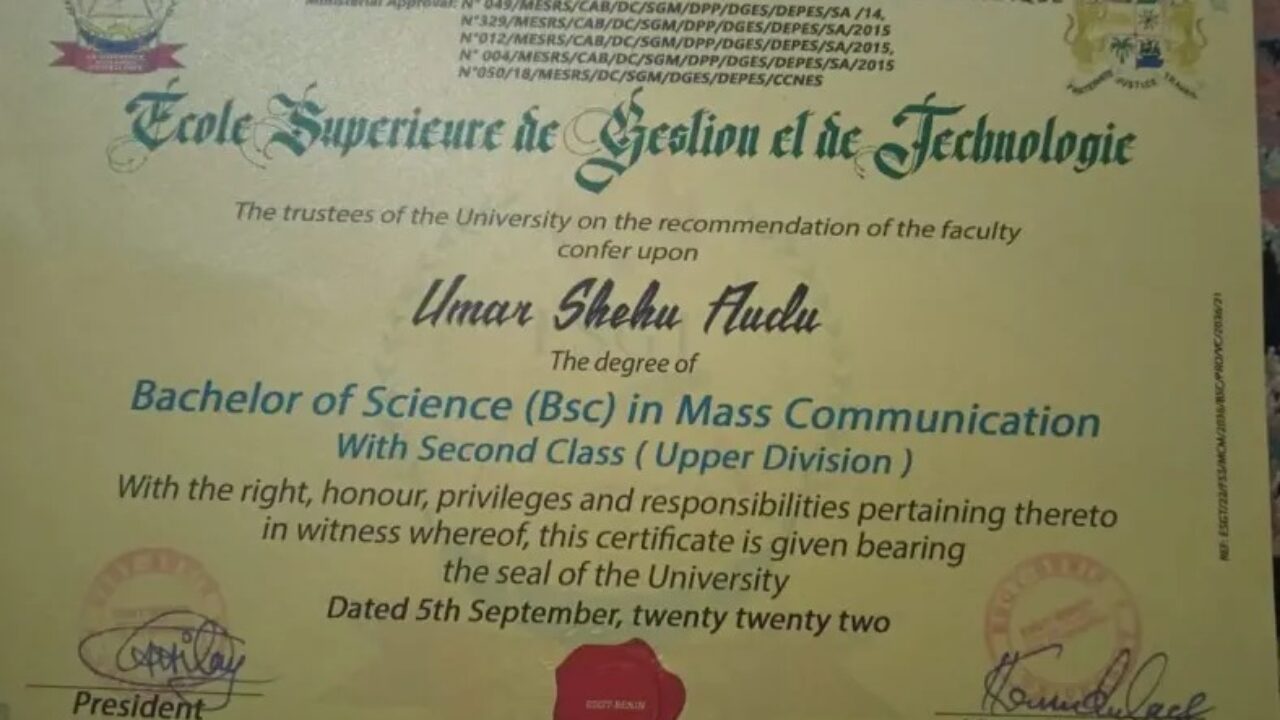
Revisiting the FG’s decision on Togo, Cotonou degree certificates

By Ukasha Rabiu Magama

The issuance of fake certificates, both within Nigeria and abroad, is not a new phenomenon. Many institutions globally face accusations of awarding certificates to undeserving candidates. Therefore, the case of Cotonou should not be singled out or become a focal point of public discussion.

While many institutions accused of such scandals in Nigeria vehemently deny the claims to protect their prestige, instances of fake certificate awards are prevalent. The consequences of counterfeit certificates awarded by Nigerian institutions are evident across various sectors, including the military, medical profession, education, agriculture, engineering, commerce, and politics.

The detrimental impact is reflected in Nigeria’s current challenges, such as a compromised democratic atmosphere, a corrupt educational system, unqualified medical personnel, an unorganised defence system, and widespread insecurity. 

The proliferation of WAEC, NECO, and JAMB miracle centres in Nigeria’s corrupt educational system contributes to the emergence of fake police and military officers, incompetent leaders, and escalating security challenges.

Banning Cotonou and Togo degree certificates might not be optimal, considering that Nigerian institutions must be held accountable. Fake certificate issues extend beyond international borders, with corruption being a pervasive challenge in Africa. Eliminating corruption is a formidable task, and scrutiny is warranted not only for the exposed journalist but also for individuals who acquire certificates through illegal means in Nigeria.

It is imperative for authorities to investigate how the journalist obtained his certificates in just six weeks and to allow the implicated institutions to present their case. Acknowledging the evident disparities among the three countries, Benin Republic and Togo have three three-year first-degree systems, unlike Nigeria, which has a maximum of 4-5 years.

Globally, the minimum time required to acquire a degree certificate is three years. Also, in Cotonou and Togo, this standard isn’t compromised. Meanwhile, not everyone who went to school or graduated from the suspended institutions bought certificates, and not every school in Togo or Benin Republic was involved in buying, selling, or awarding fake certificates.

Therefore, there is a need for the federal government of Nigeria to reverse its decision to suspend the degree programs in Togo and Cotonou and or arrest the journalists and the management of EGST University involved in such ungodly acts to face the wrath of the law. The allegation of buying, selling, and awarding fake certificates is not only peculiar to the Benin Republic and Togo but has also been alleged here in Nigeria.

In recent years, Ahmadu Bello University Zaria, Lagos State University, Imo State University, and the University of Jos were accused of selling and awarding fake certificates to undeserving candidates. The point here is, why did the federal government of Nigeria fail to sanction or suspend those institutions if it wanted to curb corruption in its educational system? Therefore, addressing this issue requires a comprehensive approach and a fair examination, not just suspending innocent institutions and maintaining the global standard in awarding degree certificates. 

To this end, the Students Union Government of the Institute Superirieur de Formation Professionelle are here to draw the attention of the federal government of Nigeria to reverse its decision to suspend Togo and Cotonou degree programs. On the other hand, it calls on the government to thoroughly investigate whether the said journalist followed a legal process in obtaining his degree from the accused certificates.

Ukasha Rabiu Magama wrote an opinion of Adamade Peter Adamade, National President of ISFOP University’s Alumni.

Muslim women must acquire digital skills now

By: Ibrahim Suleiman Ibrahim

In today’s consistently evolving digital world, the pursuit of digital/ICT skills has become increasingly important for individuals and communities alike. This is particularly relevant for Muslim women, who often face unique challenges in balancing their religious and family values with their career choices, hence, making them to be left behind in the digital landscape.

In this article, we will explore the importance of creating awareness among Muslim communities about the need for Muslim women, especially the married ones, to pursue digital/ICT skills.

One of the primary concerns of Muslim women is the compatibility of their careers with their religious values and family life. Most jobs in our contemporary secular societies often raise ‘Sharee’ah’ concerns—which mostly revolve around free mixing and intimacy with ‘non-mahrams’, prolonged unavailability in their matrimonial homes that often impede performance of domestic responsibilities, compromising the Islamically mandated mode of dressing for Muslim women, and so on, making it challenging for some educated Muslim women to identify fulfilling careers that align with their religious values and beliefs.

God so kind, the recent advancements in the ICT sector has now alternatively offered a wealth of opportunities for Muslim women to pursue careers that are both fulfilling and compatible with their ‘Deen’ and family life, but unfortunately, most Muslim women lack sufficient awareness of those opportunities.

It is quite essential for Islamic scholars and Muslim elites to be aware of the recent advancements in the ICT sector and to consider enlightening their communities about the potential benefits of digital/ICT skills for Muslim women. By promoting awareness and understanding, these leaders can help Muslim women make informed decisions about their careers and contribute to the overall empowerment of the community, without compromising their religious values and beliefs.

Importantly, pursuing digital/ICT skills can also lead to remote job opportunities that offer flexibility and work-life balance. These jobs allow women to work from their homes, enabling them to demonstrate their supportive roles in their marriages, while still advancing their careers. Some of the skills that can lead to remote job opportunities include web development, copywriting, social media management, digital marketing, graphic designs, virtual administration, data analytics and so on.

Furthermore, encouraging Muslim women to pursue digital/ICT skills can lead to greater empowerment and intellectual development. By acquiring these skills, Muslim women can supportively contribute to their families’ finances and also become more intellectually sound, which is in line with the principles of Islam that promote the pursuit of knowledge.

In conclusion, we are in an interconnected world where digital skills are increasingly relevant across all sectors. Muslim women lawfully deserve to be equiped with these skills so they can also participate more actively in the global economy and contribute to the advancement of their communities, within the limits of Sharee’ah.

There may be misconceptions within Muslim communities about the compatibility of digital/ICT careers with Islamic principles. However, creating awareness can help address these misconceptions and demonstrate how these skills can be utilized in ways that are consistent with religious values.

It’s therefore crucial for community leaders, including Islamic scholars and Muslim elites, to actively promote the value of digital/ICT skills for Muslim women. Their support and endorsement can greatly influence the attitudes and decisions of community members.

Ibrahim Suleiman Ibrahim is a Public Affairs Analyst. He can be reached via: suleimibrahim00@gmail.com