Month: June 2023

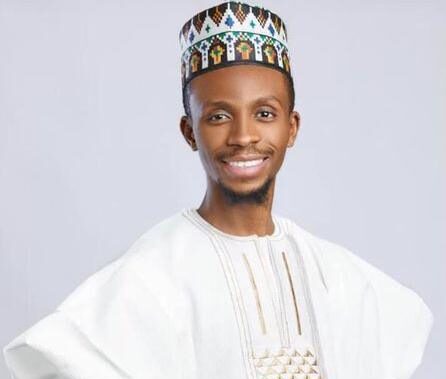
Bello El-Rufa’i: The youngest legislator to watch

By Mukhtar Jarmajo 

Bello Elrufai, a member representing the Kaduna North federal constituency, made a mark in the upcoming 10th National Assembly. In a recent interview with Channels TV, Bello showcased his humility, political acumen, and team spirit, making it clear that he is well-prepared for the task ahead.

Although he admitted no one could be fully prepared for the NASS, Bello’s academic background in political science, international relations, public relations, and corporate communications sets him apart. He recognizes the importance of having a team and their input, giving them credit for his ideas. His team helped him prepare ten Bills, which he is waiting to table for discussion at the House.

Bello’s team spirit bodes well for his future political career. He wants to leverage his associates’ expertise to build a strong political front. He is willing to compensate them financially and also give them invaluable experience. It’s a win-win situation, demonstrating his leadership skills and an eagerness to learn from others.

Bello’s focus on team building and valuing his team’s input is refreshing, particularly in a political climate where individualism is prevalent. Bello’s willingness to succeed and go far is admirable. With his thirst for knowledge and team spirit, he has the potential to make a significant impact in the National Assembly.

At 35, Bello is the youngest legislator in the new NASS. However, his age should not undermine his potential or capabilities. Instead, his youth is an asset and could increase the diversity of voices in the National Assembly.

Bello Elrufai is a legislator to watch. His humility, political acumen, and team spirit make him unique and potentially successful. His initiatives, bills, and passion for teamwork will help him make an impact in the upcoming 10th National Assembly. He may be the youngest, but he is one to watch out for.

Jarmajo wrote from Wuse Zone 2, Abuja. 

Climate Crisis: Challenges for Nigeria’s new administration

By Nusaiba Ibrahim Na’abba

There are so many things on the table awaiting the newly inaugurated administration. With insecurity topping the list, there is a great task of realising viable and sustainable economic alternatives, developing a solid healthcare structure, and battling an ever-evolving overwhelming climate reality. The just-inaugurated administration will undoubtedly be challenged by many of what its predecessors fought. Addressing these issues of high public priority is an invaluable facet of the success of Bola Tinubu’s administration.

Unifying the country after a rigorously contested election is another challenge the incoming administration will face. The recently held elections have unveiled another dimension of disunity in this country. Unity is always an essential asset in any country’s development, which is why it is a pillar upon which societies thrive. Even before the new president was elected, the Muslim-Muslim ticket that filled the air was refuted by opposition parties.

Environmental challenges have dreaded many plans to succeed in Nigeria. Recently, because they are primarily multi-faceted. In 2022, they brought an unprecedented climate crisis in Nigeria and the world. Floods have devastated communities in Southern parts of the country, and many of the communities in the North were displaced. The inherent consequences of climate-related problems in our country are truly worrisome.

Over 12,000 farmlands across 14 local government areas were destroyed in Kano State due to heavy and torrential rainfalls. These figures were pronounced by the Kano State Emergency Management Agency (SEMA). In addition, several families were forcefully displaced from their homes.

In Jigawa State, many homes were destroyed by heavy rains and floods. Numerous families had to be dispersed across schools, serving as relief camps for the displaced. Some innocent lives were lost after being buried by the building, an effect of heavy rainfall. A substantial number of farmlands were said to have been destroyed too. These issues occurred while the President Buhari administration was nearing its end and political campaigns heightened.

The federal and state governments rushed to cushion the effects by sharing palliatives with affected communities. Philanthropists also played an essential role in supporting the victims affected. Many families had lost everything, including their only source of livelihood, farming. This challenge intensified living conditions for average Nigerians in these parts of the country as prices of commodities hiked and the cost of living rose significantly.

Now after a year, we’re back at it again. The Nigerian Meteorological Agency (NIMET) has started highlighting forecasts of what we would expect during this year’s rainfall season, and indicators are frightening; heavy rains and thunderstorms are the pointers. And because the foresight comes as a warning signal, many families in these areas are already baffled with unimaginable thoughts, picturing last year’s experiences.

Apart from heavy floods, the inconsistency of rainfall in the Northern part of the country is another climate wrinkle. If not managed with the right agricultural methodologies, the inconsistency of rain will only worsen access to food supplies. Policies of the just concluded government in terms of border closure and later ban on importing products like foreign rice have hit hard a large percentage of Nigeria’s population. Most average Nigerians have long relied on these foreign food supplies for survival. Even with the supposed increase in agricultural activities as the alternative induced by the Buhari administration, the prices are unbearable.

Heat is now persistent with the cut down of trees in the North. The severe effect has been felt by people, unlike heat seasons before. This year’s Ramadan season was barely scaled through because of excessive heat. By now, many are starting to realise the importance of building trees and the ills of cutting them down. Federal and state government initiatives at this stage in our lives must prioritise replanting of new and resilient breeds of trees in places set for infrastructural activities. Our experiences have highlighted that prior climate change initiatives in this respect are not enough.

Health problems are also being exacerbated as climate change continues to unravel. Continuous pollution consistently exposed Nigerians to various health hazards. Gigantic pyramids of waste in cities have polluted healthy air. In areas where the waste pyramids are later burnt down, people are forced to breathe in harmful substances that have long-lasting effects. More so, manufacturing companies in, for instance, Kano, have been hit with several allegations of releasing toxic substances after their production processes.

According to Wasteaid (2021), with no access to waste management services, one in 3 people worldwide have no choice but to dump or burn their waste. Open waste burning is a significant emitter of black carbon, CO2, carbon monoxide, and other harmful toxins. This explains the risks attached to indiscriminate waste generation and management.

The findings are vindicated by United Nations Environment Program (UNEP) 2021 in a study which identified that Nigeria produces more than 3 million tonnes of waste annually, and only 20 to 30 per cent is collected and disposed of. Uncontrolled wasted burning, which is one of the practices, contributes to deteriorating air quality in Urban centres.

In their recent publication this year, UNEP also states that in Nigeria, sachets have become increasingly widespread, especially in fast-growing cities like Lagos. Research shows that about 50 to 60 million used water sachets are thrown into the streets daily”. When you picture the whole of Nigeria in terms of this indiscriminate act, you know a bigger problem lies ahead unless necessary measures are implored. I have not forgotten about e-wastes that have found dwelling places in Nigerian cities.

I cannot possibly explore all the existential climate challenges within this single piece. On the one hand, the federal government is currently overwhelmed with subsidy removal, dollar instability and making appointments. On the other hand, at state/local levels, some governments a busy investigating the ills of just concluded administrations while others are trying to get a hold of the affairs of the states. Unfortunately, all these aren’t slow down the speech of climate-induced consequences.

In the southern part of the country, Nigeria has been fighting oil exploration problems which have disrupted livelihood. Floods have been a major occurrence in areas where oil is not being extracted. These challenges have to be creatively and carefully addressed.

Nigeria is blessed with enormous human resources capable of producing excellent ideas to combat some of these issues. As part of the government’s obligation to serve, it must consider accepting solutions from communities, creative youths, and start-ups. Many ideas can be supported with considerable investment to help the fight against climate-induced calamities.

Nusaiba Ibrahim Na’abba is a master’s student from the Department of Mass Communication, BUK. She is a freelance writer and researcher. She can be reached via nusaibaibrahim66@gmail.com.
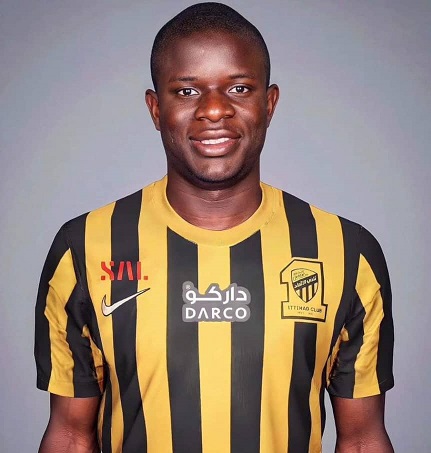
N’Golo Kanté completes move to Al Ittihad, ending era as Chelsea legend

By Muhammadu Sabiu 
 
In a significant transfer development, N’Golo Kanté, the revered French midfielder and a longstanding figure at Chelsea FC, has officially signed a four-year contract with Al Ittihad, a Saudi Arabian football team.
 
The transfer marks the end of an era for Kanté, who has become an emblematic player for Chelsea and an integral part of their success in recent years.
 
Reports suggest that the financial terms of the transfer are substantial. Kanté’s total salary over the duration of the contract amounts to a staggering €100 million. 
 
Kanté’s departure from Chelsea evokes a sense of nostalgia among fans and the football community as a whole. 
 
The diminutive midfielder, known for his tireless work rate, exceptional ball-winning ability, and precise distribution, has etched his name into the club’s history. 
 
His contributions were instrumental in Chelsea’s success, including two Premier League titles, an FA Cup, and a UEFA Champions League.
 
During his time at Chelsea, Kanté has established himself as one of the world’s premier midfielders, earning plaudits for his consistent performances and humility both on and off the field. 
 

Eng Sagir Koki vows to bring positive change

By Abbas Datti

Our newly elected representative, Engineer Sagir Ibrahim Koki, promises to serve the people of the Kano Municipal constituency with integrity and dedication.

In a historic election victory, Engineer Sagir Ibrahim Koki has emerged as the newest member from Kano Municipal in the House of Representatives. Before his campaign, he promised to bring fresh perspectives and foster positive change within the esteemed legislative body. With the weight of public trust on his shoulders, Engineer Sagir steps into office, committed to serving the constituents and championing their interests.

Hailing from the Koki district of Kano State, he has already made waves with his dynamic campaign, installation of transformers, vocational training, distribution of JAMB forms, and rendering assistance to prospective NECO candidates, which resonated strongly with a diverse range of voters across the Municipal Local government area. The constituents were captivated by Engineer Sagir’s passion for public service, dedication to core issues, and vision for a brighter future.

Throughout his campaign, Eng Sagir has demonstrated an unwavering focus on crucial matters such as healthcare reform, economic revitalisation, education enhancement, and environmental sustainability. Drawing from a deep understanding of the challenges the Municipal Area Community faced, Sagir Koki outlined innovative policy proposals that garnered widespread acclaim and support.

As he assumes office, he is determined to turn those promises into tangible action. Eng Sagir’s primary objective is to represent the voices of his people, ensuring that their concerns are heard, amplified, and effectively addressed within the hallowed halls of the legislative chamber. Eng Ibrahim firmly believes that the foundation of a thriving democracy lies in empowering every citizen and working collectively towards progress.

One of Sagir’s key initiatives is bridging the gap between different political ideologies and fostering collaboration and compromise. By promoting bipartisan efforts, he aims to break down the barriers that have impeded progress in the past, seeking common ground to tackle pressing issues head-on.

Furthermore, Sagir Ibrahim understands the significance of transparency and accountability in public office. He has pledged to maintain open lines of communication with constituents, regularly hosting town hall meetings and actively seeking public input to shape his decision-making process. By being accessible, Sagir aims to establish a strong bond with his community, ensuring that their aspirations remain at the forefront of his legislative endeavours.

The road ahead of Sagir may be challenging, but his determination to serve with integrity, empathy, and dedication remains unshaken. He brings a wealth of experience, having worked tirelessly within the community as an advocate for positive change. Now, armed with the power of legislation, Sagir Koki is ready to effect lasting transformations that will profoundly impact the lives of the people of the Municipal he represents.

As the newest addition to the House of Representatives, Engineer embarks on a journey marked by hope, resilience, and an unwavering commitment to the betterment of the people of the Municipal. Therefore, Municipal people are eagerly anticipating the positive changes that lie ahead, placing their trust in the capable hands of their newly elected representative.

Abbas Datti writes from Kano Municipal and can be reached via abbasdattibashir@gmail.com.

Majma’al Bahrain: Arabs in Kano II – the sequel

By Prof. Abdalla Uba Adamu

My posting about MU Adamu’s 1968 paper on the influence of Arabs on Kano culture, economy and religious practices has ignited a few responses of personal nature from some readers interested in their own interconnected life stories. This is a follow-up and update.

I think it is wonderful that we begin to interrogate our past so that we can appreciate our present in order to make better plans for the future. We were all besotted with this implausible concept of ‘Hausa-Fulani’ that we tend to ignore other genetic tributaries that constitute the Hausa genetic pool, especially in Kano. Such Majma’al Bahrain is either unknown to many or ignored. Bringing it out means that the ethnic picture of the Hausa is more than the mingling of the Fulani genes with the Hausa – there were dashes of Arab in there thrown for good measure.

For the most part, the Arab voices had been silent. I think it is time for them to voice out their life histories in conversations with their elders. Not to further divide a monolithic Hausa society but demonstrate how the Hausa have been developing into distinct, absorptive people. Clearly, then Hausa is not a language but a people. Ask any individual in Kano with ‘Fulani’ or ‘Arab’ ancestorial roots, and they will tell you they are Hausa, ‘even though my grandmother is Fulani/Arab/Russian/Greek, etc.’

Let’s split hairs here. Having different languages but the same skin colour – whether you are black, white, brown, yellow or (if an alien) green, and submitting to the same central, national governing authority makes you ‘ethnic’. Having the same attributes but without recognition of national authority, only blood and kinship ties make you ‘tribal’. Separation across skin colour is a race, not an ethnic issue. Arabs are a separate race from Africans. So, what happens when the racial divide is crossed (bred)? Will a new ‘race’ emerge?

The Arabs’ contributions to the economy and culture of Kano are far more than any other ethnic group, including the Fulani. Consider the Yemeni alone and their massive contributions to the animal skin trade in northern Nigeria. Initially ‘imported’ as Italian trade agents from Yemen in the early 20th century, they have now become domesticated to the Hausa society. Yes, they are light-skinned, and quite a few speak Arabic; but the mid-generations have lost the Arabic language. As a ‘minority’ group, they intermarried with local African women and their offspring contributed to the sustainable development of culture and life in Hausa societies without the consciousness of being ‘the other’. What are then the cultural specificities that tie them to the Arab world? Can it be in dress, language, food, existential rites and rituals (birth, living, death)? How do theirs – if at all present – differ from those of the Hausa?

Then consider the Lebanese and their input into the goods and products found in various Kano markets – including their influence all over West Africa. They are less integrative with their African hosts but have been linguistically domesticated, and for all intents and purposes, many self-identify as Hausa and retain some living rituals (e.g., food habits). This is an area initially mapped out by Sabo Albasu’s monumental groundbreaking research, “The Lebanese in Kano” (which is based on his 1989 doctoral thesis), and unfortunately, not much else was done on such a scale by other people. I wish he could update and re-print it, as now, more than ever, is the time for it.

The Sudanese, more than the other Arabs, had integrated more effectively into northern Nigerian Hausa communities, perhaps due to the gradation in their skin colours – from extremely dark to extremely light – than either the Tripolitanians, Yemeni, Lebanese or Syrians/Jordanians, whose clearly light skins made them stand out in any group. Establishing themselves in the city of Kano at Sudawa (Sudanese settlement), they formed part of the identity of the Kano city populace.

The Sudanese influence was also more intellectual. While they were instrumental in trade, their main contribution was in education. For instance, when the School for Arabic Studies – undoubtedly the Oxford of Arabic Studies in Nigeria – was established in 1934, it was to Sudan that inspiration was sought, including the teachers. Even what later became Bayero University Kano was first headed by Abdullahi el-Tayyeb, a Sudanese. No talk of Sudan itself being a destination for studies at all levels by northern Nigerians. You don’t see such rush for education in Lebanon or Yemen.

While rummaging through the caverns of an old abandoned hard drive, I came across a booklet that Kantoma (Muhammad Uba Adamu) had asked me to extract from his “Confluences and Influences” as a standalone paper (presented in 1998) and later with additional material, as a booklet. We named it “The Presence of Arabs in Kano”. Lack of funding prevented its publication, but I was able to get it published as a paper in a book project. A link to the paper is given at the end of this posting.

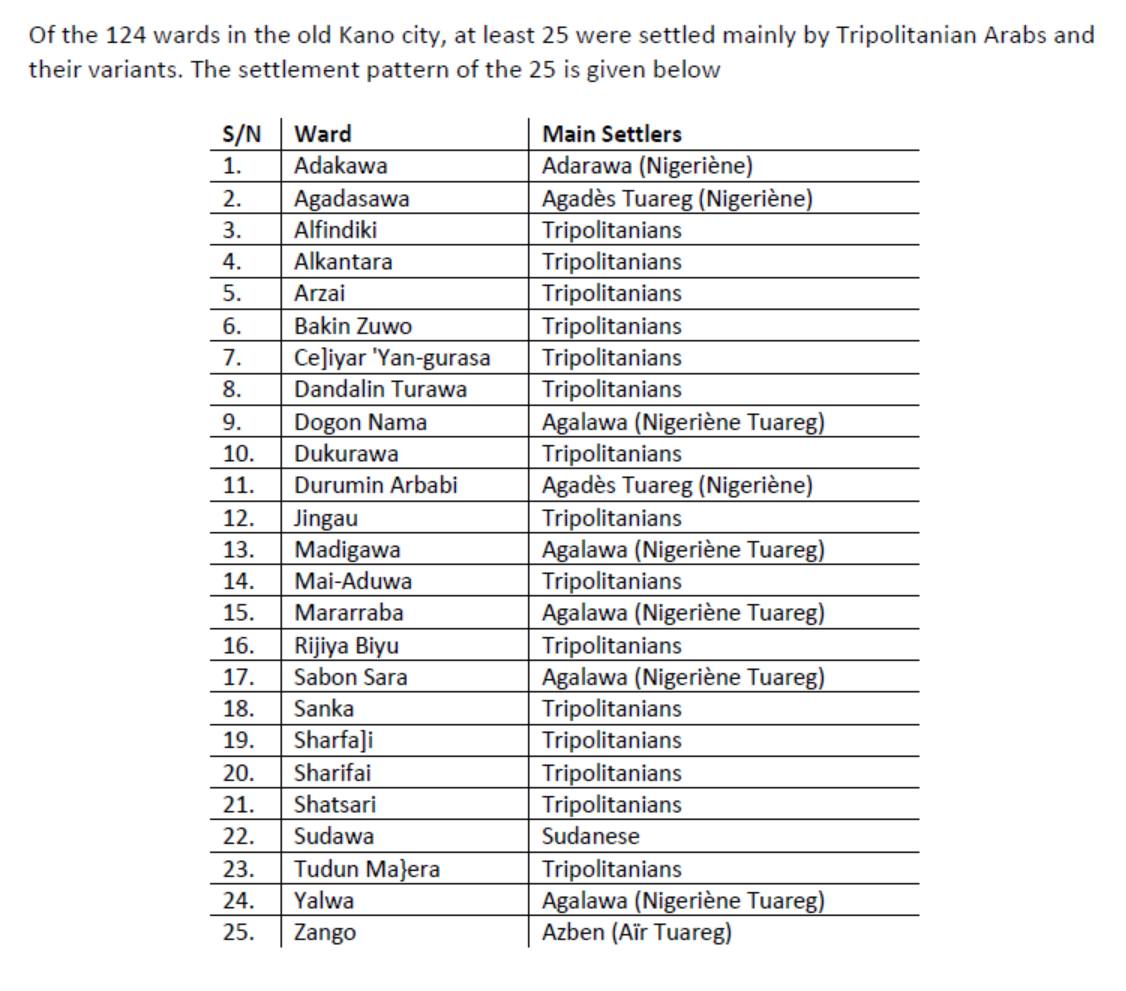
For those interested, I have included the table (from the paper attached) of the 25 Arab-dominated Kano inner city wards. I did this because not many would have the time to read 43 pages of the paper!

Adamu, Abdalla Uba. 2014. The presence of Arabs in Kano. In A.I. Tanko & S. B. Momole (Eds.). Kano: Environment, Society and Development (pp. 125-164). London & Abuja: Adonis & Abbey Publishers.

Or: https://shorturl.at/dgzW0

Late Haruna Kundila: The pre-colonial wealthiest person in Kano

By Jamilu Uba Adamu

Late Mallam Sa’adu Zungur (1915 – 1958) in his song Arewa Mulukiya ko Jamhuriya said;

“Ya Sarki Alhaji Bayero,

Ga Yan birni da Kanawiya.

Tun Bagauda na saran Kano, Suka fara fataucin dukiya.”

Kano State has been a trading and crucial commercial centre throughout its history.  History has shown that Kano has produced several wealthy individuals whose names will always be there in the annals of history.

The ability of Kano and its people (Kanawa) to create wealthy individuals did not start in this modern era. The likes of Madugu Indo Adakawa, Muhammadu Dan Agigi, Madugu Dangomba, Umaru Sharubutu, Mai Kano Agogo, Alhasasan Dantata, Adamu Jakada, Muhammad Nagoda and many others were among the wealthy individuals that Kano produced.

Late Alhaji Haruna Kundila (1810-1901) was known for his great wealth and fortune in the pre-colonial Kano during the reign of Emir Abdullahi Maje Karofi and his successor Emir Bello Ibrahim Dabo.

This popular Hausa saying attributed to him, “Ba na siyarwa ba ne; ya gagari Kundila”, means that there is nothing Kundila can’t afford to buy unless it is not for sale because of his massive wealth and purchasing power.

Haruna Kundila was born in 1810 at Makwarari Quarters in Kano city. 

The story about his source of wealth says that “one day when he came out from the house, he met Mallam Sidi (according to the story, Mallam Sidi is a pious, God-fearing Islamic teacher, and many people believe that he is a “Waliyyi” ). Mallam Sidi asked Kundila how he could help him get those that could evacuate his sewer pit. Kundila answered him positively.  When he checked and couldn’t find anyone to do the job, he decided to do it himself. When the Mallam returned and asked whether he had seen the people? He told him that the people had already come and done the work; Mallam Sidi asked him again, “How much were they supposed to be paid for the work? But suddenly, someone who witnessed how Kundila did the work alone intercedes and tells Mallam that Kundila did the work alone. When the Mallam heard that, he shook his head and said; To , Insha Allahu, duk inda warin masan nan ya buga gabas da yamma, kudu da arewa, sai ka yi suna, ka shahara an san ka “

History tells us that Haruna Kundila, who was a slave trader in those days, had trade relations with traders coming to Kano from foreign countries such as Mali, Sudan, Libya, Senegal, Damagaram, Agadas, Garwa, Duwala, Bamyo and Fallomi. 

In his heyday, no one in Kano has Kundila’s wealth. Kundila was rich and had estates by each city gate (Kofofi). It was said that he owned more than one thousand enslaved people. He was the wealthiest trader in nineteen century Kano. 

The name Kundila is because Haruna has a younger sister named Binta, who follows him at birth. After she grew up, one day, Haruna went home and found his sister in their mother’s room. He said to her, “Please, Binta, miko min kundina”. The sister started repeating the words “Ina kundina? Ina kundina? Since then, Kundila has followed him for the rest of his life. Until today, some government housing estates in Kano, such as Kundilar Zaria Road, bear the name.

It was said that when he died in 1901 (two years before the British conquest of Kano), Kano was shaken by the loss of one of the greatest wealthiest individuals in its history.

Jamilu Uba Adamu wrote from Kano via jamiluuba856@gmail.com.

Uproar over demolition exercise in Kano

By Bilkisu Kabir Ibrahim (Mrs)

It is often said, “Destruction is easy, but rebuilding takes more time to achieve.” 

Politics and governance are two sides of the same coin, as they are often used interchangeably even though they differ in veracity. In modern democratic societies, citizens (and leaders, by extension) fail to understand the difference between the two concepts in terms of meaning and operation. 

Barely less than two weeks after the swearing-in of the newly democratically elected governors and members of the states’ assemblies across the states of the federation, several governors focus on so many engagements as part of the fulfilment of their campaign promises, ranging from suspension and removing many top heads of the state’s ministries, departments and agencies alongside forwarding of new nominees to their respective state house of assemblies for various positions.  

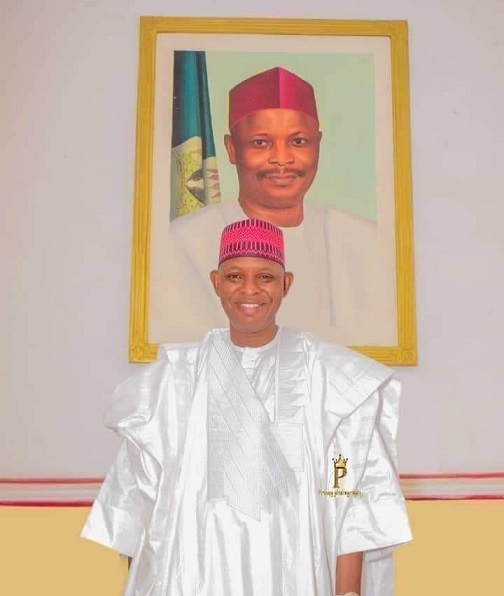
However, the reverse is the case in Kano State as the new governor fulfils his campaign promises where demolishing illegal structures is part. In his inaugural speech, his Excellency Abba Kabir Yusif revoked all sold public places and assets by his predecessor by ordering security agencies to take over such sites. A few days later, he began a demolition exercise with a 3-story building with 90No. Shops along Racecourse Road Nassarawa GRA which were reportedly owned by the son of the outgoing governor of the state, followed by another multi-billion Naira project via Public Private Partnership (PPP) arrangement initiated by his predecessor, situated at old Daula Hotel (state’s property) on Murtala Muhammad Way, Kano.

Nevertheless, several structures have been marked and knocked down as illegal buildings, which include; Eid-Ground Shops (Masallacin Idi), shops detached from Sani Abacha Stadium Kofar Mata and Buildings at GGSS Dukawuya Goron Dutse as well as some structures at Kano Hajj Camp among others. 

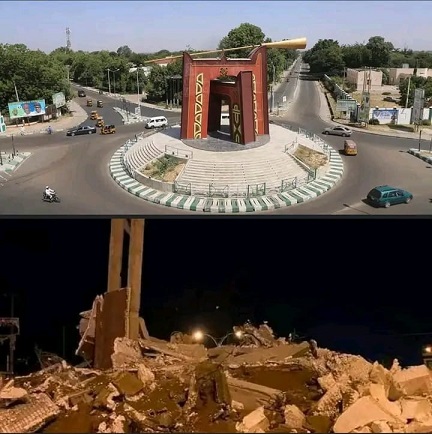
Subsequently, mayhem erupted in the state capital and neighbourhood when the governor ordered the demolition of the historic Kano roundabout structure in the early hours of Wednesday, 14th June 2023. The roundabout, known as Kano Golden Jubilee Monument, was erected in 2017 and conceived and designed by a young female architect to commemorate Kano’s 50-year attainment as a state.

While several indigenes and residents have condemned in totality the demolition of the monument, the press secretary to the governor, Sunusi Bature D/Tofa, in his reaction, revealed that the roundabout was demolished for security and safety reasons, “it also poses traffic challenges around the area due to its size blocking the view of drivers accessing all routes linked through the roundabout”. 

Nonetheless, mixed reactions become the order of the day; some residents are hailing the governor for staying firmly to his campaign promises, while many traders lament the demolition exercise as it truly affects their commercial activities by creating a hostile business environment forcing many of their customers from within and outside the state to stay away. During my interview sessions, a respondent feared the ongoing action as “it scared away private investments in the state, which is the time needed for a successful administration”. Another respondent (a victim) revealed that, on Saturday, he supplied aluminium and other equipment for a window project at Old Daula Hotel worth N30,000,000.00 but were all looted in the night immediately after the demolition, which the looters termed as “GANIMA” in Hausa. 

Similarly, it was reported that, in the heart-wrenching incident, a young boy lost his life after being struck by a truck during the demolition of a structure. The unfortunate event occurred amidst the efforts to clear the unauthorised constructions. The boy was not the only one affected, but also several individuals sustained severe injuries as they attempted to take advantage of the demolition exercise and loot multimillion items.

Some critical questions were asked about this light exercise. This government is supposed to concentrate on critical infrastructure and human development to overshadow its predecessors instead engaged in revenge and self-centred aggrandisement. 

His Excellency Abba Kabir may wish to remember that some projects need maintenance and sustenance to suit the rising demands of the good people of the state. Instead, the government should have to determine the legality or otherwise of the allocated lands by constituting high-powered technical committees to, among other things, investigate the following: 

a. Whether the due process for land allocation is followed;

b. Whether all building codes and regulations have been complied with;

c. The rationale behind the building purpose;

d. Was the land sold at market price, and whose account was the money deposited into or allocated as enshrined in the Land Use Act?

e. Was the land allocated to the rightful applicant? 

f. Was the roundabout demolition in the interest of most of the populace? Etc.

g. The committee to proffer some recommendations to the government for a proper solution. 

To crown it all, the governor may further wish to recall the Oath of Office taken during the swearing-in session, that “….I will not allow my personal interest to influence my official conducts or my official decisions …” Surely, Almighty God will ask for such utterances. 

Bilkisu Kabir Ibrahim (Mrs) wrote from Kano state, Nigeria. She can be reached via bilkisukabir1@gmail.com.

Kano Demolition: Doctor who built house with overseas loan begs Abba

By Uzair Adam Imam

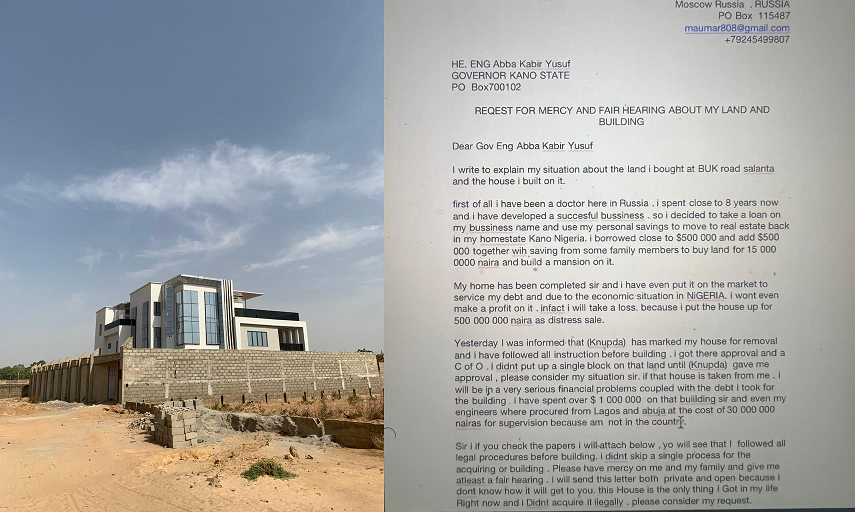
A Nigerian doctor based in Russia has pleaded with the Kano State Governor, Engr. Abba Kabir Yusuf, to spare his newly built house from demolition.

The doctor, whose name is withheld, told Kano Chronicle that he borrowed almost $500,000 and added his savings of $500,000 to build the house.

The passionate plea to the governor was in a letter written by the doctor, which Kano Chronicle shared on its verified Twitter handle.

Recall that the governor had decided not to back down on demolishing illegal structures built by his predecessor.

Abba’s administration had torn down a three-storey shopping complex located at Race Course Road, Nasarawa GRA, with 90 shops, Daula Hotel and other buildings at Hajj Camp, to mention but a few.

However, the doctor, who insisted that he put the house up for N500,000,000, pleaded with the governor to spare his home, adding that he would be at a loss if the house is demolished.

He stated, “I spent close to 8 years working in Russia now, and I have developed a successful business. So I decided to take a loan on my business name and use my savings to move to real estate back in my home state Kano Nigeria. I borrowed close to $500,000 and added $500,000 together with saving from some family members to buy land for 15,000,000 nairas and build a mansion on it.

“My home has been completed, sir, and I have even put it on the market to service my debt due to the economic situation in Nigeria. I won’t even make a profit on it. I will take a loss because I put the house up for 500,000,000 Naira as a distress sale.”

“Yesterday, I was informed that (Knupda)  has marked my house for removal, and I followed all instructions before building. I got their approval and a C of O . I didn’t put up a single block on that land until (Knupda)  gave me approval. Please consider my situation, sir. 

“If that house is taken from me. I will be in very serious financial problems coupled with the debt I took for the building,” he added.

Kano reopens applications for foreign, local scholarships for indigenes

By Ahmad Deedat Zakari 

The Kano State Government has resumed awarding local and foreign postgraduate scholarships to indigenes of the state. 

This was made public on Friday through a statement signed by the Secretary to the Kano State Government, Dr Abdullahi Baffa Bichi.

Dr Bichi called for entreaties from qualified Kano graduates. Graduates with first-class honours who are from the state and are medically fit to travel abroad are eligible to apply. 

He also noted that the last time the state awarded scholarships of this kind was in 2025, during the administration of Senator Rabiu Musa Kwankwaso.

Part of the statement reads: 

”Applications are invited from suitably qualified graduates for Kano State postgraduate foreign and local scholarships for the 2023/2024 Academic Session.

Recall that the last scholarship was offered in 2015 by Sen. Rabiu Musa Kwankwaso’s Administration which sponsored the third batch of 503 first-class graduates to 14 different countries.

After eight years without postgraduate foreign scholarship by the last administration, H.E. Engr. Abba Kabir Yusuf, The Executive Governor of Kano State, has approved the resumption of the postgraduate foreign and local scholarship with effect from the 2023/2024 Academic Session.”

Applicants are called on to fill out relevant application forms obtainable for free from www.kanostate.gov.ng/scholarship_application.

The state concludes that:

“Eligible applicants would be invited for a screening interview.

Completed application forms together with copies of credentials (indigene certificate, medical certificate, birth certificate, Primary School Certificate, WASC/GCE/SSCE certificate, Degree certificate etc) should be submitted to the secretariate of the screening committee, Old Conference Room, Office of the Secretary to the State Government, Cabinet Office, 1 Wudil Road, Kano within two weeks of this advertisement.”

Man killed by his pet dog in Cameroon

By Ahmed Deedat Zakari

A Cameroonian, Simon Ngonja, has been killed by his pet dog in Yaounde, Cameroon.

According to reports, the German shepherd fiercely attacked and mauled his owner, a senior staff at the Cameroonian Prime Minister’s office.

The incident was reported to have happened on June 11, immediately after the deceased returned from a journey.

A soldier had shot the dog dead in a futile attempt to save the deceased. However, before the intervention of the soldier, the deceased had already sustained aggravated bodily injuries and had lost a lot of blood to bleeding.

Mr Ngonja was rushed to the hospital and was stabilised before his inevitable passing on the Morning of June 15, 2023.

A Facebook user, Bella Powers, gave details as to the cause of his death in a post, he wrote :

“Killed by his dog in Yaoundé… Simon NGONJA died this morning after being fatally attacked by his own ‘German Shepherd’ breed dog.

“Returning from a trip last Sunday night, he was attacked by his dog after opening the gate of his house. He fought fiercely with the animal to the point where it was a soldier who decided to kill the dog with a rifle bullet. Taken to the hospital with a lot of bleeding, the wounds were finally fatal to him.

“He was an executive in the services of the Prime Minister in Yaoundé.
May his soul rest in peace, and our condolence to his family.”