Month: May 2023

Arsenal’s Premier League title challenge: A glass half full or half empty?

By Aliyu Yakubu Yusuf

At the beginning of every league season in Europe, football pundits look at the strengths and weaknesses of every team and make predictions on what they think will be the outcome and the position of every team at the end of the season. These pundits predict the likely winners of the league, the top 4 places, the relegated teams, the top scorer, the best player, the best goalkeeper, the best young player, the dark horses and so on.

I have followed these predictions on nearly all the major British tabloids like BBC, Daily Mail, GiveMeSports, Telegraph, Guardian, Athletic, etc. I did not come across a single pundit that predicted Arsenal to finish in the top 3 in the EPL. Most pundits earmarked Arsenal for the sixth position below Manchester City, Liverpool, Chelsea, Tottenham and Manchester United. In fact, some pundits went as far as predicting Arsenal to finish in the seventh spot below Newcastle United.

Looking at Arsenal’s title challenge from this context, it can be argued that Arsenal have punched well above their weight. By finishing second in the league, the Gunners have overachieved relative to everyone’s expectations at the beginning of the season. I have no doubt that most Arsenal fans who are now disgruntled would have indeed accepted the second position gleefully were it offered at the beginning of the season.

Arsenal’s squad is full of players in their mid or early twenties. Most of these players have never experienced a title race in their careers. The current disappointment may serve as a learning curve for Arsenal players. With Saka, Jesus, Odegaard, Martinelli, White, Ramsdale, Saliba, White, Smith-Rowe, and Gabriel approaching their primes, the future certainly looks bright in the red half of North London. A glass half full.

For the 36 weeks so far played in the EPL, Arsenal led the table for 29 weeks. In other words, the Gunners sat at the top of the table for more than 90% person of the matches played. And having led the EPL table for so long, it must be quite disheartening for the Gooners to lose the title in this disappointing fashion.

At a time, Arsenal appeared to be running away with the EPL trophy. However, most Arsenal fans will remember when their team seemed not to put a foot wrong when everything Mikel Arteta touched turned into gold. Thus, it must be heart-breaking to “bottle” everything when victory looks so tantalisingly close.

This season represents a golden opportunity for Arsenal to slap their 19-year wait for the EPL title. Considering their lofty standards, Manchester City were relatively poor for most of the season. Save for the last two months, Liverpool were having one of their worst seasons in recent memory. Chelsea were having a season from hell. Manchester United were in their usual shambles, though the coming of Erik Ten Hag has brought some semblance of calm. Spurs are just…well, ‘spursy’.

Looking at the whole picture, most of the EPL big boys were largely underwhelming for most of the season. It is difficult to imagine Liverpool and Chelsea having another miserable campaign next season for the Gunners to capitalise on. Therefore, this might just be a good opportunity missed. As I said earlier, most of Arsenal’s crop of young players have performed tremendously this season. This may spell trouble for the Gooners in the near or distant future.

Arsenal have grown a reputation of selling their best players just when they appear to hit their peak. Players like Fabregas, Nasri, Van Persie, Adebayor, Hleb, Toure etc., were all forced to leave Arsenal to realise their dreams of winning the big trophies. Will the current Arsenal players resist the temptation if (or when) big boys come calling? The vultures come circling. And this may well be another Groundhog Day for Arsenal. A glass half empty.

Aliyu wrote from Kano. He can be reached via aliyuyy@gmail.com.
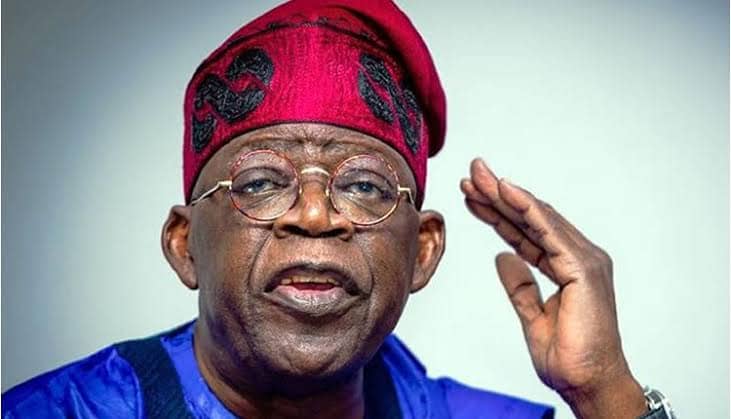
Tinubu ready to address underdevelopment issues – Osun ex-governor

By Uzair Adam Imam

The President-elect, Bola Ahmed Tinubu, has proposed a 20 to 50 years development plan to help address the menacing underdevelopment issue in Nigeria.

Bisi Akande, Pioneer National Chairman of the All Progressives Congress (APC), disclosed this on Sunday in a public lecture in Ondo.

Akande, who is also a former governor of Osun State, lamented that the failure of successive governments to have a development plan for critical sectors of the economy is responsible for the country’s underdevelopment.

He stated, “We fail to plan and, yet, we are surprised that we fail in almost all sectors as we are all lapsing into generations of plan-less hypocrites.

“I can assure you that was not what we inherited. In this same country, we used to have five years capital development plans and seven years capital development plans. Now we only plan for the immediate next election.

“We thank God that this time around; Nigerians have elected a leader who has planned for a long time to be our President.

“Asiwaju Bola Tinubu is a well-known person to Baba Fasoranti, and he is also an inheritor of the Awoist legacy of planning and integrity.

“Therefore, it is right and necessary to expect a 20 or 50 years master plan for Nigeria from President Tinubu which would transform this blessed country into a great one,” Akande added.

AI Hackathon: Arewa Data Science Academy wins $800 prize

By Uzair Adam Imam

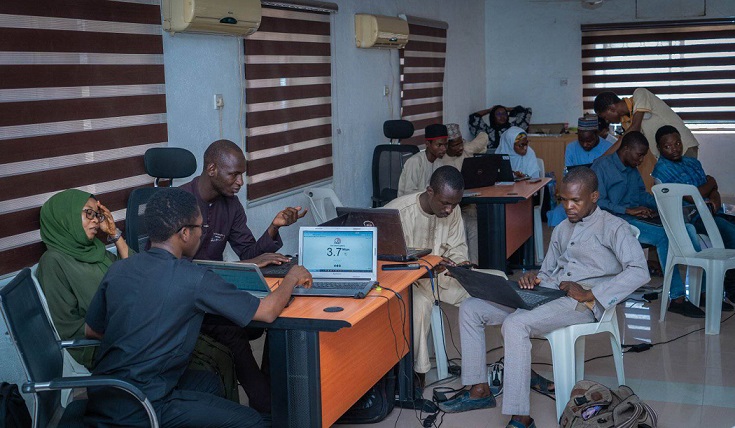
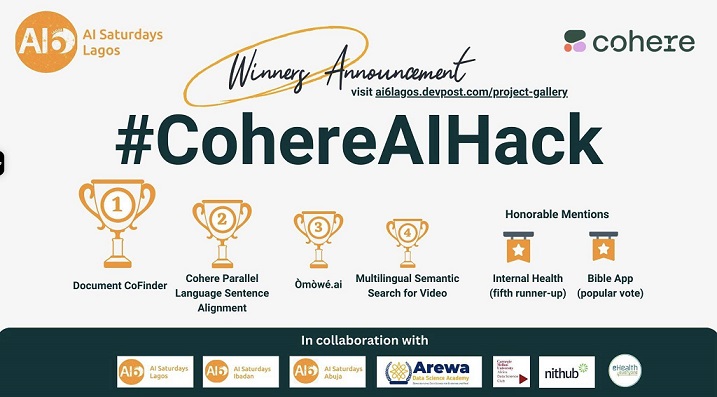
There was jubilation at the Arewa Data Science Academy on Sunday as their team emerged 2nd place in the just concluded Cohere AI Hackathon, winning a prize of Eight Hundred Dollars + Cohere AI Credit.

One of the team leaders, Dr Shamsuddeen H. Muhammad, relayed the exciting news on his Facebook account on Sunday.

Dr Muhammad added that the Arewa Data Science Team had competed against different teams and demonstrated skills and creativity in machine learning.

He stated, “I am happy to share that the Arewa Data Science team has won the competition at the Cohere AI hackathon and received a prize of 800 dollars and Cohere AI credits!

“Our fellows competed against different teams worldwide and demonstrated their skills and creativity in Machine Learning. Congratulations to the team on this achievement!”

Muhammed further stated that Arewa Data Science Academy is a free training program for Arewa youth who want to learn data science and machine learning.

He added that the academy “provides monthly stipends (N10,000) and free internet data (20GB) to our fellows to help them in their learning activities. 

“If you are interested in joining us, visit our website at: https://arewadatascience.org,” he stated.

Language is not a friend – I have bound my project

By Bilyaminu Gambo Kong-kol

Language is considered the principal method of human communication, consisting of words used in a structured and conventional way and conveyed by speech, writing, or gesture. It is a tool that establishes commonness between the sender and the receiver.

For the commonness to be established, the encoder must be well-grounded in the language he chooses to use and arrange his words systematically. He must also consider meanings such as denotative, connotative, reflected, and social, among others. 

The receiver must also do his part as interference is likely to occur from him, the environment, channel, or encoder.

However, language sometimes becomes a betrayer by betraying even the native speakers due to its rigid nature. The fact is that even if you are familiar with the rules, language may decide to disgrace you abruptly.

In this piece, Hausa, Fulfulde, and English languages will be used to explain my points.

In Hausa, it is a rule that most of the words that end with the letter “A” are feminine, and those ending with E, I, O, and U are masculine. But there are exceptions. For instance, words like kotu (court), gwamnati (government), and kwallo (ball) end with masculine vowels, but they are feminine. On one part, ruwa (water), zama (sitting), and kira (call) are masculine despite having feminine endings.

Hausa also demands that wherever possessives “Na” and “Ne” are used for masculine words, they should be substituted with “Ta” and “Ce” for feminines. For example, Jirgina ne (It is my plane), motata ce (It is my car).

Many Hausa speakers, including some of the natives in northwest Nigeria, are struggling to adhere to the rules. To get primary data on this, choose any state in Nigeria and listen to their radio stations or have physical interactions.

In Fulfulde, the law states that a word’s ending determines its demonstrative adjective. For instance, it is okay to say this horse, this room, or this pen in English, but the case is different in Fulfulde. Wamnde nde, sudu ndu, bindirgol ngol. To learn more, get a Fulani friend or wife.

This rule is giving headaches even to the LI in Yola, as it requires alertness and quickness of thought. It is normal to hear a typical Fulani man saying “Mi laari mo” instead of “Mi laari ngal” when he is referring to “I saw the hen”.

Another blunder is the introduction of the letter “V” in Fulfulde. In a standard Fulfulde setting, there is nothing like the consonant sound /v/. Hausa, too, does not have it. That is why some Hausa say bery good instead of very good. Just like the way some Hausa misplace V for B in English, some Fulfulde speakers misplace W for V in their first language. 

For example, “O vindi” instead of “O windi” (He wrote), “Mi vi” instead of “mi wi” (I said), “O va’i leggal” instead of “O wa’i leggal” (He/she climbed a tree).

One interesting thing about Fufulde is that, unlike Hausa and English languages, Fulfulde does not have pronouns that differentiate gender. Fulfulde’s pronoun “O” refers to he/she in English and Shi/ita in Hausa.  And Fulfulde’s pronoun “Ma” refers to Ka/Ki in Hausa. Maybe this was done to show our shyness and respect (Pulaaku). 

Another virus that is threatening Fulfulde is code-mixing and code-switching. Some Fulfulde speakers in Adamawa, Taraba, Gombe, and Yobe could not speak pure Fulfulde for an hour without borrowing from Hausa, English, Arabic, or their L2 words. This signifies a low level of grammar or lack of respect for Fulfulde language. It needs to be fought gallantly.

In English, rules of concord, tenses, syntax, and semantics are hectic for learners and L2 speakers. 

Concords like: “He says, I say, they say, he has, I have, they have, he does, I do, they do, he does not have, I do not have, and they do not have” are found to be confusing most especially by learners. Also, the sentences below, even though correct, may not convince learners as plural nouns could be seen nakedly. Shamsu, together with his wife, is coming to London or Maijama’a, along with Bilkisu, is coming to Cyprus. Think of “Neither Ghali nor the students are present” vs “Neither the students nor Ghali is present”. 

In tenses, the unjustified usage of the past in the present, the present in the past, or the distortion of the entire tenses is common. Moreso, the choice of words and sentence construction are influenced by speakers L1. You will see an English sentence given direct translation from Hausa, Fulani, Igbo, or Yoruba. Example: Haruna said it is for you and me.

In phonetics and phonology, words are pronounced mostly the way we hear others articulate them over time. Sometimes, Lll speakers localise the British accent. Consonant sounds like /θ/, /ð/, /ʃ/ /ʒ/, /ʈʃ/, /dʒ/, and ŋ/ are mispronounced in some words. Vowel sounds /ʌ/,  /ə/, /ɜ:/, /æ/ and the eight diphthongs play with the tongues of learners. Or should we say learns to play with them?

The topic is broad, but advisably, make sure you learn all the dos and don’ts of every language you want to communicate with people. This will pave the way for you to communicate effectively and earn your respect. By so doing, you minimise 70% to 90% of your chances of making mistakes. Don’t expect 100%; even the natives are still looking for that!

Nevertheless, always remember that language is not a friend. It may decide to disappoint you unexpectedly. I received mine on my last day as an undergraduate student at Bayero University, Kano. I was stuck fishing out whether the word “bind” is a regular or irregular verb. What is the past participle; binded, bounded, or bound? It had escaped my memory. I still don’t understand why English decided to misbehave on this special day of mine (04/05/2023).

Whatever the reason, I got a pitch that led to the writing of this article. Alhamdulillah! My appreciation to communication scholars, the Vice Chancellor of Federal University, Kashere, Professor Umaru A. Pate, and OPEC’s PR Coordinator, Dr Umar Jibrilu Gwandu, for drawing my attention immediately. I HAVE BOUND MY UNDERGRADUATE PROJECT!

Bilyaminu Gambo Kong-kol is a graduating student of the Mass Communication Department at Bayero University, Kano. He can be contacted via bilyaminugambokonkol20@gmail.com.

Doctors’ anti-migration bill and nurturing greener pasture

By Lawal Dahiru Mamman

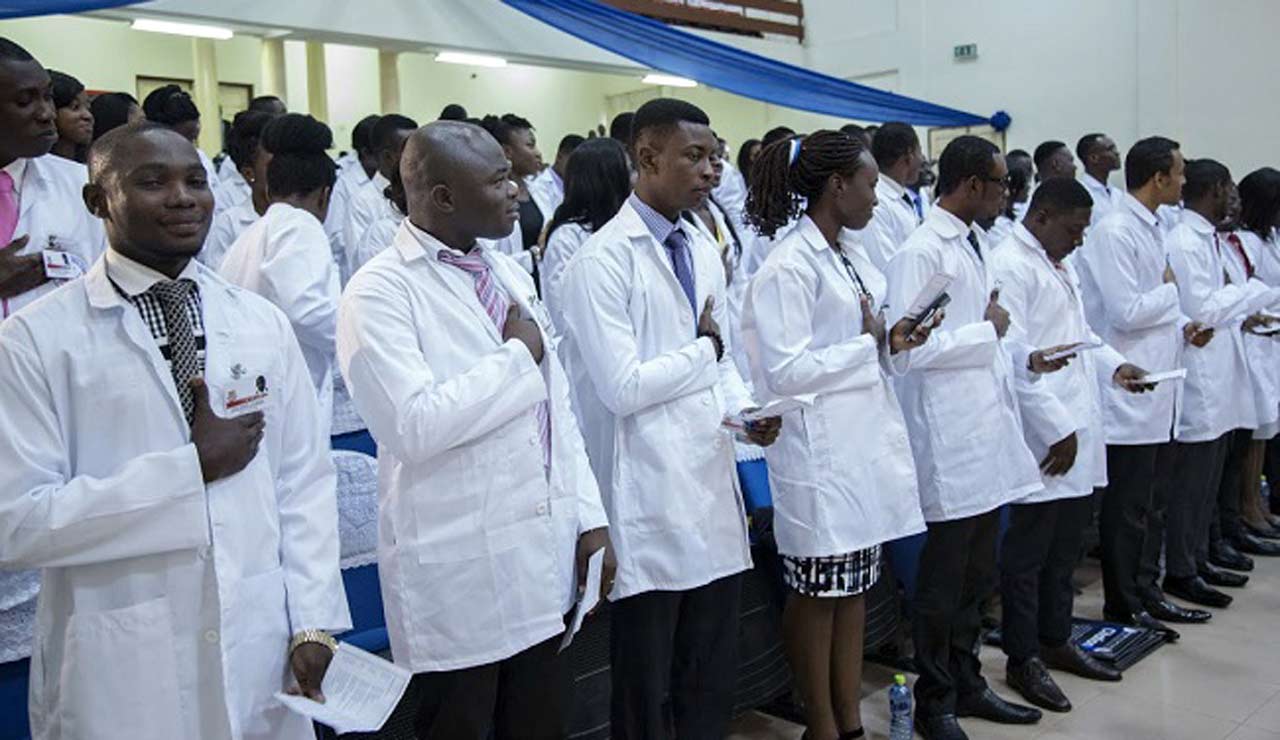
Brain drain in Nigeria has lingered for some time now. In the medical profession, it is the most dominant issue occupying the mind of physicians and other health personnel. This may not be unconnected to the fact that human life is sacrosanct.

It goes without saying that the incessant brain drain of medical personnel in Nigeria will slow the attainment of Universal Health Coverage (UHC), that all people have access to the full range of quality health services, they need, when and where they need them, without financial hardship, in this part of the world.

Mainly, the mass exodus of doctors out of the country is caused by poor welfare of medical practitioners, lack of or insufficient working equipment, and poor working environment leading to the need for seeking a more sumptuous alternative – greener pasture as it is called.

This is purely a reflection of the theory which argued that “…… if wages rose above subsistence, the number of workers would increase ….” By implication, wherever our medical brains are sprinting to have a more luscious wage or salary for the profession. This would increase the country’s workforce while wearing out our dear nation.

Discussions have sprung over time on how to salvage the situation. Experts have suggested an increment in the welfare of doctors. In contrast, others have voted for ending medical tourism, especially public officeholders, to enable them to pay more attention to funding health facilities at home.

The most recent attempt to curb the mortal exodus of medical practitioners is to shackle them with the power of the law. This is through a bill sponsored by Ganiyu Johnson, a lawmaker from Lagos. The bill seeks to amend the Medical and Dental Practitioners Act 2004 to address the brain drain in the health sector. According to the lawmaker, it is only fair for medical doctors who enjoy taxpayer subsidies on their training to give back to society.

The legislation is titled, ‘A Bill for an Act to Amend the Medical and Dental Practitioners Act, Cap. M379, Laws of the Federation of Nigeria, 2004 to Mandate Any Nigeria Trained Medical or Dental Practitioner to Practice in Nigeria for a Minimum of Five Years Before being Granted a Full License by the Council to Make Quality Health Services Available to Nigeria; and for Related Matters.’

While the above is more restricted to medical and dental practitioners, the same lawmaker said on Friday, April 14, 2023, that he would be presenting a similar bill on nurses and pharmacists; when he intends to do that, time will tell.

With different medical associations reacting in negation by stating that the bill has the propensity to trample on the rights of doctors, the Minister of Health, Dr Osagie Ehanire, said the bill is in order especially looking at the fees paid by the government to subsidise their training at universities, and the service which they render before travelling overseas. However, the minister said the service does not make up for the cost of training.

The Nigerian Medical Association (NMA) has said the bill will not see the light of the day because it impedes the constitutional right to freedom of movement of doctors and violates international labour law, chiefly since the government has subsidised students from all other professions.

The Nigerian Medical Students Association (NiMSA) and the World Medical Association (WMA) have vehemently disapproved of it, too, because the bill, according to the latter, is “not only outlandish but totally retrogressive, unresearched and very ill-informed.”

The bill that intends to give health workers full license only after five years of working in Nigeria has passed the second reading in the House of Representatives. While this may have come out of benevolence, it may not be the piece we search for to solve the puzzle of brain drain in the health sector.

If the bill sees the light of day, after five years, doctors will still have the freedom to travel out, in my opinion even more experienced. So, could this be the solution we yawn for? Instead, a more lasting solution should involve doctors and government officials meeting halfway to save Nigeria’s crumbling health sector.

I want to firmly believe that Nigeria has what it takes to cultivate the soil for growing ‘greener pasture’ our medical professionals continue to voyage foreign lands for. But only leaders fuelled with altruism can summon the political will to do the needful.

Lawal Dahiru Mamman writes from Abuja and can be reached via dahirulawal90@gmail.com.

It’s better to wait long than to marry wrong

By Hafsat Ja’afar

When are you getting hitched? Are you still single? When are we meeting our in-law or the Mr Right? You’re just choosy, aren’t you? So hurry up and get married! All these questions are uncalled for. Seriously people!

Do you need to go that extreme in asking people unanswerable questions who do not know the unseen?  It’s driven people nuts, and it needs to stop. Believe it or not, delayed marriage is a trendy issue not only within our society but also a universal issue due to the changes in our modern times.

Marriage delays in Northern Nigeria may result from the following;

Nature: Some are destined to stay single up to old age, while some are afflicted with natural diseases, which, no matter how much they want or try to get married, they cannot.

Tradition: Every family has its norms, values,  and principles. Some think their children must reach a certain age or level of education before marrying them off.  The issue of trousseau is a major setback too. These principles sometimes hurt the life of the people involved.

Illiteracy: This is another side of the coin, as some of the established youths consider marriage a burden, so they prefer private/commercial affairs. To them, getting married is like inviting old age while the “I’m Still Young” slogan still rings in their heads.

Expectation: This plays a significant role as the backbone of the marriage delay, as both parties expect luxury and goodies before marriage. The gents are looking for capacitated in-laws, and the ladies are waiting to marry into an influential family. However, this might take years for some to achieve.

Financial Instability: Due to unemployment, underemployment, inflation, cashless policy and other financial crises we all know about, some people run away from marriage.

Societal pressure on why and when you’re getting married has led many into failed and toxic marriages, which they later regret. Due to such pressure, someone I know married a man who gave his terms and conditions on splitting the bills 50-50.

As a classroom teacher, she was to handle school fees, medication, and other things. In the end, the marriage broke down because, according to the husband, she’s not complying and not making ends meet. She’s now a divorcee with two kids.

A friend-turned-sister married a man she doesn’t love, but he loves her dearly. For years their matrimony was nothing to write home about with four kids. She made his life and family a living hell to escape the marriage. She finally succeeded, taking her kids along with her and denying him custody of them.

Someone also told me it’s better to bear the title of Mrs in an abusive marriage than to stay single while time is against us. I was shocked beyond words for her to say this. She desperately needs a husband, someone to call her own.

Another one got married to a tricycle driver out of desperation, though he’s an NCE holder with no job, and she’s a graduate with a job. The interference of friends and relatives in their marital life led to serious malice between the two families. The couple used to spend weeks on no-speaking terms. All the love and sacrifices made for each other vanished, and the blame game became the order of the day. Sessions of reconciliation took place with no positive results. Finally, they went their separate ways and found peace and tranquillity, as they say.

The hustle and bustle of life is an essential element that paves the way for critical and creative thinking, mainly if a person engages him /herself in business, studying, working, and what have you. No matter how small it is, it fades away. Whatever is bothering an individual gives room for greater achievements in life.

As the saying goes, ‘it’s better to wait long than to marry wrong’. To avoid jumping into an erroneous affair, you must pray and choose wisely to avoid unforeseen circumstances.

Hafsat Ja’afar read BA (Ed) English at Bayero University, Kano. She wrote from Kano via jaafarhafsat@gmail.com.

The antics of Kano throne: History may repeat itself

By Sadiq Ilyas

In 2017, Governor Abdullahi Ganduje reportedly disagreed with Sarki Muhammadu Sanusi II’s critical comments about the government’s handling of the state’s finances. Sanusi accused the government of mismanagement and corruption, particularly about the state’s debts.

The disagreement between the two escalated in 2019 when the Kano State government created four other emirates, reducing the powers of the Emir of Kano, who was Sanusi then. 

Sanusi challenged the creation of the emirates in court, arguing that it was politically motivated and designed to weaken his position as emir. However, in March 2020, a Kano State High Court ruled that creating the emirates was legal.

In March 2020, Sanusi was removed from his position as Emir of Kano by the Kano State government, citing insubordination and disrespect to the governor and other officials. Sanusi denied the allegations and challenged his removal in court, but his efforts were unsuccessful.

Since the removal of Sanusi as the 14th Emir of Kano, many people have reacted differently, and that generated sympathy around the Emir, who was seen as a victim, while the Governor is seen as the villain. 

The Kano Governorship election result is believed to be won majorly as protest votes against Ganduje’s policies, including creating new emirates and his perceived allegation of corruption. On the other hand, the New Nigeria People’s Party, NNPP, gave a margin of 128,000 votes to the ruling All Progressives Congress, APC. Although the APC plans to challenge the victory in court, the likelihood of overturning the election is slim.

The 14th Emir of Kano is believed to have supported the NNPP with many antics. First was his appearance in a white and red outfit, the Kwankwasiyya insignia, just before the election when he visited his mother. People also rumour that he financed the campaign of the NNPP of the Governor-elect Abba Kabir Yusuf. Though the 14th Emir was out of the country during the election period, he was believed to be in Makkah praying for the victory of the Governor-elect.

Since the announcement of the Governorship results in Kano, social media space was filled with slogans such as “Sabon Gwamna, Sabon Sarki”, meaning “new Governor, new Emir”. The atmosphere in the Emir’s palace becomes tense, and the Emir’s outfit choice for the Hawan Daushe Durbar says it all. He wore golden armour, which some analysts say is a sign of confrontation in times of war. But now that the battle with swords is over, the question is who is playing with the lion’s tail. 

Kwankwaso VS Ganduje

In a recent interview with reporters, Senator Rabiu Musa Kwankwaso, the leader of the NNPP and presidential candidate of the party in the 2023 election, has stated that the incoming government of Abba Yusuf, the Governor-elect of Kano State, will review the dethronement of the 14th Emir of Kano, Muhammadu Sanusi II.

“We tried not to intervene in the issue of bringing or removing any Emir. But now, an opportunity has come. Those given this opportunity will sit down and see the issues. Then, they will look at what they are expected to do. Besides the Emir, even the emirate has been divided into five places. All these need to be studied,” Kwankwaso stated.

He also said that, as elders, they would continue to advise the incoming government to do the right thing.

Meanwhile, Kano State Governor, Dr Abdullahi Umar Ganduje, has reiterated that the four new emirates created by his administration are here to stay.

“The four new emirates are a symbol of unity, progress, and the well-being of the people. They were created to honour the people of these regions and recover the reputation of the traditional institutions,” Ganduje said during the Workers’ Day celebrations held at Sani Abacha Stadium in Kano.

He added that the emirates were created to upgrade and promote their tradition, and they have brought development to these places. “I assure you that these emirates are permanent. They have come to stay. Even if we are not in government, these emirates are untouchable. I promise you this by the grace of God, they have come to stay,” he added.

It remains to be seen how the situation will unfold in Kano State regarding the dethronement of Sanusi II and the creation of new emirates.

History may repeat itself

During the administration of Governor Abubakar Rimi in the late 1970s and early 1980s, there was an attempt to create five emirates in Kano state by splitting the Kano Emirate into five. 

This move was met with opposition by some members of the royal family and other traditional rulers, who saw it as an attempt to weaken the influence of the Kano Emirate.

However, Governor Rimi went ahead with the plan and created the new emirates of Gaya, Karaye, Bichi, Rano, and Kano. 

The Kano Emirate was reduced in size and given a more ceremonial role, while the new emirates were granted more administrative and political powers.

When Governor Sabo Bakin Zuwo took over in 1983, he reversed the decision and restored the Kano Emirate to its original size and status, with the other emirates abolished. 

His decision was seen as an attempt to restore the traditional balance of power and to address the concerns of those who opposed the creation of the new emirates.

In 2019, Governor Abdullahi Ganduje created four new emirates in Kano State, including Gaya, Karaye, Bichi, and Rano, in addition to the Kano Emirate. The move was met with controversy and legal challenges, with some arguing that it was politically motivated and aimed at reducing the influence of the Kano Emirate. This followed the dethronement of the 14th Emir Muhammadu Sanusi II. And from all indications, history may repeat itself, with the NNPP becoming a new government.

Experts opinion 

Following the recent dethronement of Sanusi as Emir of Kano and the creation of new emirates by the Ganduje administration, Nadir Nasidi, a historian at the Ahmadu Bello University Zaria, has spoken out against the move, stating that it is unnecessary and unpalatable.

In an interview, Nasidi stated, “Kano is the only emirate in the whole country with one unifying emir, but the creation of unnecessary emirs isn’t a palatable one. Many people, including myself, told the Ganduje administration that what he was doing wasn’t a good one.”

While acknowledging that Sanusi’s dethronement was final and he could not be brought back, Nasidi suggested that the other emirates be reduced to local chiefs under the overall Emir of Kano, who would be chosen from among the existing kings.

He said, “Nobody will bring back Sanusi. He’s gone already. But the other emirates must be reduced to local chiefs under the overall emir of Kano. They can choose amongst all the kings one person to be the overall king.”

Nasidi’s suggestion comes amid ongoing debates about the wisdom and legality of creating new emirates in Kano State. The creation of four new emirates in the state was met with widespread criticism, with some people accusing the government of trying to weaken the influence of the Emir of Kano.

Critics argue that the move is politically motivated and aimed at reducing the Emir’s power and influence. On the other hand, supporters of the new emirates say that it will promote development and bring the government closer to the people.

As the debate continues, it remains to be seen whether the incoming administration will consider Nasidi’s suggestion or continue with its plans to bring back Sanusi Lamido as the Emir and reverse the creation of the emirates in Kano State.

Sadiq Ilyas wrote via silyas1989@gmail.com.

A great government is built on quality appointments and commitment

By Muhammad Auwal Yahaya

A great government is not solely determined by the promises made during political campaigns but by the quality of the individuals appointed to key positions. Therefore, when a governor-elect, such as Mallam Umar Namadi, is entrusted with the responsibility of leading a state like Jigawa, it becomes crucial to prioritise quality political appointments. These appointments play a pivotal role in delivering campaign promises, establishing an exceptional government, and gaining the trust and support of the people.

Selecting candidates based on merit and competence is essential for building a strong government. By appointing individuals with the necessary skills, knowledge, and experience, a governor-elect can ensure that the government is led by capable individuals who can effectively address the challenges and complexities of governance. In addition, merit-based appointments promote efficiency, innovation, and delivering high-quality services to the citizens.

A government that reflects the diversity of its people is more likely to understand and address their varied needs and aspirations. A governor-elect can create a balanced and inclusive government by prioritising diversity in political appointments. This means appointing individuals from different ethnic, religious, and cultural backgrounds, as well as women and minority groups. Such representation fosters a sense of belonging and ensures that policies are formulated comprehensively about the diverse population.

Achieving regional balance in political appointments ensures equitable development and representation across all state regions. By appointing individuals from various areas, a governor-elect can ensure that the government’s focus and resources are not concentrated in one area but rather distributed fairly. This promotes balanced growth, reduces regional disparities, and fosters a sense of unity among the citizens.

Political inclusivity is vital for a government to effectively represent its constituents’ diverse interests and perspectives. A governor-elect, Therefore, could consider appointing individuals from different political affiliations, not just members of their party. This fosters a sense of collaboration, encourages healthy debates, and enables the government to make informed decisions that benefit the entire state rather than a specific group.

Transparency and accountability should be the cornerstones of political appointments. A governor-elect must ensure that the selection process is transparent, with clear criteria and mechanisms for evaluating candidates. By doing so, they can instil public trust and confidence in the government. Additionally, appointees should be held accountable for their actions, with mechanisms in place to monitor their performance and address any misconduct or negligence.

Consulting experts and seeking their advice is crucial when making political appointments. A governor-elect should consider individuals with the expertise and knowledge required for specific positions. By involving experts in the decision-making process, the government can benefit from their insights, innovative ideas, and strategic thinking. This leads to more informed and effective governance.

Nepotism and cronyism have no place in quality political appointments. A governor-elect must prioritise fairness and integrity, ensuring arrangements are based on merit rather than personal relationships or favouritism. By avoiding nepotism and cronyism, the government can inspire public confidence, enhance transparency, and attract competent individuals with the state’s best interests.

Regular performance evaluation of appointees is essential for maintaining accountability and ensuring optimal governance. A governor-elect should establish clear performance metrics and mechanisms for assessing the effectiveness of individuals in their appointed positions. This allows for identifying areas of improvement, providing necessary support or training, and making changes when required. Performance evaluation fosters a culture of continuous improvement and reinforces the government’s commitment to delivering results.

Involving the public in decision-making and seeking feedback is crucial for a government to be responsive and accountable. Therefore, a governor-elect should actively engage with the citizens, listen to their concerns, and incorporate their perspectives into political appointments. Public engagement and feedback not only enhance the legitimacy of the government but also provide valuable insights that can inform policy-making and ensure the delivery of services that truly meet the needs of the people.

Governor-Elect Mallam Umar Namadi has crafted an impressive blueprint for the development of Jigawa state. His vision and commitment to the betterment of the state deserve appreciation. Moreover, the blueprint demonstrates his understanding of the challenges and opportunities ahead. With such a well-thought-out plan, it is evident that he has the potential to lead Jigawa to new heights.

To transform the blueprint into reality and deliver on the campaign promises, Governor-Elect Mallam Umar Namadi should prioritise quality political appointments. By carefully considering the criteria of merit, competence, diversity, regional balance, political inclusivity, transparency, accountability, consultation, and expertise, he can assemble a team of capable individuals who share his vision and are committed to serving the people of Jigawa diligently.

The people of Jigawa state have placed their trust in Governor-Elect Mallam Umar Namadi and have high hopes for the incoming government. Therefore, it is essential to keep the spirit alive and maintain optimism for the positive changes that lie ahead. As citizens, we are responsible for supporting the new government and actively participating in the development process.

Let us pray for the success of Governor-Elect Mallam Umar Namadi and his team. Through prayer, we can seek guidance, strength, and wisdom for the government to effectively navigate the challenges and fulfil its responsibilities. We can contribute to building a prosperous and exceptional Jigawa state with our prayers and support.

Muhammad Auwal Yahaya, known as Amujaheed, is an indigene of Jigawa state and the visionary behind jgONLINE, an innovative online platform. A technophile, Jigawapreneur, and an advocate of good governance who strives for inclusivity, commitment and excellence.

Dispute between two neighbours in Kano ends in bloodbath

By Uzair Adam Imam

A bitter dispute between two neighbours in Kano resulted in a bloodbath when one of the men, Amir Sa’idu, allegedly descended on the other with several stabs.

Sa’idu was said to have stabbed his neighbour, Muktar Abubakar, with a pair of scissors on his forehead.

The Daily Reality gathered that the incident, which happened in Unguwa Uku, Kano, led to Abubakar developing a partial stroke.

Our reporters also learned that a Kano State Sharia Court sitting in Unguwa Uku had remanded Amir for his actions.

The prosecutor, Aliyul Abideen, told the court that the victim developed several illnesses after the incident.

He added that the illness later led to a partial stroke and that he was now receiving treatment in a hospital.

However, the suspect pleaded guilty to the charge.

But the judge, Nura Yusuf Ahmad, ordered the suspect remanded in prison until June 12.

He added that the case would remain pending until the victim’s situation has been reviewed.

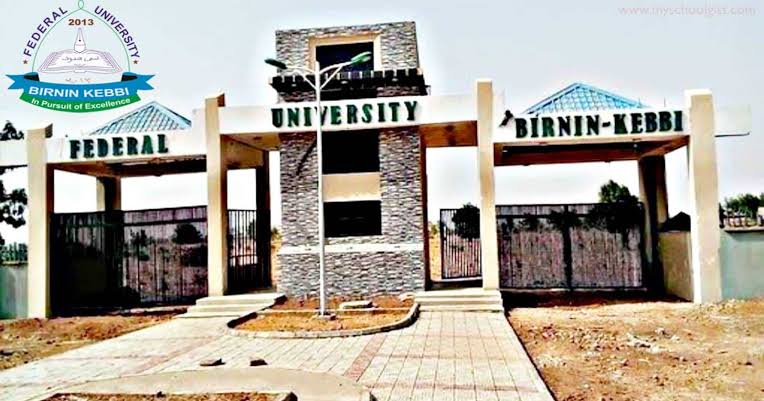
FUBK gets new DVC, directors

News Desk

The Governing Council of Federal University Birnin Kebbi (FUBK) has appointed Professor Aliyu Abdullahi Turaki as the new Deputy Vice Chancellor of the University.

The appointment was sequel to the recommendation of the Senate and subsequent approval of the Governing Council at its 26th meeting held from 10th to 11th May 2023.

The appointment is for a term of two years at the first instance and takes effect from Thursday, 11th May, 2023.

Prof. Aliyu A. Turaki attended Sabon Garin Rikoto Primary School from 1978 to 1983, where he obtained his Primary School Leaving Certificate. He then proceeded to Government Science College, Birnin Kebbi, where he obtained his Secondary School Certificate in 1990. He obtained B.Sc. and M.Sc. Biochemistry from Usmanu Danfodiyo University, Sokoto, in 1996 and 2006, respectively.

Prof. A.A. Turaki obtained his PhD in Molecular Biology at the University of Greenwich, United Kingdom in 2014. Between 2007 and 2008, he also obtained Postgraduate Certificate in Food Safety and Certificate in Applied Hazard Analysis and Critical Control Points (HACCP) from University of Greenwhich and Royal Institute of Public Health, UK.

The new Deputy Vice-Chancellor comes with over 2 decades of professional experience. He started his teaching career as a Lecturer at the College of Agriculture, Zuru, in 1998. He joined the services of Federal University Birnin Kebbi on 26th May, 2015 as Lecturer I at the Department of Biochemistry and Molecular Biology, where he rose through ranks to become Professor in 2022.

Prof. Turaki served in various capacities in the University setting. He had been the Director of Academic Planning from 2021 to date; Deputy Dean, Postgraduate School from 2021 to date and Senate Representative on Council from 2021 to date. He also served as Deputy Director, Academic Planning from 2015 to 2021 as well as Head of the Department of Biochemistry and Molecular Biology from 2018 to 2023.

Prof. Turaki published papers in both local and international journals. He is a member of several professional organizations. He was born on the 5th of October, 1970, in Zuru, Kebbi State. He is married with children.

In another development, the Vice Chancellor, Federal University Birnin Kebbi, Prof. Muhammad Zaiyan Umar, has approved the reappointments of the immediate past Deputy Vice-Chancellor, Prof. Kasimu Shehu, as Director, Research and Innovation; Prof. Isa Garba Abor of the Department of Mathematics as Director, Consultancy and Entrepreneurship as well as Prof. Kabiru Jega Umar of the Department of Chemistry as Director, School of Basic Studies.

The appointments take effect from April 27, 2023.

Similarly, the Vice Chancellor approved the appointments of Prof. M.D.A. Bunza (Biological Sciences), as Director, General Studies; Dr. Sirajo M. Bakura (Computer Science) as Deputy Director Students Industrial Work Experience Scheme (SIWES); Dr. Abubakar Musa Shinkafi (Computer Science) as Deputy Director, Entrepreneurship; Dr. Ahmad Saidu (Nursing Sciences) as Deputy Director, School of Basic Studies and Mal. Yazid Salihu (ICT Directorate) as Deputy Director, Information and Communication Technology (ICT).

Their appointments take effect from 27th April 2023.

The new appointees are charged to bring to bear their wealth of experience in the discharge of their duties and responsibilities.