The Zamfara State Police Command dislodged a bandits’ camp and freed 14 abducted people after spending 68 days in captivity.
The State Police Public Relations Officer (PPRO), S. P. Mohammed Shehu, disclosed this in a statement in Gusau, the state’s capital.
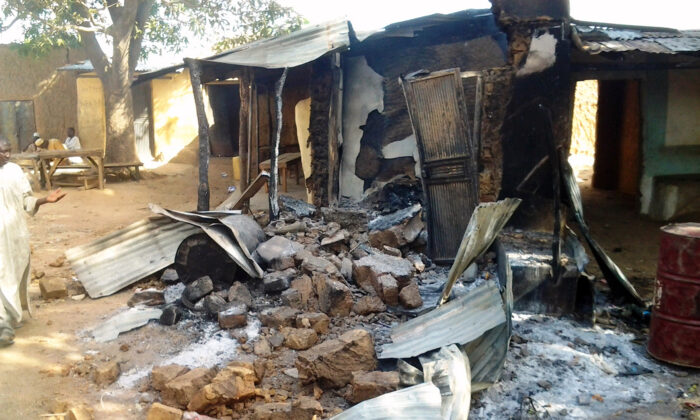
The statement reads, “On March 10, 2023, Police Tactical Operatives in Conjunction with the vigilante while on Mop Up Operation near Munhaye forest successfully dislodged bandits camp belonging to one recalcitrant bandits’ Kingpin AKA Dogo Sule.
“As a result of the operation, fourteen hostages comprising two male adults, seven females and five children below the age of 2 were rescued.
“The victims who were in sympathetic condition have been taken to the police clinic in Gusau for medical treatment and thereafter reunited with their families and relations.”
Mr Kolo Yusuf, the Commissioner of Police, expressed his pleasure over the victims’ regaining of freedom. He also reassured the continued commitment of the police to protect the lives and property of the citizens.
“Bring him in and untie his eyes”, he heard a female voice snarling in the background. He tried recalling where he had heard that voice before, but it did not sound familiar to him at all.
He looked around and saw that he was in a deserted building, there were sharp instruments everywhere, and the smell of fresh blood originated from a corner. She stood up from her chair and walked to where he was sitting with his hands tied to his feet. Before he could say a word, she had chopped off two of his fingers and whipped him severally. Then, mixed together different liquids in a bottle and handed it over to him.
“Gulp it down, or I smash your head”, her thunderous voice echoed across the four walls.
He couldn’t lift a finger, and his body kept trembling in fear, so she collected the bottle and emptied it down his throat. He had lost the surviving strength running through his limbs. Hence, he couldn’t retaliate nor attempt to stop her.
“I want to watch you die slowly, shred your body into pieces and feed it to the vultures. I want the pains you inflicted on me to manifest on you before your death. That way, I will feel fulfilled”. After these words left her mouth, she picked up the knife from the table and took a few steps forward till she could hear his heart beating heavily.
“Open your mouth”, she ordered.
“Please, have mercy on me”. He said amidst sobs.
“Ohh wow, do you remember when I said these words too, or were you so engulfed in your selfishness that you couldn’t lend me a listening ear, you were man enough to take control notwithstanding the aftermath of your greed, right? It’s time to pay for your debt”. With this, she beckoned her boys to forcefully open his mouth while she slit part of his tongue.
“Now, swallow it, or I will proceed to slit your throat”, she bellowed dropping the piece she had cut off in his mouth. He collapsed, groaning with pain as blood streamed down his throat.
“Get a bucket of water from the freezer and pour it all over him”.
He dumbly opened his eyes and glimpsed at her angry figure, he wanted to speak, but words deserted his mouth, and the pain emanating from his cut couldn’t let him move his tongue. Not in a thousand years would he have imagined this happening to him. He had scaled through so many times; why is this particular victim a thorn in his flesh, does this mean his end is here after all?
“Are you reminiscing on what had transpired between us”? Her voice jolted him back to reality.
“After you left me almost lifeless on the street that day, I swore to make you pay for what you did. I had my boys trace your whereabouts and even gathered some information about you. That was when I learnt that society doesn’t need people like you; rapists deserve to rot in hell. But wait, don’t you have a conscience at all, how can you knock down random girls just to rape them, how on earth? I mean, why do we have to share the same earth with you all?”. She spoke in great anger.
“Make him stand”, she ordered.
The boys unfastened his hands and feet, then held him side by side till he was up. Staring at the sharp edge of the blade, his heart sank.
“Why do I smell fear, are you curious to know what I intend to do with the blade?”. She asked with bittered smiles written all over her face. He only nodded.
“Strip him off his clothes. Let’s get started”. She uttered quickly and authoritatively. His body sensated to every move she made, but he couldn’t help it.
With tears in his eyes, he watched as she cut off his sexual organ. His wails were arrested by tying a gag around his mouth. It was a dreadful and sickening sight to behold. After going through severe agony, he was whipped to death and thrown out. His bloodied body was found in a public toilet the next day.
That morning, her attention was called to the awful scene by a large number of a crowd she had seen along her way to the office. Many people who have seen or heard of what had befallen him had mixed feelings. Among the crowd were some of his victims. Seeing this predator lying in the pool of his own blood in this state made them feel gratified.
She curved the corners of her mouth and flashed her most winning smile. She has finally put an end to the game he started.
Zee Aslam can be reached via zeeaslam19059@gmail.com.
About a hundred students sponsored by the Kano State Government at Digital Bridge Institute have expressed their worries over the state government’s failure to pay for their certificates five years after graduation.
The students decried that the state government has not paid the designated fees to the institute to enable them to collect their results since 2019.
They complained that the development is delaying their education as they are left stranded for over five years.
The students said they need the certificate to further their education and apply for various job opportunities, saying their future would remain bleak if the government refused to intervene.
The Daily Reality gathered that the Kano State Governor, Dr Abdullahi Umar Ganduje, had sponsored 100 students, 40 males and 60 females, to study at the institute in 2017.
The students were sponsored to study various ICT programs such as Software Engineering, Multimedia Technology, Networking and System Security, Hardware Engineering and Telecommunications.
Our future is bleak students
The graduates said their educational careers were at risk, saying the years they spent at the institute would be wasted if the government refused to intervene.
One of the graduates, who pleaded anonymity, said he missed many opportunities, including admissions to study abroad because he has not collected his certificate.
He said, “I was offered three admissions to study in India, but I could not go because my certificate was not given to me.
“Some of my colleagues told me that they even got job offers. However, they could not go for an interview since they didn’t have the certificate.
“I would have scored admission and graduated had I the certificate. Probably got employed in an organisation.”
Muktar Ibrahim (not a real name) said he wanted to further his education but could not lay his hand on his diploma certificate after graduation in 2019.
He said, “I wanted to further my education. However, I have no certificate to seek direct entry into the university.”
Aisha Hussain (not a real name) said it was painful that she was yet to acquire a degree certificate while some of her sisters and friends were serving their one-year mandatory NYSC.
She said, “We have long been expecting the payment by the government for the release of our certificates. It is sad that some of my sisters and friends have completed their degrees even though I started schooling before them.
“I also got so many opportunities. However, I hopelessly saw them pass as I could not go for any of them,” she stated.
Government ignores our appeals
Since graduation, the students said they have been pleading with the government to settle the outstanding debt to enable them to collect their certificates.
The students went to various media stations pleading with the government to come to their aid and settle the debt.
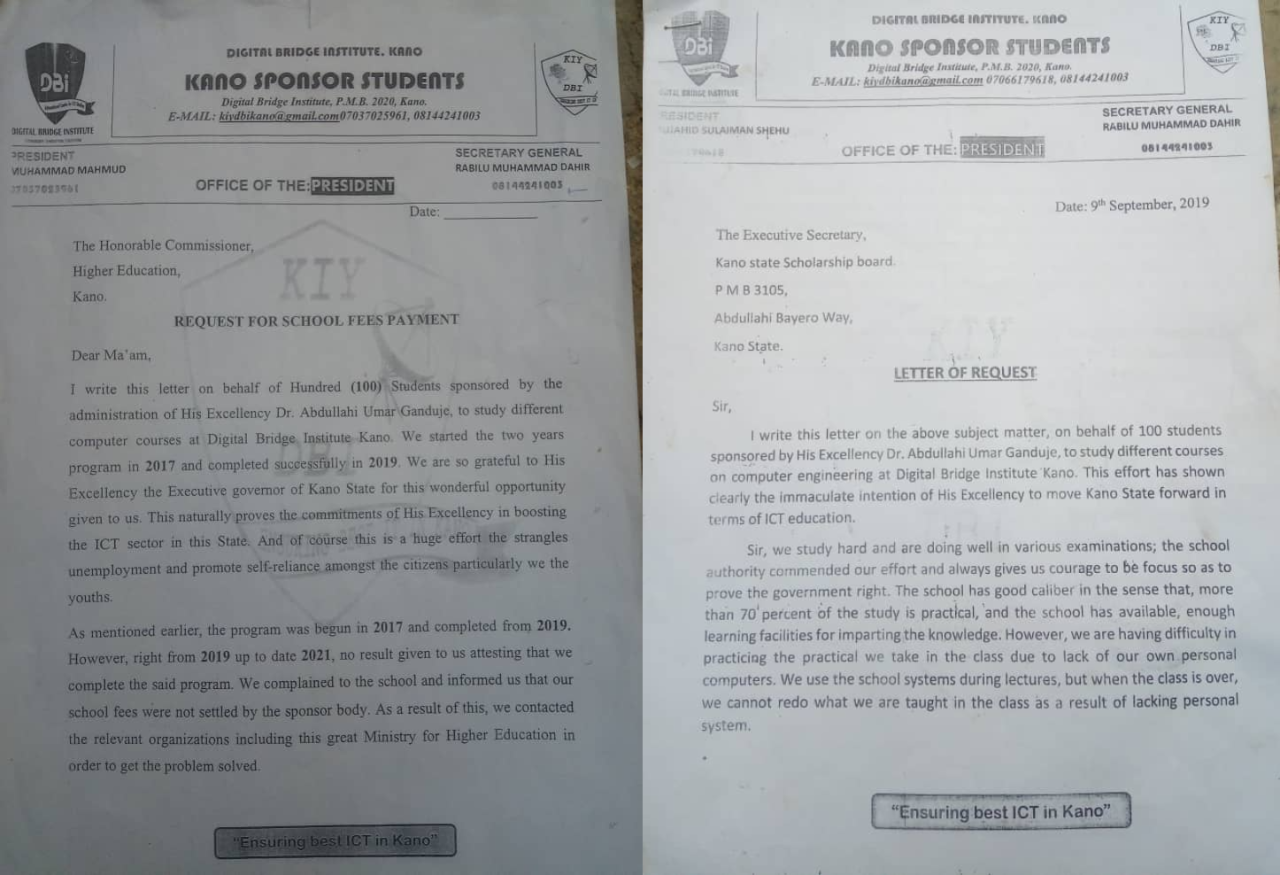
They said they also wrote letters to the Kano State Governor, Dr Abdullahi Umar Ganduje, through the Ministry of Higher Education and the Ministry of Education of the state.
However, all their efforts were in vain, as their plea did not yield any positive result from the government.
Some of these letters.
We are still not tired – students
The students who spoke to The Daily Reality said they are still not tired of sending their passionate appeals to the government to consider them.
They said they are still hopeful and pleading with Governor Ganduje to settle the debt before he leaves office this 2023.
Halima Ibrahim (not a real name) pleaded, “I urge his Excellency, Governor Abdullahi Umar Ganduje, to help us and pay for our certificates.
The lady said her parents are poor and therefore placed all their hopes on her certificate.
Another student who asked not to be named said, “Your Excellency, we know you are good and kind to the poor. We are your children. We are pleading with you to consider us.”
Maimuna Sunusi said, “Our parents cannot afford to settle this debt. Therefore, we are pleading with His Excellency to pay for our certificates and not to waste the years we spent at the institute.”
Kano State Government response
Our reporter has made several attempts to hear from the government, but all his efforts were in vain.
While the Public Relation Officer of the Kano State Ministry of Higher Education, Sunusi Abdullahi Kofar Na’isa, denied knowledge of the development, the Ministry’s Commissioner, Mariya Bunkure, could not be reached for comment.
His name was Sadik. Perhaps about 11 years old. He walked into my newly allocated office in the old Mass Communications building of Bayero University Kano (Nigeria) in 2013. I was startled. He was a tiny boy with deep dark skin, a beautiful face with intense eyes and a dolphin smile. He asked if I wanted to buy Fura (steamed millet balls blended in cow milk, often used as dessert, although it could stand on its own as a nutritious meal). He did not look like any of the usual urchins who thronged the corridors of the building look for odd jobs – run errands, empty trash, sweep office when those officially charged – and paid – to do so did not. Intrigued, I ordered one. He disappeared and returned some twenty minutes later with the Fura in a transparent plastic bag. I paid him, and that was that.
He returned the following day. When I declined to buy it because I didn’t feel like drinking the Fura, he insisted I buy it for others. When I asked why, he simply retorted that I appeared richer than other staff because, first, I was a professor, and second my office was larger. I was amused by his evaluation of my finances based on my position. And true, my office was the largest for staff, but I was a new bride in the Department – having been wedded to Mass Communication after an amicable transfer from the Department of Science and Technology (thus the ‘double’ professor tag), and all stops were pulled to make me welcome. Based on his logic of having a larger office, if not a deeper pocket, I bought about ten and asked him to distribute them to colleagues.
Sadik was to become a regular fixture in the corridor. Always after 2.00 p.m. One day he came with a blue checkered school uniform. Mentally, I thanked the boy who gave him the ‘hand me down’. The uniform was from Musa Iliyasu College, located along Gwarzo Road, a few kilometres from the New Campus of Bayero University Kano. This was a private and prestigious high school in Kano, attended by the children of the well-to-do.
I was told, however, that the uniform was his own and that he was indeed a student at the famous prestigious college. Curious about the human aspect of this development, I decided to delve further. What I found was what I want to share with you regarding the world of Hausa women.
Sadik did not come from an elite home. He was from a large Fulani family living in a ruga (a Fulani cattle encampment) near Janguza Army Barracks in Kano – itself a few kilometres from Bayero University Kano, New Campus, along Gwarzo freeway. The unit was a father, three wives and eighteen children. Sadik was the eldest in his mother’s room. They were herders. Indeed, Sadik was born near Tamburawa along Zaria Road in Kano when the family was on the move in 2002. They camped near Janguza Barracks, where they located their ‘hometree’.
The mother was the one selling the Fura at Bayero University Kano New Campus that Sadiq marketed. She had a ‘stand’ near the Faculty of Engineering. She had a lot of customers in all categories of the university community. After all, even professors love Fura. Her interaction with the university community enabled her to develop an interest in education, and she wanted to get Sadiq to attend a school and eventually a university. She did not want Sadik to follow the family herd. His father, however, wanted the child to join the family herding tradition. The mother then engaged one of her customers, a professor, to drive to the ruga and convince the father to allow the child to attend school, to which he reluctantly agreed. The mother then took over the process of educating the child.
She enrolled him in a local private primary school inside the Janguza Barracks. After he finished, she inquired which was the best high school around, and Musa Iliyasu came highly recommended. She enrolled him there. An exclusive private school. Paid for from the proceeds of her Fura business. She bought a bike for Sadik to make it easy for him to attend the school, some five kilometres from their tent. His legs could barely reach the pedals, but he was enthusiastic about learning. After school, he would go to her Fura stand, park the bike and then trample all over the BUK mega building advertising his mother’s Fura (even boldly entering the Vice-Chancellor’s office to market the Fura), all the way till 6.00 p.m. when they close ‘office’.
I interacted with Sadik for three years. He was so curious, bold, confident and always lifting books on my desk, trying to read them, asking endless questions, his eyes always darting and roving all other office. He was truly an inquisitive and intelligent child.
In 2016 I temporarily relocated my place of work to Abuja, and that was the last I saw of Sadiq. I did not fully return to Bayero University till 2022. In the intervening period, I had wistfully thought of Sadik and finally decided to find out what had happened to him when I returned. It was a massive success story of doggedness by a traditional woman.
When Sadik finished Musa Iliyasu College, he told his mother he wanted to be a pilot. She asked him to find out how much it would cost. Off he went to the Nigerian College of Aviation Technology (NCAT), Zaria, where he learned the fees could be as much as ₦7.5 million. He informed his mother, who immediately asked him to continue the process of getting admitted. She would pay the entire sum – after all, she was already a millionaire with the large herd she had. She earmarked the number of cows to sell to raise the pilot school fees. Sadik did the entrance exams but did not scale the final test. So, he was not admitted.
He then applied to BUK with his JAMB score of 201 for Computer Science but did not meet the Post-UTME requirements for the program. Again, he faced rejection. His mother initiated the process of getting him alternative university admission and was advised to take him to Al-Qalam University, a non-profit Islamic university in Katsina. He went there and inquired about the admission process and the fees. With his results, he was admitted. His mother sold two of her cows for ₦450,000 and gave him the money to pay for the school fees in Computer Science and his accommodation in Katsina. He enrolled and started his program.
When he relocated to Katsina, she sent him money every day. She eventually gave him ₦200,000, with which he started a Fura packaging business, employing his co-tenants in the house he was renting. Soon, he established a small business employing other students. Eventually, he vied for and succeeded in becoming the Vice-President of the Computer Science Students Association of the Al-Qalam branch.
Sadik became a dedicated student with a consistently high CGPA, which could eventually lead to either a good second upper or a first in Computer Science. He was eventually elected the President of the Computer Science Students of his university chapter. One day, the officers of the Association came to Kano for a function during a school break and decided to see his house, especially after he told them he lived in a ruga. They were astonished to discover he was telling the truth – their respect for his modesty raised higher.
In January 2023, I was in my office at the Faculty of Communication BUK when someone walked in. I was bent on my laptop but did notice the guest removing his shoes and coming and standing in front of my desk, waiting for a pause in my typing.
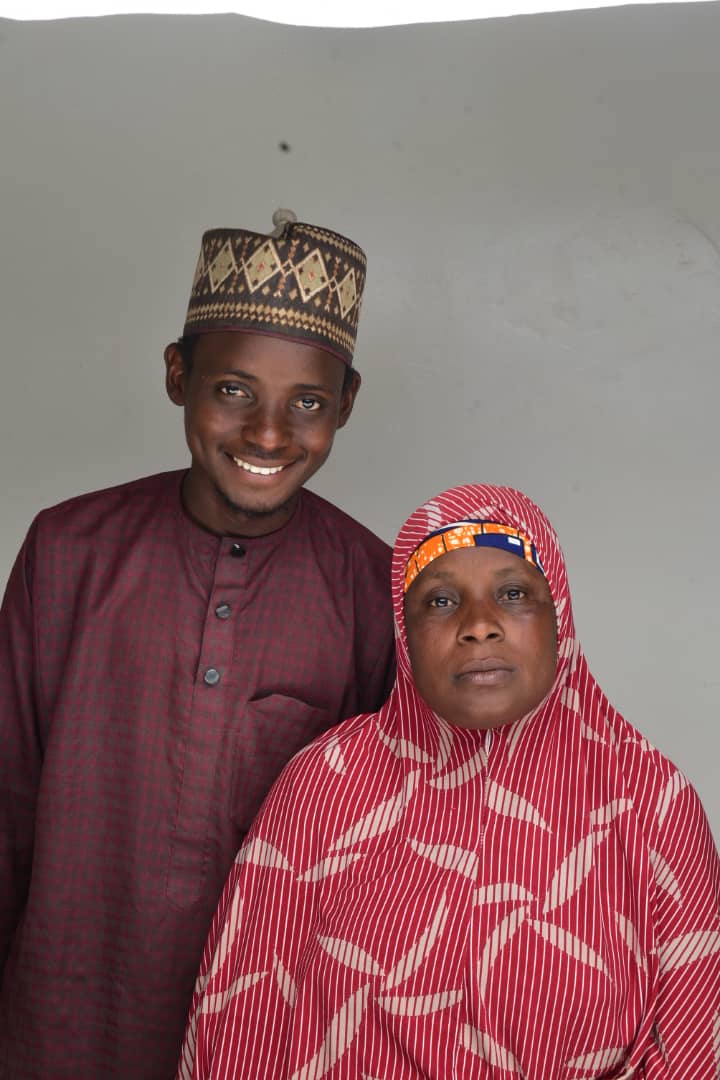
I looked up at a tall well-built young man. I immediately knew it was Sadik. At 21 years, everything about him has changed, of course, but not his dolphin smile. He told me he learnt I was asking of him and decided to come and greet me. I was so happy to see him, and it was he who related to me what I had written so far. I immediately connected him to Sunusi Ahmad Baffa Dawakin Tofa, Chairman of the Kano State chapter of the Fulfulde Development Association of Nigeria (FULDAN), of which I was a patron. They promised to come together and see how Sadik could be part of community mobilisation awareness and a role model, especially for youth. Sadiq owes his success so far to his mother.
Professor Abdalla Uba Adamu and Sadik
***
Sadik’s mother, Hajiya Hauwa Suleiman Dikko, was not an educated, entitled, privileged woman. She did not go to school. Her class was the hard knock of life. As a young girl, she missed going to school with lunchboxes and rucksacks festooned with stickers from the Marvel Cinematic Universe – Spiderman, Hulk, X-Men, and Fantastic Four. She did not attend a privileged landscaped school with paintings of Micky Mouse and Donald Duck on their walls. She had no driver to chauffer her to school in an airconditioned SUV. No TV to return to after school hours in a nice airconditioned living room. No iPads to play with. No Netflix to relax her hard stressful day. No extra lesson teacher (Uncle John or Auntie Funmi) to ensure she passed those horrible subjects such as Mathematics.
Her contemporaries who lived such life finished successfully from their expensive private schools (of course, no private school would allow mass failure, especially from children of the privileged) and had gatekeepers to ensure they got admission into the juiciest disciplines in the university of their choice. If at all in Nigeria – otherwise, it would be off to Ukraine (before it became too hot), some obscure countries in Eastern Europe, India, Cyprus, the UK or preferably, Malaysia.
When such contemporaries returned, they had cushy jobs waiting for them and a relatively easy path to the top. Eventually, they are celebrated as women of substance – given awards (which they don’t need) and celebrated in academic papers and opinion pieces as role models of female achievement and doggedness in a patriarchal society. I don’t mind their high-profile visibility. I just believe the accolades are wrongly placed, or at the very least, the Point of View (POV) should sweep around.
My female heroes? Those I will be celebrating today, the 2023 International Women’s Day? Let’s start with Sadik’s mother. And hundreds of others like her. I am sure you know one or two in your locality. They are women, often widowed, left alone, with little or no inheritance, and who, with the little they have, were able to provide much-appreciated services in their communities and keep a tight hold on their families. They don’t engage in endless and fruitless debates about gender identity or reproductive rights nor women’s representation in political representation and their share of hegemony. Rhetoric. Talking loud and saying nothing. As my main Man sang, “Like a dull knife / Just ain’t cutting / Just talking loud / Then saying nothing”. (James Brown, 1970).
Mainly, restauranteurs, these local women build people and impact their communities. With their business – restaurant (ƙosai, koko, tuwo, ɗanwake, wake da shinkafa, alkubus, gurasa, ƙashin rago, etc.), public transport (Keke NAPEP, buses, Acaba/Okada, Ƙurƙura), estate (properties, rental apartments, plots of land) – they are the role models who should be celebrated. They don’t feel entitled and are privileged in the peace of mind they have and the mentoring they do in their communities. They have no PAs, SAs, fierce dogs at the gates of their solar-powered villas and mansions, no frowning ‘maigad’ to intimidate and scare away panhandlers.
They have no SUVs as the cost of one could serve as capital for a whole year for their business. They don’t even have cars, despite some owning a transport business or so. They do not take their holidays in London or Dubai – they have no time for holidays as they are busy serving their communities. They marry off their daughters, not in grand style, with furniture imported from IKEA in China but from local makers – thus contributing to local economies.
So, what should be the concerns of women on International Women’s Day? For me, with a focus on Muslim Hausa women living in traditional communities, how about integrating them into the modern sector digital economy? Instead of empty rhetoric about gender representation, why don’t we focus on enabling them to acquire skills such as mobile phone repairs and POS services – in the comfort and safety of their homes? Many women are now engaged with mobile phones and online trading and payments. Muslim Hausa women feel unsafe in approaching service centres where clusters of men provide these services. Empowering them to be skilled in digital knowledge in the lungu and saƙo (alleyways) of our communities works better than hot-air rhetoric and genuinely can make a difference.
On this day, I, therefore, award accolades to Sadik’s mother, Hajiya Mai Ƙashin Rago Fagge (with a whole street named after her), and countless others whom I am sure Jaafar Jaafar knows more. They are truly women of substance.
Today, being International Women’s Day, please locate any in your community, go right up to her and appreciate her. Celebrate her achievements and her silent but visible impact in the community as the REAL woman of substance.
PS: Some have asked about Sadik’s whereabouts. He is in his final year at Al-Qalam, Katsina, Computer Science, and from his results so far, he is heading towards either a First Class or a very good Second Upper.
Professor Abdalla Uba Adamu can be contacted via auadamu@yahoo.com.
Nigeria’s 2023 general elections are the first many people would describe being free and fair without any other positive collocations.
Be that as it may, many would say it has no difference from previous elections we strongly condemned. But to be fair to the discourse, it was much better than the previous ones. Nigerians have witnessed a drastic reduction in vote buying, overvoting, and voter disenfranchisement, among many things.
We saw videos and pictures of election violations nationwide on election day. Some are real, and some are mere fabrications aimed at disrupting our peace – or in the popular phrase, to tire our patience than mislead our senses. However, some of these violations are just an act of immorality from urchins, and the rest are unlawful acts from unpatriotic citizens. Unfortunately, we may end up barking at the wrong tree once we separate the two above.
This is not the first time to hear that immorality is bad for you and your community. For example, one scene might have been where area boys scared off voters that they may steal from them. However, in this case, scaring off somebody is immoral, while stealing from him is unlawful.
As we know pretty well, there are no elections free from irregularities. There are people whose work is to rig elections. We could neither be able to stop them nor avoid them. But we could learn the possible ways to surprise them.
To make my points clear that we have had free and fair elections, we know that Tinubu is contesting for the ruling party. He is from Lagos, one of the most important states in the political calculation as per Nigeria is concerned. In addition, Lagos’s current governor is also from the same ruling party and complies with the presidential candidate, as many would say.
When you combine these protons, neutrons and electrons, a powerful nuclear weapon will statutorily emerge. APC would have won Lagos presidential elections against the Labour Party. But due to free and fair elections, Peter Obi surprisingly made it, and so it was.
In conclusion, for the first time, Nigeria has free and fair elections, though with few unlawful violations of electoral rules. Those denying it are mere victims of utopianism or those who lost it, and we know failure cannot be readily accepted. To date, Donald Trump is claiming to be the winner of the last American elections.
Bashir Ahmad, the Special Assistant to President Muhammadu Buhari on Digital Communication, has disclosed that the Deputy Governor of Kano State and Gubernatorial Candidate of the All Progressives Congress, APC, Dr Nasir Yusuf Gawuna, pledged to grant autonomy to local governments in Kano State if elected governor.
Ahmad stated this in a tweet on his verified Twitter handle on Thursday.
According to Ahmad, this is one of the many reasons why Kano electorates should vote for Gawuna. He noted that Gawuna would govern and operate differently.
“Dr. Nasiru Yusuf Gawuna, the Kano State APC Gubernatorial Candidate, has pledge [sic] to give local governments in the State autonomy to operate if elected as Governor. This is one of many reasons why we will vote for Gawuna as our next governor, he will govern and operate differently.” He tweeted.
While some people are after the quality of leadership, others are primarily concerned about the identities or affliliations of the people in positions of authority. Anyway, democracy gives us the chance to participate in the process of choosing our leaders. The responsibility of the electoral body, therefore, is to ensure free, fair and credible elections. But can this body be graded excellent by all the electorate or citizens?
The answer is no. It’s impossible for an agency like the Independent National Electoral Commission, (INEC), to avoid fierce criticisms. Provided some candidates lose elections, issues must be raised against the commission. However, this body can reduce doubts to the bare minimum if it scores high in terms of transparency. Sadly, it usually scores low in this aspect.
INEC has rescheduled the governorship and state assembly elections to March 18, as against the initial date: March 11, 2023. That’s just a week difference. This decision comes with diverse consequences, but my main focus is on how it affects the suffering inflicted by the so-called cashless policy.
The Supreme Court of Nigeria ruled on Friday, March 3, 2023 that the old naira notes (N200, N500 and N1,000) remain legal tender until December 31, 2023. Many Nigerians celebrated the pronouncement, but I was unsure if President Buhari and the Central Bank of Nigeria would honour the ruling. Expectedly, it’s been almost a week since the judgment, but neither of the two has issued any statement about it. However, there’s been a sense of relief as many banks are reportedly paying and accepting the old notes.
As for the President and the CBN, I expected them to say something, maybe a few days after the governorship and state assembly elections, as they might consider the scarcity of cash as an effective measure against vote-buying. So, I was counting down to the end of our suffering—our struggle for cash—when INEC scattered my thoughts by rescheduling the elections. With this postponement, we’ll have to endure the suffering a little longer.
This cashless policy introduced by the Federal Government of Nigeria has been disastrous for the the country. Businesses and individuals are facing tough times due to the scarcity of cash in the economy. The stress of queueing at banks and POS shops, more hunger for the majority, transport costs to and from banks, a depressed market for traders (particularly those running small-scale businesses dealing in perishable goods), difficult in commuting to workplaces or schools, etc. — these are just a few of what Nigerians are enduring.
While I was preparing to go to the bank a few weeks ago, an elderly neighbour transferred N5,000 to my account to help her withdraw. It would been easier for some of us (Jaiz Bank customers) until that time. I went to the bank, fully prepared for long queues, but there was no cash. The woman’s money remained in my account for a few more days until one afternoon, when she called me on the phone (while I was at work) to send it back to her. She’d seen a POS attendant somewhere with some cash. She quickly sent her daughter home to get her debit card, but within a few minutes, the POS operator exhausted the cash by serving other customers in the queue. He charged N200 for every N1,000 withdrawn, yet the queue was long. The woman regretted leaving her card at home; she needed money to cook for her children. Before that time, she had, on two or three occasions, gone to queue at banks as early as 5 a.m.
Talking about businesses, although some business owners have started acquiring POS machines and accepting bank transfers, bad network remains an obstacle. Besides, most business owners can’t afford such because of many reasons, including illiteracy and the smallness of their business scales. These are enough proof that Nigeria has yet to be ready for the cashless policy.
I can say that with the presence of digital financial institutions like Opay and PalmPay, multiple debit cards, and my little exposure due to education, I’m better off than millions of Nigerians in terms of the capacity to cope with the scarcity of cash in the country. Despite my obvious advantages, when a student of mine gave me N300 to buy a book for her a few days ago, I kept the cash in my pocket and transferred the same value to the bookseller. Yes, I needed the cash to buy items like onions, tomatoes, etc.
Back to the rescheduling of the elections, I don’t know if I’m being somewhat pessimistic, but this is just what I think. Neither President Buhari nor Godwin Emefiele may say anything about the Supreme Court ruling until after the governorship and state assembly elections. As a result, the postponement of these elections means that we may have to endure the suffering for another couple of days, say 11 or even more.
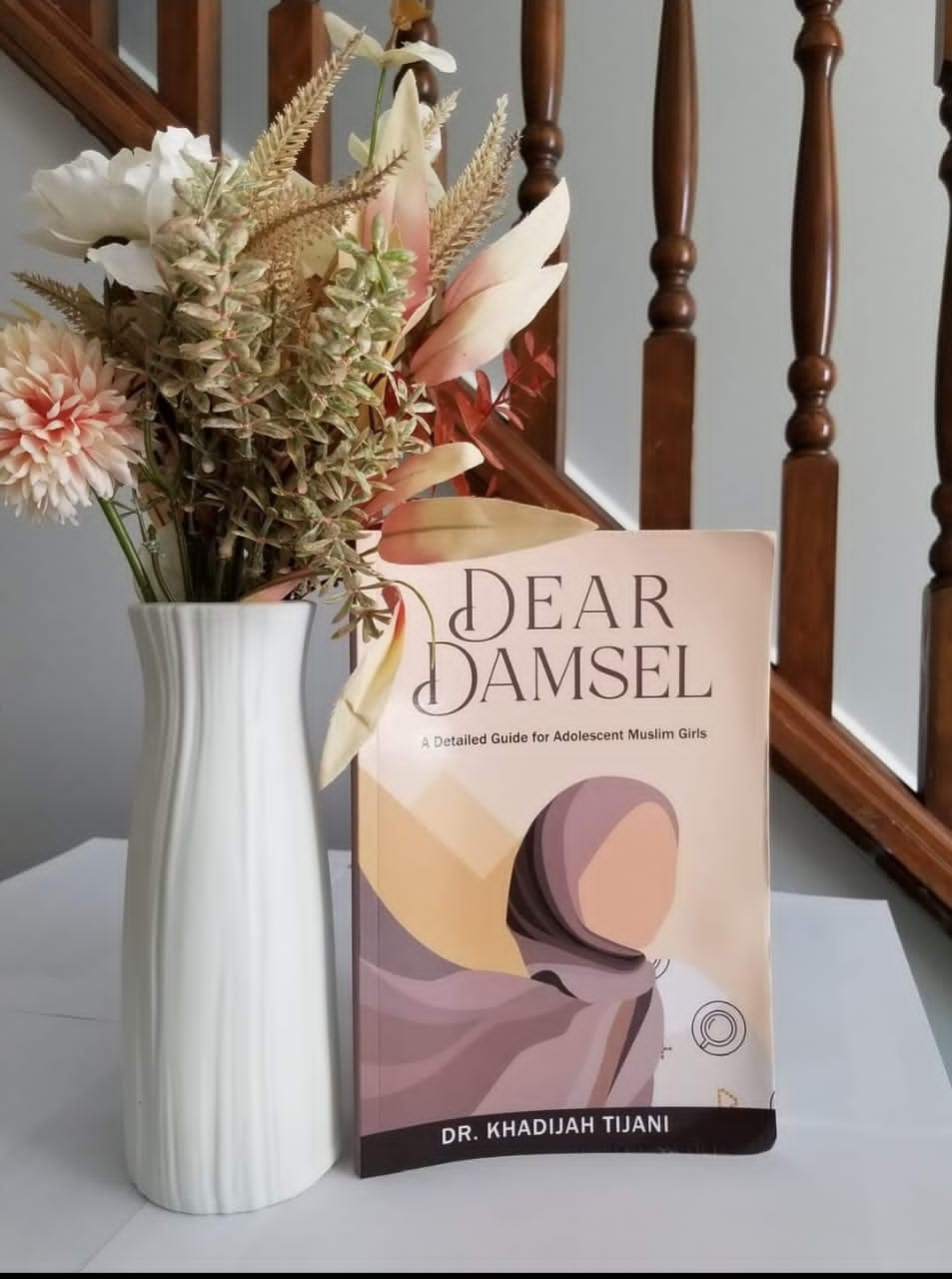
Today is #InternationalWomensDay so I thought I should write about a not-so-popular topic.
This is a reality that many Muslim female physicians, including myself, face everyday, but people don’t seem ready for the conversation. When we try to bring up the topic, the same people who call themselves advocates of equity, justice and inclusion would only pay lip service to the issue and nothing is done about it eventually.
These biases are often rooted in stereotypes and misconceptions about Islam and Muslim women. For example, people believe that “All Muslim women are oppressed or subservient to men and therefore, therefore, they don’t belong in a prestigious profession like medicine.”
This is nothing but fallacy. The opposite is, in fact, the case. We have a long record of historical Muslim women who have excelled in the health field, even before the Western world started allowing women to learn about healthcare and medicine. The Prophet himself (peace be upon him) permitted women to be involved in healthcare. Neither the fathers nor the husbands of these women had any objections. We had women like Rufaydah Al-Aslamiyyah and Nusaybah bint Ka’ab who followed the early Muslims to the battlefield and provided care for the wounded soldiers.
Muslim women are encouraged to pursue careers like medicine because it fits our feminine nature. We are empathetic and resilient. We have seen a lot of young muslim women graduating from medical schools with excellent performance. We don’t want to waste those brains, do we? We want them to be helpful to the community and to the world at large.
These biases can manifest in several ways, such as assumptions that Muslim women cannot make decisions for themselves or that they cannot effectively communicate with male patients or colleagues or that they end up not practising medicine after all the educational investment. Muslim women are just like any other human being. Allāh has given us the ability to think critically and make decisions that can lead to the preservation of lives and limbs. We may have some limitations and boundaries, but nothing stops us from saving lives.
According to Khan et al. (2022) “gendered Islamophobia is prevalent in Canada and is premised on the stereotype that Muslim women are powerless victims of their religious tradition. Visibly identifiable Muslim women in health care professions are affected by gendered Islamophobia in the form of exclusion and discrimination, which can result in lack of safety, fear, decreased job satisfaction and burnout”. (Culled from Canadian Medical Association Journal).
Muslim women in medicine also face discrimination or stereotyping based on their appearance or religious practices. For example, a Muslim woman who wears a hijab may be perceived as less professional, or may face challenges in finding work or career advancement opportunities. Many have been forced to change the way they wear their hijabs, or even, remove it altogether!
Some patients or colleagues may have negative attitudes towards Muslim women who pray during work hours. This often leads to overt bullying and hurtful comments. While I was working in a particular hospital in Nigeria many years ago, it was hard for me to boldly take an excuse from my seniors when it was time for prayers. I had to sneak out and ask a fellow junior doctor to cover for me. In contrast, when I was in Saudi Arabia, prayer times were respected and each medical employee was allowed, and even encouraged, to pray at the right time.
Another common bias against Muslim women in medicine is the assumption that they are not proficient in English or that they are not familiar with Western medical practices. This happens when women from African and Asian countries travel to the West for further training. Muslim female physicians are often overlooked for certain positions or not being taken seriously in their work, unless and until we prove our worth beyond reasonable doubt.
These biases can have significant negative impacts on the careers and lives of Muslim women in medicine. They can lead to loss of opportunities, increased stress and burnout, feelings of isolation and exclusion, and finally, total loss of interest in the profession. These things shouldn’t be happening to us, considering the need for female doctors in the Muslim community. We need more female gynaecologists to take care of our women, but the journey is riddled with these biases we’re talking about.
You may begin to wonder…”but there are still many Muslim women doing just fine in their profession”. The truth behind their success is hidden under the sea like an iceberg. They won’t tell you how they had to reduce their hijab to a certain length so that they won’t be seen as extremists. They won’t tell you how they missed salah because the environment was not fit for praying. They won’t tell you how their marriage crashed (or almost crashed) because of an unsupportive spouse. They may also not tell you how they constantly regret the moments they were not available when their children needed them most.
It is important for the medical community to actively work towards addressing and dismantling biases against Muslim women in medicine. This can involve education and awareness training for medical professionals and staff, creating more inclusive workplace policies, and actively recruiting and promoting Muslim women in medicine.
Khan et al. (2022) opine that “Education about Islamophobia and gendered Islamophobia should be incorporated within existing anti oppression and transformative learning-teaching practices in medical education. Research and stronger institutional policies and practices are needed to mitigate the harmful impact of gendered Islamophobia on Muslim women in medical spaces.”
In conclusion, discrimination against Muslim female medical professionals is a real problem affecting Muslim communities in many parts of the world. Not all of us will be able to relocate to Islamic countries. Some of us may have to stay in our home countries or travel to the West to gain more knowledge and expertise. By addressing these biases, we can create a more equitable and just environment for all medical professionals, irrespective of religion, gender, or cultural background.
Khadijah Tijani is a medical doctor. She writes from London, Ontario and can be reached through askdoctorkt@gmail.com or @AskDoctorKT.
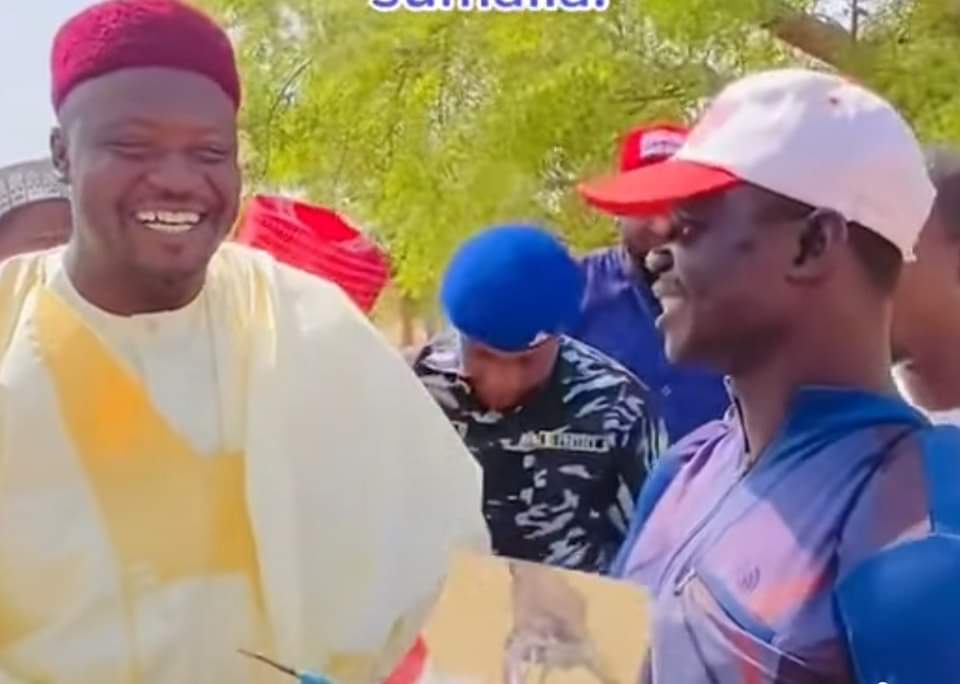
A young man from Jigawa state has embarked on backward trekking from Gwaram in Jigawa State to Sumaila town in Kano state, to celebrate the election victory of Honorable Kawu Sumaila.
The young man whom Kawu Sumaila met on the road explained that he was doing this backward trekking because almost every style of trekking has already been done, so he decided to do his own.
Even though Sumaila asked him to go back home since they met on the road, the young man insisted that he would not go back, because he had sworn to do it.
On arriving, the senator gave him a token, and he promised him a slot to go on Hajj to Makkah, because of this manly effort that he took upon himself to travel a long in a backward manner to congratulate the senator.
Professor Ibrahim Adamu Yakasai, Returning Officer of the Tudun Wada/ Doguwa House of Representatives Election, has admitted to declaring the election results under duress.
The Professor made this known in a voluntary statement dated February 28, 2023.
According to Professor Yakasai, his life and that of other INEC officials in his company were threatened, and he was afraid he would lose his life. He added that the collation area was completely under siege by hoodlums, and he was ordered to declare the results within an hour.
“I served as the Returning Officer for the 2023 Tudun Wada/ Doguwa House of Representatives Election, whose Result was declared by me on the 26th February, 2023. However, I will want to testify that the declaration I made was under duress for fear of losing my life and other INEC officials who were with me. ” He wrote in the statement.
Prof. Yakasai’s statement
He further stated that the situation made it impossible for him to act in accordance with the extant provisions of the Electoral Act.
On his reason for the disclosure, Professor Yakasai said he is testifying with the hope that necessary actions be taken to remedy the situation. However, Professor Yakasai refused to disclose whose bidding he was coerced to carry out then.
INEC has already declined to issue a Certificate of Return to Mr Doguwa, the Majority Leader at the outgoing National Assembly, for the same reason. A court in Kano granted the embattled lawmaker bail after being arrested for murder charges last week.