Month: October 2022

Ethics of posting death news on social media

By Dr Aliyu Dahiru Muhammad

My brilliant friend Dr Muhsin Ibrahim, who tries to mentor and guide many followers on social media, raised a concern about how some people announce death news on social media. I found the topic interesting, especially the responses it generated. So, I contributed my points of view which I am reproducing here for the benefit of others.

1. I think we should learn the ethics of announcing death to a relative and the general public. For instance, posting the news on sick beds or even a corpse picture is unethical and unprofessional.

2. We should be aware and sensitive whether we are the ones to inform others or not. For instance, I post this kind of news when the death directly affects me, a relative, close friends etc. However, some elders represent their areas and people respect and trust them.

3. We should be mindful of the time and how we announce if we are to do it. For instance, it was reported that one of the wives of the Prophet’s companion, whose son died, prepared him and dressed well before her husband came back. When he returned, she brought him food and had a marital relationship with him. After that, she asked him if someone kept trust in him and he now comes to take it, would he mind? He said no, it belongs to the owner. She now told him that Allah, that gave us our son, had taken him back. He now took a deep breath and started asking why you appeared the way you did until they had so and so relationship. She said to calm him down and allow him to submit easily to Allah’s will. Interestingly, they got another son who excelled among the companions in that relationship.

4. We should be ready and prepared, not panic always, and accept the sad reality. Since it’s the time of information and communication technology, and we use it for almost everything in our life, why not announce the death of our beloved ones? I rarely call on some people because after the closest relatives, neighbours and friends, as you have hundreds of contacts, it will be faster to let people know, and many people would tell you; I ATTENDED THE JANAZA because I saw your post. We know the benefits of praying for a person that passes away especially attending the funeral (Janazah) and seeking Allah’s forgiveness for them. We all want that, so there is no problem if we let people know with WISDOM.

5. We should pray even if we don’t type anything on a post, as Allah accepts a believer’s prayer. By so doing, we are actually attracting rewards to ourselves.

6. Since visiting the graveyard is difficult for some of us due to the situation we are in, the environment or other reasons, this may still remind us that death is inevitable. It’s coming to us all. It also sensitizes us to get ready and pray that it comes to us when Allah is pleased with us inshaAllah.

7. We should remember, one day, it’s ours, others will post, and we pray to Allah; whoever sees that, if he knows us, he will testify we lived a good life and have a good relationship with others and try to follow the teachings of our religion on all matters. May Allah forgive us, take our lives as faithful, and grant us your RahmaYa ArhamarRahimin.

Aliyu Dahiru Muhammad, PhD, wrote from Bayero University, Kano.

Unlocking Nigeria’s innovation potential for economic growth and prosperity 

By Salisu Uba, FCIPS

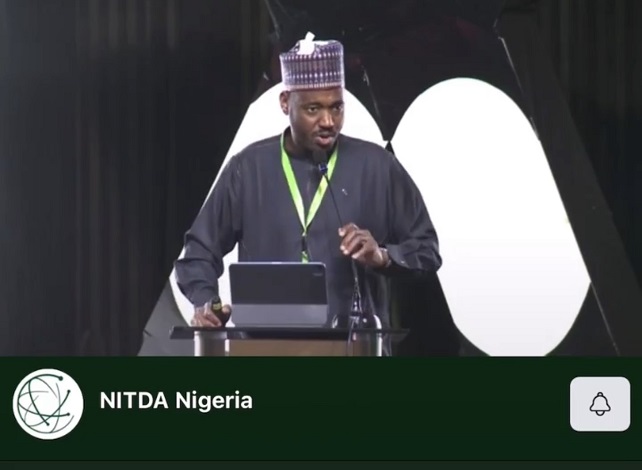
I spoke on unlocking Nigeria’s innovation potential for economic growth and prosperity at the Digital Nigeria International Conference #DigitalNigeria2022 Innovation and Ecosystem Day in Abuja, held on the 28th of October, 2022. 

I focused on what innovation is in Tech and examined the top ten innovative countries; the difference is that they prioritise human capital development, infrastructure, and knowledge-based approaches to innovation. 

I emphasised Nigeria’s competitive landscape, which includes a youthful population, ICT-savvy people, low labour costs, the recent Startup Act, digital economy leadership, and internet access, as key drivers that can transform Nigeria into an innovative nation. 

I also stressed the importance of understanding how to diffuse innovation using the well-known Roger’s diffusion of innovation model. Surprisingly, despite technological advancements, the model remains applicable. 

I also discussed what young people could do to get to the point of developing and commercialising their ideas, emphasising the importance of equipping themselves with skills, networking, and openness. I consider these as factors that will propel one to success. 

More than 1000 people from all over the world attended the conference, which featured speakers from Europe, Asia, America, and the Middle East.

The full presentation and panel session can be found on the websites of Digital Nigeria and NITDA.

Salisu Uba, FCIPS, is a blockchain expert and supply chain and commercial leader from Glasgow, United Kingdom. He can be reached via salisuuba@ymail.com.

Kano Emirate Council turbans two new kingmakers

By Uzair Adam Imam

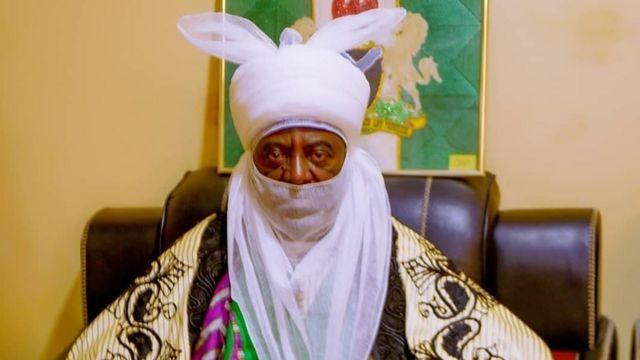
The Kano State Emirates Council Friday turbaned two new kingmakers as Sarkin Bai and Walin Kano.

The new kingmakers turbaned by Kano State Emir, Alhaji Aminu Ado Bayero, are Bashir Mahe Bashir as the Walin Kano and Mansur Mukhtar as the Sarkin Bai.

The Daily Reality gathered that Bashir Mahe, who succeeded his aged father, is now the seventh Walin Kano.

His father, Alhaji Mahe Bashir, resigned from his position to have some rest due to old age and health conditions.

While the newly turbaned Sarkin Bai, Masur Mukhtar, is a former Minister of Finance and current Vice President of the Islamic Development Bank.

Since the Jihad of Shehu Usman Danfodio in the Hausa land, Mukhtar is the ninth Sarkin Bai in the history of the Kano emirate.

Like Mahe, Mukhtar also succeeded his father, the longest-serving member of the Kano Emirate Council, who served for 63 years.

The turbaning ceremony was attended by traditional, political and community leaders from and across emirates within and outside Kano state.

Why ‘The Atiku Plan’ is better for youth empowerment and job creation

By Abdulhaleem Ishaq Ringim

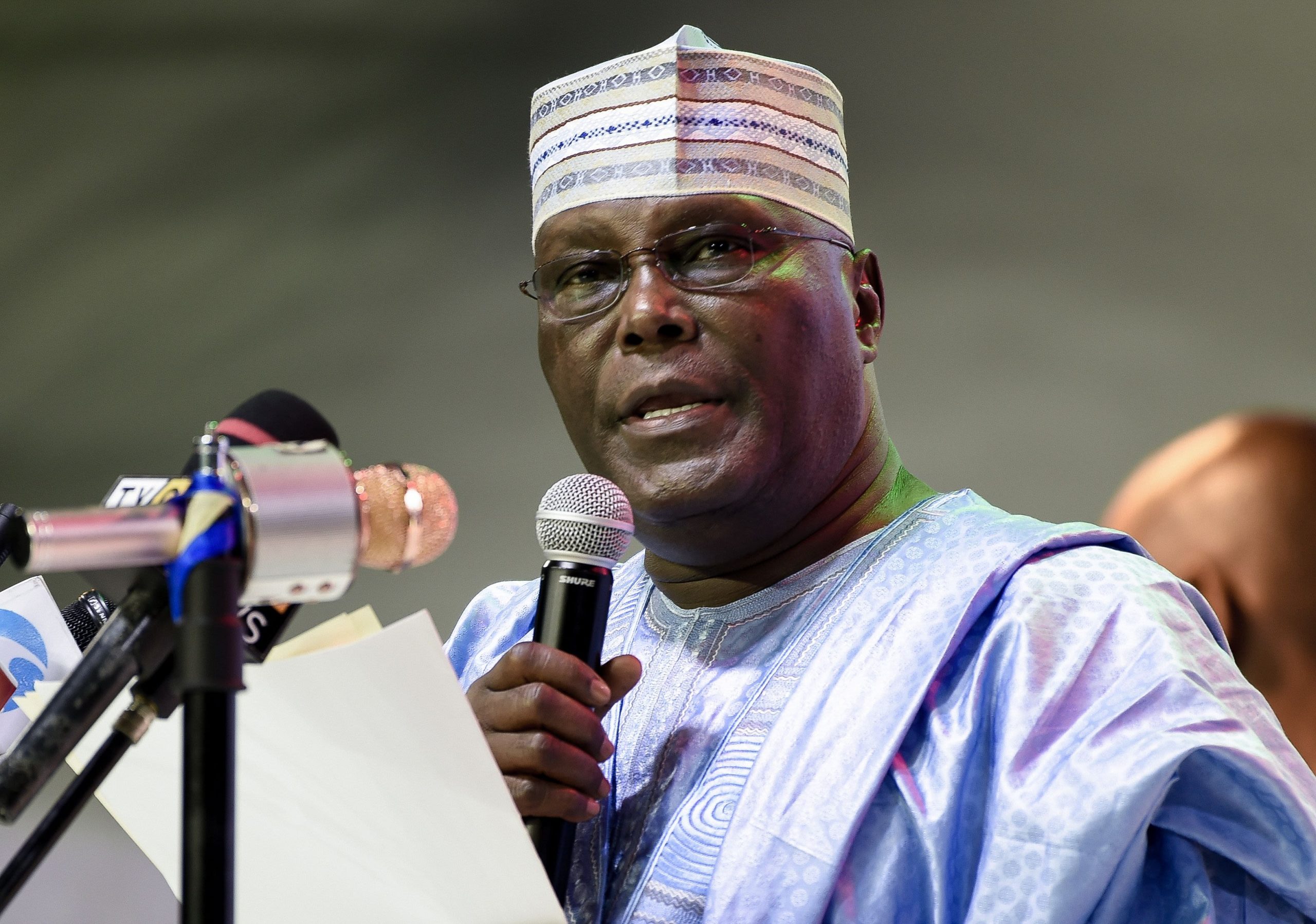
As rightly identified by policy documents of both Atiku Abubakar and Bola Ahmed Tinubu, young people remain the country’s most valuable assets. However, this tremendous resource base is severely underutilized, as evidenced by unemployment and underemployment numbers. This makes job creation and youth empowerment significant points of policy focus and concern for both candidates. 

Tinubu, to start with, in the 3-paged “Youth Empowerment and Entrepreneurship” section of his policy document titled “Renewed Hope 2023”, outlined a number of strategies his administration would implement if elected into office to ensure enhanced job creation, youth entrepreneurship development and empowerment. 

Identifying the lack of access to credit at the fore of the challenges impeding youth entrepreneurial development, Tinubu plans to ensure easy access to low-cost credit for youth-led enterprises and simplification of loan application processes. He plans to leverage the instrumentality of the CBN to develop suitable incentives for commercial banks in this regard and mandate federally owned and affiliated financial institutions to develop similar schemes. 

He also plans to bolster intergenerational business mentoring and cooperation with 2 million volunteer entrepreneurs and professionals across the nation committed to working with youth to find employment, hone job skills and create businesses. Per the plan, a Youth Advisory Council would be inaugurated to the Employment Action Plan the administration would develop if elected. 

In his bid to reform the National Youth Service Corps(NYSC), Tinubu intends to develop and strengthen a job-matching programme for graduates to enable more corps members to enter the private sector during their service years. Employers would also be incentivized to retain corps members at the end of their service.

Additionally, he intends to expand business incubation centres to support youth innovators to acquire and protect through patent and trademark registration, intellectual property and other proprietary rights over inventions and innovations. 

As far as governance and political appointments are concerned, his administration intends to preserve at least 3 cabinet positions for persons under 40, 6 more positions for persons under 50 and 20 per cent of political appointments to MDAs to persons under 40. A Presidential Fellowship Scheme would also be established to train future leaders. 

On the other hand, Atiku dedicated 10 pages to discussing his plans on “Job Creation”, where he outlined four pathways(to jobs ) his administration would create if elected President come 2023. 

The first pathway is the Informal Sector Pathway to Jobs. It starts with relaunching the National Open Apprenticeship Programme(NOAP). The programme would recruit 100,000 Master Crafts Persons(MCPs) annually who would, in turn, train 1,000,000 apprentices(especially those who have lost the opportunity to attend or complete basic education) on various trades and skills. 

The MCPS and apprentices(upon graduation) would be beneficiaries of 21st-century standard business advisory services, and their training clusters would serve as robust ecosystems that would guarantee ease of access to finance and other ancillary services. 

National Board for Technical Education(NBTE) would be mandated to create a credible, recognized and verified skills/competencies certification system for the beneficiaries of the programme. The certificates would serve as credentials for employment purposes in the “new-collar” or informal skills-based sector. The Programme, of course, would be operationalized in close collaboration with the private sector and relevant trade associations. 

The second pathway is the Entrepreneurship Pathway. It starts with working towards the speedy passage of the National Research and Innovation Fund(NRIF) Bill. When passed, the Fund would receive funding from the CBN’s MSME Fund, Development Bank of Nigeria, Bank of Industry and other private sector institutions and donor agencies. It is expected that at least 100,000 budding entrepreneurs will be added annually. 

Support from the NRIF will be in the form of grants, loans or equity investments in small enterprises. It shall be provided either as start-up capital or to scale up innovations that have already demonstrated a strong track record of impact and effectiveness. 

Atiku also seeks to introduce and actively promote a Graduate Trainee Internship Programme (GTI), which would target National Youth Corps members. The GTI will transfer useful employability skills to Corps members to increase their chances of finding sustainable employment. While they undergo entrepreneurship training, the NYSC will be matched with potential employers for internship/traineeship in the private sector. 

The technical and financial capacity of the Industrial Training Fund (ITF) would be grossly improved to operate its internship and apprenticeship programmes at a much higher scale to cover a minimum of 2 million workers per year.

The Schools to Jobs Pathway is the third pathway identified by Atiku. Here, a formal Technical and Vocational Education and Training (TVET) system will be supported and technical colleges and vocational skills acquisition centres will be re-positioned to produce skills and competencies for innovation and the creation of new ideas and products inside enterprises from where future jobs and future prosperity will derive. 

This would be followed by training of a low-level workforce, such as operatives, artisans, craftsmen and master craftsmen for commerce, industry, agriculture, and ancillary services. The absorptive capacity of the formal post-basic TVET and Vocational Centres will be increased from the current total enrolment and completion of fewer than 200,000 students to 500,000 in 2025 and 1,000,000 by 2030. 

Additionally, selected vocational training institutions would be remodelled into a one-stop shop to provide vocational training, entrepreneurship (accounting, management training expertise), life-skills programmes, etc. 

Enterprise start-up training programmes to be delivered by SMEDAN would be provided to the graduates of technical and vocational training centres who opt for self-employment. Upon completion of the training, participants will submit business plans to Micro Finance Banks and apply for loans from the Bank of Industry, which will be supported by a start-up grant from the National Innovation Fund. 

Graduates of the technical colleges will receive loans and Business Development Service coaching and support from SMEDAN/ Business Development Service Providers. On successful repayment of loans, graduates will receive a final grant (matched to the value of the original loan value) to boost their businesses.

The fourth and final pathway, as outlined by Atiku, is the MSME /ICT Special Entrepreneurship Pathway. This shall start with the facilitation of the establishment of the SME Venture Capital Fund by the private sector to provide longer-term capital for targeted small firms. The administration shall aim to attract a minimum of $250 million in private-sector funding for Nigerian small businesses. 

The administration would create a platform for de-risking SME lending, increase the MSMEs funding window from N200 billion to N500 billion, and set aside the same for the new platform. Awareness of the National Collateral Registry of Nigeria will be rigorously promoted, and the collateral registration process will be further simplified, especially for places without internet access. Enhanced registration access will help unlock much-needed finance for MSMEs. 

The administration would also establish the Financial Innovation Fund((FIF) to incentivize commercial and Microfinance banks to develop innovative solutions for providing credit facilities to the MSMEs sector. The Small-scale Industries and Graduate Loan Guarantee and the Small -Scale Industrial Credit Scheme shall be reformed and reintroduced. 

Special focus on the ICT sector will be provided by Atiku’s administration, and Nigeria shall be aggressively marketed as an outsourcing destination. With a robust IT infrastructure in place and more than 150 million mobile phones, opportunities abound in Business Process Outsourcing with the potential to create 2 million direct and indirect jobs. Nollywood, a great labour employer, would be actively promoted to make it the 3rd largest film industry in the world. 

And on political appointments, 40 per cent of the cabinet would be reserved for youth and women. 

On comparison, one would notice certain points of convergence from the above excerpts as directly culled from both policy documents. For example, both documents identified a lack of access to credit and finance as a major impediment to youth entrepreneurial development. 

However, while the Tinubu plan heavily stresses easing access to commercial loans and simplification of loan application processes, Atiku’s planned interventions seem more specific, overarching and diverse (with adequate involvement of the private sector). They also seem more sustainable as most of them would be backed by legislations and institutional pillars like the NRIF, SME Venture Capital Fund, Financial Innovation Fund etc. 

Another point of convergence is the identification of the imperative of intergenerational business mentorship as a veritable avenue for job creation, youth empowerment, and entrepreneurial development. However, with ease of access to funding interventions, the Atiku plan seems more practical considering specific policy prescriptions like the establishment of the NOAP under the Informal Sector Pathway to Jobs. It also seems more sustainable as it seeks to create a new labour market and standard for employment to be legitimized by the new NBTE skills/competency certification system. 

Additionally, while Tinubu’s NYSC reform focuses heavily on ensuring more corps members join the private sector mainly by simply incentivizing employers to retain them, the Atiku plan approaches the problem more prudently as it seeks to equip corps members with high-value employability and entrepreneurial skills through the Graduate Trainee Internship(GTI) programme before matching them with potential employers. No incentive matches the availability of employees with enhanced employability and entrepreneurial skills for private sector employers as it means enhanced productivity. 

The same goes for other interventions that both policy documents commit to pursuing. One intervention, however, that is important but seems missing in the Atiku plan is the Presidential Fellowship Scheme proposed by Tinubu to serve as a platform that gives young people the opportunity to experience and participate in public service and governance as with Kaduna State’s Kashim Ibrahim Fellowship and Lagos State’s Lateef Jakande Leadership Academy. 

Notwithstanding, the Atiku plan clearly provides more specificity and seems more practical and sustainable(backed by legislation and institutions). It is also more diverse in scope and solutions pathways for identified impediments towards enhanced job creation and youth entrepreneurial development. The Atiku plan is better for job creation and sustainable youth empowerment.

Abdulhaleem Ishaq Ringim is a political/public affairs analyst. He writes from Zaria and can be reached via haleemabdul1999@gmail.com and @pragmatist_AIR on Twitter.
Sokoto: Police apprehend man in possession of 101 PVCs

By Muhammadu Sabiu

Reports reaching The Daily Reality have revealed that the Sokoto State Police Command has detained one Nasiru Idris of the Sabon Birni Local Government Area in possession of 101 permanent voter cards (PVCs).

The suspect was apprehended on October 10, 2022, in Sabon Birni, Police Commissioner Hussain Gumel said to reporters during a briefing.

He, according to the police commissioner, was unable to explain where he obtained the 101 PVCs, adding that, “It is envisaged that owners of these cards are not only from Sabon Birni local government but could be from other parts of the state because we could not trace the rightful owners of the PVCs.”

The CP promised that after a month, the police would hand over all of the unclaimed PVCs to the Independent National Electoral Commission (INEC).

He also urged members of the public, especially those whose identification cards were lost or stolen, to visit the command headquarters and check for identification.

Ministry of Communications honours ENGAUSA Tech Hub with award of excellence 

By Muhammad Sabi’u and Uzair Adam Imam

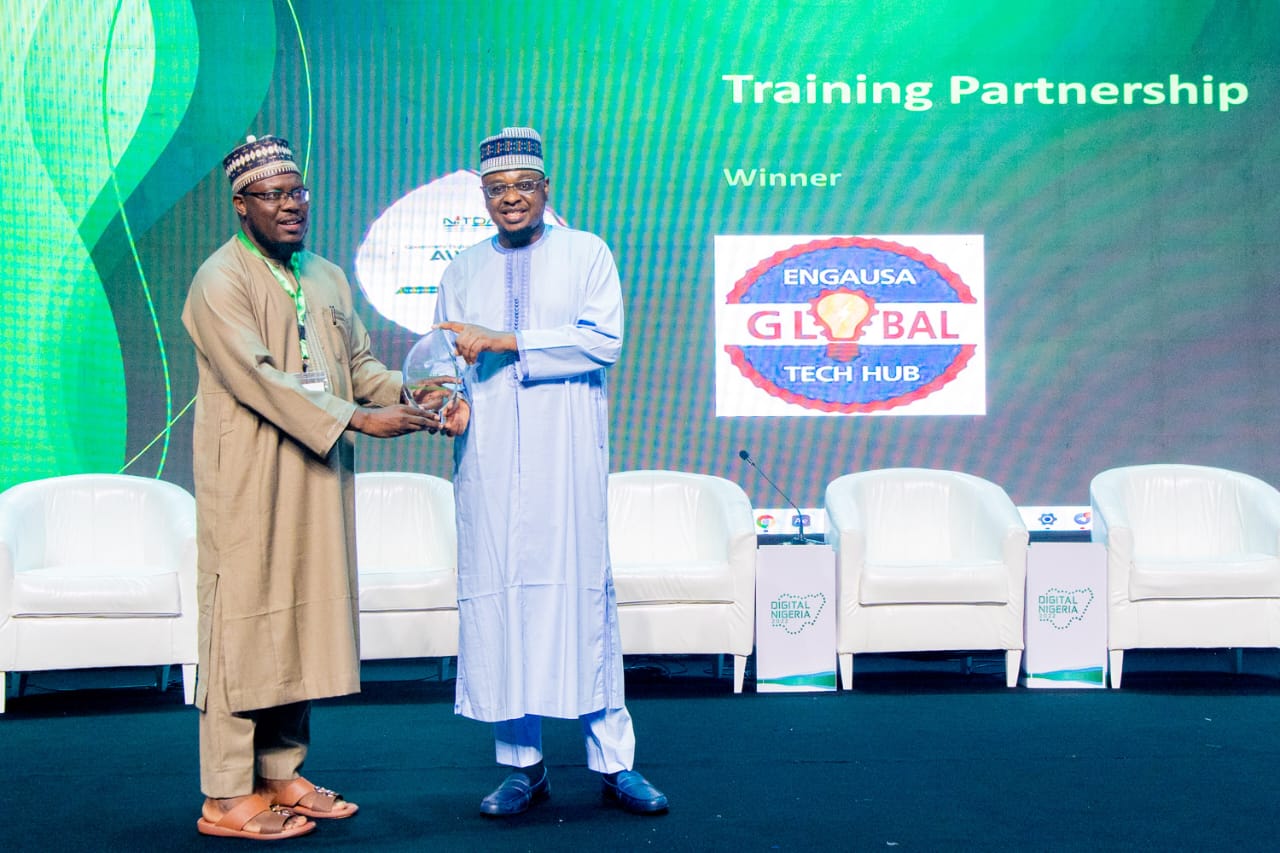
The Nigerian Ministry of Communications and Digital Economy honoured the famous Nigerian technology training firm Engausa Tech Hub with an award of excellence as the “best trainer” among partners of the National Information Technology Development Agency in the country.  

The ministry disclosed this on Wednesday in a post shared on its official Facebook handle, adding that the award was pronounced at the Digital Nigeria conference of 2022.

The firm has established a name in the area of training youths in modern digital skills, primarily in Hausa and English and continues to record remarkable successes. 

The founder and chairman of the tech hub, Engineer Mustapha Habu Ringim, said the firm recently trained over 2000 young people in different skills, including digital skills, entrepreneurship, guidance and many more.

Ringim added that the graduates trained in various science and technology skills included the university lecturers, students, and Almajiri, who never attended any formal school. 

‘We teach in Hausa to break barriers English brings about in our education system’ – CEO 

The Engausa Global Technology Hub believes that knowledge can best be taught in a mother tongue (Hausa) to break the barriers impeded by the English language. 

In a statement he made available to journalists some weeks ago, Engineer Ringim said the technology hub had also launched a library to enhance reading among youths.

He said the effort was to enhance lifetime reading culture among youths, adding that the Maisuga Ringim Library has provided both hard and soft copies of reading materials for the apprentice of the technology hub. 

With its motto, ‘breaking barriers and bridging gaps’, the firm aims to entrench inclusive technical skills acquisition and entrepreneurial skills among the teaming youths against all language barriers and technical gaps bedevilling human capital development at the grassroots.

Engausa was founded in 2019 and registered in 2022 by Engineer Mustapha Habu Ringim. 

Nigerian woman wins councillorship election in Canada

By Ahmad Deedat Zakari

A Nigerian woman, Nana Khadija Mamudu Haliru, was declared the winner in a councillorship election in Canada on Tuesday.

The Chairperson of Nigerians in Diaspora Commission, Mrs Abike Dabiri -Erewa announced the milestone in a tweet on Wednesday. 

” One of our own has done it. Nigerian in Diaspora. Nana Khadijah Mamudu-Haliru has done us proud..

She contested for councillorship in Ingersoll of Ontario council in far away Canada and has won…Congrats #ProudlyNigerian” She tweeted ” 

Mrs Haliru had expressed gratitude to the people of Ingersoll Town for electing her. She said she would dedicate herself to their service. 

She said: 

“Hello and I just want to say congratulations to all the winners tonight. I’m very grateful for the opportunity to represent Ingersoll, and I look forward to doing this with heart and all the dedication and devotion into this duty that you deserve.

“So thank you, and yes, we have a voice. We did it. We won,”

N109bn Fraud: EFCC re-arraigns suspended AGF, Ahmed Idris, others

By Uzair Adam Imam

The suspended Accountant-General of the Federation, Ahmed Idris, was reportedly re-arraigned by the Economic and Financial Crimes Commission (EFCC) over the alleged N109.5 billion.

Idris was re-arraigned alongside three others identified as Olusegun Akindele, Mohammed Usman and Gezawa Commodity Market and Exchange Limited.

It was reported that Idris and the other accused were dragged before an FCT High Court, Maitama.

Recall that they were first arraigned on July 22 before a vacation judge, Justice Adeyemi Ajayi on a 13-count charge bordering on misappropriation to the tune of N109.5 billion.

The EFCC alleged that, Idris, between February and December 2021, accepted from Akindele, a gratification of N15. 1 billion.

The sum was said to have been a motive for accelerating the payment of 13 per cent derivation to the nine oil-producing states in the Federation, through the office of the Accountant General of the Federation.

EFCC also explained to the court that N84. 3 billion from the federal government’s account was converted by the first and second defendants between Feb. and Nov. 2021.

The EFCC reiterated that the offence contravenes sections 155 and 315 of the Penal Code Act Cap 532 Laws of the Federation of Nigeria 1990.

However, the suspended Accountant General and the other defendants pleaded not guilty.

BUK revises calendar, gives students 3 weeks for revision

By Uzair Adam Imam

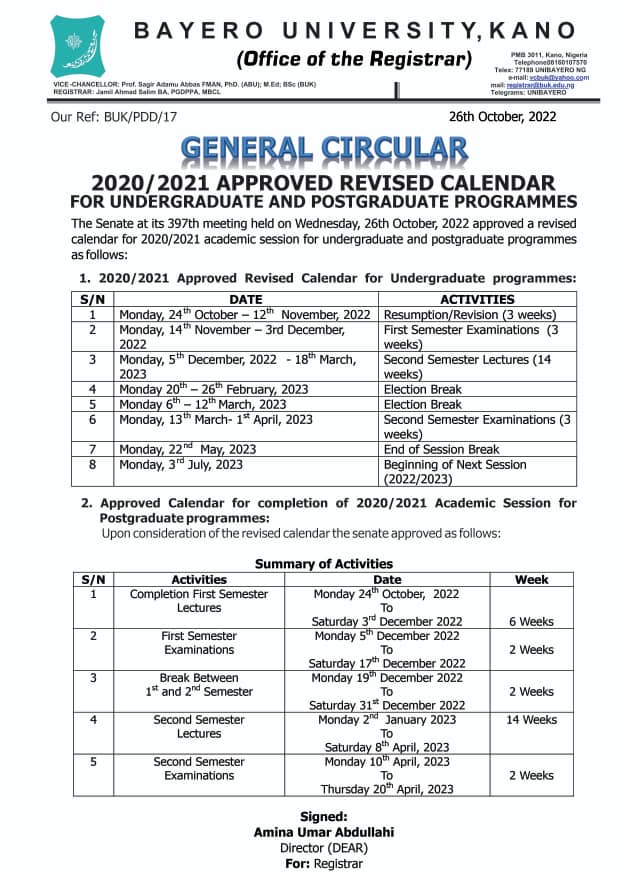
Following its resumption on Monday, the Management of Bayero University, Kano (BUK), revised its academic calendar, giving the students three weeks to revisit their previous lectures before exams.

The decision by the management was a result of a Senate Meeting held today, Monday, October 26, 2022, at the university’s Convocation Arena.

The university was about to start its first-semester examination on February 16 when the Academic Staff Union of Universities (ASUU) embarked on a strike.

The industrial action by the union, which lasted for eight consecutive months, started on February 14, 2022.

The university lecturers embarked on the total shutdown of the universities to press their demands home, which they said the Federal Government failed to fulfil.

However, after several disputes between the Federal Government and the ASUU, the union ended its strike just recently. Still, many students, parents and even most lecturers are not enthusiastic about the resumption. This is simply because the lecturers are still left stranded by the FG without payment of their salaries. If the salaries are paid, it will surely and greatly serve as a motivating factor for a vibrant return of the lecturers to their classes.

50 medical doctors leave Nigeria every week – NMA raises alarm 

By Uzair Adam Imam 

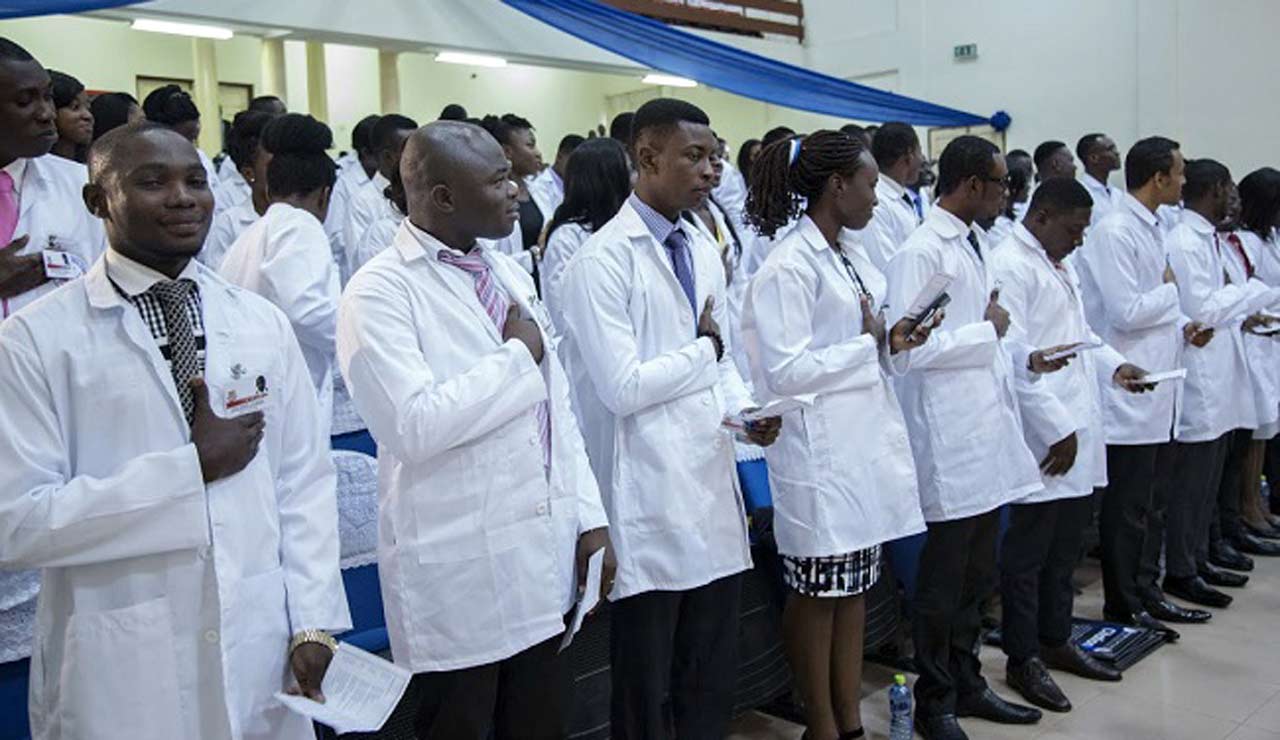
The Nigeria Medical Association (NMA) lamented that no fewer than fifty medical doctors leave Nigeria for better jobs abroad every week. 

NMA also decried the wave of brain drain that recently hit Nigeria’s health sector. 

Dr Rowland Ojinmah, the National President of NMA, disclosed this to journalists during the opening ceremony of 2022 Abia Physicians’ Week. 

Lamenting the sad development, Ojinmah urged the government to intervene and end the worrisome trend. 

It was gathered that the poor working conditions of doctors in Nigeria would be unconnected to why the doctors decided to leave the country. 

Ojinmah asked the government to fix the hospitals if they truly wanted to reverse the trend.

He stated,” The Governors are sleeping; They should not be waiting for the Federal Government alone. 

They should fix General Hospitals in their states to take care of the health needs of the citizenry at the local levels”.