Month: August 2022

Kano disburses remaining CACOVID supplies to 175 health facilities

By Muhammad Aminu

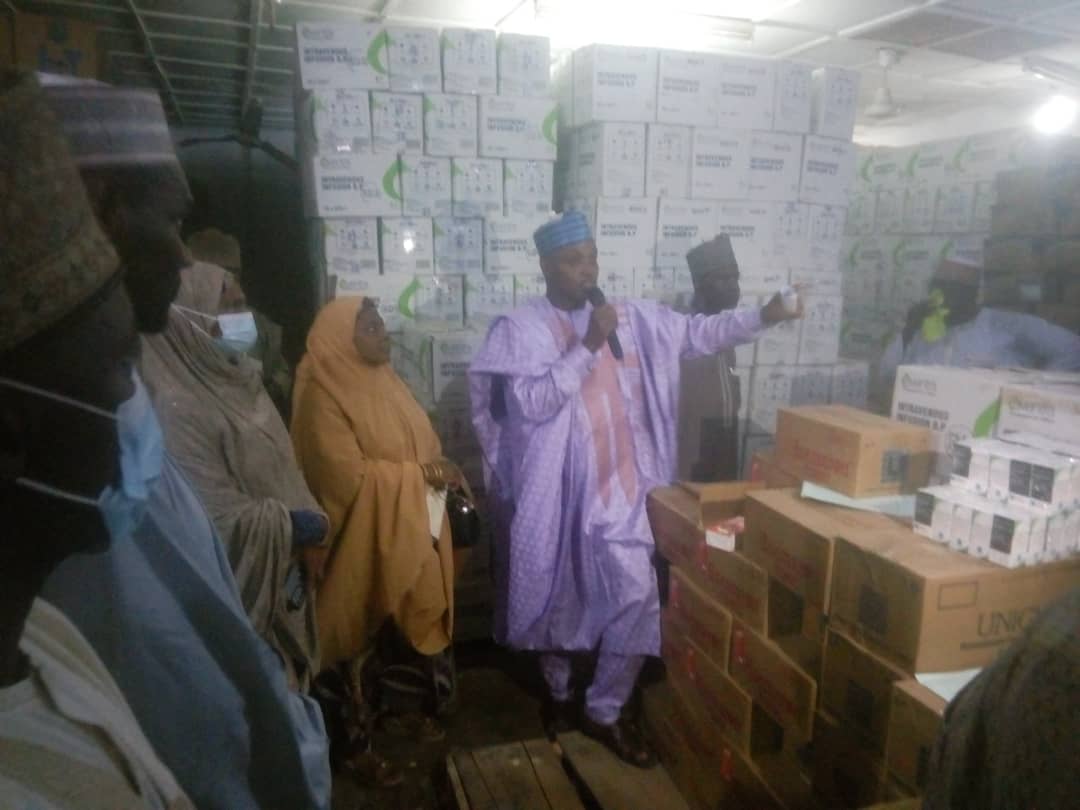
Kano state ministry of health, through the Drugs and Medical Consumables Supply Agency (DMCSA), has disbursed remnant of the CACOVID medical supplies to 175 health facilities across 44 local government areas of the state.

Primary Health Care facilities, general hospitals and specialist hospitals are the beneficiaries of the equipment.

Speaking at the flagging up, the Director General, DMCSA, Hisham Imamuddeen, said the exercise is part of the state government’s effort to improve the quality of healthcare across the 44 Local Government areas of Kano state.

He said: “Facilities need to improve to cater for the increasing population, and this is why we felt the need to distribute these equipment for the betterment of the people.”

“These are equipment from Sani Abacha Isolation Centre; they were brought here due to the decline of Covid-19.”

On his part, Kano state commissioner for health, Aminu Ibrahim Tsanyawa, represented by the Permanent Secretary of the ministry, Amina A. Musa, urged the beneficiaries to make good use of the commodities.

“The CACOVID provided additional support of these items when we were in the midst of the pandemic, which was used to provide an additional isolation centre built at Sani Abacha stadium.

“The centre was then equipped with equipment to include beds, air conditioners, television sets and gym centre among others. We thank God it has all come to pass.”

Some of the beneficiaries who started receiving the equipment commended the effort while promising to make judicious utilisation of the commodities.

TETfund unveils 10 books authored by Nigerian academics

By Muhammad Aminu

The Tertiary Education Trust Fund (TETFund) has unveiled ten textbooks authored by Nigerian scholars.

The books, which were TETFund-sponsored, were aimed at reducing over dominance of foreign publications in the nation’s higher education institutions.

Speaking at the event in Abuja, Minister of Education Adamu Adamu said the dependence on foreign academic publications portends great danger to the nation’s education sector, adding that boosting indigenous authorship would address the problem.

The minister, who was represented by the State minister of education, Goodluck Nana Opiah, said: “The paucity of indigenously authored and produced tertiary level textbooks and related academic publications in the nation’s tertiary education institutions is a known fact over time. Nigeria’s tertiary education institutions became dependent on books published outside the country with the attendant consequences of the pressure on the demand for foreign exchange.

“It is equally worrisome that the quality of most academic publications in our country leaves much to be desired. It is therefore expected that nurturing the culture of quality authorship and the production of indigenous books will not only ensure the availability of relevant books in the diverse subject areas that take cognisance of our local environment and sensitivities but will also safeguard national pride and reduce the demand for foreign exchange,” he said.

He commended TETFund for establishing the Higher Education Book Development project to tackle the scarcity of tertiary level textbooks which has before now reached a crisis proportion.

Adamu hailed the Fund for putting in place the Technical Advisory Group (TAG), whose mandate includes collaboratively working with the agency to ensure Nigerian authors churn out quality books.

“TETFund Book Development Fund intervenes in the three key areas of publication of academic books and the conversion of high-quality theses into books, support for Professional Association Journals, and the establishment and sustainability of Academic Publishing Centres (APCs).

“It is worthy of note that so far, seventy-seven manuscripts have passed through rigorous review processes by distinguished scholars and are ready for publication as books. I want to assure this gathering that an additional thirty books will be presented before the end of this year under the TETFund sponsorship programme.

“It will be of interest to note that over 60 per cent of these books are to be published by the Academic Publishing Centres (APCs) established by TETFund,” the minister said.

Executive Secretary of TETFund, Arc. Sonny Echono, who expressed delight over the quality of the ten books, said additional 30 books sponsored by the Fund would be unveiled before the end of the year.

He noted that the agency would sponsor the production of 50 textbooks in 2023.

“We have over 66 manuscripts; what we are unveiling today were published by only one publisher (one printing press) ….., by the time we unveil the remaining 30 in December, you are going to see all the authors cut across the three layers of our tertiary education institutions,” Echono said.

The TETFund boss also revealed that the Fund had provided support to ensure all the Academic Publishing Centres in the country become fully operational.

“There are seven of them across the country. When we came in March, only the University of Lagos academic publishing centre was fully functional and running, a few of them had little issues, some equipment, and other contractual issues, we have resolved all of them now.

“Four have been completed since the last few months, and the remaining we hope to finish by the end of September. The issue of operationalising them, making them self-sustaining is the debate we are having currently because we want them to run as a business enterprise and trying to create balance by focusing on academic publishing and being able to sustain themselves,” he said.

On his part, Chairman of TETFund TAG, Professor Charles Aworh, said 20 TETFund-sponsored textbooks were published in 2014 on different fields with wide acceptance from within and outside the country, adding that three of the ten new books unveiled today were from PhD theses.

He, however, called for more empowerment of the nation’s publishing centres.

“We are on course to publish 40 books before the end of the year, but the only challenge is the capacity of our universities to publish. Authors are ready to publish, manuscripts are ready,” Aworh said.

The high point of the event, which also attracted authors, academic staff unions and heads of education agencies, among others, was the public presentation of the TETFund-sponsored books, which include;1.Principles of Veterinary Surgery: A Concise Text for Veterinary Students 2. Fundamental of Chemistry 3. Fundamental of Public Finance 4.Java for Beginners and Web Design and 5. Programming for Beginners.

Others are 6. The Comparative Method and Civil-Military Relations 7. Fluid Mechanics and Hydraulics for Engineers 8. A Guide to Teacher Competence Evaluation 9. Financial Deepening and Economic Growth in Nigeria and 10. Motivational Factors and Teachers Efficiency in Secondary Schools.

I own single house in Kano, I pray to afford one in Abuja – Shekarau

By Muhammad Aminu 

Former Kano State Governor and Senator representing Kano Central Zone, Ibrahim Shekarau, has said he only owns a single house in Kano.

Shekarau, who said he still rents a house in Abuja, added that he is yet to afford a personal home in the Federal Capital Territory.

He was reacting to an allegation that he was given $1 million in a bid to push him out of Kwankwaso’s New Nigeria People’s Party (NNPP) to another undisclosed party.

He made the statement while engaging his followers, the Shura council and committees on the brewing crisis in the NNPP.

He contended that in his over 40 years of public engagement, there is no money that could influence his decision.

“In my 42 years as a leader, I was a principal of GSS Hadejia with 500 students and 64 teachers. This hand has signed and approved whatever amount of money one can think of. My commissioners are alive; I have never dictated who should be given contracts in a council meeting.

“We have handled uncountable contracts with both foreign and local contractors. So I challenge any contractor to come out and say there was a time we negotiated on a particular contract.

“I challenge every political appointee or contractor who brought one Naira to me. If it happens and they keep quiet, I will not forgive him. 

Shekarau added that as precious as plots are in Kano, he has never allocated a foot-length of land to himself in his eight years reign as a governor.

He said: “It is not that we don’t like the money, but our dignity is more important than wealth. Therefore, whoever knows any house outside the one built for me based on pension agreement, I have given it to him.”

Shekarau further pointed out that he maintains a good relationship with high-profile politicians within and outside the party, and associating or visiting each other shouldn’t be an issue.

He argued that the recent comment credited to Senator Rabiu Musa Kwankwaso necessitated him to brief his followers on the latest happening in the NNPP and the rumoured defection.

The menace of vernacular in our schools

By ImamMalik Abdullahi Kaga

The rate at which vernacular speaking is becoming rampant in schools (public and private) is so alarming. From elementary to secondary school, our children develop the ability to speak English or Arabic. But, without learning and practising it constantly, you can never be fluent in a language.

English is the official language in Nigeria, yet many people find it challenging to communicate with it. To convey your thoughts or ideas effectively and get well understood by others in many parts of the world, you must have the ability to communicate with the promising language – English because it’s a global language.

It’s regrettable and disappointing that a graduate with a bachelor’s degree or postgrad degree cannot speak or write in the official language appropriately. This, no doubt, results from one’s failure to learn it right from primary and secondary years (childhood). We cannot deny that most of us – northerners – have this weakness. But what could’ve led to this terrible mistake? First, the communication medium in our school days is often our mother tongue (Hausa).

Sadly, most schools don’t emphasise the need to use English to communicate among pupils or students. Some in question subscribe to the idea that (the English) language doesn’t determine one’s intelligence. Arguably, it is not, but we should consider the awful effect of not being able to use it correctly.

To be candid, you hardly find pupils or students communicating in English and Arabic (for bilingual schools) during school hours. For example, some teachers contribute to the escalation of this menace.

Some teach using vernacular, while others aren’t willing to prevent pupils or students from speaking it (vernacular). However, some unwisely claim that the students need a clear explanation of the treated topic. Hence, they use the local dialects to explain. This, however, doesn’t justify explaining lessons in local dialects because educationists have many teaching strategies.

Accordingly, teachers have this “disgusting” habit of speaking to students in the local dialects during class hours or break time. The students respond equally in the local dialects. During break hours, students communicate in the local languages without fear of being caught and penalised for that because the schools they attend don’t impose or simply disregard the rule.

If the abovementioned issue prevails, the coming generations will most likely succumb to the temptations to communicate in their mother tongue. Therefore, school proprietors and their managements should wake up from their deep slumber and confront this issue head-on, which helps deteriorate our education standard.

I believe teachers and prefects are the most powerful “tools” that could influence the students to comply with this because they play vital roles in shaping and correcting the students/pupils if they tend to stray.

ImamMalik Abdullahi Kaga wrote from Borno State University via abdullahiimammalik@gmail.com.

Nigeria, India to strengthen bilateral relations

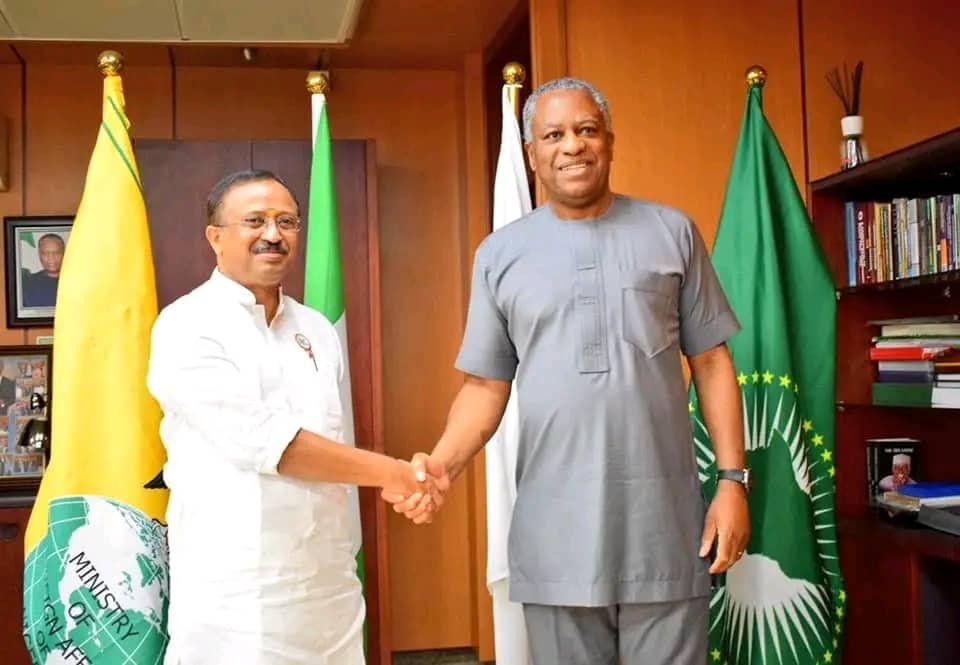
Nigeria and India are looking for strategies to enhance their mutually beneficial and robust bilateral ties.

Geoffrey Onyeama, the minister of foreign affairs, revealed this on Monday when meeting Shri V. Muraleedharan, the state minister for external affairs of India.

Muraleedharan is in Nigeria to attend the Nigeria-India Business Council’s opening (NIBC). Nigeria, according to Onyeama, is attempting to benefit from India’s expertise in the fields of information, communication, and technology.

India is one of the biggest investors in Nigeria and one of the biggest consumers of Nigerian crude, he pointed out.

In the context of the Solar Alliance and Conference of the Parties on Renewable Energy, Onyeama acknowledged India as the primary instigator.

“On Defence cooperation, there is a joint initiative with some of our Defence institutions on the development of detection of Improvised Explosive Devices which we are working on.

“Of course, that will be an important addition to the armoury of our security forces”, he added.

Muraleedharan stated that the bilateral relationship between India and Nigeria is excellent and that the meeting covered topics such as commerce, consular matters, education, etc.

The minister expressed confidence that the NIBC would enhance bilateral trade and investment in a number of industries.

Muraleedharan indicated that his nation was prepared to lend soft credit to Nigeria so that it might construct solar power facilities.

“On Power, Nigeria is part of the International Solar which is the global alliance to ensure that sustainable power is there across the world”, he noted.

Misconception about ASUU

By Sulaiman Maijama’a

If not because of the dogged determination and great perseverance of the Academic Staff Union of Universities (ASUU) in defence of education in Nigeria over the years, public universities in the country would have since been in a dilapidated condition with poor infrastructure, poor remuneration of staff.

Moreover, the universities would have been stocked with unqualified teachers, just like what is happening to our public primary and secondary schools or perhaps worse than that. Those who misconceive ASUU, for its struggles, as being selfish know nothing about what education takes to be efficient.

It is common knowledge that people who had the luxury of attending private primary and secondary schools in Nigeria earn more prestige than those who attended public ones. This is so because the quality of education in public schools at the basic level has since been diminished. But the reverse is the case at the university level; products of public universities in Nigeria can show a trick or two to their counterparts who are produced by private institutions. This is to the credit of the ASUU.

The Union, despite the meagre resources it receives and the poor funding the universities suffer, is able to produce professionals who are rising and shining in respective disciplines globally. Notwithstanding this feat, the union has been pushed over the years to go into industrial action at the detriment of students and the action by the ASUU is always greeted with criticisms from the public domain.

As a university student, the fact that our academic pursuit is being elongated owing to strikes is paining, and so, I agree wholeheartedly that strikes embarked upon by the ASUU almost annually are not the best solution and not the best way to put pressure on the government to meet its demands but, to crucify the union for its doggedness is not fair at all. If we ever dug deep to understand how much education costs in the countries across the globe and compared it to the demands of the striking ASUU members that are yet to be met for over a decade, for which they have always protested, we would discover that education in Nigeria is as worthless as a waste dump.

According to the United Nations Educational, Scientific and Cultural Organisation (UNESCO) recommendation, for any nation that wants to adequately meet the demands of education, 15 to 20 per cent of its annual budget should be earmarked for the sector. Unfortunately, Nigeria’s budget for education has always fallen below the recommended benchmark.

Despite the daunting tasks and the challenges that are posing threat to the sector and the need for additional funding, President Buhari’s 2021 budget share for education is the lowest in ten (10) years. Out of N13.08 trillion budgeted for the year, only N742.5 billion, which is equivalent to 5.6 per cent, was allocated to education, which is the lowest allocation since 2011. This is about half of what President Jonathan earmarked for education in the 2015 budget.

In 2011, President Goodluck Jonathan allocated 9.3 per cent of the total budget to education. It was further increased to 9.86 per cent in the 2012 budget; elevated to 10.1 per cent of the total 2013 budget. It was 10.5 per cent in the 2014 budget, and the same President Jonathan earmarked 10.7 per cent of the 2015 budget, which happened to be the highest in the last decade.

However, when President Muhammadu Buhari came on board, in his first budget in 2016, the education share was cut short drastically to 7.9 per cent of the total budget, and in 2017, it was reduced to 7.4 per cent of the total budget; in 2018 it was 7.04 per cent, while 7.05 per cent of the 2019 budget was allocated to the sector and in 2020 it was 6.7 per cent, and 5.6 and 7.9 in 2021 and 2022 respectively.

While former President Jonathan had every year increased the budget share for education throughout his stay as president from 9.3 per cent in 2011 to the highest 10.7 in 2015, President Buhari has been drastically reducing the budget from 7.9 in 2016 to the lowest 5.6 in the 2021 budget.

In any case, the Buhari/APC-led administration’s lackadaisical approach toward education is indisputably disastrous to the lofty dreams of young Nigerians to attain global recognition academically. How could a serious government that values education give only 5 per cent of its annual budget to the most sensitive sector like education? This is beside the series of outstanding memoranda of understanding the government signed with the ASUU in 2009, 2013 and 2017, as well as the Memorandum of Action (MoA) of 2019 and 2020, but yet to be implemented. How on earth could you expect the ASUU not to be aggrieved?

And now, the Minister of Education is further fuelling the disagreement by telling the ASUU members that their six months denied salaries during which they were on strike would not be paid, making reference to the “no work, no pay policy”. I don’t know the provision of law on this, but my concern is, how can you come to meet with a union of intellectuals like ASUU and dare to tell them that this is the final government’s offer and that there is no need for negotiation; it is either they accept or reject it? This is highly ridiculous.

In my view, education is a treasure. Whatever huge amount of money is invested in it, it will definitely pay off eventually. A member of the Senate Chamber, whether or not they raise a motion, whether or not they contribute to a debate, earn a whopping thirty 30 million or thereabout monthly. This is minus all other illegal earnings which are obtained through leakages and corruption. In comparison to academics, a professor who spends his life sacrificing his time and pleasure doing research to contribute to knowledge does not earn a mere five hundred thousand a month, with all the inflation.

I don’t want to dwell much on making comparisons with the fortune allocated to the National Assembly. But, if such an amount of Naira notes which is beyond imagination, would be given to the National Assembly, why can’t the Federal Government meet all the demands of the ASUU to proffer a lasting solution to this lingering strike that is jeopardizing the future of the Nigerian youth, wreaking havoc on the economy and threatening the fabric of our social structure?

It is evident during the EndSARS protest in 2020, when students were on strike, that the strike was a contributing factor that fueled the agitation, which later turned tragic. Had it been the youth who were mostly the ones at the forefront of the demonstration who were on campuses, busy coping with their academic activities, the move would not have been accepted to such an extent, and therefore, the government would have easily controlled it.

As the saying goes, “an idle mind is a devil’s workshop”. Now, the 2023 forthcoming elections are fast approaching, and the youth are bored doing nothing and, therefore, can indulge in anything that comes their way. Who knows what could possibly be the next trend if the youth remain idle?

The Federal Government must understand and appreciate the value and power of education, respect all agreements reached with the ASUU and invest more resources in the sector in order to save the future of young Nigerians. This is because, without education, man is like an animal.

The ASUU, on the other hand, needs to understand that strike is nothing but a calamity to education. They should adopt amicable and diplomatic ways of engaging the government. “When two elephants fight, grasses suffer the most”.

Maijama’a is a student at the Faculty of Communication, Bayero University, kano. He can be reached via sulaimanmaija@gmail.com.
NBA Vice President faults Tinubu’s absence at conference

By Ahmad Deedat Zakari

John Aikpokpo-Martins, the Vice President 1 of the Nigerian Bar Association (NBA), has faulted the absence of the All Progressives Congress (APC) presidential candidate, Bola Ahmad Tinubu, at the NBA 2022 Conference. 

In a post made on Facebook on Monday, the senior lawyer said, “The failure of Tinubu to be at the NBA conversation is a bold statement.” 

Senator Kashim Shettima, the vice-presidential candidate of APC, represented Tinubu at the NBA 2022 Conference themed “Bold Transition”.

In attendance at the conference were leading presidential candidates for the 2023 election. These include former Nigeria’s vice president and presidential candidate of the Peoples Democratic Party, Alhaji Atiku Abubakar and presidential candidate of the Labour Party, Mr Peter Obi and other dignitaries.

Outrage as suspected army personnel kill Islamic cleric in Yobe

By Uzair Adam Imam

Hundreds of people have clamoured for the immediate prosecution of the two suspected killers of a Yobe-based Islamic cleric, who are alleged to be personnel of the Nigerian army.

The news of Sheikh Goni Aisami’s murder went viral at the weekend and threw thousands of people to express shock and outrage at such a significant loss in the country, especially to the Muslim North.

 Reports from Yobe indicate that Aisami was gunned down Friday at about 10 pm while en route to Gashua from Nguru after he gave a lift to one Lcpl John Gabriel.

 DSP Dungus Abdulkarim, the spokesman of the Yobe Police Command, said the suspect claimed to be a soldier attached to 241 Recce Model Battalion, Nguru.

Gabriel bites the hand that fed him

Abdulkarim stated, “Aisami was driving his car to Gashua from Nguru when the principal suspect, who was in mufti and carrying a camp bed, pleaded with him for a lift to Jaji-Maji.

“On approaching Jaji-Maji, the cleric stopped the car to urinate,” he said, adding that as soon as he returned to continue the journey, the principal suspect brought out an AK-47 and shot him twice to death.

Abdulkarim further stated that the suspect tried to run away with the Sheikh’s car but failed, as it got stuck in the mud and the vehicle could not start.

“He put a call through to the second suspect, who drove another vehicle to the scene. Unfortunately for him, his drive shaft broke.

“The two suspects then requested help from a vigilance group in Jaji-Maji. When the group arrived at the scene to tow the broken down vehicles, incidentally, Aisami’s body was found at the scene,” he added.

‘It’s so traumatic; bring perpetrators to book’

A lecturer with Bayero University, Kano, Malam Aliyu Yakubu Aliyu, who expressed deep concern, said the development was deplorable.

He said, “It is very unfortunate to have read that the security personnel were the people involved in this criminality. Their job is to protect lives, not to take them.

“Often, the security personnel at different levels hatch in plotting to do unlawful things in various places, including schools and banks,” Aliyu decried.

A Kano cleric, Sheikh Abdussalam Baban-Gwale, decried the traumatic incident, calling on the government to exercise justice.

He said, “Government should ensure social justice and security in the country. Back in February this year, we were also attacked by unknown gunmen on our way to Bauchi from Jos.

“Often, society does not know about the end story of such criminals. Government should, therefore, ensure their prosecutions public to help end criminality in the country.”

In a Facebook post, a security analyst, Barrister Audu Bulama Bukarti, called on the government to prosecute the people behind the killing of Sheikh Aisami.

Goni Aisami’s murder regrettable – Gov Buni

Governor Mai Mala Buni of Yobe State has expressed sadness over the murder of the Sheikh and commiserated with the family over the loss.

In a statement issued in Damaturu by his Director-General Press and Media Affairs, Alhaji Mamman Mohammed, Buni described the circumstances surrounding the murder as sad, regrettable and most unfortunate.

“The alleged circumstances surrounding the death are most unfortunate and will be investigated thoroughly. [The] government will ensure that every detail is investigated and anyone found wanting will face the full wrath of the law.

“The state government will work closely with the security agencies to unravel every detail to ensure justice is done,” he said.

Buni also called on the residents to remain calm and law-abiding as an ongoing investigation would be pursued to its logical conclusion.

Ganduje promises to boost Hisbah operations in Kano

By Uzair Adam Imam 

The Kano State Government is set to provide equipment and other relevant working materials to Hisbah offices to enhance operational capabilities.

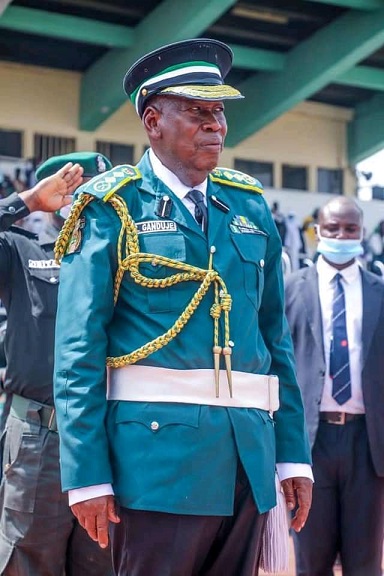
Governor Abdullahi Umar Ganduje, represented by the Kano State Commissioner for Religious Affairs, Dr Muhammad Tahir Adam, made the disclosure at the passing out parade of five hundred Hisbah corps.

Ganduje commended the efforts and commitments of the staff and management of the Hisbah Board in discharging their responsibilities.

He also called on the Kano residents to complement the government’s efforts by abiding by rules and regulations to maintain a crime-free society.

Speaking at the event, the commander general of the board, Sheikh Harun Muhammad Sani Ibn Sina, urged parents and guardians to be more vigilant. 

He said, “I call on the parents and guardians to be more vigilant and report any suspected person or character to relevant authorities to move the state forward.”

Gunmen raid Katsina community, abduct relatives of guber aspirant

By Uzair Adam Imam

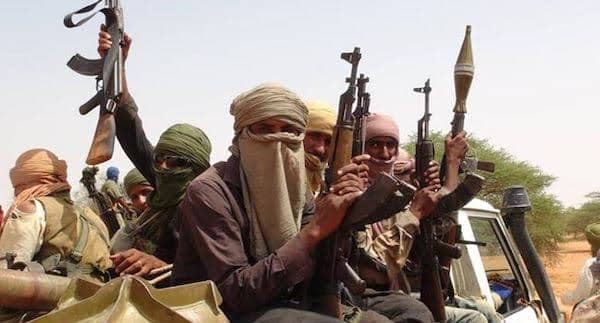
Unknown gunmen trooped into Dutsinma town of Katsina State and abducted the relative of the state APC gubernatorial aspirant, Umar Tata.

Daily Trust reported that some of the victims were wedding guests and were kidnapped to unknown destination by the shooters.

Confirming the incident, a resident, who preferred anonymity, said, “We have just returned from the house where the incident happened, we commiserated with the families of the victims.

“It (banditry) is really becoming worrisome and we are appealing to the security agencies to rose to the occasion,” he added.

Speaking to journalists, also another resident stated that the bandits initially kidnapped nine people at Unguwar Kudu quarters of the town but three were later released.

He added, “First, they abandoned an elderly woman who could not trek, with a small boy who was continuously crying. Then when they went further.

“There was a time the bandits came to Dutsinma for four consecutive days and kidnapped people. The situation has become worse and we are really disturbed,” the source said.

The Daily Reality could not reach the Katsina State Police Spokesman, SP Gambo, for confirmation as all attempts turned fruitless.