Month: January 2022

Late Dr Ahmad Ibrahim Bamba: The exit of an icon

By Bin Isah

Of all events, death stands the best chance to hold the most central attention. It’s gripping, and its grasp strong. It resembles gravity, but its force is more powerful. And it always provokes shock, pain and grief. And no matter the frequency of its happening, it is still not a normalcy. Upon its occurrence, people will respond with the same reaction as ever before. Allah SWT put it as a test, a warning and a path to the final home. But some deaths hit harder than some, and some leave deeper scars than the ordinary.

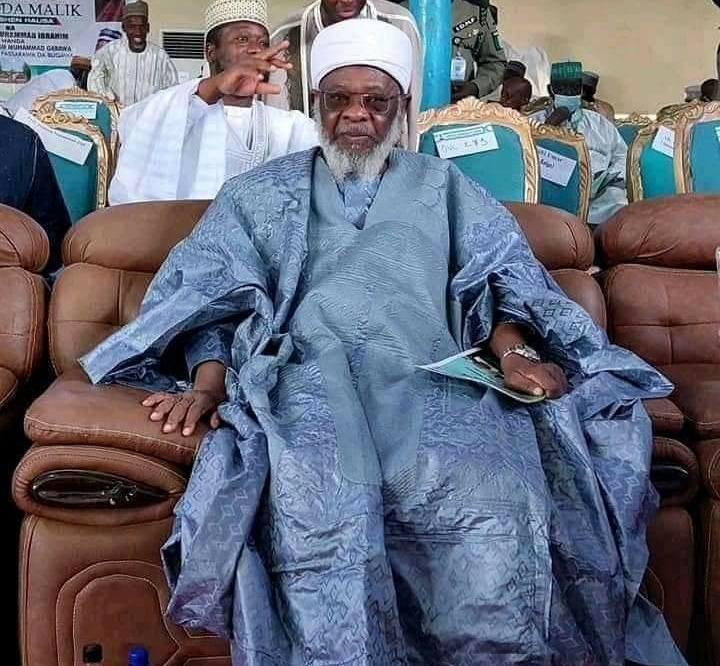
On 7th of January, death had dawned upon us with its darkness. It took a light, that is what knowledge represents. A knowledgeable mind of higher erudition, a paragon of wisdom and virtue, an epitome of Islamic scholarship and understanding, Dr Ahmad Bamba, BUK, Kala Haddasana, is gone. And that means a chasm has been created, a gap that can never be refilled.

When I first heard him in our home in my more younger days, I asked about him. I was curious to know, for something about him was indeed captivating. An elder brother of ours that used to bring his audio tapes to our abode said he was a teacher to Mallam Ja’afar. That’s the description that cut a long story short. We already knew Mallam Ja’afar, so he was the teacher of teachers, a scholar that produces scholars.

Dr Ahmad Bamba, was said to have appeared as a public preacher for three decades, that is, since his return from the Islamic University of Madina in 1991. In these periods, no any occupation had seduced him away from his devotion to his Islamic teaching and preaching. And this long time of service, on the path of Allah SWT and for the guidance of the people, is sufficient to provide a picture of a man with purpose, dignity and piety. His pleasure in the work had penetrated him so much that no any stress could disrupt it.

Even at 82, Dr Ahmad did not retire. His life had no any ambition but Da’awa service, informing people on how to live in the light of Divine Pleasure under the guidance of His Prophet, Muhammad SAW. He believed that people need to lead a righteous life, and in as much as he breathed he would have no any other endeavour. And it is clear that his life has been a blessed, graceful one. The grace that Allah SWT placed in his work is apparent. He lived with his faculties in function, and with such a vigor that scares even the energetic young. His thinking remained acute, his voice sounding, and his movement full of life. It’s the blessing of Allah SWT.

And what is more wonderful about Dr Ahmad Bamba is the way his style touches upon the tastes of all ages. The young and the old, men and women will tell you they like him. His Hausa language is original, his explanation lucid, and his treatment of matters loose, and that makes people listen to him with passion. He has a special knack for making the complex simple, and his grasp of social experience puts him at another edge. And his preaching is not boring, it’s full of fun.

Whoever remembers Dr Ahmad BUK will tell you that it’s by his reading of “isnad” he recognises him. In fact, “Kala Haddasana” is another name for him. Here is the man that spent his best time at service to the Prophetic Sunnah, teaching people the times and life of the Prophet SAW, as exemplified in his words and actions, at home and at away, making the Prophet SAW more accessible to the seeker. The prophet’s relationship with Allah SWT, with his wives, with other people across different paths and faiths, etc, Dr Ahmad leaves no any aspect without a word on its meaning and value based on the acceptable accounts.

The most popular, most reliable and well documented six books of hadith that are called “kutubus sitta” have been taught by him, and with such a precision that goes within the public purview. And Scholars that learn from him never miss his technical analysis of the . Both the public and the scholars are carried along, and this could only be done by an exceptionally phenomenal teacher. And Dr Ahmad is one. And that’s the greatest achievement that no one could beat him in its regard. He is the only champion in his league. His “Mawatta Malik” is even published into a voluminous, enriching book, and in the living language of the people, and that shows that his legacy will dance to the music of time.

Sheikh Muhammad bin Othman observed a moving Khubta, with tears breaking out of his eyes, and his breath choking him at throat. He recounted the condition in which he found Dr Ahmad at hospital, and described it as the most traumatizing one, but what Allah SWT decreed is the most prevailing. He said, “I saw knowledge before me, lying on the bed —ga ilimi kwance. Inna Lillahi Wa Inna Ilaihi Rajiun.” I could not do anything, we could do nothing about it, he added. “Dr was not even conscious. I left with a heavy heart, and the whole night I couldn’t sleep well.” In the morning, around 10:58, he was informed that Dr Ahmad was no more. Inna Lillahi Wa Inna Ilaihi Rajiun.

The death of Dr Ahmad recalls to life the life he has lived, and that its mark shall remain upon the mind of the living. It is however a void that stimulates remorse at the recess of people’s hearts, because such a loss is irreplaceable. Though his knowledge shall continue, and his wisdom be applied in the art living, discussing and teaching, his absence will leave many questions unanswered and many problems unsolved when they surface. There are gifts that leave with those that bear them. And Dr Ahmad is gone.

While being interviewed after the funeral prayer, Dr Sani Umar R/Lemo described the loss as huge, a bleak sign that knowledge is precipitating. He said that people will indeed feel the emptiness occasioned by Dr Ahmad’s leaving. Of all their lives, they know Dr Ahmad with teaching and preaching. He is a guide, a father, a guardian, as Sheikh Dr Abdallah G/Kaya put it. To all scholars, he is a role model, an example to be emulated. And scholars from different parts of the world have expressed their sadness over the loss. And to Allah SWT we all belong, and to him is our return.

I was at the graveyard, close to his grave, and what I saw and felt in that moment will stay with me for a longest while. In fact, the entire experience shall be memorable. People were swallowed by grief, held by remorse and chained by love. Upon the arrival of his body, I found myself frozen with words and motions. I remained silent, only feeling the sensation of the pain that engulfed me. I shed tears, and over the fact that Dr Ahmad was truly gone. Here is a knowledge in shroud, a remarkable personality buried, a pious scholar being laid to rest. Only “Allahu Akbar” and “Inna Lillahi Wa Inna Ilaihi Rajiun” that filled the air held me, but I could have fallen aground. Finally, Dr Ahmad was in his grave, closed and gone, forever. Inna Lillahi Wa Inna Ilaihi Rajiun.

Bin Isa writes from Kano State and he’s a desciple of the late Dr Ahmad Ibrahim Bamba.

Death is the key to life

By Abdullahi D. Hassan

For centuries, the word Death has been viewed according to civilizations, faiths and isms. Death is the only attribute a person must undergo regarding social status or wretchedness, from the recorded history of Homo Sapiens to the present age. Humans face all sorts of challenges that cease the existence of life and body. Thus, some individuals meet their end via natural causes.

Death is a threshold; disunite a magnetic love between children and parent, decouple chemistry among spouses and reflect mourning on a follower’s mind over the demise of a good leader. Yet, for ages, no one returns from such a journey to testify for the living souls. So, how is life in purgatory?

We read and write biographies and memoirs of late people to adjudge their erstwhile accomplishments, either good or harmful to society. Statues were erected for the commemoration and monumental projects named after great people across walks of life.

The first death that shook my nerves terribly happened two decades ago in Jos, North Central, Nigeria. Then, the two Abrahamic faiths were involved in a brutal religious conflict. Both the Muslims and Christians kill indiscriminately for futile and dogmatic intuition. The dreadful scene is yet to skip my memory.

Two people, a man in his blooming age and an adolescent girl, were caught by the militia mob. They received intense attacks from all directions. Finally, one of the zealots struggled the man down, poured fuel on him, and ignited the lighter. The girl cries in a harrowing pitch, pleading in Hausa, “Dan Allah, kada ku kashe mu! Yaya ne,” meaning, I’m begging you in God’s name, don’t murder my brother. He was cremated alive to ashes. I don’t know what happened to his sister. If I hear any narratives about death, murder and genocide, my mind abruptly recalls the barbaric nostalgia.

In 1888, a French newspaper published an obituary headline entitled ‘The Merchant of Death is Dead’ erroneously confused Alfred Nobel instead of his brother, Ludwing Noble, who died on his visit to Cannes. Alfred Noble amassed a huge fortune by selling explosives used in wars. The story went viral across Europe, and critics were happy over his death. He wrote in his will, “those who, during the preceding years, have conferred the greatest benefit to humankind”. The Prize was established in Chemistry, Literature, Medicine, Physics and Peace. The Nobel Prize has been awarded to great thinkers, policymakers, leaders, advocates, activists, and international organizations for over a century. From 1901 to 2020, 962 became Nobel laureates.

Mikhail Kalashnikov, the world’s deadliest inventor of AK-47, designed the assault rifle used by the Soviet Army in 1949. His horrendous automatic weapon soldiers hold for wars to kill enemies at the battleground. Warlords, like Charles Taylor, trained child soldiers to torture, kill and rape women. AK-47 is the weapon of choice by Jihadists in terrorist activities. In 2007, a statue of Kalashnikov was displayed in Moscow. Vladimir Putin described him as “a symbol of the creative genius of our people”. He wrote a letter to the head of the Russian Orthodox Church saying, “the pain in my soul is unbearable. I keep asking myself the same unbearable question: If my assault rifle took people’s lives, that means I am responsible”.

The two famous men, Alfred Nobel and Mikhail Kalashnikov, destabilized human sanity and championed cruelty. Noble is an antithesis of knowledge and rational thinking to wedge vacuums in scholarship for the benefit of humanity. For instance, in 2010 Nobel Prize in Physiology-Medicine was awarded to Robert Edward for curing infertility and IVF discovery. And also, Paul Crutzen won the Nobel Prize in Chemistry for the breakthrough in studying the ozone layer and climate change.

On the other hand, Kalashnikov’s invention is the anathema of the world’s suffering. Especially, Global South countries, some 800,000 Tutsi villages were slaughtered with machetes and AK-47 in Rwanda alone. His unwanted weapon caused more havoc worldwide than any assault rifle from the 20th century to this millennium.

Death is the key to life. Since we were born, we have escaped many channels to survive. Some die at the neonate stages; others pass from adolescence to the peak moment of life. Some took their life by themselves as a result of karma or tiredness to continue living in a dying condition and hopeless dreams. But, no matter what it takes, one day, we must die by a slight obstruction unbeknown to us or evident.

Lastly, change your storyline as Alfred Nobel does if you are not dead. Not insincere lamentation of Mikhail Kalashnikov’s conviction to write a letter to the religious leader. Who is not a God rather tutelage of religion? If your close relatives display selfishness like Kevin Carter, it is not too late for his attention and legacy changes.

Abdullahi is a freelance journalist and writer. He will be reached via Abdulbaffah@gmail.com.

The voice of moderation and reason is lost: Tribute to Dr Ahmad Muhammad Ibrahim, 1940-2022


By Kabiru Haruna Isa


“The death of a scholar is the departure of knowledge”.~Yahya b. Ja’far


In the afternoon of Friday, January 7, 2022, Dr Ahmad Muhammad Ibrahim, who was popularly and variedly known as Dr Ahmad Bamba; Dr Ahmad BUK; and Кala Haddasana, succumbed to the cold hands of death. Whoever attended the Muslim traditional funeral prayer did not need to specialize in Thanatology or the assistance of any thanatologist to decipher that his passing on has shocked not only the northern Nigerian Muslims but perhaps the entire Muslim world.

Hundreds and thousands of mourners from different nooks and crannies of northern Nigeria trooped to his mosque, Darul Hadith Masjid, at Tudun Yola quarters in Kano Metropolis to observe his Salat al-Janazah (funeral prayer). Based on my personal observation, the congregants comprised adherents of different doctrinal and ideological groups who were deeply touched by his death.

Dr Ahmad was one of the elder statesmen of the Muslim North who chose to be independent-minded, honest, forthright, focused and overtly apolitical. Those who grew up in Kano can vividly remember his educational sessions in the 1990s when he read a series of hadiths (narrative records of the sayings and customs of the Prophet Muhammad), which were aired on CTV (now Abubakar Rimi Television, ARTV), Radio Kano and other broadcast media.

What distinguished his educational sessions from those of other Islamic scholars were his sonorous voice, interactive dialogue, active learning process, and the constant prodding of his audience to debate jurisprudential issues. He created a convivial and liberal atmosphere for his students to either agree or disagree with his interpretations of holy texts without necessarily derailing from the subject matter, which demonstrated his deep knowledge of theological hermeneutics. 

Even though a Salafi, Dr Ahmad was a bridge-builder between Sufis and Salafis in northern Nigeria ostensibly due to his old age, maturity, accommodation and toleration. He always tried as much as possible to avoid deployment of insulting and libellous language to either demonize or hereticize those whose doctrines differed from his.

To err is human. As a human being, he might have wronged others, especially during his formative years, but he personified moderation and toleration as a fully accomplished and elder-scholar. Muslims will surely miss his fatherly voice of moderation, reason, truth and honesty. 

Despite his erratic temperament, Dr Ahmad was a forgiving person who never intended to hold animosity beyond the grave. I remember my personal interaction with him when Malam Babangida Namadi introduced me to him sometime in 2020. I pleaded with him to document his life narrative as some scholars did, such as Shaykh Abubakar Mahmoud Gumi in his autobiography, Where I Stand.

Dr Ahmad responded that he had a lot of stories to pass on to the younger generations based on varied phases of his life, bitter and positive experiences, social networks, scholarly itineraries and odysseys, family life, marriage counselling, pedagogy, university and national politics, truce and reconciliations and intra-faith relations. He further said that he would never write an autobiography because many people offended him and had already forgiven them; therefore did not want anything that would trigger his emotions.

The death of Dr Ahmad has created a vacuum that will take time to be filled because of his dedication and contributions to scholarship and the study of hadith in the Muslim world. To produce a scholar of his calibre is not an easy task, especially in the 21st century when young people exhibit hedonistic tendencies and many societies experience a systemic educational decline.

I will conclude with a famous quote of Umar “the death of a thousand worshipers is easier to bear than the death of a scholar who has knowledge of what Allah has permitted and forbidden”.

It will take us a long time to come to terms with the departure of Dr Ahmad. May Allah admit him into Jannatul Firdaus, amin.

Gmail: khisa.his@buk.edu.ng Department of History Bayero University, Kano.

Beyond Pantami’s tears

By Ahmad Deedat Zakari

I am not unmindful that weeping public officials and politicians are viewed with the lens of suspicion. However, the ineptitude of politicians and activists who cried their way to public offices is the main reason critics dismiss their weeping as mere optics and grand hypocrisy. In the case of the Minister of Communication, Isah Alih Pantami, I think most of his critics are only disappointed, having held him to a higher standard of character. Most of them think he should not be silent amidst our many challenges, particularly in the North. Therefore, they view his outburst of tears as giving attention to a lesser evil.

Pantami wept for what he deemed moral decadence while passing a message in a religious gathering. The sincerity of his tears was questioned and debated, but the concerns raised with those tears remains incontrovertible. As unpleasant as it sounds, a nation whose youths and citizens stole from a mall consumed by fire has lost its moral compass. Pantami acknowledged this sad reality with those controversial tears. We should all cry for our collective woes. 

Like it is common with almost all societal problems, finding solutions starts from the sober admittance of the anomaly’s existence and recognizing the need for deliberate actions. In this situation, orientation is the way to go; it is necessary to teach the youths with model examples from leaders that life should not solely revolve around the craze for illegal acquisition of material things. And that there are nobler causes that make the world a better place. To be fair to Pantami, his message in that gathering was not less of an orientation. However, there is a need for a larger and more diverse platform for a more significant impact. 

There are many issues worth our tears and palpable concerns in today’s Nigeria. For instance, we are riddled with devastating security situations up North and secessionist threats down South. Moreover, young people who should be under the warm protection of their parents and in classrooms roam the streets freely, demonstrating what extreme poverty is. All these amidst a biting economy, and governments at various levels appear to be in slumber. 

It is undeniable that nations worldwide have challenges and problems peculiar to ours. The only difference lies in the actions of the governments and citizens of these nations. Sadly, we dwell more on trivialities than issues that uplift our country from the abyss of wreckage done to us all, especially our leaders. As thought-provoking as Pantami’s tears became, the genuineness or otherwise should not elicit serious attention; because we have more problematic issues that bother our survival as a nation. 

It undoubtedly remains our right to express our misgivings and hold our leaders accountable for all their actions. However, building a dream country is far beyond talking too much and minor actions. Simply put, we are yet to captain our ship and take our nation’s destiny into our own hands, at least by my honest measure. Just like Pantami wept over what he considered offensive, we express our dismay regarding every issue we believe our country’s problem all the time.

But like JF Kennedy poignantly postulated, “Ask not what your country can do for you, ask what you can do for your country” He used this historic sentence to call on Americans to civic actions and responsibilities. I believe the mindset of patriotism and owing one’s country civic obligation, plus deliberate actions like registering to vote and encouraging others to do the same, is the catalyst that will propel Nigeria to greatness.

Ahmad is a 5th-year Law student at the Faculty of Law, Ahmadu Bello University Zaria and can be reached via ahmadzakari@gmail.com.

Restructuring Northern Nigerian divorces’ mindsets

By Hussaina Sufyan Ahmed

We can categorically define a divorcee as someone unlucky in a specific marriage. I know that I will be in the minority if I say divorcees are given less chance to develop themselves personally before getting pressured into remarrying in the Northern part of Nigeria.

I understand and appreciate the concern with threading carefully regarding resuscitated emotions and intimate urges. However, a ‘decent’ society like Northern Nigeria expects that you abide by the rules of decency in ensuring that you either preserve yourself for your next spouse or remarry to avoid falling into the traps of indecency.

In this aspect, indecency refers to the lack of adhering to the control of urges for every culturally and religiously conscious person. These traits are seen as the signs of responsibility, including sustaining oneself; ready to take up self-evaluation, focusing on goodness, and maintaining dignity.

The pressure that comes from the family, society and whatnot is justifiable. However, the pressure that comes with engaging these divorcees in personal development is a progressive vacuum seat.

A divorcee can either be a man or a woman. But statistics show that a woman is more affected by divorce financially while a man is affected mentally. But, of course, this assertion is opinionated, as there can exist other varying opinions.

Let’s take Kano State as a case study. In 2020, Dr Sabo Dambazau, in an interview with Kano Focus, said 45% of divorces in Kano are caused by co-wife rivalry. Other causes he highlighted include forced marriage, fake identity by the men before marriage, lack of catering for family financial affairs succinctly, and suspicion from either the man or the woman.

For Dambazau, a lack of trust causes suspicion. And this distrust is seen in wives taking their husbands’ phones. Often, both check each other’s phones.

According to Dambazau, couples need counselling, personality development, and consciousness of Islamic teachings through the actual practice of the teachings to reduce divorce. This can be supported by enrolling in Islamic schools. He ended with advice on staying genuine and honest during the courtship before marriage.

My scope will be Personal Development for the Divorcee. It is essential to know that learning and seeking knowledge are the two fundamental processes that every human should consciously and intentionally be involved in.

As a divorcee, the first focus should be personal development. And this cannot be achieved without being intentional about self-development. So, how do you achieve personal development?

As someone who might have gone through emotional downturns or physical battles in their marriage,  self-development evaluation is a facet to help you check yourself and correct the mistakes you might have made. Every human is fallible. Hence the premise of every divorce is that both parties have a role to play in the faults. However, one side usually weighed in as more wrong than the other. Still, there is never a party devoid of guilt(s). So, you use the experience of a failed marriage to build your knowledge about marriage if you wish to be in it again.

In trying times, maintaining spirituality is crucial. In the North, an epitomic feature is the presence of religious rooms to learn from – while you rule in self-development. You cannot rule out upgrading your belief. For instance, there are many Islamic schools for Muslim divorcees in various Northern states. And seeking the appropriate knowledge through such schools enhance and contribute to the upliftment of morale.

This sums up an inference of a child’s upbringing in a typical Northern Muslim home. Thus, before reaching the age of five, recitation of verses from the Quran begins, opening the ability to read and recite rhymes and books in western schools. So, who says learning has a boundary or specific scope?

Another aspect of personal development is acquiring soft skills. For some female divorcees, one of the reasons their families or society has pressured them is usually due to self-sustenance. A woman in a non-secular community like the North has to either sustain herself financially, be under her parents or a man. You do not have to rush into another marriage to develop yourself personally. Instead, go out and learn soft skills such as MS Office, graphic design, Corel Draw, Digital marketing, social media management, online journalism, etc. You can acquire most of these skills online or offline for free or pay a token, especially if you desire to get the certificate.

Personal development stretches out to unlearning, learning and relearning, and in this, we cannot rule out upgrading education level to the next stage. If you are a primary school certificate holder, secure a secondary admission. If you are a secondary school certificate holder, try and acquire a UTME form, sit for the exams, and pursue admission, even if it’s a polytechnic or college of education. And for a bachelor’s degree holder, it is easier though costlier, which makes it essential to personally develop the self so as far as there is determination and hard work.

In all of these, I suggest that families and society give premium corporations to divorcees to see that they are helped towards self-development and not pressured to remarry. Of course, marriage can come later but having productive and oriented divorcees instead of a new payroll of reproductions will push the nation’s economy forward.

“Read. Read in the name of thy Lord who created; [He] created the human being from a blood clot. Read in the name of thy Lord who taught by the pen: [He] taught the human being what he did not know” (Quran, 96: 1-5).

Hussaina Sufyan Ahmed wrote from Kano. She can be reached via sufyanhussainaahmed@gmail.com.

Buhari appoints Ayo Gbaleyi as Chairman, Federal Mortgage Bank (FMBN)

By Ahmad Deedat Zakari


President Muhammadu Buhari, on Friday, January 7, 2022, appointed Mr Ayodeji Ariyo Gbaleyi as the Chairman of the Board of Directors of the Federal Mortgage Bank (FMBN).


A statement on the verified Facebook account of presidential spokesperson Mr Femi Adesina confirms the appointment.


In describing the appointee, the statement reads,” A Chartered Accountant and an Associate of the Chartered Institute of Taxation, Gbaleyi is a well-known financial expert who was once a Commissioner for Finance in Lagos as well as a player in the aviation sector.”


He added that Mr Gbaleyi replaced Chief Adesoji Adeeyo, who passed on recently.

JIBWIS quizzes Dr Jalo Jalingo over comments on Prophet’s parents

By Muhammad Sabiu

The national leadership of the Jama’atu Izalatil Bid’a wa Iqamatis Sunnah (JIBWIS) alias Izala, headed by Sheikh Abdullahi Bala Lau, has in a meeting held in Abuja on Wednesday asked its controversial national secretary, Dr Ibrahim Jalo Jalingo, to desist from discussing and publicising controversial issues.


This is coming amidst the criticism and bashing Dr Jalo receives, especially on social media, over his position that the parents of Prophet Muhammad (SAW) “would not be in Heaven.”


The Islamic organisation’s statement released through its Facebook page said the meeting was held by its top-ranking executive members. It has resolved to make it necessary for any member cleric to have a knowledge-driven discussion before publicising any controversial topic.


It also asked all its social media handlers to pull down any content that promotes the controversial thought of the secretary, adding that what is now required is prayer looking at the security challenges bedevilling the country. 


Many people describe Dr Jalo’s position as balderdash and disrespectful to the person of the Prophet (SAW).

My life, my choice: Why I rejected university job for catering (II)

By Aisha Musa Auyo 

Coursework lasted for four months. I enjoyed it as it’s Psychology, and got excellent results. But I couldn’t go back as planned, as I had already enrolled my kids in school. I complained to my parents about my lack of a job and how relatively boring it was to stay without my husband. They promised to do something about that. I ventured into the catering business full-time while my husband and I were still making plans to reunite. Fortunately, another transfer was by the corner, so the goal is to wait and see the posting. Living alone was getting harder for him and affecting his work productivity. No man wants to go home to an empty house. No man wants to be eating out every day; the inconveniences are just too numerous.

On my side, I felt empty and taking care of the home and raising the kids alone was taking a toll on me. He could only come once a month and spend two to three days. His kids saw him as a stranger. Although we were constantly on video calls, it’s not the same as being present.

An opportunity for a university job came, but I rejected the offer, explaining that we were leaving as soon as the transfer came out. The one and half years we did apart as couples have taught us never to try that again; I’ve changed my decision on work. I called my husband, told him about the offer, and made it clear I was not accepting it. He advised I should not do anything hasty, but I remained unshaken. Any job that would tie me to one place and make me apart from my husband is not worth it. At that time, the transfer came out, and the location was not travel-friendly. His workload too would not allow unnecessary travel, so the job is a big No for me. 

However, People judge from afar and couldn’t hide their disappointment of me not working in a cooperative world. A neighbour looked into my face and told me, ‘if you reject the job because of your husband, I swear you will regret this decision’.

 I was not saying I would not work outside my kitchen, but whatever my work is, it shouldn’t be the one that would split my family apart. One should not be surprised if they see me working outside home tomorrow if the work was within the place I stay and can offer transfer whenever we are made to leave the state. So, yes, my future work should revolve around my husband’s work state.

But for now, I choose catering, and I decide to do what works for me. Who knows it, feels it. Those who mattered have accepted and made peace with my decision. The challenge now is balancing the catering business with my PhD thesis.

Let me explain why my parents want us to pursue these degrees. They are university professors, have few kids, with guaranteed pension and gratuity. So, they don’t need any financial help from us. But they want us to be independent and financially stable. In addition, they want us to be highly educated and respected. As parents of girls, in this era of divorce, irresponsibility, and many life uncertainties, they know the best they could give us is this education.

Our parents often tell us that they’re not rich; they won’t leave us with mansions and millions when they die. This education is the only legacy they have, and I understand them. The University environment does that to its inhabitants. This is a general problem ‘we quarters’ children’ face.

A neighbour of mine whom we came from the same quarters made a similar decision not to work or further her education. She told me how her dad used to compare her to coursemates, that they’re all PhD holders now and doing great things in the university. Thus, he always begged her to at least further her education. To our parents, a bachelor’s degree is never enough.

To say I’m grateful to my parents is an understatement. Wallahi, I often cry, knowing I can never pay them for all they did to me. They’ve given and are still giving me the best of everything; we are over-pampered. We are the envy of our peers, and we have achieved so much at young ages due to their persistence and guidance. It’s not only Boko (Western education) they gave us; they also ensured all of us have memorised the Quran at young ages and have attended multiple Islamic schools and conferences.

Moreover, they have our best interests at heart; they are even overprotective. So I’m not only grateful, but I always feel indebted. All I do is pray for them to have the best of here and hereafter. Now, this story is history as I’ve eaten my cake and still have it. I’m doing my PhD while my family have been reunited. A postgraduate program is temporary and flexible. I’m glad I followed my parents’ advice, thanks to them, I’ll be a young Dr soon inshaAllah.

The lessons here are:

1. Allow, guide and encourage children to follow their dreams and passion. The result is a win-win, as parents won’t have to push the kids to work or study hard. Passion naturally breeds excellence.

2. Don’t make or set life goals too early. Be open-minded. The definition of success is very dynamic. Our dreams can change as we advance in age and transition from stage to stage in life.

3. Accept people’s decisions even if you have power over them. Just pray, and let them face the consequences. If it turns out good, that’s great. If it turns out bad, that’s a lesson, not a failure. All decisions are born from real-life experiences and or reading that change one’s line of thinking or learning an idea somewhere that sparks one’s interest in something.

4. When your passion is what you do for a living, your life will be happier thus healthier. The fulfilment and peace are on another level.

5. Diversify your knowledge and skill. Don’t just dwell on a single niche and plan your life around that. Don’t pigeonhole your thinking into believing that “I am a civil servant” or “I am a business person” and nothing else. It’s too dangerous. Life is dynamic; even if you chase degrees, learn a skill or trade. Government jobs are not guaranteed. Priorities also change, especially for women. For instance, my catering business has never been affected, even though I’ve been moving around. Cooperate jobs will not have been this flexible. 

6. Read, read, and read. Learn, unlearn, and relearn. Reading is an art that teaches one about life beyond their daily reality. Reading could help you avoid many problems, crises, and misunderstandings. Reading changes one’s outlook towards life makes one understand himself, those around him and the world better.

7. People should learn to mind their business and respect other people’s choices. Every individual is entitled to their decision. Making derogatory comments, asking personal questions, or judging based on half-baked information hurts. Many people think my husband, as an Ustaz, dictates my decision to be a housewife for now. On the contrary, he supports, pushes, and encourages me to work hard on my school projects. When I told him about the university job offer, he was willing to sacrifice. I single-handedly decided to reject it. He promotes my thesis and business on their tv channels. He pays for my air tickets whenever I need to see my supervisor and lots more.

8. Sometimes, one needs to stand firm on his decision, especially about his own life. Sometimes, one needs to put himself first; it’s not selfishness.

9. A married woman can actualise her dreams, career, and aspirations with a husband’s support.

10. To achieve greatness, one needs to make sacrifices. Success has never been achieved without struggle.

Finally, and most importantly, pray hard for God’s guidance on whatever decision or journey you want to embark upon. With a clean heart and good intentions, trust Allah to be always there for you.

Aisha Musa Auyo is the CEO of Auyo’s Cuisine and wrote from Abuja. She can be contacted via aishamuauyo@gmail.com.

My life, my choice: Why I rejected university job for catering (I)

By Aisha Musa Auyo 

Today, as a wife and mother, my definition of success is being an excellent homemaker that nourishes and nurtures my family in the best way possible. I want my topmost contribution to the world to be a set of individuals who are peaceful, loving, respectful, intelligent, honest and hardworking people. I want to be more successful as a homemaker than in school. I want to be always there for my family, not relying on others to discharge my primary responsibilities. Today, this is my priority!

In the world of academia, nothing counts better than degrees and working in the university. I was born and brought up in that world. My parents are academics, and their dream for us is to have as many degrees as possible and as early as possible. We know nothing but books. And lucky enough, the books love us.

I finish secondary school at 16 and my bachelor’s degree at 20. I wanted to be a doctor like every brilliant student, but life had it; I had a chronic ulcer in my teenage age. Thus, I was always in and out of the hospital. That ailment made my dad change his mind about letting me study medicine. He said he couldn’t stand seeing my dream and hard work being crushed by (University) Senate committees because I was sick and couldn’t write or pass medical school examinations. “I’m in the committee for years, and I know these things”, he told me.

That’s how I was advised to study education. It was not what I wanted, so I wrote exams to pass, not to fail. I graduated with a 3.46 CGPA, below almost everyone’s expectations. I’m always known for acing my exams. The least they expected from me was 2:1. I learned not to do what I didn’t want from that result, never again. It’s either “A” or nothing. 

I have a passion for cooking, and it’s known to everyone around me. So, after graduation, my mom enrolled me in a catering and hospitality management program –to ‘kill’ time before the mandatory National Youth Service Corps (NYSC) scheme. I gave that program my all and finished with an excellent result.

I got married a few days after my catering program. The plan was to live in our state, but my husband was transferred to another state two weeks after marriage. So, NYSC came, and I was posted to my home state as planned. However, I was alone, and my husband had to travel to and fro every week to his place of work and his new bride. It wasn’t easy on us, and we decided to stay together after service.

But before finishing my service, my parents advised me to register for a master’s degree. So, I started lectures a few days after my POP. Unfortunately, this delayed our decision to stay together with my husband, as we are constantly travelling to meet each other whenever we have a break in school and work, respectively. Fortunately, the master’s coursework is an 8-month program. So, I left the state immediately to settle with my husband, coming to school every month to see my supervisor. But this time around, I decided to study what I wanted.

I had to convince them that I couldn’t give it my all if it were something I didn’t like. Let’s negotiate; you want master’s, huh? Let it be something I like so that I’ll bring you the “As” you always want, I said to them. My parents wanted me to major in Biology, but I wanted Psychology, as it’s the only thing that caught my interest in education. It’s the only thing close to my medical career dream. Thus, I studied it with passion and graduated with First Class honours!

At 22, I was the youngest and the only one without a job in our class. The result proves to me passion breeds excellence. Kiyosaki’s Rich Dad, Poor Dad, and Angela Duckworth’s Grit taught and encouraged me to make employment out of what I love. They taught me how working on one’s passion can bring money effortlessly. I learned and practised making money out of what I love – cooking. Catering allows me to work in the comfort of my home, regardless of the location. People must eat anywhere, and many of them appreciate good food. Nonetheless, this passion of mine generates controversies.

Since I was young, those who have known me always thought this girl’s future was in academia. She’s a bookworm, brilliant, etc. So, they’re disappointed; such a waste of intelligence! Some bold ones even ask why I don’t work. Won’t your husband let you work? Why are you furthering your education since he will not let you work? Why continue wasting time, energy and resources on school if you don’t want to work? This and that.

Back to my academic life, I continued travelling from where I stayed to where I schooled, and vice-versa for my thesis until another transfer came – too far away location now. At that time, I was almost done with my master’s thesis as I was waiting for external defence. I had to wait for good eight months before I was called. Travelling from the new location to the university was far and stressful, as one had to travel by air.  So, there’s additional strain on travelling and financing. I had two kids then, and I travelled with them whenever school called.

We went for the viva, which was so relieving. At least now we can rest, I thought. A few weeks later, my parents advised me to register for a PhD. I tried to convince them that the distance was too much, promising them that I’d do that whenever I settled in one place, not now that I’m on the move. I also told them PhD was for those with a career in academia and that I was not working yet.

Moreover, a PhD is expensive, and I have never seen a self-sponsored unemployed candidate doing that. I even argued that at 26, I was too young for a PhD. But no, they would not hear me. I didn’t want to hurt them or make them think that I put my husband before them; I applied. They were delighted.

I went for the aptitude test, and my score was high. I was ranked the second-best; my admission number is 00001—the first to be given admission that year. But deep down, my husband and I were not comfortable with the decision. We thought it was too early to be living apart as our marriage was still young, less than ten years. Within me, I have this fear of what would happen to my marriage? Should I leave my husband and come to pursue worldly degrees? It’s not like he failed in any of his responsibilities. He is, in fact, the one sponsoring the PhD.

Being in the barracks has opened up my eyes to the realities of life. Sadly, gentlemen turned to womanisers due to a lack of family around. I have seen how northern Muslim men change or are lured and tempted by the evils of the world. I have seen many scary things that I had never thought could exist or happen. Even though living alone should not be an excuse for their behaviour, their bad behaviour couldn’t have escalated to that level. I vowed never to leave my man at the mercies of those home breakers, so I planned to go back immediately after coursework.

Aisha Musa Auyo is the CEO of Auyo’s Cuisine and wrote from Abuja. She can be contacted via aishamuauyo@gmail.com.

Security agents nab man with mutilated human body parts

By Muhammad Sabiu

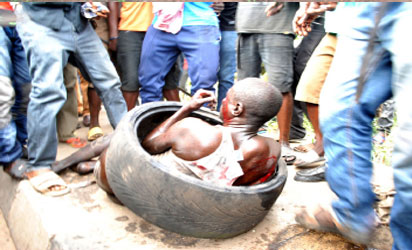
A man from Igege in Osun State was apprehended with mutilated human body parts on Wednesday. His identity, however, could not be confirmed immediately.


Some residents were said to have notified security agents after becoming suspicious of the man’s movements.


The suspect was forced to bring out mangled human body parts from a bag while several bystanders beat him with sticks and screamed profanity at him, according to video footage captured at the scene of the crime.


The suspect could also be heard in the video denying his involvement in ritual killings and criticising persons he claims to have set him up.


Residents attempted to lynch the man, and members of the Hunters Group of Nigeria and the Amotekun Corps were brought to the scene.


Sunday Olaifa, Chairman of the OlaOluwa South East Local Council Development Authority, informed our correspondent that once the man was apprehended, villagers attempted to lynch him, but he was saved by security personnel.


Olaifa, who said he had to rush to Igege to appeal to the villagers, sought a thorough probe into the situation to guarantee that justice was delivered.