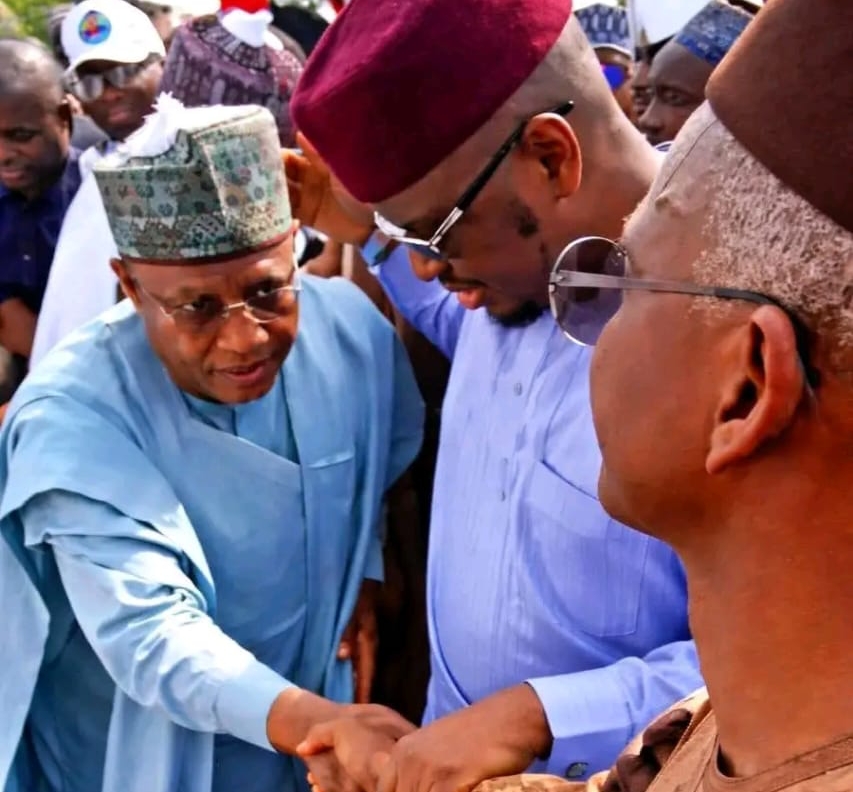
When Grief Softens Hearts: A Moment Misunderstood
By Nasir Yakub
In moments like these, society often reveals not just its opinions—but its depth of understanding.
The criticism directed at Prof. Isa Ali Pantami for attempting reconciliation between Nasir El-Rufai and Uba Sani during a moment of grief is not entirely surprising. What is surprising, however, is how quickly we rush to question sincerity where reflection is most needed.
We often speak about peace as if it should arrive only under perfect conditions, carefully scheduled, emotionally neutral, politically convenient. But history, human nature, and even faith teach us otherwise: true reconciliation rarely waits for ideal timing. It finds its way through cracks, through pain, through loss, through moments when the soul is stripped of its usual pride.
A funeral is not just a ceremony of farewell. It is a confrontation with reality. It is a silent sermon louder than any speech. In such moments, hearts soften, egos retreat, and the illusion of permanence fades. If there is ever a time when a word of peace can penetrate deeply, it is then.
So what did Pantami truly do?
He recognized a moment many would ignore.
He spoke where many would remain silent.
He acted where others would hesitate out of fear of perception.
And yet, he is criticized, not for division, but for daring to suggest unity.
Let us ask ourselves honestly:
If he had remained silent, would these same voices not accuse him of cowardice? Of political bias? Of abandoning the moral responsibility to speak truth?
We must be careful not to create a society where every action is condemned and every silence is also condemned. That is not accountability; that is confusion.
To those who argue that reconciliation is misplaced because of past betrayals, one must ask: is politics not a landscape of shifting alliances? Did differences between Atiku Abubakar and El-Rufai prevent gestures of humanity in times of grief? Today, former adversaries stand side by side. Yesterday’s distance becomes today’s alliance.
This is not hypocrisy. This is reality. And perhaps, more importantly, it is a reminder that human relationships are larger than political disagreements.
Peace is not weakness.
Reconciliation is not surrender.
And timing, as we often misunderstand it, is not always about comfort; it is about opportunity.
Prof. Pantami did not force reconciliation. He did not impose unity. He simply opened a door.
Whether those involved walk through it or not is their choice. But opening that door, at a moment when hearts are most receptive, is not insensitivity. It is wisdom.
In the end, the real question is not whether the timing was perfect. The real question is:
When the opportunity for peace presented itself… would you have chosen silence?