The modern discourse around housework for wives from the Islamic legal perspective has garnered beyond the adequate level of scholarly attention. It is as old as the marriage institution itself in the Islamic tradition.
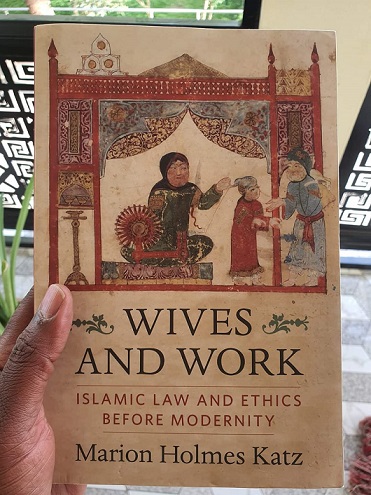
The book, Wives and Work: Islamic Law and Ethics Before Modernity, published in 2022 by Columbia University Press, is a compelling and intellectually rigorous work that broadly contributes significantly to Islamic studies and gender studies.
Marion Holmes Katz’s meticulous research and refined analysis dismantle stereotypes and offer a fresh perspective on the complex realities of Muslim women’s lives. By engaging with Islamic legal and ethical traditions, the author not only deepens our understanding of the past but also provides a platform for critical reflections on the contemporary challenges and possibilities surrounding women’s roles as wives and their engagement in the workforce within Muslim-majority societies.
The book adopts a well-structured framework with an elaborate introduction followed by four body chapters and concludes with a thoughtful synthesis. Each chapter is dedicated to the diversity and development of fiqh discussion of domestic labour for the respective periods of the four Sunni schools of law.
The first chapter emphasises the formative period of Islamic law (8th-9th century CE) with a profound exploration of the Islamic literary corpus reflecting the social realities of the early Islamic community, then focusing heavily on wives’ domestic labour in the Maliki legal school.
Moving into the 10th century CE, the second chapter of the book examined the issue of domestic labour through the lens of Shafii scholar Abul Hasan al-Mawardi using his legal manual, Al-hawi al-Kabir, as a paradigm for deconstruction but at the same provided a captivating contrast through his ethical manual Adab al dunya wal din.
Chapter three navigates into the intellectual realm of the Hanafi school of law, specifically focusing on the legal manual Al-Mabsut by the esteemed Hanafi scholar al-Sarakhsi. This comprehensive investigation illuminates al-Sarakhsi’s profound analysis and interpretations pertaining to domestic labour, offering an in-depth understanding of the Hanafi school’s intricate perspectives.
Geographically and temporally shifting to the post-classical period in Damascus, chapter four directs its attention to the Hanbali school of law. The focal point of analysis lies in a meticulous exploration of Ibn Qudama’s seminal work, which would later face extensive challenges from the visionary scholar Ibn Taymiyyah. Ibn Taymiyyah’s radical approach to the subject matter promotes a ground-breaking and transformative vision of the ethics of marriage, firmly rooted in the Qur’an and hadith traditions.
As Nigeria approaches May 29, the inauguration date of a new administration, newly elected lawmakers and politicians have intensified the lobby game. The Muslim Rights Concern (MURIC), an Islamic human rights group, has also joined the debate. Though a Muslim group, MURIC wants the Senate presidency to go to a Christian from the South. The group has therefore called on all Muslims vying for the post to withdraw.
This was made known in a statement issued on Thursday, May 18, 2023, by the Executive Director of the group, Professor Ishaq Akintola.
The statement reads:
“As the clock ticks away for the 29th May inauguration date of the Bola Tinubu administration, elected lawmakers and politicians have intensified the lobby game. We have seen how the different geo-political zones, as well as individual politicians and stakeholders, have demanded key positions in the National Assembly.
“Chief among those positions is the Senate presidency as it is the Number 3 position in the country after the president and vice president. As a major stakeholder in the affairs of Nigeria, we have followed with keen interest the imbroglio, which greeted the Muslim-Muslim ticket and how it ended in Nigeria having a Muslim President-Elect and a Muslim Vice President-Elect.
“In view of this outcome and considering the multi-religious character of our dear country, Nigeria, it is our considered opinion that the post of senate president should go to a Southern Christian. Nigeria needs the cooperation of both Muslims and Christians because only such collaboration can engender peace and development.
“Although we are a Muslim group, we believe very strongly that Muslims should not take all the top posts despite being the undisputed majority group in the country. Muslims must be ready to share power with their Christian compatriots. Politics is a game of give and take, and Nigerian Muslims must play it right.
“We must all be ready to demonstrate a willingness to work together as a people in spite of our religious differences. Afterall, there is no Muslim electricity supply, no Christian roads, no Muslim public transport system and no Christian naira. Our problems are identical, and whatever affects our country affects both Muslims and Christians together.
“A good example is COVID-19. Hunger knows no Muslim, and malaria knows no Christian. Poverty is common among the adherents of both faiths. Let us, therefore, share what belongs to all with love and find solutions to our common problems together.
“MURIC, therefore, calls on all Muslim candidates vying for the position of the senate president to withdraw in order to allow Christian candidates from the South to have a free hand in the competition (preferably the South-South because the South East has occupied the post on several occasions).
“In addition, MURIC tips any suitable candidate from the North West for the post of deputy senate president in view of the fact that the zone gave the largest number of votes to the party and the candidate that won the election.”
The Muslim Rights Concern (MURIC) has called on the President-elect, Bola Ahmed Tinubu, to reward Governor Nasir El-Rufa’i of Kaduna State with a juicy post for his enormous contribution towards the attainment of Tinubu’s success in the 2023 presidential elections.
MURIC made this passionate plea on behalf of El-Rufa’i in a statement by its Executive Director, Professor Ishaq Akintola, on Monday.
Akintola stated that MURIC deemed it germane to remind Tinubu of the need to pay debts owed and appreciate those who made his current status a fait accompli.
According to him, this is important in order to start sowing the seed of success for the incoming administration as well as to secure a strong foothold for 2027.
He further stated that El-Rufa’i should reap the rewards for standing between those in the corridor of power and their inglorious choices.
The statement read, “As the days inch closer to the inauguration of the new administration of Bola Ahmed Tinubu as President of the Federal Republic of Nigeria and Commander-in-Chief of the Nigerian Armed Forces, the Nigerian political spectrum has been inundated with power struggle intrigues and post allocation schemes.
“This is not new to us since we know that failure is an orphan, but winners are always surrounded by all and sundry.
“However, we deem it germane to remind the President-Elect of the need to pay debts owed and appreciate those who made his current status a fait accompli. This is important in order to start sowing the seed of success for the incoming administration as well as to secure a strong foothold for 2027.
“Gratitude is a major characteristic of a good Muslim. Allah says in the Glorious Qur’an, “If you are grateful, I will increase my favours on you…” (Qur’an 14:7). If the President-Elect shows appreciation to the ‘Noble Dozen’ from the North, he will enjoy more of their solidarity.
“It is noteworthy that the ‘Noble Dozen’ (i.e. the twelve governors who insisted that power must shift to the South) was led by Governor Nasir El-Rufai of Kaduna State. There is no Nigerian who is unaware of the unique support and unequalled solidarity given by this Northern group to the President-Elect. El-Rufai, in particular, left his palatial office in Kaduna to spend days in Abuja.
“His contribution to our victory, the victory of the Muslim-Muslim ticket, is unquantifiable. He became the mouthpiece of the Muslim-Muslim ticket camp, moving from one media house to another. We must not allow all these to go in vain.
“In particular, we must remember the risk El-Rufai took as he stood between those in the corridor of power and their inglorious choices. We must not forget his bold confrontation of the central bank governor over the latter’s misguided, ill-fated and accursed naira discolouring.
“It will beat all imaginations and expectations, particularly among Muslims if El-Rufai is not considered for a juicy post in the cabinet of Bola Ahmed Tinubu. We have played national politics the way it should be played. But now is the time to be focused. Choice positions should not be allowed to go to political charlatans, fairweather friends, hypocrites and parasites. El-Rufai is a different cup of tea. He is tested and trusted. He is the icon of Northern dignity.
“To the President-Elect, we have this to say: guard very jealously the good relationship and the alliance between the North and the South West. It is a union steeped in historicity. Compensate the North for its dignity and integrity without being unfair to the rest of the country.
“We bequeath you the burden of Nigeria. Your road will be rough, no doubt about that, but with prayers and your well-known administrative acumen and political sagacity, Almighty Allah will clear the bumps and roadblocks for you,” the statement added.
The last time I saw Abdulaziz was on the evening of Tuesday, May 2, 2023. He was on the way to the sick bay supported by Waziri and Albani. Nasir, the NAMLAS president, was also in their company. A bike was eventually called upon to convey them there. Sadly, that was the last time I saw him in flesh and soul. In his infinite wisdom, the Creator has decreed that “every soul shall taste death.” And the time came for Abdulaziz on the evening of Thursday, May 4, 2023.
As Muslims, we believe and submit to the will of Allah. However, a week after Abdulaziz’s demise, I still live in self-denial. Everything seems too sudden, and I still wish it is a terrible nightmare. It’s somewhat unfathomable that he did not complete the examinations he so much prepared for and started with us. Like many final-year law students, Abdulaziz’s mind was already in the Nigerian Law School, and preparation was underway. His demise was the least expected way to say goodbye.
I have known Abdulaziz since we assumed academic activities in January 2017 at the Faculty of Law. However, we became closer in our fourth year when we shared room 90 of Ali Akilu hostel. He would spend much of his time listening to scholars of comparative religion. Videos of Zakir Naik and the late Sheikh Ahmad Deedat dominated his phone gallery. He had an unquenchable thirst for the study of comparative religion, and he was ever ready to share this knowledge.
A week before his death, he had addressed us after morning prayers in Al-Muntada Mosque and emphasised the need to study comparative religion. He undertook to take the course to willing participants in the second semester.
Like many of us, Abdulaziz was a man with dreams for a great future. When we lived together, he narrated the ordeals that led him to study law after he completed NCE and became a certified teacher. That’s a pretty long story, but the bottom line is that he had a reason to work hard, and he worked very hard. He knew where he was going and what it took to get there, and he was set for the journey to greatness at dawn. Sadly but with gratitude to the will of the Almighty, his light was blown out in his prime.
Allah endears his loved ones to people. Abdulaziz was loved by many. This was evident in the crowd that graced his funeral. His teachers, colleagues, friends, students and even non-Muslims were all at Haruna Danja Mosque to bid him farewell. The love the people had for him did not end with him; it extended to his immediate family.
A few days after his death, classmates and friends raised more than half a million for his wife and the two children he left behind. I think he is loved by Allah, who perfected his character and made him the darling of everyone whose path he had crossed. He always met all of us with a cheerful countenance, and he was never known for engaging in frivolities. As much as this is my opinion, I am not subjective. My opinion about him would not have been different if he were alive.
Abdulaziz will be missed for many reasons and by many people. He left a positive mark on the lives of many. The local chapter of the Muslim Student Society of Nigeria (MSSN) of the Faculty of Law will miss him dearly. He had been a committed official since his admission to the faculty and was committed till his transition.
Abdulaziz’s teachers and classmates will miss him greatly. He was an exceptional student who spoke and asked questions in class when necessary. I remember vividly how he was asked to translate Suratul Kafirun by Professor Danladi in our last Jurisprudence and Legal Theory class. Unfortunately, that was just two weeks from his unanticipated exit.
He also left a vacuum to be filled at the Kongo Campus Islamiyya, where he taught Tawhid, amongst other courses. His learned brothers at the Student Bench and Counsel, who had appeared before him while he was Khadi of the student judiciary, will miss his judicial wisdom and excellent understanding of Islamic Law.
Besides his family, whose pain at this difficult time is unimaginable, Abdulaziz will be in our pleasant memories for a long time. As the reality of his death sets in, I feel his absence. May Allah forgive him, forgive us, console us and take care of his family, ameen
His name was Tijjani, and nicknamed Ma’aslam. He mainly lived in the Sabon Sara ward, Kano city, but was a common sight along the Mandawari junction to Kasuwar Kurmi corridor in the 1960s.
Everyone considered him nuts. Apparently, he built a single-storey building without stairs to access the upper floor. He did not think a door was necessary for any structure either, so the building had no doors. He simply jumped up to the upper floor at night and jumped down in the morning. It was enough for the ward head to report him to the Jakara magistrate for him to be locked up on insanity charges.
During the hearing, he was given a basket to fetch water. He simply laughed at the judge, informing him that only a madman would attempt to fetch water in a basket. The judge threw the case out, declaring him perfectly rational. He may be nuts – although eccentric was more apt to describe his behaviour. But then, it takes a certain amount of nuttiness to be an innovator. And he was an innovator.
As children – and I am talking 1960s inner city Kano – we simply referred to him as Ma’aslam. He, I would argue, planted the seeds of onomatopoeic intertextuality in Hausa popular culture, at least in Kano. This was the process of picking up an element of popular culture, say, a song, converting it side-by-side into a different language (intertextual), using ‘sound-alike’ of the original (which is onomatopoeia) into a new one. A quick example was the Bob Marley hook:
Get up, stand up,
Stand up for your rights
Sadi Sidi Sharifai, a Kano onomatopoeic superstar, converted this to:
Jallof, Jallof,
Jallop, sai da rice
Try singing both the original and Sadi’s interpretation, and you have become an onomatopoeic star yourself!
In 1967, the American super soul star James Brown & the Famous Flames recorded the stunning live double album of their concert at the Apollo Theatre in New York. It was, perhaps unimaginatively enough, titled, ‘Live at Apollo.’ A standout track on the album was ‘I Feel Alright’. Its choral hook was:
‘Hey, hey, I feel alright
One time, uh!’
The album of the concert was released on 16th August 1968. I was 12 years old then, and still now, totally wired in music, complete with a Ukulele guitar, given to me by David Hofstad (author of Tabarmar Kunya play). My Dad, an avid music lover, noting my attachment to the song which was played on the radio, simply bought the double album for me at Musa Zamani Record store in Fagge (are there any old codgers who remember this record store?). I played it to death on the old Grundig music player we had then.
Back to Tijjani Ma’aslam. With his eccentric behaviour categorising him as loony, Ma’aslam started reciting the ‘Dalailul Khairat’, a celebrated manual of salutations upon the Prophet Muhammad (SAW), written by Muhammad ibn Sulayman al-Jazuli in 15th century Morocco. What was unique about Ma’aslam’s open-air recitation, however, was that he adopted the James Brown meter in the song, ‘I Feel Alright’, as his chorus. His rendition of the hook for his recitation of the Dalai’lu was:
Mujibun, Mujabun,
Afiyan, Afuyan,
Rasulillahi
Ahlan wa Sahlan
Rasulillahi
This was accompanied by James Brown’s dance moves (shown on Television’s Soul Train, which was available in a few houses that he might have access to). Maybe he was not reciting the salutations in their structured order, but at least his verses were discernible, as the Dalai’lu itself was recited in a song form by many reciters in Kano. What he did, and did it differently, was using a foreign music meter to make it more accessible. This formula was to be adopted by the Ushaqu Indiya group of devotional singers in the city of Kano (actually along the same neighbourhood as Tijjani Ma’aslam). More of this in subsequent articles/posts.
Tijjani Ma’aslam’s delivery mode was intertextually onomatopoeic to ‘Hey, hey, I feel alright’. The chorus was ‘Rasulillahi’. Ma’aslam was usually followed by a gaggle of kids echoing the chorus while he merrily led the way, clapping his hands, dancing and reciting the names of the Prophet from the Dalai’lu. Elders were bemused at the spectacle and simply labelled Ma’aslam crazy. He might have been. He certainly was not following the sequencing of the Salawat from the book. But his performances opened a door.
Up the road from his haunt and covering the same zone was the Palace cinema. This was built and completed in 1951 and opened in 1952. Palace cinema became an instant hit with the youth, closeted in the city and without any visible means of night-time entertainment. Before its opening, and still a carryover from the World War II years (1939 to 1945), a curfew used to be imposed on city residents at 8.00 p.m. With the relaxation of the curfew, the few neighbourhood plazas (dandali) that offer games for youth (both boys and girls) were no match for the sheer spectacle of a massive screen accompanied by loud music. The predominant films shown in the cinema were cowboy or mainstream European films. However, after independence in October 1960, Indian films started to be shown from November 1960 in Kano cinemas. Early films screened included Cenghiz Khan, Jaal, Sangeeta, Raaste Ka Patthar, Waqt, Amar Deep, Rani Rupmati, Dharmatama, Dost, Nagin and thousands of others. The one that caught massive imagination in Kano’s inner city, however, was Rani Rupmati, originally released in India in 1957 but only found its way to Kano cinemas in the 1960s.
Like all Indian films, at least from what the industry refers to as Bollywood, Rani Rupmati had a lot of songs – in fact, its overall screenplay is based on two people united by their love of music. However, two songs from the film caught Kano’s inner city imagination, ‘Itihaas Agar Likhna Chaho’ and ‘Phool Bagiya Mein Bulbul Bole.’ Interestingly, there was no choreographic dancing in these two songs, unusual for general Bollywood films but typical of earlier, more historical and artistic ones.
The first, ‘Itihaas’, sung by Lata Mangeshkar, has a great hook that, thanks to Tijjani Ma’aslam, became domesticated by kids along his sphere of influence and Palace cinema zone. It goes something like this:
Itihaas agar likhana chaho /
Itihaas agar likhana chaho /
Azaadi ke mazmoon se /
…
To seencho apni dharti ko /
Veeroon tum upne khoon se /
Har har har Mahadev /
Allaho Akubar /
Har har har Mahadev /
Allaho Akubar /
Sung within the backdrop of a band of warriors getting ready to go into a battle, led by a woman (the titular Rani Rupmati), it certainly gave the picture of a woman more enlightening than what was both the Hausa and Indians are used to. The film itself endeared itself to Hausa through the modesty of the women – shy drooping kohl-enhanced eyes with long blinking lashes, fully clothed (even the swimming scene shows the singers fully clothed in the river), with sari that resembles Hausa wrapper (zani), lots of jewellery, and stunning beauty. A Hausa common saying of the period was, ‘Allah, kai ni Indiya ko a buhun barkono’/God, let me visit India even in a sack of pepper. That was how besotted Hausa youth were to the beautiful Indian women seen on the screen, giving a false impression that every single Indian woman is beautiful.
Hausa youth, inspired by Tijani Ma’aslam, quickly domesticated the chorus of the song as:
Ina su cibayyo ina sarki / where are the warriors, where the is king?
Ina su waziri abin banza / And the useless vizier?
Mun je yaƙi mun dawo / we have return from the war
Mun samo sandan girma / and we were victorious
Har har har Mahadi / hail, hail the reformer
Allahu Akbar / Allah is the Greatest
Har har har Mahadi / hail, hail the reformer
Allahu Akbar / Allah is the Greatest
In an interesting case of lyrical substitution, the Hausa intertextual transcription captured the scene of the song as shown in the film, if not the actual meaning of the words. Loosely translated, the original verse was urging warriors to defend their land with their lives and become part of history. The chorus translates as ‘Let each of us sacrifice ourselves to Mahadev’.
While Mahadev was a reference to the Indian deity, Shiva, this pantheistic line was followed by a monotheistic reference to Allah, the Supreme Being in Islam. Thus, two contrasting religious sentiments were expressed in the song. It was likely that S. N. Tripathi, who directed the film and composed the music, introduced the chorus to attract both Hindu and Muslim audiences. After all, while Rani was a Hindu, her love interest in the film, Baaz Bahadur, was a Muslim. The expression, however, has since then been used as a slogan of communal harmony between often warring Hindu and Muslim communities in India.
But more stunningly, the Hausa version substituted the word ‘Mahadev’ with ‘Mahadi’. The Hausa heard ‘Mahadi’ (guided one), not ‘’Mahadev’, which worked perfectly well. Substituting Mahadev for Mahadi Islamized the song, as it were. In Islamic eschatology, Mahdi is a messianic deliverer who will fill the earth with justice and equity, restore true religion, and usher in a short golden age lasting seven, eight, or nine years before the end of the world.
The second song from the film, ‘Phool Bagiya Mein Bulbul Bole’ (also sung by Lata Mangeshkar, with Mohammed Rafi), also inspired onomatopoeic intertextually but further afield from Kano and bizarrely entered into Hausa urban legend of the 1960s. Its first verse goes something like this:
Phul bagiya me bulbul bole /
Daal pe bole koyaliya
Pyaar karo /
Pyaar karo rut pyaar ki aayi re /
Bhanwaro se kahati hain kaliya /
Ho ji ho ho ji ho ho ji ho /
Ho ji ho /
What Hausa youth heard in the choral refrain was ‘Hotiho’, not ‘Hojiho’, and in the film Rani Rupmati, the lady (played by Nirupa Roy) came to be referred to as Hotiho. The Hausa griot, Mamman Shata (d. 1999) popularised the word (which has no particular meaning) in his song, Mallam Sidi, ‘Mijin Hotiho’/Mallam Sidi, Hotiho’s husband.
In the film, there was no marriage between Rani and Baaz Bahadur because she said she was ‘married to her music’, despite living with him after running away from home to avoid death from a chalice of poison given to her by her father to avoid the shame of her rejecting a chosen husband. In all their dialogues, Rupmati and Baaz Bahadur stress their shared love for music, not their love for each other. So, Shata did not accurately describe the relationship in the film. However, such deep film analysis is not important to the transnational interpretation of Shata of Baaz Bahadur as a signature tune for a hen-pecked husband. Shata’s interpretation of the actor who played Rani’s lover was certainly in order as he was effeminate and obsessed with music rather than empire building, despite being heir to a throne. It was even Rani who led their army into war. He was wounded in the battle and ran away.
Another Hausa griot, Ali Makaho (d. 1984), known famously for his anti-drug song, ‘Mandula’, briefly referenced Rani Rupmati in another of his songs.
Za ni Kano / I’m going to Kano
Za ni Kaduna / I’m going to Kaduna
Mu je Katsina lau za ni Ilori / Let’s go to Katsina and Ilorin
Na je Anacha / I will go Onitsha
Ni ban san kin zo ba / I didn’t know you had arrived
Da na san kin zo ne / If I had known you have arrived
Da na saya miki farfesu / I ‘d have bought you [pot of] pepper soup
Hitoho hotiho /
Hotiho hotiho /
With a comedy skit thrown in, Ali Makaho’s rendering uses Phoolbagiya’s meter to narrate a series of anticipated travels over northern Nigeria. As an intertextual comedy, it worked and remained of his most memorable skits.
A third Hausa griot to adapt a song from Rani Rupmati was Abdu Yaron Goge, who played the goge (a large fiddle played with a bow). Abdu picked ‘Raat Suhani’ from the film for his adaptation. Since, unlike the other griots who used the elements of the songs from the film, Abdul was a musician, he used two approaches – first was rendering the symphonic structure of the opening bars of the actual composition, Raat and playing it on his fiddle, then secondly, he onomatopoeically appropriated Mangeshkar’s lyrics as Hausa version. The original lyrics were as follows:
Raati Suhani /
djoome javani /
Dil hai deevana hai /
Tereliye /
Tereliye /
These lines were pure expressions of love the protagonist has for her lover, especially ‘in the beauty of the night’ [raati Suhani]. Abdu Yaron Goge’s rendition was as follows:
Mu gode Allah, Taro / We should thank Allah, people
Mu gode Allah, Taro / We should thank Allah, people
[These lines vocalized the opening bars of Raat]
Duniya da daɗi /This world is nice
Lahira da daɗi / The hereafter is nice
In da gaskiyar ka / If you are truthful
Lahira da daɗi / The hereafter remains nice
In babu gaskiyar ka / If you are untruthful
Lahira da zafi / The hereafter is blazing
Thus, in a single verse (which he kept repeating over and over till the end of the performance), Abdul Yaron Goge borrowed a popular musical motif from another culture and domesticated it to Hausa entertainment. At the same time, he delivered a message totally different from the original meaning.
There were, of course, many other onomatopoeic intertextual interpretations of Indian film songs, but the three songs from Rani Rupmati, predated by Tijjani Ma’aslam’s innovative use of foreign motifs, were the definitive pioneers in music. In Literature, look towards Abubakar Imam and Magana Jari Ce. The intertextual origins of Hausa arts, of course, started in the 1930s; but its migration to music was certainly in the 1960s. It spawned a Hausa Cinema industry which was labeled ‘Kanywood’ in 1999, a few years before the term ‘Nollywood’ to refer to the Nigerian English language cinema, was created.
On a final note, Nazeer Abdullahi Magoga, a Kano ‘Indian’ (who speaks the language fluently, to the shock of BBC Delhi, who sent a crew to interview him in Kano, in Hindi) composed a song for the Centre for Hausa Cultural Studies, Kano which I was heading, but which I had to pause due to lack of funding. He used the Raat Suhani meter and used both Hausa and Hindi lyrics in his wonderfully beautiful tribute to the Centre. A link to the song on YouTube is given below. To really appreciate Nazeeru’s performance, listen to the original Raat Suhani from the film Rani Rupmati, also provided in a link.
Cibiyar Nazarin Al’adun Hausa by Nazeer Magoga [Raat Suhani template]
I am writing to express my firm belief in the need to consider re-installing Sarkin Kano Muhammad Sanusi II as Emir of Kano. As you are fully aware, Emir Sanusi II was illegally dethroned in 2019, allegedly for supporting your governorship ambitions, despite the absence of credible and substantiated evidence to support that claim. However, reinstating him will set your tune of kicking out all illegalities perpetuated by the Ganduje administration over the years. Additionally, I believe that his installation is one crucial point for you towards your effort to bring back Kano on the route of development previously set by the administration before Ganduje’s.
During his previous reign as Emir, he brought about innovative changes that standardised the ethics and customs of the institution. He organised massive seminars, workshops, and symposia for title holders to share ideas and strengthen the Kano traditional/sarauta institution. He also ensured that any member found violating standard ethics or even involved in immoral activity was thoroughly punished.
Additionally, he was reported to have improved the welfare package of junior workers of the emirates. He provided career opportunities for many of them, something that anyone could not have imagined many years ago. Therefore, it was safe to say Emir Sanusi II laid the foundation for the institution’s changes to strengthen its course as a principal legacy of the Kano people and “Kasar Kano’.
Considering the unity of the system, Emir Sanusi made sure that all other members of the ruling houses and other renowned houses of royals and clerics who felt neglected were brought back and given a sense of belonging. For example, he brought back the house of the late Emir of Kano Muhammad Inuwa Abbas (1963-1963) by turbaning his son Yahya Inuwa Abbas as Dokaji and later Dan Maje. In addition, he settled the dispute surrounding the Wazirin Kano title by giving the title back to the Waziri Gidado family. He also revived the houses of Sarkin Kano Alu (1894-1903), Danlawan Ayuba, Sarkin Shanu Hamza, Danburam Abubakar, Magajin Gari Inuwa Wada, Sarkin Fada Sule Gaya, Marafan Kano Sule, Danmasanin Kano Yusuf Maitama, Ma’ajin Kano Umaru, and many other aristocratic houses in Kano.
Furthermore, as part of his bicentenary celebration to mark 200 years of establishing the Dabo dynasty, preparations were in the final stages to bring back other houses, including your own house/family (descendants of Galadiman Kano Yusufu Maje Garko), Danburan Haruna, Galadima Khadir, Dan Isa Sanda, Sarkin Shanu Hassan, and surprisingly even the descendants of Sarkin Kano Tukur (1893-1894). The importance of bringing back these houses cannot be overemphasised, particularly in establishing unity and stability of the traditional institution in Kano.
According to many people, the neglect of many of these houses over the years has contributed to the continuous down-spiralling route the emirate had faced, something anarchists like Ganduje took full advantage of to bring destruction to family and the Kano traditional institution.
Emir Muhammad Sanusi is the only capable, noticeable figure within the “Bani Dabo” (apart from you) who has the resources, power, and connection to shoulder the burden and drive the institution to further development and greatness. He commands respect among government officials, fellow traditional leaders, clerics, and politicians from different backgrounds and sections of this country. In this aspect, your government can take full advantage of that. As an Emir, he can lead the Kano contingent on any assignment to boost Kano’s image and prestige. You have nothing to worry about with Emir Sanusi going anywhere because, as the famous Hausa praise saying goes, “Ranar fita kunya sai da Muhammadu.”
Emir Sanusi could also foster religious unity in Kano and, by extension, the country. With his position as the Khalifa of the Tijjaniya Sufi sect, he commands complete allegiance and fellowship of the sect. Additionally, his cordial relation with Izala scholars in the state and beyond, such as Dr Bashir Aliyu Umar, Sheikh Aminu Daurawa, Dr Nazifi Inuwa, Prof Mansur Sokoto, etc., as well as the Qadriyya, particularly its leader Sheikh Kariballah Kabara is vital to foster the religious unity and harmony thereby ensuring peace and stability in the state.
In terms of government policy development, Emir Sanusi is the perfect ally. You could wisely tap into his vast connection around the globe alone. He can lead an economic revolution in the state, provide advice on economic policies and be at the forefront of wooing investors. His connections to international firms like black rhino, African development bank, Islamic development bank etc., is the perfect avenue for you to exploit to bring about the much-needed changes Kano state needs. As I read, some of your campaign promises can be achieved swiftly with his insight and possibly heading.
For example, the policy of sending students (Kano indigene) abroad to postgraduate training. With his connection to educational centres and institutes worldwide, he can link with many universities and your government to achieve understanding and agreement. Knowing him, he may even convince some institutions to set up campuses and centres in Kano to facilitate educational growth further, as it is on your agenda for the state.
Like your proposed health policy, his connections with United Nations as a Sustainable Development Goals advocate, and health NGOs worldwide suit your government’s exploit. Through these bodies, grants and funding could be accessed by your government to improve health infrastructure, particularly in our rural areas suffering from difficulties in health care infrastructure.
Finally, it is important to note that bringing back Emir Sanusi II will benefit Kano State and the entire country. He is known to be a vocal advocate for good governance, accountability, and transparency, which are much needed in our country today. He has also participated actively in national discourse and contributed immensely to shaping public opinion on critical issues such as poverty, education, and healthcare. His return to the emirate will undoubtedly enhance his capacity to contribute to national development, a benefit that cannot be overstated.
In conclusion, I hope you will consider reinstating Emir Muhammad Sanusi II as the Emir of Kano. His reinstatement will bring stability and development to the Kano traditional institution and provide a platform for the state government to tap into his vast wealth of knowledge, experience, and connection for the overall state development. Thank you for taking the time to read this piece.
We all know and believe that marriages are associated with numerous cultures. These cultures come together to add flavour to the unforgettable memories that would be created in the minds of the brides and grooms during so many events of marriage celebrations.
The indelible joys and memories of marriage ceremonies usually transcend to even the minds of parents, friends, and relatives of both the brides and grooms. So, the importance of all the events associated with marriage ceremonies cannot be overemphasised in many cultures.
However, adopting the so-called Western civilisation has marred many events associated with marriage ceremonies, especially in the Northern-Muslim societies of Nigeria.
For instance, not more than a decade ago, the bride’s popular “Kamu” or “Sa lalle” usually took place in a sister’s house to the bride’s mother. And the people that would be in attendance at this event will comprise only the closest friends of the bride and some of her few female acquaintances.
Unfortunately, today, such events usually take place in outside rented event centres where the groom and his friends could be in attendance too. Not only that, it’s possible for a dance competition between the groom and bride, or between the groom’s friends and the bride’s friends during this historically decent event.
The most moving part is that it’s now a normal and unpreventable trend in so many events associated with marriage ceremonies that the brides must appear almost half-naked. So instead of the decent “riga da zani of Atamfa“, the bride will wear a Western wedding gown.
Even if the dresses are tailored locally, they will not only be diaphanous that one can see through, they are ensured to be tight enough to reveal all the contours and bumps in the bride’s body. And it’s in this kind of dress that the dancing will take place. So common. Are we really in our senses?
Remember, I insinuated earlier that parents usually attend these kinds of events. Can’t they stop it? Is it now normal for them too? I am sure our forefathers are not like this. And they didn’t train their children to be like this. Why only us?
I think Muslims need to be careful with this ‘alphaness’ ideology that some of our brothers are advocating among Northern Nigeria’s netizens. They seem to encourage men not to sympathize with women, especially their wives, and to show no empathy when dealing with these women entrusted with them as wives. Most of these views come from what is termed ‘taken the red pill,’ essentially, men who have been awakened from feminist delusion to the supposed reality that society is fundamentally misandrist and dominated by feminist values.
This is contrary to the teachings of Islam. And while ‘taken the red pill’ advocates go this extreme as a counter to the other extreme of feminist ideologies that openly promote rebellion and hate against the menfolk, both perspectives tend to be against the teachings of Islam, which expect Muslims to take the middle course, often. And although we see writings from some Muslim women in the North suggesting that they have imbibed these feminist ideologies, there is no justification for going the other extreme.
The Prophet (SAW) said women were created from the most crooked rib, and if you insist on straightening her, you will break her, which means to divorce her. He (SAW) taught Muslim men not to expect perfection from women. Even his wives, the mothers of the believers, were cautioned in the Qur’an on some of their behaviours towards the Prophet (SAW). How, then, could one expect perfection from other Muslim women?
Yes, Islam expects total obedience to husbands from women in what is not Haram, and a woman who fails to obey her husband is living in sin. She is to serve him and should not even go out of her home without his permission, among other duties. The Prophet (SAW), after an Eid prayer, went to the women’s side and informed them that one of the reasons that some of them may be taken to hellfire on the last day is their disobedience towards their husbands.
But as humans, some women will fail in fulfilling the rights of their husbands just as some men will fail in their responsibilities too. Some women are evil in their actions and treatment of their husbands, just as some men are next to Satan in the way they treat their wives. These are by no means reasons to hate on the womenfolk, in general, nor the men in toto.
Husbands, as leaders, are expected to be full of forgiveness and understanding and should show appreciation for the good side of their wives. Qur’an Chapter 30:21 says, “And of His signs is that He created for you from yourselves mates that you may find tranquillity in them, and He placed between you affection and mercy. Indeed, in that are signs for a people who give thought.” This is the way a couple should be seeing themselves.
Again, being kind, helpful, and emphatic to your wife is Sunnah. It is even commanded in the Qur’an, Chapter 4:19 says, “… And live with them in kindness …” The Prophet was helpful to his family in every way possible. He wasn’t washing plates nor sweeping the apartment every day as some Muslim women want to emphasize, but it is on record that he did help – maybe a few times. A Muslim man will earn rewards if he helps with the intention of following the Sunnah. He will earn rewards when he is helpful, kind, and generous to his wife(s). He (SAW) said the bests among you are those who are best to their wives.
A wise man once said to me that one of the ways to have a healthy marriage is to be as patient as possible with your wife when she fails to fulfil your rights (not adorning herself to your taste, for instance), but you should not ignore her actions when the rights of Allah are not fulfilled (for instance, when she is committing sins, you have to stop her because she is under your care and you will be asked by Allah).
As Muslims, we do not ‘throw women on the street’, and our women do not ‘belong to the street’ regardless of how much we feel they wronged us. We call our wives even if they do not call us; we just assume they are busy with the children or work. We do not live in a tit-for-tat kind of setting with our spouses in which we take revenge for every wrong one does. We do our bit as Islam commands us, even if the other party is not reciprocating as they should. We believe this temporary world is a test, and we do our best to pass this test with the hope that Allah will reward us with the best of His Jannah in the hereafter.
Both men and women should learn from the Prophet’s teachings in their marital lives and not copy the tone of the ‘red-pilled.’ They are reacting to the misandry that they believe is prevalent in the Western world.
Musab Mafara, PhD, can be contacted via nmusabu@gmail.com.
The way time skyrockets must frighten the humanity of every human. It was like yesterday we started to fast the holy month of Ramadan, but today, it has gone like a blink of an eye. And, later, it will come back like a sudden show of lightning—those that will live to the time will see it.
For the reason above, I would like to advise us all by saying; that time isn’t something we’ll play with—one has to milk every opportunity that comes to them. And, don’t dare to lose any worthwhile thing that may come to you in your life—when you do so, it’s challenging to have the ability later.
Secondly, we all remember the good deeds we did during Ramadan, give, read the Quran, perform Tahajjud, and learn numberless things and teachings by listening to our scholars that did Tafseer during the month. So let us continue doing all the profitable workouts, by doing so, our societies will change into a splendour that must attract all people around the globe.
Ultimately, I’ll use this medium to admire each Muslim from every part of the world — precisely, those from Africa who fasted under the taxing situation of sunshiny days and many obstacles. Although, they could eat in their closed rooms and drink when performing ablution, in toilets, offices, and others. However, they didn’t, due to their beliefs that their creator is with them everywhere and in every situation. Therefore, we must be praised, indeed!
There is a clause that is capable of solving many problems, but most of us often use it only to defend our flaws. The clause is: Nobody is perfect. Instead of internalising and living with this priceless statement, we tend to remember it only when people criticise our misbehaviour or mistakes. This clause is much more than a defence tool. Its proper use comes with an invaluable gift: open-mindedness.
Almost every time I come across a war of words (especially such that involves religion) between ordinary people on social media, I quickly blame our inability or refusal to listen to alternative views. I find it unfortunate that my guesses regarding such unhealthy behaviour are usually right.
We sometimes hold certain opinions so strongly that every other view becomes repulsive. This is one reason that makes me doubt if I will ever forget the year 2007. It was a time when I realised the danger of obstinacy. I discovered that a single source or person could never attain a true scholarship. Although it is still a work in progress, when I receive an important piece of information from anyone, I try to examine it or consult other sources to confirm its reliability.
I’ll explain my point with a few examples. In my quest to upscale my communicative competence in English, I follow certain scholars online. One of them, a professor of English, once made a social media post about English grammar, and I noticed a “wrong” pattern in the post. In an attempt to know if that was an exception to the general rules, I told him what I knew about the pattern. He never replied; he only liked my comment. If it were today, I would try to ignore his “mistake” because, considering his status, such a question could embarrass him.
Three years later, I bought a book he authored, and I noticed about six “wrong” patterns, including the one I had asked about on social media. Although the book is an interesting read, when a colleague of mine asked how she could get it for her daughter, I discouraged her because I feared that the teenager might internalise some “wrong” patterns.
Much as I would refrain from stating categorically that the prof is completely wrong, all the sources I have consulted, including the Oxford Advanced Learner’s Dictionary, point to that.
Away from English grammar, there is a renowned Islamic scholar who has been on the international scene for decades. Today, like many other people, he stresses the need to avoid castigating Muslims who try to mend their ways in Ramadan, arguing that the season is an opportunity to turn over a new leaf. However, I once heard him criticise the same category of people, calling them Ramadan Muslims (who are disbelievers for 11 months, only to become the most sincere believers in Ramadan). I would say that his earlier statement was either a mistake or due to a gap in his understanding. He is a human being.
In addition, my little exposure has revealed certain mistakes my teachers (from elementary classes to university) made while I was under their tutelage. I have also realised some of my mistakes as a teacher. My students could discover even more.
This discussion points to one fact: Humans are fallible. If you pointed out one perfect human being today, I would argue that you do not know that person. Therefore, it is advisable to tread very carefully in our interactions with human beings. Although I respect my teachers, [religious] scholars and elders, I believe that there is no single person in the world today whose lifestyles are completely worthy of my imitation or whose statements are totally deserving of my adherence. Instead, I strive to expose myself to multiple sources before taking a stand on issues, especially religious ones. It is dangerous to be obsessed with a single scholar because nobody is perfect.