Land grabbing

Thugs demolish homes in Lagos, demand millions from landlords

By Sabiu Abdullahi

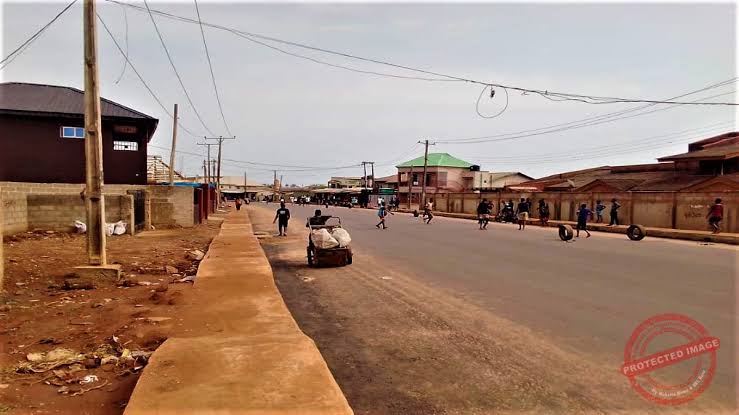
Residents of Surulere Community in Amikanle, near the Command area of Alimosho Local Government Area of Lagos State, have been thrown into distress after suspected landgrabbers invaded the neighbourhood and destroyed multiple properties.

According to a report t a Nigerian newspaper, the Punch, homeowners said the attackers, widely known as Omo Onile, stormed the community on Tuesday, January 27, 2026. They allegedly demanded payments ranging from N15m to N25m from property owners. Those who failed to comply reportedly had their buildings pulled down.

Findings revealed that at least 50 structures have been affected. The demolished properties include residential houses, shops, and perimeter fences.

Residents explained that the invaders arrived in large numbers. They claimed to be acting on court documents from the Federal Housing Authority, authorising them to collect renewal fees. They also threatened to demolish any structure whose owner refused to pay.

One of the children of an affected landlord, identified simply as Oluwafewa, alleged that security personnel accompanied the group during the operation, which lasted about two weeks. He said the development left many families devastated.

“The thugs asked the landlords to obtain a form, which cost N100,000. Then they demanded an initial payment of N5m, with N10m to be paid later. They charged different prices for different houses.

“Some said they were asked to pay N25m, but they demanded N15m from my parents,” he said.

When asked if the group identified those backing them, he replied, “They are working for no one. They are Omo Onile, and they claimed they own the estate. The FHA has told them to desist, as it didn’t authorise any demolition.”

A visit to the area showed heavy damage across the community. Policemen were seen seated in a corner with patrol vehicles parked nearby, while some of the hoodlums remained around demolished structures.

Another resident, who spoke anonymously, alleged that violence accompanied the invasion. He said one individual was assaulted for recording the incident.

“They beat someone who was filming them on the day they first invaded our community. They nearly destroyed the man’s phone. They really dealt with us,” he said.

A different resident claimed the issue had persisted for years. He recounted how his uncle lost property under similar circumstances a decade ago after failing to meet the financial demand.

“My uncle lost his property to them 10 years ago. The matter has existed for years, and I don’t think there is any solution in sight. That was how they came about 10 years ago and demanded N5m from my uncle. He didn’t have the money to give them, and he forfeited his house,” he said.

Angered by the destruction, residents organised a peaceful protest last week. They gathered in front of the affected buildings with placards, calling on Governor Babajide Sanwo-Olu and other leaders to intervene.

One protester said, “They mounted our buildings and removed the roofs. We have been to many offices to lodge complaints, but no help has been offered. At this point, we don’t know what to do.”

An official of the Federal Housing Authority, who spoke anonymously, described the demolition as illegal. The official said personnel sent to monitor the situation were chased away.

“They were impersonating. The FHA didn’t send the thugs. We were told about the incident by the residents. We have written to the Commissioner of Police and even the Lagos State Taskforce to that effect. We also sent our officials to the scene, but the thugs chased them away,” he said.

When contacted, the spokesperson for the Lagos State Police Command, Abimbola Adebisi, said she was unaware of the incident but promised to make inquiries. She did not respond to subsequent calls or messages seeking updates.

The situation has left many residents counting losses and calling for urgent government intervention to halt further demolitions.
Revenue is not a substitute for healthy environment, let’s tell Baba Ganduje

By Murtala Uba Mohammed

Governor Ganduje’s romance with capital project is too obvious and apparent. Only a bias mind can deny him his love for billion of Naira capital projects such as construction of some urban roads, underpasses and flyovers which qualify the city to lead in terms of transport infrastructure all over the country. Governor Ganduje’s interest in commerce and revenue drive is quite vivid considering his bias towards conversion of every available inch of land in the metropolis into commercial property. This is in addition to the proliferation of shops created in over ten markets in Kano Metropolis. In his zeal to generate revenue, Baban Abba has transformed Kano Road Traffic Management Agency (KAROTA) from law traffic enforcement to tax collection agency!

History of Kano would definitely remember this government of converting some of the most sacred spaces such as prayer grounds, cemeteries and historical places into commercial plots. While, Colonel Idris Garba has found it wiser to relocate Kano City Animal Market from its old location to accommodate the increase demand for bigger Kano Central Eid Ground and to give the ancient city a kind of Eid ground it deserves; Ganduje felt it is necessary to downsize it to nearly one fifth of its original size in order to make way for his dearest commercial land use. In fact, governor Ganduje’s romance with commerce qualified him to have national honour award of commercial order for Niger (CON)!

It is also obvious that governor Ganduje has given Kano more than what it requires as centre of commerce by converting the remaining open spaces, green areas, blue ecosystems and city’s recreational gardens into commercial plots, leading to the emergence of multi-million plazas in all parts of the already gentrified city. The case of destruction of the last phase of the city wall along BUK road, the Freedom pond along Gwarzo Road, the Dan’agundi on BUK Road and many other smaller water bodies are just tips of Ganduje’s land conversion icebergs. A case of city garden along Maiduguri is another justification for his romance with commerce.

Also, many waste collection centres were either allocated to Ganduje’s political lieutenants to develop it for commercial use or sold to a highest bidder. No thanks to irrational desperate attitude of Kano people to land acquisition which Bandirawo capitalized upon and coupled with the creation of plots on many state’s parks located in peri-urban local government under the forestry department of Ministry of Environment. Ganduje would have converted city’s Zoological Garden to commercial plot if not for the outcry and serious pressure from good sons and daughters of the State.

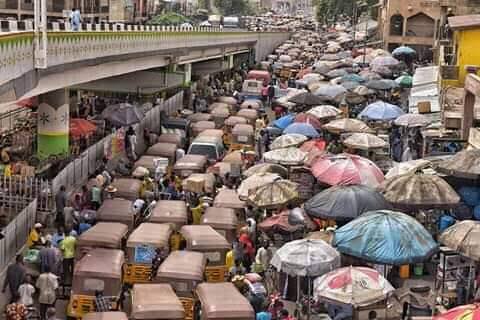
While, expanding the commercial land use and (possibly) enlarging what goes into supposedly state IGR, the government action is negatively affecting the environment. The governors love for the building of commercial areas at the expense of other landuses affects the functioning of the ecosystem there by distorting the near equilibrium state of the environment. A city without parks and green areas is just like child whose nose was covered or severed; suffocation is inevitable and death is the end point. Our governor (whom the law saddled with responsibility of land protection) should be reminded that the green areas are not just for decoration, they are carbon sink meant to absorb harmful air like Carbon dioxide, Sulphur oxides, chlorofloro carbons and other pollutants which are hazardous to human health. They also help in moisture retention, groundwater recharge, check soil erosion and ecosystem stability. The importance extends to social and economic contribution by providing revenue, connecting people with past and providing shades. Kano City is already noisy, building more roads and destroying greens which this administration is supporting and encouraging, make people to own more cars and reduce the functional attenuation city’s noise. In a city where transport is not regulated and left at the mercy of highly informal private individuals, one will just end up with a growth that is going in a reverse way. Today, only God knows the number of tricycles in Kano that pollute the air and colliding with peoples’ vehicles.

Nowhere, water and blue infrastructure is as important as dryland, however, unfortunate the protector turns destroyer. The city therefore is witnessing urban drought due to water table dwindling. The city dwellers now buy water from cart-pusher, whose hygienic condition is terribly bad, at the rate of 50 to 100 naira per 25 litre jerrycan. The state’s own water supply is just a nightmare.

Kano city now witnesses intrusion of newly emerged hills, not of lava, rather of refuse. This is a clear pointer to the problem of rush in privatizing the long-time government’s REMASAB to a very little-known private company. Surprisingly, rather leasing the formal areas (where pilot testing were done through Franchisee System), the government decided to include the informal areas where residents are overwhelmingly poor and unlikely to afford commercial waste service. The government had successfully improved its revenue by not shouldering part of its social responsibilities, but it had traded-off the health and well-being of the public for worthless amount of money. The city-folk now pay the price through living in the mid of waste.

No matter how crucial it is, revenue is not in any way akin to destruction of environment. One can get good revenue without depriving the environment its decency. This can be achieved through verticalization of buildings where shop demands can be met without losing open and green areas. Also, city’s green and open spaces can be privatized in their natural state to generate more revenue. The recent proliferation of Event centres and sport Centres can utilize the city’s ponds and open spaces without necessary building up permanent structure.

While the state makes a lot of noise on domination of public transport by Adaidaita sahu tricycle where revenue was difficult to generate, not much was done to introduce more formal public mass transit such as Bus Rapid Transit and Bus Mini Transit that would fetch more revenue to the government with less damage to the environment. It is still not late for the government to reverse and rethink of best ways to manage the waste generated. Commercial, industrial and formal areas can be made to pay for waste services, but not slum and shanty areas. Let the state engage radically in educating and reorienting the citizens, this will make people to be more formal in their businesses, and which will eventually boost the state’s revenue.

It is important to note that for every city to be liveable, certain ecological services and resources must be retained at all cost. Failure to keep them is tantamount to exhibiting nonchalant attitude to nature despite that Nigeria is a signatory to most environmental treaties. It implies that one is at war with descent living. I am afraid, history will judge this administration for destroying the little it inherits of environmental heritage in the name of foolhardy capitalism. I hope His Excellency was not punishing us for someone’s faults. Other individuals might have done some wrongs to him, but let him remember that he has no place like Kano. Let us give Kano a descent ecosystem, not only for us but for the yet to be born generations.

Murtala teaches Geography at Bayero University, Kano.