Kannywood

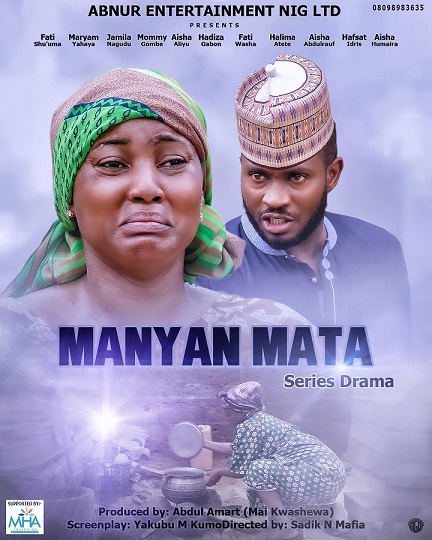
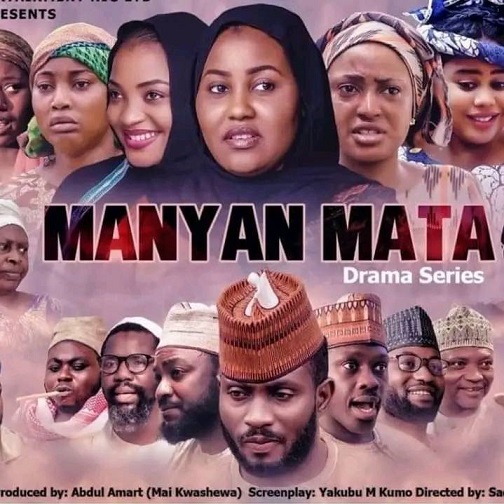
Manyan Mata: A new, worth-watching Hausa series

By Salim Toro

Yesterday, after meeting with Usman Toro, I returned home immediately to have dinner before retiring to bed. My siblings were watching a Hausa web series, Manyan Mata. So, while having dinner, I caught half of the episode they were watching. I found it captivating and worth watching.

I later learned it’s a new Hausa web series that premieres on YouTube and airs on Arewa24 every Saturday at 9 pm. The series is produced and directed by Ahmad Amart and Sadiq N Mafia, respectively. It brings all the leading Kannywood actors and actresses, such as Ali Nuhu, Adam A Zango, Sadiq Sani Sadiq, Hadiza Gabon, Fati Washa, Saratu Gidado, Momee Gombe and much more.

The storyline of the series is fascinating, entertaining, and educational as well. It highlights and depicts most of the trendy issues in our society (Arewa), such as marital and parental responsibility, girl child education and Almajiranci.

While I find the series riveting and worth watching, I recommend it to everyone here. Rest assured that you will benefit from it in one way or another. Happy watching!

Salim Toro sent this via salimabdulhamid0909@gmail.com.

Quick takeaways from the premiere of Manyan Mata!

By Mahmud A. Zukogi

This much-awaited, much-talked-about and star-studded film series, which incidentally will hit your screens today, Saturday, February 11, 2023, at nine o’clock this evening on Arewa 24, was premiered on February 4 at the Film House, Ado Bayero Mall, Kano.

The event, which was graced by the invited guests and Kannywood’s veteran, reigning and emerging stars, was full of the usual fanfare, excitement and expectations associated with the premiere of any new film. The red carpet was lit with beautiful lighting and stars, and guests took turns to pose to the beauty and demand of the evening.

The industry is gradually exploiting the opportunities that film serialisation provides, no thanks to the exciting marketing platform made available by the leading entertainment television, Arewa 24. It is to the eternal credit of the television that such films as Dadin Kowa, Gidan Badamasi, Labarina, Kwana Casa’in, Gidan Danger, etc., have become popular and a must-watch by the teeming audience of the industry. It is obvious, therefore, that the art of film serialisation has gained currency in the industry, and Manyan Mata is coming to compete for space and attention. How it is able to do this will depend largely on the techniques and the staying power of the crew, especially the producer and the director.

Manyan Mata is produced and directed by two of the industry’s iconic duo, Abdul Amart (Maikwashewa) and Sadiq Mafia. What the film brings to the table can be summarised into three: innovation, diversity and topicality of motif. Abnur Entertainment is known in the industry for innovations that have opened a window of opportunities to the core stakeholders, from the producer down to the end of the ladder in the entertainment chain.

The film is highly diverse because of the array of stars it could gather under one roof. As far as the Kannywood industry is concerned, it takes great power, confidence and directing abilities to handle these stars, each with his/her ideals and idiosyncrasies. Thus, if any outstanding star is left out of the film, it could be a result of unavoidable oversight or a logistical glitch. But getting Ali Nuhu and Adam Zango, the northern and the southern poles of the industry, in one set is no doubt speaks of the commendable effort of the producers. Talk of the leading female stars of the industry; name them, and they are all there.

What, then, are the central motifs of the film and which has made it outstanding and a must-watch? The Almajirci question, the girl-child abuse/prostitution and the male overload of the women under the guise of marriage have been juxtaposed to educate, entertain and, most of all, draw public empathy to the raging social issues putting us down as a people.

The premiere opens with electrifying scenes of these social motifs, and this drew great excitement from the audience, who expressed individual understanding and appreciation of the representations in the film and its many expectations.

Veterans of the industry were well represented, ranging from Kabiru Maikaba, Shehu Hassan Kano, Hajiya Saratu Gidado Daso and the like. No less represented were the leading directors in the industry who came to support one of their own. There were expressions of appreciation and critique of the film, which was well received by the directing crew.

Overall, the premiere evening was full of life, excitement, and encomiums for the head of Abnur Entertainment, Abdul Amart, for his creativity and vision.

The greatest oversight is the industry’s inability to tap into the opportunities provided by the university which is next door. As far as the industry is concerned, there has not been a concerted effort to establish the needed relationship between and gown, a beneficial relationship that would help to grow the industry and take it to a whole new level of growth and worldwide visibility.

Strong institutional linkage is desperately needed to grow the art and economy of this under-tapped multibillion-dollar industry. I’m aware that scholars such as the respected Professor have invested so much energy in intellectual research that would have propelled the industry to the worldwide heights it ought to be. Same for Professor Yusuf Adamu, Ibrahim Malumfashi and, lately, Dr Muhsin Ibrahim, who has published widely and recently completed his PhD on a topic related to the industry at the University of Cologne.

Yours sincerely and his colleagues were only there in their individual capacity and not on institutional representation, which shouldn’t be the case.

It is thus necessary and about time that this costly oversight is remedied. The industry needs to open up and embrace change, and the best way to do this is to key into the opportunities they stand to gain by establishing a solid relationship with the university to improve its art and human capacity. I also believe this should be a two-way process, so the university should take the industry into confidence and dispel its image of unapproachability.

Mahmud Zukogi can be reached via mabuzukogi78@gmail.com.

Lessons from Adam A. Zango’s life

Muhammad Ubale Kiru

Adam A. Zango, for those of you who don’t know him, is a Kannywood Film actor who is popularly known as Adamu Usher for his spectacular dance steps. He appeared in more than 100 Hausa films over the years.

While lamenting why his marriage is in chaos, Adam identified that his wife committed a number of mistakes that may probably lead to their divorce. One of the mistakes mentioned was that she posted a video of herself taken at a beauty parlour while having henna (kunshi) done on her and at the same time dancing.

He indicated that such action was something he prohibited all his wives from doing, and he was devastated by the action. Hence, he stated it as one of the things she did. Now, the irony is this – these people have no shame in picking young girls to act in their movies. They have no shame in displaying these young girls on TV dancing and sometimes even touching them. However, they know quite well that it is wrong, yet they lure young girls into it.

Adam felt so bad that he is thinking about divorcing her because of what he himself is doing with other women and yet posting on the internet.

Dear ladies: You see, most of you are not smart. Men can do things and run away with it, but can you? Adam can spend 50-60 years of his life acting, but for you, the maximum is 40-45. This means what you are doing is not really a good business because, in the end, they will use you and then dump you. They know so well that it is not right, yet, they get you involved because they don’t care about your life or future.

In an interview with Hadiza Gabon, she was asked about when she would be getting married or if she had a fiancee. In her response, she said, “yes, I have a fiancee. As for when I will marry, that I don’t know because I can’t marry off myself”. They have plenty of suitors, but will they be ready to commit to marriage? The answer is NO. because Film is a bad business for women. It doesn’t matter whether it is Kannywood or Hollywood. The majority of them spend their lives pursuing lusty men and, in the end, commit suicide or die in nursing homes helplessly and full of regrets.

Top 5 Kannywood films of 2022

By Habibu Ma’aruf

The year 2022 has not been great for the Kannywood film industry. There was a substantial decline in feature film production as the popularity of series films soared, piquing the interest of more producers. Cinematic releases were at a premium throughout the year, with just nine films, making it a ratio of less than one release a month. The situation was so severe that no major production was shown at cinemas, even during the Eid ul-Fitr festivities.

However, while some of the few releases fell flat on their faces, others have managed to make it in the trying year. Find below the top 5 Kannywood films of 2022. Please note that only feature films were considered for this list.

  1. Aisha

Directed by Hafizu Bello, the movie, Aisha, is critically and commercially successful. It beats Kayi Nayi (Dir, Gumzak 2021) to become Kannywood’s biggest grosser by earning over ₦5.5 million during its elongated run in two cinemas. This is not surprising as it’s a production of ‘the box-office king’ Abubakar Bashir Mai-Shadda. The story revolves around the eponymous character, Aisha (played by Amal Umar), who dies after being raped, and her parents’ struggle for justice. The plot is uncommonly twisted but perfectly pieced together. The film has a strong message and a realistic narrative. It exposes the grim reality in some higher institutions where students commit serious misconduct. It stars Amal Umar, Nura Hussaini, Adam A. Zango, Sani Danja, and Shamsu Dan Iya, among others.

  1. Lamba

Before the premiere of this Ali Gumzak-directed comedy, there had already been an overwhelming craze for its title song. This has helped the film to rake in ₦1.32 million on the first day, beating the previous record first-day collection of ₦1.25 million by Fanan (Dir. Alolo 2021). Produced by Abubakar Bashir Maishadda, Lamba is a social satire set against the backdrop of ‘Audio money’ (a slang term for the fake display of wealth). It tells how some three young men (Adam A. Zango, Umar M. Sharif and Ado Gwanja) flaunt false riches to impress the classy girls they meet on social media. The unveiling of their true identity is later shown in brilliantly executed, hilarious scenes that get the audience laughing throughout.  The film lacks an innovative script, but it’s an excellent comedy that succeeded in tickling the funny bone. Other casts include Aminu Sharif (Momo), Maryam Booth, Maryam Yahaya, Bilkisu Abdullahi, Aisha Najamu, etc.

  1. Nadeeya

Although the eponymous movie Nadeeya wasn’t initially meant for cinematic release, it still managed to get a large audience while showing on the big screen. The film is an issue-based drama about ‘upbringing’. It depicts how some parents spoil their kids, specifically daughters, and the practical difficulties such children face in life. The story focuses on a pampered daughter, Nadeeya (acted by Rahama Sadau), who faces similar challenges after marriage. The film is hard-hitting and very meaningful. It shows that children’s first learning begins at home, and their personalities and morals depend largely on their upbringing. The actor’s performance is also impressive.  It was produced by the leading actress Rahama Sadau and directed by Yaseen Auwal. Other casts include Umar M. Shareef, Rabi’u Rikadawa, Asma’u Sani, etc.

  1. Hikima

This movie is a murder mystery specially made with a considerable budget to meet the requirements for showing on Netflix. It’s, however, yet to show on the online viewing platform. The film, which premiered in cinemas in late 2021, was released to the wider public in 2022. It tells the story of a philogynist lecturer, Sadiq (Nasir Naba). It begins from a court session with Sadiq being accused of murdering his female student. The film is richly suspenseful, but many audiences criticise it for having a convoluted plot. Moreover, the cinematography and actor’s performance, among others, place it ahead of its peers this year. Hafizu Bello directed it, while Mustapha Ahmad (Alhaji Sheshe) was the producer. It stars Nasir Naba, Ishaq Sidi Ishaq, Sarah Aloysius, Sani Mu’azu, Maryam Yahaya, etc.

  1. A Bikin Suna

A Bikin Suna tells the story of Mustapha (Ali Nuhu) and his wife Ummulkhairi (Mommy Gombe). They have been married for five years without giving birth to a single child. This fact makes Mustapha’s relatives accuse Ummulkhairi of infertility. She becomes pregnant afterwards, and everyone begins to like her. However, a new conflict erupts when the young baby gets missing during the naming ceremony. The film is generally enjoyable. It’s directed by Yasin Auwal and produced by Danjuma Salisu. Other casts include Saratu Daso, Musa Mai-Sana’a, Maryam Yahaya, Shamsu Dan Iya, Rahama MK, etc.

Habibu Ma’aruf Abdu wrote from Kano. He can be reached via habibumaaruf11@gmail.com.

Movie Review: Dan Jarida

By Habibu Maaruf Abdu  and Muhsin Ibrahim

It’s well known that series movies have recently dominated the Kannywood film business. As a result, some major producers in the industry have already abandoned features for the production of TV series. As the trend develops, the famous producer Abubakar Bashir Maishadda gets on board with the big TV drama Dan Jarida [The Journalist].

The hyped Maishadda debut series, directed by Hafizu Bello, is a thought-provoking thriller mainly about journalism. It is notable for featuring an ensemble of reigning stars in a never-before-seen avatar. A Duniya famed Daddy Hikima, who consistently portrays a villain, is playing a positive leading role in the latest series for the first time.

Launched on Sunday, 25 December 2022, the show will continue to be aired weekly on Arewa24 TV and Maishadda Global Resources YouTube channels. The first episode exposes a tiny part of the story arc. It begins with some crooks chasing a reporter Fauziyya (acted by Amal Umar), who videotapes them while killing and burning someone. They eventually catch and mutilate her to death. Everything keeps revolving around this conflict until the episode’s end…

The first episode is an auspicious start to what promises to be an exciting crime-thriller. It gathers momentum right in the few reels, taking viewers to the background of its major characters. They are; a criminal mastermind Madugu (Sha’aibu Kumurci), who disguised as a philanthropic politician, and Sadiq (Daddy Hikima), Fauziyya’s boss and a media company manager with dogged determination and integrity.

The drama is a delight to watch, at least by how it goes so far. It also promises to be more so when the rest cast of Lawan Ahmad, Tijjani Asase, and Isah Ferozkhan (Presido), among others, enter the next episodes. The camera work particularly captures the intense nature of the film, and the background score gives it full support in generating the desired tone.

Besides depicting the exhaustion, uneasiness and risks associated with journalism, Dan Jarida drama reminds journalists about the importance of doing their job right. It is also a great attempt to provide real insight into the causes of various crimes that are ubiquitous in our society today.

Beyond the positive aspects mentioned above, smoke, as used in the series to create cinematic depth, could be enhanced. For instance, there is little or no need for a smoke when Magudu and his henchmen capture Fauziyya. One may assume it is the exhaust of their cars, which cannot be. In other instances, the smoke is too thick, and its colour looks unnatural.

Finally, while recommending the new series to all and sundry, particularly the Kannywood audience interested in journalism and politics, we appeal to the makers to refrain from exploiting the promising story for commercial purposes. Moreover, they should refrain from extending it beyond reasonable length as producers of some contemporary YouTube series do.

Abdul Amart appointed chairman Tinubu Kannywood Campaign Group 

By Ibrahim Hamisu

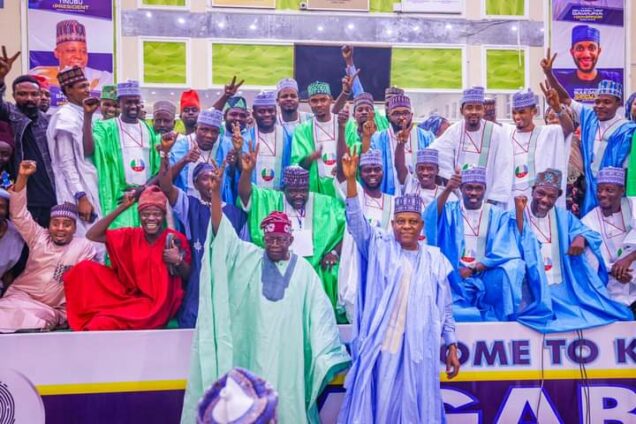
Following the cheerful welcome received by the presidential candidate of All Progressive Congress, APC, candidate, Bola Ahmed Tinubu, when he visited Kano State, and the considerable role played by many members of Kannywood in his acceptance in the state, names of many members of the industry appeared in the list of the members of Tinubu/Shatima campaign committee. 

The list was a part of an announcement made by the Director General of the APC presidential campaign committee, Governor Simon Bako Lalong. He confirmed the selection of Kannywood members among the Presidential Campaign Council, PCC, with producer Abdul Amart Maikwashewa, as its leader. 

The announcement was signed by the Director of Press and Public Affairs to Governor Simon Lalong of Plateau State, Dr Makut Simon Macham, on 8th November 2022. 

The PCC chairman, Governor Simon Lalong, beseeched the members of Kannywood to call all their fans, supporters, and every Nigerian to support their candidate and promote his good political agenda. 

The members include Abdul Mohd Amart (Maikwashewa) as Director, Isma’il Na’abba Afakallah as Deputy Director, Jadda Garko as Deputy Director II, and Sani Mu’azu as secretary. 

Other members include Malam Khalid Musa, an advisor to the Kano State Governor on the Kannywood industry, as an advisor of the committee; Bala Ahmad and Shu’aibu Yawale, also as advisors. 

Others include a veteran actor in the industry, Ali Nuhu, as a director of actors’ affairs; Jamila Umar Nagudu as his Deputy I and a comedy actor, Sulaiman Yahaya (Bosho), as Deputy Director II. 

A famous singer, Fati Nijar, was appointed as Deputy Director I, singer’s affairs; Ado Gwanja is her Deputy Director II; Dan Isa Mai Kaho is Deputy Director III. 

A comedy actor, Mustapha Badamasi Nabraska, an advisor to Kano State Governor on propaganda, was appointed as director of Works, while Alasan Kwalle was appointed as his deputy. 

Ahmad Salihu Alkanawy will be the operation director; Emmanuel will be his assistant. Tahir I. Tahir will be the program secretary; Adam A. Zango will be his Deputy I; Dailo Pam Lojok will be Deputy II. 

Nasir S. Gwangwazo, a writer, film producer, and editor of Manhaja Newspaper of the Blueprint Media company, will be the News and Publicity Secretary. Hafsat Sulaiman from Kaduna State will be his assistant. 

Hassan Shehu Kano will be the news coordinator on newspapers, radio, and television. Ibrahim Adamu will work as a social media news coordinator, where they will assist Gwangwazo. 

Malam Ado Ahmad Gidan Dabino (MON) will be the director of technical works; Hamza Baban Muri as his Deputy I, and Ibrahim Maishunku as his Deputy II.

Ɗan Musa Gombe will be the studio’s matters, while Sulaiman Albankudi will be the coordinator. Auwal Big Time will be the assistant coordinator. 

Mansura Isa will be the welfare officer; Nuhu Abdullahi will be her first assistant, while Abubakar Ndako Kutugi will be her second assistant. 

Director Sadiq N. Mafia will be the program manager, Audi Sitin will be the first assistant, and Audi Boda will be the second assistant. Asma’u Sani will be the women’s coordinator I, while Maijidda Minna will be coordinator II. 

Sadiq Sani Sadiq, transportation coordinator; Bello Muhammad Bello will be his assistant. Falalu A. Dorayi is the finance director, while Shatima Mansoor will be his assistant. Amina Adamu will be the chief coordinator, while  Ibrahim A.I.T will be her assistant. 

There is also the list of elders of the committee, which include: Sani Idris Moɗa, Magaji Ibrahim Mijinyawa, Muhammad B. Uwar Hankaka, Hajara Usman, Sa’idu Isa Gwaja, and Ɗan Azumi Baba which is also known as Kamaye. 

List of general members of the committee includes Maryam Yahya, Husaini Sule Koki, Nura Ɗan Dolo (Yaya Dankwambo), Aminu Ari Baba, Fati Abubakar Das, Nazifi Shariff, Abubakar Sulaiman (Ɗan Auta), Umma Shehu, Yahanasu Sani, Hauwa Abubakar (Waraka), Aminu Mirror, Waziri Dabo, Anas Sulaiman Nasir, Sani Ɗangwari, Bala Kufaina Abuja, Hamza Badamasi, Hadiza Abdullahi Kabara, Aminu Dumbulum, Maimuna Abubakar (Momi Gombe), Hauwa Garba (‘Yar Auta), Aisha Mahuta, Musa Mai Sana’a, Binta Ola, Abdulrahman Alfazazee, Nasir Adam Salih, Adamu A.D Bauchi, Mudassir Kassim, and Tijjani Abdullahi Asase.

Kannywood Elders Forum, through its public relation officer, Kabiru Maikaba, has already congratulated Abdul Amat Maikwashewa and other members of Kannywood for the well-deserved appointments.

AFMAN Kano elects new leaders

By Habibu Maaruf Abdu

The Arewa Film Makers Association of Nigeria (AFMAN) Kano chapter has elected new executives to pilot its affairs for the next two years.

The ten-member exco were elected unopposed in an uncontested election held on Saturday, December 3, 2022, at the Social Welfare Centre, Court Road, Kano.

Captain Musa Gambo emerged as the union’s new chairman, succeeding Jamilu Yakasai who had been holding the position since 2019.

Other members of the new exco include:

Mansurah Isah – Vice chairperson

Mustapha Anwar – Secretary

Abubakar Adamu G. Boy – Treasurer

Hassan Maiwada – Financial secretary

Zaharaddeen Muhammad – Press secretary 1

Abubakar Alaramma – Press secretary 2

Ali Worth Me – PRO 1

Rahama M.K. – PRO 2

Maimuna Muhammad (Wata Yarinya) – Welfare officer

The film industry in Nigeria: A two-left-legged maiden

By Zailani Bappa

I read a post by someone who expressed his worry about the lack of unity of purpose (in fact, he said, unity of everything) among the Nigerian people. He was writing about the movie industry. He said Hollywood had been a household name for a country as vast as America. So also Bollywood for a country as big as India. Both countries are bigger and more economically prosperous than Nigeria.

However, despite the existence of Nollywood, we still have the Kannywood in Nigeria. He believes the existence and progression of Kannywood are retrogressive to the Unity of purpose in the industry in Nigeria. I reason with him. However, that is only when the matter is viewed from the surface. Scratch the surface a little, and you’ll see the bigger picture.

Both Nollywood and Kannywood emerged in prominence in the 1990s. Nollywood comes in English, pidgin, Igbo and Yoruba. The Kannywood comes mainly in Hausa and a few times in English. Looking at the Hollywood and Bollywood industries as both business and national projects, both Industries tend to project National Unity, National Pride and National dignity of their respective countries. And the business does not discriminate in the selection of protagonists.

However, in Nigeria, tribal, sectional and religious stereotypes continue to influence the industry, which makes it even more difficult to have a unified industry. To date, egg-heads of the Nollywood industry find it difficult to accept the fact that the industry needed to diversify and be all-inclusive in sourcing for their resource. For instance, African-Americans in the US are arguably the lowliest rated race in the US. However, the Hollywood industry does not believe so. The Industry became all-inclusive and explored for talents instead of being led by stereotypes. Now the negros are almost the best actors in the industry. That is how it grew to excellence.

In Nigeria, however, Nollywood, with the advantage of producing in English first, metamorphosed most of the vernacular protagonists into English productions but unwittingly limited the train to those from the South-East of the Country who saw themselves as the owners of the industry. For instance, the far Northern Nigerian does not deserve more than the role of a gateman in Nollywood films. If at all you hear the name Musa, Usman, or  Bala, then, it’s the guy employed to look after the gate or wash the cars of Obinna, Ifeanyi or Chibuzo. The Lagos-based Industry is not making any genuine efforts to integrate with the Kannywood industry, even as the latter continues to grow in influence and affluence in the North and elsewhere.

However, the Kannywood, with its vast audience across the Hausa-speaking communities across the globe, also failed to grow in its intellectual capacity. It instead gets stuck to its money-making trash productions in the name of soyayya themes, which, apart from the sheer entertainment it provides, literally promotes empty value to the morale, capacity and quality of lives of the audience, not to even talk of national value, pride and dignity.

In Nigeria, the film industry has no idea or focus on National project but purely exist for business reasons. Hollywood has developed over time to become an agenda setter for the United States policymakers and implementors. It has now become a platform and potent avenue for increasing the influence of the United States over other nations and peoples worldwide. The Indian Industry also helps that country placate the outside world with its numerous internal crises and contradictions by promoting a clean, prosperous and happy India.

In Nigeria, Nollywood promotes less national dignity and unity but corruption, indecency, cultism and disunity. It exposes more of the weak and bad sides of the country, its institutions, leaders and people instead of strengthening their good sides more. Why? Because they make better money doing that since their productions appeal more to the wrong side of humanity in us. The Kannywood, with its empty intellectual value, is simply vain. So, as the two continue to grow side by side like that, we may have to do with the fast growth of a two-left-legged maiden of an industry.

Zailani Bappa wrote from Bauchi State via zailanbappa@gmail.com.

Kannywood producer Abdul Amart honoured with doctorate in Togo

By Habibu Maaruf Abdu

The famous Kannywood producer, Alhaji Abdurrahman Muhammad, popularly known as Abdul Amart Mai-Kwashewa, has received an honorary doctorate in Diplomacy and Public Management from IHERIS University, Togo.

This was disclosed in his Instagram post on Sunday, November 13, 2022.

“On the 12th of Nov 2022, I was honoured by the IHIRIS (sic) University Togo with a doctor of philosophy in Diplomacy and Public Management. It is indeed a great honour, and as such, I will like to thank the management of IHERIS university for this great honour. May Allah almighty make it useful for me and the entire Universe.”

Amart is the CEO of Abnur Films and the national president of the Yahaya Bello Network (YBN) group. He was recently appointed as the director of Northern Artists (Kannywood) for the Tinubu/Shettima Presidential Campaign Council.

This is IHERIS University’s second degree of honour conferment on a Kannywood personnel, having previously conferred producer-cum-actor, Usman Uzee, with a doctor of philosophy in Media and Communication Studies in 2021.

Recall that Ali Nuhu was the first Kannywood member to receive an Honorary Doctorate after being awarded a Doctorate in Entrepreneurship and Youth Development by the ISM Adonai American University, Cotonou, in 2018.

2023 elections: Kannywood members join APC presidential campaign team

By Muhammadu Sabiu

The All Progressives Congress, APC Campaign Council’s Director-General, Governor Simon Lalong, has approved select Kannywood members to join the council ahead of the 2023 presidential election.

Lalong made the comment in a statement published in Jos, the state capital, signed by his spokesperson, Dr Makut Macham.

The inclusion of film practitioners, according to the director general of the APC’s presidential campaign, was done to increase the involvement of artists from the northern region in the campaigns.

According to Lalong, Bola Tinubu, the APC presidential candidate, recently visited Kano and spoke with group members, which led to the approval.

He added that the APC presidential candidate had pledged to give Kannywood members a chance to participate in the campaigns, showcasing their skills while also aiding the party in winning the upcoming general elections.

The Kannywood group has Abdul Amart as Director, Ismail Afakallah as Deputy Director and Sani Mu’azu as Secretary, with other leaders heading different divisions.