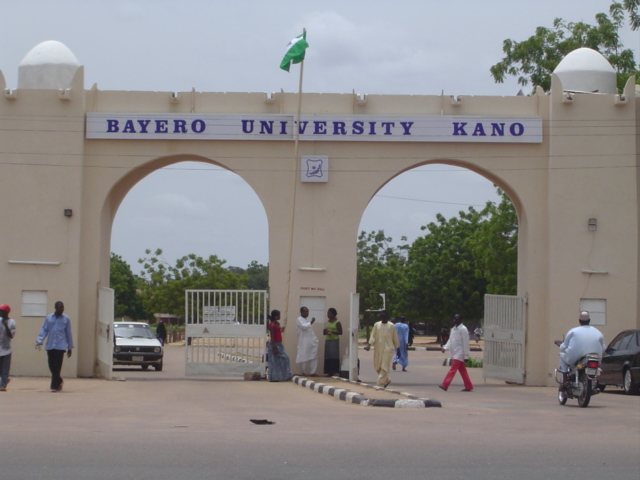
Bayero University Kano

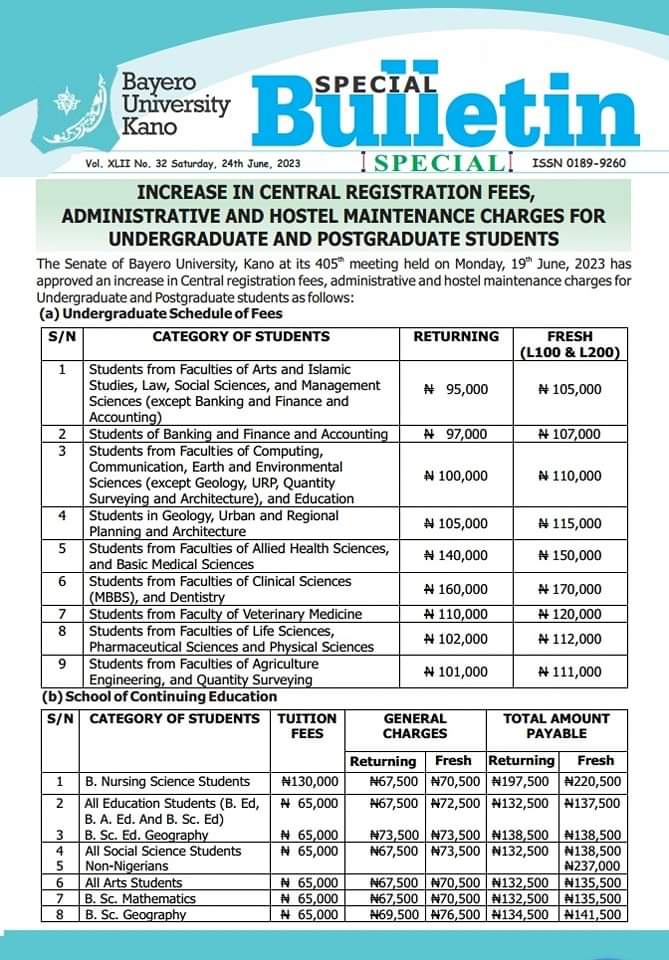
BUK dismisses rumours of increased registration fees

By Uzair Adam Imam

The news making the round about the increment in school fees by the management of Bayero University, Kano (BUK), has dragged many students into a sheer panic while others fear the increment would be the end of their academic journey.

However, the school management debunked the circulated news on Wednesday and described it as fake news meant to startle students.

Malam Lamara Garba, the school Deputy Registrar, Public Affairs, told The Daily Reality that the story was baseless, urging the general public to reject it as “there is no official disclosure on that effect”.

The Daily Reality recalled that the news about the increment in the school fees to N170,000, initially said to be leaked information, has gone viral since the beginning of the last week.

The Students Union Government (SUG) claimed to have made several attempts to highlight the negative consequences the increment would have on students and subsequently held two meetings on the process with the school management.

Auwal Lawal Nadabo, the school acting SUG President, stated that all their efforts were in vain as the school management remained firmly on its stands after all the meetings.

Nadabo, who relayed this on a Facebook post, said, “The school management, after all consultations and finalizing the proposed fees, called for a second meeting where it was confirmed to the student leaders that the new range of school fees would be N97,000 to N170,000, as the case may be.

However, asked whether what the SUG President said was true, Garba denied knowledge of the meetings, saying, “I don’t even know when they had the said meeting with the management.”

Return to Forever: African Studies in Europe

By Prof. Abdalla Uba Adamu

Frankfurt, Germany. 3rd July 2013

The German immigration officer looked at me and gave the usual clenched-mouth smile. I did the same. I am used to it. He flipped through my passport and then looked up.

“How many days are you staying THIS time.” Emphasis on THIS.

“Two days in Cologne”, I replied. “Today, tomorrow, and the day after that, I am off.”

He stamped the passport without asking for the usual – return ticket, invitation, hotel booking – all of which I had. He wished me a pleasant say and waved to the next person behind me.

I was then in Cologne to attend the valedictory retirement conference held in honour of the woman who mentored me and virtually adopted me as her son – Heike Behrend, who was retiring from the Institute of African Studies, University of Cologne, Germany, where she was the Director. She created the research category of “Media and Cultural Communication”, and I was the first African to be invited to deliver a lecture at the cluster. The Immigration Officer’s reference to the length of my stay was in response to the numerous times I had been to Germany – and never stayed beyond the time necessary for whatever it was that brought me.

The week from Tuesday, 30th May to Sunday, 4th June 2023, I returned after ten years. This time, the occasion was to attend ECAS2023: 9th European Conference on African Studies, with the theme of “African Futures.” It was hosted by the University of Cologne. “African Futures” explores the continent’s critical engagements with the past, present, and future of Africa’s global entanglements. ECAS is the largest and most visible single event under the AEGIS umbrella. AEGIS is an expression of a much wider and dynamic set of African Studies connections, collaborations, activities and opportunities within and beyond Europe. The conference, lasting four days, had over 70 panels involving hundreds of papers and speakers. All were efficiently coordinated through the various classes at the University of Cologne.

Earlier in the year, I and colleagues from Germany and US had submitted a panel, “Digital/social media and Afrophone literature”, for consideration at ECAS 9. It was accepted.  The conveners were me (BUK), Uta Reuster-Jahn, Umma Aliyu (Hamburg) and Stephanie Bosch Santana (UCLA). Before submitting our panel to ECAS, we first held an online symposium which was preceded by a call for papers. Despite sending the CfP to various universities and the Nigerian Academy of Letters (NAL), the response was pretty poor. The symposium was titled Social Media as New Canvas, Space and Channel for Afrophone Literatures. It was eventually held online at the University of Hamburg, Germany, on 22-23 February 2023. The participants then were from Germany (Uta Reuster-Jahn, Umma Aliyu Musa), Nigeria (Abdalla Uba Adamu, Zaynab Ango, Ado Ahmad Gidan Dabino, Nura Ibrahim, Asabe Kabir Usman, Isyaku Bala Ibrahim), Tanzania (Hussein Issa Tuwa, Zamda Geuza), Ghana (Nikitta Dede Adjirakor), Stephen Ney (Canada), US (Stephanie Bosch Santana).

After the symposium, we submitted a panel for the ECAS 9th edition. Our panel was accepted, and all the participants of the online seminar were issued official letters of invitation to process their funding for the conference in Cologne in June 2023. As a panelist, I was fully funded to attend by Deutsche Forschungsgemeinschaft (German Research Foundation, DFG). Umma and Uta were able to sponsor themselves from Hamburg. Unfortunately, only Nikita from Ghana was able to come from the others who could not get any funding. As a result, our panel, held on Wednesday, 31st May 2023, had only four speakers. It was déjà vu all over again – after almost 24 hours of flying and waiting at airports (Kano, Abuja, Doha), I was given only 20 minutes for the presentation.

My paper was “From Kano Market Literature to Kano Social Media Literature: The Reincarnation of an Afrophone Literary Genre.” The paper traces the trajectory of the genre from print media to its liberation in online media, with a specific focus on Facebook, Wattpad and APK files on Google Play. The paper uses netnographic methodology to harvest the dominance of and reaction to the newly reincarnated genre, which, far from being dead and buried, is more than ever before, alive and kicking in other spaces – beyond censorship or any form of criticism. In the process, the paper explores the freedom gained by the authors in unrestricted storylines that cross boundaries of identity, gender and alternative sexualities.  The Journal of African Literature Association (curated by Taylor and Francis Group) has agreed to publish the papers of the Symposium in 2024. We will have to ask for more contributors.

Another dividend for me was that I was approached by a representative of Lexington Books in the US for the possibility of publishing my paper as part of a book on Hausa media cultures if I have something like that. As it happened, I have almost completed such a project titled “Hausa Cinema” (to complement Jonathan Haynes’s book, “Nollywood”) which was to be published by the Ohio University Press in 2010, but things went southwards! Now Lexington Books is providing an opportunity, and I am excited about it.  

Our panel was lively, though, and I even met a fan! He was Jos Damen, Head of the Library and ICT Department of the African Studies Centre at the University of Leiden. While I was making my presentation, he took my picture with his phone and uploaded it to my Wikipedia page (itself created by another fan)! Later he told me I needed to have a picture there, and he took that responsibility. So it was kind of him!

The conference attendance was a fantastic homecoming for me because although Heike Behrend had retired back to Berlin, where she came from (and where I visited her in 2015 had a wonderful dinner when I was a guest of the Haus der Kulturen der Welt, Berlin), Muhsin Ibrahim is now in the same institute. Both Muhsin and I were from Bayero University Kano. Muhsin was teaching Hausa at the Institute.

I first came to Cologne in 2004 – at the invitation of Heike Behrend when I met her in Kenya. At that time, I had an invitation to participate in an African Literatures project at Johannes Gutenberg University, Mainz. Heike asked me to reroute my itinerary to stop at Cologne, teach a Postgraduate class and give a public lecture. I did both on Monday 15th November 2004. Since then, I have almost lost count of the times I visited Germany – Berlin, Freiburg, Hamburg, Leipzig, and the wonderful Cologne with its incredible, massive and stupendous cathedral – the largest Gothic church in Northern Europe. It was in Cologne in 2004 that the foundation of my ethnographic foray into critical media studies was laid. Unlike in Nigeria, where many saw me as an ‘interloper’ (as they murmur, ‘After all, he is a Biologist, isn’t he?’), here it is not what you study but what you can contribute to any discipline. I have been to Colone four times and other cities several times – all on the same mission of promoting Hausa media studies.

ECAS 2023 started wonderfully with Muhsin meeting me at the Koln Hauptbahnhof and helping me drag my luggage through various concourses to the trains that would take us to his flat: a very lovely well-furnished, and very spacious space. Upon arriving and freshening up, a massive mountain of uncharacteristically fat masa was waiting for me. Even the masa looks like a ‘Bajamushiya’! The soup alone could feed a family for a week! It was a truly delicious welcome. Once I got rid of the hunger, he took me to my hotel, IBIS Centrum.

Breakfast in the morning at the hotel saw a meeting of Who-is-Who in African studies – both diasporic Africans, home-based Africans and European and American researchers. It was indeed a wonderful gathering. In addition, I had a chance to reconnect with one of the most promising diasporic Hausa African Studies experts – Musa Ibrahim.

Musa is based in Ghana. He travelled there through South Africa and Japan, ending up in Bayreuth, Germany, where he obtained his doctorate. We met at Leipzig in 2018, and I collected his CV with the hope of getting him employed in our Information and Media Studies department, Bayero University Kano. However, the university was not interested. Before you knew it, he was grabbed by the University of Florida, Gainesville, where he spent about three years before getting another appointment at the University of Ghana. Such rich and varied experience would have been valuable to us in Kano, but the parochialism of our university system did not factor in multidisciplinarity.

The following day saw dinner at Muhsin’s house, and this time, Umma Aliyu, originally from Bauchi, joined us. Umma now lives and teaches in Germany at the University of Hamburg (after her studies at Leipzig). Like Muhsin, she also teaches Hausa at Hamburg, where she took over from Joe McIntyre (Malam Gambo), who retired some time ago. During dinner, we brainstormed the idea of two book projects – which, for me, was one of the significant takeaways from ECAS9.

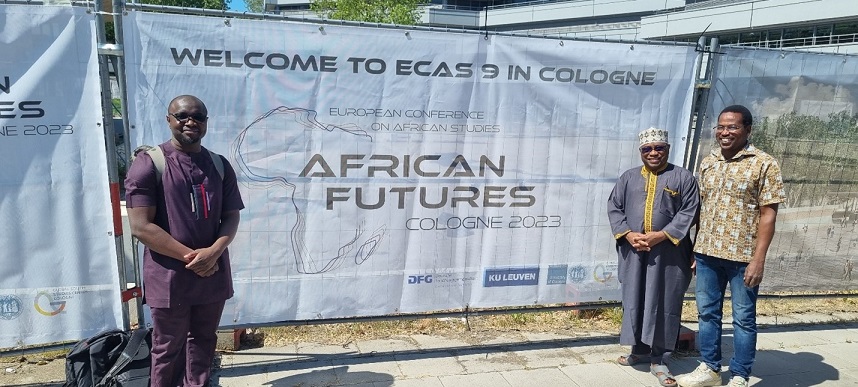
Muhsin, Abdalla and Musa at ECAS9, Cologne

The first book project would be tentatively titled “Hausa Studies in European Diaspora: Experiences and Perspectives.” This will be a collection of chapters written by Hausawa living and working permanently in various European universities, either teaching Hausa or other disciplines.  The objective is to demonstrate how internationalised Hausa scholarship is. We started with about five in Germany alone.

The second book project would be a post-Boko Haram narrative. So far, the Boko Haram literature has focused on the human disaster of the insurgency – virtually all books written were from the governance, security and disaster perspectives. Yet, much success has been and is being recorded in the war against terror in the form of surrenders, deradicalisation and reintegration. Yet, no one is looking at this. Using ethnographic field data, the book project will provide another side of the war on terror in Nigeria. We were excited and promised to work on various draft proposals before embarking on the works, which we hope will be completed by 2025.

The Conference’s overwhelming focus on the multidisciplinarity of African Studies was an eye-opener—no room or time for a narrow perspective on scholarship. No one cares about what your degrees are in – what matters is what you are bringing to the table NOW and how it impacts the knowledge economy of African societies and contribute to the decolonisation narrative.

For me, Cologne is a Return to Forever – the beginning of an endless loop of research and investigation.

My deepest thanks to Muhsin for being such an excellent, graceful host.
Language is not a friend – I have bound my project

By Bilyaminu Gambo Kong-kol

Language is considered the principal method of human communication, consisting of words used in a structured and conventional way and conveyed by speech, writing, or gesture. It is a tool that establishes commonness between the sender and the receiver.

For the commonness to be established, the encoder must be well-grounded in the language he chooses to use and arrange his words systematically. He must also consider meanings such as denotative, connotative, reflected, and social, among others. 

The receiver must also do his part as interference is likely to occur from him, the environment, channel, or encoder.

However, language sometimes becomes a betrayer by betraying even the native speakers due to its rigid nature. The fact is that even if you are familiar with the rules, language may decide to disgrace you abruptly.

In this piece, Hausa, Fulfulde, and English languages will be used to explain my points.

In Hausa, it is a rule that most of the words that end with the letter “A” are feminine, and those ending with E, I, O, and U are masculine. But there are exceptions. For instance, words like kotu (court), gwamnati (government), and kwallo (ball) end with masculine vowels, but they are feminine. On one part, ruwa (water), zama (sitting), and kira (call) are masculine despite having feminine endings.

Hausa also demands that wherever possessives “Na” and “Ne” are used for masculine words, they should be substituted with “Ta” and “Ce” for feminines. For example, Jirgina ne (It is my plane), motata ce (It is my car).

Many Hausa speakers, including some of the natives in northwest Nigeria, are struggling to adhere to the rules. To get primary data on this, choose any state in Nigeria and listen to their radio stations or have physical interactions.

In Fulfulde, the law states that a word’s ending determines its demonstrative adjective. For instance, it is okay to say this horse, this room, or this pen in English, but the case is different in Fulfulde. Wamnde nde, sudu ndu, bindirgol ngol. To learn more, get a Fulani friend or wife.

This rule is giving headaches even to the LI in Yola, as it requires alertness and quickness of thought. It is normal to hear a typical Fulani man saying “Mi laari mo” instead of “Mi laari ngal” when he is referring to “I saw the hen”.

Another blunder is the introduction of the letter “V” in Fulfulde. In a standard Fulfulde setting, there is nothing like the consonant sound /v/. Hausa, too, does not have it. That is why some Hausa say bery good instead of very good. Just like the way some Hausa misplace V for B in English, some Fulfulde speakers misplace W for V in their first language. 

For example, “O vindi” instead of “O windi” (He wrote), “Mi vi” instead of “mi wi” (I said), “O va’i leggal” instead of “O wa’i leggal” (He/she climbed a tree).

One interesting thing about Fufulde is that, unlike Hausa and English languages, Fulfulde does not have pronouns that differentiate gender. Fulfulde’s pronoun “O” refers to he/she in English and Shi/ita in Hausa.  And Fulfulde’s pronoun “Ma” refers to Ka/Ki in Hausa. Maybe this was done to show our shyness and respect (Pulaaku). 

Another virus that is threatening Fulfulde is code-mixing and code-switching. Some Fulfulde speakers in Adamawa, Taraba, Gombe, and Yobe could not speak pure Fulfulde for an hour without borrowing from Hausa, English, Arabic, or their L2 words. This signifies a low level of grammar or lack of respect for Fulfulde language. It needs to be fought gallantly.

In English, rules of concord, tenses, syntax, and semantics are hectic for learners and L2 speakers. 

Concords like: “He says, I say, they say, he has, I have, they have, he does, I do, they do, he does not have, I do not have, and they do not have” are found to be confusing most especially by learners. Also, the sentences below, even though correct, may not convince learners as plural nouns could be seen nakedly. Shamsu, together with his wife, is coming to London or Maijama’a, along with Bilkisu, is coming to Cyprus. Think of “Neither Ghali nor the students are present” vs “Neither the students nor Ghali is present”. 

In tenses, the unjustified usage of the past in the present, the present in the past, or the distortion of the entire tenses is common. Moreso, the choice of words and sentence construction are influenced by speakers L1. You will see an English sentence given direct translation from Hausa, Fulani, Igbo, or Yoruba. Example: Haruna said it is for you and me.

In phonetics and phonology, words are pronounced mostly the way we hear others articulate them over time. Sometimes, Lll speakers localise the British accent. Consonant sounds like /θ/, /ð/, /ʃ/ /ʒ/, /ʈʃ/, /dʒ/, and ŋ/ are mispronounced in some words. Vowel sounds /ʌ/,  /ə/, /ɜ:/, /æ/ and the eight diphthongs play with the tongues of learners. Or should we say learns to play with them?

The topic is broad, but advisably, make sure you learn all the dos and don’ts of every language you want to communicate with people. This will pave the way for you to communicate effectively and earn your respect. By so doing, you minimise 70% to 90% of your chances of making mistakes. Don’t expect 100%; even the natives are still looking for that!

Nevertheless, always remember that language is not a friend. It may decide to disappoint you unexpectedly. I received mine on my last day as an undergraduate student at Bayero University, Kano. I was stuck fishing out whether the word “bind” is a regular or irregular verb. What is the past participle; binded, bounded, or bound? It had escaped my memory. I still don’t understand why English decided to misbehave on this special day of mine (04/05/2023).

Whatever the reason, I got a pitch that led to the writing of this article. Alhamdulillah! My appreciation to communication scholars, the Vice Chancellor of Federal University, Kashere, Professor Umaru A. Pate, and OPEC’s PR Coordinator, Dr Umar Jibrilu Gwandu, for drawing my attention immediately. I HAVE BOUND MY UNDERGRADUATE PROJECT!

Bilyaminu Gambo Kong-kol is a graduating student of the Mass Communication Department at Bayero University, Kano. He can be contacted via bilyaminugambokonkol20@gmail.com.

Malam Jamilu Salim: A Short Tribute to a Fatherly Administrator

By Muhsin Ibrahim

Part One

It was 2005 when I applied for admission into Bayero University, Kano (BUK). In Nigeria, getting admission without knowing someone at the university is pretty hard. My late father was working there as an accountant, but remembering how my immediate older brother couldn’t secure admission a year before despite our father’s efforts, I did not bother to ask for his help. Our eldest brother (Yaya Babba), now late, was nonetheless a student. Knowing he was not an ‘ordinary’ student due to his age, I approached him for assistance.

I was lucky Yaya Babba knew Malam Jamilu Ahmad Salim. I cannot say what his position at the University was then, but he could help, Yaya Babba assured me. My only fear was my SSCE result, which was neither WAEC nor NECO, the two conventional entry exams. I had NABTEB and was applying to the Faculty of Education. But on the other hand, my UTME/JAMB result was excellent.

Yaya Babba met Malam Jamilu during a Hajj pilgrimage the previous year, and they clicked. To those who knew our brother, he was almost everyone’s friend. Thus, they maintained a cordial relationship after the Hajj. When we met Malam Jamilu, he calmed me down, virtually assuring me of admission. Although I got the admission without his help – or anyone’s but Allah – in the end, how he treated me was fantastic and fatherly.

Part two

After graduating in 2010/2011, Bayero University employed me as a lecturer. Fast forward, I got another lecturing position and admission for my PhD at the University of Cologne, Germany, in 2017. I signed a bond and left BUK on a Study Fellowship in late August. Months later, I thought about the implication of collecting two salaries, something I didn’t plan for. I thought I would only be a Teaching Assistant à la the American university system. I discussed this confusion with selected colleagues, including my contemporaries and seniors. Opinions differed. Confused, I decided to go to the top.

With the intervention of a friend, I met Malam Jamilu, now a Director of the Establishment. He advised me as if I were his child on what I should do when I met the Vice-Chancellor, Prof. Yahuza Bello. So, I did, and it worked like magic. Appreciating my sincerity, Malam Jamilu thought the University could (should?) release me – on a Leave of Absence (LOA) – without paying back the few months’ salary I received. So, he asked me to request that in my application letter. Although it didn’t work, I remain eternally grateful for his rare kindness and generosity.

Part three

Weeks before my four-year-long LOA ended, I received an email from my Head of Department that I should resume or resign. My love for BUK is more than you can imagine. But, of course, I love my new workplace, which offers me abundant opportunities, resources, and much more. Still, I hesitated to divorce my beloved BUK, where my academic journey began just like that. Nevertheless, my close family and friends suggested I bid BUK a final farewell. But how do I do it? Just tender your resignation, and that’s it, a voice told me. Another one said no, contact the ever-helpful Malam Jamilu for guidance – so I did.

Malam Jamilu, now a Registrar – the peak of his career – was much busier. He probably lost my number and couldn’t return calls from unknown callers. The friend who helped me the other time and his underling, Rabia Shour, told him that Muhsin called the other day. He apologised for not answering. Thus, when I called again, he quickly picked up. He was apologetic in his welcoming manner.

Upon hearing my story (again) and my current request, he didn’t mince his words on what he would do in my situation: resign. He added that that was a development we should all celebrate. He briefly lamented the condition of Nigerian universities and congratulated me.

I was about to drop the call when Malam Jamilu advised me to word my letter carefully and diplomatically. For instance, instead of titling it “Letter of Resignation”, it should read “Notice of Withdrawal of Service”, among other excellent tips.

The last part

I am sure Malam Jamilu did more for many more people in his decades-old career, four of which were as the University’s top administrator. He was an incontestably hardworking, dedicated and brilliant manager who rose through the ranks and contributed significantly to the university and its members’ growth and development. Since our father’s death in September last year, no other death shocked me as his. Wallahi, I spoke about him with a friend visiting me from Nigeria yesterday. We didn’t know he would die at the age of 59 later in the night!

May Allah forgive the shortcomings of Yaya Babba, my father (Alhaji Ibrahim Lawal), Malam Jamilu and our other loved ones. The list is getting longer. Everyone and everything will perish (Quran 55:26).

Muhsin Ibrahim, PhD, wrote from Cologne, Germany. He can be contacted via muhsin2008@gmail.com.

BUK class 1991 honours new Jaiz Bank MD

By Sumayyah Auwal Ishaq

The Bayero University Kano (BUK) set of 1991 has honoured the newly appointed Managing Director and Chief Executive of Jaiz Bank Plc, Dr. Surajo Salisu.  

The graduates, who left BUK over 30 years ago, were excited to celebrate Dr. Salisu being a member of the 1991 set. The leadership of the set commended the board of the bank for choosing Dr. Salisu meritoriously.  

While appreciating the new MD, they equally prayed to Allah Almighty to guide and protect him in the new role. 

Prominent among the 1991 set include Brig. General Sani Usman Kukasheka, Amb. Bello Husseini Kazaure, Prof. Abdullahi Musa Ashafa, Zainab Akanbi, Alh Sanusi Garba Abdullahi, Hajia Hadiza Hamis, Mr. Chukwuyere Amaechi, Mr. Dorathy Sako, Alhaja Jumoke Dunmoye among others.

Bayero University debunks school fees increment rumours

By Sumayyah Auwal Ishaq

The Bayero University Kano (BUK) has debunked rumours that the institution has increased registration fees.

A statement published in the official bulletin of the university and signed by Lamara Garba, the Deputy Registrar, Public Affairs, says, “The attention of the Management of Bayero University, Kano, has been drawn to a purported fake letter in circulation on social media announcing an increase in registration fees.”

The statement further adds, “In the light of the above, students, parents, and other stakeholders should note that Bayero University has not yet decided o ln any school fees increase as against the social media post being circulated by some unscrupulous elements”.

The Management cautioned members of the public to disregard the information as fake and malicious.

SAS Kano promoted Shari’ah after Jihad – Prof. Naniya

By Ibrahim Mukhtar

The main aim behind the establishment of the famous School for Arabic Studies (SAS) Kano was solely to promote Shari’ah after the conquest of Northern Nigeria by the colonialists.

This was disclosed by Professor TIjjani Naniya of the History Department, Bayero University, Kano, during the SAS day celebrations, which marks the 82nd anniversary of the school.

The History professor went down the history lane and narrated how the school was established and how the then-colonial government wanted to undermine Shariah by promoting their own legal system.

According to the professor, “Sarki Alhaji, who was the first emir of Kano to have performed Hajj, was the one who applied and sought the approval of the colonial masters to establish a school which would cater for the peculiar legal needs of the Northern Muslims.

The colonial masters thought it would be another way to distort and dominate the Islamic legal system, but unknown to them, the School for Arabic Studies would outshine them and their mischief.”

Prof. Naniya narrated how the school admitted only brilliant students based on merit and how a son of a late business tycoon in Kano was expelled as a result of his bad attitude then.

He further talked at length about how the story of the school went high and how the model was copied and established in other states in Nigeria and beyond. Finally, he urged all the attendees to pray for those emirs and leaders who worked very hard to promote Islam and Shariah for all the country to benefit.

The 82nd anniversary took place Monday, December 26, 2022, on the school premises. The event was well-attended by the alumni of the school and other dignitaries.

BUK student elected LAWSAN National President

By Ahmad Deedat Zakari

Comrade Yasir Abubakar, a 400 level law student of Bayero University Kano, has been elected the National President of the Law Student Association of Nigeria, LAWSAN.

The LAWSAN Electoral Committee, LECOM , declared Abubakar winner after he polled 30 votes in the election of the national executives of the association held at Swiss Spirit Hotel, Porthacourt on Friday night

Abubakar polled 30 votes to defeat his closest rival, Ann Lyam Iverem of Bingham University, Nasarawa, who polled 26 votes.

All efforts to reach the president-elect of the association as at the time of writing this report were futile.
However, Abdullahi Farouk , BUK LAWSAN President happily confirmed the development to the Daily Reality on Saturday morning.

According to Farouk, the victory is well deserved and they are grateful to God and Law students all over the country for the confidence in Abubakar.

He said: “We are extremely elated, It is a well deserved victory, because Yasir Abubakar has done his best, over the years he has served the association in different capacities, he has travelled across the regions and he has acquired all the skills necessary to steer the association to a greater height. We are grateful to God and the entire LAWSAN for reposing confidence in Yasir Abubakar. We assure you that you won’t regret choosing us.I pray that Allah make it easy for him to discharge his shouldered responsibilities effectively and efficiently”

Fact-check figures to change narratives smearing Northern Nigeria, Don tells journalists  

By Muhammad Aminu and Uzair Adam Imam

A Senior Lecturer at the Department of Mass Communication, Bayero University, Kano, Dr Ibrahim Siraj Adhama, has urged journalists to fact-check figures to change the narratives by the media that paint Northern Nigeria black. 

Adhama stated this at a One-Day Workshop for Early-Career Journalists on Reporting Northern Nigeria, Fake News and Journalism Ethics organized by a Kano-based online media organization, The Daily Reality. 

The workshop, which was held at Bayero University, Kano, was organized by the management team of The Daily Reality Newspaper to groom journalists in Northern Nigeria on reporting.

He said our northern reporters should have apparatuses to re-examine statistics by the World Bank and IMF, among others, before reporting them for public consumption. 

Adhama, who spoke on “Issues in Reporting Northern Nigeria: A Framing/Agenda Setting Perspective, said the north was represented in media as economically and educationally backward with a high number of out-of-school children. 

He said, “We need to stop swallowing statistics about us. Most of these statistics by the World Bank, IMF, etc., will never favour us. 

“Thus, we should have an apparatus to re-examine them before reporting them,” he added.

Speaking on how those reports affect Hausa-Muslim northerners and, by extension, other ethnic groups, Adhama maintained that all the things we read about us in the Southern media were in themselves, despite claiming objectivity, subjective.