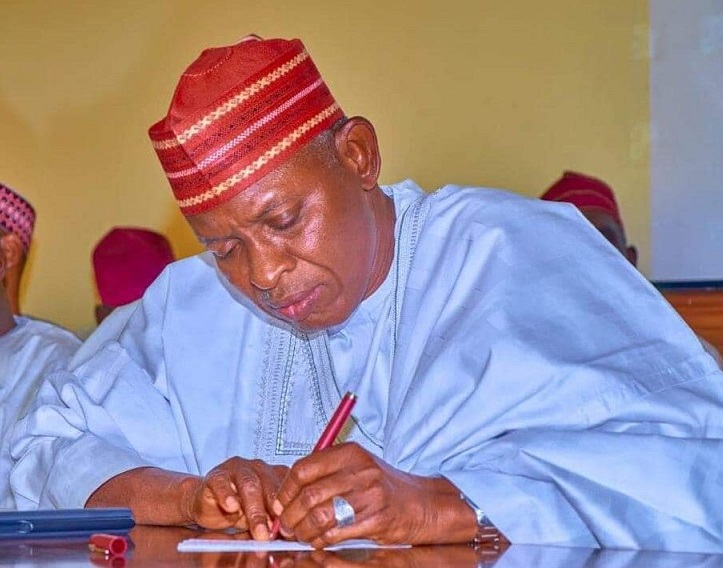
Abba Kabir Yusuf (Gida-Gida)

Kano to equip 200 schools with 50,000 computers

By Hadiza Abdulkadir

Governor Abba Kabir Yusuf has announced that 200 public schools in Kano State will each receive 250 computers, totalling 50,000 units, under a major digital education initiative supported by the World Bank through the AGILE Project.

The distribution, aimed at bridging the digital divide in education, was announced during the flag-off ceremony for instructional materials distribution held in Kano.

“Our goal is to bridge the digital divide and ensure our students are not left behind in this era of technological advancement,” the governor said.

According to Sunusi Bature Dawakin Tofa, the governor’s spokesperson, the initiative is expected to boost digital literacy among students and enhance the overall quality of education in the state.

“This is a transformational investment in our future. It will improve access to technology and empower thousands of students with the tools they need for academic success,” Bature said in a statement on Monday.

Governor Yusuf reaffirmed his administration’s dedication to promoting inclusive and innovative education through investments in digital tools and resources.

Kano Govt to solarise 200 public schools

By Hadiza Abdulkadir

In a bid to provide stable electricity and improve learning conditions in public schools, Governor Alhaji Abba Kabir Yusuf has announced plans to solarise 200 public schools across Kano State.

The initiative, unveiled during the official flag-off ceremony for the distribution of instructional materials to schools, is part of the World Bank-supported Adolescent Girls Initiative for Learning and Empowerment (AGILE) Project.

Governor Yusuf stated that the installation of solar power systems would ensure uninterrupted electricity supply, thereby creating a conducive environment for learning and digital education.

“This effort is part of our broader commitment to modernise education infrastructure and ensure that our students are learning in environments that support innovation and growth,” the governor said.

His spokesperson, Sunusi Bature Dawakin Tofa, noted in a statement issued Monday that the intervention aims to eliminate power-related challenges that have long hindered the use of technology in public schools.

The solar project is expected to enhance teaching and learning outcomes while supporting other digital initiatives planned by the state government.

Kano State Government approves ₦3 billion for NECO fees

By Hadiza Abdulkadir

The Kano State Government has approved the sum of ₦3 billion for the payment of National Examinations Council (NECO) examination fees for students in public secondary schools across the state.

This initiative, under the leadership of His Excellency Governor Abba Kabir Yusuf, aims to support thousands of students by removing financial barriers to completing their secondary education. 

Stakeholders and social media commentators have praised the decision, describing it as a significant step towards promoting educational equity and youth development in the state.

More details later…

Kano bans live political programmes

By Hadiza Abdulkadir

The Kano State Government has imposed an immediate ban on all live political programmes aired by media organisations in the state.

As Kano Times online news media reported, the decision was announced during a quarterly stakeholders’ meeting organised by the Ministry of Information and Internal Affairs. The meeting, chaired by the Commissioner for Information, Comrade Ibrahim Abdullahi Waiya, brought together government officials and media executives.

In a statement signed by Sani Abba Yola, Director of Special Duties at the ministry, the ban aims to prevent the spread of inflammatory content that could jeopardise the state’s cultural and religious harmony.

“We are not trying to stifle political dissent,” Comrade Waiya told the gathering. “Our objective is to protect the sanctity of our cultural and religious values.”

Further measures were introduced during the meeting. All individuals invited for interviews on media platforms must now sign an undertaking committing to avoid abusive, defamatory, or culturally insensitive remarks.

Presenters have also been directed to avoid provocative questions or gestures that might provoke defamatory or damaging statements against individuals or the state.

Waiya acknowledged a recent decline in the use of inflammatory language on air, crediting the ongoing collaboration between the ministry and media houses for the improvement.

He also disclosed that the government has rolled out sensitisation campaigns targeting political presenters, media commentators, and members of the Council of Friday Imams to promote responsible public discourse.

“We want to ensure that all public communication is done with integrity—free of defamation and in a way that protects the reputation of Kano State,” Waiya said.

Kano to launch statewide data collection Initiative

By Muhammad Sulaiman Abdullahi

The Kano State Government is set to begin engaging volunteer ad-hoc data collectors across the state’s 484 wards as part of efforts to establish a comprehensive multisectoral data bank and dashboard. The initiative, which is nearing 70 per centcompletion, has been approved by the Executive Governor, Alhaji Abba Kabir Yusuf.

According to the State Statistician-General, Dr. Aliyu Isa Aliyu, the volunteers, who must be residents of their respective wards, will be trained by the State Bureau of Statistics on the use of digital data collection tools. 

Dr Aliyu added that their responsibilities will include collecting demographic data such as births, deaths, maternal and child mortality rates from ward head registers and graveyards, as well as statistics on education, healthcare, security, and access to water and electricity.

Dr. Aliyu emphasised the importance of collaboration between volunteers, ward heads, and community stakeholders to collect accurate and timely data. He added that school teachers and health workers are strongly encouraged to apply once the application portal is made public.

“This is a collective responsibility and an opportunity for all of us who are committed to supporting our state,” he said. “Together, we shall make Kano great.”

Kano vows tough action against sexual harassment in schools

By Uzair Adam

The Kano State Government has pledged to take firm action against any teacher or school staff member found guilty of sexually harassing students, warning that such offenders will face legal prosecution.

This was disclosed on Tuesday by the Senior Special Assistant to Governor Abba Kabir Yusuf on Student Matters, Ibrahim Ma’ajiyi Sumaila, at a high-level stakeholders meeting organized by the Centre for Awareness on Justice and Accountability (CAJA).

The event aimed to address the growing concern of sexual harassment in educational institutions.“As an Islamic state, Kano will not fold its arms and watch our daughters suffer abuse and humiliation. Any teacher who dares to violate a student will be flushed out and prosecuted without delay,” Sumaila declared.

He also assured full government support to NGOs championing advocacy and reform in the education sector.

The meeting, which included students, legal experts, journalists, and civil society groups, marked the launch of a six-month project by CAJA focused on curbing sexual harassment through strategic institutional policy-making.

Kabiru Sa’id Dakata, CAJA’s Executive Director, explained that the initiative aims to develop clear, stand-alone policies for tertiary and secondary schools, noting that many institutions either lack such policies or bury them in vague student handbooks.

“We spent three years pushing for a national law on sexual harassment—it’s a slow process. Now, we are pursuing individual institutions to adopt clearer policies,” he said.

Dakata pointed out that many victims suffer in silence, with some dropping out or failing academically for resisting the advances of predatory lecturers.

“Students often don’t even know where to report these incidents. That’s a failure of the system,” he added.

Delivering a paper on the topic, Barrister Maryam Ahmad Abubakar defined sexual harassment as any unwanted verbal, physical, or psychological behavior of a sexual nature that disrupts the learning environment.

She reiterated the importance of education, moral guidance, and religious teachings in tackling the issue.

Among the strategies proposed were enforcing strict penalties, adjusting admission and employment ages, and incorporating moral instruction into general studies curricula.

Supported by the Nigerian Women’s Trust Fund and other partners, CAJA also plans to empower survivors as advocates, conduct outreach in selected schools, and produce awareness materials to amplify the campaign.

Echoes of the past, choices of today: Will Kano’s throne withstand the test of time and wisdom?

By Usman Abdullahi Koli

The grandeur of Kano’s emirate is not merely an inheritance of a throne but the custodianship of a deep-rooted history, culture, and tradition that represents the very soul of African heritage. From the era of Bagauda to the reign of Ado Bayero, the emirate has stood as a symbol of resilience, dignity, and continuity. 

Today, as the emirship tussle continues, it presents a defining moment not just for those directly involved but for the entire Kano people, whose unity and stability rest upon the wisdom of their leaders. It is a moment that demands measured actions, guided by history and the sacrifices of great monarchs who prioritised the collective good over personal ambitions.

The Kano Emirate is no stranger to succession disputes; however, history has shown that wise leaders have navigated such crises with patience, foresight, and a commitment to preserving the integrity of the institution. From the reign of Emir Muhammadu Sanusi I to that of Ado Bayero, the emirate has undergone significant transitions- some peaceful, others contentious- but ultimately resolved with a sense of responsibility toward the larger interest of Kano.

Today, we see echoes of the past in the contest between Emir Muhammadu Sanusi II and Emir Aminu Ado Bayero. While the legal and political dimensions of the crisis continue to unfold, the moral weight on those involved is immense. The key question remains: Will the dignity, harmony, and prestige of Kano take precedence over personal interests, or will history remember this episode as a moment of avoidable discord?

History is replete with examples of monarchs who faced displacement yet responded with wisdom, ensuring that their thrones remained symbols of honour rather than sources of division. In 1936, King Edward VIII of Britain abdicated the throne out of personal conviction, avoiding a constitutional crisis. 

More recently, King Juan Carlos of Spain voluntarily stepped aside to preserve national unity and dignity. Within Africa, deposed monarchs have often demonstrated restraint, placing the peace of their people above personal grievances.

A particularly relevant example is Emir Muhammadu Sanusi II, who, despite the political implications of his removal in 2020, did not rally his supporters to contest the decision. Instead, he accepted his fate with remarkable composure, trusting in destiny and the historical cycle that governs leadership.

Governor Abba Kabir Yusuf is enormously responsible for ensuring that his administration’s actions do not fuel unnecessary tensions in Kano. While he holds constitutional authority over traditional institutions, wisdom dictates that such decisions be made with a far-reaching vision that safeguards Kano’s unity, stability, and the sanctity of its traditions. Political decisions should not be allowed to erode the revered position of the emirate.

To Emir Aminu Ado Bayero, this moment calls for deep introspection on the true essence of leadership. His revered father, Emir Ado Bayero, was an emblem of peace, patience, and sagacity. The respect he commanded was not merely because he sat on the throne but because of his ability to navigate crises with wisdom. Now, his son faces a historic test: will he allow personal ambition to override Kano’s peace, or will he embrace the noble path of sacrifice? The decisions he makes today will shape how history remembers him.

To Emir Muhammadu Sanusi II, his reinstatement is a return to power and an opportunity to lead with renewed wisdom and vision. His expectations are immense—not for vengeance or retribution, but for reconciliation and statesmanship. The people of Kano look up to him to use his vast experience, intellect, and leadership to heal divisions, restore trust, and solidify the emirate as a pillar of stability.

Kano is more than a city; it symbolises Africa’s resilience, culture, and civilization. The emirate embodies centuries of tradition that must not be tarnished by personal conflicts. The world is watching, and history is recording. The real question is not who occupies the throne today, but how that throne is preserved for generations to come.

It is crucial for external influences, particularly those in Abuja, to respect the Kano State Government’s decision. The constitution recognizes states as custodians of their emirates, and any interference from outside forces risks escalating tensions rather than resolving them. Political insinuators should avoid fueling discord and instead honour the autonomy of Kano’s leadership.

Now, the great tradition of the Sallah Durbar, which both factions claim to organise, must not become a battleground for supremacy. The grand procession, deeply embedded in Kano’s cultural and Islamic identity, is meant to unite, not divide. It should not be reduced to a contest of power. Both sides must recognize that personal ambitions should never overshadow the collective peace of Kano. True leadership is tested not in times of comfort, but in moments of crisis, and the world is watching to see whether wisdom or ego will prevail.

Great monarchs are remembered not for how fiercely they fought to retain power, but for how wisely they managed transitions, prioritized peace, and left behind legacies of honor. The lessons of Kano’s past emirs—from Bagauda to Ado Bayero—should serve as a guide for present leaders. These revered figures ruled with dignity, wisdom, and a profound sense of duty to their people.

Those who occupy the throne today must consider: Will they be remembered for upholding this legacy or for diminishing it?

May wisdom prevail over pride, and may Kano remain the fortress of culture, tradition, and unity it has always been.

Usman Abdullahi Koli wrote via mernoukoli@gmail.com.

Kano delegation embarks on fact-finding mission to Edo over travellers’ killing

By Uzair Adam

A high-powered delegation from the Kano State Government on Thursday departed for Edo State on a fact-finding and peace-building mission following the gruesome killing of 16 Kano travellers who were burnt to death in the Uromi community.

This was disclosed in a statement by Ibrahim Garba Shu’aibu, spokesperson to the Deputy Governor of Kano State, who said the visit aims to investigate the circumstances surrounding the incident and foster peaceful coexistence.

The Daily Reality reports that the committee was constituted in response to national outrage and concern over the violent attacks that led to multiple deaths and the displacement of residents, including indigenes of Kano living in the area.

The delegation is led by the Deputy Governor of Kano State, Comrade Aminu Abdussalam Gwarzo. It includes notable figures such as the Emir of Rano, Ambassador Mohammad Isa Umar, and commissioners from various ministries, including Religious Affairs, Local Government and Chieftaincy Affairs, Special Duties, and Women Affairs. Also in the team are the Chairman of Bunkure Local Government Area and other top officials.

Speaking at the Mallam Aminu Kano International Airport before departure, Deputy Governor Gwarzo emphasized the committee’s dedication to justice and peace.

“Our mandate is clear — to investigate, consult, and recommend sustainable solutions. This is not just a fact-finding mission, but a peace-building initiative aimed at restoring confidence and preventing further violence,” he said.

He noted that the tragic event last month has escalated tension in the area. During their week-long stay, the committee will meet with the Edo State Governor, security chiefs, traditional leaders, and civil society groups.

The statement also mentioned that the mission aligns with the Northern Governors Forum’s broader efforts to promote unity and address insecurity nationwide.

It concluded that “Further updates will be provided as the committee progresses with its engagement in Edo State. “

_________________________________

Muhsin Ibrahim, PhD

Institute of African Studies

University of Cologne 

Blogwww.muhsin.in

Edo governor visits Kano, vows justice for slain hunters

By Uzair Adam  

Edo State Governor, Monday Okpebholo, has visited the Kano State Government and the families of 16 hunters burned to death by criminals in Uromi, Edo State, to offer condolences.  

Speaking at the Government House, Okpebholo expressed shock over the incident and confirmed that 14 suspects had been arrested.  

The Daily Reality reports that the governor assured justice for the victims’ families.  

Similarly, Kano State Governor, Abba Kabir Yusuf, urged Okpebholo to ensure the culprits are punished.  

Yusuf also called on the federal government to disclose the identities of those arrested and urged the Edo government to compensate the families of the deceased.

Sustain Ramadan virtues, support less privileged – Governor Yusuf

By Uzair Adam 

The Governor of Kano State, Alhaji Abba Kabir Yusuf, has extended warm Eid-el-Fitr greetings to Muslims in Kano and beyond, urging them to uphold the virtues of patience, compassion, and unity cultivated during Ramadan.  

In a statement issued by his spokesperson, Sunusi Bature Dawakin Tofa, on Sunday, the governor emphasized the need to sustain the spirit of sacrifice and selflessness, encouraging citizens to support the less privileged and promote harmony in their communities.  

Governor Yusuf reaffirmed his administration’s commitment to improving living conditions by ensuring economic growth, social welfare, and infrastructural development. 

He also stressed the importance of peaceful coexistence among different ethnic and religious groups, describing unity as Kano’s greatest strength.  

Addressing the recent killing of Kano indigenes in Edo State, the governor expressed deep sorrow over the tragedy and vowed that his government would not rest until the perpetrators were identified and brought to justice.  

He urged citizens to use the festive period to strengthen family bonds, promote reconciliation, and foster peace. 

He also called on them to emulate the exemplary character of Prophet Muhammad (Peace Be Upon Him) by upholding justice, honesty, and compassion in all dealings.