


Rarara security guards dismissed by Nigerian Police for unlawful act
By Ahmad Deedat Zakari
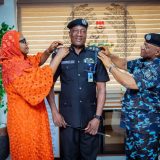
The Nigerian Police Force, NPF, has dismissed three officers on the ground of infamous conduct.
NPF Spokesperson, CSP Olumuyiwa Adejobi, disclosed this in a statement he signed and made available to journalists on Thursday.
According to the statement, the dismissal is sequel to complaints received against the erring officers.
He wrote, ” Subsequent to complaints and findings on video evidence widely circulated on Friday 7th April, 2023, on social media of high-handedness, unprofessional conduct, and misuse of firearms against some policemen from Special Protection Unit (SPU) Base 1, Kano, and a follow-up orderly room trial of the affected policemen by the Force Provost Marshal, three officers from the SPU Base 1 Kano have been dismissed for the offences of discreditable conduct to wit misuse of firearms, abuse of power, gross indiscipline, and wastage of live ammunition.”
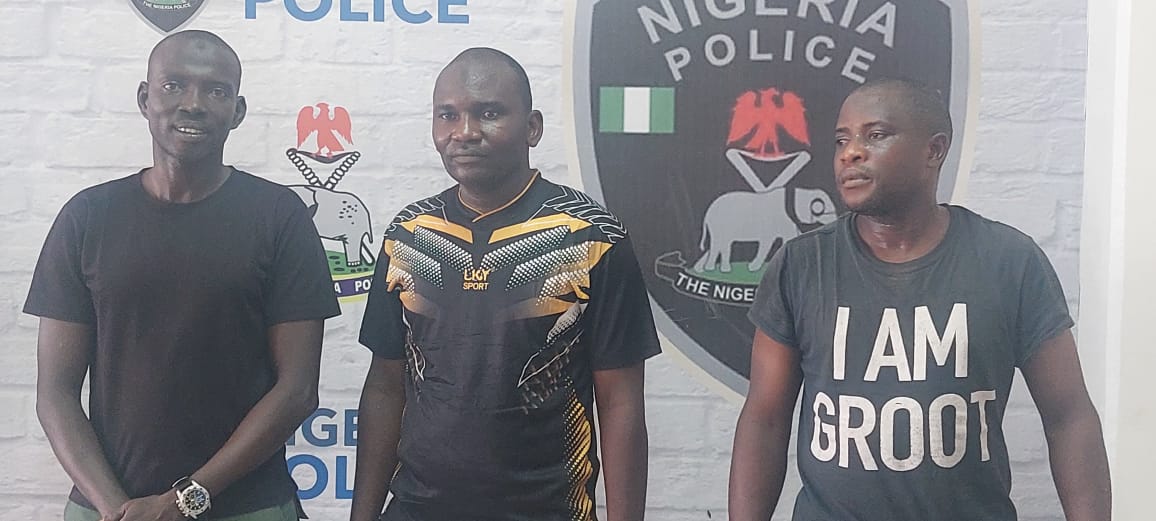
The affected policemen are Inspector Dahiru Shuaibu, Sgt. Abdullahi Badamasi and Sgt. Isah Danladi.
The said officers were attached to a musician in Kano on escort duties and were seen in videos shooting indiscriminately into the air.
Consequent of the development, the NPF warned officers to be law abiding ‘to avoid running foul of its provisions and attracting attendant sanctions’
Endless road accidents in Nigeria
By Bako Jennifer Bootnaan
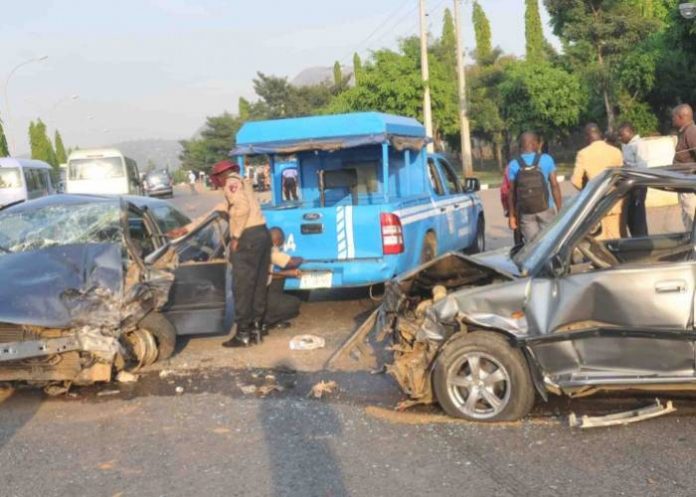
The major causes of recent road accidents, especially in Nigeria, may include but are not limited to the following circumstances:
Over-speeding: Drivers often exceed the speed limit on highways and roads, leading to loss of control of the vehicle and accidents.
Poor road conditions: Many roads in Nigeria are poorly constructed and maintained, leading to accidents due to potholes, uneven surfaces, and poor drainage.
Non-compliance with traffic rules: Many drivers in Nigeria do not comply with traffic rules and regulations, leading to accidents.
Overloading: Many commercial drivers overload their vehicles with passengers or goods beyond their capacity, making the car unstable and prone to accidents.
Driving under the influence: Many drivers in northern Nigeria drive under the influence of alcohol or drugs, impairing their judgment and leading to accidents.
Some possible solutions to reduce road accidents in Nigeria are:
Enforcing traffic laws and regulations: The government should implement and penalise drivers who break them.
Improving road infrastructure: The government should improve road infrastructure by constructing and maintaining good quality roads, bridges, and drainage systems.
Educating drivers: Drivers should be educated on the importance of obeying traffic rules and the consequences of reckless driving.
Regulating commercial vehicles: The government should regulate commercial vehicles, especially their loading capacity, to prevent overloading and improve safety.
Increasing awareness: The government should raise awareness about road safety through campaigns, media, and education to encourage safer driving practices among road users.
With the above assertion, if adequately implemented, road accidents may become a thing of the past, not in northern Nigeria alone but in the country.
Bako Jennifer Bootnaan writes from Mass Communication Department, Abubakar Tatari Ali Polytechnic, Bauchi Bauchi State. She can be contacted via jenniferbakobootnaan@gmail.com.
Bayern suspend Mané for punching Sané
By Muhammadu Sabiu
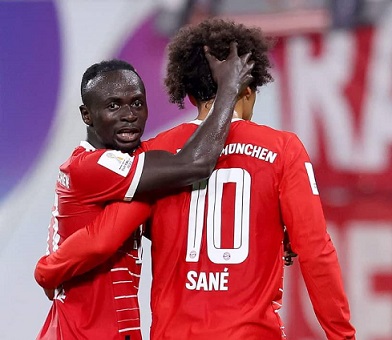
Bayern Munich have suspended Sadio Mané after he punched his teammate Leroy Sane.
Following Bayern’s 3-0 loss to Manchester City on Tuesday night, Mane and Sane got into an argument in the dressing room.
The Senegalese international confronted Sane after the game because he was upset with how Sane treated him on the pitch.
He lost his cool and hit Sane in the face, leaving him with a bloody lip.
The suspension, according to reports, is until further notice.
Astronomical World: City Killer, Intelligent Beings and Earth Astrophysics
By Bilyaminu Abdulmumi
The first time I came face to face with a cosmic event was during the solar eclipse back in 2006. Before the event, the meteorologist announced it was coming, but while the naysayers kicked against it, the curious others, including myself, waited with bated breath. In Jega Kebbi State, a partial eclipse was experienced at about 9:40 am. The entire horizon slowly became dark for about an hour. In some other areas of the country, the eclipse was total darkness. Afterwards, the sky became clear and normal. Those who were asleep had only woken up to learn about it.
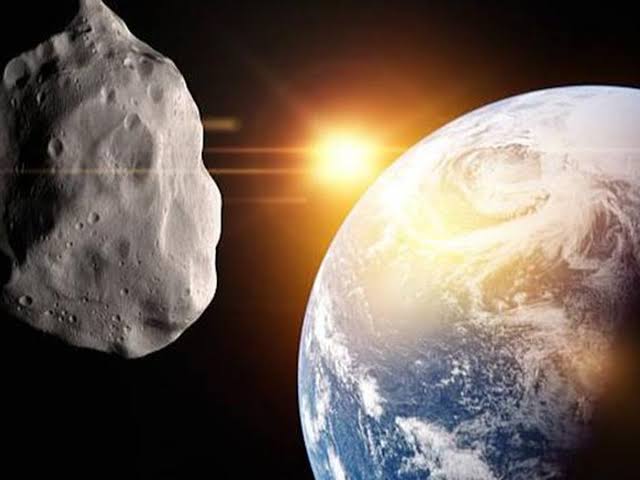
A couple of days back, on the 25th of March, another startling cosmic phenomenon took place; an asteroid passed between Earth and Moon’s orbits, specifically 175,000km away from Earth. According to astronomers, this is very close! The asteroid was nicknamed City Killer, indicating its potential to harm a city should it strike Earth on a habited area. But it was not as the name implies because, by God’s grace, the asteroid passed harmlessly as predicted.
Like all other cosmic events, the City Killer passage was discovered long before for possible action and announcement to the public, so people across the globe could follow the event live! The burning question here is, if Europe and other developed countries stand toe-to-toe proactively defending our Earth: in what part is Africa contributing? Are we stakeholders in these unfolding events?
The area of astronomy is both interesting and, at the same time, frighteningly complex; astronomy is an embodiment of epic proportions. Whenever something is referred to at the cosmic level, it is near impossible or almost infinite.
From what we learn from time to time from astrophysicists, the Sun is the centre of our solar system, and other planets, such as our Earth (and the 7 other known planets), rotate around it. To further complicate our life, the Sun is in constant spiral motion rotating around its axis, while the planets orbit around it!
The cosmic phenomenon would begin to go wild in our imagination when the concept of size and distance were brought up. The size of our Earth is about 12,800km, but compared to the size of the Sun of 1,400,000km, it is like comparing a dot with a circle. In addition, the distance between our Earth and the Sun is about 150 million km. Now imagine the size of our solar system!
The size of our galaxy (Milky Way) is mind-boggling. According to what astronomers told us, there are billions of solar systems in our galaxy. At this level, the distance is no longer measured in km but in light years. For instance, the distance between our star (Sun) to the closest Sun in our galaxy is about 4.25 light years. Light travels at the speed of 3,000km per second, so at this rate, it will only take light to travel from Borno to Lagos (a distance of about 1600km) about half a second. Now, this light that can travel in half a second from Lagos to Borno has to continue travelling for 4 years and 3 months to reach the next Sun close to ours. Pray! They told us there are billions of galaxies in the universe.
Because of this cosmos proportion, scientists such as Stephen Hawking believe that we can’t be the only intelligent in the universe. This view espouses that in one of the billions of galaxies in the universe, in one of the billions of solar systems in a galaxy, a celestial being like our Earth (bursting with intelligence) must exist. The universe is too vast to contain just one intelligence. The intelligent might be at par with us in terms of advancement, we could be way smarter than them, or the reverse may be the case. One astronomer said that it is scary anyhow one looks at the scenario: to say that we are not alone in the universe or we are alone.
The terrifying part of the multi-intelligence theory is, should the other intelligent locate us, what will be our fate? Are they going to destroy us in their search for raw materials just like we human beings are increasingly wreaking havoc on climate and habitat in exchange for raw materials (for technological advancements)? Or are they going to cooperate with us to add to our knowledge? It is equally frightening for the single intelligence theory: we are the only ones in this vastness of space. As much fantasy as the former theory looks, developed nations are not joking, as they committed a multi-billion dollar research centre in this direction: SETI (Search for Extraterrestrial Intelligence).
Unlike SETI, Earth astrophysics has been bagged. Earth doesn’t rotate on its axis for 24 hours to complete a cycle only but rotates around the Sun 365 days to complete a cycle. By God’s grace, the 24-hour cycle ensures night and day, while the 365 days cycle ensures seasons. The moon does similar; it rotates around the Earth in a month as a source of light for us, to keep time management, and to ensure Earth’s stability. Should the moon be trapped in the Earth’s shadow it will be a lunar eclipse, or should the moon pass between Earth and Sun hence blocking the Sunlight, we get a solar eclipse.
It is understandable for “people” to exhibit sheer amusement in the discussion of cosmic events. During the 2019 lunar eclipse, one deeply amused person asked: if our Earth rotates, why are we still in Nigeria? He appeared to mean that if the Earth actually rotates, then we should not be where we are now. Maybe we should be in Saudi Arabia by now!
Abdulmumin can be reached via: bilal4riid13@gmail.com.
Jigawa: Gov’t approves compulsory retirement of Judge Dabi over collecting bribe
By Muhammad Sulaiman Yobe
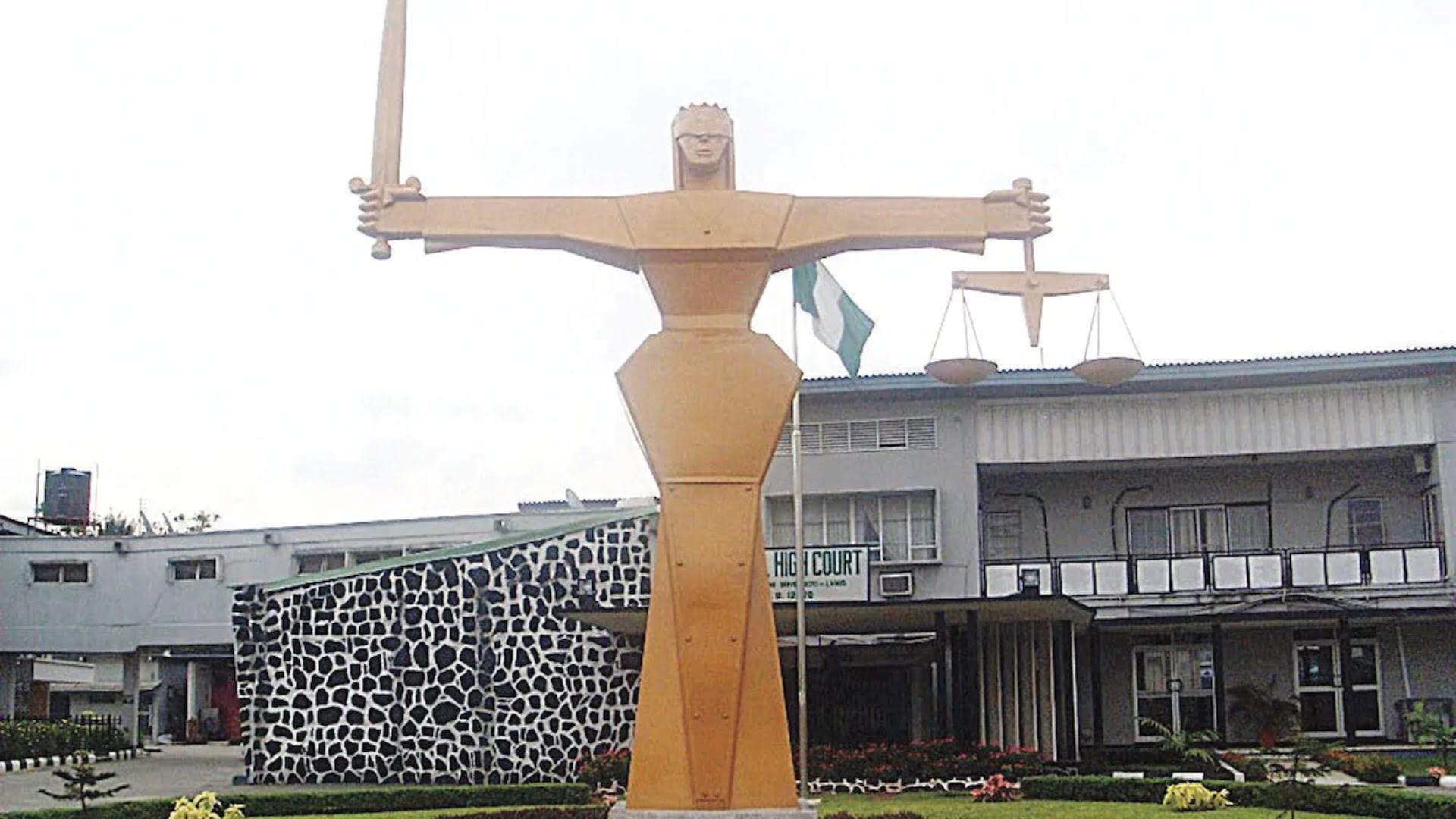
Jigawa State Judicial Service Commission has approved the compulsory retirement of a Upper Sharia Court Judge, Alkali Safiyanu Muhammad Dabi, for collecting bribe.
A statement issued by the Director Publicity and Protocol Matters, State Judiciary, Abbas Rufai Wangara, stated that the Commission also approved the promotion of four senior staff of the state judiciary to various positions.
The statement added that the commission also approved the appointment of Barrister Aliyu Muhammad as Deputy Chief Registrar II, Sharia Court of Appeal; Barrister Abdulrashed Al`asan, Chief Inspector Sharia Court; Barrister Muhammad Lawan, Zonal Deputy Chief Inspector Sharia Court of Appeal while Barrister Muhammad Adamu was appointed as Zonal Deputy Chief Inspector, Sharia Court of Appeal.
Similarly, the commission warned that any judicial officer found wanting in the discharge of their duties would face the wrath of the law.

Final-year OAU student beaten to death over phone theft
By Muhammadu Sabiu
A mob reportedly lynched Okolie Ahize, a final-year student from the Department of Civil Engineering at Obafemi Awolowo University, OAU, Ile-Ife.
Ahize allegedly got hit for stealing a cell phone from the university’s Hall of Residence. It was learned that the student had been tortured and was declared dead upon arrival at the Obafemi Awolowo University Teaching Hospital Complex’s Emergency Medicine Department on Tuesday afternoon.
A statement by the university’s Public Relations Officer, Abiodun Olanrewaju, reads, “The Administration of Obafemi Awolowo University, Ile-Ife, Osun State, has condemned, in strong terms, the incidence that led to the death of a part 5 student of the institution.
“Preliminary investigation revealed that the student died of a mob action on the allegation that he stole a phone.
“Saddened by this ugly development which he described as unfortunate, the Vice Chancellor, Professor Adebayo Simeon Bamire, has set up a committee to unravel the circumstances that led to this incident.
“The action of the mob, being a violation of the law of the country and of the University regulations, has been reported to the police who have commenced investigations.”
A crack on Hadiza Gabon’s wall: Humanizing Northern Nigerian stories
By Sa’id Sa’ad
Being a lover of reality shows, award nights, behind-the-scenes and documentary movies, I’d always dabbled from one interview to another, especially exclusive interview rooms that humanise celebrities from various industries. Something that often allows me to see these people beyond their screen-portrayed selves, beyond their polished English-speaking tongues in sets, and beyond their filtered pictures on Instagram.
From Steve Harvey’s show to Trevor Noah’s. From Coffee with Karan to dozens of international shows of the same make-up. Each of them has always fed me the dose of vitamins I needed to see different fantastic interviewees in their human form. Sometimes, I would wonder deeply how one person could have this widened, divergent existence.
However, in Nigeria, shows like #WithChude hosted by Chude Jideonwo have become relevant to Nigeria’s entertainment industry, bringing music artists and Actors – Nollywood – to live through personal exclusive discussions that spark varying conversations. Meanwhile, the advent of Ebuka Obi Uchendu’s Black Box Interviews has presented a new dimension for this art. Through bringing similar personalities as #WithChude’s, the Black Box interviews – geared by Ebuka’s mastery in media and moderation makes it more humane, deep – yet story-driven and intense conversations that would take about fast-phased 2-hour discussion that would leave you wanting more. Undoubtedly, these contents have been the source which news media and bloggers would often plug their ‘stories’ and ‘gossips’ from, giving more relevance to the celebrities and promoting their art. And above all, selling the stories of these people, majorly, using it to their career advantage.
As you might already predict, Northern Nigeria’s entertainment industry has lagged same platforms, except for a few interview programmes produced by media companies. BBC Hausa’s Daga Bakin Mai Ita and Arewa24’s Kundin Kannywood are a few examples of what it was for the industry. Perhaps – as perceived by many – as a lack of “capacity” or “interest” to pursue the same, especially from the industry players. Or rather, others believe that as a result of the notion that northerners do not appreciate northern content. The latter, as sad as it may sound, has continued to place a borderline between contents from the region and its market. However, a robust attempt – from the industry players as thus they benefit from it – would have been a Noah’s Ark to what northern Nigeria’s storytelling would become and even the industry market. Hence, Hadiza Gabon’s Room.
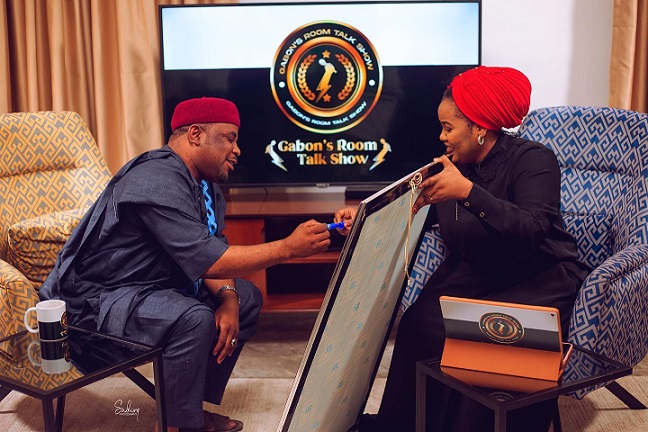
Since the advent of the show – as much as I hardly ever skipped Daga Bakin Mai Ita – I am one of those who’ve watched every episode of Hadiza Gabon’s Room since its inception. Being a household name in northern Nigeria, Hadiza Gabon’s Room, a personal show produced by the actress lately, has gained attraction in the region. This should raise an eyebrow as to how northerners react to northern content or stories specifically produced in Hausa. Prior to the production, the most likely, perhaps consistent programme that ‘tries’ to do this task of humanising the northern entertainment artists has been Daga Bakin Mai Ita which, of course, contributed, though very shallow.
Another close ally to that was what used to be Kundin Kannywood, produced by Arewa24 – the first indigenous Hausa-speaking TV channel – and hosted by ace Kannywood actor Aminu Sheriff Momo. With the wider reach and technical skills invested in producing them, the duo have proven to have a lighter foundation of sustainability as they are run, produced and aired by media organisations who might – at any moment – halt, pause or terminate the programme, especially if any of its episodes attempt to wobble with the organisation’s reputation. But one would never separate celebrities and trends. Or can we?
I agree that “northern Nigeria does not appreciate northern Nigerian content” due to my experiences with middle-class-elite Hausa-speaking northern Nigerians who find their faces wrapped in shame to consume anything northern or anything Hausa. Be it music, film or any form of art. But even more, sometimes you could drop your jaw at how much northerners “dismiss” what becomes of Hausa celebrities from the region. Many were caught “bragging” about how much they didn’t recognise a certain northern celebrity they bumped into at a shopping mall.
But this is not so much different from what the same generation of Yoruba and Igbo does to their indigenous language promoters and contents as well. Perhaps the only difference between the Hausa-consuming northern Nigerian population and the others is that the typical educated middle-class or elites half-baked exposed northerner consume Hausa-produced content with ‘shame’. While a Yoruba or Igbo population consumes these contents in their own languages with ‘pride’. Unless for few who are bold hit the table, some have made it a subject of mockery to their friends who listens to Hausa songs or watch Hausa movies. Making it a “measure of exposure”.
Ordinarily, I’d assume that only a few people like myself – who are interested in storytelling and care about northern stories – consume Hadiza Gabon’s Room until a few weeks ago when the host interviewed a Kannywood actress who’d broken down on the show over what people would describe as “poisonous love” with another unnamed artist. This brought numerous comments from different people in the industry and beyond. But most surprising, from the same “typical educated middle-class or elites half-baked exposed northerners” admitting to having “been watching” the show. Perhaps this can also reflect a hypocritical-denial and intentional lack of acknowledgement. So, it’s safe to say these two contributed to placing the region’s storytelling where it is. Maybe even moved it farther.
Now, self-made analysts on social media have been placing the show on a scale weighing Hadiza Gabon’s skills in media or journalism, and some even going to the extent of breaking bits and pieces of how the questions should be asked. In all honesty, it is not balanced to completely dismiss the fact that there is still more to do from the producer in terms of the technicalities of the show, but it is also imperative to understand that Shows like these grow, get better and improve, with time. This could be reflected in what Ebuka Obi Uchendu or Chude Jideonwo’s shows were ten years ago and what they are now.
However, as a writer and a communications specialist, I would rather than analyse, admit that Hadiza Gabon would have become one of the bravest from northern Nigeria’s entertainment industry to self-produce such funnel that would feed – good or bad – stories from what creatives do in northern Nigeria. At least, a good or bad story is better than no story. Or better still, if Ebuka’s Black Box Interview Show could tell deeply personal stories about the life, career journey and even growth of certain entertainment stars from other parts of Nigeria, then there is a likelihood that Hadiza Gabon could be to northern Nigeria celebrities what Ebuka Obi Uchendu is to Nigerian Celebrities.
Though balancing stories is an essential part of storytelling, it is also unimaginable to think that one day you would find Chude Jideonwo interviewing Hamisu Breaker or Ado Gwanja on his show. This is not to be dismissive about the possibility of that, but the prospect as of now is blurry. Therefore, these stories from these people from northern Nigeria have to come out from northern Nigeria. And that is why Hadiza Gabon should be commended for that.
On the other side, celebrities have soon produced multiple of these shows – using their popularity to sell their stories – while putting a spotlight on their artists, storytellers, entrepreneurs, writers, tech gurus and even educators. And like tomatoes spread out on the front line of an open market, these have been central to the stories they tell the world about themselves. Since we refused to do the same, we are left with our favourite duo, “Almajiri and poverty” narratives.
Imagine if Hadiza Gabon’s Room is a Live show where these guests will speak – without filters, editing or CUT!? Such that truth will be told as raw as it should be, and the eyes will communicate a lie? Imagine if other writers and journalists would consistently write about whatever in-creatives-sake is coming out from northern Nigeria in theatre, movie, and music, such as Muhsin Ibrahim? Imagine if there were multiple consistent shows produced by the industry players who would use their popularity to air their stories, such as what Hadiza Gabon does in her Room? Imagine if consuming these contents in local languages is seen as mere “interest” rather than as a “measure of exposure”? Imagine! Imagine! Imagine!
This is a crack created by Hadiza Gabon’s Wall. We have now seen the gap. And there is more to see. Storytelling does not rest on the edge of a singular art form. Rooms as well, have ways of speaking. They have walls that portray. They have a roof that reflects. They have floors that nurture. We can only humanise our stories when we hang them on the walls and paint them. But what will become of us if our walls continue to crack?
Sa’id Sa’ad is a Nigerian writer, poet and playwright from Maiduguri. He is the NFC Essay Award Winner 2018 and the Peace Panel Short Story Prize Winner 2018. He tweets at @saidsaadwrites and can be reached via saidsaadabubakar@gmail.com.
Holy Qur’an University confers honorary doctorate on Sheikh Pantami
By Abdurrahman Muhammad
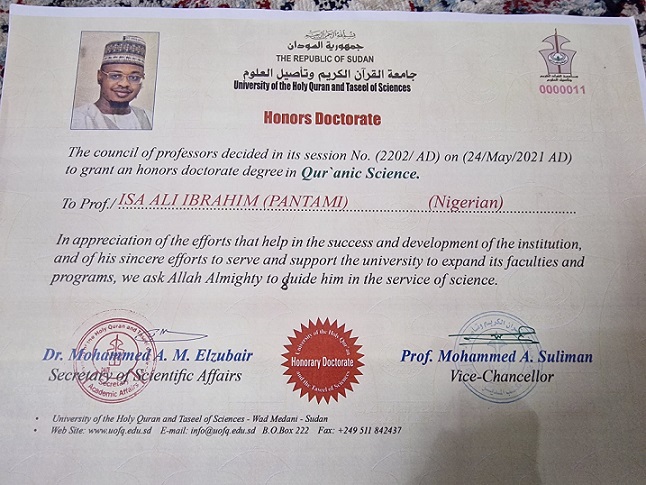
The University of the Holy Qur’an and Taseel of Sciences of the Republic of Sudan awarded Nigeria’s Minister of Communications and Digital Economy and renowned Islamic cleric, Professor Isa Ali Ibrahim (Pantami), with an Honorary Doctoral Degree in Qur’anic Science.
While the Honourable Minister was awarded in May 2021, he received the award certificate and shared the same on social media only recently.
According to the official social media handles of the Minister, he was the first person in sub-Saharan Africa to receive the award. The statement, in part, reads:
“With the exemption of North Africa, he was the first African to receive the recognition on the Glorious Qur’an.”
During Ramadan, Sheikh Pantami delivers Tafsir at the Annur Masjid in the Nigerian capital, FCT Abuja. He also holds other preaching sessions outside the Holy Month at the same mosque or elsewhere.

Time Waits for Nobody: A Ramadan reminder
By Salim Samaila Marafa
It was like yesterday, The crescent of Ramadan was sighted, and we started fasting. But here we are today, with a few days to Eid-el-Fitr. Indeed, the speed at which time flies is amazingly alarming.
Among God’s creatures, time is an independent creature that exists without hinging on anything. It flies without waiting. It comes and goes without notification, so you either learn how to manage it or fall victim to “lack of time.”
Time is an undefeated warrior. It saw the rising and falling of great heroes and significant events and memorable moments. But, It put all of them in the bin of history. That’s all. The only warriors who can defeat time are those who know how to use it well. Therefore, we should learn how to use and manage our time to our advantage before it shows its habit of slipping away without notice. Since our time is limited and our days are numbered.
Ramadan is the month’s name in the Islamic calendar, while the month is a small portion of the time. Therefore, we should use this time, Ramadan, wisely, positively and to our advantage.
Ramadan is Islamically considered a holy month of blessings and Allah’s abundance of mercy. Our beloved prophet (pbuh) even narrated that during Ramadan, Satan is chained, doors of hell fire are closed, and those of paradise are widely opened.
Also, Ramadan is Islamically considered a glorious period during which Allah spreads the mat of his forgiveness to his servant. So, as we are observing the fasting of day 18 today, skip reading this reminder and ask yourself this question “From day one of this month up to date, what did I do that can earn me Allah’s forgiveness and blessing.”
If the answer to the above question is ” I did this and that”, it is okay, but not enough. Redouble your effort within these few remaining eleven or twelve days. To have more blessings in your possession.
However, if the answer to the above question is ” I did not do anything good,” then this is where your problem started. But don’t panic; you are not that too late. You still have 11 days ahead of you; you can turn over a new leaf before it’s over and be forgiven by Allah the almighty.
What should I do to be forgiven and blessed by Allah?
This is a good question we should all ask ourselves. There are uncountable positive things one can do to earn Allah’s forgiveness in this holy month of Ramadan.
First, take your Qur’an, open it with good intentions and read as many verses and chapters as possible. Remember, every alphabet (harafi) of the holy Qur’an attracts ten rewards when you read it in the sacred month of Ramadan due to the holiness and glory of the month. So, if you. You can read two chapters daily, meaning you can read the Qur’an before the month slip away.
Secondly, help those needy people around you. Give out voluntary charity (sadaqah) to those who deserve it. Allah will surely reward you and forgive you for it long as you did it for His sake.
Thirdly, do you have parents alive?
If yes, be obedient to them, and show a kind gesture towards them. Allah loves those who love and take care of their parents. If your parents are no more, Don’t worry, do what you should have done to them, to their friends and to old people in your neighbourhood.
And to your dead parents, ask Allah’s forgiveness and mercy for them whenever you observe a prayer or any act of ibadat. This is another way you can get Allah’s mercy and forgiveness.
When night spreads darkness over the world, don’t just sleep from A to Z. Wake up when night ages, perform ablution, observe at least two rakat Voluntary prayer ( salat) and ask Allah whatever you wish. The night is a special period during which Allah accepts the prayers of his servants.
Remember, you can do many other things to get Allah’s forgiveness and blessings, which I did not mention here. Just Do them. This is a Ramadan reminder from your brother in Islam. Have a good Reading.
May Allah accept our fasting, prayers and every act of ibadat. And may He count us among those He forgives in this holy month of Ramadan.
Salim Samaila Marafa wrote via salimsamailamarafa82@gmail.com.
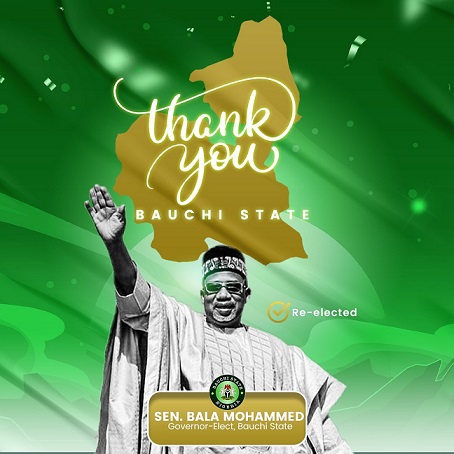
Now that he has clinched the Certificate of Return: Then what next?
By Abdulrahman Yunusa
The fact that election is the major hallmark of democracy is enough to be an apparent reason for anyone that thinks they can cheat the process under a democratic state to make it to any political seat that requires such periodic election is but an outright implausible and wishful thought.
Meanwhile, unlike other affairs, elections are conducted across the nation occasionally (after every four years in the case of Nigeria). It’s an avenue upon which the political actors compete and make it to a particular political position in government.
Therefore, the re-emergence of Governor Bala Muhammad for the second time as the Governor-elect of Bauchi state won’t be an exception since he passed all the above required constitutional procedures during this fierce political battle to emerge the champion of the 2023 governorship poll.
Yet, this hasn’t come to me as a surprise, for he met all the prerequisite requirements needed to make it for the second term. His handworks are there, manifesting themselves from all angles of governance. But the hurdles he went through to make this task and yet glamorous journey possible is what left me befuddled.
Once more, I congratulate His Excellency Governor Bala Muhammad of Bauchi state for making such a historical and spectacular political breakthrough against all odds. You have indeed shown how shrewd you are political.
For muzzling, silencing, dismantling, and burying the politics of godfatherism in the state, I can’t relent in thanking you for such a magnificent job. Hence, permit me to boldly inform your detractors that you have set precedence upon which the future generation must care to imitate in their future respective political affairs in the state.
However, without impacting the lives of your people, this feat couldn’t have been achievable by you at this tragic moment. For you have gone through all the series of political threats from friends, masters and foes, and you dismayingly thrash them down, thereby making them irrelevance in the game once more time.
Given that Governor Bala has received his certificate of return for the second time, shall we inquire about the shallow-minded gang who, over the past weeks, has been parading and making some baseless claims that their man is coming? Coming from where to where for God’s sake?
Is this not enough for them to bury their face in shame? Is this not sufficient for them to retreat from making other gibberish in the name of mandate reclamation through the court of law upon baseless allegations? Why couldn’t they stop making themselves ridiculous objects in politics?
Thank God for making such a rare move, throwing such a formidable political gang un to the dungeon of history amidst a critical moment. Thus this success has genuinely reflected the outcome of your tireless effort, resilience, hard work, perseverance, dedication and, above all, the incessant prayer you stick to.
I hope you will maintain the tempo and make the state among the top infrastructurally and economically. I further pray that the second tenure will be more productive for the state’s citizens. And may the state’s resources be judiciously utilised for the benefit of all.
May Bauchi succeed once again under the didactic watch of Governor Bala Muhammad Kauran Bauchi.
Abdulrahman Yunusa is a social and political affairs analyst. He writes from Bauchi and can be reached via abdulrahmanyunusa10@gmail.com.