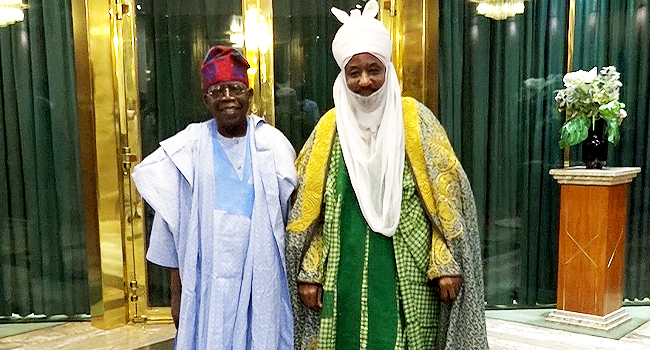
Sanusi’s longtime fuel subsidy stance and the harsh reality of implementation
By Lawan Bukar Maigana
At a birthday lecture titled “Weaponisation of Poverty as a Means of Underdevelopment: A Case Study of Nigeria,” organised in honour of former Governor Rotimi Amaechi at the Continental Hotel in Abuja, the Emir of Kano, Sanusi Lamido Sanusi, bitterly complained about the unprecedented hardship Nigerians face today.
According to him, the inflation and poverty gripping the nation are the direct consequences of loving to rule over people rather than loving them through developing favourable policies. That’s what I understand from his statement. But isn’t the fuel subsidy removal connected mainly to the realities he pointed out?
Many might forget, or conveniently overlook, that this same Sanusi Lamido Sanusi has been one of the strongest advocates for removing fuel subsidies since 2012. Years ago, I heard him proudly state on BBC Hausa that he had repeatedly advised President Muhammadu Buhari to remove subsidies and shut down Nigeria’s borders.
Respectfully, Buhari granted only one of his two wishes—closing the borders while leaving fuel subsidies intact. The subsidies lingered for years, postponed amid fears of political backlash.
Under President Bola Ahmed Tinubu, the fuel subsidy has finally been removed. The impact on ordinary Nigerians has been brutal—prices for fuel and essential commodities have surged, sending inflation into uncharted territory. People are being hunted by hunger and economic hardship like never before.
In this context, I believe Sanusi’s recent criticisms miss the mark. If anyone deserves celebration, it is President Tinubu,who dares to implement what Sanusi himself recommended years ago. Blaming Tinubu alone, even though Sanusi didn’t mention his name, for the hardship is unfair because he and other elite policymakers never offered concrete solutions or mitigating measures to cushion the blow on the poor when pushing for subsidy removal.
It is important to remind Nigerians that the blame for this economic situation is shared, not the fault of any one individual or administration. As the former Governor of the Apex Bank, Sanusi is part of the problem he now publicly laments. He advocated for the policy without proposing corresponding safety nets or economic reforms to soften the impact. The failure to plan has cost Nigerians dearly.
At the Abuja event, Sanusi asked a question that cut to the heart of leadership in Nigeria: “Do we as leaders truly love Nigerians, or do we just like ruling over them?” The answer is painfully obvious: too many leaders are interested in power for power’s sake. They seek to rule over the masses rather than serve them by crafting policies that uplift the poor.
This question should prompt serious reflection. If policymakers want to see genuine progress, they must remember that leadership is more than advising harsh policies; it is about standing with the people during the painful transitions these policies cause. It is about preparing the ground and providing support systems before asking citizens to bear the burden of economic reforms.
Nigeria’s elites, including Sanusi, need to own their history, yesterday. They must remember their past advocacies and be willing to share responsibility when those policies create hardship. It is easy to blame the current government for long-advocated but poorly planned decisions. It is far harder to admit one’s role in the consequences.
The harsh reality is that many elites conveniently forget their yesterday—the positions they took and the policies they championed. When those policies are finally implemented, and Nigerians bear the consequences, those same elites criticise the outcomes as if they had no hand in shaping them.
The lesson here is clear: policymaking in Nigeria must be holistic. It must consider not only economic theories but also social realities. Removing subsidies may be necessary, but without effective mitigation strategies, it becomes a weapon of poverty, inflicting untold suffering on the most vulnerable.
So, as Nigerians struggle with inflation and hardship, we should remember the true colours of our elites. They must be held accountable—not only for the policies they recommend but also for the human cost of those policies.
Lastly, I ask again: Should those who recommend harsh policies also bear part of the responsibility for their outcomes? The answer is a resounding yes. True leadership demands not just bold ideas but also the courage to accept the consequences and work tirelessly to protect the people.
Lawan Bukar Maigana is a journalist, humanitarian, Pan-Africanist, and social commentator. He’s known as Ibn Maigana on Facebook.

He stood, he served, he inspired: My tribute to Dr Bala Maijama’a Wunti
By Usman Abdullahi Koli, ANIPR
It is difficult to tell the story of a man whose life was not just lived but felt deeply, genuinely, and profoundly. It’s over now, the last file signed, the final handshake exchanged, the door gently closed behind a man whose entire life has been anything but ordinary.
As of May 30, 2025, Dr. Bala Maijama’a Wunti stepped out of public service, quietly bowing out from a remarkable journey that shook boundaries, lifted lives, and left behind a trail of courage, dignity, and truth. I find it not only fitting but necessary to say this: Now that it is done, let this be my tribute.
Much has been said, written, and whispered in admiration since his retirement announcement. But what I pen today is not a replica of what others have offered. This is personal. This is from a heart that was moved years ago when I sat quietly among students of ATBU Bauchi, listening to a man speak not as a bureaucrat, not as a technocrat, but as someone who had walked through fire barefoot and came out not burnt, but better.
He wasn’t speaking to impress. He was telling the truth, raw and unfiltered. He spoke of days when meals were not guaranteed, when dreams seemed laughable in the face of brutal reality. He described the hunger, the worn sandals, the sleepless nights, and how faith became his pillow. I remember that moment clearly. That day, in that humble auditorium, something shifted. It wasn’t just a speech. It was a defining moment for him and for us who listened.
In that moment, I carried three life lessons from Dr. Wunti—ones he never explicitly taught but demonstrated through his life.
First: Prayer is not optional. I have never encountered a man more grounded in submission to the Divine. No matter how tight his schedule, how demanding the office, and how crucial the meeting was, he found time to pause and connect with his Creator. And he did it not out of habit but conviction. It shaped everything about him: his calm, clarity, and confidence.
Second: He never forced what his heart didn’t embrace. Dr. Wunti did not do things just to tick boxes. He left it alone if his soul wasn’t aligned with a cause. This rare integrity gave his actions an unusual depth. Whether leading multi-billion-naira reforms or quietly helping an ailing community clinic, he did so with full acceptance and sincerity.
Third: Compassion wasn’t a virtue for him; it was a reflex. He gave not because he had to, but because he knew what it felt like to need and not have. Every school he built, child he sponsored, borehole he commissioned, and hospital bill he paid came from a heart softened by experience. He remembered. And in remembering, he uplifted.
Born in Bauchi, in a household where survival often came before ambition, Dr. Bala Wunti grew up in the shadows of lack. But he did not let it define him. Instead, he let it refine him. He pushed through school with sheer determination — from Chemistry at Ahmadu Bello University, Zaria, to earning his MBA in Marketing from ATBU Bauchi, and a Postgraduate Diploma in Management. These were not just academic milestones but small battles won against the odds.
Then came the Nigerian National Petroleum Corporation (NNPC). He joined in 1994, and what followed was a remarkable odyssey. From Production Programming Officer to GM Corporate Planning, and eventually MD of the Petroleum Products Marketing Company (PPMC), he did not just fill positions — he transformed them. His work at NAPIMS as Group General Manager changed how Nigeria handled petroleum investments. Projects like Operation White restored sanity to a system many had given up on.
But beyond strategy and structure, he brought the soul into the system. He refused to let numbers dehumanise policy. He saw the downstream sector not as a marketplace but as a lifeline, and he made it work for people, not just profits.
Still, if you asked Dr. Wunti his proudest achievements, he would not point to the boardroom. He would likely tell you about the girl in Dass who got a scholarship and later became a pharmacist, or the widowed mother in Katagum who now has a roof over her head. He would tell you about community boreholes, school renovations, and the youth he mentored who are now leaders in their own right.
He didn’t just serve; he saw. He saw people not as statistics but as stories. And he listened. And when he could, he helped. Quietly. No cameras. No hashtags.
In his family, Dr. Wunti is not the oil executive; he is Abba. A father who sits with his children teaches them not just by advice, but by example. A husband who understands that love is shown in small acts, in presence, in patience. He did not let success steal him away from those who mattered most. He carried them with him.
Now that his chapter in public service closes, many will remember Dr. Wunti for the policies he shaped, the reforms he led, and the titles he bore. But I will remember him for something more enduring: the humanity he never let go of.
Some may chase greatness by building empires. But some, like him, choose to make people. And when people grow, they remember. They speak. They write just like I am doing now.
Dr. Bala Maijama’a Wunti didn’t retire. He simply stepped into another phase of influence that does not require office walls or government files. His impact now lives in the echoes of children’s laughter in classrooms he built, in the gratitude of patients treated in hospitals he supported, and in the hearts of all of us lucky enough to know the kind of man he truly is.
Thank you, sir, for rising and taking many of us along with you.
This is not goodbye. It’s an honour.
Usman Abdullahi Koli wrote via usmankoli31@gmail.com.

Customs PRO urges use of data in PR as Nigeria prepares to host APRA 2026
By Sabiu Abdullahi
The Nigeria Customs Service (NCS) has reiterated the importance of using data to drive public relations, as it joined communication professionals from across Africa to mark the 50th anniversary of the African Public Relations Association (APRA) at the 36th Annual Conference held in Mombasa, Kenya.
The event, which took place from June 9 to 13, 2025, at the PrideInn Paradise Beach Resort, attracted over 500 delegates including academics, policymakers, corporate executives, and development partners.
Themed “Transforming Africa through Safe and Responsible Digital Communication”, the gathering focused on shaping the future of public relations on the continent.Representing the NCS was Assistant Comptroller Abdullahi Maiwada, the Service’s National Public Relations Officer.
He delivered a presentation titled “Leveraging Data Analytics for Effective Public Relations Practice in the Nigeria Customs Service.” In his remarks, he explained that public institutions must embrace data to build public confidence and communicate reforms clearly.
“Public relations has moved from the era of assumptions to a profession guided by evidence. At Nigeria Customs, we are applying data analytics not just to shape narratives, but to measure impact, evaluate stakeholder perception, and make informed communication decisions,” AC Maiwada stated.
He credited the Service’s shift to a proactive communications strategy to the leadership of the Comptroller-General of Customs, Bashir Adewale Adeniyi, MFR. Maiwada noted that the NCS now employs media intelligence tools, real-time feedback systems, and sentiment analysis to strengthen its relationship with the public.
“The future of public sector communication lies in our ability to listen, adapt and engage purposefully. As gatekeepers of public trust, we cannot afford to be reactive. We must lead with clarity, backed by verifiable data,” he added.
The conference also served as a platform to formally announce Nigeria as the host of the 2026 edition of the APRA summit.
The Honourable Minister of Information and National Orientation, Mohammed Idris, conveyed the country’s readiness through the Director-General of the National Orientation Agency (NOA), Mallam Lanre Onilu.
“Nigeria is deeply honoured by the confidence reposed in us to host APRA 2026. This is a historic opportunity not just to celebrate excellence, but to deepen our collective resolve to use communication as a force for good across the continent,” Onilu said.
Key figures at the conference included APRA President Arik Karani, Immediate Past President Yomi Badejo-Okusanya, President of the Global Alliance for Public Relations and Communication Management Prof. Justin Green, World Communication Forum Association President Maxim Behar, and Nigerian Institute of Public Relations (NIPR) President Dr. Ike Neliaku.
In a goodwill message, International Public Relations Association (IPRA) President-elect Esther Cobbah encouraged PR professionals to use their craft to promote unity and advance equity, trust, and development across Africa.Dr. Neliaku also led a key panel session, where he presented a paper titled “Navigating Good Governance and Development in Africa Through Responsible Digital Communication.”
He urged governments to invest in strategic communications and called on practitioners to treat trust and reputation as essential assets in the digital era.
The active participation of the Nigeria Customs Service at APRA 2025 reflects its commitment to modernising its image and public engagement approach.
With Nigeria set to host the next APRA conference, the NCS is expected to play a central role in shaping Africa’s future communications agenda, anchored in innovation, accountability, and data-driven storytelling.

Kano politician dies during funeral of former Dala council chairman
By Uzair Adam
Former Chairman of Wudil Local Government Council, Abubakar Abdullahi Likita, on Monday slumped and died during the funeral prayer of his close associate, former Dala Local Government Chairman, Mahmoud Sani Madakin Gini, in Kano.
Likita collapsed while the Janazah prayer was ongoing, causing panic among mourners. Efforts to revive him failed, and he was confirmed dead shortly afterwards.
A close associate, Abubakar Musa, told journalists that Likita’s funeral prayer will take place on Tuesday at 10:00 AM at his residence in Bompai, Kano.
It was gathered that Likita was in the same vehicle with the 2023 Kano State governorship candidate, Dr. Nasir Yusuf Gawuna, on their way to the funeral.
It was earlier reported that Madakin Gini died in a car crash along the Kaduna-Abuja highway on Monday.
The deaths of the two prominent political figures have thrown Kano’s political scene into mourning, especially among those who served under the Shekarau-led administration.

FG deploys additional troops in Benue
By Anwar Usman
The Federal Government has deployed additional troops to Benue State in response to the latest deadly attack in Yelewata, Guma Local Government Area, which claimed the lives of many of residents.
The Secretary to the Government of the Federation, George Akume, stated this on Monday in a statement.
Akume condemned the deadly attack and reiterated the federal government’s commitment to end the violence.
He said President Bola Tinubu swiftly ordered a full-scale military operation to flush out the perpetrators and restore peace in the area, following the “mindless and disheartening” killings in the state.
He said, “I express profound appreciation to President Bola Tinubu for his swift directive for a full security operation to rid Benue of these killers and bring the perpetrators to justice. It is to be noted also, that the federal government has rendered assistance through NEMA, while more troops have been deployed to Benue state to handle the explosive situation.
“Expressing grief over the merciless killing of many of innocent men, women, and children in the state, Akume described the incident as a wound to the country.
He said, “The continued bloodletting and mindless killings across Benue State are both disheartening and utterly condemnable.
“This latest reprehensible act, one among too many, is not merely a tragedy for Benue; it is a deep wound to the soul of our nation.
“These dastardly acts are not restricted to Benue State alone. Plateau and Zamfara states also suffer the same fate. These killings are economically deterministic, not religiously driven.”
Akume called on leaders and stakeholders in Benue to set aside all differences and urgently unite to chart a sustainable path to peace.
He further stated that “We must rise above division and act decisively to protect our people and preserve our future”.
The SGF urged all Nigerians, regardless of faith or belief, to uphold peace and brotherhood.

Tinubu cancels Kaduna visit, heads to Benue over deadly attacks
By Uzair Adam
President Bola Ahmed Tinubu has cancelled his scheduled visit to Kaduna State, redirecting his trip to Benue following a renewed wave of violent attacks that have claimed multiple lives and displaced several communities.
This was disclosed in a statement by Bayo Onanuga, Special Adviser to President Bola Ahmed Tinubu on Information and Strategy, on Monday, as obtained by The Daily Reality.
According to the statement, President Tinubu will be in Benue on Wednesday, June 18, 2025, where he is expected to meet with traditional leaders, religious figures, political stakeholders, youth groups, and community members in a town hall session aimed at addressing the root causes of the conflict and finding long-term solutions.
Ahead of the visit, the President has already deployed top government officials to the state, including the Secretary to the Government of the Federation, the Inspector General of Police, heads of intelligence agencies, the National Security Adviser, and the Chairmen of the National Assembly Committees on Defence.
President Tinubu, while condemning the latest violence, urged citizens to embrace peace, unity, and mutual respect.
He also extended his condolences to the families of those killed and affected by the unrest.
Meanwhile, his postponed visit to Kaduna will now take place on Thursday, June 19, 2025, where he is expected to commission key state projects.

Nigerian health worker jailed in UK for kissing vulnerable patient
By Hadiza Abdulkadir
A UK court has sentenced Nigerian health worker Adewale Kudabo to six months in prison for kissing a vulnerable patient in his care, in what the judge described as a “serious abuse of trust.”
Kudabo, who was employed at a care facility in England, was found guilty of engaging in inappropriate and non-consensual physical contact with a patient. The court heard that the victim was emotionally and mentally vulnerable, and unable to provide informed consent.
Presiding Judge Alex Menary said Kudabo’s actions represented “a gross violation of professional boundaries,” and stressed the duty of care owed by healthcare workers to those they serve.
Henry Fernnandez, the prosecutor, said Kudabo was allocated to bathe the patient who was in a lot of pain.
When finished bathing the patient, Kudabo reportedly kissed her on the lips
“The patient was dependent on your care and protection,” Judge Menary said during sentencing. “Instead, you exploited that vulnerability.”
In addition to the prison sentence, Kudabo has been removed from the health care register and is barred from working in the care sector in the future.

The Proliferation of National ‘Honours’
By Amir Abdulazeez
If we can recall, on 7th October, 2015, a 19-year-old student, Hassan Mohammed Damagum, sacrificed himself to save others from a suicide bomber who attempted to attack a mosque during the Subh (Dawn) prayer at Buhari Housing Estate in Yobe State. Hassan had sensed that the individual standing next to him was a suicide bomber trying to kill people. The boy was said to have confronted the bomber, who blew both of them off.
Again, on 25th January 2017, Yakubu Fannami, another student from Borno State who was just in SS1, died a hero while preventing a suicide bomber from entering the Darrusalam Science and Islamic Academy in Maiduguri. Fannami tackled the female suicide bomber, preventing her from reaching the mosque and detonating her explosives, thus saving the lives of many worshippers.
To the best of my research, which may be inadequate, neither of the two boys was publicly given significant national recognition. Nigeria’s story is replete with the neglect of brave and heroic citizens who had sacrificed a lot and even laid down their lives to save others.
Since 1999, Nigeria has always chosen to reward and honour many lazy elites who contributed virtually nothing but became huge beneficiaries of government patronage and corruption. Every President has made it a duty to bestow national honours on his chosen elites as one would do with his personal property.
In line with the routine tradition of his predecessors, President Bola Tinubu used the June 12, 2025, Democracy Day to confer over 100 national honours, some posthumously. As expected, many awardees are members of his administration and personalities very close to him. A section of the awardees list portrays a belated compensation package to a gang of Abacha victims, who actually need justice more than honour.
While people like Prof. Humphrey Nwosu (CON), Prof. Wole Soyinka (GCON), Alhaji Balarabe Musa (CFR), Bishop Matthew Hassan Kukah (CON) and Femi Falana, SAN (CON) truly deserve their awards, it would have been wiser and more balanced to include people like Late Bashir Tofa (Abiola’s NRC opponent), Late Abubakar Rimi and Magaji Abdullahi (two important SDP figures who miraculously delivered Kano, Tofa’s State, to Abiola) and, of course, M.D. Yusufu, the presidential candidate of MDJ, who was Abacha’s sole challenger in his bid to undemocratically transform into a civilian president, among others. Perhaps, they would be remembered by this or another President in the next set of awards, for at this rate, every political household name, dead or alive, may soon have a national honour in Nigeria by 2030.
What exactly is this national honour, and who deserves it? The honouring system was originally envisioned as a prestigious recognition of exceptional service to the nation. It was formally established by the National Honours Act No. 5 of 1964 to inspire patriotism, reward merit, and foster national unity.
The structure of national honours, divided into two orders (Order of the Federal Republic and Order of the Niger) and eight ranks (GCFR, GCON, CFR, CON, OFR, OON, MFR, MON), was designed to reflect degrees of national impact. However, the system’s proliferation and indiscriminate distribution have undermined these distinctions, often placing true heroes, statesmen and national icons equal or below some presidential sycophants, political loyalists and officeholders, regardless of their performance or public standing.
The early years of Nigeria’s national honours system reflected its original purpose. Recipients such as Dr. Nnamdi Azikiwe, Sir Ahmadu Bello, Chief Obafemi Awolowo and Mrs. Funmilayo Ransome-Kuti were honoured for verifiable and transformative contributions. However, over time, the politicisation and personalisation of the awards diminished their integrity, giving way to an annual ritual often characterised by hundreds of questionable awardees whose contributions to the nation are neither tangible nor verifiable. In the past 15 years, things have gotten worse as the selection system itself has been incompetently reduced to a mechanism marred by political patronage, duplication and credibility crises.
Today, the integrity of this noble initiative is in serious jeopardy, with widespread scepticism about its selection process and relevance. Ideally, recipients should be individuals whose lives exemplify ethical integrity, measurable public impact and selfless service. However, the current trend favours tenure over achievement and proximity to power over merit. Politicians under corruption investigation, individuals with no tangible contributions and business moguls with opaque wealth have all made their way into the honours roll. Prominent Nigerians have rejected national honours in protest. Chinua Achebe, Gani Fawehinmi and Wole Soyinka famously turned down honours, citing corruption, misgovernance and the lack of transparency in the process. Their principled refusals sent powerful messages about the need to restore the system’s credibility. As Achebe aptly put it, ‘a government that fails its people cannot in good conscience bestow honours’.
Numerous scandals have exposed the flaws of the system. In 2022, the conferment of awards to serving ministers during a prolonged ASUU strike and the inclusion of people accused of corruption represented a new low. Even more embarrassing were administrative blunders such as conferring posthumous awards to please certain interests and duplicating awards to the same person under different titles. Meanwhile, countless unsung heroes remain ignored. Rural teachers shaping future generations, healthcare workers battling epidemics without protection and community leaders mediating conflicts receive no recognition.
The establishment has reluctantly recognised a few non-elitist Nigerians in the past. The belated honour to Dr. Ameyo Stella Adadevoh (posthumous OON, 2022), whose sacrifice averted an Ebola catastrophe in August 2014, only came after sustained public pressure for about eight years. In August 2018, then President Muhammadu Buhari and the United States Embassy honoured the Bauchi State-born 83-year-old Malam Abubakar Abdullahi, a Muslim Imam in a village in Plateau State. He sheltered and fed 300 Christians for five days to prevent them from being killed in an uprising. The old man ran from one corner to the other, stopping youths who wanted to enter the mosque to get hold of his guests. Eventually, they gave up after realising that the only way to execute their evil plan was to kill the old man. That was how he saved their lives. I am not sure whether the man was given any national honour beyond that presidential acknowledgement.
If we are to continue like this, I will suggest the renaming of the awards to “Special Presidential Honours”. The National Honours Act, last revised in 2004, offers the President near-total discretion, with little room for public input or institutional checks. With time, it has been turned into a presidential farewell affair as outgoing Presidents routinely populate honours lists upon leaving office to pay back loyalists. Recent attempts at reform, such as the proposed National Honours and Merit Award Commission, represent a step forward but are insufficient on their own. Far-reaching legislative and administrative reforms are needed to restore the honours’ integrity. This includes public nominations, independent vetting panels, open selection criteria and mandatory justification of award decisions.
A critical reform must also introduce public objections and transparency mechanisms, such as publishing nominee shortlists and designing revocation protocols. Honours should be rescinded from individuals found guilty of crimes or misconduct post-conferment. The system should no longer shield disgraced figures or treat national honours as irrevocable symbols of status, regardless of later behaviour. Furthermore, awards should be capped annually to preserve their exclusivity. Honouring fewer, more deserving Nigerians will increase the prestige of the titles and prevent undeserving awards. Most importantly, the honours system must reconnect with the grassroots. By recognising farmers, nurses, teachers, inventors and humanitarian workers, Nigeria can turn the system into a true tool of national inspiration.
All these are, by the way, because ordinary Nigerians no longer care about leaders honouring themselves and their cronies. No impoverished Nigerian has the luxury of waiting to be honoured by someone whose honour is questionable himself. All Nigerians are asking for is guaranteed security to farm, stable power supply to produce, quality and affordable education to learn, reliable healthcare to survive and a stable economy to thrive. When they can provide this, they can go on naming and renaming national monuments after their wives and continue with the vicious cycle of self-glorification in the name of national honours.
Twitter/X: @AmirAbdulazeez

Indonesian province pays men to get vasectomies to curb population growth
By Maryam Ahmad
An Indonesian province is offering cash rewards to men who undergo vasectomy procedures, in a bold effort to slow the country’s rapid population growth, The Star reports.
As part of a government-backed family planning campaign, local health authorities say the initiative aims to promote shared responsibility in reproductive health. Men who voluntarily get the procedure will receive a financial incentive, though the exact amount has not been publicly disclosed.
“We want to raise awareness that family planning is not just a woman’s burden,” a provincial health official told The Star. “Men also have a role to play in managing population growth.”
With over 270 million people, Indonesia is the fourth most populous country in the world. Officials warn that continued population growth could strain resources, from healthcare to education and employment.
While some have praised the initiative as progressive, others have raised concerns about potential social pressure and the need for proper counselling to ensure informed consent. Authorities say all participants will receive thorough medical guidance before proceeding.
The program is currently being rolled out in selected areas and could expand if deemed effective.

Donald Trump vows to broker peace between Iran, Israel
By Abdullahi Mukhtar Algasgaini
U.S. President Donald Trump has announced his intention to mediate peace between Iran and Israel, citing his past successes in conflict resolution.
Speaking via his social media platform, Trump stated that negotiations are currently underway and expressed confidence that a resolution could be reached.
He compared the situation to his previous efforts in brokering peace between India and Pakistan, as well as between Egypt and Ethiopia, and Serbia and Kosovo.
“This is nothing new for me,” Trump said. “I’ve done it before, and I can do it again.” He reiterated his commitment to ending the conflict, though he lamented that his efforts often go unrecognized.
“People see what I’m doing, even if they don’t always acknowledge it,” he added.
Trump’s statement comes as Israel has reportedly urged the U.S. to intervene in its escalating tensions with Iran.
However, the Trump administration has maintained that it will not engage militarily.
In another claim, Trump revealed that he and Russian President Vladimir Putin have discussed the matter and agreed on the need to de-escalate hostilities between Israel and Iran.