
59th birthday: Tinubu praises Shettima’s dedication
By Abdullahi Mukhtar Algasgaini
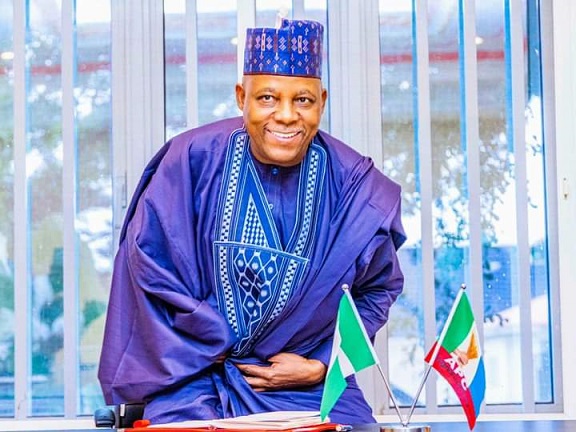
President Bola Tinubu has celebrated his deputy, Vice President Kashim Shettima, as a loyal partner and a pillar of his administration, on the occasion of Shettima’s 59th birthday.
In birthday message released on Tuesday, President Tinubu commended the Vice President for his unwavering “courage, sense of duty, tenacity, determination, and belief in Nigeria’s greatness.”
Reflecting on their political journey, the President stated that his choice of Shettima as a running mate was based on “competence and other qualities that Nigeria could depend on,” adding that the Vice President has justified that choice every day by strengthening the administration’s work and bringing fresh perspectives.
The message highlighted Shettima’s past service as a two-term Governor of Borno State and a Senator, noting that he demonstrated that “leadership is service, not privilege, even in the face of immense challenges.”
President Tinubu credited their partnership as integral to the early successes of the ‘Renewed Hope Agenda,’ specifically mentioning advancements in securing global partnerships, food security, and investment reforms.
Looking ahead, the President expressed confidence that their collaboration would continue to yield visible results for Nigerians, including new trade corridors, schools, hospitals, and jobs.
He concluded by describing their relationship as a bridge across Nigeria’s regions and traditions, united in purpose. He wished the Vice President “renewed vitality, wisdom and more years of impact.”
The Vice President marks his 59th birthday on Tuesday, September 2, 2025.

Jigawa at 34: Building a legacy of growth and stability
By Muhammad Abubakar Tahir
Jigawa State was created on August 27, 1991, by the administration of General Ibrahim Badamasi Babangida. Since then, the state — with its 27 local government areas and Dutse as its capital — has grown remarkably in almost every sector, living up to its nickname: “The New World.”
Anyone familiar with Jigawa today will agree that, among the states created at the same time, it has made more than commendable progress. Its story has been one of consistent development, particularly in modern agriculture, healthcare, environmental sanitation, good governance, and infrastructure.
Over the years, each governor who served the state has left a footprint of meaningful projects. Their efforts deserve gratitude and prayers from the citizens, for together they have turned Jigawa into one of Nigeria’s quiet models of growth.
One of the most visible achievements is in road construction. According to surveys, Jigawa ranks among the top three states with the best road networks in the country. Travelling from Birniwa to Gwaram, one will see how successive governments have invested in quality roads that connect communities, ease transportation, and improve livelihoods.
In agriculture, Jigawa stands tall as a national pillar. About 75 per cent of Nigeria’s exported food products originate from the state — a feat that underscores its central role in sustaining the nation’s economy.
Governor Umar Namadi’s administration, in particular, has deepened support for farmers. By making fertiliser affordable, offering loans, and providing milling machines and rice processing equipment, his government has empowered rural farmers and strengthened food security.
In Hadejia, the rice business has transformed lives. Buyers now flock in from across the country, increasing state revenue and creating employment opportunities. Many youths have become millionaires through rice farming and processing. And it is not just rice — Jigawa also thrives in sesame, hibiscus, millet, and maize, with many of these products being exported internationally.
The state’s lesser-talked-about sectors are also booming. Fish and frog farming, for instance, are creating jobs for youths from both North and South, while contributing to local revenue. My recent investigative work with WikkiTimes highlighted this silent but powerful transformation.
Education has also advanced. The sons and daughters of Jigawa continue to make their mark both nationally and internationally. Governments past and present have invested in schools and supported talented youths to acquire modern skills abroad — laying a foundation of knowledge for future generations.
Governor Namadi has shown particular resolve by announcing plans to recruit 10,000 teachers — a bold initiative that will strengthen the education system.
Progress is also visible in other areas, including electricity, water supply, and street lighting. Towns and villages that were once engulfed in darkness are now well illuminated, symbolising infrastructural renewal.
Jigawa has also remained at the forefront in welfare policies. It was one of the first states to implement the national minimum wage, long before it became mandatory across Nigeria. This pro-worker stance has relieved hardship for civil servants and enhanced productivity.
The state’s reputation for peace and security is not to be overstated. Jigawa remains one of the safest states in the country — a fact that allows visitors to move freely without fear. Governor Namadi has further strengthened this by addressing farmer-herder conflicts, ensuring lasting harmony among communities.
Tourism is another rising potential. The serenity, natural beauty, and hospitality of Jigawa are gradually attracting visitors, opening new doors for cultural and economic growth.
Truly, Jigawa has fulfilled its promise as the “New World.” From humble beginnings, it has become a source of pride not only for its people but also for Nigeria.
May Allah continue to bless Jigawa with peace, progress, and prosperity. Ameen.
Muhammad Abubakar Tahir wrote in from Hadejia, Jigawa State, via abubakarmtahir81@gmail.com.

Kano police arrest 107 suspects, recover weapons in new operation
By Uzair Adam
The Kano State Police Command has rolled out a fresh security initiative tagged “Operation Kukan Kura” to strengthen community policing and intensify the fight against crime using both kinetic and non-kinetic strategies.
The Commissioner of Police, Ibrahim Adamu Bakori, disclosed this during a press briefing on Monday, noting that the operation aligns with the directive of the Inspector General of Police, Kayode Egbetokun, to entrench community-centered policing.
He explained that the initiative is designed to boost public participation and encourage collaboration with security agencies, stressing the crucial role of residents as the “eyes and ears of the Police” across the state.
He recalled that similar strategies had earlier produced positive outcomes, particularly in tackling thuggery, locally called Fadan Daba.
Bakori also highlighted the Command’s recent breakthroughs, revealing that 107 suspects were apprehended in August for offences such as armed robbery, kidnapping, human trafficking, drug trafficking, and theft.
Items recovered during the operations include an AK-47 rifle, seven fabricated guns, 11 live rounds of ammunition, motor vehicles, motorcycles, cows, cutlasses, knives, and large quantities of illicit drugs.
He added that in 2025 alone, the Command had recovered hundreds of weapons and significant quantities of narcotics.
While commending officers for their resilience, he pointed out that the adoption of digital tools and technological innovations had further enhanced police operations.
The Commissioner assured that the Command would continue to adopt fresh strategies to outpace criminal elements and sustain peace in the state.
He expressed appreciation to residents and the media for their vigilance and support.
“The willingness of our people to share information has greatly enhanced our operations and strengthened our capacity to safeguard the state,” he said.
Bakori urged the public to promptly report crimes or suspicious activities to the nearest police station or through the Command’s emergency hotlines.

Israel is committing genocide in Gaza, scholars say
By Muhammad Abubakar
The world’s foremost body of genocide experts has declared that Israel’s military campaign in Gaza meets the legal definition of genocide.
In a resolution issued this week, the International Association of Genocide Scholars (IAGS) urged Israel to “immediately cease all acts that constitute genocide, war crimes and crimes against humanity against Palestinians in Gaza.”
The association cited starvation, the blocking of humanitarian aid, and forced displacement among the practices that, in its view, fulfill the criteria set out under international law.
The resolution adds to growing international pressure as civilian casualties and a deepening humanitarian crisis continue to draw condemnation from human rights groups and global leaders.

ONSA slams El-Rufai over ‘baseless’ ransom claims
By Abdullahi Mukhtar Algasgaini
The Office of the National Security Adviser (ONSA) has issued a stern rebuke to former Kaduna State Governor, Nasir El-Rufai, dismissing his claims that the government pays ransoms to bandits as “baseless” and “false.”
The statement, released on Monday, comes in response to an interview El-Rufai gave on Sunday where he alleged that ONSA coordinates a policy of payments and incentives for criminals.
“The attention of the Office of the National Security Adviser (ONSA) has been drawn to comments made by the former Governor… he alleged, falsely, that the ONSA coordinates a policy of payments and offers incentives to bandits. This claim is baseless,” the statement read.
ONSA firmly stated that at no time has it or any government arm under the current administration engaged in such practices, adding that it has consistently warned citizens against paying ransoms.
The security office outlined the government’s dual strategy of “decisive kinetic operations alongside community engagements,” crediting this approach for the improved security and “relative peace” now experienced in previously terrorized parts of Kaduna like Igabi, Birnin Gwari, and Giwa.
The statement highlighted the elimination of notorious bandit kingpins such as Boderi, Baleri, and others in Kaduna, as well as the recent apprehension of leaders from the terrorist group, Ansaru.
In a strongly worded conclusion, ONSA described El-Rufai’s denial of these security gains as “unfair and deeply insulting” to the memories of fallen security personnel.
It urged the former governor and all political actors to “desist from dragging national security institutions into partisan battles,” emphasizing that the fight against banditry is a “collective struggle, not a platform for political point-scoring.”

More than 60% of Gen Z in US back Hamas over Israel, survey finds
By Muhammad Abubakar
A new survey published by The New York Post has revealed that more than 60 per cent of Generation Z in the United States sympathise with Hamas over Israel in the ongoing conflict.
The findings highlight a significant generational divide in perspectives on the Middle East, with younger Americans expressing stronger support for Palestinians compared to older demographics who largely align with Israel.
Analysts suggest that Gen Z’s views may be shaped by social media narratives, human rights advocacy, and growing criticism of U.S. foreign policy in the region. The data underscores shifting attitudes that could have long-term implications for American politics and international relations.
The survey has sparked debate across the political spectrum, with some commentators arguing that the results reflect rising awareness of Palestinian suffering, while others warn of increasing radicalisation among youth.

Measuring the impact of strategic stakeholder engagement in the identity ecosystem
By Muhamad Mikail
In today’s interconnected and accountability-driven environment, a stakeholder is anyone who has an interest in or influence over an organisation, ranging from employees, customers, investors, and regulators to local communities and advocacy groups. Stakeholder engagement is a strategic process that involves informing, consulting, collaborating with, and responding to these groups to ensure transparency, secure buy-in, manage risks, and incorporate feedback into project planning and execution. According to the International Association for Public Participation (IAP2), stakeholders are those who are “affected by or can affect the outcome of a decision or project,” making their inclusion vital to successful outcomes.
A 2020 McKinsey & Company report found that organisations that engage stakeholders meaningfully tend to perform better across both financial and social metrics, and are 2.3 times more likely to outperform their peers. The World Bank now requires stakeholder engagement in all funded projects, and frameworks like the Global Reporting Initiative (GRI) emphasise stakeholder inclusiveness as a core principle of sustainable reporting. In this context, stakeholder engagement is no longer a courtesy—it is a strategic imperative for organisations seeking long-term relevance, impact, and resilience.
Since it became effective in December 2021, the Nigeria Digital Identification for Development Project has sought to have a proactive and open relationship with its stakeholders, across public and private institutions, ministries, departments and agencies, the media, Front End Enrolment Partners, Non-governmental organisations, Civil Society Organisations, disability clusters and women’s forums. This consistent stakeholder engagement is viewed as being fundamental to the core development objective of the Project, which is “to increase the number of persons with a national identity number issued by a robust and inclusive foundational ID system that guarantees their access to services”. This is to ensure the provision of a verifiable means of identification (NIN) for all Nigerians and legal residents of Nigeria.
Thus far, the Project has successfully organised stakeholder consultation workshops annually for critical stakeholders in the ID sector across Nigeria. Importantly, these consultations elicited feedback and synergy on areas of collaboration, building on established networks and structures across communities and ward levels. Reports of these consultation workshops have been published in three national dailies, which serve as a means of reporting back to stakeholders on the progress of implementing their recommendations and suggestions.
It is worthy of immense applause that the Project, through the Ecosystem Coordination Strategic Unit, (ECSU) in manner yet to be replicated in the country and anywhere else in the world supported the then Nigeria Data Protection Bureau headed by Dr Vincent Olatunji, devised a master stroke strategy of engaging critical stakeholders in the digital economy ecosystem, data protection thought-leaders, cybersecurity experts, policy makers, technocrats, NGOs, CSOs, development partners and even politicians in the drive to the drafting, passage of the data protection bill and eventual assent by President Bola Ahmed Tinubu on the 12th of June 2023 all under one year. This eventually gave rise to what is now known as the Nigeria Data Protection (NDP) Act of 2023, which led to the establishment of the Nigeria Data Protection Commission.
Furthermore, the Project Coordinator of the Project Implementation Unit, Mrs Tito Ejenavi said in a speech delivered at the opening of training for over 7,157 revalidated Front End Enrolment Partners and agents, that the PIU is part and parcel of NIMC and has supported the National Identity Management Commission in entering several partnerships that have benefited underserved communities, disability clusters and several women forums including taking enrolment to their communities, test of accountability scorecards and assignment of special enrolment agents to enrol persons with disability, drafting and validation of disability policy, inclusion strategies, incentivisation of enrolment partners using the business model and billing solution, aided by the geo-spatial mapping of all communities and cities in Nigeria. The NIMC is also collaborating with the National Social Safety Net Coordinating Office to enrol the poorest of the poor into the National Social Register and validate the Social Register using the NIN.
As a result of this engagement and numerous other initiatives, NIN enrolment figures and data have improved by millions each month. From January 2022 when enrolment for the NIN stood at seventy-two million, seven hundred thousand, three hundred and sixty (72, 700, 360) and May 2025, enrolment currently stands at one hundred and nineteen million, six hundred and twenty-three thousand, two hundred and twenty-nine, a whopping addition of forty-six million, nine hundred and ninety-two thousand, eight hundred and sixty-nine. This accounts for a 48.80% increase in the number of people enrolled and issued a National Identification Number, NIN.
Establishing and maintaining good relationships requires a long-term horizon, involving taking varied steps and making different, far-reaching decisions. The NIMC through the Project Implementation Unit, PIU of the NDID4D Project have invested heavily and strategically in the training and retraining of grievance redress representatives across the 36 states of Nigeria who across all NIMC centres are to serve as the first points of contact for any aggrieved enrolee, enrolment agent or residents of the host communities especially when such situation is tied to enrolment for the NIN or any other services that the NIMC currently offers.
Concerted Efforts are being made through CSOs and women’s forums, such as the Federation of Muslim Women Association of Nigeria (FOMWAN), to personalise relationships with communities across the federation. This is achieved by building on their already established structures and networks, and working through their employees to create links with local communities and drive inclusion. Grievance redress has taken centre stage with the establishment and expansion of a NIMC 24/7 toll-free line to address grievances from anywhere in the country. The DG/CEO of NIMC, Engr. Abisoye Coker Odusote has been quoted in several official events stating that NIMC takes grievances seriously and will address them in a reliable and timely manner.
It is worth noting that strategic stakeholder engagement is a key strategy for governments, organisations, and community groups in developing coherent policies and projects. It is our sincere hope that many more sustainable and people-centred reforms will be pursued in the drive to reposition our digital identity ecosystem, thereby helping to enhance the growth of our digital economy. I therefore call on the National Assembly to expedite the passage of the amendments to the NIMC Act of 2025, as forward-thinking legal reforms like the NIMC Act amendment hold the key to unlocking the limitless benefits of the Fourth Industrial Revolution.
Muhammad Mikail is a Communications Professional and writes from Abuja. He can be reached via muhammadnmikail.mm@gmail.com.

Ban on commercial motorcycles at BUK sparks outcry from students, business owners
By Kabiru Abdullahi Muhammad
The recent decision by the management of Bayero University, Kano (BUK), that bans commercial motorcycle operators (okada riders) from operating within the university community has triggered widespread outcry from both students and business owners.
For decades, motorcycles have been a lifeline for transportation and commerce in the university environment.
But since the ban, traders in the popular Coke Village market say their businesses have suffered unprecedented losses.
Malam Tasiu Hamisu, a foodstuff dealer who has operated in Coke Village for over 30 years, described the impact as devastating.
“I have never experienced such a huge downfall in my business until now when the school management stopped the bike men from working,” he lamented.
There were about 400 motorcycle riders in the university, with roughly 100 operating daily. Many of them were among my most reliable customers.
“Some bought foodstuffs worth ₦3,000 every day, while others bought occasionally. Now that they are gone, my business has been seriously affected. The only time we used to lose customers was during school holidays, but this is worse,” he added.
He also noted that students who previously sent riders to purchase goods on their behalf no longer have that option.
Malam Aliyu Sulaiman Ibrahim, another trader who sells palm oil, groundnut oil, and other household essentials, echoed the same concern.
“This issue has really affected me, and I have lost a lot of customers,” he said.
Similarly, Malam Umar, who operates a café, narrated how the ban has disrupted his daily routine.
“Sometimes when fuel finishes in the middle of work, I used to send a bike man to quickly get petrol. But now I can’t, and students won’t wait for me to go myself because there are many other shops they can turn to. This affects me badly,” he explained.
Students Struggle with Transport
Students are also struggling with the issue. The management introduced on-campus tricycles (adaidaita sahu) as an alternative, but there are only five to six tricycles available to serve thousands of students.
Every morning, long queues form at the university gate, with many students forced to trek long distances to their faculties.
Zainab Lawan, a student from the Faculty of Agriculture, shared her frustration.
“I nearly missed a test because I was waiting for a tricycle. In the end, I had to trek all the way from the gate to my faculty. It is really stressful, especially when you are in a hurry to attend lectures,” she said.
Both students and business owners said that the ban has created more hardship than solutions.
As Malam Tasiu put it: “The university is not just about classrooms; it is also a community. We all depend on one another to survive.”

Kano under siege: Battling the menace of thuggery, phone snatching
By Suleiman Musa Yahaya Ikara
The scourge of thuggery and phone snatching in Kano State has escalated into a grave crisis, endangering students and residents alike.
Just weeks ago, a Bayero University, Kano (BUK) student fell victim during a routine trip to Dorayi.
The incident added to growing insecurity, leaving residents anxious about their safety and wellbeing, particularly in the metropolis.
The BUK community is still mourning the gruesome killing of a 300-level student, Umar Abdullahi Hafiz, by suspected phone snatchers near his off-campus residence in Dorayi.
His death underscores the brutality of the menace.From Danbare to Kofar Kabuga, Kofar Mata, Zoo Road, Sheka, Dorayi, Rijiyar Lemo, Kurna, and Gwagwarwa, violent attacks have become daily occurrences.
Street ambushes, stabbings, daylight robberies, and mobs armed with axes, stones, and knives have turned once-busy neighborhoods into zones of fear.
The perpetrators, commonly called fadan daba, have shaken public confidence in urban safety.
Media platforms are awash with disturbing videos and images capturing these attacks.
A source from Bayero University, kano said “The incident was so devastating and heartbreaking. As a girl from far away who chose to study in Kano, I ended up being robbed. It makes me feel discouraged.”
Confirming the university’s concern, Director of Public Affairs, Lamara Garba, said investigations and a manhunt were underway in collaboration with security agencies.
Similarly, the immediate past Vice-Chancellor, Prof. Sagir Adamu Abbas, condemned the killing and pledged to work closely with law enforcement to ensure justice.Despite these assurances, the violence persists.
Deep-rooted gang networks quickly replace arrested members, exposing the limits of enforcement alone.
Outrage across Kano has grown as the climate of insecurity signals that no one is truly safe.
The Law and the Crime
Legal experts remind citizens of their rights and the penalties awaiting offenders. Barrister Ibrahim Bako explained: “Section 43 of the Nigerian Constitution guarantees citizens the right to own property. Sections 286 and 287 of the Penal Code define theft and prescribe up to 10 years imprisonment for offenders.”
He added that phone snatchers could be charged with multiple offences, including theft, robbery, extortion, and criminal conspiracy
Root Causes: Drugs and Idleness
The NDLEA has linked the rise of thuggery and phone snatching to drug abuse among youths. In 2024, the Kano Command arrested over 1,345 suspects, seized 8.4 million kilograms of illicit substances, and secured 128 convictions.
Initiatives such as Operation Hana Maye continue to dismantle drug joints and rehabilitate addicts, but the challenge persists.
Searching for SolutionsGovernor Abba Kabir Yusuf has pledged decisive action against sponsors of youth gangs, alongside empowerment and job creation programs.
Yet, many argue that this is not enough. Community leaders stress the role of parents, traditional rulers, and residents in guiding young people away from crime.
Zayyana Abdullahi, a community leader stated that “Strengthening community policing, empowering neighborhood vigilantes, improving surveillance, and building trust between residents and law enforcement are critical for restoring safety.”
A Call for Collective ActionThe Kano Police Command, led by SP Abdullahi Haruna Kiyawa, acknowledges the worsening situation and has intensified operations.
Still, durable peace will require more than arrests, it demands holistic action.enforcing the law, tackling drug abuse, empowering youths with skills and jobs, and rebuilding community trust.
The coordinated efforts of government, law enforcement, religious bodies, and civil society must go hand in hand.
Kano’s battle against thuggery and phone snatching is not just a fight against crime,it is a fight for the soul of the city.

Thinking with Sule Lamido: An inside review of Being True to Myself
By Samaila Suleiman, PhD
“No amount of deconstruction and reconstruction, to turn history on its head, can bury the truth” – Sule Lamido.
Writing a review of Being True to Myself, the autobiography of His Excellency, (Dr) Sule Lamido, is, for me, both an intellectual obligation and a profoundly personal reckoning. As a student of historiography and politics of knowledge production, book reviewing is an integral part of my professional calling. At the same time, as a member of the editorial team of the Sule Lamido Autobiography Project (SLAP), along with my colleagues Dr Nu’uman Habeeb and Mustafa Ibrahim Chinade, I lived with the idea of this book, from its conception to the first manuscript drafts, the final typeset, and its printing and public presentation.
Book reviewers are traditionally expected to be neutral critiques, assessing works with analytical distance and relying largely on their reading of the text. What I offer here, however, is a deeply personal reflection of a tripartite engagement with the author, the text, the context of its production and the reactions it elicited from readers. This is, therefore, not a conventional book review but an attempt, as one of the editorial consultants for the project, to recount the story of thinking (working) with Sule Lamido in the making of Being True to Myselfitself.
The Context
I first met Sule Lamido in 2019 when the late Professor Haruna Wakili introduced me, along with Dr. Nu’uman Habeeb and Mustafa Ibrahim Chinade, to serve as editorial consultants for his autobiography project. Our role was to facilitate the production of the text through interviews and other editorial interventions. Before this meeting, my knowledge of Lamido was limited. I knew him only as a former Minister and Governor. What I did not immediately realise was how profoundly the project would impact me as a historiographer, constantly negotiating the epistemological questions of truth, power, and narrative responsibility.
The first lesson I drew from the project was the discovery of Lamido as an intellectual—an aspect of his persona that is often overshadowed by his public image as a forthright politician. At our inception meeting, I was immediately struck by his brilliance and philosophical acuity—following a lengthy conversation about the focus of the autobiography. My initial perception of Lamido was quickly overturned. Beneath the image of a seasoned politician, I encountered a man of deep philosophical substance, whose politics is rooted in a profound knowledge of history and critical thought.
Although Lamido is not a career academic, his grasp of political and historical discourse is profound to the extent that some of his academic friends affectionately call him “Professor.” He is one of the few politicians around who embodies the tradition of first-generation politicians, whose politics are grounded in principles and knowledge.
Over the course of many interviews with the editorial team, Lamido narrated his life story with a precision and wit that often left me marvelling at his hyperthymesia, attention to detail, and critical reasoning. Each time we returned to a topic for clarification, he would recount events with striking consistency, as though he had already internalised the book long before the project began.
As the project advanced, Lamido took control of the content, style, and narrative flow of his autobiography, insisting on framing his experiences within a broader historical process. Even at the stage of typesetting and design, he remained involved, reviewing passages, fact-checking, and fine-tuning the manuscript. At one point, I jokingly said to him, while the book was already at press: “Your Excellency Sir, bakin alkalmi ya bushe”—implying that no further edits should be made, especially with the launch date approaching.
Some of our most intense editorial discussions went beyond factual accuracy to debates about historical methodology and explanation. When Lamido was advised to moderate some contentious revelations in the manuscript, he posed critical questions around secrecy and privacy in knowledge production, carefully dissecting the distinction between classified and declassified records. I found myself challenged, at times humbled, by his rigour and the depth with which he interrogated established academic assumptions about Nigerian history, politics, and writing. This level of discursive sophistication is rare among people without advanced degrees in historical studies.
There were moments when the manuscript resisted simplification, and we chose to retain its complexities rather than smooth them over, because they were intellectually honest. This demonstrates that a political memoir, at its best, is not merely a legacy-building exercise, as many autobiographies are, but a critical exercise in self-reflection within the context of history. Lamido gave himself that space and, in doing so, gave us the opportunity to reconsider some of our scholarly convictions about the nature of truth, memory, and life writing.
The Text
Lamido’s distinctive voice is evident throughout Being True to Myself. Those familiar with his discursive signature will immediately recognise his bluntness, candour, and unfiltered expression in the text.
Unlike many public figures whose autobiographies are primarily shaped by ghostwriters, Lamido maintained a hands-on approach. Each chapter bears his imprint, making the work not only intimate but also a demonstration of authorial agency.
Even the book’s title was not chosen lightly. It was the product of a year-long reflection on what Lamido’s life represents. Ultimately, Being True to Myself was favoured as the narrative’s central theme, mirroring the life of a man of unshakable principles and conscience. The title comes from a passage where he describes himself as “an independent-minded child, who always stood his ground…not because I felt important, but because I tried to be true to myself.”
What makes Being True to Myself particularly compelling is its historical nuance and emotional texture. Lamido alternates between humour, vulnerability, and defiance, recounting comical childhood stories, such as his naïve performance during Ramadan tashe, alongside harrowing experiences of persecution and betrayal. His willingness to revisit painful memories, without bitterness but with conviction, creates a text that is both deeply personal and politically insightful.
The book is divided into eight broad thematic parts, tracing Lamido’s journey from his early life in Bamaina to his career in the Nigerian Railways and Tobacco Company, his involvement with the PRP, his time as foreign minister, and his tenure as governor of Jigawa State. It offers rich commentary on important political events such as the annulment of June 12, his detention under General Sani Abacha, his role in the formation of the PDP, the Obasanjo Presidency, his tenure as Foreign Minister, the Yar’Adua Presidency and how he was succeeded by Goodluck Jonathan, and the intricacies of power, politics and democratic governance in Jigawa state.
In discussing Nigerian politics, Lamido dons the garb of a political scientist and historian, offering a critical examination of the military’s role in Nigerian politics. He critiques successive regimes, from Buhari’s military rule to IBB’s sophisticated but flawed transition programs, Abacha’s repression, and Abdulsalami’s genuine and successful transitional government, as well as the restoration of democracy. His reflections read as much like political history as autobiography, enriched by his insider perspective. One cannot help but wonder at the contents of his library, given his ability to weave theory and empirical detail with ease.
The Praise and the Pushback
Since its launch in May 2025, Being True to Myself has attracted a wide range of reactions, from praise by the media, scholars and statesmen to criticism from political associates, reflecting the complexity of both the author and the book.
At the high-profile launch in Abuja, political heavyweights celebrated the work. President Bola Tinubu, through his minister, commended Lamido as “a bold, consistent, and principled politician whose personal journey mirrors the story of Nigeria’s democratic evolution.” He described the book as a “significant contribution to Nigeria’s political literature,” encouraging other political veterans to document their experiences for posterity.
The book reviewer, Dr. Iyorchia Ayu, lauded Lamido’s courage, recalling episodes such as the author telling an IGP, “Who are you?” and a military head of state to his face, “You must resign”.
The book has not been without detractors. Some critics, including Malam Aminu Ibrahim Ringim, a former Chief of Staff to Lamido during his governorship, criticised the memoir as being rife with “self-glorification, misrepresentation and disrespect for the contributions of others.”
Taken together, these divergent reactions reveal the dual nature of Being True to Myself as both an intimate self-portrait and a contested historical document.
On the whole, the Sule Lamido Autobiographical Project is an elegant demonstration of how autobiographies can serve as a space for dialogue between politicians and scholars, working as collaborators in the pursuit of truth.
As former President Olusegun Obasanjo writes in the foreword: “No historian or public affairs officer should be without a copy of the book. I enjoyed reading it.”
Happy 77th Birthday and best wishes, Sir!
Samaila Suleiman, PhD, wrote from the Department of History, Bayero University, Kano. He can be reached via smlsuleiman@gmail.com.