Politics

You can add some category description here.

Muslim domination of Nigerian politics, El-Rufai’s remarks and the quest for a just social order!

By Ibraheem A. Waziri

1. As against the postulations of some, who think Nigeria to be a fantastic, British-contrived social experiment. Many believe it to be purely a product of inevitable historical processes that ordinary mortals should only play along with. So, it is said that statesmen and cultural priests cum social philosophers must – by the spirit of the time, fair universal human values and exigencies of frequent unassailable moments – always create and promote a narrative of a reasonable sociocultural balance for the country to continue to thrive.

2. In this, since religion is adjudged, by scholars of identity in history, to be the strongest factor in social mobilisation. It is safe to assume that the crème de la crème of the Nigerian military, who ruled the nation between 1983-1998, although mostly Northerners and Muslims, had good intentions; to have worked hard to ensure the provision of religious balance, between mainly Muslims and Christians, in the general administration of the national and sub-national units of the country.

The Justification

3. A casual review of both the 1st and 2nd Republic is enough to show tendencies to Muslims’ domination of the Nigerian political space. Also, since Islam is consistently found to be deeply expressive in the discourses and practices of its adherents daily, especially in Northern Nigeria, non-Muslims may not help but feel threatened – even if only imagined, not real – with marginalisation when individual Muslims are in power. This, regardless of whether their predilections do not suggest inclinations to any assumed extremist tendencies. Because often politics and politicians ride on only prevailing narratives and popular sentiments as major currencies during elections and subsequently in forming finer details of general governance policy direction!

4. This may have been why people like the late Capt. Ben Gbulie would maintain this in his book, Nigeria’s Five Majors, and much later when he responded to questions by late Barrister Yahaya Mahmood SAN during a session at the Oputa Panel. That one of their reasons for staging the January 1966 coup d’état that killed mostly Northerners Muslims in power was intel, they got and rigorously verified to confirm, by some standard, that the then Nigerian government, led by mainly Northern People’s Congress (NPC), was clandestinely planning a Jihad with the hope of Islamising the country.

5. The measures of balancing taken by the military may not be favourably viewed by modern reviewers, depending on the angle of vision one takes. But it is unmistakably clear that had the prevailing rhetoric of the Nigerian Muslim communities of the late 80s and 90s – that were even celebrating as heroes on various pulpits, figures and ideals of contemporary Islamist movements in Egypt, Iran, Algeria, Afghanistan and Sudan – met with a popular narrative of Muslim majority populated Nigerian state, the results would have been better imagined now. 

6. Thus, during both the two aborted electioneering processes of 1992 and 1993, to usher in a democratic government, General Ibrahim Babangida (IBB), the Head of the Nigerian state, deliberately tried to ensure political parties presented bi-religious tickets for elections into offices of governors, everywhere there is a significant population of people of differing faith, and ultimately that of the Presidency.

7. Many scholars and pundits alike have concluded that it was the failure of the southern Muslim, Moshood Abioĺa, Social Democratic Party’s candidate, who is said to have won the election, to respect IBB’s wish to select Paschal Bapyau, a northern Christian, as Vice Presidential candidate that led to the annulment of June 12 1993 elections! The Quest for such religious balance was that important to IBB, as we can conveniently presume it to be part of his insight and blessed wisdom clinging to higher moral flanks, advancing the standard of a fair, indivisible Nigerian nation.

8. Fast forward to the events preparatory to ushering in the fourth republic in 1999. It was the same cream of former Northern Nigerian top military generals who insisted on a power shift to the South, particularly to a Christian president, who would, in turn, have a Muslim running mate from the North. Thus, Northerners or Muslims from the South were cajoled to stand down their ambitions in the name of peaceful, regional and religious balance!

To Every Action…

9. Yet, as the timeless law of physics stipulates, there is an equal and opposite reaction to every action taken. So also the decision to premise all the sociocultural discourses on Nigeria on the narrative of religious balancing. Religion as a determinant of who gets what, in the string of the political equation, and ultimately down the line on the food chain of the country’s rentier economy, also became the cheap tool providing the impetus for persistent conflicts and unending violence, particularly in some subnational units in Northern Nigeria.

10. In Kaduna, my state, there has been a wave of religiously motivated crises, coupled with agitation for territorialism and territorial expansion, more resource allocation and political representation, since 1987. After the ushering in of the fourth republic in 1999, it continued assuming an alarming direction, characterising every aspect of the policy discussion in the state. Every single appointment, political or otherwise, must factor in religion. Yet the wave of the crisis did not show any sign of going away. It kept consuming many lives and properties, casting a blight on every possible future of progress and development. Refugee camps became a distinct feature of satellite towns in the state.

11. Government, civil society and faith-based organisations became very busy and active daily on the issues of conflict resolution and rehabilitation and resettling of refugees more than any other thing. From 2013 to 2014, Reverend Joseph Hayeb, the present Kaduna State Christian Association of Nigeria’s Chairman and a Muslim cleric, Shaykh Haliru Maraya, served as Special Advisers to the then Kaduna State governor, Mal. Mukhtar Yero on Christianity and Islam, respectively. They partnered with an international peace promotion non-governmental organisation, Global Peace Foundation, in a state-wide campaign for peace and conflict resolution in the state. Malam Samuel Aruwan, who was to become the first Commissioner of Internal Security and Home Affairs in Kaduna 2019 – 2023, and I joined them on the invitation. We wrote essays and appeared with them at conferences, engaging in the discourses of why Muslims and Christians must find ways to live in peace!

2015!

12. the deployment of superior vigilance technology, by the Independent National Electoral Commission, in the conduct of the 2015 elections exposed the fallacy of the premise ascribed to the religious balancing narrative that has lasted for 30 years in Kaduna. Instead of the entrenched assumption that the religious demographic spread in the state is almost 50-50 between Christians and Muslims, it was realised that it was at most 30 – 70 in favour of Muslims!

13. This, unfailingly, was to give room to so much reflection, on the utility of the religious balancing narrative, in providing the needed peace and stability for the general administration of the state. In that, a fair and dispassionate assessment could be said that over the years, it has proven to be a burden to the state and is threatening the overall peace and stability of the Nigerian Nation! Even if it has once been useful in keeping peace and maintaining justice, providing stability and strengthening the foundation of the Nigerian Nation.

14. More so, the assumed justifiable reasons that made the northern military elite deploy it then can be said to be no longer there now. As Samuel Huntington projected in his 1993 seminal work, The Clash of Civilisations and the Remaking of World Order, the appeal of the universal call to Jihad among Muslims would lose its popularity in about 25-30 years. That Muslims world over would gradually appreciate and align with the values of democracy and its prescriptions in the rule of law and freedom of expression.

15. Global war on terror and the experience of the Muslims here, home to Boko Haram, has helped make Huntington’s prophecy real. It significantly changed the perspectives and disposition of the Muslim elites in the country. Many scholars and clerics have stopped identifying with Jihadi rhetoric and, in many cases, withdrawn or dissociated themselves from the earlier ones they once made. There has been a wide-ranging consensus among a larger section of them to work with the present multi-religious composition of Nigeria and support its established institutions!

16. Also, the era now is not a military era, where the earlier conceived balancing narrative can be sustained by fiat nationally and sub-nationally. Democracy is here, and its promises, based on the premise of popular participation and will, are bound to force the hands of society in a particular direction.

17 In 2019, the Pew Research Centre, an independent American think tank that specialises in social sciences, demographic research and analysis, published that, in 2015, Muslims in Nigeria constituted 50% of the population as against Christians who are less. And by 2050, Muslims will constitute about 60% of the people, while Christians will be less than 40%. 

18. When I wrote about this on the 11th of July 2022, in a message wishing fellow Muslims well during Sallah celebrations, I also called them out to reflect on what Nigeria they would want. Many experienced pundits and senior citizens in my list submitted that the 60% per cent figure is most likely the population of Nigerian Muslims now. We are only hindered from knowing that for a fact because the past Nigerian military leaders had struck out religion as a variable in all official national headcounts. They believe that by 2015, Nigeria’s Muslim population will likely be 70 – 75%. 

19. All these should point to the reality of the futility of struggle, for a just social order, in Nigeria while clinging to the religious balancing narrative. 

The El-Rufai Example of 2019!

20. Malam Nasiru El-Rufai was elected into the leadership of Kaduna State on top of events significant to unravelling the wave of fallacies that made operational in the state, the religious balancing narrative. He was equally confronted with the reality of the non-viability or even risks associated with any attempt to perpetuate it.

21. In 2019, he won the election after confronting the operational, religious balancing narrative and crushing it. Amid cheers by the Muslim community, who are excitedly displaying an air of triumphalism, some of us must have assumed that the winner takes all maxim will be deployed. Yet Malam Nasiru went ahead in his acceptance speech on the 11th March 2019 to state: _“Let us all see and value each other as human beings descended from Adam and Eve. Let us end the misuse, abuse and manipulation of religion for personal gains. Religion should be a private matter. Our identities should not become barriers to common humanity. Our doors are open to a new chapter of concord.”

22. Subsequently, appointments and responsibilities were allocated based on merit, trust, commitment, party loyalty, and clearly outlined cause. Thus, many so-called sensitive positions, like the Accountant General, Commissioner of Internal Security and Home Affairs, and many others, go to non-Muslims!

23. In this, as an independent observer not speaking for Mal. Nasiru, I will say that one can see that if the Muslim-Muslim ticket has any purpose, it is only for burying the religious balancing narrative, which has proven to be cancer, in the body of our journey of development, into a just and prosperous society. It is also to serve as a teachable moment, to Muslim leaders, politicians, and the teaming youthful population, on operationalising the new narrative of the Muslim majority Kaduna and Nigeria, which is soon to be the new order of the day.

The Controversial Speech of 28th May 2023!

24. Nigeria’s 2023 elections, which saw the much-maligned success of a Muslim-Muslim ticket at the national level, had reasons to give Nigerian Muslims a feeling of triumphalism again. It has confirmed their numerical superiority and harbours the tendency of permanently killing the religious balancing narrative in our national politics. It also came with the risk of making some elements among Muslim politicians, clerics, and scholars alike start using it, in future, in a manner that would be inimical to the interest of their fellow Muslims, non-Muslims and the idea of the Nigerian nation.

25. The farewell dinner, Imams, clerics and Islamic scholars organised for Mal. Nasiru Elrufai, the 28th of May, 2019, in my opinion, was the best place for him to kick start the conversation about what the victory of the Muslim‐Muslim ticket should mean to the Muslims and the country in general. Both mark the end of the religious balancing narrative, religious politics and what future clear Muslim dominance or leadership should mean. 

26. From the clips of the recordings circulating in social media and the translation of the entire speech by various news outlets. It is clear that though Elrufai spoke appealing to his audience’s sentiments and good feelings, he was also unequivocal that the Muslim leadership across history and his, in Kaduna, did not and shall not try to discriminate against non-Muslims. This is a call and a subtle cautionary appeal to those who may think otherwise to reflect and reconsider as an exemplary guide in future.

The Ways Forward

27. Nigeria has moved into a new era in its history and evolution. Not that it has only seen the futility and, ultimately, the end of the religious balancing narrative; it has also come to the era where the influence and wisdom of its retired military generals in its democracy is about to cease altogether. All hands must be on deck to help chart a new cause and craft a fresh narrative for its sustenance and maintenance on a just and equitable pedigree.

 28. The country’s new reality of a sociocultural composition needs the attention of scholars, pundits and policymakers to ensure that the nation moves with reasonable speed on the lane of development. And this is what that speech by El-Rufai on that day should be seen to have helped to transit the national conversation quickly!

Ibraheem A. Waziri wrote from Zaria, Kaduna State. He can be reached via iawaziri@gmail.com.

News I presented forged academic certificates to INEC libellous – Kaduna Senator reacts

By Uzair Adam Imam

Senator Lawal Adamu Usman of the Peoples Democratic Party (PDP), Senator representing Kaduna Central Senatorial Zone, has bitterly denied the allegation swirling around that he forged certificates and threatened to take legal action.

Senator Usman was said to have presented a fraudulent academic certificate as part of the documents presented to the Independent National Electoral Commission (INEC) during the 2023 election.

Reports have it that a former student of the Department Public Administration of Ameer Shehu Idris College of Advanced Studies, Zaria, had claimed that the serving senator used her result to gain admission into a university.

But in his reaction, Senator Lawal Adamu Usman, in a letter through his solicitors Messrs E. N. Ogbu & Associates, stated that the story published on 12th July 2023 with the caption: “Kaduna Senator used my result for varsity admission, witness tells tribunals” is libelous and defamatory, and therefore threatened legal action.

The letter further reads: “However, the procedure to obtain these facts were thrown to the wind with respect to the reportage in itself as same, according to our Client, were a calculated effort to wickedly dent an image and status earned over the years by dint of hard work.

“Our Client has suffered emotional and psychological trauma over the “fake news” printed to dent his hard-earned reputation in the eyes of the public over information that is not only false but inexistent.”

“The Nigerian Government has times without numbers strictly warned the generality of the public against spreading what is now known to be “fake news.”

Is Tinubu Awoist – a disciple of Awolowo?

By Abdullahi Khairalla

Given the recent tsunamic and fundamental economic and educational reforms in the country, people have started raising historical and comparative questions of whether President Bola Ahmed Tinubu holds dearly the sacred political and economic principles and ideals of a centenary Yoruba saint Obafemi Awolowo known as ‘Awoism’.

Since the 1960s, Yoruba politics has been dominated by a political orientation known as ‘Awoism’. The phrase refers to the political philosophy of the late Yoruba political leader Awolowo, who espoused policies he called “democratic socialism”. Its primary tenets were welfarerism, free social services and job creation. Awolowo loomed large over Yoruba politics for over forty years. He was an intensely intellectual figure with great energy.

Awolowo had a ground-breaking term of office as the premier of Nigeria’s Yoruba-dominated Western region between 1955 and 1959. During this time, he introduced free education and health care in his region with other social welfarist policies.

Awolowo’s political ideology did not die with him. He was a great and transformational leader who was loved, revered and cherished like the rock of Gibraltar by the Yorubas and all who benefitted from his pioneering social welfare programmes. They refer to themselves as ‘Omo Awolowo’ (Awolowo’s children) or Awoists (disciples of Awolowo and his principles). Awolowo’s ideas remain so deeply ingrained in the political psyche of the Yoruba that being an Awoist is regarded by many Yorubas as the only legitimate apprenticeship before becoming a Yoruba politician on the national stage.

President Tinubu has very few in common with Awolowo. Tinubu, just like MKO Abiola, is not like Awolowo. Awolowo was trim, dapper and austere. In contrast, Tinubu is well known for his staggering wealth and flamboyance, which made him appear larger than life. Awolowo was a socialist: Tinubu is an ultra-capitalist billionaire who sits atop— bringing in completely capitalist-oriented policies in the education sector, oil and gas industry, health, electricity and many others, which makes him look like the opposite figure of Awolowo in Yoruba land.

Of course, Awolowo’s death politically orphaned the Yoruba. He had served or played a dual role as the Yoruba leader and also their political representative on the national scale. After his death, Yoruba politics were dominated by one trend. First, there was the search for another iconic and radical socialist to inherit Awolowo’s dual role. 

Many thought Tinubu would apply some Awoist policies on Nigerians now that he became the Nigerian president, but the recent developments and realities seem to belie this hope. 

Abdullahi Khairalla writes from the Department of Political Science, University of Maiduguri.

Emefiele’s case in court – DSS

By Uzair Adam Imam

The Department of State Services (DSS) Thursday said that it has charged the suspended governor of the Central Bank of Nigeria (CBN) to the court.

This was coming as a response to the order by a Federal High Court sitting at Maitama in Abuja which it ordered that Emefiele should either be released or charged to court.

Recall that in a judgement delivered by Justice Hamza Mu’azu, the court held that Emefiele’s continued detention without trial, amounted to a gross violation of his fundamental right.

Responding, Peter Afunanya, DSS spokesperson, said, “Sequel to an Abuja High Court Order of today, 13th July, 2023, the Department of State Services (DSS) hereby confirms that Mr Godwin Emefiele has been charged to court in compliance with the Order.

“The public may recall that the Service had, in 2022, applied for a Court Order to detain him in respect of a criminal investigation.

“Though he obtained a restraining order from an FCT High Court, the Service, however, arrested him in June, 2023, on the strength of suspected fresh criminal infractions/information, one of which forms the basis for his current prosecution.

“The Service assures the public of professionalism, justice and fairness in handling this matter and indeed the discharge of its duties within the confines of the law,” he added.

Tinubu’s slots to opposition parties move for one Nigeria

By Uzair Adam Imam

The reservation of some slots to the opposition parties by President Bola Ahmed Tinubu could be seen as a move afoot to get a better Nigeria which was one of the things his administration promised Nigerians since his victory.

The Daily Reality recalls that Tinubu promised to run an inclusive government that would thrust Nigeria into greatness.

Speaking as the president-elect in March, Tinubu said he was seeking a better country not just for himself and his supporters but for all Nigerian people, regardless of their political affiliations.

The Kwara State Governor and Chairman of the Nigeria Governors Forum, Abdulrahman Abdulrazaq, relayed the news about the slots reservation to journalists at a meeting of the forum in Abuja on Tuesday.

He said that Tinubu reserved some appointments in the governing boards of agencies, parastatals, institutions and government-owned companies for members of the opposition Labour Party and the Peoples Democratic Party.

Abdulrazaq stated that the President asked the governors to nominate competent persons to serve on the boards and parastatals of Federal Government agencies which were dissolved last month.

According to him, Mr Tinubu dissolved the boards last month, which left no fewer than 2,000 vacant positions expected to be occupied by new nominees.

He added that “Among the agencies are the North-East Development Commission with 12 vacant board slots, Independent Corrupt Practices and Other Related Offences Commission with seven board seats; Joint Admissions and Matriculation Board, seven; Teachers Registration Council of Nigeria, 21.

“Nigeria Social Insurance Trust Fund, 12; National Universities Commission, 21 and Transmission Commission of Nigeria, 14; National Health Insurance Authority,12

“Others are the Nigerian Safety Investigation Bureau, 7; Nigerian Meteorological Agency, seven; Nigerian College of Aviation Technology,8; Nigerian Police Trust Fund, 8; Nigerian Natural Medicine Development Agency,10; Federal Institute of Industrial Research, 11 and National Centre for Technology Management, 11 among others,” he stated.

Sit-at-home: Nigerian Army hands down directives to raid IPOB hideouts

By Uzair Adam Imam

The Nigerian Army has sworn blind to deal adequately with the Indigenous People of Biafra (IPOB) on its unlawful sit-at-home order throughout the Southeat states.

It was gathered that Maj. Gen. Taoreed Lagbaja, the Chief of Army Staff, ordered troops to raid IPOB hideouts and stop them from unlawfully enforcing residents to remain indoors for two weeks.

The Daily Reality reports that the order came after Simon Ekpa, a Finland-based pro-Biafra agitator, announced that there would be a two-week sit-at-home in the South-East region from July 31.

Ekpa disclosed that the order was to demand the immediate and unconditional release of the detained IPOB leader, Nnamdi Kanu, as well as facilitate the freedom of Biafra nation, among others.

He also threw threat that anybody or group of people that refuse to comply with the the sit-at-home order would attract ‘heavy consequences’.

However, speaking with the journalists, the Director, Army Public Relations, Brig. Gen. Onyema Nwachukwu, declared that such an announcement was unlawful and would not be condoned.

Onyema said, “The renewed threat by IPOB to compel the people in southeastern Nigeria to sit at home is not only appalling but a violation of the fundamental rights of southeastern Nigerians and, therefore, unlawful. This will never be condoned.

“The Chief of Army Staff has handed down clear directives to the 82 Division of the Nigerian Army operating in synergy with other security agencies to ensure robust patrols to dominate all flashpoints and emplace measures to ensure citizens are free to go about their legitimate businesses.

“Strangely, Simon Ekpa, a notorious terrorist and self-acclaimed leader of IPOB, is in Finland making a living for himself and his family, but ordering the people to shut down their means of livelihood by sitting at home,” he added.

Abdulaziz Abdulaziz appointed as a media aide to President Tinubu

By Muhammad Sabiu

Abdulaziz Abdulaziz, a renowned journalist from Northern Nigeria, has been appointed as the Senior Special Assistant to President Bola Tinubu on Print Media. 

This is contained in a widely shared list of special assistants and advisers the president appointed recently. This esteemed position reflects the recognition of Abdulaziz’s exceptional talent and dedication as a journalist, leaving behind a trail of remarkable achievements throughout his career. 

Abdulaziz’s appointment is a testament to his unwavering commitment to journalism and his remarkable track record.

Ortom dismisses news of own nomination as minister in Tinubu’s gov’t

By Muhammadu Sabiu 

Samuel Ortom, the former governor of Benue State, has refuted rumours that President Bola Tinubu had proposed him for a ministerial position. 

It has been observed that Internet users have been spreading rumours that the former governor made the anticipated ministry list. 

The governor, however, referred to the story as false and misleading and urged people to ignore it in a statement issued by Terver Akase, his media assistant. 

The statement reads, “The attention of the immediate past Governor of Benue State, Samuel Ortom has been drawn to the speculation on social media that he has been nominated for a ministerial appointment. 

“We urge members of the public to disregard the report as it is false and misleading. 

“Chief Ortom deeply appreciates those who have taken time to call and verify the information”.

Buhari denies begging Tinubu not to probe him, ex-govt officials

By Uzair Adam Imam

The former President of Nigeria, Muhammadu Buhari, denied the social media allegation that he asked President Bola Ahmed Tinubu not to probe him and other ex-government officials.

The social media report had it that when Buhari and Tinubu met in London last week, the former pleaded with his successor not to probe his cabinet members.

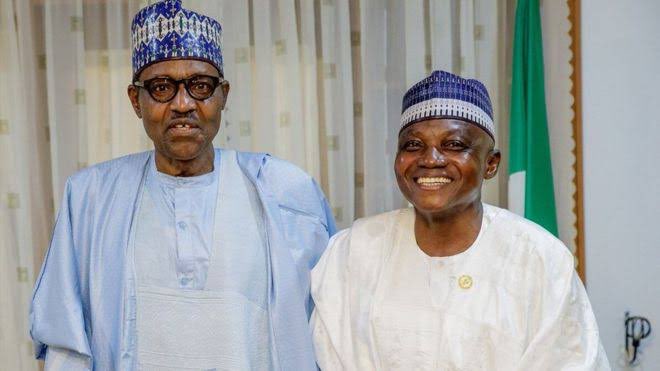
However, Buhari who denied the allegation through his spokesperson on Thursday, Malam Garba Shehu, said the story was not true.

Shehu in a statement he titled ‘What Buhari didn’t say to President Tinubu’ said: “If social media is to be believed, former President Muhammadu Buhari is requesting his successor, President Bola Ahmed Tinubu not to investigate some former officials of his government.

“It is fake, let us not discuss it or give it energy or air of publicity. This is fake news, and nothing more. Thankfully, there was no one other than the two leaders in the room in which they met, so no one was there to report their conversation.

“As much as possible, the former President wishes to remain outside the spotlight so as not to distract the new administration.

“He chose to go home in Daura hoping to find the type of quiet he wished for himself but realizing that this was not the case, visitors trooping in morning, day and night, he moved out to a more distant place.

“It remains his wish that he be allowed to have his needed rest, and for the Tinubu administration to have the right atmosphere to work on the realisation of the promises they made,” he added.

Bello El-Rufa’i: The youngest legislator to watch

By Mukhtar Jarmajo 

Bello Elrufai, a member representing the Kaduna North federal constituency, made a mark in the upcoming 10th National Assembly. In a recent interview with Channels TV, Bello showcased his humility, political acumen, and team spirit, making it clear that he is well-prepared for the task ahead.

Although he admitted no one could be fully prepared for the NASS, Bello’s academic background in political science, international relations, public relations, and corporate communications sets him apart. He recognizes the importance of having a team and their input, giving them credit for his ideas. His team helped him prepare ten Bills, which he is waiting to table for discussion at the House.

Bello’s team spirit bodes well for his future political career. He wants to leverage his associates’ expertise to build a strong political front. He is willing to compensate them financially and also give them invaluable experience. It’s a win-win situation, demonstrating his leadership skills and an eagerness to learn from others.

Bello’s focus on team building and valuing his team’s input is refreshing, particularly in a political climate where individualism is prevalent. Bello’s willingness to succeed and go far is admirable. With his thirst for knowledge and team spirit, he has the potential to make a significant impact in the National Assembly.

At 35, Bello is the youngest legislator in the new NASS. However, his age should not undermine his potential or capabilities. Instead, his youth is an asset and could increase the diversity of voices in the National Assembly.

Bello Elrufai is a legislator to watch. His humility, political acumen, and team spirit make him unique and potentially successful. His initiatives, bills, and passion for teamwork will help him make an impact in the upcoming 10th National Assembly. He may be the youngest, but he is one to watch out for.

Jarmajo wrote from Wuse Zone 2, Abuja.