Opinion

How I adopted Professor Maiwada’s style of classroom instruction: Tribute to a teacher and mentor

By Professor Salisu Shehu

The impact that teachers make on students vary in type, magnitude and degree. And as well, they differ in the way and manner they influence students. While to a great extent students unconsciously internalise/emulate certain manners, characters and styles of their teachers, in some cases that is done consciously and deliberately too. This is the fact that I am obliged to reveal as I pay tribute to my teacher and mentor all through my teaching career in the university. In other words, I am hereby proclaiming to the World that Professor Maiwada not only taught me, but he was in the top rank of my mentors and role models.

Professor Maiwada taught me Educational Psychology, Research Methods and Statistics in my second and third years of undergraduate studies and again he taught me the same courses at my master’s degree level. Indeed it was Professr Maiwada that made me love Educational Psychology and influenced me to eventually specialise in it.

I so much admired Professor Maiwada’s style of teaching. Once he enters the lecture room/theatre, after the usual greetings and courtesies between the lecturer and students, he would turn to the board (black as it was then) and write the topic and the outline of his lecture. He would then take students through the outline (sub-topics) to the end. His writing on the board and on paper was not only clear and legible but quite neat and beautiful. It would be difficult to hear students complaining that they did not understand Professor MAIWADA’S lecture. This is a style of instruction that I consciously and deliberately adopted up to this moment.

More importantly, my intellectual debut and voyage into the ISLAMIZATION OF KNOWLEDGE paradigm and school of thought were principally owed to the influence of Professor Maiwada. Two other teachers of mine that also influenced me in this regard are the late Dr. Musa Ahmed and Professor Aliyu Dauda. It was however, Professor Maiwada that really mentored me in this regard. When I wrote my M. ED Dissertation on: “A Study of the Islamic Perspective of Cognitive Development: Implications for Education”, supervised by the late Dr. Musa Ahmed, Professor Maiwada was indeed my defacto supervisor. He painstakingly read every single line of my work, meticulously corrected and advised me appropriately and where necessary.

Although, he surely had clear mastery of his subject matter of instruction, Professor Maiwada would never brag in the classroom or even try to make a show of it. He would, however, in his typical soft spoken manner, deliver his lecture with pedagogical effectiveness and mastery.

Professor Maiwada was not just a role model in the classroom. His entire teaching life presents an exemplary disposition of academic discipline, rigour and intellectual adeptness. Once he comes to the faculty he would either be in the class teaching or in the office going through students’ projects, dissertations and theses. He was never given to petty talks or sundry gossips. As he made his way to the office he would greet and answer greetings with a dint of politeness and humbleness. He was one of our older Professors that never sent their pens on leave. Not surprisingly, he was prolific up to the time of his retirement churning out papers and editing journal articles and book chapters and returning them within stipulated times. It was very rare if not impossible to hear any student complaining that Professor Maiwada had held his (project, dissertation or thesis) chapter beyond reasonable time without returning it read, improved, or corrected.

Though he was obviously apolitical, but destiny conferred on him the privilege of holding almost all academic/administrative positions of leadership in the university. Across three different universities (Bayero University, Kano, Al-Qalam University, Katsina and Northwest University – now Yusuf Maitama Sule University, Kano) the Katsina-born Professor was a Head of Department, a Dean, a Deputy Vice-Chancellor and a Vice-Chancellor without having to contest at any given time. For the records, he was the Pioneer Vice Chancellor of Al-Qalam University, Katsina. At two different times of leadership interregnum he acted as a Vice-Chancellor in both Bayero University, Kano and Yusuf Maitama Sule University respectively.

As the academic trail blazer that he was he presented, to my mind, the first ever valedictory lecture at the point of his retirement just last month before the commencement of the ASUU strike. Unknown to us all, he was only having barely a month and some weeks to his grave.

He purposely called to tell me about the lecture and the date that was scheduled. I missed it and out of respect and adoration I called to apologise. He told me that it did not hold but was postponed. When the second date was fixed he again called. I made it a point to attend. But as destiny would have it, I got an appointment of visa interview in Lagos on the same date. So I did miss it. I could not call to apologise again out of shyness.

It was only a few days ago I heard of his sickness. I could not even visit him in the hospital because I was out of Kano for a couple of weeks. I just got the shocking news of his death. It was such a tragic loss to the Ummah and indeed to the the academia and Bayero University, Kano.

May I use this medium to condole his immediate family, the Departments of Education and Special Education, the Faculty of Education and the Vice – Chancellor, Professor Sagir Adamu Abbas. Incidentally we were both his students, although not in the same class.

“Of the believers are men who are true to that which they covenanted with Allah. Some of them have paid their vow by death (in battle), and some of them still are waiting; and they have not altered in the least”. Suratul Ahzab, verse 23.

May Allah, al-Ghafur, al-Raheem forgive him and shower His Infinite Mercy on him. May He give us the fortitude to bear the loss.

Sexual harassment: Invading women

By Khairat Suleiman Jaruma

As she walked through the fabric market, a man touched her lower waist, slightly touching her bottom. He then said, “Sexy girl, come buy from me”. She turned back abruptly and hissed. “Fool”, she muttered under her breath. But, she didn’t stop; she kept walking, minding her business.

Those are the kinds of unwelcomed and irritating gestures most women experience every day in public places like schools, offices, markets, malls, etc. Unfortunately, no one frowns at these things. Instead, when a woman complains out loud about these things, she is seen as short-tempered or very intolerant, and more often than not, she gets victim-blamed.

According to a YouGov survey, 97 per cent of women aged 18 to 24 have experienced sexual harassment in public space, and more than 70 per cent of women of all ages have endured such behaviour.

While most people always make excuses for sexual harassment, such as mode of dressing or gestures, I think there’s no excuse for sexual harassment. For me, it’s just a very exasperating level of immorality, given that you can always ask for permission. Sexual harassment has terrible and long-lasting effects on women, including a decrease in women’s productivity, confidence, self-esteem, and overall participation in every aspect of life.

Sexual harassment isn’t limited to making inappropriate advances. It includes any unwelcome verbal or physical behaviour, sharing sexually indecent images or videos, such as pornography or salacious gifs, sending suggestive letters, notes, or emails, staring in a sexually suggestive or offensive manner or whistling, making sexual comments about appearance, clothing, or body parts, inappropriate touching, including pinching, patting, rubbing, or purposefully brushing up against another person.

Responsibility for the eradication of sexual harassment rests on everyone’s shoulders. Notably, we need to teach our brothers and male children that harassing women is NOT “cool”; what is “cool” is having respect for the opposite or same sex, obtaining appropriate consent of the person involved, and accepting “NO” as meaning “NO”.

Lastly, every survivor of sexual harassment must send a message across the world that there is no disgrace in being a survivor of sexual harassment. Instead, the shame is on the aggressor.

Khairat Suleiman Jaruma wrote from Kaduna via khairatsuleh@gmail.com

Tribute to Danmasanin Funtua

By Zaharadeen Muhammad

Some weeks ago, His Royal Highness, The District Head of Funtua, Sambo Idris Sambo, announced the confirmation of chieftaincy titles on some few outstanding sons of Funtua in recognition of their contributions to the town and the country as a whole. One of them is an unsung luminary in academia, and the health sector whose take off to educational journey began as Newton’s apple. But was it not William Shakespeare who likens the world to a theatre role with entrance – often by fluke, stage performance and exit? This time, Dr Umar Aminu’s entrance and performance will be profiled, and it will be quite the zinger.

Almost half a century ago, a religious scholar left Funtua for Katsina on a mission to supervise Islamic schools and carried his much younger brother with him. On a particular day, the curious lad wandered off to explore the new surrounding, and as fate would have it, he chanced upon a primary school in the neighbourhood. He surreptitiously tucked himself behind the door panel as he peeped into a class through the apertures relishing the nectar of the lesson.

He was to frequent the school many more times afterwards. Unknown to the school teachers and his brother, till the momentous day that his inert nature got the very best of him, he ventured an answer from his hideout to a puzzling question that appeared to elude the students sitting inside. Having gotten over his shock, the startled teacher identified where the voice emerged from, walked stealthily but tactfully toward the doorway and seized the kid. “he has to be enrolled,” thought the teacher. The brilliant boy in this tale was Dr Umar Aminu, and the elder brother was sheikh Aminu Liman of blessed memory. The anecdote was a watershed.

His academic sojourns would take him to Zamfara, Bauchi, Zaria culminating in him bagging a PhD in Public Health from Texila American University, USA. He gathered the mountain of knowledge and wealth of experience over the years working in public and private organizations and international agencies such as UNICEF, WHO, USAID, and FRIM. He brings to bear in solving various societal issues in Katsina state and beyond. To paraphrase sir Winston Churchill, what is the use of living if it is not to make this muddled world a better place for our posterity long after our departure.  

His first landmark contribution was to the health sector way back in 1999 when a glaring shortage of health personnel in the state was a cause of deep concern. Then, as a key member of the MSSN, he broached the idea at one of its meetings for establishing a centre for training health technicians who can, in the long run, make up for the inadequacy. The program began with only a handful of students and has metamorphosed into the world-class Muslim Community College Of Health Science and Technology, Funtua. Today, the school runs a wide range of health-related courses at ND and HND levels and draws a motley of students from every nook and corner of Nigeria.

His curiosity and a natural aversion to passivity and mediocrity made him the first to be on the ball whenever things appear to go south. That is why when there was statewide successive massive failures in SSCE between 1999 and 2003, a big blow to the quintessential reputation of the state in that regard,  instead of joining the wagon by stepping on the pedestal of lamentation, he met with stakeholders in the ministry to find out ways of ironing out the problem. He was one of the brains behind creating the refresher program, which, under the able stewardship of Malam Ilyasu Umar, has hatched hundreds of students who became medical doctors, pharmacists, engineers,  mathematicians, etc. Thus, leaving another indelible footprint in the sand of time.

His empathy and compassion dispose him to pursue numerous charitable causes, especially in education, where he has facilitated and personally offered many scholarships and grants to the less privileged. Moreover, his being a versatile and cynosure in education and business informed our decision to invite him to speak at our first (NIPES) public lecture themed ‘Our Economic Mindset’ held on February 2021. The advocate of functional education, self-development and entrepreneurship eloquently demystified our present unemployment crises that became ubiquitous clog and articulated sundry out of the box ways of putting a dent in the issue.

Dr Umar Aminu, The Danmasanin Funtua possesses most attributes our people recognize in the words of Anthony Kirk-Green as ‘Mutumin Kirki” in the book of the same title. These are truthfulness, trustworthiness, generosity, patience, good sense, bashfulness, courtesy, self-esteem, wisdom and scrupulous behaviour.  

“When a mother-cow is chewing grass,” said Chinua Achebe in Things Fall Apart, “its young watch its mouths”  We, the youngsters, have been watching from afar and up close and have drawn so much inspiration from his noble deeds. For these reasons and more, we join the joyous multitudes celebrating this well-deserved title. Allah shi tayaka riko, amin.

Zaharadeen Muhammad wrote from Abdullahi Aminci Road, Funtua, Katsina State via Zaharadeen2020@gmail.com.

Why campus journalism is a necessity

By Fatima Usman

Campus Journalism gives students the opportunity to hone and practice their journalistic skills and be the voice of change by getting readers to think about pressing issues that they probably wouldn’t have read anywhere else.

The endeavor provides a platform for students or student communities who look to expand their horizons beyond just the campus and discuss topics such as gender equality, human rights, or even the protection of animals.

Campus Journalism plays a role in information dissemination, enlightenment, and educating the general public just like journalism did in the broader society.

Quite unfortunately, students of communication who are supposed to be the engineers of campus journalism are the ones who have shown little or no interest in campus journalism practice on our campuses.

Many journalists doing exceptionally well in the mainstream media today were one time in their lifetime campus journalists. The like of Adejumo Kabir of the HumAngle, Adeyemi Ibrahim Olarotimi of Foundation for Investigative Journalism (FIFJ), and recently our own very one, Yakubu Mohammed of (FIJ).

The guys mentioned above are all products of campus journalism, doing exceptionally well in the mainstream media immediately after graduating from the university.

However, I see no reason why campus journalism wouldn’t prosper in our universities, looking at the impact of being people’s voice. Three things are involved in campus. You rather be a campus politician, campus journalist, or bookworm.

I think many students choose the former over the latter because of its monetary incentive. However, in campus journalism, it’s all selfless service where at a point in time, you get threatened with ratification because of one story or the other.

However, campus politicians get to receive dues from students they spent and be big guys on the campus without proper accounting. This makes many students choose politics over journalism on campus.

Setting Ibrahim Badamasi Babangida University Union of campus Journalists, which is still at its infant stage and doesn’t witness the desire to progress as it is supposed to, could be attributed to the unfriendly atmosphere given to the union by the University management.

Students are threatened whenever they make a publication, either good or bad about the university. Unfortunately, this has also killed the vibe of many students writers who are afraid of being expelled from the university.

In universities like the University of Ilorin (UNILORIN), Usman Danfodio University (UDUS), and Ahmadu Bello University Zaria (ABU), campus journalism is doing great because of the utmost recognition given to them by the University management.

Finally, as a campus journalist, you must learn how to report facts, nothing but fact, as nobody will give the ghost to threaten you when you do what you have to do rightly.

So, journalism is a selfless service and, when practiced appropriately, can correct the wrongs, tell the people what to do, how to do it, and when to do it.

I, therefore, call on any journalism student to have the habit of writing, as writing is the only difference between a journalism student and a science student.

Fatima Usman is a 300 level student of mass communication, IBB University, Lapai. She can be reached via usmanfatima499@gmail.com.

Al-Khatib and Al-Shiraziy: A template for humility and mutual respect

By Ibraheem El-Caleel

I have always intended to share some history on the relationship between two great Islamic scholars who lived in the same era. They are both from Shafi’i Fiqh school. I find their story inspiring, and believe sharing it might motivate some students of knowledge to emulate the legacy they left.

These two scholars are: Shaikhul Islam Abu Ishaqal Shiraziy and Al-Imamul Hafiz Al-Khatibul Baghdadiy. Due to their expansive erudition in different fields of knowledge, both have a rich biography that can barely be covered appreciably in a article. We may only cut part of the history which fits into our topic. I will share their brief biographies individually below:

Abu Ishaqal Shiraziy: His name was Ibrahiym bn Aliyyu bn Yusuf, born in 393 AH. He was a versatile scholar who specialized in Fiqh. In fact, Al-Muwaffaqul Hanafiy nicknamed him the “Amirul Mu’mineen of the Fuqaha”. He has authored several Fiqh books of Shafi’iyyah specifically, and Usulul Fiqh generally. The famous of those books is “Al-Muhazzab fiy Fiqhil Imamish Shafi’i”. Imamul Nawawiy later on authored a commentary of this book and titled it “Al-Majmu’u: Sharhul Muhazzab”. Al-Majmu’ today is arguably the most referenced and most comprehensive compendium of the Shafi’iyyah. In fact Nawawiy himself in the muqaddimah (introduction) of the book noted that, although several scholars have authored Fiqh books, the most renowned books for training Fiqh scholars are Al-Muhazzab and Al-Wasit. Al-Wasit is a fiqh book by the intellectual Imam, Abu Hamidinil Ghazali.

All these are pointers to what a legend Al-Shiraziy was in Fiqh. He made strong footprints in Fiqh and nearly considered the most productive Faqih (jurisprudent) in the 5th Century of Islamic calendar. Although he was poor, he was still a zahid (ascetic), whose fear of Allah was evident in his actions. There was a time he entered a mosque and misplaced his 1 Dinar. Later on, he remembered and he went back to the mosque. He met 1 Dinar in the same spot he left but he became sceptical whether it was actually his1 Dinar or a 1 Dinar of someone else; since he is not the only person who could have forgotten 1 Dinar in the masjid. He left it there without picking it up. He didn’t want to consume from anything illegitimate (haram) or vague (shubha). Allahu Akbar. 1 Dinar (an equivalent of about N1,300 today).

Al-Khatibul Baghdadiy: His name was Abubakar bn Ahmad bn Ali, born in 392 AH. He was a versatile scholar with specializations in Hadith and Hadith Sciences, then General History. Imamul Dhahabi called him “the seal of the Hadith Masters”. It was said that since the death of Imamul Daraqutniy, Baghdad had not witnessed a great scholar of Hadith like Al-Khatib al-Baghdadiy. He was a man who dedicated his entire life to scholarship. He once studied the entire Sahihul Bukhariy from the female scholar Karimah Al-Marwaziyyah in just 5 days. For a second time during Hajj, he again studied the entire Sahihul Bukhariy in just 3 days from Imam Isma’il bn Ahmad Al-Naisaburiy! In Al-Dhahabi’s record, this is the fastest learning rate ever heard in history. I remember Dr Kabir Asgar in one of his Mustalahul Hadith classes suggesting that perhaps the reason why Al-Khatib learnt Sahihul Bukhariy twice from these two scholars was because he wanted to get a shorter chain of narration. Both Karimah and Isma’il were students of Al-Kushmeehaniy, who was a student of Firabriy, and Firabriy is a direct student of Imamul Bukhari. So Al-Khatib was motivated to learn Sahihul Bukhari twice from those two scholars just to have a direct short chain between him and Imamul Bukhari and perhaps an ijazah (license).

It was narrated that some Jews once brought a document to the Leader of State, claiming that it is a letter of Prophet Muhammad (Peace be upon Him), where he waived jizyah (tribute) from the people of Khaibar. They said it was the handwriting of Sayyidna Aliyyu bn Abi Talib and with some companions as witnesses. The Leader didn’t deny it, but he referred them to Al-Khatib, to investigate the trueness of this letter before it can be implemented. Al-Khatib looked at the document attentively, then he said, “it is fake!”. He was asked; how did you know that it is fake? He said, they placed Mu’awiyah bn Abi Sufyan as witness, and Mu’awiyah accepted Islam in the year of Conquest (8AH), and Khaibar was liberated in the year 7AH (before Mu’awiyah accepted Islam). They also mentioned Sa’ad bn Mu’adh as a witness, while Sa’ad actually died two years before the liberation of Khaibar. People were astonished of how Al-Khatib Al-Baghdadiy exposed this fraud.

Al-Khatib was a prolific author who didn’t miss a single aspect in Hadith Sciences without authoring a whole book on it. Abubakar bn Nuqtah said, “every sincere person knows that scholars of Hadith who came after Al-Khatib are indebted to his works”.
You can read further about the biographies of these scholars from “Siyar A’alamin Nubala” of Imamul Dhahabi and “Tabaqaat Al-Shafi’iyyah” of Imam Tajuddeen Al-Subkiy.

These are some of the lessons I would like to highlight about their stories:

Despite the fact that Al-Khatib was one year older than Al-Shiraziy, he still learnt Hadith from him. Meaning Al-Khatib was a student of Imam Abu Ishaqal Shiraziy. Age should never be a reason why you discriminate against a teacher, or a scholar.

There was a time Al-Shiraziy was narrating a hadith where Bahru bn Kunaiz was part of the chain of narrators. So he turned towards his student, Al-Khatib and asked him, what can you say about this narrator? Al-Khatib said, if you would permit me, then I will explain. The teacher (Al-Shiraziy) humbly came and sat among the students, then Al-Khatib gave a detailed explanation of this narrator. His teacher (Al-Shiraziy) praised him for this, saying, “This is the Daraqutniy of our time!”. The key lesson here is: as a teacher, do not feel shy or too arrogant to learn an aspect of knowledge from one of your students. If you know your student has more knowledge than you in a specific field, there is no reason why you shouldn’t learn from him. Also, as a student, do not feel so high of yourself because you have a better edge than your teacher in a specific field of knowledge. It should never decrease the respect you have for that teacher.

Despite the fact that Abu Ishaqal Shiraziy was a poor man, he didn’t follow ‘politicians’ to bootlick them to give him material benefits, to go for Hajj. He died without making it to Hajj even though he was a great Imam of Fiqh. He managed himself with the little that Allah has blessed him with. So as a scholar or student of knowledge, do not disgrace your image by frequenting politicians and leaders to beg them for financial enablers. Poverty doesn’t reduce your worth, but bootlicking does.

As we have seen in the case of Al-Khatib, there is no harm for a scholar to make himself available to offer scholarly assistance to the government of his city, state or country. Politicians should also learn that scholars are a great resource for you to utilize in effective leadership. They help you refine raw issues for ready, instant implementation.

Humility, simplicity and respecting people does not reduce your image. It rather boosts your image. This is why as part of a hadith in Sahihu Muslim, the Prophet (Peace be upon him) said, “وَمَا تَوَاضَعَ أَحَدٌ لِلَّهِ إِلاَّ رَفَعَهُ اللّهَ”. Meaning, “… and one who shows humility, Allah elevates him in the estimation (of the people).” These two scholars are both high-ranking, but they exude visible rays of humility. Today, more than 1,000 years after their deaths, their names are still mentioned in high regards.

May Allah grant Al-Jannatul Firdaus to the Imams Al-Khatibul Baghdadiy and Abu Ishaqal Shiraziy; and us. May Allah grant us humble hearts and zeal to learn from their depths of knowledge and good characters. Amin.

Ibrahiym A. El-Caleel

My deafness: A blessing in disguise

By Ibrahim Tukur

Becoming a doctor was my childhood dream. When I was a child, I had an overwhelming desire to save as many lives as possible. The dream was nurtured by my elder sister Maryam Tukur. But back in school, I never performed well in class. More often, I scored low in the exams. That was what principally irritated my father. Although my father couldn’t read nor write, he more often than not flogged me for performing poorly in the examinations.

When I was in primary two, my father employed a tutor to teach us at home but sadly, it never worked on me. Like a dumb, I never grasped anything the tutor taught me. That even made my father angrier.

While we were in the second term, I suddenly fell seriously ill and lost my hearing sense to meningitis. In my parents’ strenuous efforts to restore my hearing, they took me to different doctors and herbalists who prescribed me some medicines that never worked. Finally, after many abortive treatments, my parents gave up the struggles and left everything to Allah, the Exalted of all.

Life became very challenging for me when I became deaf. My friends gradually avoided me. I was often lonely in school and at home. My father became hopeless about my education. Even my dream of becoming a doctor scattered itself like broken glass. 

When my academic performance worsened, which my teachers constantly complained about, my father withdrew me from school and kept me at home doing nothing.

A year later, upon recommendation, my father admitted me into Government School for the Deaf, Malumfashi. That was where I began to thrive. It was there that I learned to write my name, nay, perceived life from extraordinary angles.

I’m currently a 400 level student at Bayero University, Kano (BUK). Unfortunately, due to some problems, I could not realize my dream of becoming a doctor. But Alhamdulillah. Deafness is not a barrier to greatness.

It’s not only our leaders’ fault

By Sadam Abubakar Soba

Bad government and the lack of good leadership have been a significant concern in Nigeria. Specifically, the rampant banditry cases, kidnapping and other social vices surge are primarily attributed to the leaders’ fault. However, when we ponder deeply, we will realize that in most cases, the said security threats and other aspects are due to our collective faults.

It’s a tradition of the uncreated creator of Allah (SWT) to bestow authority to a particular member of a large society. Meanwhile, no angel shall be sent from heaven to serve a position of power to humankind society. Therefore, we have to prepare the leaders who should serve us justly within ourselves.

Parents who condone and regard the triviality of their children’s wrongdoing should stop it.  In the old days, a neighbour could correct other neighbours’ children’s mistakes and receive commendation from the father of the disobeyed child. Unfortunately, the reverse is absolutely the case today. Children are allowed to be trained by the spoilt environment, the degenerate peer, and the western and local irresponsible media. Can we expect decent children from such an unorganized system??

Most youths of the present day but rare possessed the qualities of our forefathers. We lack courage, confidence, patience, venturesome to mention but few. Our excelled business tycoon did not wake up rich just a day; it takes a great deal of hard work and patience to amass wealth.

Up to date, our patriots get their reputations and continued prayers from living human beings because of their selfless service to humanity. Are we doing the same today?? Most bandits, kidnappers, and those who indulge in raping destroying the chastity of young girls and boys are not alien or transported from the outside world. They are the product of society, killing the same community.

Lawlessness, vandalism, and inappropriate usage of government infrastructure have been the day’s order. Of course, people would complain of the bad road causing accidents. But, as soon as good roads are constructed, overspeeding and reckless driving would cause more accidents.

People would complain of lack of Justice. Howbeit, they are not proponents of the reign of Justice in society. Go to villages and some urban areas and see how older people treat their young ones. This spread across every part of societal settings that make the whole day, weeks, months and even a year.

Let’s all go back to our senses, embrace our responsibility, practice the righteous deeds enshrined in our religion, do the needful, stop cursing leaders, and let’s all correct our mistakes.

Sadam Abubakar Soba wrote from Coventry, United Kingdom, via  sadamabubakarsoba@gmail.com.

Revisiting Sardauna’s northernization policy

By Abdullahi Yusuf Tela

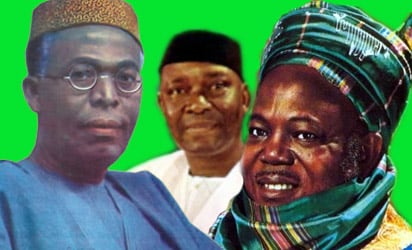
Between 1949 to 1960, the reign of Sir Ahmadu Bello as the Premier, the Northern Nigeria environment has seen tremendous development. By October 1960, because of his super influence, Ahmadu Bello has become a mighty figure within and outside the borders of northern Nigeria.

As described by Paden in Ahmadu Bello: Sardauna of Sokoto, the main concern of the Sardauna was “northernization”. His practical approach towards developing northern Nigeria was quite exceptional. Paden further states that “the north is his family, and he must get his family on the right track so that it can play its proper role within the federation and the world at large.”

Sardauna’s love for the growth and development of the North made him pursue a series of northernization policies, all in an attempt for a balanced growth amongst the regions despite warnings from other competing regions as to the consequences of his this ideology.

Sardauna had once replied, “No…. Over my grave!” This was in response to Dr Ibiam, who urged Sardauna to abandon the northernization policy.    

During one of his visits to the North, Dr Nnamdi Azikiwe opined that the north under Ahmadu Bello’s reign was working consistently to catch up with the South in the race for progress. He added that its local government set up guarantees a stable government; its people respect and revere their emirs as a symbol of constituted authority while respecting elective representation in their local councils.    

His leadership style and dexterity made the former “Northern Cameroon” become “Sardauna Province”. Although the area called “Northern Cameroon” was part of Cameroon, Sir Ahmadu Bello lured them with a promise that if they joined Nigeria, he would grant them a separate province with lots of benefits as the Northern Nigerians. The Northern Cameroon province eventually voted to be part of the northern region through a referendum.

Ahmadu Bello, through his unreserved love for the youths, had fixed several of them in the civil service. It was found out that in 1961, out of the 41,000 employees in the federal civil service, only 400 were northerners. Due to this low turn-out of the northern people in the civil service, Sardauna developed the habit of making an appointment then sending the person on leave for a crash course at home or abroad. This created a lot of opportunities and positions for young northerners.

Abdullahi Yusuf Tela wrote via abdultela2@gmail.com.

TikTok and selling immorality to consumers on the internet

By Yahuza Abdulkadir

A source culled from Wikipedia says that TikTok, known in China as Douyin, is a video-focused social networking service owned by Chinese company ByteDance Ltd. It hosts a variety of short-form user videos, from genres like pranks, stunts, tricks, jokes, dance, and entertainment with durations from 15 seconds to three minutes. TikTok is an international version of Douyin, released initially in the Chinese market in September 2016.

However, I was not a user of TikTok until a few weeks back when a friend gave me the hint to start using the app to promote my art by creating short videos of spoken word poetry. And then, I came to learn young people use the platform to showcase their talents in comedy, singing, dancing and other forms of entertainment through creating short videos and sharing them across a community of users.

However, after launching my account, I felt it was boring for people like me to find comfort there. The only person I was able to follow was Alhan Islam because I am interested in what she does. After a few days, I could no longer log in to the app again.

As of January 2022, out of the 4.8 billion social media users globally, TikTok has 1 billion active users, earning a spot in the six most famous social media platforms. Cloudfare’s 2021 Year In Review puts TikTok as the most famous website in 2021, surpassing even Google. Tiktok net worth is $50 billion in 2020 and now nearly $75 billion in 2022. Despite the nature of content promoted on the platform, one may want to know that so many individuals earn huge amounts of money through their videos’ engagements.

According to Forbes Magazine, a 17-year-old American social media personality and dancer, Charli D’Amelio, the most followed video-creator on the platform, earned $17.5 million in 2021, making her the highest-paid TikToker of the year.

I read many articles on Facebook and other blogs where people lament the platform to be a weapon for killing the young women in this generation. They said most of the videos created by users promote indecency and immorality. But recently, I found out that it’s not only in Nigeria that such content is being promoted; it’s almost everywhere globally. This made some countries take legal action on the matter. Countries like Pakistan has imposed and lifted four bans on TikTok, tagging the platform to be responsible for promoting immoral, obscene and vulgar content.

Bangladesh government also involved itself in the war against pornography to save children and adults from moral and social degradation by blocking the platform’s internet access. TikTok was also temporarily banned in Indonesia in the year 2018. The Indonesian government said the platform has a lot of harmful content to children.

In 2020, the platform was also banned by the Indian government to protect the data and privacy of its citizens from threats that have to do with national security, and they tagged the platform responsible for promoting inappropriate content. As a result, the platform lost 167 million users in the country. What would surprise you is that even China has banned the use of this platform.

This shows that the Nigerian government can also ban TikTok if it wants to. Do you think it’s not possible? I think it’s possible if we look at the “Twitter ban saga.” Unless the government thinks the use of this platform has no consequence on their side. If that’s the case, we need to go back to our homes and solve the problem. As people would say, “Charity begins at home.”

We shall all know that social media platforms are there to serve a purpose, and if it turns out that we tend to lose our good morals and forget where we came from by joining the trends and “feel among syndrome” – showing the world how indecent we are, then we have deceived nobody but us. So I think good characters matters the most.

Furthermore, it’s disheartening to see the young women in the Arewa community selling their body parts on cyberspace, not only on TikTok. This occurs almost on every social media platform. It’s a massive disappointment to our cultures and values. Whatever one might engage in, they should know “the internet never forgets.”

Yahuza Abdulkadir wrote from yahuzaabdulkadir50@gmail.com.

A moment with the late Abubakar Gimba

By Umar Nasale Ibrahim

Whoever wants live in the world with others after his body leaves the open space should write. A reader, they say, lives a thousand lives before he dies. A writer, as he is also a reader, lives many other lives after he dies. Thus, a writer benefits more than a reader.

Abubakar Gimba died some years back, leaving a handful of books of great might to the posterity to enjoy. Although I haven’t met him to learn of his living policies yet, he had sent them to me before he departed, reaching me late the previous year. He published many books, out of which only three came to me to read for the time being.

“Witnesses to Tears” is the first I encountered, and out of pleasure and amusement of how I enjoyed it, I looked for “Sacred Apples”. Not long after finishing it, a friend came with “Footprints”, and I snatched it to read. These are the books, out of almost twelve publications he had/has, I could lay my hands on. Reading them has been like a conversation of the admonition of how to live with others. In fact, this is my takeaway from the books.

“Footprints”, for example, is permeated with political inequities of the civilian and military governments of a fictional state I presume to be Nigeria. The political paradox discussed in the book, in the end, turned out not to be what I learned from it. The social relationship of the characters in the narration that develops its plot still fascinates me. Though in this regard, one may say that the writer is conscious of it, not all the readers may apparently take care of it.

The central home in the book is composed of two living parents with three children. Two males and a female, though the other male is much of a minor character. The female child, Farah, is a university graduate teaching at a secondary school her younger brother joins later in the book. This is one of the fascinating things the book has left me with. The male parent, Jibran, was a teacher, so his child became one. She engages in a relationship with her co-teachers, and Jibran has never been aversed in the relationship. The open-arm welcome to the teaching profession, the loving arms with which it is embraced and the burning desire to turn the lives of others in the book through the good profession is an emulable action.

That’s one. And to be precise, not to say much, the most important other issue is the interfaith relationship of the characters. Haytham and Basil are the intimate co-working mates of our female character, Farah. Haytham is a Christian and has been the boyfriend of Farah for a long time before Basil turned to show interest in her and thus married her later. The duo has become constant visitors of the house, first as friends, for courtesy and later, for a date. No matter the nature of the visit, Jibran would warmly engage them in conversation about the leadership of the country and the way out. Farah, with her father, would be supporting the country’s civilian activists to be given power, while others would intellectually be opposing her views. Usually, the conversations last long and no way in it one would dare include religion in it. The actual outlook of one’s humanity is the concern.

This was ringing in my ears while I was reading the book. Just telling me of how Gimba lived in the community he lived. And for sure, he was a religious man of dignity. But, to say he was a reader is just an insult to his reading avidity.

May Jannatul Firdaus be his current comforting home, amin

Umar Nasale Ibrahim can be reached via: umarnasaleibrahim@gmail.com.