On my return in April 2012, I reported to my Vice-Chancellor, Prof. Abubakar Adamu Rasheed. In a moment of radical inspiration, he asked me to submit every publication and activity in communication to the HoD of Mass Communication, the late Dr Balarabe Maikaba, for possible recommendation as a professor of Media and Cultural communication. In the meantime, a position for a professor was created in the Department of Mass Communication to accommodate my presence.
I was surprised at this as I thought once you are a professor, you stay that way without any addition! The then Dean of the Faculty of Social and Management Sciences, Prof. Adamu Idris Tanko, also welcomed the idea. Dr Balarabe Maikaba wrote a supporting letter. I put in the application and submitted all the papers I had in the new area for external assessment.
In January 2013, I received a phone call from my Vice-Chancellor informing me that assessments of my publications sent out months earlier had returned positive. Therefore, I have been appointed Information and Media Studies professor with effect from October 2012. There was only one wonderful caveat: I was to relocate to the Department of Mass Communication from the Department of Science and Technology Education, where I was then the Head of the Department. This relocation was the most significant move in my academic career. The day I received that letter counted as one of the happiest of my entire life.
I suddenly realized that my earlier desire to be in the Faculty of Science was to become a research scientist. Now, 32 years later, I have become a research social scientist while retaining my scientific focus. Allah truly blessed me. The journey to the first professorship took 17 years (1980-1997), while the second took 15 years (1997 to 2012).
I handed over the Department of Science and Technology Education on April 25 2013, symbolic of my birthday. My new Department and the Faculty overwhelmingly welcomed me when I formally reported on April 26 2013. Even more remarkable, the Communication Studies fraternity also welcomed me – apparently, they have been keenly following my what one calls ‘revolutionary forays’ in media studies.
It was thus an honour to be made a member of the Governing Council of the Association of Media and Communication Researchers of Nigeria (AMCRON) and a member of the Association of Communication Scholars & Professionals of Nigeria (ACSPN). It was humbling to be in the company of communication giants such as Idowu Akanbi Sobowale, Ralph Akinfeleye, Lai Oso, Umaru Pate, Nosa Owens-Ibie, Hyginus Ekwuazi, Victor Ayedun-Aluma, Eserinune McCarty Mojaye, Abiodun Adeniyi and many wonderful others. It was always a pleasure to meet at various conferences and workshops and appreciate each other.
I was given a huge sparkling brand-new office with all the frills! I have already been teaching Management Information Systems (MIS) in the Department of Business Administration of the Faculty for almost ten years. Additionally, I had been a ‘part-time’ staff of the Mass Communication Department for seven years, teaching and supervising students. So, I was not new to the faculty. For me, being in the Department of Mass Communication was the absolute way to chill out my career to retirement in 2026, in shaa Allah.
So, am I the only ‘double’ professor in Nigeria? It depends on the context. If you are referring to two professorships in two different disciplines (which is the actual context of a double professor), then yes, according to the NUC’s Directory of Full Professors in the Nigerian University System (2017), I am. However, being a professor at two different universities does not count. The second professorship has to be qualified through an external assessment of scientific works in the discipline, a process my Vice-Chancellor at the time and Chairman of the Appointment and Promotions Committee of the University rigorously followed.
Is this the same as Emeritus Professor (some have referred to me as such)? No. An Emeritus Professor is an honorary title given to a professor to show respect for a distinguished career and who has retired (critical qualifier) from the university successfully and honourably. It is neither a right nor automatic. It is a privilege (just like the professorship itself), given at the discretion of the university to an outstanding professor (mostly the university one is retiring from, although an appointment to such position could also be made to the retiring professor in a different university).
One cannot be appointed an Emeritus until they have retired (whether before or at the age of retirement). It is usually conferred (at a ceremony) to those the university feel that despite retiring, they can still add value to the academic programs of the university, either through teaching, research, supervision or other leadership functions. It often attracts a token stipend (not salary), and the office the professor retired from. It is also for life – meaning he stops being an Emeritus when he shifts to the other side of the universe the James Webb Space Telescope would not be able to locate! Here is a list of Emeritus Professors in Nigeria (updating).
How common is double professorship generally? Rare. A limited discussion was held on Quora, where a few examples from some American universities were cited. For instance, Andrew Gelman is a professor of statistics and political science at Columbia and a professor of statistics at Harvard. He has no political science degree at all. His first degree was in physics, and his graduate work was in statistics. He has received the Outstanding Statistical Application award three times from the American Statistical Association, the award for the best article published in the American Political Science Review, the Mitchell and DeGroot prizes from the International Society of Bayesian Analysis, and the Council of Presidents of Statistical Societies award. Have a look at this blog to know how he came to be occupying those two chairs.
This answers the question of whether I should be a professor in Mass Communication without a degree in Mass Communication. At the professorial level, it is your output that matters. My own site might satisfy one’s curiosity about what the fuss is all about. As my Vice-Chancellor at the time, Prof. Abubakar Adamu Rasheed, pointed out when my case was presented in 2012, if anyone is a professor of History and made enough contributions to the field of Physics, they can also apply and be assessed as a professor of Physics.
Oh, I almost forgot. Two professorships? Yes. Two salaries? Unfortunately, no! You get only one salary.
Prof. Abdalla Uba Adamu wrote from the Department of Information and Media Studies, Bayero University Kano, Nigeria. He is, among many other things, the former Vice-Chancellor of the National Open University of Nigeria (NOUN). He can be reached via auadamu@yahoo.com.
Sadly, the issue of insecurity is becoming somewhat politicised. The danger lurking behind this, however, is alarmingly disarming. The problem is multifaceted. While some criminals do so to make end meets, many indulge in crime due to conflict of interest. Be that as it may, the government’s inadequate measures to tackle security is a lurking bomb capable of blowing into civil unrest.
In a documentary by BBC in Zamfara, Fulani Bandits frequently invade villages, abduct inhabitants and slaughter anybody who resists. They also raid roads, shoot passengers and drag drivers out of their cars. In a somewhat passionate yet disarming effrontery, Fulani Bandits have gone beyond the camera reach as they film each other, showing obsession with guns and frequent drug-taking.
Speaking to one of the bandits’ warlords, Ado Alero, BBC reported that Alero considers his action to be a means to attract the government’s attention. Alero is one of the most feared warlords in Zamfara, whose behest police had put the bounty of 5 million Naira considering his rule in a recent massacre. He was recently turbaned in one of the bandits’ villages.
In another interview with one of the leading bandits’ commanders who led an attack and abduction of nearly 300 school girls in one government girls’ secondary school in Jengebe, Abu Sani confirmed to BBC that they had collected 60 million from the government to release them. They used the money to buy more riffles. Abu Sani said they did that to destabilise the government and keep her from intervening in the parrying. In another attack launched by the bandits, more than 200 people, including women and children, were reportedly killed. Further, they threatened to kill 120 Hausas at the behest of any single Fulani lost to Hausas.
This follows the sorry state the Fulani had been subjected to. They were abandoned, extorted and apprehended for so long. Their cattle were also rustled. They’re made worthless; no hospitals, no schools, and nobody cares to listen to their cries. Thereupon, they take guns to protect themselves.
In response, the Hausa, on the other hand, organised vigilante militias who went on a rampage and attacked Fulani Hamlets, killing any Fulani their eyes could meet.
Hassan Dan Tawaye (Hassan the rebel), a Fulani, who was reported to have first brought AK-47 to Zamfara, explained to a BBC correspondent that each side of the warring parties was at fault. When bandits attacked the Hausa community, Hausa militias were quick in reprisal and, in the process, killed many innocent lives.
Hassan Dan Tawaye, having laid down his guns to pursue peace, has returned to armed conflict. Hassan said they could not endure the levity of getting killed and were tired of waiting for the government to intervene. Therefore they have taken guns.
At this point, the Zamfara state government is in a dilemma and forced to negotiate with the bandits. However, Abu Sani said that each side benefited from the insurrection. He further noted that the polity’s increased insecurity politicised the problem. Things deteriorate because any of the parties, from top to bottom, needs money.
Dishearteningly, while Northwestern Nigeria is on fire, governments both at the federal and state level are becoming insensitive and lack the audacity to tackle the menace adequately. This has led to the bandits getting more enamoured and the victims being pesticide. The worst is how the state government asked the citizenry to buy guns so that they could depend on themselves. However, this is not the answer to the situation on the ground and would not provide the garment possible enough to stampede insecurity within the polity.
On the other hand, it’s interesting how the National Assembly’s impetus to impeach the president over the long-endure insecurity issue in the nation. The National Assembly had on Wednesday given the president six weeks ultimatum to resolve the issue of insecurity in the country or risk impeachment. This has relieved the citizens but is not good enough to suppress their fears of the criminals who sworn hell-bent on countering peace in all ramifications and bringing the nation to its knees.
It’s indeed of great concern and fear to see the centuries-old, good relationship between Hausas and Fulanis deteriorating. We, therefore, urge the government to deploy numerous tactics to tackle the insecurity issue in northwestern Nigeria and other parts of the country. More military bases should be built in and across various states with insecurity problems, and there should be sufficient military equipment for proper and successful operations. Finally, both sides should be demanded to lay down arms, concede for peace, and reconcile a trust.
May Allah bring back peace in Zamfara, Northwestern Nigeria and Nigeria in general, Amin.
Like a bolt of lightning, a key to open the freedom door dropped literally on my lap through the radio. In 1996 the government of Kano (Nigeria), where I live, was battling with Hausa creative fiction and public morals. One after the other, Islamic sheikhs came on the radio and condemned newly emerging Hausa creative fiction writers as being responsible for poor attention span in schools (and subsequent poor grades) and immorality. They did not indicate how many of the novels they had read, though. Their condemnations caught my attention, for it seems there was a reading culture among Hausa youth – something public culture kept lamenting as lacking among youth.
Reading culture is, of course, an environment where reading is championed, valued, respected, and encouraged. BUT it seems that the reading culture in Kano meant reading school textbooks (if available) and passing examinations. Reading culture? James Hadley Chase, Harold Robbins, Irvin Wallace, Agatha Christie, Denise Robbins, Nick Carter, Joan Collins, Wilbur Smith, et al., anyone? So why not Ado Ahmad, Balaraba Ramat, Ɗan Azumi Baba, Bilkisu Salisu Ahmed Funtuwa? All the objections against Hausa literature were based on the baseless Media Effects Theory, which believes that mass media influences the attitudes and perceptions of audiences.
I, therefore, decided to delve into this ‘problem’ further. It was to be a bridge between cultural studies (popular culture) and education (reading culture).
I eventually traced the production of Hausa novels to the City Business Center in the city of Kano under the proprietorship of Alhaji Abba Lawan Maiunguwa, a childhood friend. This led to Ado Ahmed Gidan Dabino, unarguably the most successful of Hausa novelists, and the forging of a life-long friendship based on respect. I spent about two years in the field, talking, recording, and unarchiving writers, critics and fans of the Hausa creative fiction.
The writers included Ahmad Mahmood Zaharadden Yakasai, Yusuf Muhammad Adamu, Ibrahim Saleh Gumel, Ɗan Azimi Babba Cheɗiyar Ƴan Gurasa, Aminu Abdu Na’inna, Badamasi Shu’aibu Burji, Hamisu Bature, Aminu Hassan Yakasai, Abdullahi Yahaya Mai Zare, Bala Muhammad Makosa, Bashir Sanda Gusau, Bala Anas Babinlata. Female authors of the period included Hauwa Aminu, Talatu Wada, Zuwaira Isa, Safiya A. Tijjani, Binta Bello Ɗanbatta, Binta Maiwada, Jummai Mohammed Argungu Karima Abdu D/Tofa, Bilkisu S. Ahmed, and the most outstanding of them all, Balaraba Ramat Yakubu.
Along the line, I developed the Hausa hooked glottal sound characters (Ƙ, ƙ, Ɗ, ɗ, Ɓ, ɓ) to help in proper Hausa writing on computer word processing programs using Fontographer software. But that is a story for another day. Next, I went to my dad, Muhammadu Uba Adamu (Kantoma), discussed with him my new-found direction and sought his blessings. He readily approved. Not surprising, considering he had always been a radical on his right. Further, my early contact with literature was from his library, as he studied Political History with English Literature as a minor. His approval, and even later, endorsement, gave me courage.
Finally, I summoned enough nerve (remember, it was not my field, and I was aware those ‘in the field’ jealously guard their turf) to write an article and send it to Ibrahim Sheme of the New Nigerian Weekly newspaper. It was titled “Hausa Literature in the 1990s”. It was published in their April 24 and May 1, 1999 issues. It created a tsunami of a reaction.
Unbeknownst to me, the debate about the merits (or lack of) of Hausa creative fiction had run its course in various Hausa language newspapers and magazines. Hawwa Ibrahim Sherif fired the first salvo in an interview with Ibrahim Sheme, published in Nasiha, on September 6 1991 (some eight years before my own article).
Following on from her views (and she was a writer herself), two camps emerged – those who did not see any merit in the novels, and those who believed in them, the latter, perhaps understandably, was made up of mainly authors themselves, such as Ado Ahmad Gidan Dabino, Yusuf Adamu, Kabiru Assada, etc. In 1998, Novian Whitsitt, an American student, even submitted a PhD thesis on Hausa creative fiction with a focus on Hajiya Balaraba Ramat Yakubu. His thesis was titled The Literature of Balaraba Ramat Yakubu and the Emerging Genre of Littattafai na Soyayya: A Prognostic of Change for Women in Hausa Society.” It was submitted to the African Studies Program University of Wisconsin-Madison.
You could therefore imagine the fire I came under; An Educationist was venturing into Hausa literary studies. Some accused me of being an ignoramus who knows nothing about Hausa literature (true), and others accused me of encouraging immorality (not true).
To get rid of my accused ignorance, I adopted two methods – both facilitated by my being a true believer in science and its methods. The first was rooted in the ethnology of Hausa cultural production. This approach was based on Victor Turner’s exposition of the ‘anthropology of experience’, itself based on Wilhelm Dilthey’s conception of ‘what has been lived through’. The approach enables the exploration of how people actually experience their culture and how those experiences are expressed in forms as varied as narrative, literary work, theatre, carnival, ritual, reminiscence, and life review. To get a closer look at the cultural production, it was necessary to be embedded in the process.
I started by identifying what was more or less a Bohemian cluster of Hausa fiction writers hanging out at City Business Center, Daneji, Kano city, along Sabon Titi. Then, I embedded myself into their cluster and observed what they were doing – inspiration for their stories, discussing plots for stories, typing, artwork, printing, marketing, etc. This went on for almost five years from 1998. As a result, I gained deep insights into their creativity and concerns. I also read quite a few of the fiction they produced to gain a more immersive experience.
In this process, I did not rely on secondary data but became a primary data gatherer myself. This came in good stead much later when I submitted a paper to a journal based in France. The editor wanted me to provide references for some of the narrative encounters. I pointed out that I was the reference and used Turner’s field study framework as a basis because I was there. The editor accepted, and eventually, the paper was published.
For the second method, I launched myself into a self-study of Critical Theory from the roots: to reflect on and critique society through literature. There were four varieties of such theory: new criticism, poststructuralism, psychoanalytic criticism, and Marxist theory. I delved into the first two, deeming that the other two do not apply to my data. I became a student of Jürgen Habermas and his “Structural Transformation of Public Sphere”, in which I see Islamicateness in expounding the boundaries of the public sphere. Stuart Hall and his critical works in cultural studies provided another roadmap to understanding the reception of media texts. Marshall Hodgson’s essay on the idea of “Islamicate” societies seemed to mesh perfectly well with my own sites of contestation of media production, distribution and consumption. Anthony Giddens and his Structuration provided an excellent introduction to Agency.
I thus refused to cage myself within Nigerian Hausaist (for which I am not one) delineation of Hausa studies into apparently mutually incompatible divisions of Literature (Adabi), Language (Harshe) and Culture (Al’ada). I said ‘apparently mutually incompatible’ because if you are versed or specialized in one, you are not expected to know much about the other. In other words, you should ‘stay behind the yellow line’!
And so, the battlelines were drawn, and for almost five years to 2004, New Nigerian Weekly and Weekly Trust pages were awash with what Ibrahim Sheme referred to as The Great Soyayya Debate. I was in the thick of it. But, since the debates were on pages of newspapers and therefore meant for the general readership, I focused on simply defending the right to write rather than the morals of the contents (for which, in my opinion, show cleanliness) or the grammatical sophistication of the writers. They have a right to write and thus write the rites to right the wrongs they perceive in society – after all, the genre is referred to as ‘adabi’ (reflection).
Only four people at Bayero University believed in what I was doing. Isma’ila Abubakar Tsiga, Sa’idu Ahmad Babura, Abubakar Adamu Rasheed and Ibrahim Bello-Kano – all from the Department of English and European Languages. Ibrahim Bello-Kano, or IBK as he is popularly referred to, was the Seminar coordinator in the Department of English and European Languages in 2001. He invited me to present a paper at their Departmental Seminar, which I agreed to and presented in January 2001. It was the first academic presentation of my research. I was understandably nervous because I was presenting something on new terrain to people fully trained and versed in it. However, the paper’s title, Tarbiyar Bahaushe, Mutumin Kirki and Hausa Prose Fiction: Towards an Analytical Framework, introduced something to the polemics besides just moral indignation.
However, soon enough, the massive success of Hausa fiction authors (despite scathing criticism from academic and public culture) emboldened them enough to migrate to the emergent Hausa video film industry. If there is one person to be credited with creating the Hausa film industry, it was a writer, the late Aminu Hassan Yakasai. He was both a novelist, a scriptwriter and a Hausa soap opera star. He and his collaborators, such as Bashir Mudi Yakasai and Salisu Galadanci, launched the first Hausa video film, Turmin Danya, in March 1990. This predated Nollywood’s Living in Bondage in 1992. Sunusi Burhan Shehu, a novelist, established a Hausa film magazine, Tauraruwa, and in a regular column in August 1999, created the term “Kanywood” to refer to the Hausa film industry. It is the first reference to a film industry in Africa and predated “Nollywood”, which was coined in 2002 by Norimitsu Onishi in a New York Times report.
In 1999 Sarauniya Films Kano released the catalytic video film that literally shaped the direction of the industry. It was Sangaya. It was, like most Hausa youth literature, mainly a love story. It was not the story that was significant about the film, however, but its soundtrack with catchy song and dance routines backed by synthesized sound samples of traditional Hausa instruments such as kalangu (talking drum), bandiri (frame drum) and sarewa (flute). The effect was electric on a youth audience seeking alternative and globalized—essentially modern—means of being entertained than the traditional music genre, which seemed aimed at either rural audiences or older urbanites. It became an instant hit. Indeed, the success of Sangaya was as momentous in the history of the Hausa video film industry as Living in Bondage was for the southern Nigerian video films. The Hausa video films that subsequently emerged were predominantly based on cloning Bollywood films and production characteristics – love triangles, gender rivalry, and choreographic song and dance routines. At least until 2007, when the system crashed after the leakage of a private steamy sex video of a popular actress. The entire entry was labelled bad, just like the literature industry. A new censorship regime was instituted that made film production difficult.
Internet became widely available late 1990s, and by 2000 it had become affordable. Before that, we had to rely on the National Universities Commission (NUC) switchbacks to access it. So when Nitel started offering it, we jumped on. Yahoo! Groups was launched in early 2001. A series of discussion boards formed the earliest reiteration of social networks, predating Facebook, which was created in 2004 but became available only in 2009 to us. Seizing the opportunity to create lively discussions, I formed three groups on the Yahoo! Groups platform: Finafinan Hausa, Littattafan Hausa, and Mawaƙan Hausa, from August 31 to November 15 2001. Finafinan Hausa was by far the liveliest.
By 2009 when the discussions whittled away, there were almost 25,000 postings on the board. Other boards did not fare too well. Further, between 2000 to 2009, I chaired thirteen Hausa video film award ceremonies, four of which were organized by Yahoo! Groups. The discussion board really popularized many of the Hausa video film stars. The University of Frankfurt in Germany even dedicated a Library Officer to join the groups and harvest all the comments as examples of public discourse on Hausa popular culture.
All these did not prevent me from participating in educational alphabet soup agency activities, so I was still rooted in Education. Criss-crossing the north, training education officials, writing reports no one read, and working out the next activity. Along the process, I became Head of the Department of Education – rather reluctantly, for I was enjoying fieldwork in cultural production and educational alphabet soup interventions (the latter helped to put additional plates on the table!).
In 1993 the late Prof. Mike Egbon of the Department of Mass Communication, Bayero University Kano, visited my office and asked me to help supervise his PhD student who was working on the transfer of communication education curriculum from the US to Nigeria. Between 1991 to 1992, I was a Fulbright Senior Research Scholar at the Center for Studies in Higher Education, University of California, Berkely. My work focused on the transnational transfer of education from the US to Nigeria, resulting in a book published in 1994 in New York. It was titled Living on a Credit Line: Reform and Adaptation in Nigerian University Curricula. It was my work in the US which I had been discussing at various places within the campus that attracted Mike Egbon, and he appointed me as co-supervisor and internal examiner to his student. Mike Egbon, then, was the one who opened the door for me to enter the Mass Communication department.
While all this was happening, a conference on Hausa video films was held in one of the northern Universities. The conference condemned the films, just as earlier on, the writers of Hausa fiction were also condemned. Many of these writers, using the cheap availability of video cameras, had transitioned from Hausa fiction to Hausa films and, in the process, attracted a lot of mainly non-indigenous Hausa into the industry. But because these elements use the Hausa language in their films and rely virtually exclusively on cloning Hindi cinema, all Hausa films were tarred with the same paintbrush. So the focus of the conference held somewhere in the north was to confirm how bad the films were from cultural perspectives.
However, in August 2002, a group of academicians and members of the Hausa entertainment industry in Kano got together to discuss the state of research on Hausa popular culture and media technologies, with particular reference to the Hausa films. It was meant to be a brainstorming session with various inputs from members overshadowed by the then-current crisis in the non-marketability of Hausa films due to condemnations from the public culture. Further, it was noted that there had been no systematic study of the phenomena from academic perspectives, at least by the practitioners themselves. A strong observation at this meeting was the increasing role of media technologies in popular culture and how Hausa urban communities are refining the concept of entertainment among the Hausa.
The group noted, with concern, a lack of local input into the systematized pieces of research showing the relationship between Hausa culture and popular media as a vehicle of cultural preservation and transmission. In this regard, it was noted some of the most significant advances in this area were made by our foreign Hausaist colleagues. All these researchers have published extensively on Hausa culture and language, and their works are heralded as authoritative accounts of Hausa popular media.
Thus, while the group acknowledged the immense contributions made by these foreign researchers, it saw these researches as challenges to stimulating local scholars into exploring other terrains of popular culture among the Hausa. As a result of these observations, the group suggested a series of activities aimed at creating collaborative opportunities for research between local researchers, practitioners of popular culture (literature, music, film, indigenous knowledge etc.) and international partners. A committee was formed to articulate all these into a conference, and I was made the Chairman of the Committee.
Eventually, on 3rd to 5th August 2003, we held the first-ever international conference on Hausa films in Kano, with the theme of Hausa Home Videos: Technology, Economy and Society. It was hugely successful, attracting presentations from US and Germany in addition to both local film practitioners and academicians. I, Yusuf Adamu and Umar Faruk Jibril edited the papers and a book with the same title as the conference was published in Kano in 2004. The resolution of the conference was to establish a Center for Hausa Cultural Studies. This was meant to be a think tank that would hold monthly events to promote Hausa cultural production in the internet age.
Later, tired of the constant criticisms against me from the film industry despite all my efforts (they believed that by focusing on culture, I was disparaging their art), I shifted my ethnographic focus to music, with a particular focus on the Rap genre which was trending at the time. This community of cultural producers – K-Boyz, Kano Riders, Lil’ TeAxy, BMERI, ClassiQ, Dr Pure, G-Fresh, Haddy, K-Arrowz, the late Lil’ Amir, etc. – proved more welcoming than filmmakers.
By 2004 I had attracted the attention of some colleagues overseas, particularly Brian Larkin in the US, Graham Furniss in the UK and Heike Behrend in Germany. I even wrote a visa approval letter for Heike Behrend, then Director, Institute of African Studies, University of Cologne, Germany, to come to Nigeria and conduct fieldwork on Hausa films. Heike Behrend was to later “adopt” me as her son. She is a brilliant ethnologist with a field experience in Kenya and Uganda, as detailed in her excellent book, Incarnation of an Ape. An autobiography of ethnographic research (2020), which itself is a textbook on the anthropology of experience. As she stated in a YouTube introduction to the book, “it was about reversing the perspective and showing how those I meant to ethnograph ethnographed me.”
Thus, when Graham Furniss was asked to nominate participants for a “Seminar on Media in Africa” in Nairobi, Kenya, organized by the International African Institute in August 2004, he nominated my name, and I was accepted. Again, in the same year, he was invited to Johannes Gutenberg University, Mainz, Germany (plainly referred to as the University of Mainz) to participate in the 8th International Janheinz Jahn Symposium “Creative Writing in African Languages: Production, Mediation, Reception”. It was to be held at the Centre for Research on African Literatures, Johannes Gutenberg University Mainz, 17-20 November 2004. Graham had too many engagements for the period and suggested to the organizers that I should be invited – something they accepted. I received an invitation to participate in the conference.
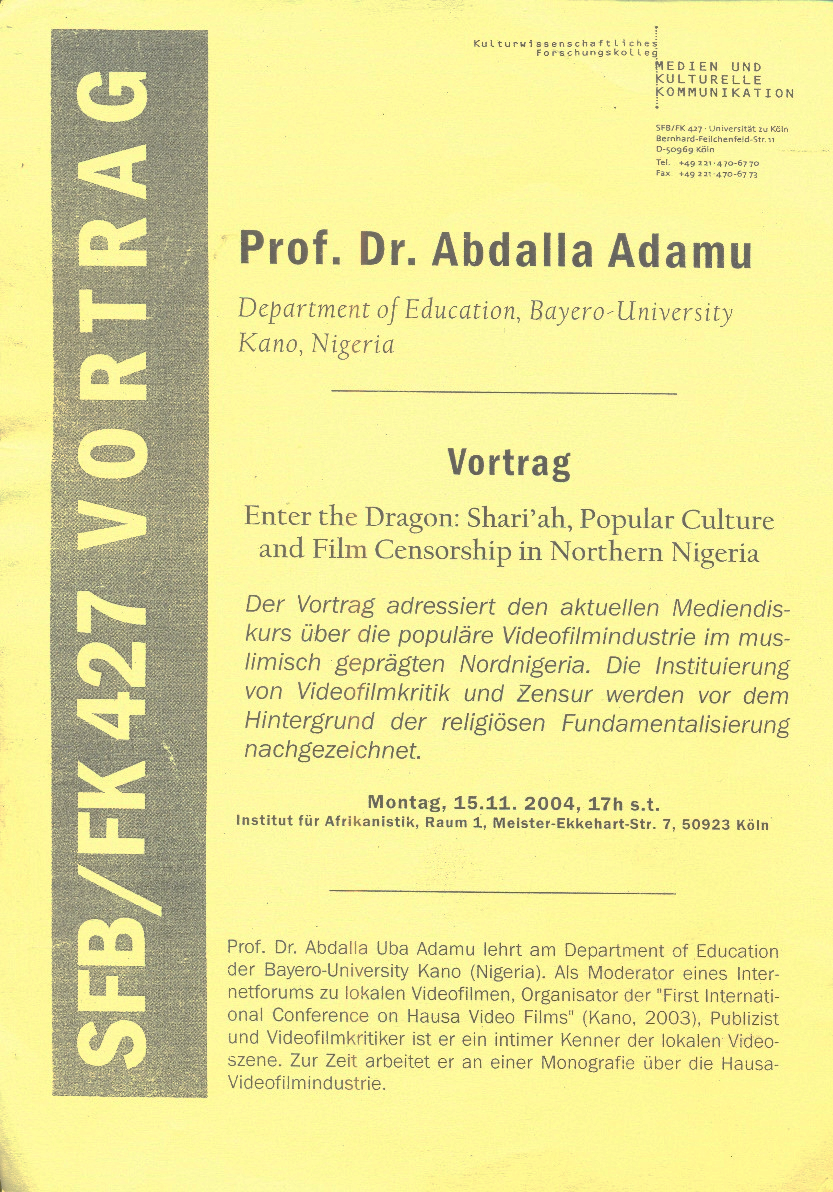
At the first event in Nairobi, I met Heike Behrend, who was also invited, and during an off-conference interaction over a cup of expresso (her favourite rendering of coffee!!) I informed her of my coming trip to Mainz for a conference. She immediately extended an invitation for me to come to the University of Cologne on my way to Mainz and present a seminar to doctoral students on any topic I like. This I did on November 15 2004 and presented a paper to the students. It was titled “Enter the Dragon: Sharī’ah, Popular Culture and Film Censorship in northern Nigeria.”
Vortrag
Note, from the poster, that I was still in the Department of Education. When I returned to Nigeria, I met Dr Gausu Ahmad, then Head of the Department of Mass Communication BUK, who insisted on the paper being presented at their own Departmental Seminar. Before that, I was already teaching Advanced Research Methods to postgraduate students and Online Journalism at all levels. Further, I was already working with a doctoral student in the Department. Unknown to me, Dr Gausu had already recommended my employment as a Part-Time lecturer in the Department of Mass Communication. A letter to that effect was eventually sent to me in November 2005. Earlier, the Department had requested my transfer from Education, but the Vice-Chancellor at the time refused.
The visit to Germany in 2004 was the beginning of a series of travels to various universities as a visiting lecturer/professor/guest speaker etc., in media and cultural production. These included the US (University of Florida, Gainesville; Rutgers State University of New Jersey; Barnard College, Columbia University), UK (School of African and Oriental Studies), Switzerland (University of Basel), Germany (Freie University, Berlin; University of Mainz; University of Freiburg; University of Cologne, University of Hamburg; Humboldt University), South Africa (University the Witwatersrand), and Cameroon (University of Yaoundé).
In November 2008, I was once more invited to Germany for an event. After my event at the University of Hamburg, one of the participants, Nina Pawlak from the Department of African Languages and Cultures, University of Warsaw, Poland, approached me and asked if I would like to visit Poland for three months as a Visiting Professor. I delightfully accepted. The funding was to come from the European Union under the program of The Modern University – a comprehensive support program for doctoral students and teaching staff of the University of Warsaw as part of Sub-measure 4.1.1 “Enhancing the educational capacity of a higher education institution” of the Human Capital Operational Programme, of the EU. After all the paperwork was done, I was eventually offered the Visiting Professor position at the Department of African Languages and Cultures, University of Warsaw, Poland, from March 1 to May 31 2012. I taught two courses: Transnationalism and Identity in African Popular Culture and Oral Traditions in Local and Global Contexts.
Prof. Abdalla Uba Adamu wrote from the Department of Information and Media Studies, Bayero University Kano, Nigeria. He is, among many other things, the former Vice-Chancellor of the National Open University of Nigeria (NOUN). He can be reached via auadamu@yahoo.com.
Many good things should have happened to Nigeria, but such good things were and are still averted by Nigerians who feel threatened by others. Our collective psyches teach us to be myopic and to lack reason. These make us promote selfishness, ethnic chauvinism or even other material gains at the expense of the best public interest.
Now that Kwankwaso/Obi ticket has been ethnically killed, I am happy that it didn’t come to fruition. It would have been disastrous to the nation as Peter Obi supporters are turning into something else. Now that it didn’t happen, it left some issues to ponder, especially on our reasoning that it shouldn’t have even been thought of in the first place. It left us with no hope as to the politicians we see, who are a sort of “young” blood, compared to those whose actual age, patriotism, source of wealth and health status are all not certain.
All of us in the North, without a doubt, believe that Dr Rabiu Musa Kwankwaso is far better than Obi. They are not comparable in whatever capacity, from academic credentials to practical experience, national spread, political platform and even patriotism. However, one irony about the ticket was that the way Northerners believe in Kwankwaso is similar to how South Easterners believe that Obi is better. They think that Obi is the only answer. In their bid to justify that, they reduced Kwankwaso to pieces, saying he was over-ambitious. This is where they woefully failed. This was what made the thought of bringing the ticket even more worrisome.
Obi’s supporters shouldn’t be blamed, as the country is programmed this way. People only know and promote people they are so much close to, naturally. What will happen if this natural knowledge is mixed with bitter secessionists’ sentiments and arrogance that beclouded their thought of anything if not theirs?
There are some reasons why Kwankwaso shouldn’t have even thought of Obi. Perhaps Kwankwaso did that out of nationalism and as another way of garnering support from the other end. Still, one thing Kwankwaso failed to realize was that Obi’s candidature was no longer his own. It has long been hijacked by a fake Christiandom, Obidients/OBiafrans and other disgruntled politicians from the other end. First, however, let’s consider some points here.
The way Nigeria is, a country with such a vivid religious divide, with Muslims as the majority and Christians with a significant number, the Christians must feel offended if they do not feature as number two, if not number one in the country. In this case, someone may say that democracy is, to some extent, a hoax. If not, why shouldn’t the majority carry the board all the time? But in Nigeria’s situation, Christians are many, and they would feel somehow alienated by the APC’s Muslim/Muslim ticket.
Therefore, it will be a miscalculation for anyone to ask Obi to deputize instead of being the lead. Christians may not take it lightly. They have already fought the Muslim/Muslim ticket and failed, and now the only option left for some of them shouldn’t be tempted or played with. Therefore, looking at it from this angle, it was a terrible idea right from the beginning. Reuben Abati confirmed this in an interview when he opined that, during one of their talks about Kwankwaso/Obi, he asked one question! And the answer to that question, given to him by the NNPP representatives, convinced him that the Kwankwanso/Obi arrangement was dead on arrival.
He asked them, is it fair that after a Northener – and maybe a Muslim – finishes his eight-year tenure, another Northerner will rule again immediately? He said the Kwankwanso/NNPP representatives responded that that is not an issue to worry about. This is their point of reasoning which should be understood.
Another point is regional affiliation. This doesn’t give much, but many Southerners may prefer to have someone healthier than Bola Tinubu, not minding his religion the way the Northerners do. Here, Obi as the lead may be more appealing to them.
On the other hand, there is an issue of the Igbo presidency. Igbo politicians have been too stubborn, divisive and too regional in their approaches to national discourse. They always create problems for themselves, of which Obi’s candidature is part. You can’t disown your country, engage in a series of treasonable felonies, condone crimes, support terrorism against your nation, and then think you would be trusted.
The idea of rallying behind Obi as the only source of salvation is another mistake made by the Igbos. It will make them more stubborn or more alienated. If Obi fails – which will likely happen, some of those overzealous OBiafrans who now threaten all who talk against Obi will surely be more stubborn and restless. And the mainstream politicians would put them aside as they know they are inconsequential.
Now that the ticket has been killed, most commentators agree that it wouldn’t change anything even if it had happened. The real fight is seen to be between the two giants. Now both camps should sheath their swords and forge ahead.
Kwankwaso and his supporters should continue to aim high. Merging with anyone among the two major parties cannot produce a result, and going alone is not the solution. Madugu and his team should think within and outside the box and develop a real solution.
As for Obi’s real supporters, the real Obidients, they should learn tolerance and know that Nigeria is not Imo, Abia or Enugu. Two states’ votes in the North can equal the total number of states in the South-East region. This is based on the latest voter statistics released by the Independent National Electoral Commission (INEC), which shows that the North has more voters registered in the continuous voter registration that ended last Sunday.
Therefore, these OBidients, including the OBiafrans, should be more civil, tolerant and open-minded. They should interact well with others, show decorum in their manners, and not allow the OBiafrans to lead them.
Right, it is time to address this issue. I am blessed and honoured to have variously been acknowledged and hailed as a ‘double professor’, ‘dual professor’, the only one from northern Nigeria, etc. How’s that even possible?
The first professorship was in 1997 (Science Education and Comparative Higher Education, to give it its full title), and the second one was in 2012 (Media and Cultural Communication). Two totally different disciplines. I delivered an inaugural lecture for each in 2004 and 2014, respectively. Further, I am both a Member of the Nigerian Academy of Education (MNAE) and a Member of the Nigerian Academy of Letters (MNAL) – a cross-over that is quite rare in Nigeria. A close friend says I am nuts to have two professorships. It’s okay; we used to call him nuts, too, when we were kids. I admit, though, it does take a bit of nuttiness. However, the whole ‘double professor’ thing came about by happenstance, thanks to the innovative, courageous Prof. Abubakar Adamu Rasheed, Vice-Chancellor, Bayero University Kano from 2010 to 2015, now Executive Secretary, National Universities Commission from 2016. Here is the whole backstory to the opera in one season of three episodes!
S01EP01: Liftoff
As a senior high school student, I had a target: to become a professor by 40. Given that I was born in 1956, that gave me up to 1996 to do my gig, exit stage left and hopefully seek new directions. Right from elementary school, I had wanted to work in a university after a visit to the house of then Malam Sani Zahradeen in 1966 on the old campus of Bayero University. Awed by the splendour of the house (and quite frankly, the wonderful breakfast I was offered), I decided right there and then the University will be my abode. I was ten at the time.
After going through the grind of schooling and finishing at Ahmadu Bello University, a degree in Science Education (Biology/Physiology) saw me getting employed as a Graduate Assistant in July 1980 at Bayero University Kano. The clock had started ticking – I had seventeen years to contact. I felt like I was in a cryogenic sleep capsule bound for a planet in the Betelgeuse star system, a mere 500 light-years from Earth. A confession, though. Education was not my preferred choice of Faculty at employment. It was the Faculty of Science. Made attractive by a blind ambition to become a research scientist – not a teacher. Plus, many top-notch teachers from the Department of Biological Sciences, ABU, my alma mater, had migrated to BUK during the period. I wanted to continue being their students because of their brilliance (fondly remembered, included Dr Shotter). But as fate would have it, I was employed in the Department of Education.
I did everything necessary to progress through the system, getting a DPhil at Sussex (courtesy of the Commonwealth Scholarship Commission) and a Fulbright Senior Scholar residency at the University of California, Berkely, US. I also became a Resident Fellow at the Rockefeller Foundation’s Bellagio Center near Lake Como in Italy. Beautiful view, wonderful neighbourhood, made only grisly by the fact that the Italian dictator Benito Mussolini (1925 to 1945) and his wife (or was it mistress?) Claretta Petacci were executed at Dongo, near the Lake, in 1945. A gruesome tourist attraction whose grimness does not take away the timeless beauty of the area.
Finally, after submitting all the necessary papers for assessment, I was conferred first Associate Professor of Science Education and Comparative Higher Education in 1994, and with more publications, full tenured Professor of Science Education in 1997. I was 41. Missed the mark by a year. Due to the weird BUK politics at the time, the professorship was only announced in 2001 but suitably backdated to its proper date, October 1997. I immediately wanted to give my inaugural lecture, but I was asked ‘join the line’ of others who were to present – all six of them. Eventually, I was asked to come and give mine after three years. I did so on April 24, 2004. It was the seventh in the university. I had wanted it on my birthday, but considering that April 25, 2004, was a Sunday, I settled for Saturday.
When I reached the point of being promoted and awaiting results back in 1996, I found myself interrogating the rest of my life. At that time, university lecturers retire at the age of 65. So that meant I had about 25 years to retire in 2021 – a futuristic date then. I had also crossed all the t’s and dotted all the i’s in Education, at least as far as I could see. I found myself deeply involved in alphabet soup agencies – you know, USAID, DFID, UNICEF, NPEC, UBEC, WB, etc., mostly talking loudly and saying nothing. I simply can’t see myself day in and day out enmeshed in this process of eventually recommending things to the government through reports nobody bothered to read. If I didn’t find something to do, there was every chance of me becoming truly nuts.
Prof. Abdalla Uba Adamu wrote from the Department of Information and Media Studies, Bayero University Kano, Nigeria. He is, among many other things, the former Vice-Chancellor of the National Open University of Nigeria (NOUN). He can be reached via auadamu@yahoo.com.
A year ago, I analysed climate disaster scenarios that happened within one week, which affected the entire world virtually. I then narrowed and streamlined my analysis by including some flood flashpoints in Nigeria, including Hadejia, Ringim and Auyo in Jigawa State.
Some office sit-tight professors, including one architect who resided in the UK for a long time, responded to my take with archaic and obsolete climate data. They vehemently descended on my double-decker analysis like wounded lions! But I forgive them because lots of them have lost touch and are never up-to-date with what is happening in the climate change world.
Moreover, some hardly attend UN-COPs or even care to read or research how climate dynamics and their attendant consequences affect Mother Earth. Instead, theirs is to sit in the office, review old literature(s) (emphasis mine), and take a vantage from there. They often think this can make them appear original.
Now it is the beginning of the first week in August 2022. And the news, videos and photos that were and are sent to me on a daily basis vindicated my flood projection(s) in certain Nigerian states such as Jigawa.
For example, a childhood friend from Hadejia (name withheld) sent me a picture of a flooded market segment in Hadejia. He then said, “Nura, kaga abin nan fa daka fada akan Hadejia ina ga zai zama gaskiya“. Meaning: Nura, it appears that what you said about Hadejia(referring to my assertion on flooding in Hadejia) will be true.
I then laughed it off and let go!
The rest now lies on the residents and inhabitants of that town. They either decide to move to the highlands along Malam Madori Road and expand Hadejia along that axis, or they should continue to live with their thinking and be lost in oblivion.
Nonetheless, I sincerely commiserate with the victims of this first phase of the flood. May Allah help their situations in this country with hopeless, very unserious and dangerous politicians and political leaders.
It is no longer news that the security situation in the country is pathetic and worrisome. Even the blind can see that the country is held to ransom by forces that challenge the state’s monopoly of violence. It is appalling that governments at various levels have failed in their primary objective of protecting the lives and properties of citizens. Terrorism and other atrocious crimes are being perpetuated wantonly and daily.
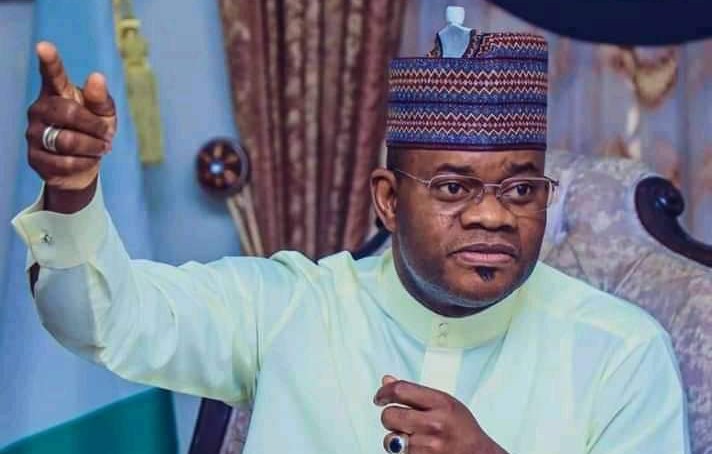
However, the Kogi State Governor, Alhaji Yahya Bello, is doing something different and commendable. In a Nigeria stuck with a replete of security challenges, Bello seems to be a shining example worthy of emulation by the president and his brother governors. This explains the relative peace we enjoy in Kogi, although it shares borders with about ten states in the country. Even while the country’s capital is under siege by terrorists and bandits, the same can not be said of Kogi State, which is about two hours drive from Abuja.
Other state governors have to learn that as chief security officers of their states, the responsibility of protecting the lives and properties of people in their state falls on their shoulders. As much as collaboration is necessary between the states and the federal government on internal security issues, there is apparent incompetence of the highest order on the side of President Muhammadu Buhari.
For example, whenever there is a security challenge in Kogi State, the governor actively engages locals and traditional rulers in the area of the security breach to proffer solutions. This has proved effective in curtailing crimes. Although every state has its peculiar security problem, it is high time the governors realized this and came up with creative solutions like Bello is doing.
Although many Nigerians have realized President Buhari is a grand failure, it would still do the country immense good if the president adopts Bello’s carrot and stick approach to security. Bello queries and suspends government officials and traditional rulers complicit in security infractions.
Bello similarly rewards the officials who do the needful in forestalling attacks and maintaining peace. But, sadly, the president only expresses shocks and issues empty threats that are never backed with actions. He honestly needs to learn from Bello, his political son and acclaimed mentee.
This write-up seeks the correct the perception of some people about the Commercial Banks’ operations and the Central Banks’ regulations.
A banking operation is a business like any other business. They collect money from those that have a surplus and channel it to those that are in deficit with the sole aim of making positive returns. In this sense, the business has to respect the law of demand and supply, which basically determines the prices. Human beings are rational in nature; thus, they try to avoid anything that could bring them dissatisfaction in favour of the things that could bring them satisfaction.
Basically, peoples are the owners of commercial banks. They invest their personal net worth in banks with the sole aim of making profits and avoiding disasters. However, because of the high-risk nature of the banking operations (i.e., dealing with money, complicated mode of operation, and the important roles these institutions play in economic development), the government, through Central Banks and other regulatory agencies, makes certain regulations with the aims to make their operations smoothly and to safeguard the investors’ money. The government regulates the banking system by setting a minimum Liquidity Requirement, Minimum Capital Requirements, Non-Performing Loans threshold, Maximum Expense vs Revenue (efficiency ratio) Requirement, Concentration Ratio, etc.
Based on the above, to ensure fairness to all (developed or underdeveloped) within a given jurisdiction, these regulations must be made equal among the banks in a particular category (i.e., International banks, National banks, Microfinance banks, etc.) by considering several factors.
For example, regulators set the minimum Capital requirements for international banks differently from national banks or microfinance banks just to make sure fairness is achieved uniformly within the country. No particular region, segment, or people will be given preferential treatment over the other. In setting these regulations, due to the nature of banking operations, any preferential treatment because of the underdevelopment of the region will set that region or people preferred in the disadvantage stage because investors will definitely not find it easy to risk their capital in a high-risk region that did not have stringent regulations that could safeguard their money.
Because of the rationality of the consumers who are the capital providers to the banks, if the regulations are enforced in a particular region due to the so-called reason that the region is not advanced and the economic life is difficult in such a way that will temper with investors interest (i.e. attaining a positive return and avoiding negativity) to protect their personal wealth invested, they will run away from that region in favour of the region that has an adequate regulation to safeguard their hard-earned money.
No one will stay in the region, which will cause them to lose money unless few. (even these few could only stay if they believed they could get a higher profit/interest rates by charging high markup on loans and advances to cover the high risk they took by staying in an area in which there is a high risk of defaults). This will cause economic hardship, a high rate of crime, terrorism, and continued deterioration of the conditions in such a region.
If we look all over the world, due to the loan default expectation, any region that proves to be economically more prosperous enjoys the teaming number of investors trooping to such a region for investment even though the gain is lower because of the competition. That is why the profit/interest rate on loans charged to borrowers in developed nations is much lower compared to what is charged in developing or underdeveloped nations that have lower ratings or high credit risk (this is basic as per as risk management is concerned), i.e., in Nigeria commercial banks charges between 20%-25% on loans while in the US or the UK the rate is lower than 5% per annum. What explains this scenario is simply, in comparison to US or UK, Nigeria is a high-risk country disturbed by a high rate of corruption, insecurity, terrorism, etc. which scare any rational investor away unless he could be compensated by charging a high-interest rate that will worsen the economic situations of the borrowers.
To me, the way forward for a less economically developed region to compete with another region is to continue educating its younger ones gradually. Research shows a positive correlation between education, low corruption, terrorism, and improvement of economic conditions. With a good and quality education, businesses will thrive, people will prosper, income will improve, and well-to-do members of the region or investors from outside will invest their surplus funds in such a region because of the expectation of positive gains on their investments and good business models that will ensure non-default in the loans.
Any enforcement by the regulators on the people’s right to the investment of their personal wealth (i.e., calling for the government to enforce peoples invest their wealth in a region with a high risk of default in such a way that they will incur losses just because the government wants help that region or the region is less developed) is an illusion and will do more harm to the region than good in future. In the end, instead of that region prospering because of that policy, it will end up deteriorating.
Dr Idris Mukhtar wrote from Jeddah, Saudi Arabia, via mukhtaridrisu@gmail.com.
“I will not and cannot ignore the religious concerns and ethnic sensitivities of our people. Taking them into due consideration is an important part of good and able governance. But religion, ethnicity, and region cannot always and fully determine our path. To forge ahead as a nation toward development and prosperity, we must break free of old binds. We must recalibrate our political calculations to where competence and fairness matter more than reductive demographics.”
That was vintage Bola Ahmed Tinubu, the Presidential candidate of the All Progressives Congress (APC), making a passionate case for his choice of running mate and Nigerians to look at the bigger picture of loyalty, dedication, competence, good governance, and to, for once, ignore the petty details of individuals’ personal choice of how to worship God.
Tinubu, in that historic statement he signed on July 10, to announce Senator Kashim Shettima as his running mate ahead of the 2023 election, urged Nigerians to look back at the days of the country’s glory where ethnicity and religion matters little and, United voters on June 12, 1993, to vote for the fantastic duo of Late Chief MKO Abiola and Babagana Kingibe, in what has been described as the most credible election in the country’s history.
The announcement of Shettima did not come to any keen observer of Nigerian politics as a surprise. It had been coming for a long time and even with the organized opposition to the choice of a Muslim running mate, Tinubu had no choice at all because if he had to stand the best chance of winning the election and pick a very loyal and committed person who is also competent to serve as Nigeria’s Number Two Citizen, it had to be Shettima. A few other names were mentioned in the days before the announcement, but it was obvious that Shettima ticked all the boxes and Tinubu is smart enough not to punish a very deserving person based on the con-incidence of his religion.
In Shettima, a serving Senator from Borno Central, ‘The Jagaban’ will have a dependable, loyal, charismatic, diligent, articulate, purposeful, visionary, and intelligent ally as his Deputy.
A leader is always expected to be courageous, fearless, committed to his belief, and stand by his conviction no matter the consequences. Shettima was extremely vocal and consistent in fighting for Tinubu to get the ticket to the party and there was never a time he waivered or relented. Tinubu has also doubled down on his choice of Shettima as his running mate despite the groundswell of opposition against it by career rabble-rousers who will always wail no matter what happens. Though Shettima is on record to have repeatedly said he never supported Tinubu during the primaries for the self-centered aim of being on the ticket but for the common good of all, the fact that the two great men took turns to fight for each other and stood by each other at difficult moments means there will be remarkable chemistry and spirit of camaraderie that will overwhelm the Presidential Villa to Nigeria’s advantage if they win…
And to clear the air on all the misconceptions, propaganda, and lies about the so-called Islamisation agenda, we all know Tinubu has no history of religious bigotry or extremism. This is a man who married a Christian and in their decades of living together supported his wife to become a pastor in the largest church in Nigeria and also allowed his children to practice Christianity freely. It was also Tinubu as Lagos state governor who released Missionary schools to their original owners, a feat that has proven difficult in other states up till today. How can a man who literally ‘Christianised’ his own family and allowed Christians to have their way in Lagos to ‘Islamise’ Nigeria?
As for Shettima, he is on record to have protected the Christian community in Borno state from the wickedness of Boko Haram terrorism when he served as governor. He spent over a billion naira to rebuild all the churches destroyed by the demons, sponsored the highest number of Christians to the Holy Land in Jerusalem, and appointed a good number of them into important positions in government. So he did not only stand up to the terrorists, he fought them to a standstill even as they tried to kill him and his family. How on earth would such a man want to be part of the so called Islamisation agenda?
For Shettima, accepting Tinubu’s offer was merely a call to duty that he could not say no to even though he never lobbied or campaigned for it.
This is how his running mate, Tinubu, in that memorable statement, captured the essence of Shettima’s appointment and the value he would bring to the ticket, and governance if they win: “Senator Kashim Shettima’s career in politics and beyond shows that he is eminently qualified not only to deliver that all-important electoral victory but, also, step into the shoes of the Vice President. As a man with the talent, maturity, strength of character, and patriotism he has my implicit confidence and faith.”
On the needless emphasis on Shettima’s faith, Tinubu further wrote: “I am aware that many will continue to focus on a particular detail, the question of his faith. However, if we truly understand the challenges upon us as a nation, then we must also see the imperative of placing competence in governance above religious sentiment.”
“In 1993, Nigerians embraced Chief MKO Abiola and a fellow Muslim running mate, Babagana Kingibe, in one of our fairest elections ever. The spirit of 1993 is upon us again in 2023. As such, the ticket we present today represents a milestone in our political history. It symbolizes our party’s determination to be a leading light among political parties in Africa,” he added.
In 1993, Abiola and Kingibe called their ticket ‘Hope 93.’ Thirty years later, Nigerians will indeed have a realistic hope of robust, outstanding, and qualitative governance in these two excellent gentlemen, if they win the election.
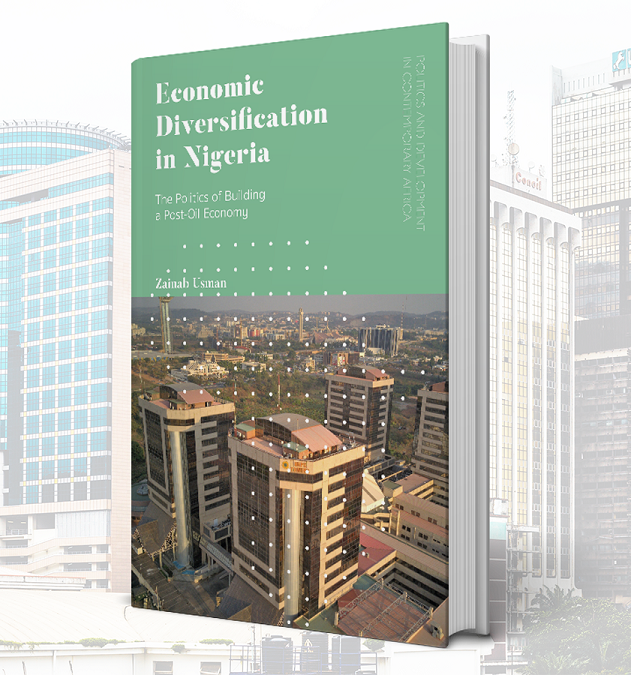
Economic Diversification in Nigeria by Zainab Usman is an in-depth analysis of Nigeria’s political economy that presents an apt delineation of the interplay of politics, institutions and policymaking in the process of economic development. Zainab’s is an attempt at instituting a diagnostic exercise to identify(beyond prevailing conventional narratives) major impediments to sustained development.
By repudiating ‘resource course’ and ‘backward neopatrimonilaism’ as the causal roots of Nigeria’s economic underperformance, the book presents a thesis that centres on challenges to economic diversification in resource-rich countries as the major impediment to economic transformation and development.
The author did a great job at identifying pathways to achieving economic transformation and establishing the state’s role in guiding the process but argued that the efficacy of the state’s guiding interventions remains a function of its institutional capacity which in turn depends on its political character.
Hence, to deconstruct Nigeria’s peculiar political character and its implications for economic transformation, the book deployed carefully designed frameworks for the analyses. Central among these analytical templates is the political settlement framework, which defines the influence of the distribution of political power on policymaking for development.
Per Zainab’s model, economic transformation, especially in resource-rich countries like Nigeria, depends on a kind of political settlement that distributes power among elite formations to ensure the emergence of a stable political coalition. This is why even while Nigeria has witnessed periods of semi-steady economic growth in her national life, such has never been adequate enough to usher in sustained development.
As an “Intermediate” State, Nigeria’s breed of political settlement is characterized by the formation of unstable political coalitions and cyclical political crises (especially in political transition periods). This has ensured that the country is always in crisis management. And the resulting policy and reform orientation has always assumed a manner that prioritizes short-term macroeconomic stabilization over long-term structural economic transformation.
The author, however, believes that such a political configuration is not immune to change. She explained that certain “critical junctures” determine whether a prevailing political configuration will change or persist. At these junctures, elites are constrained to take certain policy actions. And the economic outcomes of such policy actions depend on whether the assumed policy direction takes a stabilization or transformational orientation.
Using this framework, the author analyzed two subnationals, Lagos and Kano, to demonstrate the complex interplay of politics and policymaking and its influence on economic outcomes. The analyses mainly focused on critical junctures for both states and the resulting policy orientation and outcomes in relation to their contrasting political settlements. Lagos presented itself as a model for economic transformation while Kano a microcosm of Nigeria as it is.
The book concluded with recommendations on how Nigeria’s political settlement can be balanced by institutionalizing “zoning” as a power-sharing agreement, adopting a shared vision for transformation, and addressing market failures while emphasizing the imperative of building a post-oil economy. I find the book very interesting. It presents thought-provoking arguments and indeed updates our mental models on the challenges of economic diversification in Nigeria’s context.
Not that I agree with every postulation. In fact, I can’t entirely agree with the relegation of culture as an outcome of economic development rather than a determinant. Culture precedes economic activities(not to talk of development) in global historical trends, so I believe it cannot be an outcome of what it fundamentally precedes as far as existence is concerned.
As I posited some weeks back (linked), I belong to the school of thought that considers culture as a significant determinant of economic development alongside geography and climate. However, I believe culture itself is a product of nature, geography, climate and the environment.
I believe that at every point in human history, the culture of any people is determined and constituted by a combination of the powerful and inter-generationally persistent ‘cultural legacies’ the people have inherited over time (mostly developed in response to geographical and climatic determinants) and the cultural aspects developed as a result of the influence of [mostly unpleasant] environmental changes and the need to adapt to them.
Hence, I believe nature, geography, climate, and environmental changes determine the cultural compatibility and disposition(positive or negative) of any people towards development. Therefore, I have not seen enough reason to forgo Varoufakis, Gladwell and others on geographical and cultural determinism regarding economic development.