Security

NAF neutralises 23 bandits fleeing Kano after night attacks

By Uzair Adam

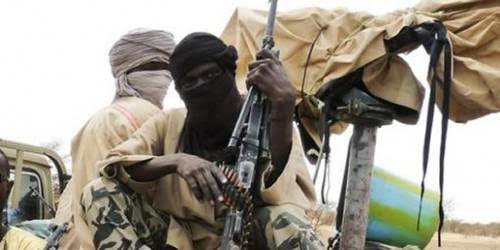
At least 23 suspected bandits were neutralised in a coordinated military operation after armed groups launched attacks on Shanono and Tsanyawa local government areas of Kano State between the night of January 1 and the early hours of January 2, 2026, according to the Nigerian Army.

The development was disclosed in a statement issued on Sunday by the Assistant Director, Army Public Relations, 3 Brigade, Nigerian Army, Major Babatunde Zubairu, who said the operation involved joint task force troops on the ground and the Air Component of Operation FANSAN YAMMA.

According to the statement, troops successfully contained the attacks in Kano. They inflicted heavy casualties on the assailants before tracking the fleeing bandits to Karaduwa village in Matazu Local Government Area of neighbouring Katsina State. 

Acting on credible intelligence, the Air Component pursued the group as they attempted to regroup after escaping Kano.

The Army said intelligence reports revealed that the bandits were in the process of burying some of their members killed during the initial clashes when they were located at Dan Marke in Matazu LGA. 

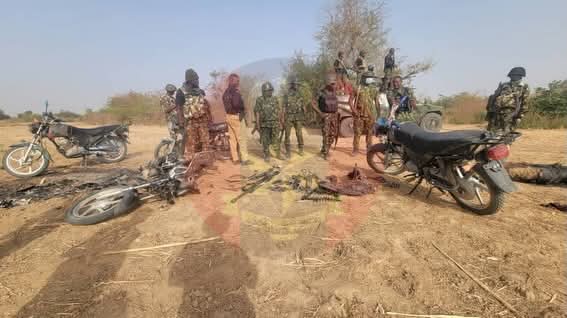
Air Component Sector 2 of Operation FANSAN YAMMA reportedly trailed their movement until several motorcycles converged after crossing a dry riverbed.

“A precision airstrike was immediately launched,” the statement said, noting that the operation was supported by aerial Intelligence, Surveillance and Reconnaissance missions. 

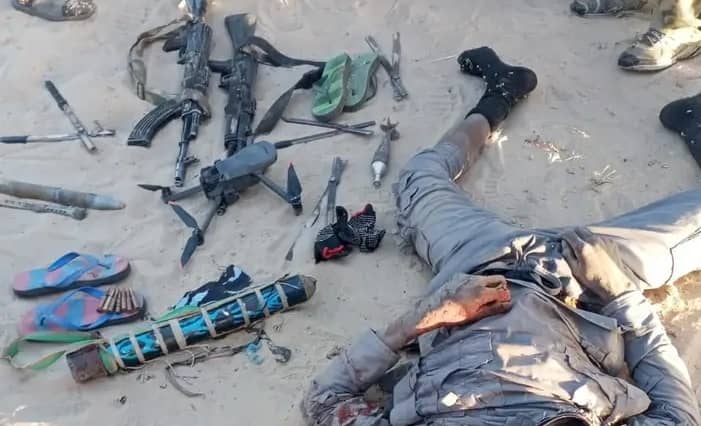
The strike, according to the Army, resulted in the neutralisation of at least 23 terrorists, while several others were believed to have sustained injuries. 

It also damaged the group’s weapons and other equipment.

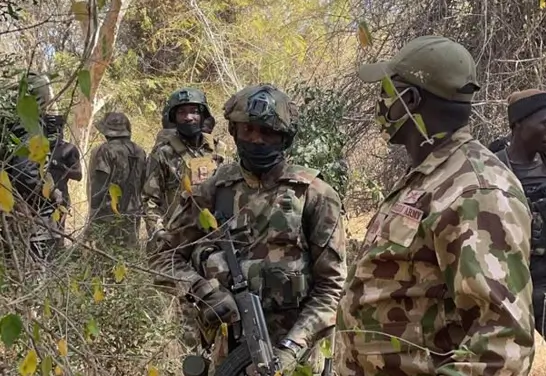
Reacting to the operation’s outcome, the Commander of 3 Brigade, Nigerian Army, commended both the air and ground troops for their exceptional courage. 

“Their bravery and resilience in the face of adversity are commendable,” he said.

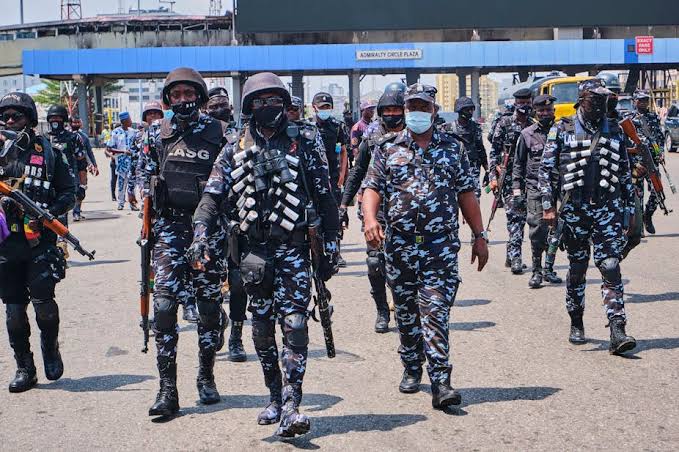
The Army added that the security situation in Kano State remains calm, with troops sustaining robust patrols and close monitoring of flashpoints. 

It stated that troop morale and operational efficiency remain “very satisfactory.”

The Nigerian Army also appealed to the public to continue supporting security agencies by providing timely and credible information.

Such cooperation, it said, would further aid efforts to disrupt banditry and other terrorist activities.

Major Zubairu stressed that troops, working alongside other security agencies, remain committed to safeguarding lives and property nationwide and will continue to take all necessary measures to ensure national security.

Nigeria must turn to modern technology to defeat insecurity

By Aminu Babayo Shehu

Nigeria is facing one of its toughest internal security battles in decades. From the kidnapping of schoolchildren in Kebbi and Niger states to the killing of senior military officers, including a Brigadier General, criminal groups continue to operate with increasing boldness. Bandits, kidnappers and terror cells now openly upload videos on platforms like TikTok and WhatsApp, displaying weapons, hostages and propaganda with little fear of consequences.

This is no longer an era where outdated tactics can secure the nation. Criminal groups are becoming more technologically aware, while the state still relies heavily on manual intelligence and slow-response systems. Countries facing similar threats have adopted advanced tools and strategies. Nigeria must follow the same path.

The United States and Israel use drones, satellite intelligence and geolocation trackers to disrupt hostile organisations long before they strike. Rwanda has established a modern drone command system to enhance surveillance and national security. India employs mobile tracing, SIM mapping and digital pattern analysis to dismantle kidnapping networks. These examples show that even in challenging environments, technology can expose criminal movements, reduce their operational freedom and strengthen national response.

Nigeria can apply the same approach effectively.

Real-time aerial surveillance remains one of the most critical gaps in Nigeria’s security architecture. High-altitude drones equipped with night-vision cameras and thermal sensors can monitor large forest areas where bandits hide. Such drones transmit live data to command centres, enabling tracking of movements and coordination of precision strikes. In many cases, soldiers need not be deployed on foot into ambush-prone areas; operations can be guided or executed remotely.

Mobile intelligence is another powerful asset. Every phone, even when switched off, leaves digital traces. With firm collaboration between telecom operators and security agencies, criminals can be located through cell-site analysis, call patterns and movement anomalies. India has successfully used these tools to reduce large-scale kidnapping syndicates.

Satellite imaging, when paired with artificial intelligence, can detect camps, vehicles, and human movement in remote areas. Modern software can analyse thousands of images within minutes and flag suspicious activity such as heat signatures, makeshift shelters, or recently cleared land. This drastically improves early detection and reduces operational delays.

State governments can also invest in early-warning technologies. Community CCTV networks, automated alarm systems and remote-sensor alerts can shorten response times. Local initiatives that once existed in a few states need consistent funding and national integration.

At the federal level, the Presidency should coordinate a national security technology blueprint. This would bring together drones, cyber-intelligence tools, biometric systems, satellite monitoring, and geospatial-analysis platforms into a single central command. Strategic partnerships with technologically advanced nations can reduce costs and strengthen capacity.

Nigeria’s security forces have courage and dedication, but courage alone cannot defeat modern criminals who rely on speed, shock and terrain mastery. Technology is the equaliser. It exposes hideouts, cuts communication lines and allows the state to strike before criminals mobilise.

The tools exist. They are affordable. They have worked in other nations. What Nigeria needs now is clear political will, long-term investment and an understanding that 21st-century threats demand 21st-century solutions.

If embraced, technology can save lives, disrupt kidnappers and terrorists, and restore the confidence of millions of Nigerians who deserve safety.

Aminu Babayo Shehu is a Software Engineer and Mobile Developer with experience building technology-driven solutions, including systems for logistics, telecommunications, e-commerce, and security-focused applications. He writes on technology, national development and digital transformation.

[OPINION]: A swift response to insecurity: commending Governor Abba Kabir Yusuf

By Anas Abbas

The launch of Kano State Security and Neighbourhood Watch Guard on December 23 by Governor Abba Kabir Yusuf is a timely and reassuring response to growing concerns about insecurity across the state.

At a moment when residents were increasingly raising alarm over safety in their communities, the governor chose action over silence.

In recent months, reports of petty crimes and organised disturbances have unsettled many neighbourhoods, threatening Kano’s long-held reputation as one of the more peaceful states in the North.

These concerns were not distant headlines but daily experiences discussed in markets and almost everywhere in Kano state. Acknowledging this reality, Governor Abba Kabir Yusuf’s administration moved swiftly to confront the challenge.

Central to the initiative is the deployment of 2,000 security personnel, carefully drawn from all local government areas of the state. This structure ensures broad representation, local knowledge, and community trust key elements in effective crime prevention. By embedding security personnel within familiar environments, the government strengthens early detection and rapid response.

The neighbourhood watch guard complements existing security agencies rather than replacing them. It is designed to close the gaps where formal policing alone may struggle, particularly at the grassroots. This layered approach reflects a practical understanding that modern security requires cooperation, intelligence sharing, and community participation.

Beyond physical protection, the initiative delivers psychological reassurance. Visible security presence restores confidence, discourages criminal behaviour, and reassures residents that the government is attentive to their fears. Insecurity thrives where people feel abandoned; decisive leadership reverses that narrative.

Governor Abba Kabir Yusuf deserves commendation for the timing of this intervention. Launched during a period of heightened social and economic activity, it demonstrates foresight and sensitivity to public safety risks. It also reinforces the principle that governance must be proactive, not reactive.

However,as implementation unfolds, sustained training, accountability, and respect for human rights will be essential to long-term success. If properly managed, the neighbourhood watch guard can become a durable pillar of community safety.

In taking immediate steps to safeguard lives and property, Governor Abba Kabir Yusuf has sent a clear message: the security of Kano’s people is paramount. This initiative stands as a strong example of responsive leadership in challenging times.

Kidnappers rake in N2.57bn ransom in one year — Report

By Uzair Adam

Kidnappers operating across Nigeria collected at least N2.57 billion in ransom payments between July 2024 and June 2025, according to a new report released by SBM Intelligence.

The report, titled “The Year Ahead at an Inflection Point” and published on December 19, 2025, examined key political and economic trends shaping Africa in 2025. It revealed that while kidnappers demanded an estimated N48 billion within the 12-month period, only a small fraction of that amount was eventually paid by victims and their families.

SBM Intelligence noted that kidnapping in Nigeria has increasingly become a well-organised, profit-oriented enterprise, flourishing amid weak governance structures, expansive ungoverned rural areas and deteriorating security conditions in several regions of the country.

According to the findings, at least 4,722 people were abducted in 997 kidnapping incidents during the period under review, while no fewer than 762 people lost their lives in attacks linked to banditry and related criminal violence.

Although ransom demands rose sharply in naira terms, the report observed that the actual earnings of kidnappers remained relatively modest when converted to dollars due to the depreciation of the naira. The N2.57 billion paid translates to approximately $1.66 million, only slightly higher than the $1.13 million equivalent of N653.7 million collected in 2022.

The Northwest emerged as the epicentre of kidnapping activities, accounting for 425 incidents, representing 42.6 per cent of cases nationwide. The region also recorded 2,938 victims, amounting to 62.2 per cent of all abducted persons across the country.

Zamfara State recorded the highest number of victims at 1,203, followed by Kaduna and Katsina States. SBM Intelligence attributed the prevalence of kidnappings in the region to vast, poorly governed rural communities and the presence of entrenched bandit networks capable of carrying out large-scale operations with minimal resistance.

In contrast, the Southwest recorded the lowest level of kidnapping activity, accounting for just 5.3 per cent of incidents and 3 per cent of victims during the same period.

The report further highlighted a rise in mass abductions, defined as incidents involving more than five victims, which accounted for about 23 per cent of all recorded cases and were largely concentrated in northern states. It noted that entire communities were sometimes targeted, with abducted persons reportedly forced to work on farms and mining sites controlled by criminal groups.

Beyond kidnapping, SBM Intelligence drew attention to escalating violence across several parts of the country in 2025. In the Northcentral region, attacks linked to armed herders persisted through March, with Benue State particularly affected. A single attack in Katsina-Ala Local Government Area on March 7 reportedly claimed 15 lives.

Zamfara State also experienced repeated deadly incidents, including an attack in Tsafe Local Government Area on March 13 that left 40 people dead, alongside mass abductions in Maru Local Government Area on the same day.

April and May were identified as some of the deadliest months of the year, with attacks in Plateau and Benue States killing more than 100 people combined, while mass abductions involving up to 100 victims were recorded in Zamfara, Katsina, Kebbi and Sokoto States.

Gumi backs Matawalle, calls for non-kinetic approach to insecurity

By Hadiza Abdulkadir

Prominent Islamic scholar, Sheikh Ahmad Mahmud Abubakar Gumi, has publicly endorsed the appointment of former Zamfara State governor Bello Muhammad Matawalle as Minister of State for Defence, arguing that his approach to insecurity prioritises dialogue and community engagement over purely military solutions.

In a post shared on his Facebook page, Gumi said security experts have long maintained that communal conflicts cannot be resolved through force alone, noting that military action accounts for “only about 25 per cent” of effective conflict resolution. He described Matawalle as one of the few political leaders who recognised this reality during his tenure as Zamfara governor.

According to Gumi, Matawalle’s outreach to aggrieved groups significantly reduced banditry in the state at the time, reopening major roads and markets that had been shut for years due to insecurity. He cited personal travel experiences along routes such as Gusau–Anka–Gummi and Wurno–Isa–Shinkafi–Gusau, which he said had become safe during that period.

“Cattle markets were opened, and life was returning to normal,” Gumi wrote, adding that the gains were later reversed following what he described as “military non-cooperation,” which led to renewed hostilities.

The cleric argued that Matawalle’s current role at the Ministry of Defence places “round pegs into round holes,” urging Nigerians to set aside “petty local politics” in support of what he called a new federal government paradigm shift in addressing insecurity. He concluded by praying for unity, peace, and progress for the country.

Gumi’s intervention has once again sparked debate, given his controversial role in public discussions on banditry and insecurity in northern Nigeria. While some supporters credit him with advocating dialogue as a pathway to peace, critics have accused him of being sympathetic to armed bandits—allegations he has repeatedly denied.

Security analysts remain divided on the effectiveness of non-kinetic strategies, with many arguing that dialogue must be carefully balanced with law enforcement and accountability. The federal government has yet to officially respond to Gumi’s remarks, but officials have consistently maintained that Nigeria’s security challenges require a mix of military action, intelligence-led policing, and community-based initiatives.

As the administration continues to recalibrate its security strategy, Gumi’s comments contribute to the ongoing national conversation on how best to end violence and restore stability across conflict-affected regions.

Who will save Nigerians from road accidents?

By Isah Kamisu Madachi

On Thursday, 4th December 2025, my cousin Tajuddeen bade us farewell on his way to Lafia, Nasarawa State. They left early in the morning in a Hummer bus. Around 10 a.m., they had a terrible accident in a town near Bauchi metropolis. All the passengers in the vehicle were badly injured. Tajuddeen, along with the bus driver and two others, instantly slipped into coma.

Other passengers were either with more than one fracture or several wounds. On the evening of 6 December, the driver’s suffering came to an end as he passed away. The following day, another one of the passengers in the coma also died. On 8 December, the third victim in coma breathed his last, leaving my cousin still in the ICU section of the Abubakar Tafawa Balewa University Teaching Hospital, Bauchi.

The cause of the accident was tyre failure. While they were on the road hoping to reach Jos in the afternoon, their back tyre burst and the bus somersaulted several times. The primary cause of the tyre failure was actually overload. Coincidentally, as I was on a phone call with a friend, he narrated how another terrible accident occurred close to my hometown as a result of tyre issue which instantly claimed two lives and left others badly injured.

I was really shocked and worried because not long ago, on a trip to Lagos, our own bus was carrying two commercial vehicles in addition to overloaded luggage of passengers and waybills. Even before the vehicles were brought, one had to ask whether humans would still get a seat after such loads were mounted. Lo and behold, the vehicles were arranged in a way that you couldn’t even see them inside the boot.

Last month, on our way back home from Kano, we witnessed another accident around Shuwarin town in Jigawa State. It was a jam-packed hummer bus obviously heading to either Damaturu or Maiduguri. They also had a tyre failure which resulted in several deaths. By the time we arrived at the accident scene, out of more than 20 passengers including the driver, only two people were still alive. The rest appeared lifeless.

If I were to narrate all the road accidents I have witnessed, most of them caused by tyre failure, I would have to write a book of a hundred pages. Road accidents are too many across Nigeria. Less than one week ago, I saw a picture on social media that stirred wide reactions. A commercial bus was overloaded to the extent that if one wanted to go out at a transit point, they had to pass through the boot as the doorway was blocked by bags. Even in the case of an emergency, no one could use the door because luggage completely covered the entrance. Many people commented that this is common in Nigerian motor parks.

When we talk about things that claim the lives of Nigerians, I believe road accidents is of course one of the biggest culprits, even more than insecurity in some cases. Anyone who travels widely by road knows this fact. And most of these accidents are avoidable if only we take transport safety seriously.

To bring to an end or at least reduce the intensity of the problem, we need a comprehensive transport policy that tackles overload and the abuse of luggage space. Parks should be mandated to use dedicated cargo buses. If a passenger’s luggage is above 10kg, it should automatically be transferred to a cargo vehicle, not stuffed into a bus carrying humans. For waybills, there should be separate buses whose only function is to transport goods from one state to another; especially the popular routes between Northern and Southern Nigeria or even within the North along routes like Kano-Borno, Taraba-Kaduna, Abuja-Adamawa and others.

Another important solution is the deployment of safety personnel to every major park. Their only job should be to inspect buses and car tyres to ensure they are in good condition before departure. Once there is no compliance, the driver must not be allowed to go. Of course in Nigeria some people may try to offer bribes to bypass checkpoints. To address that, these safety officers should not be local staff. They should report directly to an independent transport safety unit with strict oversight, rotating officers frequently to reduce compromise.

Still, digital systems can be introduced. Each bus should be scanned and cleared through an electronic checklist linked to a central database. If a bus fails safety checks, it should not receive the clearance code required to leave the park. With this kind of structure, even bribery becomes difficult to offer because safety approval will depend on digital authentication, not an individual officer’s discretion.

Nigeria needs to take road safety as seriously as other deadliest national issues. The number of lives cut short on our roads is heartbreaking. Families are losing loved ones every day due to accidents that could be prevented if we enforce discipline, regulate overload, inspect tyres, and treat transport safety as a matter of policy, not luck. 

Isah Kamisu Madachi is a policy analyst and development practitioner. He wrote from Abuja, and can be reached via: isahkamisumadachi@gmail.com

Student dies following alleged phone theft at UNN

By Anas Abbas

A student of the University of Nigeria, Nsukka (UNN) has died in tragic circumstances following an alleged assault by fellow students who accused him of involvement in a phone theft incident.

The incident occurred at the Eni Njoku Hall of Residence, where the undergraduate was reportedly confronted by other students over suspicions that he was connected to the disappearance of a mobile phone.

Sources say that the confrontation quickly escalated into a physical attack, with several students and hostel residents reportedly administering a severe beating.

The victim was said to have suffered critical injuries during the altercation and was later taken to a medical facility, where he was pronounced dead.

Details about the identity of the deceased, including his name and level of study, have not yet been officially released by the university or law enforcement, but various posts on social platforms refer to him as a UNN student who was allegedly beaten to death on suspicion alone.

The Enugu State Police Command has reportedly initiated an investigation into the matter to ascertain the exact sequence of events and whether criminal charges are warranted. Authorities are reviewing eyewitness testimony and security footage as part of the probe.

UNN management has not yet issued an official statement confirming the student’s death, but the incident has sparked concern among students and advocacy groups over rising cases of campus vigilante justice and the dangers of taking the law into one’s own hands.

Further updates are expected as police continue their investigation and as the university responds to queries from the press and the public.

Sharenting and infant privacy: The hidden cost of sharing our children online

By: Abdulhameed Ridwanullah

On July 22, 2015, the then-spouse of Nigerian Afrobeats queen Tiwa Savage, Tunji “Tee Billz” Balogun, announced the birth of their son, Jamil, on social media with an image of the father and son’s hands. This, no doubt, was an intimate moment. But beneath that act was the normalization of what researchers described as “sharenting”. Sharenting is a pervasive practice of documenting every stage of a child’s life online. From the baby shower, scan pictures, delivery room and other “first” images in the life of the baby documented for public gaze, sharenting has become normalized to an extent that those calling for caution are regarded as old-school.

Sharenting is now recognized globally as a growing digital privacy concern because it exposes children to long-term data risks they cannot consent to. But in Nigeria, the consequences are amplified by our unique digital ecosystem.
What makes sharenting particularly risky in Nigeria is not only what online platforms do, but what we (users) do. On the users’ part, Nigerians’ platform usage has shown a pattern of resistance that outsmarts platforms’ regulations. In my research on platform resistance, I argued that Nigerians have developed what I call a digital okada culture: creative, evasive practices that bypass platform safeguards the same way commercial motorcycle riders bypass formal road rules. Screenshots, screen recording, parallel WhatsApp accounts, anonymous repost pages and third-party aggregators routinely move supposedly “private” content into the open, uncontrolled publics.

We have seen photos of the naming ceremonies privately shared on WhatsApp status, making their way anonymously to Instagram gossip pages like Instablog9ja and other similar gossip blogs. Simply put, a controlled WhatsApp status update can end up on strangers’ phones instantaneously. Our digital culture in Nigeria is a highly porous ecosystem where content easily escapes parents’ control, which complicates sharenting.
It is instinctive for proud parents to want to celebrate their joy with friends and family. Culturally and religiously speaking, giving birth is not a small feat. It is one of the memorable achievements in one’s life.

The magnitude and social significance of it alone are good reasons to celebrate and post children online. For diaspora families, social media posts also help them connect with grandchildren and relatives not seen physically. On the surface, this looks like a harmless practice. But once it is placed inside a digital okada culture, the comfort of “I only shared it with my contacts” becomes an illusion.

Even mainstream financial institutions have begun to warn that oversharing children’s information online can create future vulnerabilities. A 2018 BBC news report indicated that Barclays Bank forecasted that by 2030, sharenting could result in £670 million in online fraud. The bank added that parents might be “lulled into a false sense of security” without grasping the long-term implications of oversharing online. That warning is not just about money; it is about the long tail of our children’s data.


But financial fraud is only a small fragment of the risk. The bigger problem is how children’s data feeds an entire economic system. As I have written previously, the “paradox of social media is that a digital footprint is both transient and permanent”. It is transient because our post quickly disappears from most feeds, but the metadata is stored permanently in corporate databases. This is what Harvard professor Shoshana Zuboff calls surveillance capitalism.


Sharenting allows surveillance capitalism to thrive because parents voluntarily funnel massive intimate behavioural data about their children into algorithms. This behavioural data could be monetised by building a detailed, lifelong predictive profile of the children. According to privacy researchers, children’s photos that people share online are being used to train facial recognition algorithms and AI systems.

Think about that! Our children’s faces are being used to teach machines without our or their consent. Parents’ excitement often leads to the surrender of children’s data to platforms without their consent. Even celebrities who build careers on social media visibility, like Rihanna and Cardi B, are choosing to obscure their children’s faces to mitigate risk. Drake famously raps in the Emotionless track that “I wasn’t hiding my kid from the world; I was hiding the world from my kid”.


Many Nigerian parents take comfort in the illusion of privacy of End-to-End Encrypted messaging platforms. They assume that posting baby photos on WhatsApp Status, especially to a restricted contact list, is safer than throwing them on Instagram. Messages on WhatsApp are encrypted, no doubt; however, that alone does not mean data extraction isn’t taking place.

Metadata about what we share (e.g., baby photos), who we talk to, when, location, duration, and frequency are extractable and shareable data that the platforms can use to build a behavioural pattern.
In other words, even when images disappear, their informational shadows remain.

Beyond the momentary applause and privacy concern, what happens when these children grow up and do not appreciate their lives being displayed online and their privacy being taken away? Teenagers are already suing their parents in Europe for unconsented exposure. It is only a matter of time before a similar conflict emerges in Nigeria. I am not a technological Luddite. Far from it. I am just a concerned technology researcher who cares about the use and misuse of social media.


In a country shaped by digital okada culture, parents cannot assume that what they post about their children will stay where they intended. Sharenting is not just about cute photos; it is about handing our children’s futures to platforms, algorithms and a porous digital public they did not choose.

Nigeria needs greater digital literacy around children’s rights. There is also a need for more public awareness campaigns and discussion about consent beginning at home. Parents must think beyond the moment of joy and consider the digital futures they are constructing for their children.

Abdulhameed Ridwanullah is a researcher at Media for Empowerment and Impact Lab, Northeastern University, Boston, USA. He can be reached at olaitanrido@yahoo.com

Troops rescue hundreds, destroy terror camps, illegal refineries nationwide

By Uzair Adam 

Nigerian troops have rescued 318 kidnapped victims, neutralised several terrorists, and arrested many others during coordinated operations across multiple regions in November, the Defence Headquarters (DHQ) has said.

A statement issued on Thursday explained that the operations also led to the deactivation of 16 illegal crude oil refining sites and the prevention of suspected oil theft valued at over N217.6 million. 

Troops additionally recovered thousands of litres of crude oil and AGO during the raids. The military assured that efforts are ongoing to secure the release of the students recently abducted in Niger State.

In the North East, troops of Operation Hadin Kai sustained pressure on Boko Haram, ISWAP, and JAS fighters through land and air offensives carried out in several local government areas of Borno and Adamawa States. 

The operations resulted in the neutralisation of terrorists, arrest of collaborators, rescue of kidnapped victims, and destruction of terrorist camps and equipment.

In the North West, troops under Operation Fansan Yamma carried out similar missions in Zamfara, Sokoto, Katsina, Kano, Jigawa, and Kebbi States. Several terrorists were neutralised, suspects arrested, and kidnapped victims rescued. 

Air operations also targeted hideouts in Kankara and Faskari, destroying camps and disrupting logistics networks.

Troops operating in the North Central under Operation Enduring Peace conducted raids in Plateau and Kaduna States, neutralising extremists, arresting suspects, and rescuing victims. 

Additional missions under Operation Whirl Stroke in Benue, Nasarawa, and Taraba States led to more arrests, rescues, and recoveries of arms, vehicles, and livestock. 

Operations extended to Kogi State and the FCT, where extremists were neutralised and more victims rescued.

In the Niger Delta, troops under Operation Delta Safe intensified efforts against oil theft in Bayelsa, Delta, Imo, and Rivers States. 

These operations thwarted theft valued in millions of naira, dismantled illegal refineries, and led to the arrest of oil thieves and other criminals. 

Additional patrols also led to arrests and the seizure of arms and ammunition.

In the South East, under Operation Udoka, troops conducted raids across Enugu, Ebonyi, Abia, and Cross River States. 

The missions led to the neutralisation of terrorists, arrests, rescues, and the recovery of weapons and explosives. Air strikes in Ezeagu LGA destroyed terrorist camps and supply routes.

The military commended the troops for their bravery. It urged Nigerians to continue providing credible information to support ongoing operations and to support veterans through the Armed Forces Remembrance Day initiative launched on December 2, 2025.

According to DHQ, the Armed Forces remain committed to lawful operations aimed at restoring peace across all affected parts of the country.

Obi says Kanu’s conviction could deepen unrest, calls for political solution

By Hadiza Abdulkadir

Former Labour Party presidential candidate Peter Obi has warned that the conviction of IPOB leader Mazi Nnamdi Kanu could worsen insecurity in the country. Obi issued the warning in a statement posted on his social media accounts, saying the development comes at a time when Nigerians are already struggling with economic hardship and widespread violence.

Obi said Kanu’s arrest, detention, and now conviction represent “a failure of leadership,” arguing that the concerns raised by the IPOB leader could have been addressed through dialogue and inclusive governance rather than coercion.

He cautioned that the government’s approach risks aggravating tensions in the South-East and further stretching security agencies already battling multiple crises nationwide.

According to him, nations facing similar internal tensions often adopt political solutions and negotiated settlements when legal processes alone cannot guarantee stability.

Obi urged the Presidency, the Council of State, and respected national figures to intervene and pursue reconciliation, warning that only justice, fairness, and meaningful engagement can prevent the situation from escalating into a deeper security challenge.