News

Kano governor vows to secure minors’ return from Abuja court

By Uzair Adam

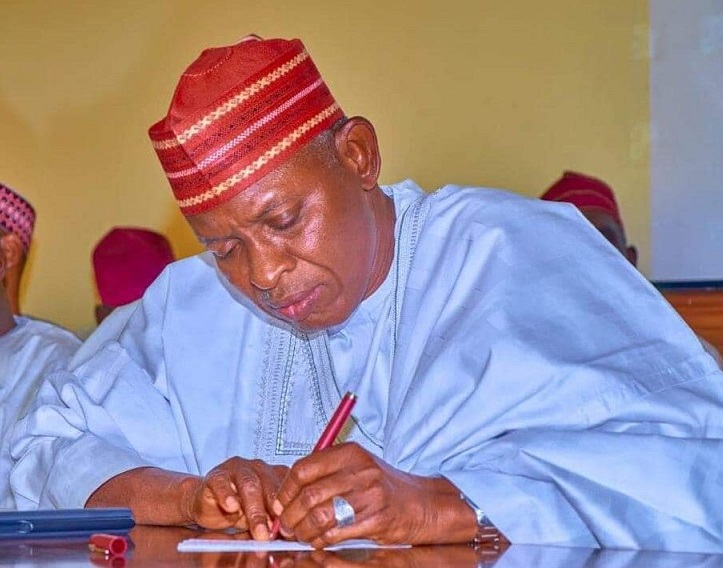
Kano State Governor Abba Kabir Yusuf has pledged to secure the return of minors from Kano who were arrested and face charges, including arson and treason, at a Federal High Court in Abuja.

The 76 suspects, most of them minors, were detained during the August #EndBadGovernance protests, where incidents of vandalism, confrontations with police, and anti-government chants reportedly occurred.

Tensions ran high during their arraignment as some of the minors reportedly fainted while waiting in the courtroom.

Responding to the incident on his X page, Governor Yusuf stated that he has directed Kano’s attorney-general and justice commissioner to address the situation urgently.

He wrote, “My attention has been drawn to the court appearance of teenagers (some believed to be from Kano) in Abuja. The Commissioner of Justice has been instructed to act immediately on the issue. We shall do everything possible to get them back to Kano, in sha Allah.”

Korean embassy in Nigeria honours customs chief Adeniyi

By Sabiu Abdullahi

The Korean Embassy hosted a dinner for Comptroller-General of Customs (CGC) Adewale Adeniyi and his management team, strengthening bilateral relations and shared objectives. 

CGC Adeniyi praised Korea’s commitment to partnership, adding progress through collaboration. “It is due to our dedicated partnerships that the NCS is now engaged in data analytics programmes, in alignment with World Customs Organization standards.” 

Korean Ambassador Kim Pankyu commended Adeniyi’s dedication.  He said, “We are honoured by the Comptroller-General’s presence and look forward to further strengthening ties.” 

Deputy Comptroller-General Greg Itotoh thanked the Embassy for its support. 

“The Embassy’s support and willingness to partner are instrumental in driving our Service to greater heights.” 

The event affirmed Korea’s dedication to Nigeria’s customs modernisation and capacity-building efforts.

#EndBadGovernance: Minister vows to take action in promoting the welfare of arraigned minors

By Anwar Usman 

The Federal Government has said there is an ongoing plan to improve the welfare of minors detained over their alleged participation in the nationwide #EndBadGovernance protest. 

This was disclosed in a statement by the Minister of Youths Development, Ayodele Olawande, on Friday. 

Earlier today, there was uproar at the Federal High Court sitting in Abuja after some of the arraigned minors fainted and a great number of them looking malnourished after being detained for three months. 

The court later ruled that they be granted bail in the sum of N10 million each, while the prosecutor asked the judge to remove the names of those who collapsed from the charge. 

While reacting to the development, Olawande said the ministry is “engaging with the ministry of interior towards finding out the facts of the situation and improving the welfare of the young people being held, not just in relation to this case but in correctional centres across the country”. 

He further added, “Please rest assured of the Ministry’s commitment to protecting youth’s interests and the welfare of young Nigerians, wherever they may be”. 

More details later…

FG meets with NASU, SSANU, calls for suspension of strike

By Anwar Usman 

The Federal Government has called on the Non-Academic Staff Union of Educational and Associated Institutions (NASU) and the Senior Staff Association of Nigerian Universities (SSANU) to call off their strike, which is now in its fifth day. 

This call was made by outgoing Minister of State for Education, Dr. Yusuf Sununu, who led the government delegation in discussions with the union leaders on Thursday. 

Sununu, representing new Education Minister Dr. Tunji Alaussa, stated that efforts were underway to address the issues leading to the industrial action.

Public universities across Nigeria had shut down since Monday due to the indefinite strike by NASU and SSANU, who are protesting the government’s failure to release four months of withheld salaries from 2022. 

During the negotiation, Dr. Sununu confirmed to the union leaders of the government’s commitment to resolving the matter.

He was quoted as saying, “We have reviewed the reasons for the strike and briefed them on the Federation Ministry of Education’s efforts to resolve the issues.”

He stated that discussions had reached an advanced stage and appealed for cooperation from union members to achieve a stable academic environment. 

The chairman of the Joint Action Committee of NASU and SSANU, Comrade Hassan Makolo, expressed optimism regarding the meeting’s outcomes.

He assured that the unions would suspend the strike once their members confirm receipt of the withheld salaries.

“We had a productive discussion. By the time our members receive payment alerts, the strike will be over,” Makolo said.

He added that the unions are hopeful these commitments will prevent future disputes over similar issues.

Nigeria loses more than N200bn annually printing books abroad—Group

By Anwar Usman 

The Gutenberg Prints Association of Nigeria has explained that Nigeria loses over N200 billion annually on printing books overseas. 

Mr. Adekunle Adebambo, the president of the association, said this during a press briefing on Thursday in Abuja. 

According to Adebambo, Nigeria has the capacity to provide all the printing equipment needed in the country, which will in turn promote the much-celebrated industrialisation and growth of the nation. 

He called on the federal government and relevant authorities concerned to improve local production capacity and implement policies that would ensure a stronger and more vibrant printing industry in the country. 

“There is no year that Nigeria does not spend over to N200billion minimum in printing books abroad. 

“Most school authorities have made it mandatory for students in nursery, primary and secondary schools to buy books which mostly produced abroad. 

“We are appealing to relevant stakeholders involved to look into this issue. Because we cannot industrialise when we have opportunities and we are not utilising it.” 

The president called on the Ministry of Education to partner with Nigerian universities to establish bachelor and postgraduate degree programs in printing technology and management. 

He further added that “with government, stakeholders, and Nigerian’s support, GUPPAN believes that we can build an industry that not only serves our country’s needs but also enhances its standing on the global stage. 

“The time has come for concerted action to correct past missteps, uphold the standards set by Act 24, 2007, and restore integrity to the Nigerian printing industry. 

“We urge the media to support us in highlighting these issues as together we can ensure a future where the Nigerian printing industry stands as a pillar of professionalism, innovation and national pride,” he said. 

The News Agency of Nigeria reports that the briefing was organised with the theme” Industrialisation: The Role of Printing Business and Enhanced Printing Profession, Challenges and Solutions.”

Governor Inuwa attends National Economic Council meeting in Abuja

By Abdullahi Mukhtar Algasgaini

Gombe State Governor, Muhammadu Inuwa Yahaya, CON, today joined his counterparts and key national stakeholders for the National Economic Council (NEC) meeting held in the Council Chamber of the Presidential Villa, Abuja.

The meeting, presided over by Vice President, Sen. Kashim Shettima, was attended by state governors, ministers, and other essential policymakers to discuss and devise solutions for Nigeria’s pressing economic issues.

During the opening, Vice President Shettima highlighted the critical need for sustained collaboration between federal and state governments to implement policies aimed at economic recovery and sustainable growth.

The NEC meeting’s resolutions are expected to set a renewed agenda for tackling inflation, enhancing fiscal stability, and boosting economic resilience amid global and domestic pressures.

2024 Mo Ibrahim report reveals alarming governance decline in Nigeria

By Uzair Adam

The 2024 African Governance and Transparency Index, published by the Mo Ibrahim Foundation, has highlighted pressing governance challenges for Nigeria, revealing a steady decline in critical governance metrics.

Victor Okebe Agi, Public Relations Officer at the Centre for Fiscal Transparency and Public Integrity, noted that the report placed Nigeria 33rd out of 53 African nations, with an overall score of 45.7 out of 100, down by 1.4 points since 2014.

Nigeria’s performance was particularly weak in key categories such as Security, Rule of Law (39.7), Participation, Rights and Inclusion (47.9), Foundations for Economic Opportunity (48.6), and Human Development (46.4).

Further analysis by the Centre for Fiscal Transparency and Public Integrity’s Transparency and Integrity Index reveals systemic governance issues across federal, state, and local institutions.

These findings suggest broader institutional challenges and a declining national standing within Africa and globally.

The report warns that Nigeria’s governance issues—lack of transparency, inadequate public sector accountability, and inconsistent anti-corruption efforts—have far-reaching implications.

“The decline in Nigeria’s governance not only affects national stability but also deters foreign investment and hinders economic growth,” it states, emphasizing the need for immediate reforms.

The Centre has urged the government to address these issues by enhancing anti-corruption mechanisms, improving compliance with the Public Procurement Act, and establishing stronger protections for whistleblowers.

Moreover, bolstering judicial reforms and promoting inclusive policies are vital to restoring public trust and ensuring equal justice.

The report concludes with a call for increased investment in healthcare, education, and skills training, aiming to build human capital that can drive Nigeria’s future economic growth and competitiveness across Africa.

Minimum wage adjustment sparks momentum in private sector

By Uzair Adam

Following the recent enactment of a N70,000 minimum wage for public workers, over 20 states have announced their readiness to implement the new standard.

However, the private sector’s response remains less visible.

Notably, the textile industry has set a new precedent, as the National Union of Textile Garment and Tailoring Workers of Nigeria (NUTGTWN) and the Nigeria Textile, Garment, and Tailoring Employers Association (NTGTEA) agreed on a 25% pay increase for the sector’s lowest-paid workers.

Vanguard reports that this adjustment, effective August 1, raises their monthly wage to N75,000.

Meeting under the National Joint Industrial Negotiating Council (NJINC) in Lagos on October 21, 2024, representatives of NUTGTWN and NTGTEA reviewed their sectoral collective bargaining agreement (CBA).

The current agreement includes wage-related allowances such as medical, transport, and food subsidies, aiming to offer better support amid Nigeria’s challenging economic climate.

The NJINC also announced efforts to incorporate clauses from ILO Conventions 190 and 155, reinforcing workplace safety and addressing harassment.

“This year’s negotiation outcome underscores the union’s dedication to a living wage,” stated Peters Godonu and Ali Baba, leaders of NUTGTWN.

Despite the textile sector’s significant challenges, such as rising production costs, smuggling, and insufficient infrastructure, the union expressed appreciation for the cooperation shown by the NTGTEA.

The union also called for government support, urging policies that protect the textile industry and enable it to remain competitive.

With the NJINC’s history of peaceful negotiations and its commitment to social dialogue, leaders stress that a supportive regulatory environment is crucial for the sector’s sustainability and growth.

Rising petrol prices testing Nigerians’ patience – Labour warns FG

By Uzair Adam

Organized Labour has expressed concerns that the continuous increase in petrol prices is straining Nigerians’ tolerance, warning that the government may soon face a public reaction to these economic pressures.

The most recent hike, according to Labour, is yet another burden added to an already struggling populace.

Labour emphasized the growing hardship, urging the government to address the simmering discontent among citizens.

It noted that Nigerians’ silence should not be mistaken for acceptance, as persistent economic pain could lead to an unpredictable response.

“Even a goat can bite when pushed to the wall,” a representative cautioned.

In a similar vein, the Chemical and Non-Metallic Products Employer’s Federation (CANMPEF) highlighted the broader impact of fuel price hikes on sectors including logistics, production, and household income.

The group warned that, combined with other economic challenges, these increases are eroding purchasing power and stifling growth.

The Independent Petroleum Marketers Association of Nigeria (IPMAN) also added that delays in accessing fuel from Dangote Refinery, despite prior payments to the Nigerian National Petroleum Company Limited (NNPCL), are exacerbating supply issues and maintaining high prices.

IPMAN argued that giving marketers direct access to refinery fuel could alleviate some of the price pressures.

Labour leaders have called on the government to reconsider policies affecting essential commodities, warning that patience among citizens is running thin.

Petrol prices rise nationwide as marketers shift supply to Dangote Refinery

By Uzair Adam

Major oil marketers across Nigeria have increased the price of Premium Motor Spirit (PMS), commonly known as petrol, from N1,010 to N1,050 per litre.

The Daily Reality gathered that the 4% increase is primarily noted in Lagos and nearby areas.

Meanwhile, independent marketers are adjusting their prices to range between N1,100 and N1,200 per litre, varying by location.

The recent hike reflects Nigeria’s deregulated oil market, where petrol prices are no longer fixed. Due to this flexibility, filling stations across the country show slight price differences, though some stations maintain similar rates.

Industry insiders say the adjustments are linked to the anticipated supply shift to the Dangote Refinery, which oil marketers expect will streamline distribution and potentially impact future prices.