National

You can add some category description here.

Questions on Naira redesign

By Abdulhalim Ishaq Ringim

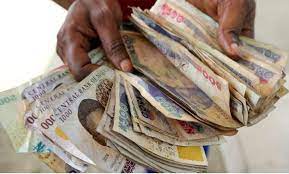
Yes, there’s about N2.73 trillion outside bank vaults. This figure represents 85% of the N3.23 trillion in circulation. However, it only represents 6.5% of more than N49 trillion that is in circulation.

Now, let’s consider Nigeria’s unbanked population which stands at 64 million according to World Bank’s “The Global Findex Database 2021: Financial Inclusion, Digital Payments, and Resilience in the Age of COVID-19” report.

What financial intelligence, as a matter of specificity, does the CBN have regarding the magnitude of the money circulating within this highly populous unbanked system. If we were to assume all the N2.73 trillion is in the hands of these unbanked population, then the amount of money on a per capita basis would be about N42,000. Is that too much?

But we all know this assumption is far from reality because the banked population also hold cash for transactionary and precautionary purposes(as in the case of emergencies). So let’s extend our assumption by adding 50% of the banked population to the unbanked population and let the final figure be the number of people who hold cash either because they are unbanked or because of other purposes as transactions and precautions. The per capita cash amount would reduce to N28,000. Is that also too much?

For the hoarding claims, economically speaking, what is the incentive of hoarding cash in Naira considering the continuous devaluation and inflationary trend that has been wiping the value of the Naira against the dollar when there are various hedging options available? Does the CBN have any tentative intelligence that suggest massive hoarding or is this just another trial and error policy?

But let’s also assume there’s indeed hoarding and some people are holding suspicious money. Have the CBN thought of the possibility that the hoarders might now be forced to consider hedging options by flooding the market with money in exchange for hedging-compatible commodities? Have they considered the inflationary tendencies of such an eventuality? Check Dr. Adamu Tilde’s most recent post to appreciate the happening in real world markets. Is the recent sharp rise of the dollar value also a consequence of such tendencies?

The risk of counterfeiting has always been present. The CBN confiscated N64.7 million and N56.8 million in 2019 and 2022 respectively. Compared to the money in circulation, are these figures significant enough to evoke the need for a currency redesign?

If it is for the purpose of managing inflation and ensuring the CBN contractionary monetary policies become more effective, then let’s assume they succeed in mopping up most of the cash outside banking vaults. Is it increased money circulation that actually causes inflation or increased money supply? Isn’t the CBN culpable in the expansion of money supply through their unhealthy tendencies of printing money for government spending via ways and means? What are they doing about the money supply? What is the government also doing about deficit spending and the projected budgetary deficit for the coming year?

Is our inflation strictly a consequence of the Demand-pull Effect(caused by an increase in money supply or credit with commensurate increase in demand for goods and services and resultant price increases) or is it a consequence of a combination with the Cost-push Effect as a result of increase in Oil prices and other commodities(mostly as a result of global events plus local events e.g insecurity, oil theft, floods etc) that is gradually rippling and causing increase in the prices of production process inputs? Does the CBN also not think that the hike in the prices of commodities as a result of the consequence of hedging(possibility of which has been painted by Adamu Tilde in his recent post) would also contribute in aggravating the Cost-push as a result of hikes in production process inputs?

What is the CBN tackling exactly?

Abdulhaleem Ishaq Ringim writes from Zaria.

Quest for traffic kills quality journalism in cyberspace – Expert

By Uzair Adam Imam

A communication expert, Aisar Fagge, said the quest to keep up with breaking news has led to a high degree of error in online media reporting today.

Fagge, a lecturer at the Department of Mass Communication, Kano State Polytechnic, said the failure was due to the less or absence of proofreading and confirmation of facts by the editors.

He said this on Sunday when speaking on the “Fake News on Nigerian Cyber Space: The Role of an Ideal Journalist” at a One-Day Workshop for Early-Career Journalists on Reporting Northern Nigeria, Fake News and Journalism Ethics.

At the event organised by the management team of The Daily Reality Newspaper that took place in Bayero University, Kano, Fagge said the absence of or weak gate-keepers contributed to the lack of quality journalism in Nigerian cyberspace.

He also attributed the high degree of error in today’s online news reporting to poor staffing, which leads to the single-handed operation of the media.

He said, “Almost everyone wants to establish an online newspaper. A single person wants to be a publisher, a reporter and an editor all by himself. No doubt, the standard of journalism falls.”

The event had in attendance many communication experts and journalists from within and outside Kano state, including some that joined the workshop via Zoom from overseas.

Abuja-Kaduna train service to resume this month, FG announces

By Muhammadu Sabiu

The Federal Government announced on Monday that the restoration of train service between Abuja and Kaduna is scheduled for this month, November.

The Transportation Minister, Mu’azu Sambo, said this in Abuja while presenting his ministry’s scorecard.

He claimed that sufficient security had been put in place to guarantee the well-being of the travellers. 

However, the Minister did not provide a precise start date.

The incident in March, which claimed the lives of several passengers and resulted in the suspension of rail operations on the Abuja-Kaduna route, according to Sambo, taught the ministry enough lessons.

Insecurity weakens Nigerian education, increases number of school drop-out – Minister

By Uzair Adam Imam

The Minister of Education, Adamu Adamu, said the lingering security challenge in Nigeria had weakened the country’s education system.

The minister said the insecurity in the country also contributed to the rising number of out-of-school children today.

He disclosed this on Thursday in Abuja during the ministerial session of the 66th National Council on Education (NCE).

In the event themed ‘Strengthening of Security and Safety in Nigerian Schools for the Achievement of Education 2030 Agenda, Adamu said the issue would soon be addressed.

He added that President Buhari’s administration was working tirelessly to reduce the number of out-of-school children and the illiteracy level in the country.

He said, “I’d like to call on all states to rise up to their responsibilities and provide a safe and secure learning environment for both students and teachers.”

Furthermore, the education minister also said that all schools must be safe and secure at all costs.

Katsina: Parents of 39 abducted kids beg gov’t for help

By Muhammadu Sabiu

Parents of the 39 children who were kidnapped on Sunday by bandits while working on a farm in the Faskari Local Government Area of Katsina State have begged the government to help rescue them.

The Mairuwa community, according to a source, suffered the most heinous damage during the bandits’ raid.

He noted that when they (the bandits) approached the farm, the terrorists began shooting intermittently.

The source was quoted to have said, “They demanded N3m from the owner for him to be able to harvest his produce, he gave them N1million as part payment and decided to begin the work before completing the money, but unfortunately the bandits did not accept that. In our village, Mairuwa, alone we have 33 among the victims including young ladies who are due for marriage.”

SP Gambo Isah, the Katsina police spokesman, assured that efforts were ongoing as to how the abductees would be rescued.

Meanwhile, the Daily Reality has obtained reports that showed six of abductees had regained freedom on Tuesday.

MURIC to CBN: Make sure you inscribe Ajami text on Naira notes

By Uzair Adam Imam

The Muslim Rights Concern (MURIC) made a passionate plea to the Central Bank of Nigeria (CBN) to inscribe the Arabic text, Ajami, on all naira denominations just as they had been.

The MURIC Director, Prof. Ishaq Akintola, made this disclosure in a statement he made available to journalists.

Professor Akintola said the Muslim body supports the move by the Central Bank of Nigeria to redesign the naira notes.

However, he said, “the Arabic inscription, known as Ajami, must be inscribed on all the naira denominations.

“With the proviso that all the denominations must contain Arabic inscriptions just as they had been before, Arabic Ajami was conspiratorially and unjustly removed from some denominations. “The removal provoked Muslims and caused division within the country. Only its return to all denominations can heal the wound,” Akintola said.

Naira Redesign: Rumour on removing Ajami is false – Sunusi

By Uzair Adam Imam

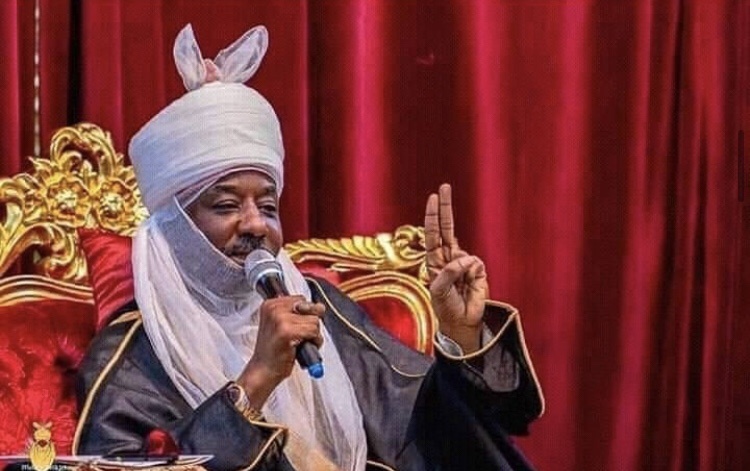
The 14th Emir of Kano State, Muhammadu Sunusi II, urged the general public to reject the rumour that the Central Bank of Nigeria (CBN) would redesign the naira notes to remove the Arabic text (“Ajami”) on them. 

Sunusi, a former governor of CBN, added that the rumour was false and baseless and meant to mislead the masses. 

Recalls that the CBN Governor, Godwin Emefiele, announced the CBN’s intention to redesign, produce, release and circulate new series of N200, N500, and N1,000 banknotes.

Sunusi disclosed this on Monday in a short video he made, which immediately went viral on social media platforms. 

The former Emir said he noticed the rumour circulating among people and said he spoke to the CBN governor about the development. 

“I heard some people, including clerics, engaged in a heated argument over redesigning the naira note, claiming that the Arabic text would be removed if the naira is redesigned. 

“I contacted the CBN governor about the development, and he clarified that the rumour in circulation was false.

Sunusi also urged the general public to disregard the rumour.

Insecurity: Türkiye to deploy drones, helicopters in Abuja 

By Uzair Adam Imam

The development of security threats in the Federal Capital Territory, Abuja, has become worrisome and continues to terrorise citizens.

Countries, including the United Kingdom and the United State of America, issued the wake of a terror alert to Nigeria and their citizens that have been in the country for various reasons. 

On Saturday, Nigeria was greeted by the Republic of Turkey’s words to deploy drones and helicopters to Nigeria to help the country cope with the fears of insecurity threats. 

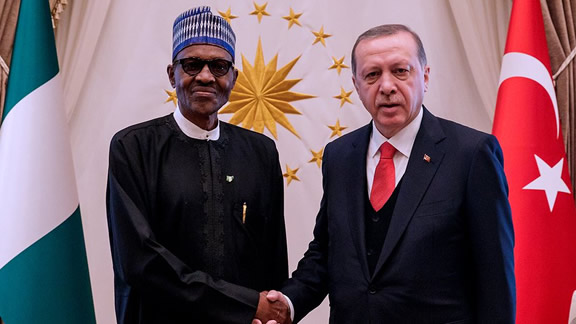
The Ambassador of the Republic of Turkey to Nigeria, Hidayet Bayraktar, disclosed this adding that the drones and helicopters would soon arrive in Nigeria as part of efforts to strengthen the security architecture of the country.

Bayraktar was reported to have made this intention public during the commemoration of the 99th National Day of the Republic of Turkey in Abuja.

He said, “The defence contracts signed between our countries last year marked a historical record.

“Taking this opportunity, I am proud to announce that two of our flagship defence industry platforms, Bayraktar (TB-2) drones and (T-149) ATAK helicopters, are set to arrive in Nigeria.

“We are confident that new Turkish defence products will support the efforts of the Nigerian government and contribute immensely to the peace, prosperity and security of fellow Nigerians,” Bayraktar said.

Paradigmatic Shift in Literary Ignorance: Ajami on Naira Reloaded

By Prof. Abdalla Uba Adamu

As we enter into the ‘will they, will they not’ mode of uncertainty typical of Nigerian public culture about the change of Nigerian higher currency denominations announced by the Central Bank of Nigeria (CBN) on 25th October 2022, my mind went back to an article I wrote on 16th April 2007. This was in the wake of the removal of “Arabic inscriptions” on the Nigerian currency (the Naira) on 28th February 2007 in the new currency notes that removed the Ajami (Hausa written in Arabic script) writing that indicated the denomination of the respective currency note and replaced with the Latin alphabet. This is a ‘remix’ of that posting on the then-popular platforms of Blogspot. Mine was called Nishadin Hululu (Hausa Popular Culture).

The full historical overview of how the Arabic “script” came to become part of the essentially northern Nigerian Muslim Hausa educational package is given in Manuscript Learnability and Indigenous Knowledge for Development – Hausa Ajami in Historical Context. A version is available at https://bit.ly/3zoi7XN.

I rarely bother to visit Nigerian “Naija” websites on the web or any other group of politically motivated Nigerians. I know what I will find – the usual vituperative tirade against northern Nigerians, Muslims, Hausa, ad nauseum. Southern Nigerians have three fundamental articles in their crusade against northern Nigeria: Islamic fanaticism, conservative feudalism and their weird perception of the “born to rule” syndrome held by the ‘northerners’. No matter how many groups of Nigerians you interact with, these three form the main focus of the divide in Nigeria. They are the main reasons why Nigerian “unity” is virtually impossible.

I doubt if there is any other group of Africans who hang out their dirty ethnic laundry like Nigerians. Although, I accept, for the most part, such ranting is probably not personal; they are basically religious – the Christian versus Muslim divide, rather than any feeling of superiority of one ethnic group over the other. Any such feelings of superiority are part of a religious template that sees the acquisition of education as the central criteria for judging the value of a whole people. Thus education, not religion, is the central fulcrum around which the Nigerian nation wobbles.

Southern Nigerians acquired education through Christian Missionary activities from about 1849. Such education became the mainstay of acquiring Westernized modernity. Inevitably Western education brought by Christian missionaries to Nigeria became equated with Western Christian values. For the most part, Christian southern Nigerians are happy with this because it makes them “civilised” – in the absence of any cherished antecedent cultural values. Thus, any other worldview is considered barbaric.

Northern Nigerians, specifically the Hausa and the Kanuri, acquired education through conversion to Islam since 1250 and even earlier in the Kanuri kingdom. The constant eddy of scholars from north African learning centres throughout the 14th to 17th centuries ensured a sustained scholastic tradition in Muslim northern Nigeria. Muslim northern Nigerians, therefore, had a longer exposure to the concept of formalised learning and literacy than southern Nigerians. Universal basic education was indeed introduced around 1464 in the city of Kano when new methods of indigenising the Arabic script to Hausa phonology were created. This led to the creation of a novel way of writing out the Hausa language in a script that young scholars will understand. This method of indigenising Arabic script to the Hausa language became “Ajami”. It became one of the main ways of educating young pupils in northern Nigeria. Do you remember all those “Almajirai” you see in northern Nigerian cities? Well, most are fluent in Ajami writing. Currently, the most prominent modern Hausa political singer (though not the most talented or likeable), Dauda “Rarara” Adamu Kahutu, has an extensive catalogue of his songs, all written in Ajami which he reads as he records in the studio.

Ajami, therefore, is any literacy strategy in which any language is written in Arabic. Over 50 languages are currently written in the script. First, let us look at the parallel sphere. If any African language is written in Latin characters, it can be called Ajami. Ajami is not Islamic; any more than the Latin alphabet is Christian.

However, in a new era of reform, CBN decided to remove the “Arabic” script from the Nigerian currency in new currency notes launched on 28th February 2007. The removal of the Ajami script on the Nigerian currency reflected Nigeria’s deep-rooted religious divide because the Arabic script was seen as religious – and Nigeria is considered a secular country. This equates Arabic with Islam – ignoring the vast number of Arab Christians throughout the Middle East.

The logic of the removal of what the Nigerian economic establishment calls “Arabic inscription” on the Nigerian currency given by the Nigerian Government was premised on using a Latin inscription that is available to all Nigerians (even if in mutually exclusive languages), rather than an exclusive script tied down to a particular religious culture. According to the then Governor of CBN, Professor Chukwuma Soludo, during a sensitisation visit to the Sultan of Sokoto,

“I will also like to inform you that the removal of the Arabic inscription on the notes is not targeted at any group or religion but rather to promote our language and cultural heritage…As you can see, Naira is the symbol of our nationalism and our pride. It is pertinent to let you understand that Arabic is not one of our national languages, and it was inscribed on the notes forty years ago because the majority of people then could read it in the northern part of the country to the detriment of their counterparts in the South (ThisDay, 16th February 2007, posted to the web 19th February 2007 at https://bit.ly/3TQ4FEw.

Similarly, the CBN issued a rebuttal to the controversies by stating that the “de-ajamization” was to “conform (to) Section 55 of the 1999 Constitution, which recognises four languages, English, Hausa, Ibo and Yoruba as medium of conducting government businesses.” After all, as they claimed, after forty years of Western education, most people in Nigeria should be able to recognise Roman inscriptions. This, we believe, can strengthen our unity by ensuring equity and fairness. Indeed, the replacement was done in national interest and the desire to comply with the Constitution of the country.”

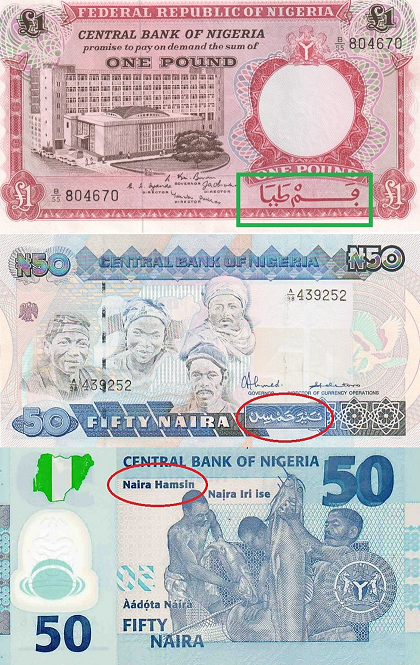
But how can national unity be attained when a large proportion of the country is still marginalised? To prevent this marginalisation, the British colonial administration introduced the Ajami letters on the first Nigerian modernised currencies, well aware of the large education gap – and therefore, the ability to read and understand Latin characters on the country’s currency notes. An example was the £1 note.

Fam daya” was prominently written to enable those literate in Ajami, but not the Latin alphabet, to identify the currency.

Interestingly, the main argument was that the presence of Ajami on Nigerian currency was seen to the “detrimental” to southern Nigerians (who presumably do not understand it) – yet the inclusion of the Latin alphabet is not seen as detrimental to non-Roman literate northern Nigerians (mainly Muslim Hausa, who presumably do not understand it). In this warped logic, it is, therefore, easier to alienate Muslim Hausa northern Nigerians than southern Nigerians, especially since a Christian was the President of the country (and a Christian Governor of the Central Bank facilitated the alienation). Of course, when a Muslim becomes the President, the arguments might be revisited – and reversed, which another subsequent Christian president will also revisit, and so on endlessly. Farooq Kperogi actually imagined a nightmare scenario that might come out of this in 2022 at https://bit.ly/3TOt2T1.

The inclusion of the script on the Nigerian currency by the British colonial administration was an acknowledgement of the rich literary heritage of a vast number of people in Nigeria who could not read the Latin script– and not a strategy to impose Islam on anyone in Nigeria. Indeed, the British colonial administration had no reason to propagate Islam. Yet on the currencies circulated by the same administration, the “Arabic inscription” was conspicuously present. This was maintained until 2007 when the despised Arabic inscription was removed and replaced with the much-loved Latin ‘inscription’. An example with ₦50 illustrates this.

The ₦50 with the ‘Arabic inscription’ of Ajami merely indicates that it is fifty naira in Hausa. In the redesigned ₦50, the Roman name for the Hausa was ‘naira hamsin’ instead of the Ajamized ‘hamsin’ in the old note. Yet, ‘hamsin’ means fifty in Arabic! So, like it or not, Arabic remains on the naira. To get rid of it, you have to get rid of the Hausa language entirely since about almost 45% of Hausa words are based on the Arabic language.

Further, other multicultural countries pay such homage to multiple literacies in their currency notes. The Indian currency, for instance, has 15 language scripts, including Urdu (Ajami) – despite Arabic not being part of its national languages.

And while not explicitly stated, the links made by the Nigerian economic establishment with Arabic to Islam seem to be part of a move to “de-Islamize” Nigeria – scoring a cheap point, particularly in the way most northern Nigerian states re-introduced Islamic Shari’a in their governance from 1999 led by Zamfara State, and the earlier issue of Nigeria’s membership of the Organization of Islamic Countries (OIC) in January 1986, which the Nigerian Christian (as well as Marxist Muslim) groups were against.

We look forward to the new currency notes in December 2022.

Prof. Abdalla Uba Adamu wrote from the Department of Information and Media Studies, Bayero University Kano, Nigeria. He is, among many other things, the former Vice-Chancellor of the National Open University of Nigeria (NOUN). He can be reached via auadamu@yahoo.com.
Naira Redesign: CBN, Minister of Finance trade words 

By Uzair Adam Imam

There have been up and downs concerning the re-design of the Naira note in Nigeria as the Central Bank of Nigeria (CBN) and Ministry of Finance, Budget and National Planning continue to trade words over the development. 

The minister of Finance, Budget, and National Planning, Zainab Ahmed argued that the CBN’s proposal to redesign the Naira might not yield any good result. Ahmed stated that the redesign would have serious negative effects on the country’s crippling economic growth. 

However, the Spokesman of the CBN, Osita Nwanisobi, challenged Ahmed, who said her ministry was not carried along.

Nwanisobi reiterated that CBN duly sought for the approval of President Muhammadu Buhari which he granted immediately. 

The Daily Reality recalls that the CBN Governor, Godwin Emefiele announced the intention of the CBN to redesign, produce, release and circulate new series of N200, N500, and N1,000 banknotes.

Re-designation of Naira portends serious consequences – Ahmed

“Distinguished senators, we were not consulted at the Ministry of Finance by CBN on the planned Naira redesigning and cannot comment on it as regards merits or otherwise.

“However as a Nigerian privileged to be at the top of Nigeria’s fiscal management, the policy as rolled out at this time portends serious consequences on [the] value of Naira to other foreign currencies.

“I will however appeal to this committee to invite the CBN governor for required explanations as regards merits of the planned policy and rightness or otherwise of its implementation now,” she stated. 

CBN was surprised by what Ahmed said 

However, the CBN spokesperson,  Nwanisobi expressed surprise at the minister’s claim, stressing that the CBN remains a very thorough institution.

He said the decision of the CBN management is in line with provisions of section 2(b), section 18(a), and section 19(a)(b) of the CBN Act 2007.

He also urged Nigerians to support the currency redesign project.