Business

You can add some category description here.

Nigeria Customs Service collaborates with Benin Republic to boost trade

By Sabiu Abdullahi 

The Nigeria Customs Service (NCS) is intensifying its collaboration with the Republic of Benin Customs Administration to boost trade activities between the two nations.

A high-level delegation led by the Comptroller-General of Customs (CGC), Bashir Adewale Adeniyi MFR, met with the Director-General of the Customs Administration of Benin Republic on Thursday, 11 April 2024. 

The primary agenda of the meeting was to discuss strategies to amplify trade activities and implement previously agreed-upon recommendations from their earlier meeting in Cotonou.

The CGC was quoted as saying, “We are cognizant of the established framework for cooperation between our respective customs administrations. This framework was established at a higher level by the authorities of the heads of State, President Patrice Talon of Benin and His Excellency President Bola Ahmed Tinubu of Nigeria, both expressing a desire to work together.” 

Mrs Adidjatou Hassan Zanouvi, the Director-General of Benin Customs Administration, welcomed the delegation and reaffirmed their commitment to executing the agreed-upon measures.

She stated the importance of thorough monitoring for effective implementation. 

The collaboration between the two customs administrations aims to facilitate seamless trade operations and the efficient management of cross-border activities for mutual benefit.  

During the visit, the CGC also inspected ongoing projects within the Nigeria Customs Service, Seme Area Command.

Accompanied by the Customs Area Controller, Comptroller Timi Bomodi, he assessed the progress of the projects and received assurances of diligent oversight from the responsible authorities.

Nigerian artisans and their psychological warfare

By Ibrahim El-Caleel

I have noticed one thing with artisans. A good number of them hate it when you ask them about their charges before commencing work on your item, be it electrical faults, plumbing issues or any other tasks. The prefer completing the job before telling you the price.

The underlying psychology here is for them to gain leverage in negotiation. By completing the task first, they position themselves in a stronger bargaining position. They will always argue that they have already done the job and they have really suffered to do so. This leaves you at their mercy, with some even framing their service to you as a massive favour.

However it goes, they will win. If you don’t pay as much as they want to charge you, then they will leave you with a guilt feeling about shortchanging them. An empathetic person will be prompted to add more money “just to clear his or her conscience”.

This is their psychology.

However, it is all your fault. No work should begin without a clear, mutually-agreed labour cost. It is akin to an employee signing an offer letter without a specified salary. Imagine starting a job as a Medical Doctor and your offer letter simply says, “we will pay you a monthly salary by 30th of every month.” No specified figure. What if at the end of the month the hospital pays you a salary of ₦17,500 while you were expecting ₦250,000? It’s absurd.

This is why both parties should agree on very clear terms before any work begins. If you meet your mechanic in his workshop, ask him how much he will fix your car’s Stabilizer & Ball Joints. Don’t agree with his vague assurances that, “No na Oga.. we are together”. Insist on knowing his charges upfront before the work begins.

Interestingly, this reminds me of an incident with Dr Sakynah some years back. After completing her shopping at the market, she hired a wheelbarrow boy to transport her goods and he brought them. When she asked him about his charging fee? He declined mentioning a figure, but told her “ko nawa ne ki bada; Allah Ya sa musu albarka”. Meaning, “just pay any amount of money; may God bless it”. She obliged and paid him ₦20, and that’s when he began murmuring.

“What happened again?”, she asked him.

“Haba. Ai ke ma kin san ya fi haka!” (Haba. You also know that this work deserves more than what you just paid), he replied.

She asked, ‘were you not the who said I could pay anything and may God bless it?’ So she asked him again, “how much is your money?”

Without any hesitation, he replied, “₦50!” And she now gave him his money. She could have paid him N200, and the guy would be happy that the strategy is working.

This is also another strategy artisans use to charge you more than what is their actual pay. They will tell you to simply pay any amount, no problem. I don’t know why any merchant would do this. Is it possible for me to go to a kiosk and pick a large loaf of bread, and then the kiosk owner will tell me to pay any amount? It’s impossible. So why do artisans issue labour with a blank price tag?

But then it is a strategy for price discrimination. You sell the same goods or service at different prices to different consumers. A seller is happy to do this, but a buyer feels uncomfortable. Some buyers even feel like they were swindled. This is the same strategy the e-CEOs of “DM for pricing” are using. They lure you to inbox, and sell a ₦2,000 kitchen utensil to you at ₦5,000; then lure your friend to inbox and sell the same product at ₦2,400.

As a buyer, you must be smart. Most sellers are already very smart. If you are not smart as a customer, they will maximize their profit out of your meager earnings. This is why they get richer annually while you either stay flat or decline. Sapa wan finish you.

Commercial Lawyers would say, “Caveat Emptor“, or “Let the Buyer Beware.”

Agribusiness in Nigeria needs standardisation, NABG says

By Uzair Adam Imam  

At a media briefing on the “Agro Commodities Standard Grading System National Validation” programme, Jafar Umar, Director General of the Nigerian Agribusiness Group (NABG), called for the standardisation of Nigeria’s agro commodities grading system to align with international standards.

The event is scheduled to take place in Abuja. The organisation believes that agriculture, as a major sector of the economy, has the potential to lift Nigeria out of its current socio-economic challenges, according to the Director General.

He also highlighted NABG’s ongoing efforts to partner with public, private, and donor institutions to improve the business environment for agribusiness. 

Celestine Okanya, Director General and CEO of NiNAS, stated that NABG is dedicated to ensuring that agribusiness people and smallholder farmers receive the maximum return on their investments.  

This is achieved through a focus on improving the productivity and profitability of the agribusiness sector.

Dangote inaugurates 15 billion naira nationwide rice distribution initiative

By Uzair Adam Imam

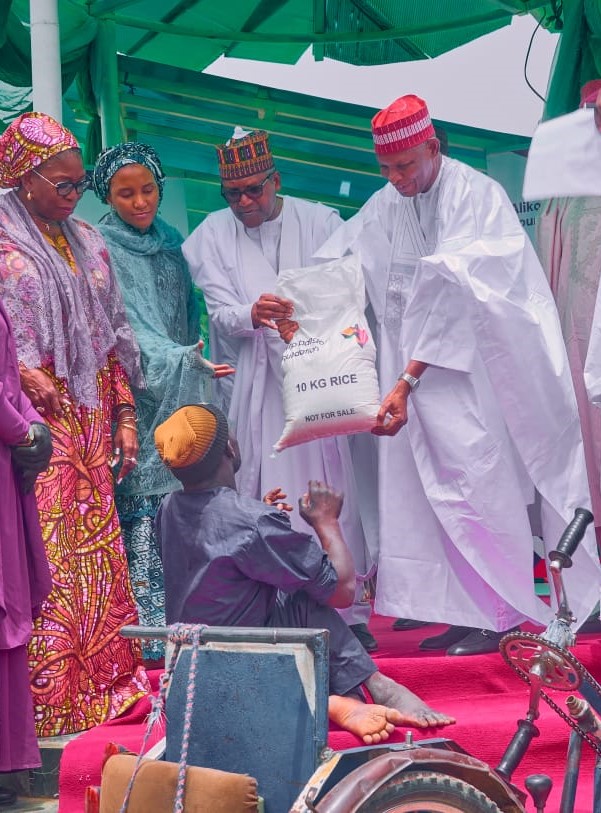
In an effort to address the pressing needs of the less privileged during these difficult times, Alhaji Aliko Dangote, the Chairman of the Dangote Group, has initiated a nationwide distribution of one million bags of rice.

The distribution began in Kano State, with 120,000 beneficiaries, and will continue throughout the country.

The rice will be disbursed in all local governments in Kano State, and the initiative will then be replicated in other states. Dangote hopes that this effort will alleviate some of the hardships faced by the poor.

The Dangote Group’s nationwide rice distribution program was officially launched at the Kano State Government House, with Alhaji Aliko Dangote himself in attendance.

The ceremony was also attended by Kano State Governor, Alh. Abba Kabir Yusuf, who expressed his gratitude for the initiative.

According to Dangote, the rice distribution aims not only to alleviate hunger in the short term, but also to invest in long-term solutions for communities across Nigeria.

The program represents a significant step towards ensuring food security and reducing poverty in the country.

“We should stand as one community, one nation, extending our hand of friendship and brotherhood,” remarked Dangote.

He also emphasized on the importance of unity and compassion during these challenging times.

“During this month of Ramadan, we are reminded of the spirit of compassion and generosity. This initiative is not just about addressing hunger; it’s about fostering a sense of communal support,” he added.

Alh. Aliko Dangote said the gesture is for 774 local governments nationwide, covering one million bags of rice, with Kano State receiving the lion’s share of 120 thousand beneficiaries

“I am confidently informing you today’s distribution is special. Despite the fact that for the past 30 years, we have been extending support to the teaming populace. We decided to come and add this project to relieve our fellow Nigerians in need.

In addition to the current rice distribution program, Alhaji Dangote informed the audience that the Dangote Group has also been providing meals for 10,000 beneficiaries daily in Kano State.

He also mentioned that the nationwide rice distribution initiative cost a total of 15 billion Naira.

Governor Abba Kabir Yusuf thanked Alhaji Dangote for his generosity and noted that the assistance comes at a critical time when many people are struggling.

He urged the distribution committees, including the HISBAH Board, to ensure that the rice reaches the most vulnerable members of society, and thanked Alhaji Dangote for his commitment to helping those in need.

Governor Yusuf stated that the gesture by Alhaji Dangote will greatly alleviate the hardship faced by the people of Kano, and noted that selecting 120,000 beneficiaries from Kano for the inauguration ceremony was significant.

Zouera Yousoufou, the Managing Director of the Aliko Dangote Foundation, also spoke at the event, highlighting Alhaji Dangote’s consistent philanthropic efforts and the critical role that the foundation plays in promoting and facilitating such initiatives.

She stated, “It is we at the Dangote Foundation who encouraged him to publicize the gesture, so others can immulate but he has been doing it for years without the left hand knowing what the right hand was given, ensuring that assistance is provided to those in need without drawing undue attention.”

The distribution of palliatives organized by Alhaji Aliko Dangote demonstrates a commitment to alleviating the suffering of those less fortunate, embodying a spirit of compassion and solidarity. It is a meaningful gesture of support for those in need.

Binance’s conflict with Nigerian authorities and troubles worldwide

By Haruna Chiroma

Binance is widely regarded as the largest cryptocurrency platform globally, facilitating billions of dollars in transactions daily. As of March 3 2024, it had over 179 million registered users across 100 countries and supported over 30 languages. Despite its prominence, this emerging financial institution operates with relatively lax oversight from financial regulatory agencies, unlike traditional financial institutions. This lack of stringent policing renders the platform vulnerable to illicit transactions. 

However, Binance also plays a significant role in fostering economic growth and providing earning opportunities for both digital natives and digital immigrants. Established in 2017, Binance rapidly gained widespread acceptance, particularly among digital natives, spreading rapidly like wildfire. 

Binance has encountered significant resistance from governments worldwide, citing concerns over its lack of transparency and regulatory issues. Numerous countries have completely banned Binance from their cyberspace, prohibiting transactions within their borders. These countries include China, Malaysia, Italy, Vietnam, the Philippines, Thailand, Australia, and several others. Despite all this, Binance is boldly embracing the wave of AI to stay competitive in the cryptocurrency market. 

The company has incorporated an AI token known as “Sleepless AI” into its platform, which is available on the Binance Launchpool. A visit to the Binance website indicates a listing of the top AI crypto tokens according to market capitalisation, with a market cap of over $7 billion and over $1.3 billion in trading volumes. 

Despite being banned from Japan, in 2022, Binance made determined efforts to re-enter the Japanese crypto market by expressing interest in acquiring Sakura, a Japanese crypto company. In another development, Binance sought a crypto license in Germany to facilitate transactions within the country’s crypto market, aiming to expand its presence across Europe. 

However, the crypto giant encountered regulatory hurdles from German financial regulators. In a prompt response, in March 2023, Binance announced the withdrawal of its license application. Following sanctions imposed on Iran, sidelining the country from traditional financial systems, Iran turned to Binance as an alternative gateway to financial institutions. Blockchain data reveals that between 2018 and 2022, Binance facilitated over $8 billion worth of transactions for Iranian firms. 

Banning Binance from a country does not necessarily prevent Binance customers from finding alternative means to conduct transactions within the banned country’s crypto market. The Wall Street Journal, published on August 2, 2022, stated that Binance successfully facilitated over $90 billion in transactions in one month within China’s crypto market. 

In the current digital age, blocking access to Binance is unlikely to be effective. Users can easily bypass restrictions by installing a Virtual Private Network (VPN) with a fleet of thousands of servers across many countries, choosing a server in a country where Binance operates, and accessing the platform with minimal effort. 

In 2021, Binance encountered regulatory challenges in Thailand, with the country’s financial authorities accusing the platform of operating without a license. This led to filing a criminal complaint against Binance with the Thai police. Later, Binance was finally banned from operations in Thailand.

Binance finds itself entangled in a legal dispute with US authorities, facing accusations of violating federal money laundering laws by neglecting to report more than 100,000 transactions deemed suspicious. Prosecutors argue that Binance serves as a prime environment for ransomware transactions (a cyberattack method that denies victims access to their computers until a specified ransom is paid via payment systems) and the exchange of payments for child abuse materials. In what appears to be an effort to resolve the matter out of court, Binance has opted for a plea bargain with US authorities. 

Under the terms of that agreement, Binance agreed to pay the US authorities a substantial fine of over $4.3 billion ($1.81 billion for criminal acts and forfeiture of $2.52 billion). Additionally, Binance plead guilty to sponsoring terrorism and involvement in money laundering. As part of the agreement, Binance has committed to operating within the legal framework and implementing monitoring mechanisms, as reported by Reuters on February 24, 2024. 

On February 24, 2013, NPR reported that the US Securities and Exchange Commission and Commodity Futures Trading Commission filed a lawsuit against Binance in court. The lawsuit was based on the absence of regulatory oversight, highlighting Binance’s operation without stringent policing akin to traditional financial institutions, artificially inflating trade volumes, and diversion of customer funds. 

Currently, Binance is engaged in a contentious dispute with the Nigerian government, which has resulted in the government blocking access to the platform. The government reportedly fined Binance a substantial sum of $10 billion, though the circumstances surrounding the fine are controversial. Users can circumvent the block by utilising a VPN, as previously discussed. Therefore, legalising and regulating the platform would be more prudent rather than the Nigerian government potentially losing billions in revenue through the backdoor. 

Given that Binance handles transactions in billions of dollars, I argue that it would be unwise to discard the benefits along with the drawbacks (“throwing a baby with the bath water”). Particularly in light of the high levels of unemployment among youths and the prevailing hardships in the country, many young people have discovered opportunities in the world of Binance. Therefore, rather than outright banning Binance from Nigeria, integrating it into its legal framework may yield better outcomes. 

As a short-term solution, Binance should be permitted to continue its operations in Nigeria under stringent control mechanisms established within the country’s legal framework, with critical oversight from entities such as the Central Bank of Nigeria (CBN), Economic and Financial Crimes Commission (EFCC), and other relevant authorities. 

For a long-term strategy, the CBN and EFCC, in collaboration with the Cybersecurity Department of the Federal University of Technology, Minna, should undertake high-impact research to be sponsored by the CBN and EFCC to develop a robust framework for regulating cryptocurrency operations in Nigeria. This framework should balance Nigeria’s legal system and economic growth objectives. 

Emphasising research and development is a globally recognised best practice for addressing societal challenges instead of relying solely on inter-ministerial committees, which may lack the necessary technical expertise, resources and research skills. 

Haruna Chiroma, Ph.D. Artificial Intelligence, wrote from the University of Hafr Al Batin, Saudi Arabia, via freedonchi@yahoo.com.

Re: CBN’s revocation of 4,173 Bureau De Change (BDC) licenses

By Rabiu Aliyu Kiru

It has been announced by the Central Bank of Nigeria (CBN) that 4,173 Bureau De Change (BDC) licenses have been revoked, while 1,368 BDCs remain valid nationwide.

In the CBN publication signed by Sidi Ali Hakama (Mrs.), she did mention a series of offenses that prompted the CBN to revoke the BDC license. Such offenses never involved more than 3,000 BDCs.

I am a professional accountant and a BDC consultant. I have consulted for over 3,000 BDCs out of the total number of BDCs quoted above, and more than half of the total number of these BDCs only engage in buying from the CBN and selling to end-users.

I am beginning to wonder how the issues of money laundering and financing of terrorism will affect such a large number of these BDCs.

Going by the CBN regulations, which were visibly stated on the Approval of Principles (AIP), there is no place mentioned on the AIP where CBN has the right to cancel a BDC License at its own discretion.

The CBN should note that owners of these BDCs have been in business for almost 10 years now, but a BDC holder pays the sum of N250,000 to CBN each year as payment for the Annual Renewal License.

The CBN should also be informed that owners of these BDCs have been in recess for almost 10 years now, yet a BDC holder pays the sum of N250,000 to CBN annually as payment for the Annual Renewal License.

Despite following the CBN guidelines, the CBN abruptly cancels a BDC holder’s license.

The CBN should also note that these BDC holders contribute to the growth of the Nigerian economy, especially by creating job opportunities and eradicating poverty among the citizenry.

In fact, I believe that with the advent of this new government, which has adequate advisers, such an action should not be taken, particularly given the high level of increase in commodity prices and other wares.

The CBN should bear in mind that the BDC owners are learned enough to fight for their rights, particularly for those that they are operating within the ambit of the law.

In my previous advice that I gave to CBN, I never presumed that such advice could not be adhered to. This made me think that I was talking to the wrong person, not to the CBN, which consists of professionals.

It is pertinent to this that I am drawing your attention once again to revisit my observations and advice I gave you directly on your CBN portal.

Rabiu Aliyu Kiru wrote from Kano State. He is a BDCs Consultant, and can be reached via rd_aliyu@yahoo.com.

Businesses you can start with less than 10K capital

By Aisha M Auyo

Introduction

With the rise in the cost of living, the removal of fuel subsidies, and other factors affecting the average Nigerian, I thought about how we could do something to augment our income. A business or service that will bring more into our account, known as a side hustle, depends on our skills and capital.

In this write-up, I will start with a business idea that requires ₦10,000 or less, and I plan to progress to a more complex skill and larger capital investment.

So, what’s a side hustle? A side hustle is an additional employment opportunity unrelated to a person’s full-time job that provides supplemental income. In other words, a side hustle is a way to earn extra income in addition to a full-time job. With the extra money, it may be easier to pay bills, contribute to savings, or assist with other expenses.

The additional income could also help turn your side hustle into a growing business. Unlike a part-time job, a side hustle usually offers more freedom and more control over what a person does, when they do it, and how many hours they devote to it.

Individuals can usually pursue a side hustle that involves their passions and talents, and some may eventually make their side hustle their primary career. If you’re interested in making extra money outside of your full-time job or want to explore a new career, consider starting a side hustle.

To pursue one successfully, it is helpful to choose the type that matches your interests, skills, and professional goals. Learning more about side hustles might allow you to earn money while doing something that engages you and gaining professional experience in a new field.

Benefits of having a side hustle

1. Gaining flexibility: Individuals typically manage the time they dedicate to their side hustle, making it easier to integrate into their existing schedule as full-time employees. By controlling their schedule, they can make their side hustle accommodate other events or commitments they have while still earning additional income. This may help them gain flexibility and maintain employment in their existing role while also pursuing their passion.

2. Improving your finances: A side hustle is a way to earn additional income in addition to a full-time job. With the extra money, it may be easier to pay bills, contribute to savings, or assist with other expenses. The additional income could also help turn your side hustle into a growing business.

3. Exploring Your Passions: One advantage of a side hustle is the opportunity to pursue a career you’re passionate about. Pursuing your passions as part of a side hustle may allow you to develop your side hustle into a career. You can also develop specific skills that may help make your side hustle successful.

In this article, I’ll discuss 16 ideas for side hustles you can try with a capital of ₦10,000 or less. They are as follows:

1. Tutor/Lesson Teacher: Many families seek extra help with their children’s schoolwork. Offering tutoring services can be a successful side hustle, and helping students can be rewarding. This side hustle may accommodate a full-time job since many tutors only work before or after school hours. I advise you to find students near your area so you can walk or commute for less than 500.

2. Babysitting: With many nursing mothers going to work or other engagements daily, the need for a babysitter has risen. Also, the lack of relatives and extended family households has given rise to mothers depending on others to help with their children. You can stay at the person’s home and look after their children, or the baby could be brought to you if you live in a baby-friendly environment.

3. Cleaner: This side hustle offers a variety of options, including cleaning residential homes and commercial businesses. Additional service options could include cleaning the interior, exterior, or both aspects of buildings. You may offer as many or as few of these services as you wish, and you could charge different prices depending on the service.

4. Car wash: Offer to wash cars in your neighborhood or find a local car wash where you can assist the owners when they’re overwhelmed.

5. Technology repairer: If you have an affinity for technology, a potential side hustle could be repairing technology. This could include fixing computers, laptops, smartphones, or tablets. These devices are a big part of many people’s lives for work and leisure, and some pay for repairs on these devices. You may have the option to control how these repairs come to you, such as having them sent through the mail, having clients bring them to you, or picking them up yourself.

6. Rental property manager: If you own a residential or commercial space, renting it out could be a successful side hustle. Whether you rent it out short-term or long-term, and for businesses or vacations, there are many options and potential clients. You can either advertise on your own or use real estate sites or companies that can help you reach potential renters.

7. Personal trainer: Helping others reach their fitness goals can be a very rewarding side hustle. You can maintain a schedule of clients around your availability, and you could work at a public gym or park your facility if you have one. There are certifications and licenses you may be interested in earning as you enter this job field.

8. Tailoring: If you have experience in tailoring and sewing, another side hustle could be doing alterations. This is when a customer visits a tailor to have their garments altered to fit their bodies. A common example is wedding dresses, as many brides order dresses and have tailors alter the dresses to their exact measurements.

9. Plaiting hair: If you have the skill of plaiting hair, you can do this in your free time. If customers aren’t coming, you can offer to do home service in your neighborhood or places not far from your area. Home service also allows you to meet others who might want their hair done.

10. Henna design: In this era of women wanting to look their best, henna design has come to stay. Women want to adorn themselves with this natural product. If you have the skill of either red henna, dye, Rani, or Sajem design, offer to do it at your place or provide home services. These things sell and don’t cost a lot.

11. Manicure and pedicure: Working-class women and men want to pamper themselves and look their best. So, getting their nails, feet, and toes done is something they will need. The tools for this service may not cost up to 5k. Also, home service will work just as well if one doesn’t have space.

12. Roasting corn/plantain/yam: This business is ubiquitous, yet we can’t get enough of it. Try roasting on the roadside along a busy route in your area when you are free. Buying corn, plantain, or yam for a start-up won’t cost more than 2k, then add coal and a rack for roasting.

13. Making snacks: Making small chops or snacks for events or daily for schoolchildren and workers is another way to get a steady income. Parties and social functions are always coming up. You can even offer a home service where the client buys all the ingredients, and you make the snacks for them to refrigerate.

14. Selling drinks/Zobo/kunun aya: Depending on the weather, cold drinks always sell. But with the advent of health awareness and the vices of carbonated drinks, people are opting for natural drinks. Nonetheless, one can combine natural and carbonated drinks in a bucket with ice. This will cost less than 10k.

15. Selling fruits and vegetables: Fruits and vegetables are always needed, and not everyone has the luxury of going to the market or store every day. So, bringing these to their location will always be welcome, from cucumbers, bananas, plantains, peppers, carrots, or onions. One can always get a customer needing one of these.

16. Online advertisements: If you are an internet user, you can help with social media posting or managing business accounts. You can take videos or pictures of items and advertise them, then get paid for your efforts. If you have many contacts on WhatsApp, you can advertise products and services on your status and get paid for doing so.

Which of the above businesses sounds appealing or doable to you? Is this feature helpful? In what ways? Please share your thoughts with us.

Aisha Musa Auyo is a doctoral researcher in educational psychology, a wife, a mother of three, a homemaker, a chef, and a parenting/relationship coach. She can be reached via aishamuauyo@live.co.uk.


For 17 years, Apple has been the most admired company globally—Fortune

By Sabiu Abdullahi 

In Fortune’s annual ranking of the world’s most esteemed companies, Apple has reaffirmed its supremacy, claiming the top spot for an impressive 17th consecutive year.

The comprehensive list, featuring 1,500 companies boasting revenues exceeding $10 billion, highlights Apple’s unwavering influence in the corporate realm, albeit with a marginal dip in its overall score from the previous year. 

Fortune meticulously curated the elite selection, narrowing down the contenders to 680 companies.

A discerning panel, comprising 3,700 executives, directors, and analysts, meticulously assessed each company across a spectrum of categories, ranging from investment value to social responsibility. 

Despite a modest decrease in its score, Apple continued to shine, securing the foremost positions in critical categories such as social responsibility, financial soundness, innovation, and global competitiveness.

Microsoft, on an upward trajectory this year, clinched the second spot with a notable triumph in the computer software industry.

Amazon, though sliding one place, maintained a strong presence with commendable scores in internet services and retail, securing its position in the top three. 

Apple’s consistent reign atop Fortune’s Most Admired Companies List underscores the company’s enduring commitment to excellence and innovation.

This accomplishment speaks volumes about Apple’s ability to navigate a dynamic business landscape while upholding unparalleled standards.

Skills acquisition and the rise of Arewa female entrepreneurs

By Aminu Mohammed

The article was inspired by a video on Nelly Agbogu’s Facebook page, also known as Naijabrandchick. In the video Aisha Falke of Northern Hibiscus created, she urged female vendors in the Northern region to take advantage of the NBC Trade Fair, scheduled to be held in Kano on February 4, to showcase their products to potential buyers.

This caught my attention, and I scrolled through Nelly’s Facebook page to learn more about the programme. I was impressed by the quality of content and creativity displayed by different female vendors from the North. They were soliciting for patronage of their products during the forthcoming trade fair. I was pleased to see that many young female entrepreneurs from the North are now engaged in small businesses and have embraced the spirit of self-reliance.

I also observed the activities of many northern female vendors on Instagram, TikTok, and Facebook, such as Maryam Gatawa and Aisha Abubakar. These vendors sell items ranging from well-packaged local food to products consumed by people every day.

Growth of Female Entrepreneurs

I am impressed by Maryam Gatawa’s sale of many of our local food items, such as beef jerky, powdered garlic and date, garin kunun tsamiya made from powdered millet, and garin dan wake (bean dumplings), all of which are well-packaged. This surge in the number of young women engaged in various businesses gladdens my heart and is an indication that things are changing in the north, unlike before. I am still using the bean dumplings I bought during my visit to Nigeria last year.

Some northern female entrepreneurs, such as Aisha Falke and others, have encouraged Arewa women to start small businesses by organising workshops, seminars, and training in Abuja, Kaduna, and Kano. However, more needs to be done to encourage our women to imbibe the spirit of self-reliance.

I have always encouraged my younger sisters to engage in small businesses. They are all engaged in small businesses and other activities that earn them money. There is nothing like financial independence and the ability to take responsibility for one’s life by involving oneself in a productive venture.

Small-scale and medium businesses are critical for the growth of any economy, as they employ one or more people and create jobs. Encouraging many young people to pursue entrepreneurship for their economic emancipation is vital. Any activity that generates income and enables one to earn a livelihood should not be looked down upon. You cannot escape poverty when you are not willing to do the so-called “dirty jobs”.

Need for Change in Mindset

It is essential to note that the North is currently facing a dire situation due to the mindset of its people. The youth must change their mindset about salaried jobs and embrace entrepreneurship. Over-reliance on government jobs has made things worse for us and led to the region’s retrogression. We cannot move forward as a society when most youths do not want to engage in small businesses or trade to earn a livelihood. Most of our graduates look down upon people doing vocational skills while roaming the streets looking for jobs. They prefer to remain idle rather than engage in a vocational skill.

The progress and development of the North depend on a productive population skilled in various aspects of human endeavour. We cannot make meaningful progress when most youths who graduate from university brandish their certificates without any skills to help them survive. It is vital to acquire both education and skills to survive in the new economy. I have spent money to acquire digital marketing skills despite my academic qualifications.

I still reiterate that the Northern youth should focus on acquiring digital skills, and those not interested should learn vocational skills. Stop dwelling in the past and embrace change. The era of looking for public sector jobs is over. The economic situation in Nigeria, which has been worsened by inflation and stagnant income, warrants the need for young men to engage in small businesses to earn a livelihood.

I have a nephew, Kabiru, who graduated from Bayero University Kano a few years ago. He decided to take the bull by the horns after the service year to learn furniture making rather than roam around looking for a job. Kabiru is now fully engaged in furniture making and has four employees who support him in his shop. I gave him a job to do for me during my visit to Nigeria last year, and he executed it to my satisfaction. Today, Kabiru is doing very well in his vocation, while some of his friends are still searching the streets for jobs.

Of course, not everyone can be an entrepreneur or run a small business, but we cannot continue to cling to the past and expect any progress in our region. Our young men should stop wasting time chasing certificates without commensurate skill. They should stop waiting for their relatives to help them secure government jobs as they are no longer tenable.

Necessity of Skill Development 

There are several free resources available on platforms such as YouTube, Google, Coursera, Udemy, Simplilearn and others, which can be used to learn a variety of skills like digital marketing, data science, web development and more. Those not interested in acquiring such skills must focus on vocational skills like fashion designing, furniture making, baking, plumbing, etc. Those who have the financial resources can also consider small-scale businesses or farming.

We must encourage our women to engage in entrepreneurship and strive to acquire education and critical skills that can help them manage their businesses better. We cannot afford to have many ignorant and unproductive people in our society. It is important to promote girl-child education and discourage the Almajiri system. We cannot have millions of children roaming the streets without proper education that will enable them to live a productive life.

As January 2024 draws close, our youth should wake up and become more productive. Instead of wasting their time sitting under trees with friends in their neighbourhood during productive hours, they should go and learn a skill or trade that can enable them to contribute to the economy of their community. I wish you the best of luck as you strive to improve your life.

Aminu Mohammed wrote this article from Ingolstadt-Bayern, Germany. He can be reached at gravity23n@gmail.com.

How investing in shares, mutual funds can help you become financially independent

By Aminu Mohammed

The inspiration for this article came from a short Facebook post by Bashir Abubakar Gazaki, who advised young people to invest their money in shares of good companies to attain financial independence. His followers’ lack of financial awareness caught my attention, as evidenced by the comments below the post, where many people asked him to explain the stock market. 

It is not surprising that personal finance is not taught in universities. I learned about stock investments through books such as “The Richest Man in Babylon” by George Samuel Clason, “Rich Dad Poor Dad” by Robert Kiyosaki, and “Rich Dad’s Guide to Investing: What the Rich Invest In That the Poor and Middle Class Do Not.” I read these books shortly after graduating from Ahmadu Bello University, Zaria. 

The books gave me insight into why some people, despite working for many years, still struggle in life. The inspiration from these books led me to purchase my first share during my service year in Adamawa state. Similarly, a fellow corps member from the southwest who knew the stock market advised me to invest in good companies.

Invest money in assets Instead of liabilities 

Investing your time actively and your money passively is an excellent way to secure your financial future. Passive income refers to the money you earn from your assets, such as property, shares, mutual funds, Treasury bills, etc., while you sleep. Unlike your job, assets generate income for you, whether you work or not. So, it’s crucial to avoid wasting your money on liabilities and start investing in assets.


If you earn a salary or own a business, it is best to save at least 10 per cent of your income and invest it wisely. Investing in shares doesn’t require a large sum of money. Suppose you know about stock trading. In that case, you can invest in the United States stocks or the Nigerian stock market, even if you start small with a low amount.


However, it is understandable that many individuals are scared of investing their money in the stock exchange, given the capital market crisis in 2008, where several people lost a significant portion of their funds. I have experienced losses in the stock market myself, particularly with the shares I bought in the defunct Oceanic Bank and Bank PHB. But I have also gained from stocks like Dangote Sugar, GTBank, and Zenith Bank. Life is all about risk; sometimes, we win, while other times, we lose due to unforeseen circumstances. But that shouldn’t stop us from exploring new investment opportunities, no matter how little.

Investigate companies before Investing

Investing in the stock market is a business that requires a long-term strategy and patience rather than a quick way to get rich. Having a good understanding of the companies you invest in is crucial. According to Warren Buffet, the Chairman of Berkshire Hathaway, one of the most successful investors in the world, the best way to achieve greater rewards is to think long-term. Buffet recommends holding stocks for at least five to 10 years to accumulate wealth. However, some traders still profit by trying to beat the market daily.


If you are hesitant about investing directly in stocks, you can consider mutual funds, designed for people who want to minimise risk but have lower returns. You can contact your local banks, such as First Bank, GTBank, UBA, Stanbic IBTC, and others that offer asset management services. These companies manage various types of mutual funds under the guidance of experts.


As a salaried worker, unforeseen circumstances such as job loss or a downturn in business can be devastating. Therefore, it is important to have a safety net in the form of investments to help you recover in case of any unforeseen circumstances.

Consult a stock broker before buying any Shares

It is important to conduct thorough research and seek expert advice before investing in shares. Look for stocks with strong fundamentals and invest in them wisely. Diversifying your investment across different sectors and companies is recommended to maximise your returns.

It is crucial to emphasise that individuals with little knowledge about the stock market should educate themselves on basic financial concepts before investing in shares. The companies mentioned in this article are for illustration purposes only and to encourage young people to take control of their financial future through smart investments. Investing in shares is not a quick way to get rich, and seeking professional advice before investing is highly recommended.

I wish you the best as you strive towards financial independence and personal growth.

Aminu Mohammed wrote this article from Ingolstadt, Germany. He can be reached at gravity23n@gmail.com.