Month: March 2025

Insecurity: Senate summons NSA, security chiefs over insecurity

By Anwar Usman

The Nigerian Senate has again summoned all security chiefs to appear before the house next week over the rising insecurity bedeviling the country.

Those summoned include the National Security Adviser, Nuhu Ribadu; Chief of Defence Staff, General Christopher Musa; Chief of Army Staff, General Olufemi Oluyede; Chief of Naval Staff, Vice Admiral Emmanuel Ogalla; and Chief of Air Staff, Air Marshal Hasan Abubakar.

Other security agencies are the Inspector General of Police, Kayode Egbetokun, Director General of National Intelligence Agency, Mohammed Mohammed, and the Director General of Department of State Services Adeola Ajayi.

The president of the Senate Godswill Akpabio, while speaking during Wednesday’s plenary, said the service chiefs were initially invited but could not attend due to scheduling conflicts.

He stated that the rescheduled meeting next week will centered on deliberating on critical security issues inorder to proffer urgent solutions.

The Senate also raised serious concerns over allegations that certain international agencies may be financing the Boko Haram insurgency.

On February 19, security chiefs were summoned to explain allegations that the United States Agency for International Development was linked to funding Boko Haram and other terrorist groups in Nigeria.

The meeting will look into these claims among others, address Nigeria’s broader security challenges, and shape policy responses.

NAHCON, Flynas sign agreement for 2025 hajj airlift

By Uzair Adam

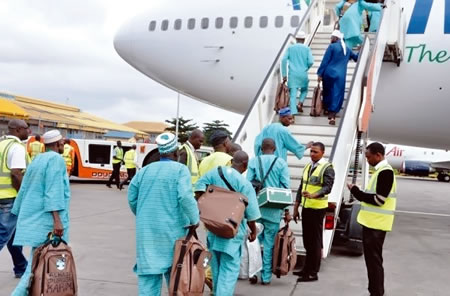
A Saudi-designated Nigerian Hajj air carrier, Flynas, has formalized an agreement with the Nigerian government for the airlift of pilgrims for the 2025 Hajj operations.

The National Hajj Commission of Nigeria (NAHCON) has announced that the transportation of Nigerian pilgrims to Saudi Arabia will commence on May 5, 2025.

The agreement was signed on Monday at NAHCON’s headquarters in Abuja by the Chief Commercial Officer of Flynas, Mr. Khaled Alhejairi, and the commission’s Chairman and CEO, Professor Abdullahi Saleh Usman.

Present at the signing were Flynas’s Director for Business Development, Mr. Yasser Ajlan, Manager of Business Development, Mr. Hani Isma’il, and the Managing Director of First Planet Travels and General Sales Agent (GSA) of Flynas in Nigeria, Alhaji Umar Kaila.

Mr. Alhejairi reaffirmed the airline’s commitment to maintaining high service standards for Nigerian pilgrims, stating that Flynas has consistently fulfilled its obligations since joining the Nigerian Hajj operations in 2014.

“We want to assure NAHCON that Flynas will continue to provide comfortable and seamless travel experiences for our esteemed customers in Nigeria during the Hajj operation,” he said.

In January, NAHCON approved four airlines—Flynas, Air Peace, Max Air, and Umza Aviation Services Limited—for the 2025 Hajj operations. Among them, Flynas, the most experienced, has successfully transported Nigerian pilgrims for the past decade.

For the 2025 Hajj, Nigeria has a projected quota of 71,274 pilgrims, with NAHCON preliminarily allocating 22,894 pilgrims to Flynas, 9,145 to Air Peace, 23,342 to Max Air, and 15,893 to Umza Air.

Flynas, which operates in Nigeria under the Bilateral Air Services Agreement (BASA) between Nigeria and Saudi Arabia, has played a key role in stabilizing airlift operations for Nigerian pilgrims while expanding the capacity of its workforce.

Wike calls for Fubara’s impeachment amid political unrest in Rivers State

By Abdullahi Mukhtar Algasgaini

Nyesom Wike, the Minister of the Federal Capital Territory (FCT), has weighed in on the ongoing political tension in Rivers State, urging that Governor Siminalayi Fubara should be impeached if there is a legitimate reason.

During a live media chat on Wednesday, Wike expressed his frustration with the current state of affairs, emphasizing the importance of adhering to the rule of law and accusing the governor’s close associates of exploiting him and the state.

Wike stressed that lawmakers should not be pressured into a hasty impeachment, adding, “If he has done something to be impeached, let them impeach him. It’s not a criminal offence.”

He also took issue with the idea that a small group of lawmakers could enact laws that could later be challenged in the Supreme Court.

The Minister reflected on his own experience with the political landscape, highlighting a situation where elder statesman Ferdinand Alabararba had strongly supported the rise of an Ijaw governor, only to be later disrespected by the very individual he helped.

Wike expressed disbelief at the political gamesmanship, and criticized the tendency of some to treat elected officials as subordinates.

Wike also criticized the Pan Niger Delta Forum (PANDEF), calling it the “worst organisation” he had encountered, accusing it of attempting to undermine President Bola Tinubu’s mediation efforts.

In a controversial statement, Wike also weighed in on the issue of Ijaw representation in the Niger Delta, declaring that the Ijaw people do not constitute the majority in the region and stating that Ijaw men should only govern in Bayelsa.

MSSN-ABU expresses sorrow over kidnapping of its member, calls for prayers

By Hadiza Abdulkadir

The Muslim Students’ Society of Nigeria (MSSN), Ahmadu Bello University (ABU), Zaria, has expressed deep sorrow over the tragic kidnapping of one of its members, Abdussalam Rabi’u Faskari, a 300-level MBBS student. 

The incident, which also involved two members of his family, occurred as they traveled home from the Government House of Katsina State.

Abdussalam, known for his academic excellence and deep religious commitment, is not just a promising medical student but also an accomplished Islamic scholar. 

He is an Imam at the College of Medical Sciences mosque. He also secured the first position in the 60Hizb category at the last National Musabaqa (Qur’anic competition).

The MSSN community, along with the wider Muslim ummah, is now calling for fervent prayers for his safe return, as well as for other victims of similar tragedies. 

The statement from MSSN urged all students to remain steadfast in their faith, emphasizing that “with hardship comes ease” (Qur’an 94:6).

This unfortunate event is part of the growing security crisis affecting Nigeria, where kidnappings for ransom have become alarmingly frequent. 

Calls for more decisive government intervention and lasting security solutions continue to mount as families and communities grapple with these distressing incidents.

Hey, Nigerian Christians, it’s time to stop the bigotry

By Ammar M. Rajab

The recent uproar among some Nigerian Christians over the decision by the states of Katsina, Kebbi, and Bauchi to close schools for the holy month of Ramadan serves as yet another reminder of the deep-seated prejudice that certain Christians in Nigeria have toward anything associated with Islam and Muslims. This decision to observe the holiday is neither new nor illegal; it is well within the rights of these states, just as Christian-majority states regularly declare holidays during Christian celebrations.

Let me be clear — the schools are not closing arbitrarily. This decision is part of the officially approved academic calendar and coincides with the globally recognized Islamic holy month. Ramadan is not just about fasting; it is a profoundly spiritual time when Muslims dedicate themselves to prayer, charity, and community service. In a region where the vast majority are Muslims, it is reasonable to make space for religious observance. Why, then, does this simple act provoke such unnecessary outrage from some Christian voices?

This hypocrisy becomes even more pronounced when one considers that Christian-majority states have done the same, if not more. Just a few months ago, in December 2024, the Governor of Benue State, Hyacinth Alia, declared a two-week holiday for civil servants to celebrate Christmas and New Year. Nobody raised an eyebrow. This is not unusual.

Cross River State has also been declaring extended holidays for Christmas and the famous Calabar Carnival since 2004. These are Christian holidays observed in Christian-majority states, and nobody labels it religious bigotry. But when Muslim states exercise the same right, it suddenly becomes a national scandal. Why the double standard?

This selective outrage reflects the deep-seated bigotry that some Nigerian Christians have toward Muslims. Any policy, tradition, or cultural expression associated with Islam is instantly deemed backward, oppressive, or indicative of religious dominance. In contrast, similar practices from Christian communities are regarded as cultural pride and religious freedom. Why this hypocrisy? Why the persistent anger whenever Muslim states make decisions that align with their people’s beliefs? What exactly is the issue?

Enough is enough. Nigerian Muslims are not second-class citizens. The constitution guarantees freedom of religion and allows states to make decisions that reflect their people’s cultural and religious identities. If Christian states can observe Christian holidays without controversy, then Muslim states can observe Islamic holidays without needing to apologize to anyone. No group has a monopoly on public holidays, religious expression, or cultural identity.

It’s time for Nigerian Christians who participate in this unnecessary provocation to cease this religious bigotry. Live and let live. Respect the rights of others just as you expect your own rights to be respected. Nigeria is a multi-religious, multi-ethnic country, and it can only thrive when we all honour each other’s beliefs and traditions.

If you can celebrate Christmas and Easter with state-backed holidays in Benue, Cross River, and many other Christian-majority states, then Muslims can celebrate Ramadan in their own way as well. Anything less is not just hypocrisy—it’s outright bigotry. And it’s time for all of us to say: enough is enough.

Ammar M. Rajab wrote from Kaduna, Nigeria.

Meningitis outbreak claims 26 lives in Kebbi

By Uzair Adam

The Kebbi State Government has confirmed the death of 26 people following a suspected outbreak of cerebrospinal meningitis in three local government areas—Aliero, Gwandu, and Jega.

Addressing journalists in Birnin Kebbi on Tuesday, the Commissioner for Health, Alhaji Musa Ismaila, said the outbreak had led to an unusual rise in cases, with symptoms including fever, severe headache, neck stiffness, stomach pain, vomiting, diarrhea, and sensitivity to light.

“In week seven, we recorded a surge in cases, prompting investigations. A total of 248 suspected cases were identified, and 11 samples were sent to the National Reference Laboratory in Abuja for confirmation. While two samples—one from Jega and another from Gwandu—tested negative, results for nine others are still pending,” he said.

The commissioner provided a breakdown of fatalities, stating that Gwandu recorded 15 deaths, Jega had six, Aliero reported four, while one person died in Argungu.

He further disclosed that advocacy efforts had been carried out in collaboration with the World Health Organization (WHO), Médecins Sans Frontières (MSF), and the United Nations International Children’s Emergency Fund (UNICEF).

To contain the outbreak, the state government has allocated N30 million for the purchase of drugs and other medical supplies. Isolation centers have been set up in the affected areas, and essential medical commodities have been distributed to support treatment efforts.

Ismaila urged the public to adhere to health guidelines and report any suspected cases to the nearest health facility for prompt intervention.

Panel probes alleged corruption among senior correctional officers

By Uzair Adam

The special independent investigative panel set up to examine allegations of corruption and other violations by senior personnel of the Nigerian Correctional Service (NCoS) has commenced its probe.

Dr. Uju Agomoh, the panel’s secretary and chair of the session held on Tuesday in Abuja, stated that several cases under investigation involve high-ranking officers overseeing custodial centers across the country.

These cases reportedly include corrupt practices, abuse of authority, and mistreatment of inmates.

Agomoh explained that the panel has been tasked with conducting a comprehensive inquiry into specific allegations and recommending immediate reforms to prevent future misconduct while improving correctional services in Nigeria.

“Recent reports highlight instances of corruption, torture, cruelty, and degrading treatment within the nation’s correctional facilities,” she said.

“These violations undermine the rights and dignity of individuals in custody.”

The panel is expected to propose short-term, medium-term, and long-term measures to address the concerns raised.

The Daily Reality learned that the Minister of Interior, Dr. Olubunmi Tunji-Ojo, established the investigative panel following widespread controversy surrounding the incarceration of cross-dresser Idris Okunneya, popularly known as Bobrisky.

Additionally, the panel is examining allegations of corruption and extortion against the head of Kuje Custodial Centre, Iloafonsi Ikechukwu, who has been accused of intimidating, threatening, and defrauding an inmate.

‘Nasir El-Rufai’ game has commenced

By Zayyad I. Muhammad

The 2027 game will not only be interesting but will also mark a significant turning point in Nigeria’s political landscape. The voting patterns and intricate scheming that shaped the 2023 elections will not be replicated in their exact form, yet their influence will still be felt. While the key political figures who played major roles in 2023 will remain central to the unfolding drama, they will adopt new strategies, shift alliances, and engage in different forms of political maneuvering.

The battle for power will be defined by strong political platforms, influential players, a formidable war chest, scientifically crafted strategies, and carefully calculated negotiations. The presidential race, in particular, will be a high-stakes contest, shaped by a mix of ambition, ideological shifts, and pragmatic political decisions.

An incumbent seeking a second term will be a bulldozer—with an enormous war chest, a solid structure, and the full weight of state power behind them. President Bola Ahmed Tinubu will fight tooth and nail to secure reelection, as mostly, any first term president will do so. However, the APC stronghold – the North, is gradually slipping from the party’s grasp. In fact, 75% of President Tinubu’s second-term resources and energy will be expended in the North—making it a crucial battleground for his team. If the Tinubus have played their card very well, the North would have been firmly in the arms.

The North will be the main battleground, while the Southwest will find itself in a dilemma—torn between supporting their own and upholding their deep-rooted tradition of rewarding excellence. The Southeast will watch from the sidelines with arms akimbo but will ultimately follow their hearts, while the South-South may take a more indifferent stance, adopting a “let’s just move” attitude.

The recent resignation of Nasir El-Rufai from the All Progressives Congress (APC) and his defection to the Social Democratic Party (SDP) is just one of many major developments that will reshape the political terrain in the coming months and 2027 approaches. El-Rufa’i’s early defection serves as a catalyst for the unfolding political drama. The Tinubu team is fortunate to have this early warning, giving them ample time to strategize. Meanwhile, the opposition will be on the offensive, while the APC will be forced into a defensive position.

For the opposition, the biggest challenge will be balancing the interests of four key groups: the Atiku camp, the Kwankwaso camp, the Peter Obi camp, and the El-Rufai/Buhari former ministers’ camp. They must navigate these competing interests carefully if they hope to strike the winning formula.

As political camps solidify and realign, new alliances will emerge, while old ones will fracture under the weight of conflicting interests. The electorate, too, will evolve—demanding more from their leaders and scrutinizing candidates beyond party affiliations.

Ultimately, the 2027 game will be a masterclass in political strategy and power dynamics—one that students of politics, analysts, and observers alike will find fascinating to study for years to come.

Zayyad I. Muhammad writes from Abuja, zaymohd@yahoo.com, 08036070980

Minister opposes closure of schools for Ramadan fasting

By Sabiu Abdullahi

The Minister of State for Education, Suwaiba Ahmad, has called on the governments of Bauchi, Katsina, Kebbi, and Kano states to reconsider their decision to close public schools during Ramadan.

She stated that no Muslim-majority nation follows such a practice.

Speaking on Channels Television’s Political Paradigm, Ahmad emphasized that even in countries where Islam is the dominant religion, schools remain open during the fasting period.

“In each state, the education system is under the state level, and they have the right to make decisions. However, we can only engage them and present our position on the matter,” she said.

She further argued that Islamic teachings do not require schools to be closed for fasting.

“Even in countries recognized as Muslim nations, like Saudi Arabia, schools remain open during Ramadan. There is nowhere it is written that you must shut down schools because of fasting,” she stressed.

To support her argument, she referenced Islamic history.

“The Prophet (S.A.W) even went to war during Ramadan, so it is not something that should hinder education,” she noted.

Ahmad expressed concern over the academic time lost due to the closures.

She also revealed that the Federal Ministry of Education is engaging with the affected states to address the issue.

“What about the period that will be lost? This is something we are looking into as we continue discussions with the state governments,” she said.

The decision to close schools for Ramadan has sparked debates among education stakeholders.

Some argue that it is unnecessary, especially in regions already struggling with high levels of poverty and illiteracy.

The Christian Association of Nigeria (CAN) has criticized the move, describing it as discriminatory and a violation of the rights of non-Muslim students in the affected states.

Similarly, the National Association of Nigerian Students (NANS), through its National Public Relations Officer, Samson Adeyemi, has condemned the decision, calling it an infringement on students’ right to uninterrupted education.

However, the Supreme Council for Shariah in Nigeria (SCSN) has defended the action taken by some northern state governments.

Mass exodus reportedly hits Kaduna APC after El-Rufai’s defection

By Sabiu Abdullahi

A wave of resignations has struck the All Progressives Congress (APC) in Kaduna State following the departure of former governor Nasir El-Rufai from the party.

Multiple resignation letters obtained on Monday indicate that several APC members, particularly those loyal to El-Rufai, have been leaving the ruling party in large numbers.

This development comes just hours after the former governor publicly announced his defection to the Social Democratic Party (SDP).

Similarly, some former commissioners who served under El-Rufai have also withdrawn their membership from the APC.

Among them are Ja’afaru Ibrahim Sani, a former Commissioner for Local Government, and Hajiya Hafsat Mohammed Baba, who previously oversaw Human Services and Social Development.

Both submitted their resignation letters to their respective ward chairmen on Monday.

In his letter, Sani expressed disappointment with the way the party leadership treated its members.

He stated, “With the hatred and disdain shown to us by the leadership of the party we worked hard to nurture, it has become compelling to seek another platform in our desire to bring development and prosperity to our dear people.”

He further explained that after consulting with key stakeholders in Anchau, Kubau Local Government Area, and Kaduna State, he decided to leave the APC immediately.

“As I move on, I remain grateful to you and to all members of the APC, as well as the electorates in the Ward, Kubau Local Government Area, and the State for the support rendered to me as Chairman of the APC Stakeholders, Kubau LGA,” he added.