Month: July 2023

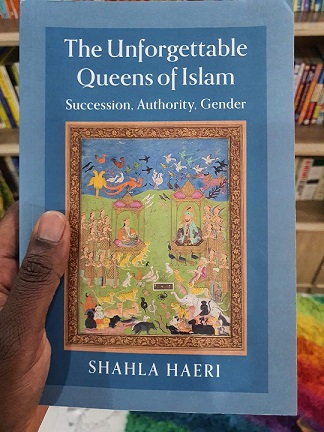
Book Review: The Unforgettable Queens of Islam

By Dr Shamsuddeen Sani

It’s very easy to ignore this book. Underrate it even. I found myself rereading it for many days, given the enormous importance of the topic, especially in the contemporary discourse in Muslim-majority countries about woman’s leadership. Being a recent publication in 2020, and although the author didn’t explicitly state it, it appears to be building to improve upon earlier work by the late Moroccan feminist writer and sociologist Fatima Mernessi with her book, The Forgotten Queens of Islam.

Shahla Haeri embarks on a journey of gendering the historical narrative of sovereignty and political authority in the Muslim world, shedding light on the lives of Muslim women leaders who defied the norms of dynastic and political power to rise as sovereigns in their deeply patriarchal societies.

The author’s usage of the term “queen” is not meant to be taken literally for all six prominent figures discussed in the book but rather to signify their immensely influential leadership roles during their respective eras. While recognising the significant impact of numerous women in Islamic history who exerted influence behind the scenes, Haeri emphasises those women who stood at the forefront of the political machinery, actively engaging with the structures of authority and power.

She doesn’t just relay the historical milestones of these great women in historical Islam but brings in a fresh perspective on how we look at the concept of women’s leadership in the Islamic tradition. The author situates women rulers’ rise to power within three interrelated domains: kinship and marriage, patriarchal rules of succession, and individual women’s charisma and popular appeal.

This book prompts deep contemplation on patriarchy within the pre-modern normative Islamic tradition. But one needs to be careful because the author appears to be overly problematising patriarchy in some instances significantly beyond what we consider as would have been normal in pre-modern Islam. She did allude, however, to the critical role of men in women ascending to positions of political authority. 

Structurally, this book has a Preface and Introduction and is broken into three main parts with two body chapters. Part I, Sacred Sources of Authority: The Qurʾan and the Hadith, lays the background for her accounts, with a deep examination of the primary sources of the Qurʾan and hadith, through the Qurʾanic story of the Queen of Sheba and the biography of the Sayyida Aisha (RA). Haeri relays the Quranic account of the dramatic encounter between King Solomon and the Queen of Sheba, popularly known as Bilqis. Drawing primarily from Tha’alabi and al-Tabari, the book cross-examines the sovereignty of Bilqis and connects the Quranic revelations with what she believes was the exegetes’ medieval patriarchal reconstructions.

Part II of the book is about Medieval Queens: Dynasty and Descent. In Chapter 3, the book explores the leadership life of the long reign of the Ismaili Shiite Yemeni queen. It examines Queen Arwa’s fascinating political acumen and how she survived the political and power succession tussle dealing with the 3 Fatimid caliphs of Cairo. Chapter 4 examines the short sovereign rule of the only female sultan of the 13th century Delhi Sultanate, Razia Sultan: ‘Queen of the World Bilqis-i Jihan. 

The 3rd part of the book, which explores the contemporary Queens and examines the institutionalisation of succession, provides an in-depth look at Benazir Bhutto and Megawati Sukarnoputri but will not spoil more here for the interesting details in the book.

Haeri concludes this work of ethnohistory which is deeply personal as she peppers in the concept of the “paradox of patriarchy,” which refers to the historical tradition of power succession among men, particularly fathers and sons, or even brothers, whose family ties legitimise the customary transfer of power. She quickly alludes that the relationship between fathers and sons can be a source of tension and rivalry, where they may fear, resent, or even seek to eliminate each other. In contrast, father-daughter relationships tend to be more personally fulfilling and have fewer political consequences for the father. The preference of patriarchs for their daughters is not only driven by self-preservation but also by their recognition of their daughters’ talents and political astuteness.

Dr Shamsuddeen Sani wrote from Kano. He can be reached via deensani@yahoo.com.

Demons called phone-snatchers

By Sulaiman Maijama’a

In recent times, the most vicious of all vices in our society is phone snatching. This dastardly act is perpetrated by gangs of youth of 15 to 25 years who carry weapons and terrorise people. Sometimes, these youth injure their victims or even stab them to death.

This evil act usually is plotted and carried out at night, but sometimes, in broad daylight, the youth disguise themselves as tricycle operators and unleash their cruelty against people. There is hardly a week that would pass on without a report of a victim of phone snatching.

This activity becomes a nightmare for people and poses a great threat to the freedom of movement of innocent citizens, making it difficult for them to go about their everyday business, especially at night, without the fear of being attacked by phone snatchers.

It is common knowledge that phone snatching continues to be pervasive in different states of the North. It assumes a higher degree in states like Kano, Bauchi, Plateau, and Gombe.

The nefarious activity can be directly or indirectly attributed to a lack of proper parental care and broken homes. The youth who lack good parental care or come from broken homes usually move with the wrong people, and their movements are not queried or followed up, thus having the freedom to do anything without being probed.

Peer pressure is another cause of youth involvement in social vices. The youth who spend more time with their friends easily get influenced due to their weak nature and tender age.

Youth have a high level of curiosity to learn, have fun and practice new things, thus making them deviate. And as the saying goes, “Show me your friends, and I will tell you who you are” The significance of friends and how they influence lives is so enormous that many youths were conscripted into phone snatching.

Parents’ negligence also makes the wards turn to their friends for love, emotions, care, and advice, who can lure them into deadly acts. An abandoned child can look up to their friends for love and affection. Some maids, house helpers, and family members who are always around children without parents can introduce these vices to them.

Not only that, but unemployment has also added intensity to immorality that graduates to this monster called phone snatching that threatens the social well-being of the people. 

According to the report by a Global consulting firm KPMG, titled “Global Economic Outlook”, Nigeria’s unemployment rate was projected to rise further to 40.6 per cent this year. This revelation is alarming and must be uppermost in the mind of every responsible citizen. “An idle mind”, as an adage says, “is a devil’s workshop”.

Drug abuse is another social determinant. Despite the pronouncements of the efforts by the National Drug Law Enforcement Agency to curb the menace, the percentage of drug abusers is on the rise, and they quickly and freely access the hard drugs of their choice. This allows the youth to be intoxicated before they carry out their devilish act of phone snatching.

It is pertinent that all stakeholders should rise against social vices. Youth that engage in these dangerous acts need help, advice and rehabilitation for the addicted ones.

Parents need to know their children’s friends, status, and other people the children associate with. This is majorly the role parents should play in their children’s lives. Mothers should, in particular, be close to their children. Close monitoring and time should be given to children by parents. Children should be taught the moral values that might help shape their cognitive abilities.

The media ought to be playing their roles of education and information by organising forums to enlighten people about the dangers associated with social vices. Similarly, they should be playing surveillance by warning early on of any potential danger.

Security operatives, government and all stakeholders must be active and alert to caution, rehabilitate or punish (where necessary) any person seen as a threat to others.

All hands must be on deck to combat the menace of phone snatching in our societies.

Maijama’a wrote from the Faculty of Communication, Bayero University, Kano. He can be contacted via sulaimanmaija@gmail.com.

Abdulaziz Abdulaziz appointed as a media aide to President Tinubu

By Muhammad Sabiu

Abdulaziz Abdulaziz, a renowned journalist from Northern Nigeria, has been appointed as the Senior Special Assistant to President Bola Tinubu on Print Media. 

This is contained in a widely shared list of special assistants and advisers the president appointed recently. This esteemed position reflects the recognition of Abdulaziz’s exceptional talent and dedication as a journalist, leaving behind a trail of remarkable achievements throughout his career. 

Abdulaziz’s appointment is a testament to his unwavering commitment to journalism and his remarkable track record.

The Daily Reality offers scholarship for BUK students

The Daily Reality (TDR) online newspaper management is pleased to announce the opening of its Endowment Fund Program and invites eligible and interested applicants to apply.

In light of the recent rise in registration fees at Bayero University, Kano (BUK), TDR plans to offer a grant to students who have had their articles published on the platform as a way of support.

Thus, if you are a BUK student and have your article published by TDR, please, contact us via contact@dailyrealityng.com or thedailyrealitynews@gmail.com. Please, submit proof of your student status at BUK, such as a copy of your ID or admission letter, along with the title of your article. The application closes on July 16, 2023, at 11:59 pm.

Please, join us in supporting young people’s education. Every contribution counts.

Sincerely yours,

TDR Editorial Team

Nigerian Muslims condemn burning of Qur’an in Sweden

By Muhammad Sabiu

The Nigerian Supreme Council for Islamic Affairs (NSCIA) has issued a press release strongly condemning the recent burning of the Glorious Qur’an in front of the main Mosque in Stockholm, Sweden. 
 
The NSCIA, led by President-General and Sultan of Sokoto, His Eminence Alh. Muhammad Sa’ad Abubakar, CFR, mni, speaks on behalf of the entire Nigerian Muslim Ummah in expressing their outrage and denunciation of this act.
 
The statement partly reads, “This abominable and heinous act is a clear affirmation of the growing high level of Islamophobia while evidencing the impunity of Islamophobes whose hatred for Islam and Muslims knows no bound. Actions and utterances credited to these Islamophobes smack of gross insensitivity, and disrespect for the feelings and sensibilities of nearly two billion Muslims in the World. This is one too many attacks on Mosques in Sweden, especially recalling that of 2015 and another in December 2022, following which a damaged copy of the Qur’an was left chained up and hanging outside the entrance of the Mosque.”
 
The NSCIA, along with global leaders and individuals, condemns this provocative and blasphemous act in the strongest possible terms. The burning of the Qur’an stands as a testament to the growing levels of Islamophobia and the audacity of individuals driven by hatred for Islam and Muslims.
 
Such actions and rhetoric displayed by Islamophobes demonstrate a profound insensitivity and lack of respect for the feelings and beliefs of the nearly two billion Muslims worldwide.
 
This incident is not the first of such incidents in Sweden, with previous instances occurring in 2015 and December 2022, where a damaged copy of the Qur’an was left hanging outside a mosque’s entrance.

A young journalist transforming radio broadcast journalism in North-Eastern Nigeria

By Yahuza Abdulkadir

It has become a daily routine on weekdays for Muhammad Usman to roam around the conducive atmosphere of Al-Ansar Radio station in Maiduguri, checking the work progress of his team. As the youngest Head Manager of the station with vast experience in media and communication for development, he has helped position the radio station as a platform that promotes accountability and public journalism in terror-torn Borno State.

Al-Ansar Radio, established in 2020, is owned and operated by Al-Ansar Foundation, a local nonprofit organisation helping underprivileged people in Borno access Western and Islamic education and healthcare, teaching religious tolerance.

The radio station has a vision of setting up a leading diversified broadcast media organisation in Nigeria, leveraging state-of-the-art facilities to bring value to its audiences and advertisers.

Amid the post-insurgency in Borno state, through the efforts of Usman, who is skilled in program management, Al-Ansar Radio station has been playing a pivotal role in organising programs that help mitigate conflicts, counter violent extremism, and promote peace messages across social media platforms and in local communities.

Heading the Al-Ansar Radio station wasn’t an easy task for Usman. However, he maintains the momentum and seeks strategic partnerships with non-profit organisations and various stakeholders across Borno State.

The radio station, which broadcasts in three languages comprising English, Hausa, and Kanuri, has been producing awe-inspiring programs and hosting compelling radio dramas that appeal to the interest of its audience and resonate with the diverse and rich cultures of Borno State.

The station’s partnership with GoalPrime Organization Nigeria has yielded positive results in hosting the “Da Rarrafe”, a program aiming towards building the capacity of children to leverage effective communication channels to discuss solutions to social problems. Another one is the “Lafiyarmu Jarinmu” program which brings in health professionals to highlight health problems in local communities and suggests possible solutions to them.

Some of the programs garnered more engagement from the communities in Borno state, thereby making a lasting impact on the audience.

These programs are the likes of “Zauren Mata”, a women-focused program addressing issues on gender stereotypes and girl child rights and showcasing the role women can play in peace-building.

Arewa Ina Mafita” also captures Northern Nigeria’s challenges and provides practical solutions. The “Baban Bola” program also features discussions on the environment and climate change.

These impactful programs have earned the station recognition and awards. Notable among them is the DH Communication Media for Humanitarian Services Award.

“These achievements and awards serve as a testament to the exceptional work and unwavering commitment of our Head Manager, Usman, and the entire team at Al-Ansar Radio,” said Umar Bakari, a staff at Al-Ansar Radio.

With such remarkable efforts from Usman’s leadership, Al-Ansar Radio has become one of the most trusted media platforms in the northeast region—a reliable source of information and edutainment.

Usman is a bona fide Borno State citizen and a Business Management graduate from the University of Maiduguri.

Looking further, Usman is resilient and defies every norm to build cohesive communities through radio journalism in this place that was once known for chaos. His tremendous efforts are birthing results even beyond the Sahara desert.

This is evident that early-career journalists, professionals, and growing media organisations in Northeast Nigeria can tap inspiration from Usman’s commitments and follow the same path to make their indelible mark within the radio journalism industry.

Yahuza Abdulkadir wrote from the city of Maiduguri, Borno State Capital.

Bauchi husband killer, netizens and the other side of the story 

By Lawan Bukar Maigana 

Maimunatu Suleiman, 21, stabbed her husband, Aliyu Mohammed Gidado, to death on July 5th, 2023, in their residence at Kofar Dumi in Bauchi State, Nigeria. 

Since then, I have read different narratives about the tragic incident. Some said she killed him because it was a forced marriage, while others said she murdered him because of his willingness to remarry. 

As a trained journalist and fact-checker, I needed to investigate the narratives’ source, save the public from being misled by merchants of misinformation and fake news, and feed the crowd with authentic information.  

Using Facebook, I identified his neighbour and demanded that he send me his phone number so we could talk about the incident, and he did. He told me that Aliyu and his wife married in January 2020 and have one child—a boy. 

“Their marriage was out of love. Everybody knows them, and most people in their area have admired them because of their love for each other which culminated in their marriage. 

“And they never had any serious issues until recently when Aliyu realised that Maimuna had been going out without his permission as her husband.

“Aliyu returned home three days ago and expressed sadness about her deviant conduct, which later resulted in a serious misunderstanding between them that nearly broke their marriage, but his father and older brother intervened”, the neighbour explained.

On the day the incident happened, Gidado’s father saw Maimunatu’s friend coming out of their house after they spent hours in her room holding her plasma TV, but he didn’t talk to them. 

It is a tradition in their house that the last person who comes in after 10:00 pm ensures everyone is around before closing the gate. 

Wednesday night after 10 pm, his older brother called his name and asked if he was around so he would lock the gate, but Aliyu didn’t answer. His brother asked thrice but to no avail. 

Worriedly, his brother approached his room and observed that he was gasping for breath. He quickly got back to his room and took a touch and entered the room and saw his brother soaked in blood while his wife, the prime suspect, was facing him. 

That was when he quickly called their father to see what happened and subsequently sought help from their neighbours to rush their brother to the hospital. Unluckily, Gidado died before they got to the hospital. 

Out of patience, concern, and resilience, they rushed his wife to the hospital, thinking she was stabbed. The doctors informed them that she was safe and had only sustained bruises on her stomach. 

After she regained consciousness, Gidado’s father asked what had happened, and she told them that thieves had jumped over the fence and killed her husband when she went to the toilet to pour her child’s urine. 

She even told them that the thieves ran with her plasma TV, unknown to her that the bereaved old man saw her friends going with her plasma TV hours before the unfortunate incident but didn’t argue with her. 

Curiously, the victim’s father told her that there was no way thieves would jump over the fence without being seen by a tea seller beside their gate, whose place is always busy with people. 

After discovering that she was suspicious, they called police on her. 

The cops took her to the station, where she confessed that she stabbed him twice in his chest because of a misunderstanding in the evening. 

It was also reliably confirmed that she has a three-month pregnancy for Gidado. 

Therefore, those who said the murderer was forcefully married to him are just lying to the public. Their marriage was out of enormous love. 

Similarly, an Abuja-based lady Maryam Sanda mercilessly stabbed her husband to death on November 2017. 

Many media outlets, largely online alongside social media influencers, had disseminated unverified chronicle stories about the tragic incident without confirmation from the parties involved. 

Sharing unfiltered and fabricated information is seemingly becoming a norm in Nigeria among media outlets and internet users to manipulate people’s perceptions of facts. 

It is necessary to call on spreaders of information and netizens to please desist from sharing unverified information and cultivate the habit of digging into stories before publishing them. 

Please pray for the repose of Gidado and his mother. She died in early January 2023. 

Lawan Bukar Maigana writes from Borno and can be reached via email:lawanbukarmaigana@gmail.com.

Benue community kills monstrous hippo

By Ahmad Deedat Zakari

A hippopotamus that is said to be making life unbearable for residents of the Agatu Local Government Area of Benue State has been killed by youths of the Agatu community.

The huge hippopotamus ran out of luck on Thursday, when it was overpowered and killed by youths in possession of local weapons.

According to reports, the hippopotamus had been preventing fishermen from freely carrying out their occupation, confining them indoors, damaging their canoes, and causing injuries to some fishermen.

It was also accused of devouring crops and destroying farmlands in the riverine villages of Agatu.

It was further alleged that the same hippopotamus had killed someone near the old bridge in Makurdi before fleeing to Agatu through the River Benue

Olikita Ekani, a former media aide to the immediate past governor of Benue State, Samuel Ortom, shared a video showing the youths using local tools to kill the animal.

Ekani disclosed that the Agatu youths had taken down a monster that had been terrorizing the waterways between Adeke and Ebete.

His statement reads in part “Agatu youths killed a monster that was terrorising their waterways between Adeke and Ebete.”

On the concept of Almajiri

By Aisha Yahya Ibrahim

Almajiri is a word deduced from the Arabic word “Almuhajir, “ meaning an immigrant. Almajiri is a localised Arabic word. It is from the root word called “Hijra”, which means migration from one place to another for the sake of ‘Allah’. This concept of migration implies that one could relocate from where he does find conducive for worshipping his creator (Allah) to where he could find a conducive environment for worshipping Allah.

At this height, Nigerians correlated this concept with relocating children from one place to another in search of knowledge of Islam generally or the Quran in particular. The reason could be traced to the followings:

1. We have observed the misconception and misapplication because the children are relocating to places without proper care and sponsorship. They’ve become a nuisance to society.

2. The reason for the migration is that it is not conducive due to oppression. Whether one is oppressed or violent against people seeking Islamic knowledge cannot be equated to such oppression or violence.

3. Children are moved from where the knowledge is available without care or sponsorship, e.g. moving children from Kano to Kaduna instead of remaining with their parents in Kano, where they can have proper care and support. This results in the children begging on the street for sustenance.

4. There are instances where the children are even moved from where the knowledge is available, and the environment is conducive to where the command is not open, e.g., children being moved from Kano to Abuja.

THE IMPLICATIONS ASSOCIATED WITH THE AL-MAJIRI SYSTEM NIGERIA.

The following are some of the apparent implications of the Almajiri system in Nigeria.

1. The children become vulnerable to health hazards regarding their food and clothes; in most cases, some of these children walk barefoot.

– The food they eat: In most cases, these foods are remnants, and the actual eaters are unknown how the food was cooked and kept.

– The clothes they wear: We often see these children wearing the same cloth for up to a week or more without washing them.

This can lead them to develop skin problems due to accumulated germs.

– Walking barefoot: Some of these children walk barefoot. As a result, it leads to them contracting fungal infections on the nails (Onychomycosis) or the skin of the feet (Tinea pedis), better known as athlete’s foot.

2. They tend to be influenced negatively in terms of behaviour, e.g. They become exposed to drugs, i.e., taking drugs.

There’s a high level of theft mainly carried out by these children, e.g. snatching people’s items on the road when they get the chance.

3. These children will grow into adulthood as lazy citizens who depend solely on what people give or forcefully take away from people for survival.

 In today’s society, mainly in Northern Nigeria, children living with their parents sometimes disguise themselves as Almajiris just to get free money and food from people. These children have become so lazy that they don’t want to work; they prefer to go out and beg.

It’s important to note that this is due to some parents not taking responsibility for their children. 

A CALL FOR ACTION

For a better society, it is high time the government at all levels came in and ensured that these children are taken off the street to ensure that these children don’t become a threat to society and its people.

WAY FORWARD

The government cannot do that alone to ensure that these children are taken off the streets.

A collaboration between Government at all levels, Non-governmental organisations, Islamic religious leaders and Traditional Rulers.

Religious leaders: Religious leaders here can ensure the actual concept of the word is correctly explained to their followers as well as the need for these children to be taken off the streets through enlightening the general public about the negative consequences and acts of sins that are incurred as a result of the misapplication and the need to bring lasting solutions to it, at this moment working together to ensure that the real thing is established and the actual aim achieved.

The religious leaders are responsible for enlightening the Quranic teachers of these Almajiris on the danger of allowing the children to flood the streets begging for food.

The religious leaders also have to mediate between the Quranic teachers and wealthy Muslims to educate the rich Muslims on the need for charitable work to feed these Almajiris. They are also responsible for alerting the government through the Ministry of Youth and Development on the need to aid these Almajiri institutions and their Quranic teachers because that’s part of the government’s social responsibility instead of letting them become a menace to society. 

Traditional Rulers: Traditional rulers here are the closest people to this institution. They can physically mediate between the Almajiri institution and the government. They can ensure no child is found roaming about through their local security outfit. They can quickly investigate where the children came from, who the parents are, and so on since we now have parents who no longer take responsibility for their children.

Non-governmental organisation: The non-governmental organisation here can assist through some charitable work. i.e. distribution of food and other relevant materials.

Government: The federal government’s role in combating this menace cannot be overemphasised. The government here can put laws in place to ensure that no child is roaming the street as an Almajiri. The government can help shelter these children, i.e., just as we have government orphanages, we can adopt the same method and other assistance through collaboration with religious leaders, Traditional rulers and non-governmental organisations.

Above all, agitation for eradicating the Almajiri institution won’t be right, but a reformation.

And I hope this gets to the appropriate authority!

Aisha Yahya Ibrahim  wrote via ibrahimaishat432@gmail.com.

Sokoto Governor denies staff entrance to Government House 

By Ahmad Deedat Zakari

Sokoto State Governor, Ahmed Aliyu, denied entrance to members of staff of the Government House over lateness to work on Thursday. 

The governor drove to the Government House at about 8:30 to the reality that most of the staff were not in their offices and duty posts. 

According to reports, the governor only met cleaners and a nurse at the Government House Clinic. Consequent to the development, he ordered the security to lock up the gate and not allow entrance to anyone.

Speaking on the decision, the governor explained that “This is not a matter of joke.

 “What is expected from any serious government is to ensure timely payment of workers’ salary.

 “When I came in, I paid two months’ salaries within three weeks.

 “That is why I drove myself to the office because my driver did not come in time.

 “But I will not tell you my next line of action because you, too, came late (referring to the interviewers),” he said.

 The governor added that “I promised the people of Sokoto State that I would not betray their trust nor allow any public officers to do so.

 “You either work or return our money. You cannot collect our money without justifying it,”