Month: March 2022

Intellectuals

By MA Iliasu

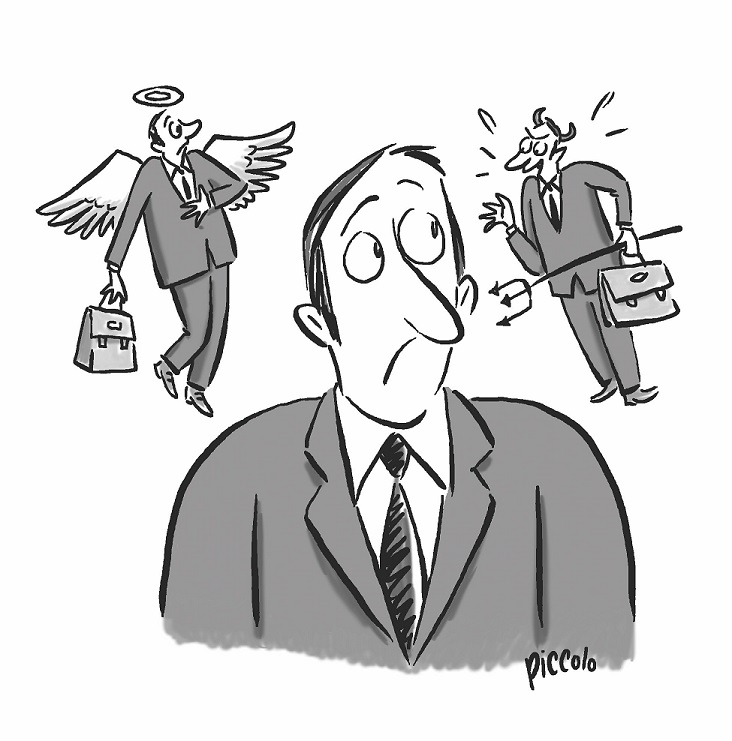
More than seventy years ago, the American or rather the undeniably global economist for all that he has influenced with his precise textbook, Paul A. Samuelson, wrote an article titled “Intellectuals”. He uncovered the fallacies of the established Intellectuals of the American society. To him, how they author books that only their friends and students can read, venture discourses only they can engage in, and prescribe policies that have zero respect for emotions, feelings, cultural intelligence and any mortal touch that may agree with common decency epitomises their names: “The Intellectuals”.

In Nigeria, we’re not short of them. Currently, we’re in an international political menace in which Russia put efforts to decimate Ukraine. The moral, ethical, physical, metaphysical, philosophical, epistemological, and even the economic motives and justifications flow freely on the internet. I will not tell you my own, but I’m relaxed knowing about others’. However, “The Intellectuals” are only interested in prescribing books and journal articles, publishing eccentric articles with dense grammar to vividly show they’re not for public consumption but only produced to satisfy the demand of their inner circle. Meanwhile, they bastardise, thus urging the public to take every piece of information on the conflict they may get from the BBC, VOA or CNN with a pinch of salt like the tyrannical antisocials they’re, despite not giving the public any alternative. That’s “an intellectual” for you.

To be precise, this is not a musing on Russia and Ukraine. It’s about the nerve-racking fuel scarcity that has bamboozled the Nigerian federation over the previous month and current. The one started with the speculation of the economically controversial subsidy removal that triggered the ever wicked economic class into succumbing to their Animal Spirit through hoarding. After all, which non-God-fearing mogul would allow the chance to double his revenue off the oppressed lower class without any effort? There’s none!

Discussions on the Nigerian political economy, especially outside university classrooms, are more dominated by the fake, impractical ideal of national consciousness and patriotism. And it takes place even though at no point does the term “Nigeria” ever mean the same to everybody; the poor wanderers, the profit makers, capitalist exploiters and the political hoodwinkers. And still, the Intellectuals want to build our economic skeleton upon that nonexistent psychological pillar. Is it possible?

Nigerians are the brilliant species who have gained relevance by declaring “Economics nothing short of common sense”. And that’s why they despise efficiency and efficacy despite their horrible love for eccentricity. But, if that’s not the case, how do you justify persuading people to buy what’s expensive when what’s cheap and of superior quality is available?

Through patriotism, they say. After all, people should use their hard-earned money to fund the ego of the anti-logic system of governance. For in the future, they say, there’ll be wonders. Meanwhile, the only wonders we’ll ever see is the one that reflects on the ironic, unethical, inefficient and anti-liberal, unreasonably orthodox, the often mix of the two, logic of the Nigerian Intellectuals that I’ll disclose below:

“Let’s stop importing fuel till we achieve self-sufficiency. That should be our way. A country with the mineral muscles of Nigeria should not be importing fuel. Let that be our moral standard. Let’s endure all the suffering for now. Let’s be patriotic. We’ll be alright shortly afterwards.” – isn’t this a lovely musing?

Do you disagree? Yes, I know you do. You’re an economist! What I want to ask is, why do you agree with the same pattern of thinking and logic when it’s used on Rice? – One reason:

Fuel scarcity & inflation is pressing every aspect of my society, up to the bottom, thus the outrage. And mostly the rich, who have limousines and Corollas to drive home from work and to the wedding evenings at the city parks, to power gigantic generators for their freezers and air-conditioners, and to calm their nerves from the so-called working stress. Then the industrialists who power their workshops and trade zones. And the artisans who harness all the profits. And that’s why nobody wants to hear anything long English Language, solution or no!

But rice scarcity & inflation, that one only press the poor, the bottom tier. That’s why every time we speak, they quote the models of David Ricardo & Keynes. That’s the only time they remember Ricardo and his comparative advantage or Keynes and his misunderstood, poorly-implemented government intervention. That’s the only time they want to disagree with Audu Ogbeh. So maybe Economics is more than common sense, after all. Thus they even go deeper into the mathematical models of Euler and Nash.

Everybody is acknowledging the need for government to take off its hands from fuel because it’s unfriendly for the lords at the top and the intellectuals at the middle, which is a policy prescription that sanity has advocated forever. But nobody wants to acknowledge the need for government to take its hands off the food industry, perhaps because the top dogs eat what they want from wherever they want, while it’s the bottom tier servants of God that are dying of hunger and historical inflation.

But why the lack of consistency?

Confusion is the reason, which can also disclose the lack of coherence along with discussions of such relevance. In Nigeria today, you’ll see an acclaimed intellectual who’ll die for his liberal romanticism supporting the economics of border closure. It makes me curious how possible it’s for Friedrich Hayek and Paul Samuelson to eat at the same table without arguing? Well, I think that’s the probability of the logic being consistent & cogent. Likewise, the essential orthodox wondering around the idea of ‘unpolice-able’ modern technology despite every magnum opus of their scholarly background suggesting otherwise.

The problem of the American society we love to imitate when it suits us (to quote Chinua Achebe) is that they believe in economics too much. But, interestingly, in Nigeria, they don’t believe in economics at all. And that’s why both are paying the price of extremism while hiding behind Keynesianism. In their experience, greed has taken over everything. But in our own, the economy has become a prison. And the wardens holding the keys are the intellectuals who will rationalise anything.

MA Iliasu wrote from Kano via muhada102@gmail.com.
Two policemen fired for alleged murder of army officer, drug trafficking

By Muhammad Sabiu

Two Inspectors from the Nigerian Police Force in Borno have been fired for alleged unprofessional behaviour.

Tahir Ali and Saidu Nadabo, the two sacked Inspectors, are both assigned to the Borno-based 53 Force Mobile Unit.

Mr Abdu Umar, the Commissioner of Police (CP) in charge of Borno, told the News Agency of Nigeria (NAN) about the development in Maiduguri on Thursday.

According to Umar, Ali was fired for allegedly killing Army Warrant Officer Donatus Vokong, who was assigned to Operation Hadin Kai, while Nadabo was fired for allegedly trafficking 4.5 kilograms of cannabis sativa.

He added that the army officer was killed by the policeman, who was under the influence of alcohol.

“I have just directed senior officers of the command to arrest any personnel with riffle and is under the influence of alcohol or who engage in gross misconduct,” the Commissioner assured.

2023: Redeem Church moves to support Osinbajo

By Ahmad Deedat Zakari.

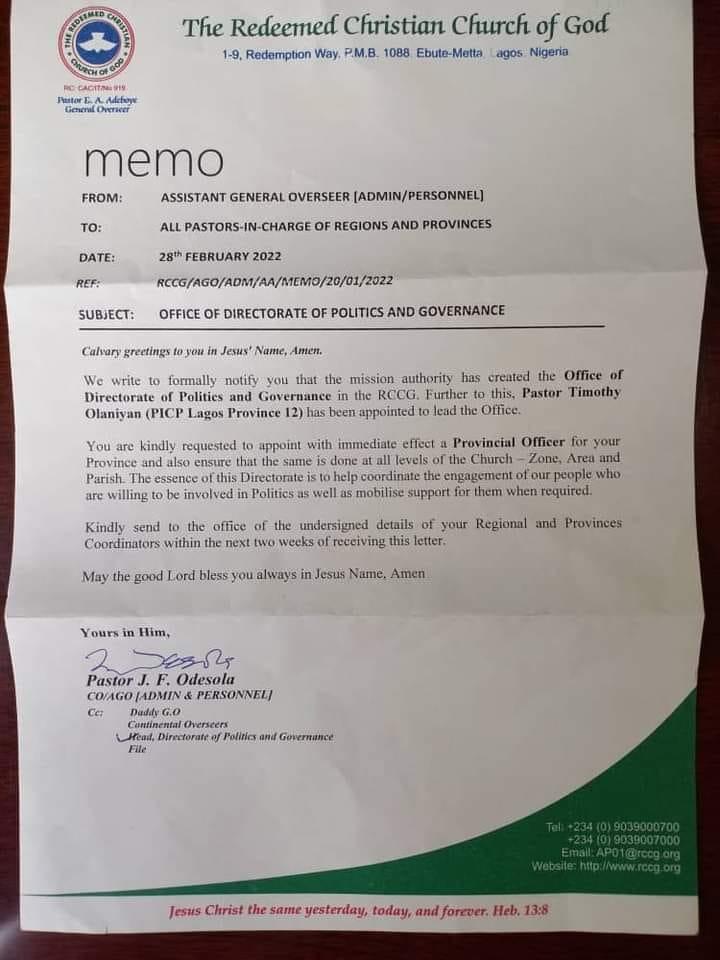
The Redeemed Christian Church of God (RCCG) has created a new directorate, named the “Office of Directorate of Politics and Governance.”

This development was contained in a memo dated February 28, 2022, and signed by the Assistant General Overseer Administration and Personnel of RCCG, Pastor J.F. Otedola.  

“We write to formally notify you that the mission authority has created the Office of Directorate of Politics and Governance in the RCCG. Further to this, Pastor Timothy Olaniyan (PICP Lagos Province ) has been appointed to lead the Office” The first paragraph of the memo reads.

Pastor Otedola also requested for provincial officers to be appointed for each province of the RCCG and all levels of the church with utmost urgency in respect of the new directorate. 

“You are kindly requested to appoint with immediate effect a Provincial Officer for your Province and also ensure that same is done at all levels of the Church – Zone, Area and Parish. The essence of this Directorate is to help coordinate the engagement of our people who are willing to be involved in Politics as well as mobilise support for them when required,” the memo further reads.

Nigeria’s Vice-President, Professor Yemi Osinbajo, maintains a father and son relationship with RCCG General Overseer, Pastor E. A Adeboye, is in charge of the Lagos Province 48 (Olive Tree Province Headquarters) of the RCCG. The recent development coming from the church cannot be unconnected with his 2023 presidential ambition.  

People have expressed different views on politics and religion and the active participation of the church and religious bodies. 

According to Mr Peter Onah, “they are biblical figures that participated actively in politics”. He added that religion and politics are two different things that can go together.

However, Mr Nurudeen Bukar, who was confronted by the Daily Reality on the issue of politics and religion, expressed a different view. According to him, “it is best when religion focuses on its primary mandate of preaching and guiding people”.

Bukar argued that partisan politics is not suitable for religious groups as it will distract them from their religious obligations.

JIBWIS tackles CAN, cautions against fanning embers of disunity in Nigeria

By Uzair Adam Imam

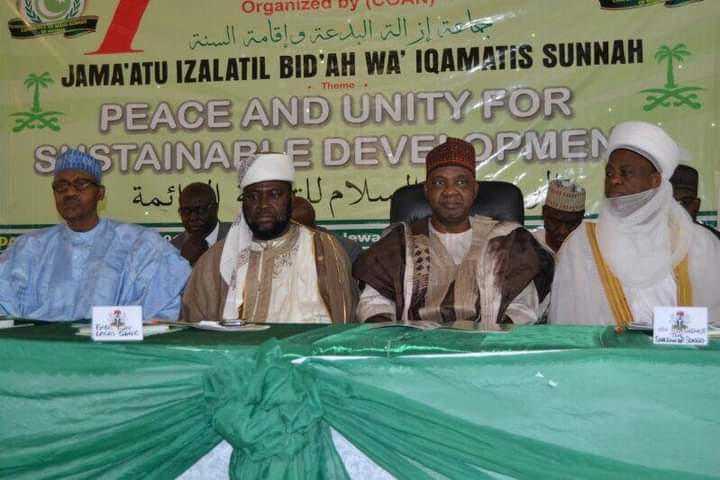
The National leadership of Jama’atu Izalatul Bid’ah wa Ikamatus Sunna (JIBWIS), has urged the Christian Association of Nigeria (CAN) to desist from sticking its nose into politics.

Recently, CAN said that there must be a presidential power shift to a Christian to succeed President Buhari in 2023, a comment that continues to generate mixed reactions from Nigerians.

But in a statement on Thursday, 10th March, 2023, the National Leader of the JIBWIS, Sheikh Abdullahi Bala Lau, said the decision as to who should succeed who should be the business of registered political parties not CAN’s.

Bala Lau warned that CAN should not abdicate its responsibility of preaching peace and national stability for politics.

Bala Lau said: “The attention of JIBWIS Nigeria has been drawn to the widely circulated news of Christian Association of Nigeria insisting on a Christian successor for President Muhammadu Buhari in 2023.

“This is as ill-timed as it is dangerous. The position of CAN as widely reported by Nigerian newspapers has elicited reactions that seem to have further overheated the polity. Jibwis Nigeria notes that this, a wrong move, is what you get when religious leadership indulges in decidedly-partisan campaigns.”

According to Bala Lau, CAN’s campaign of the presidential power shift to a Christian successor will not augur well for the country.

He added, “Like any responsible organisation, JIBWIS Nigeria carefully reviews the implication of CAN’s campaign for a shift of Presidential power to a Christian in 2023 with deep concern.

“To begin with, the campaign in favour of a Christian successor for President Buhari does not make sense, if we reflect on the historical reality of where and how power has resided in recent years.”

“It is common knowledge that from 1999 to date, we had Christians dominating the democratic space for 14 years. Break it down: Chief Olusegun Obasanjo, a Christian was in power for 8 years and Dr Goodluck Jonathan had 6 years. Conversely, if we look closely, the Nigerian Presidents who were Muslims were two – Alhaji Umaru Musa Yaradua governed for 2 years and Muhammadu Buhari is now in his second term of 8 years. Unlike CAN, JIBWIS Nigeria is not mounting undue pressure on any political party or group by insisting on a Muslim candidate as a matter of entitlement. All we ask for is that political parties must insist on a competent, capable and upright Nigerian to be fielded.”

“CAN should not court the trouble of the nation’s political party leadership, who have the mandate to screen and nominate candidates and wait for the final verdict of the voters.”

“Most importantly, CAN should be viewed as a respected religious association and not a political party with mandate to determine what qualifies one to be a Buhari successor,” Lau concluded.

Racism: Poland at it again

By Usama Abdullahi

I didn’t want to talk about this. But my mind is sick of it and wants me to spell it out. My piece centres on racism today. It’s something that most of us are barely familiar with. Yes, most of us, who haven’t travelled to the white world, know next to nothing about it. Some of us might not know that this ill-treatment against black people exists. While others, like me, do hear and read about it either on television or in newspapers. 

As a kid, I knew nothing about racism. Neither did I ever acknowledge its existence. It is because I was too young to understand what that meant. I used to think that the whites were superior humans that accord us, the blacks, some respect. But, contrary to my little kiddish thoughts about the whites, a vile or an irresponsible white man loathes this glowing dark skin. This blessed skin that wrestles all sorts of skin threats or irritation, someone from the other part of the world has aversions for it. 

This skin that withstands the sun’s heat, someone who’s driven by hatred for the faultless black men, considers it hell. I came across the word Ku Klux Klan at 12. At the time, I had Longman Dictionary with me. I would carry it wherever I go. So when I first took a glimpse at the then unfamiliar word, I paused for a while. Afterwards, I proceeded to read its meaning till the end. I couldn’t believe it at first. 

True. I couldn’t believe that there used to be a secret society during the 20th century which supported white supremacy in the Americas. This outlawed secret society fights the blacks and drives them out of the United States despite being legal citizens. I’m glad that this fraternal group is now defunct. But the problem is that racism is feathering again. It is fast dominating the white world. Some of them, the racists who have no respect for individual differences, honour its stay. They see nothing wrong when a black person gets badly treated because of his skin.

Sadly, we are entangled in a world that supports baseless animosities toward the people we share different views, faith or race with. The world we dwell in is a respecter of evil. We live to dine at the expense of our oppressed brothers from other parts of the universe. We see skin colour as a barrier to our unity and coexistence. Hence we look at each other with intense disgust. Unknowingly, this racism kills our hope to live a meaningful life.

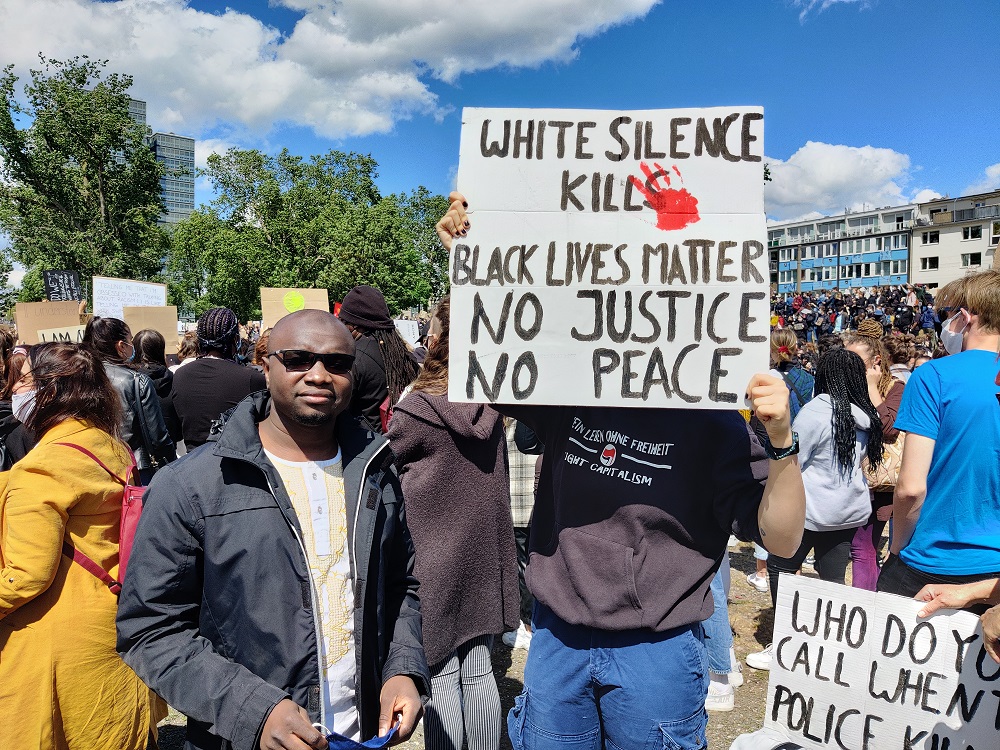
Last year, we were hit by the tragic news of an African-American man who had his fate crushed in the hands of a cruel white policeman. The news filled up the media until it captured public attention. Concerned black folks, particularly the deceased’s bereaved family, went through hell as a result. As a result, many people took their outrages to the streets, protesting against racism with the hashtag, “Black lives matter”. And they were assured of drastic measures to prevent such by the American government.

Considering America’s quick intervention on the matter, we thought the issue of racism was laid to eternal rest, but it, like Lazarus, has been resurrected. We saw the uproar and slighting comments which trailed the media over the failure of Bukayo Saka, Marcus Rashford and Jadon Sancho to score during the penalty kick of the Euro 2020 final. We also saw the unusual treatment against Zouma over a minor offence on his cat, costing him millions of dollars. And, unfortunately, Poland is at it again.

It’s sad to watch how the blacks were denied entry into the train conveying people from the war-ravaged Ukraine to Poland. Despite the threats they face, the racial prejudice in these racist morons prevails and has got to the point of favouring the Ukrainians over Africans or blacks – as if they aren’t all humans in need of urgent aid. Racism is a disease that bites deep into our hearts. It is also a barricade that holds back our progress as humans. So, It’s high time we stopped promoting racial discrimination.

Usama Abdullahi wrote from Abuja, Nigeria. He can be reached via usamagayyi@gmail.com.

Law and the evil of lawyers

By Tijani  Hassan Abdulkarim

This may sound a bit controversial, but I’ve not seen a profession that promotes evil in the open like the legal profession. With the wig on, lawyers stand before the judge in defence of evildoers and plotters with a mandate of seeking their acquittal, using superior cunning arguments by looking for loopholes in the legal system and twisting the law for the sole purpose of earning monetary reward from their clients.

Doing the above is, of course, attributed to their training. I presume the training lawyers receive in the law school before being called to bar involves teaching them how to play down on their inherent personal conscience directly or otherwise. This leaves me pondering over the degree of good conscience left in the legal practitioners. Don’t get it twisted; many morally sound lawyers are equally in the profession across different chambers within the country.

Unfortunately, close discerning will reveal how the profession thrives best in deceit and feasting on the miscalculations of the appellant seeking justice before a competent court of jurisdiction.

Please permit me to cite two recent instances: one of a criminal offence and the other of a Shariah case, all in Kano State, Nigeria. We will need to pay close ear to discern how lawyers in the defence team are attempting to remodel the course of justice by dragging the cases to secure the release of the accused on all grounds.

It is no longer news that  Sheikh Abdul-Jabbar Nasiru Kabara, the controversial Kano preacher, has been charged to court by the state government for offence bordering on blasphemy according to Islamic law. However, knowing full well the gravity of the (expected) outcome of the judgement, lawyers got in to ensure the acquittal of the accused despite the volume of evidence against him.

Upon discovering the hidden antics of the lawyers who have promised to defend and clear him of all charges, Abdul-Jabbar rescinded their counsel, protesting that they were insincere to their pledge of seeking justice on his behalf. His vituperation was that the lawyers were capitalising on his ordeal to enrich their chambers through the series of legal bottlenecks they’re cracking. The infamous Sheikh opted to stand in self-defence. All this drama unfolded after his defence team’s complete assurance of being victorious at the commencement of the hearing. Though, the possibility is highly impossible.

The second scenario from the same Kano is connected to the late five-year-old Haneefa, whose teacher Abdulmalik Tanko kidnapped and murdered in cold blood. Again, the details are everywhere on the web. Therefore, it is no longer news that the culprit openly confessed on camera and before the whole public of conniving with his accomplices to commit the crime and even went further to seek the forgiveness of the mourning parents.

Fortunately unfortunate, when the case came up for mention before the court, the same accused pleaded not guilty to the charges of kidnapping, culpable homicide, and murder read against him. Guess who advised him to claim innocence after the entire nation and the international community condemned his evil action? The lawyers – his defence counsel.

I am sure it is now visible to you to connect the obvious dots between the law profession, self-centeredness, injustice, deceit and outright evil against society. It is further appalling to see that most of these legal minds who wore the mask of innocence always go with the slogan of protecting the accused from being deprived of their human rights. This beg the question of what now happens to the fundamental human rights of the victims who have been deprived of their right to life by these evildoers?

Moreover, what is the fate of the society and its members who have been thrown into a theatre of evil because evildoers have the guarantee of going free by the antics of lawyers who are trained in using the constitution for the good of themselves; nay the society.

My submission is not an over-generalisation. There are good lawyers, and the opposite ones are also in abundance. However, the current reality will require the good to rise to the defence of the common good to save the society from the evil of their colleagues. To do that, our justice system needs to be remodelled to guarantee quick justice delivery. Remember, justice delayed is justice denied.

Post Scriptum: Without prejudice, this is my sincere sentiment on the practices of lawyers who are bent on defiling the legal profession in Nigeria and the world over. This will not interrupt the fact that I admire the job and aspire to study and practice as a legal luminary, but it has to be for good.

Tijani  Hassan Abdulkarim is a graduate of Mass Communication from Ahmadu Bello University, Zaria.

Mentorship is all they need

By Maryam Muhammad Lawan

They both entered Ammi’s room with crestfallen faces.

“Ammi, I don’t know what’s wrong with this boy. I saw him in the afternoon wandering about the street with those ludicrous coteries and now with a gamepad instead of a book!” Yaaya exclaimed. 

Ammi sighed as if she could not utter a word.

I know she could, for she has been trying her best. Anis would only pick his book to study when Ammi sounds emphatic. Not sure if it’s hearty, for he would start to sleep shortly after he starts reading, and that will be the end. 

Yaaya broke the silence in the silent room with a query. “What exactly do you want?”

Mentorship! I answered the question for Anis quiescently.

 He continued, “Unless you straighten up and fly right, our efforts will be fruitless.”

Anis is blessed with a quick cognitive capacity but is prone to play.

 “I’ll try my best and make sure he get his acts together, but he’s listless now. Tomorrow will be a better day,” I said to myself. 

The Next Day

I stealthily entered Anis’s room and met him ironing his sport wears. 

 “This is supposed to be done before today, my friend,” I said teasingly.

 He replied amusingly, “I heard you, but not well. However, I may hear you well when you go out and say Assalaamu Alaikum.”

Deep down, I know he’s trying to requite, for this is always what I say whenever he bangs into my room without saying the Salaam. 

I went out, said the Salaam and entered. 

I soothingly asked about his preparation(s) for the forthcoming exams.

 “Which preparation?” He asked. “Y’all should know that this JAMB is just luck,” he added. 

“So you wrote the exams before, wow! What was your score? “I uttered innocuously. 

“Look, Anis, can you please give me a listening ear?” This time around, it’s more of motherly. 

He switched off the iron and turned his attention to me. 

“Last year, when I did my JAMB examination, were you not proud of my score? Were you not the one that added that to your status with ‘can ur sis be brilliant like this’ as the caption? Do you remember how that result trended? Why? It’s all because of the score, Anis. I wasn’t the only one that wrote JAMB that same year, but mine trended most.” Can you remember how I read hard? Why don’t you do that, Anis?”

The room was silent for a while.  

“There’s nothing like luck, except that in almost everything, there may be a refutation. Some candidates may prepare well, but fail, while others will pass without preparing, but this is a hen’s teeth. I want you to train hard and pray harder, please, dear. Will you do that? “ 

He astonishingly answered in the affirmation. 

“I remember how some students mocked us (me and my friends) just because we were preparing hard. How foolish? None of them scored more than 130. Karina was among them; she scored 98. I know you can still remember that. So, in case you come across those sets of people, get them the cold shoulder. But, eventually, we shall smile together,” I said. 

“It’s almost 7:30 am. Let me leave before your school bus arrives. Peace out, bro, I said and added “no procrastination please,” when exiting out of the room. 

“Anis!! I shall celebrate with you as well, “I said this when I saw him reading voraciously after coming back from Islamiya in the evening. 

I could see happiness in Ammi’s and Yaaya’s faces. 

It’s time for the Maghrib prayers, so the young boy must keep everything and pray. 

He stood up while uttering, “So help us, God.” I wasn’t the only one that said “Ameen.”

Yaaya was at the parlour, ready to move on to the mosque, while Ammi was there to pick the phone she left at the dining table. I, Yaaya and Ammi said that Ameen happily.  

The young boy moved on to the restroom to perform his ablution.

 He held Ammi and Yaaya in awe, they happily prayed for him, and they both left. 

Maryam Muhammad Lawal wrote from Kaduna via mmafamam@gmail.com.

ASUU strikes: Many students may opt to “yahoo-yahoo” and other crimes

By Ahmad Deedat Zakari

It is the grass that suffers when two elephants fight. This is the sad situation of students in Nigeria’s public universities. Students find themselves suffering anytime ASUU goes on strike.

The innocent Nigerian students bear the brunt of the impasse of the duo – the Academic Staff Union of Universities (ASUU) and the federal government. At the end of every fight for a better condition of service by ASUU, their remuneration is paid, but the students are left to compensate themselves for the time they lost and the emotional trauma caused by the strike.

As legitimate as ASUU’s demands may be, keeping students at home to pursue these demands does not appear logical to me. As for the government, their attitude reminds me of Gbemisola Adeoti’s poem, “Ambush” where the literary genius described the land using many metaphors to demonstrate how dreams are murdered.

Students dreams are unceremoniously halted whenever ASUU embarks on strike. Some lose interest in education altogether, and others continue with less enthusiasm. Clichés like ‘school na scam’ seems to then make sense and many students embrace crimes like cyber fraud popularly known with the sobriquet ‘yahoo yahoo’ as an alternative to education. This is among the many problems usually caused by strikes.

Adeoti was right in his poem when he said, “The land is a giant whale that swallows the sinker, with hook line and bait aborting dreams of good catch fishers turn home at dusk blue peter on empty ships” Many students often try to escape this land that consumes dreams, they seek education in small neighbouring countries like Togo, Niger and Ghana etc. Some stay back to attend private universities they can afford while politicians and wealthy people send their children to Europe to get education. ASUU’s strike is not only demarketing our public universities in Nigeria. This attitude slowly kills the dreams and the universities, as anyone with a choice will not consider the option of attending one.

ASUU’s strike put students at a disadvantage in the pursuit of their progress, happiness and other life aspirations. It causes them unnecessary delays. They watched their peers in private universities graduate and take on the next steps in their lives while they are consoled with the saying that God’s time is the best. The Nigerian student is often stared in the face with the reality of George Orwell’s saying that “All animals are equal but some are more equal than others. A country that is seemingly careless about the education of its people is breeding the ground for poverty and crimes.

Quality education is no doubt the key to the greatness of any nation. But, sadly, it is not on the priority list of our leaders. While the government takes the most considerable blame for why universities are always on strike; we cannot wholly excuse ASUU for their complicity in killing the university education in Nigeria by going on regular strikes which often leave students stranded and confused.

Please ASUU change your strategy, we suffer every time.

Ahmad Deedat Zakari can be reached via ahmadzakari111@gmail.com.

Unification of Nigeria: Incidental blessing

By Habib Korede

Restructuring has been a topic on Nigeria’s news headlines for decades, and as the 2023 general election approaches, ‘restructuring’ is one optics for political campaigns. However, the unification of Nigeria, which has continually stirred this debate, results from the colonials’ avarice but has fortunately been a blessing.

Before the colonials, Nigeria was home to over 300 ethnic groups, with Hausa in the North, Igbo in the South-East, and Yoruba in the South-West, as the three dominant ethnic groups. These ethnic groups operate under various separate entities such as ethno-religious, geo-regional, and political nationalities under caliphate, kingdoms, and empires,

The colonials amalgamated these entities through divide and rule policy on 1 January 1914, following Frederick Lugard’s recommendation. The colonials take full advantage of their exploration of the country by sternly concentrating power at the centre to favour their political and imperial interests instead of laying a good foundation for nation-building. This has become a puzzle for Nigeria in the post-colonial era. 

Struggles for inclusion at the centre and resource allocation have resulted in many heated controversies, distrust, compromise, and violent conflicts. These include the crisis that emanated in the 1959 and 1964 federal elections, the January and July 1966 coups, the three years civil war of 1967–1970 when the Igbo region wanted to secede into Biafra, followed by several bloody coups and counter-coups.

The unity of Nigeria has also been threatened by various ethno-religious conflicts resulting from bad governance, such as the Kaduna State Zangon-Kataf crisis in 1987, 12 June 1993, Moshood Abiola’s presidential election annulment crisis, and return to the military junta in November 1993.

The return to the democratic system of government under the leadership of Gen. Abdulsalami Abubakar, which gave birth to the presidency of Obasanjo in May 1999, led to a rapid paradigm shift in Nigerian political history.

Deterioration in the governance of the country sparked several protests. Protests like the 2012 fuel subsidy removal and the 2020 #EndSARS that resulted in the death of protesters are only a few examples.

From 1999 to date, every region of the country has shown dissatisfaction with the status quo. This dissatisfaction has led to several agitations and overheating of the country’s polity, which metamorphosed to ethno-religious and inter-communal crises, such as the year 2000 Kaduna crisis, the 7–13 Sep. 2001 Jos crisis, and so on.

These crises triggered the formation of several ethno-militia groups such as the Oodua Peoples Congress, Indigenous People of Biafra, Movement for the Emancipation of the Niger Delta, Niger Delta Avengers, the Boko Haram insurgency, banditry and the coordinated Fulani/Herdsmen-Farmers conflict. These militias are agent provocateurs that simultaneously unleash terror in the country to disrupt governance, leading to several national conversations, such as restructuring, decentralisation, creation of state police, and separation. 

The rising agitation for a restructured Nigeria results from perceived marginalisation, discouraging national leadership, identity crisis, ethno-religious intolerance, the concentration of power at the centre, and lack of patriotism.

However, different scholars have interpreted the word ‘restructuring’ differently, and both the antagonists and protagonists for a restructured Nigeria dissent on its meaning. Though, I see restructuring as ‘using an efficient medium to restore a collapsing building to save everyone in the building.’  

From 1914 to 2014, eleven constitutional conferences were held to strategise the most favourable federal system and resource sharing policy to keep the regions satisfied and united. However, the 2014 national conference confirmed inequality in the demand of all the country’s parts. Each region demands a policy for their vested interest even when it disfavours the unity and progress of the country. 

The Southern region suggests the country should revert to the regionalism of the 1963 constitution. Still, this suggestion was frayed by the fear of dominance and marginalisation of the minorities from future governance of the majority in these regions. 

Besides, the founding fathers of Nigeria were more selfless and patriotic than the current group of leaders, and the country’s population is higher than it was; these will make regional governance in contemporary Nigeria impracticable. 

Decentralisation of power and the emergence of state police, as suggested by many, will aid in the production of a pool of authoritarian state governors whose misuse of power will decline the country’s democracy. But, as mentioned by the former president of Nigeria, Goodluck Jonathan, ‘the stronger the boat of (democracy), the more it is able to meet the challenges of its voyage and deliver on its promise to citizens.’

Notwithstanding, the Northern region focused on creating additional states and power rotation among the six geo-political zones. Obviously, creating more states will further deteriorate the already weak economy because of the unnecessary administration cost. 

It is noteworthy that the clamour for creating a new state is not for developmental reasons but political purposes. This will abet the emergence of unproductive parasitic state elites, lead to the agitation for creating additional states, and eventually actuate the aggressive Balkanisation of Nigeria. Like Yugoslavia, East Timor, the former Union of Soviet Socialist Republics, and South Sudan. 

The systemic restructure of Nigeria will be insurmountable. The 1999 constitution stands as a considerable constraint to the systemic and resource restructuring because of the intricate processes involved in amending the constitution. This is one of the reasons the 2014 national conference ended in a stalemate; Nigerian leaders benefit from the current state of affairs in the country. They manipulate the system for their selfish interests. These leaders capitalise on the gullibility of the average Nigerian by using ‘restructuring’ as a campaign strategy to divide Nigerians, to amass votes at the polls after every four years. 

Because Nigeria has remained an indivisible entity for over 100 years shows the unity of the country. The many challenges Nigeria is facing arises from the selfishness of the leaders and the mindset of the citizens. It is eminent that Nigerians should recognise the power in population and diversity before it is too late. Thomas Malthus explains that: ‘The power of population is indefinitely greater than the power on the Earth to produce subsistence for man’.

Nigerians yearn for a prosperous Nigeria, and Nigerians need to know that prosperity comes with unity, sacrifices, and patience. ‘The cost of disintegration (of Nigeria) is higher than the cost of being together. We have everything to gain by being united than disunited,’ as stated by the former President of Nigeria, Olusegun Obasanjo.

The perennial agitation for restructuring and separation ensues from bad governance, corruption, insecurity, nepotism, and ethnic intolerance.

Achieving two concurrent goals will solve these problems: the first will be to intensify the country’s social structure, which will aid in reconciling Nigerians and redefine the perception Nigerians perceive Nigeria. The second will be strengthening the central government by building robust institutions where no one is above the law and where meritocracy always supersedes mediocrity.

Social restructuring of Nigeria is achievable under different progressions: by prioritising civic education and history at the basic education level; refurbishment of unity primary and secondary school across the country; the national youth service corps should continue to aid the youths of the country to explore the diverse cultures and enhance pragmatic multicultural solutions to the country’s problem; there should be an effective orientation agency that will be responsible for sufficient enlightenment of the masses, particularly on peace and unity of the country; and investing in intercultural dialogue.

When there is an unarguable socially restructured Nigeria, patriotism will augment, and every other thing will fall into place.

Most of the 36 states governors are doing a lot of things wrong. Still, the centre always receives the blame because of the rising weakness in the capacity of the central government to sanction the misappropriation of resources and bad governance by the state government adequately. Building powerful autonomous institutions will strengthen the central government.

Powerful institutions will enhance check and balance in the activities of the other arm of the government, which will help filter the best candidate for the leadership position in the public sector, and will unquestionably prosecute the guilty ones.

Powerful institutions will promote democracy and credible leaders. In the words of Chinua Achebe, ‘Nigeria is what it is because its leaders are not what they should be.’

Nigeria, a country with the fastest growing economy in Africa, the highest GDP on the continent, and the sixth most populous country globally, has all the potential required to become the world superpower. Good governance will enhance an excellent economy, peace, stability, and prosperity.

According to Ibrahim Index of African Governance, good governance is ‘the provision of the political, social and economic goods that any citizen has the right to expect from his or her state, and that any state has the responsibility to deliver to its citizens’.

Therefore, when the citizens are getting all the social and economic values they are expecting from the government, no region will have the urge to clamour for restructuring or separation of the country. However, there cannot be good governance when there is no equity, equality, transparency, inclusiveness, accountability, justice and responsiveness in the country’s activities

Habib Korede is a BEng (Hons) Civil Engineering graduate and a writer. He authored Propelling Success, and The Kalahari Review has featured his work. He can be reached via habibkorede247@gmail.com.

ASUU vs FG: A solution to the university revitalization fight

By Professor Abdelmalik Abdelghaffar Amoka

ASUU in 2008, provided pictorial documentation on the state of infrastructural decay in public universities to the Federal Government (FG). After several struggles and strikes, FG put together a Committee on the NEEDS assessment of the public universities, headed by Prof. Mahmood Yakubu, the then TETFund Boss. Prof Mahmood Yakubu’s committee after a thorough work recommended that 1.3 trillion naira is required to revitalize all the public universities (Federal and State universities) to make them suitable learning environments for the normal human being.

Just like the 2021 visitation panel report and the 2021 report of the renegotiated 2009 agreement, the NEEDS Assessment report was dumped somewhere till ASUU declared another strike in 2013 for the report to get attention. An agreement was then reached between ASUU and FG after the 2013 strike that the fund will be spread from 2013 to 2018. GEJ’s government released 200 billion naira for 2013 before he was voted out and Buhari’s government took over in 2015. As of 2013, Gen Muhammadu Buhari, Mal. Adamu Adamu, Mal Nasiru El-Rufai, Alh Lai Muhammed, and APC as a party believe that the government of Jonathan was “irresponsible” for their failure to implement the agreement reached with ASUU on public universities. They gave all sorts of convincing supporting reasons why FG can meet the demands of ASUU. El-Rufai was in OBJ’s government and he knows how government works. So, hypocrisy did not come to people’s mind, they didn’t see any point in doubting his position and his 2013 post on the ASUU strike went viral.

The general public is always on the fence during these fights for university revitalization. Some choose who to support based on where their loyalty lies at that moment. That is the reason why those who were against the FG on the ASUU strike in 2013 and now supporting FG on ASUU strike on the same issues. Since 2015, the APC government has refused to release the funds for public universities. After about 4 ASUU strike actions for the last 7 years of the government of President Buhari, they have not been able to release up to 100 billion naira for universities revitalization. Meanwhile, they are adding more universities.

There is this class of public school beneficiaries that believe that FG does not have 1 trillion naira to fix our universities to make them attractive to any student except through the introduction of tuition fees. But some of us think that the people, including civil servants, are too poor to afford tuition for University education, else it will become an elitist institution. Public schools produce us and some of us are super-rich. So, if we believe that FG is actually broke to fund education, then we can intervene to revitalize the public universities in the interest of national development and for the love of the country.

Nigerians are cheerful givers. Our business moguls, media celebrities are fond of gifting their friends. Not sure if it’s for show-off. For example, Nightlife boss, Obinna Iyiegbu, popularly known as Obi Cubana got cash and other gifts worth over 250 million naira for his mother’s burial in July 2021. David Adeleke, popularly known as Davido in November 2021 raised 200 million naira within hours that he donated to the orphanage. I recently saw an unconfirmed impressive list of donations for the Attah of Igala coronation from my brothers. There are several of such donations. This is evidence that Nigerians are cheerful givers.

Nigeria’s generous donation of one million dollars to the Humanitarian Trust Fund for Afghanistan shows that even the government is generous. Only a cheerful giver will use 100 billion naira to rehabilitate non-functional refineries that are still not functioning. Only a cheerful giver will pay 69 billion naira as salaries to refinery workers that generated zero revenue and only go to work to warm their office chairs.

The public primary school system is dead, the public school system is dead, and the public university system has nearly collapsed. But why don’t we extend this generosity and cheerful giving to the education of the ordinary Nigerian? why can’t the elites donate a fraction of the money they sent abroad to educate their kids?

The agreement in 2013 was for FG to release N210 billion naira every year for 5 years. 9 years later, not up to 23% of the fund was released to the universities after 9 years. Maybe FG is actually broke even though they are establishing more universities and the key players are getting richer. A poor and broken man doesn’t add to his responsibilities.

Let’s apply the principle of our supposed generosity and cheerful giving to solving our education problem. Let’s open a public schools revitalization endowment fund. Let’s get 100 thousand cheerful givers from politicians, businessmen, captains of industries, Bank CEOs, celebrities, and the noisy “Abroadians” to donate 200 thousand naira every month for a year. That will give us 240 billion naira revitalization fund annually. Do that for 5 years and we’ll have 1.2 trillion naira to revitalize public universities.

Put up Board of Trustee and Fund management team from the donors to ensure that the fund is shielded from mismanagement. Nobody wants to see his money misused. Then, ASUU won’t have to go on strike for revitalization and will limit ASUU’s demands to welfare. The government won’t be looking for tuition fee that is not there or students’ loan that is not sustainable, students won’t have to stay at home for months due to strike. The university will be good enough for our big men that ship our money abroad. The industries will get a quality workforce. The universities will be attractive to international students and we’ll start earning forex from education.

But unfortunately, our cheerful giving in Nigeria does not extend to public education. Public education made us and we are either part of those destroying it or watching it destroyed without any slight resistance. It’s like a case of climbing to the top through the public education ladder and destroying the ladder after getting to the top. And unfortunately, the supposed middle class, a class that is nearly wiped out, that needs the ladder is afraid of the oppressors but blames ASUU.

Amoka is a social analyst, prolific writer and a Professor of Physics, Ahmadu Bello University, Zaria, Nigeria.