Northern Nigeria

Arewa24 and the globalisation train

By Zailani Bappa

The satellite television, Arewa24, with headquarters in Kano, will continue to be a pain for northerners who cherish their heritage. It is a necessary evil and a bad influence on the teeming youth in a predominantly conservative society. But, it is established to achieve a purpose and do that efficiently and quickly.

I learned the medium was established by the US government through one of its established NGOs some nine years ago. Amidst the devastating experience of Boko Haram in this part of the country, several studies have indicated to the West that the passion for Islamic values in the North and the teeming followership of a springing set of radical Salafists in the region is the major cause of such developing activism….or should I say…terrorism.

Hence, the decision to spend the hard-earned tax-payers money of the American people to build an entertainment television station in the heart of conservative Kano (after rejecting Kaduna and Abuja as a base for the new medium). I am sure you know that when these guys give you a dime worth of something with the right hand, they are sure enough to take back something worth a dollar from you with the left hand.

So, the Arewa 24 came into light with a bang…..good hands employed mostly popular actors from the entertainment industry as pioneer staff, with good pay for them to work optimally and to stay, very enticing and entertaining programmes with fresh breath of air and of course, all programmes beamed to us with the best of technology one can find around here. Significantly, most programmes target women and the young.

Free of charge, we were entertained until the station became a menu that came to every table in the house. Then came the next stage of the plan (as I see it). It was sold out to a very rich and powerful Nigerian who has the capacity and the passion to run it according to both the quality of content and the pursuit of the target.

Gradually, the programmes started becoming more daring in their approach to change. There is mild and uncoordinated resistance here and there, but the medium has a strong advisory consultant. They evade or outrightly neutralise every challenge from angry quarters at times. And they will continue to do so.

I firmly believe that the Arewa 24 debut, acceptability, prowess, and popularity (often challenged with visionless resistance) are only the tip of the iceberg. This is an era of globalisation. It is a moving train we cannot stop. It will reach its destination, ultimately. Our resistance to it will continue to be a massage to its global ego.

So, for those who understand this phenomenon, just pray, stay calm and do your own thing according to your conscience. Teach your young ones to value your values the way you can, very hard and consistently; then, leave the rest to God. This fight is just too big for us……..for every one of us.

Zailani Bappa wrote from Bauchi State via zailanbappa@gmail.com.

Negligence of technology careers in northern Nigeria

By Salim Sani Haladu

The medical industry held the most lucrative career prospects in the past, and parents encouraged their children to study medical-related courses. During those days, parents were willing to invest any amount to see their children as doctors, nurses, and pharmacists. Some even compelled their children to study these courses. Consequently, these children achieved remarkable success in these fields.

However, the landscape of lucrative careers has shifted in contemporary times. Technology-related careers have emerged as the new leaders in terms of profitability and job opportunities. According to the US Bureau of Labor Statistics, “the projected employment growth for computer and information technology occupations from 2021 to 2031 is 15 per cent, significantly above the average for all occupations”. This shift is becoming evident even to a layperson.

This change has led many parents to guide their children toward technology careers. Nevertheless, there exists an uneven distribution of this awareness within Nigeria. While parents in southern regions have readily embraced this change, their counterparts in the northern areas lag in grasping its significance. As a result, the northern part finds itself taking a backseat in technology careers.

In 2000, the former governor of Jigawa State, Saminu Turaki, established one of the first ICT institutes in Northern Nigeria—the Jigawa State Institute of Information and Technology, located in Kazaure. Strikingly, several students who enrolled in the institute did so solely to acquire a free laptop. They then sold the computer to fund their journey to Lagos, where they eventually engaged in dead-end handwork.

Furthermore, a project manager’s experience at the NITDA Blockchain meeting in Kano State last year highlighted the technological apathy, stating, “It is evident how far behind Northerners are in the world of technology.” Even in technology projects directly related to the Hausa Language, the predominant ethnic group in the northern region, participation was surprisingly minimal. I was astonished that only two of us from the North joined a Hausa transcription project I recently participated in.

Moreover, looking at the UTME cut-off marks for most northern universities reveals that tech-related courses like Information Technology and Cybersecurity have low cut-off marks, reflecting the limited number of applicants. Numerous examples abound, illustrating how Northerners are trailing behind in technology careers. The prevailing aspiration revolves around courses that promise a meagre N150,000 salary job.

A primary reason behind this negligence is that Northerners view technology careers as unconventional, failing to perceive them as real jobs. Mainly, if someone is working from home, it is often seen as a sign of aimlessness or lack of purpose. Unfortunately, some Northerners still hold the negative stereotype that individuals working in the technology industry are merely scammers.

Another reason is many people’s preference for security. Consequently, many opt to stay within their comfort zones rather than take risks to pursue greater opportunities. Most technology careers offer wages instead of salaries, which aligns with the Northern preference for security. It’s disheartening to learn that some people are even selling their farms to secure low-paying jobs, a profoundly unfortunate decision.

I recommended an IT course to a young man inquiring about a lucrative career. He expressed concerns about finding a job immediately after graduation. I suggested he consider creating jobs instead of continuously seeking employment.

With the rapid development of Artificial Intelligence (AI), there’s a legitimate concern that the careers Northerners heavily invest in might eventually become automated. For instance, professions involving routine tasks and predictable outcomes, such as data entry, assembly line work, and customer service, are particularly susceptible to automation. As AI technologies advance, they can handle these repetitive tasks more efficiently and accurately, potentially displacing human workers. It would be disheartening for someone to invest significantly in a career only to discover that their desired job has already been automated.

Prominent figures like the late Sheik Muhammad Auwal Adam Albani and Dr. Isa Aliyu Pantami are examples from the North who have embraced technology and achieved remarkable success. They’ve made indelible marks on the country’s technological landscape through innovative technology use.

Enhancing the curriculum of high schools is essential to address this challenge. While Data Processing and Computer Studies are part of the curriculum, introducing practical skills like coding and web development is crucial. Equipping students with these skills will better prepare them for the digital age and empower them to thrive in today’s tech-driven world.

In conclusion, the negligence of technology careers in Northern Nigeria presents a concerning trend that warrants immediate attention. The shift in lucrative career prospects from traditional fields to technology careers is undeniable, with evidence supporting the exponential growth and opportunities in technology-related jobs. While the southern regions have recognised and embraced this change, the northern regions lag due to a lack of awareness about technology careers, negative stereotypes, and a preference for security over risk-taking. Educational institutions and policymakers must take proactive measures to address this issue. By integrating practical technology skills into the curriculum and promoting a positive perception of technology careers, Northern Nigeria can bridge the gap and empower its youth to thrive in the dynamic world of technology.

Salim Sani Haladu is a Pharmacy student at Bayero University, kano. He can be reached via pharmsaleemskhaleed@gmail.com.

The resurgence of kidnapping in northern Nigeria

By Mukhtar Garba Kobi

The barbaric act of abducting people by some bad elements in the Northern part of Nigeria is one of the major threats to the endearing peace and economic growth; bandits operate on roads, communities and recently in institutions of higher learning. News of an unspecified number of farmers in Borno and students of Federal University Dutsen-Ma has gone viral lately; bereaved families of the victims are still in shock while many resolved to withdraw their wards from schools; this is bad looking at the importance of education to mankind and development of all. People in those areas are doubting the promises made by leaders on protecting lives and properties.

Nobody on this mother earth is above the law. In some developed countries, even incumbent leaders are forced to face the jury and account for their mischievous deeds in office. Still, unfortunately, in Africa, the existence of immunity attached to leaders gives them the audacity to do as they wish.

One of the bandits’ kingpins in the Northern part of Nigeria, Dogo Gide, released an audio message which a well-known media man, Bello Mu’azu, shared. Still, the message contained has added fuel to the blazing fire of insecurity. The dreaded Dogo Gide stated that he preferred to die as a bandit and had no interest in reconciling with the government, no matter the money given to him.

Since most of the bandits’ hideouts are known by our gallant security forces, they (bandits) could be cleared in a few days, but such only end in discussions. Public figures have made excellent attempts to mediate between bandits and governments. Unfortunately, their efforts were fruitless due to the negligence of the government. There is no way fire could be put out with the same fire, but combining the two (attacks and dialogue) would greatly help. Moreover, engaging in dialogue would pave the way for peace in most kidnapping-ravaged States. Culturing crops and businesses would regain their lost glories while students would learn without fear.

Furthermore, research conducted by SBM, which is an investigative firm, revealed that between June of 2022 and July of 2023, three thousand six hundred and twenty (3,620) people were taken hostage in five hundred and eighty-two (582) kidnap-related incidents in Nigeria. It was further uncovered that “North-West and North-Central regions exhibit higher in-kind ransom demands. This aligns with Nigeria’s poverty and its correlation with areas where food is commonly demanded. Additionally, these regions have seen a surge in motorcycle demands due to economic opportunities and possibly because of their potential use in terror activities”.

Some of the factors that fuel kidnappings include high levels of poverty and hunger; waking up empty-pocketed and nothing for family members to consume have forced many into the act, especially unemployed Fulani herders. The second factor is greed and uncontrolled love to be rich, which also persuaded many into kidnappings; shallow-minded persons often view abduction as the easiest way to get enough money to meet their daily needs. Kidnappers play vital roles in influencing their friends; they give uninterested friends convincing points while those low faculty of thinking accept the offer without a second thought on the implications of such ventures. 

The mass abduction of people can be stopped if the following measures are adopted: schemes for employing youths or training them on skills have left behind several villagers, and most of the arrested kidnappers were dwellers; there is a need for the villagers to be included in whatever government came-up with. Since kidnappers have leaders, there is a need to have a virtual or physical meeting with them to know why they are kidnapping. Governments should ensure that their demands are met. Granting amnesty to repentant kidnappers would be a welcome idea, but they should not be reintegrated back into societies. They should be taken to rehabilitation homes and trained on different skills to be useful community members. 

Mukhtar writes from Bauchi and can be reached via garbakobim@gmail.com.

A serious humour: Bello Galadanchi’s comedy skit for social commentary

By Sa’id Sa’ad

Earlier this year – when Bello Galadanci’s videos were becoming popular on digital platforms – a colleague posted a video of his skit on his WhatsApp status. From what might be a simple curiosity, I asked him if he knew who the person was – of course, expecting him to at least know a bit – but he replied that he did not know him beyond his not-so-much-funny recent “comedy skits.”

That was weeks after the publication of my recent essay, A Crack on Hadiza Gabon’s Wall: Humanizing Northern Nigeria Storytelling, where I described what the show meant to storytelling in Northern Nigeria and the impact of what I called “hypocritical denial and intentional lack of acknowledgement” from the northern community. As it has always been, I bumped into a tweet where a young person from “northern” Nigeria condemned the entire comedy skits made by Bello Galadanci. If I weren’t from the North, I would have wondered why Northern consumers always find a way to devalue Northern content creators in whatever discipline. But I didn’t, because I understood the game. So. Well. It is nothing to raise a brow at, mainly because, as creatives, criticism as such is often expected, “Thanks for the PR” was the short response Galadanchi gave him.

Even with the recent trooping of young creators into the skit-making industry in Nigeria, majorly due to its financial and digital-popularity lakes tunnelled by TikTok, Instagram and YouTube, one could guess accurately – as most other useful or even useless “developmental” growth – that adoption of content creation as a business by young people in Northern Nigeria, came very late, as well. It is difficult to mention by name – the northern skit creators who began early – and still maintain the same consistency as one would mention Taoma or Aproko Doctor or Mr. Macaroni from the South. Only Galadanchi and a few others still retain their craft consistently.

Many young people in northern Nigeria continue to comment, criticise, or label Bello Galadanchi and his skits in multiple ways.

Aside from the unpopular northern Nigeria population that perceives his skit as the “working-for-the-white” theory (or the painting north black belief), and the many who – due to educational standards and exposure – fail to comprehend the satirical nature of his contents, most of those who do not find him funny do so due to Broda-Shaggying or Sabinufying Galadanchi’s skit.

Unlike most skit makers in Nigeria, whose focus is majorly only on sowing laughter and entertainment into the market and reaping their golds, built on creative juice – Galadanchi’s contents are meant for social and political commentary using humour and satire. Backed by journalism, creative, and educationalist careers, it might seem almost impossible for Galadanchi – even by himself – to create non-questionable or fluid content only meant for laughter because creatives are muscled with the hunger to correct and change using their art. His could be simplified as addressing serious problems without being too serious.

Therefore, this makes it difficult for those Broda-Shaggying and Sabinufying him to comprehend the content as, thus, they expect a consciously endowed full-length comedy. I don’t mean to belittle content created by skit makers whose conscious aim is to create a hundred-percent comedy piece. However, expecting an all-comedy-induced piece from a skit maker whose purpose is challenging social and political ills using humour could be as good as expecting something from nothing.

While writing this essay, I shared on WhatsApp status a short clip from an interview Bello Galadanchi granted CGTN where he sat on stairs with three other Chinese, in a swagger-spirited looks with polished accent and blonde hair. Most GenZ’s (respectfully) responded to have known him only through his comedy and never “expected” him to be this “polished”, so far away from what they expected Dan Bello (his character) to be.

That means most of those who denigrate his content would have been from their “expected lens” through which they measure him to be. As argued in my previous essay above – could this also be what I called “hypocritical denial and intentional lack of acknowledgement” of the northern population for contents and creators coming from the north? Because, of course, what Bello Galandanchi is doing for northern Nigeria-specific social and political issues is what Aproko Doctor is exactly doing for Nigeria’s health sector and health-related issues.

Though satire could emerge in professional, amateur, elitist, and popular forms, those who do not comprehend his satire might also be due to their level of comprehension rather than the perceived educational standard or exposure. However, I believe both play a role here. Of course, satire is meant to use humour and irony to criticise, as in the case of the Nigerian writer Elnathan John with his famous book, Be(com)ing Nigerian. However, because Galadanci focuses on the “North”, he is quickly labelled with the “working-for-the-white theory”.

Perhaps if Elnathan’s book was a digital piece as Galadanci’s – and produced in the same form and language – the same label could have been blanketed for him, too. Sometimes, the theory sounds a lot like a comedy skit as well because even a deported northerner fighting the cause of his people – in any way different from the (usual) northern norms – would be considered brainwashed to work for the whites.

More so, those who do not comprehend the satire in the contents are often blindfolded from seeing the patriotism in these pieces. If not for a deep love for a people, I wonder how one would continue to create these provocative contents that question deep political ills in the region. While also soaking insults from young people in the same region who barely understood the depth of what his craft was uprooting.

However, looking at his pieces of art critically (beyond Broda-Shaggying them), how they are deeply immersed in satire and sheer creativity, one could vividly tell how varying it is from the contents created by other skit makers. If other skit makers called theirs “contents”, a creative could easily describe Galadanchi’s as a “piece of art”. The beauty in the work is so immense that one could smell creative fragrances all over the place.

Imagine if the digital youths in the north focus on – if not creating – promoting creators from the region rather than policing social media in the holy name of the north. Imagine if we all question the system in the individual creative juices deposited in us. Imagine if we learn to place a market value on the creators and contents from the north rather than wasting our time watching these wayward girls crowd-chasing nonsense on TikTok in Hausa and serving them to your screen back-to-back. Imagine if we focus on the problems rather than those who help us understand the problem. Imagine if we don’t call for the heads of those who create alphabets to remind us of where we are.

Galadanchi didn’t just find questioning the ill social and political system for Nigerians in Nigeria. He has lived with the system, experienced the system and carried dozens of scars from the system to wherever the world took him.

If these pieces of art are what come out from creatives whom the ill Nigerian system has wounded, then very soon, the Bello Galadanchi in all of us will prevail.

Sa’id Sa’ad is a Nigerian writer, poet, and playwright from Maiduguri. He won the Peace Panel Short Story Prize 2018 and the NFC Essay Prize 2018. He tweets @saidsaadwrites and can be reached directly via saidsaadabubakar@gmail.com.

Calls over shoddy Hausa translations in Northern Nigeria

By Uzair Adam Imam

Translators, language experts, and advertising practitioners in Northern Nigeria are irritated by shoddy Hausa on billboards, TV and radio stations, with some calling for an end to the practice.

The role of translation is to communicate ideas and messages across the audience. However, as those concerned individuals opined, shoddy translation is doing the opposite.

Beyond the expert communities, poor translation, especially from English to Hausa, is generating outrages in many quarters, especially as native speakers of the Hausa language demand better translation of their language.

A report by The Daily Reality disclosed how the Three Crowns Milk, Taira, and Stanbic IBT, among others, came under attack over poorly translated advertisements from English to Hausa placed on their billboards.

Experts have associated the flagrant flaws of advertising agencies and personnel with unprofessionalism. They said that the practice has grown into a disease which has since been ravaging the translation business in Nigeria.

Authority to blame

There are outrages by the relevant authorities that feel very disappointed by the terrible things in the name translation that continue to unfold these days.

A lecturer at the Department of Nigerian Languages, Bayero University, Kano, Dr. Muhammad Sulaiman, described the situation as unfortunate.

He said the way some people bastardise the translation business, especially English-Hausa translation, despite making a fortune in the business is pathetic.

Dr. Muhammad said, “Some of these people mostly do not bother about such violations but rather the money they are tapping out from the business.

“Even though translation is a profitable business, its knowledge should be considered above the profit. If you don’t have the knowledge, learn it or allow people with the skill to do the business.”

Also, a Kano-based translator, Bello Sagir Imam, decried the menace of quack and unprofessional translation ravaging the translation business today in Nigeria as unfortunate.

Imam, the CEO of English Domain, a translation company, blamed the relevant stakeholders for merely lamenting the menace without taking bold action to address it.

He added that the lack of English-Hausa translation companies in the country exacerbates the menace.

He argued that the loopholes gave space to the quack companies and will continue to bring more and worse translators until the proper measures are taken.

Imam stated, “Failure of the Northern Nigerian relevant stakeholders is an easy and thriving business environment for the quack but well packaged and connected companies mainly based in Lagos and few others in Abuja, but amazingly not in Kano.

“For instance, in the North, with the entire daily complaining razzmatazz, there is no single English-Hausa-English translation company or one where such service is among their services.

“These loopholes birthed the quack companies and will continue to birth more and worse translators until the right measures are executed.”

We need support

Imam further lamented how the lack of support from relevant stakeholders discourages aspiring English-Hausa translators.

He said, “Most stakeholders do not help the aspiring English-Hausa translators despite being Hausa native speakers and linguists, Hausa or English graduates, simply because they don’t have a prior relationship with the helpers.

“For instance, if you are not their student, those in academia will not help you. The journalists will not help you if they don’t know you.

“I feel challenged as a relevant stakeholder to walk the talk, to mitigate the problems and inspire others to wake up from their deep sleep.”

What is the root cause of quack translation?

A communication scholar from the Mass Communication Department, Professor Mainasara Yakubu Kurfi, traced the root of quack translation, shedding light on the impact of a shoddy translation on advertising.

Professor Kurfi said, “If you look at what is happening in advertising industries, you can simply conclude that there is no professionalism – lack of professionalism in the sense that most of the advertising agencies and agents did not undergo practical formal education that will avail them the opportunity to understand what advertising is and what advertising is not, as well as understanding the techniques of advertising in appealing to the public without going into their religion, culture and even norms and practices.

“That is why you see several problems, particularly with billboards and adverts. I remember I did my master’s dissertation on billboards.

“Most of these translators, either from English to Hausa or Hausa to English, are not native speakers. They are generally from Lagos, probably Yoruba by tribe, and they do not really understand the nature of the language of reception – from English to Hausa or from Hausa to English.

“Some of the techniques that you consider in terms of translation they understand, they don’t have knowledge of that.

“Also, you find out that most of these translators are based in Lagos. They are not from Northern Nigeria. Therefore, they don’t understand the language itself.

“And we do not have many advertising agencies here in Kano that will now take cognisance of those traditions and norms. Therefore, it is not surprising to see this kind of problem.

Native speakers must key in the advertisement

Professor Kurfi said that to tame the menace of native speakers, in this sense, typical Hausa/Fulani must key into the advertisement business.

He said, “The only way forward is to allow our people to enter the advertising industry. I don’t know why our people, particularly typical Hausa Fulani, are running away from advertising. Let our people be into advertising.

“Let them understand the techniques and practice of advertising, the procedures, the rules and regulations governing advertising, in the print media, in the broadcast media, even on the online media platforms, as well as billboards and adverts.

“When they understand that, you discover these problems will undoubtedly be minimal. They will be contracted to translate from English to Hausa or From Hausa to English.

“Another way out is to let our people, particularly the graduates of mass communication, establish independent advertising agencies responsible for all this kind of advert placement in the media organisations. 

“But when our people are running away, the advertising agencies or the producers or manufacturers have no option but to contract the service of the people from the southern part of Nigeria – and this is why you see all these kinds of problems happening.”

It’s posing a serious challenge to us – APCON 

The President of the Advertising Practitioners of Northern Nigeria, Sammani Ishaq, lamented the rising number of cases of poor translation.

He said that Advertising Practitioners have been working to end the problem over the years.

Sammani Ishaq said shoddy Hausa translations usually affect the persuasive aspect known for advertising and that consumers patronise the product out of desperation, not because they are being persuaded.

He said, “This is a serious issue we have been trying to address over the years. In doing so, we held many meetings and organised different programs. We even formed a forum we named Advertising Practitioners of Northern Nigeria.

“The issue is beyond imagination because most advertisers are from the southern part of the country and are either Igbo or Yoruba. It was not for ten years that northerners started advertising businesses. And, up till now, the advertising agencies are not numbered to ten.

“And what they mostly do is to hire their friends from southern Kaduna, who do not fully understand the language, let alone translate it correctly, or people who have served or had been in the north for a while.

“For this reason, the translators are not even Hausa and don’t fully understand the language. So, they usually hire people from southern Kaduna or those who have served in the north for translation.

“And, sometimes, even in the north, people mostly hire Kannywood or Nollywood actors and actresses for advertising. These people are unprofessional and lack the basis of advertisement. Hence, people purchase products not because they are persuaded to but only because the product has become necessary for them to buy.

We will deal with unregistered advertising agencies

Sammani also threatened that any unregistered advertising agency caught would be dragged before the court to face the music.

He stated, “And for this reason, APCON provided a law signed by the former president of Nigeria, Muhammadu Buhari, before he left office on May 16, 2023. The law stated that any unregistered advertising practitioner caught practising advertising must be dealt with.”

From doubt to determination: My journey to HND in Mass Communication

By Usman Muhammad Salihu

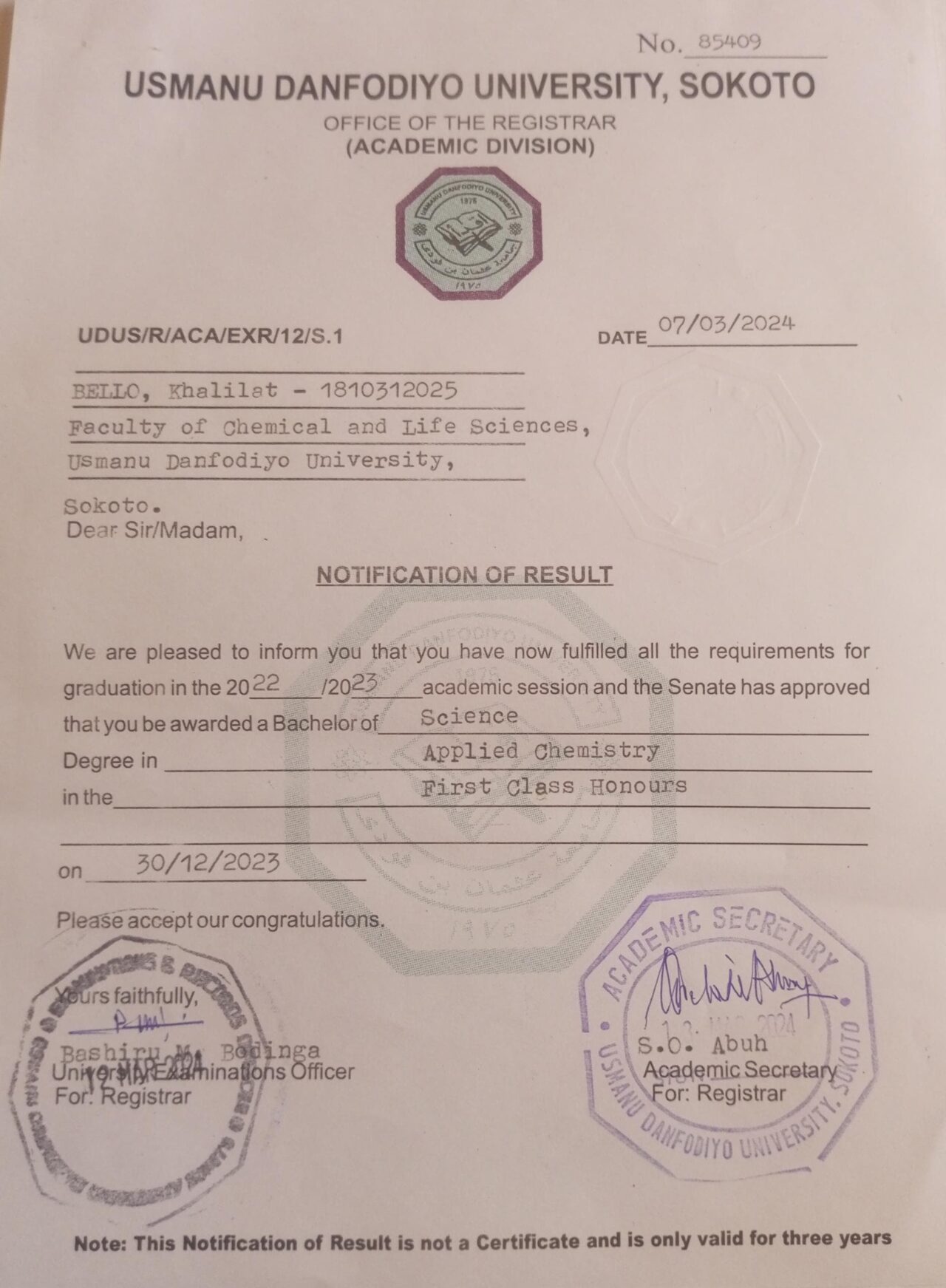
In the world of education, some paths are straightforward, while others are winding, challenging, and filled with unexpected detours. My journey towards obtaining an HND in Mass Communication at Abubakar Tatari Ali Polytechnic (ATAP) in Bauchi State, Nigeria, certainly falls into the latter category. It’s a tale of determination, sacrifice, and the unwavering support of family, mentors, and friends.

The story began in early 2020 when a conversation with my model, Abu-Ubaidah Ibrahim Kuna, led to my contemplating furthering my education. During my diploma days, I had already embarked on a professional course, Mass Communication, but some circumstances are forcing me to delve into sociology. Abu-Ubaidah’s advice struck a chord in my heart, prompting me to reconsider my choices.

Yet, life had its complexities. I was now a family man, responsible for providing for my loved ones. Pursuing my passion for Mass Communication while residing in Gombe seemed daunting. The course was unavailable nearby, and sponsorship was scarce. This predicament led me to opt for sociology. As they say, “In the absence of desirability, you make the availability your desirability.”

As fate would have it, the Direct Entry application period had elapsed, and waiting for another year was not a viable option for me. I thought of returning to Abubakar Tatari Ali Polytechnic in Bauchi, but the distance from Gombe presented its challenges. Who would sponsor my education and care for my family during this journey?

With courage and determination, I applied for HND in Mass Communication at ATAP and, to my delight, secured admission. In November 2021, I embarked on a motorcycle journey from Gombe to Bauchi State, joining my fellow students as lectures had already commenced.

As if the journey had become more challenging, I found myself in Stream B, paying registration fees every semester without a sponsor. However, divine intervention came through my elder brother, Jubril Salihu (Baban Hajiya), who provided much-needed support.

Balancing lectures and providing for my family back in Gombe was no easy feat. I travelled back almost every week, seizing every opportunity for sustenance that came my way. Skipping breakfast and even lunch became the norm, but our determination to succeed remained unshaken.

The challenges were numerous, from putting food on the table to completing assignments with limited resources. Still, we pressed on, making our presence known inside and outside the classroom as we joined the school unionism.

Our lecturers, especially Mal. Abdul Ahmad Burra singlehandedly led us to the membership of the pen profession, Mal. Nazir Abba Pali and Mal Abdul Rasheed Bala Tulu were pivotal in our journey. They nurtured us into aspiring journalists, and our articles began appearing in renowned Nigerian dailies and online media outlets. Friends like Muzaffar, Adams, Raheenert, Bello class rep, Jalam, Alpha, Aliyu, Yahya, Ibrahim, Wale, Usaina, Saeedah, Celestina, A’isha, Rinret, Anas, Baba Fema, Baba Damina and many others became our pillars of strength.

I would be remiss not to express my gratitude to my family, especially my parents, brothers and sisters, the heads of department at ATAP, my mentors, and Dr. Saidu Wanzami, who supported us during our educational journey.

In the face of adversity, we persisted. With the unwavering support of our loved ones and mentors, we overcame the obstacles on our path. Our journey to an HND in Mass Communication is a testament to the power of perseverance, determination, and the support of a strong community. As we graduate, we look back with gratitude and forward with hope, ready to embrace the challenges that lie ahead, knowing that with faith and resilience, nothing is impossible.

Usman Muhammad Salihu writes from Jos, Plateau State, Nigeria, and can be reached via muhammadu5363@gmail.com.

Climate change will affect everywhere: Are we at more risk?

By Saifullahi Attahir

Our grandparents used to remember with nostalgia how, in the past  50 years, they usually had a high-yield harvest yearly-round in the farms and surprisingly with total abstinence from using fertilisers and other modern additives. The bushes are full of trees of all sorts, vegetative forests with various colourful and nutritious leaves, guavas, mangoes, paw-paw, and dates, to name a  few. A farmer was almost always sure to have a sufficient harvest for the family with little manure from his domestic animal dungeons. They always harvest enough to feed themselves and their families, even more for the neighbourhoods.

Surprisingly, today, with all the powerful tools for mechanical farming, with all the ‘Almighty’ fertiliser, with all the agricultural institutions, with all the army of PhDs in academia, we harvest less and less. For the past two decades, our weather has constantly fluctuated with no certainty of what to crop this year or next. For instance, a  farmer would cut rice this year on clay land and experience drought, so precisely the following year, when he decided to switch to grains ( millet or sorghum), which would perfectly suit the dry land, unexpectedly, there would be a massive flood.

I live in Jigawa State and had first-hand experience with this scenario. Our farmers constantly switch between sesame (‘ridi’), groundnut, millet, and even rice. Places once dry land for sorghum and groundnut are now perfectly turned into rice farming lands. If you are doubting, come to areas around Sara town in Gwaram Local Govt, Jigawa state.

Jigawa state was initially named ‘Jigawa’  because of the large number of dry land primarily available for farming crops requiring less water. How are these vast areas becoming a mix-up, and even some submerged below water? How did we arrive arrived at this juncture? Why do we experience more floods and erosion disasters yearly?

Some of those answers are written on the wall as an effect of climate change caused by man-made activities that we failed to take any heed or measures. Some of those effects result from our ignorance to look into our environments and how we take care of our stomachs. These effects result from continuously perpetuating natural resources to satisfy our insatiable human greed.

Over the past decade, scientists and the media have been constantly alerting the populace on the danger that global temperature changes pose to the living conditions we are currently enjoying. Some of those warnings were already in effect in many parts of the globe. Research has shown how the continuous depletion of the ozone layer by emission from fossil fuel by our engines and industries poses a  great danger to the protection we once enjoyed from the Sun. The direct ultraviolet radiation from the heating Sun is no longer protected by the ozone layer, making it descend directly into our atmosphere. This led to the increased rise of the earth’s temperature to a fraction of a degree. The earth’s temperature has reached almost 2°c ( degree centigrade), with future expectations to reach 3°c.

The rise in earth’s temperature led to the constant melting of polar ice in the global North around Greenland. If you don’t know, these ices served as a pillar to the seas, habitation of billions of aquatic life, and a source of living for humans. If that ice melts, it will continue to kill those animals, shifting the ecological balance to the negative. Not only that, but mass migration of those living around the Poles would lead to overcrowding in other parts of the world, probably Europe or Africa.

Most of the current danger of global warming was caused by the developed Nations in the global North, especially Europe, which for over 200 years possessed engines that constantly polluted the air with carbon. Those countries include the US, UK, Germany, Russia, and China. Ironically, the underdeveloped countries in the global South are at the receiving end of the punishment, where floods, famine, earthquakes, storms, desertification, erosions, and drought constantly threaten them. The global South countries at constant risk of global warming are Pakistan, India, Indonesia, South America, and West and Sub-Saharan Africa.

One of the effects of global warming that people hardly pay attention to are as follows ;

1) Whenever any part of the world experiences a flood, famine, or earthquake, that part automatically becomes uninhabitable, and most of its inhabitants tend to migrate to safer places and greener pastures, especially cities. This would lead to overcrowding of urban areas, the creation of more slums, an increased crime rate, fewer job opportunities, and a reduction in the available land for farming and farmers themselves. These are the natural causes of food insecurity we see daily, the natural causes of the xenophobic attacks we hear daily, and the natural causes of the immigration problem we experience daily.

2) Overgrazing of the land without proper ways of replenishing and the constant encroachment of those specific forests and environments reserved for nomadic livestock in Northern Nigeria have forced the Nomadic Fulani to travel far to Southern Nigeria in search of pasture. This would automatically cause some altercation regarding rights, privacy, and intrusion, which causes the constant farmer-herders conflict escalating and metamorphosing into something else.

3) Many of those Fulani were now barren of their millennia-old source of livelihood (livestock) or were forced to abandon the practice because of the scarcity of grazing fields through encroachment by expanding Government or Private projects ( roads, railways, colleges, companies, hydroelectric dams). Worse, they could not attend schools or learn modern skills and mostly lived deep in the forest, so Government social amenities were scarce or absent. What do you expect from this scenario: aged old frustration accumulating over the years of negligence, ignorance, poverty, despair and envy? So those kinds of young idle minds can become a devil’s workshop if care is not taken. It’s easy to convince them through propaganda to carry weapons, which we now see as a form of banditry, armed robbery, kidnappings, and terrorism.

4) We have been witnessing the constant conversion of places once ecological habitats reserved for forestation and farming various food crops that our lives depend upon. These places are now becoming Universities, companies, barracks, airports, hotels, and rail tracks. These activities lead to less land for farming despite the exponential growth in the world population, hence the less harvest. This is the cause of hunger. Hunger leads to conflict, wars, illness, and debasement of human capital development.

The effect was not only caused by the developed Nations. We, too, have our share of the problem. I’m sure everyone raised in a rural area is aware of the constant deforestation by our people to gather burning sticks, and the worrying part is we cut the trees without planting others in their place. According to research, we need to plant ten trees instead of each one we cut down. But the sad story is that we are not even practising 1 for 1 (i.e. cut down one tree and plant one tree).

Sub-Saharan Africa is constantly threatened by desert encroachment, which would only be averted by planting more trees, especially along our roads and desert belt. People living around Jigawa State are aware of the continuous desertification yearly by metres in previously non-desert environments. This has a human and economic cost.

 Over the past five decades, the world has continually witnessed the gradual extinction and disappearance of many species of plants and animals from the earth’s surface whose research shows they enormously contribute to the stability and maintenance of ecological equilibrium. For instance,  vultures were once abundant over the skies, contributing to the degradation of carcasses that pollute the air, but today, rarely can you spot the vultures.

Hyenas, tigers, elephants, kangaroos, giraffes, swans, and thousands of other sauna and floras in aquatic and terrestrial forms were nowhere to be found. Some of those missing animal species have migrated to other parts of the globe with favourable weather. At the same time, many were wiped out through perpetual game hunting industrial and chemical poisoning. Did we know the catastrophic effect of the disappearance of these species from our planets?

It’s unsurprising that one day, humans too may start migrating to more favourable weather conditions if adverse climatic effects ravage them.

Some of the popularly known places affected daily by climate change include Jakarta, one of the world’s most densely populated cities in Indonesia, with floods destroying homes and lives every year. Hurricane Katrina in the US was a storm and mighty wind that destroyed houses, bridges, and humans. Makoko Slum in Lagos, Nigeria, is a densely populated area above water, inhabited mainly by immigrants searching for job opportunities from the deserted rural part of the country. Auyo in Hadejia Jigawa State, an area stretching many local Governments yearly affected by floods and erosion, causing devastating destruction and loss of human lives. Greenland is part of the globe at the far north pole around Antarctica. Those places are mostly covered with ice, but today, this ice melting rapidly, causing migration of the people around those parts.

The climate change effect is putting the world into a dilemma, with rising sea levels on the one hand and extreme drought and desertification on the other.

Some archaeological exploration has shown that today’s mostly desert Middle Eastern world flourished with vegetation and abundant water, lives, and different aquatic and terrestrial species. It’s only time that would tell whether we are retracing back to that same period conditions.

SOLUTION

Finally, the developed nations should continue diversifying their energy source through electric vehicles, solar stations, biodegradable energy, and hydroelectric power sources to abandon the toxic fossil fuels that pollute the atmosphere with excess greenhouse emission gases ( methane and carbon monoxide).

Also, the global South, including Asian, African, and Middle Eastern countries, should embrace conserving our God-given resources by planting more trees, regulating deforestation, and creating robust public awareness of the importance of Ecological Conservation.

Saifullahi Attahir wrote via saifullahiattahir93@gmail.com.
The Marital Mosaic: Beyond love – key elements that sustain marriage

By Aisha M Auyo

Rider: “In the intricate tapestry of marriage, love is but one thread”.

Marriage is not just the union of people who are genuinely in love with each other. It requires a whole lot of other factors to keep it going. I can confidently tell you a marriage can exist without love if the other factors exist. Our grandparents and generations before them have done it, and the divorce rate was very low compared with ours. Their marital relationship is stronger than ours, which capitalises on love.

Theirs is a relationship built on patience, understanding, selflessness, respect, belief in qadr, devotion, and peace. Not on lust. Not on love. Not on desire. Not on physical look. Not on avarice. It is almost the total opposite of marriage nowadays.

A strong marriage is determined by the sacrifices and struggles a husband and wife go through and their ability to stay strong and be patient with each other. There is no marriage without problems, issues, or tests. Even in the noble house of our Rasool, SAW, they had issues. From small ones that involve petty actions fuelled by jealousy within the wives to bigger problems that involve an accusation of adultery levied against Aisha, RA, also known as the “event of Ifk“, which can be traced to Surah An-Nur.

Couples should try not to give up when undergoing tests, DIVINE TESTS such as poverty, infertility, illness, polygamy, etc. Please understand that I am not saying we should condone HUMAN MADE CHALLENGES such as bad character, SERIAL infidelity (there may be exceptional cases of being victims or moments of weakness which should not be more than once), abuse of any kind, (mental, verbal, physical, or emotional), etc. We should be able to explore the fine line between Allah’s tests and man-made issues.

Allah says in the Qur’an, “We will test you with something of fear, and hunger and loss of wealth, and souls and vegetation. And give glad tidings to those who have patience. Those who, if in any difficulty or trial, or tribulation occurs to them or happens to them, they say: ‘Verily we are from Allah and to Allah we return.’ They are those who will receive prayers from their Lord and Mercy, and it is those who are guided.” Al baqarah.

The missed nuances in Northern Nigerian marriage customs, emphasising materialism over the essential attributes of lasting matrimony, have contributed immensely to the high divorce rate in our community. Parents neglect the core aspects of marriage and pay more attention to the superficial and materialistic aspects. Instead of counselling their kids on how to live with each other, the groom side will be busy making plans on ‘Kayan life‘ and ‘gida na gani na fada’. The bride side will be busy buying expensive furniture and ‘gara’, ‘kada a raina mu‘. The couples will be busy organising ‘Instagrammable’ wedding events that will trend for a week.

At least, the bride’s family does not joke with kayan mata and little Nasiha on ‘Yi, nayi, bari na bari’, ‘A yi haquri’. But on the groom’s side, no one says anything to him regarding how to live his life with the bride.

Then, after all the events, reality sets in. Expectations not met. The pretence energy is exhausted. Before you know it, ‘hide my ID’, parents’ intervention and divorce will happen. In less than five years, the marriage will be dissolved, with two or three innocent kids involved.

Many people would look at the marriages and successes of others and wish they were them, not knowing how much they struggled to get there or the sacrifices they made to succeed in their marriages.

In sum, I have delved into the enduring factors that fortify matrimonial bonds beyond love, drawing wisdom from the timeless legacy of our forebears. The essence of patience, understanding, selflessness, respect, belief in destiny, devotion, and peace is the age-old recipe for marital success. How strong unions are forged through trials and sacrifices. I hope this will guide parents and couples in nurturing resilient marriages by shedding light on the struggles behind seemingly idyllic unions.

May Allah make it easy for all those going through hardships in their marriages and protect us from such calamities, amin.

Always remember that, with divine guidance and patience, weathering marital storms can lead to stronger, more enduring love.

Aisha Musa Auyo is a Doctorate researcher in Educational Psychology. A wife, a mother, a homemaker, caterer, parenting, and relationship coach. She can be reached via aishamuauyo@live.co.uk.

Tinubu’s dwindling image in the North

By Zayyad I. Muhammad

Before and during his 2023 presidential campaign in the North, Bola Ahmed Tinubu was a household name among the ordinary citizens in the North. Now, President Tinubu’s public relations (PR) image in the north is fast dwindling; the Christian community is still bitter with the All Progressives Congress’s (APC) Muslim-Muslim ticket in the 2023 presidential elections, and the Muslim majority is feeling sidelined in the Tinubu government despite their massive vote for the APC during the 2023 presidential elections.

The Tinubu government has some of the best minds in public relations (PR) and the media space in its media team, but the truth of the matter is that Tinubu’s PR image in the north is dwindling and suffering, so to speak. What went wrong?

First, to be fair to Tinubu, he has allocated some good positions to the North according to its ‘rights’, but it was poorly communicated, and the appointees are in a kind of incommunicado with the North.

Secondly, many people, even outside the north, felt that the southwest had taken most of the ‘lucrative posts’—well, it is normal for any president to bring on board his own economic teams, including the people that he knows too well and has confidence in them to deliver his agenda and his party’s manifestos. Tinubu has the right to appoint anyone he wishes to, but unlucky for him, his predecessor’s actions and inactions will be used to gauge his government’s actions and inactions. President Tinubu couldn’t have jettisoned a little bit of this privilege—the idea of appointing only the people he knows too well in his economic team and close aides—since he succeeded a Buhari government that was highly accused of nepotism.

Thirdly, Tinubu’s government interaction with the north appears limited to the high echelon of society; thus, the people at the bottom of the ladder who were told that the Muslim-Muslim ticket would be ‘their government’ now feel they’re sidelined and were misled.

Fourthly, the Tinubu media and public relations teams are good, but they’re disconnected from the real north; they are not sufficiently aware of the approach and ‘language’ to talk to the north, especially APC’s strongholds. A good example is the recent CBN’s lifting of FOREX restrictions on 43 items. The general belief in the north is that the government has opened the borders for rice, maize, and other farm produce; thus, it is a direct attack on northern farmers and rice mills in the north. Up until now, there is no explicit explanation in a language, and from the ‘faces’ the northern farmers and rice millers will understand and believe.

Lastly, the Tinubu government is missing one point: it basically campaigned in its strongholds in the north on the fulcrum of the Muslim-Muslim ticket; now, its body language is that it has tilted away from the north’s political and economic interests; thus, even the ulama ( the clergies) who  ‘campaigned’ for it, is now not talking on its behalf; in fact, many of them are hammering the government. The Muslim-Muslim ticket is like an albatross to the APC, which the party must carry till and after the 2027 presidential elections; it has to continue to ‘nurture’ it like a nursing baby and also, at the same time, prove to its opponents that there is no harm in it.

What Tinubu should do: his subsequent appointments and policy pronouncements should try to pacify the north, especially the APC’s strongholds. Politics is about reward systems, and Tinubu is a master of reward systems in politics.

Secondly, appointees from the north should be visible and reachable to their communities. Many people in the APC’s strongholds in the north don’t even know some people from their folds are now appointees in the Tinubu government.

Thirdly, as earlier said, the Tinubu PR and Media team is good, but it must still be jack-up with more people from the north who know the ‘language’ and have faces that the north will understand.

Lastly, and most importantly, the Tinubu government should constantly inform the north of its efforts and activities in the areas of security, agriculture, and youth programmes in a way and in a language the north will understand and appreciate.

Zayyad I. Muhammad writes from Abuja. He can be reached via zaymohd@yahoo.com.

On our nonchalant attitude towards preserving and maintaining infrastructure

By Muhammad Dauda Muhammad

About two years or so, I was in Jimeta, the capital city of Adamawa State, where I went to visit my family. And, from my observation, the city had witnessed a significant infrastructure improvement and, more significantly, the roads. 

I was amazed to see many areas where new roads were constructed. In the past, I would have never imagined that those places would one day be tarred, but all thanks to the former and the present administrations.

Now, I will state what triggered me to develop this piece. During my visit, I noticed something ill about people’s behaviour towards the new road infrastructure put in place to ease their daily routine, especially in the rainy season. 

Though I am not an engineer by profession, from experience, I know that roads that have already been constructed don’t need any form of substance to stay on them, be it water, oil or anything such. But instead, for people to be more careful and ensure the cleanliness of the roads, they choose to make the drainages built beside the roads for the successful passage of water a place to dump wastes. However, this act congested the drainages, thereby resulting in the stoppage of the water flow, making it spilt all over the roads.

Forget about Adamawa state, which is like a development area compared to states like Lagos and Kano. Kano State is not an exception when it comes to the issue of lack of maintenance of infrastructure. Looking at the ongoing road construction along Gwarzo Road, one will wonder why and how a whole road construction company will block a road for years, all in the name of construction, which is causing more damage to the already constructed road than is good. I am referring to those places they blocked planning to build a new roundabout.

This negligence didn’t stop on properties owned and controlled by the government alone but also in learning institutions like ours. Look at the Ibrahim Gambari Square, built and commissioned a few years ago and the first on our campus. 

Almost all the features set for the beautification of the facility have lost their structure. The fine bulbs that lighten and brighten up the place at night, the concrete chairs that students use to sit and catch a glimpse, the taps that splash water stylishly in the air, and the water flow system that has already been blocked. 

It has not stopped there, but some roads need urgent attention due to eruption, not to mention the grasses that have taken over so many places, greatly threatening the people and the environment.

NB: this piece is not an exposè but a mere candid call to all concerned citizens, both from the public and those in authority, to work collectively in ensuring a transparent and dirt-free society.

Muhammad Dauda Muhammad is a final year student of Mass Communication, Faculty of Communication, Bayero University, Kano. He can be reached via muhammaddaudamuhammad@gmail.com.