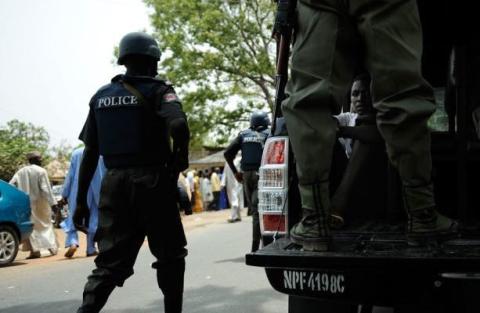
Nigeria Police Force

Police accidentally shoots Taraba governor’s sister during gunmen ambush

By Uzair Adam 

Atsi Kefas, the sister of Taraba State Governor Agbu Kefas, sustained injuries after being accidentally shot by a police escort during an attack by gunmen on Thursday.  

According to reports by Zagazola Makama, a counter-insurgency publication focusing on the Lake Chad region, the incident occurred along Kente Road in Wukari Local Government Area of Taraba State. 

Our reporters gathered that Atsi and the governor’s mother, Jumai, were travelling together when their convoy was ambushed.  

In an attempt to repel the attackers, a police officer providing escort for the family mistakenly shot Atsi Kefas.  

Troops quickly intervened, rescuing the victims and evacuating Jumai and Atsi Kefas from the scene via an air ambulance. 

Atsi was immediately taken to a hospital for treatment, although her current condition remains unknown at the time of this report.  

Security forces recovered the vehicle used by the assailants, along with an empty magazine and passenger luggage left behind by the attackers.

Police officers divert N43m from cargo worker, NPF reveals

By Uzair Adam 

The Nigerian Police Force (NPF) has uncovered how three police officers attached to Zone 7 Headquarters, Abuja, illegally diverted N43,160,000 from a cargo worker at the Nnamdi Azikiwe International Airport in August 2023.  

According to a statement released on Wednesday by the Force Public Relations Officer, ACP Muyiwa Ogunjobi, the officers—Inspector Ekende Edwin, Inspector Esther Okafor, and Sergeant Talabi Kayode—acted on the directives of DSP Peter Ejike. 

They unlawfully arrested Andrew Ejah, an employee of FATFAD Cargo Nigeria Limited, who was transporting N74,950,000 on behalf of clients.  

The officers reportedly detained Ejah at Zone 7 Headquarters and falsely declared that only N31,790,000 was recovered. They allegedly demanded a portion of the funds in exchange for suppressing the case.  

Upon receiving a petition from the owners of the missing funds, the Force Headquarters assigned the IGP Monitoring Unit to investigate. 

The unit recovered N31,790,000 from the officers, who maintained that it was the total sum confiscated during Ejah’s arrest.  

Further investigations revealed that the officers had tampered with evidence. Photographs taken at the time of arrest, showing the full amount, were allegedly lost after the phone used was damaged. 

However, forensic analysis exposed their conspiracy to divert N43,160,000 and move it out of the Federal Capital Territory (FCT) for safekeeping.  

The statement also addressed circulating reports accusing Inspector-General of Police Kayode Adeolu Egbetokun of shielding a cartel involved in smuggling new banknotes from the Central Bank of Nigeria. 

The NPF dismissed the claims as false and part of a smear campaign to divert attention from the officers’ misconduct.  

“The implicated officers have been suspended and face prosecution for serious misconduct, tampering with exhibits, abuse of office, and corrupt practices,” Ogunjobi added.  

The NPF urged the public and media to disregard false narratives aimed at tarnishing the Inspector-General’s image and undermining ongoing police reforms.

Police arrest two, rescue four children from traffickers in Rivers

By Uzair Adam

Operatives of the Rivers State Police Command have rescued four children from an alleged child trafficking ring and arrested two suspects linked to the crime.

The children, aged between one and thirteen, were reportedly found at Alaeze Guest House in the Rumukwachi community of Obio/Akpor Local Government Area, where they were allegedly being held before being handed over to a nurse identified as Loveth, who runs a maternity home.

Grace Iringe-Koko, the Public Relations Officer of the command, stated that the hotel manager played a key role in uncovering the situation.

“The Managing Director of the Guest House became suspicious of the activities of one Esther Anthony, who attempted to check out with the children. He insisted that she provide proof of being their mother,” Iringe-Koko explained.

In response, Anthony left the premises and returned with police officers, accusing the manager of abducting the children and threatening her with a firearm.

However, the manager contacted the Choba Area Command, leading to Anthony’s arrest.

Further investigations revealed that Anthony had conspired with another suspect, identified as Favour, to traffic the children from Swali community in Bayelsa State.

Another accomplice, Purity Silas, was also apprehended in connection with the case.

In a startling development, a family in the Rumuodara area of Port Harcourt identified Anthony as the person who had previously stolen three of their children and sold them to Loveth.

The suspects have reportedly confessed to the crime and are now in police custody, with the case transferred to the State Criminal Investigation Department (CID) in Port Harcourt for further investigation.

Police arrest tailor for alleged teen trafficking

By Uzair Adam

Police have arrested a woman suspected of trafficking teenage girls from Eku, Ethiope East Local Government Area of Delta State, to neighboring African countries for prostitution.

Sources revealed that the suspect, who runs a tailoring shop, allegedly lured girls who came to sew clothes with promises of lucrative jobs abroad.

“She convinced them by painting a picture of better opportunities overseas,” a resident said.

It was also gathered that several parents had been questioning the woman about the whereabouts of their daughters before her arrest.

“One of the girls disclosed to a family member that the tailor facilitated her travel plans,” another source added.

A police official from the Abraka Division confirmed the arrest, stating that the suspect has been transferred to the Police Headquarters for further investigation.

Borno police recover 8 unexploded devices, reassure public of safety

By Uzair Adam 

The Borno State Police Command has successfully recovered eight unexploded devices from the Dala and Gwange areas of Maiduguri, the state capital. 

This discovery was made on Friday following distress calls about unidentified objects suspected to be explosive ordnance.

According to ASP Grace Michael, the command’s Deputy Public Relations Officer, the police received a distress call about unidentified objects clustered near an uncompleted building in the Dala-Abuja Talakawa Area, Maiduguri. 

The police swiftly moved to the scene and recovered six projectiles and one unexploded mortar bomb.

Later that day, the police received another distress call from the Gwange Area about an unidentified object washed ashore on the Gwange river bank. 

The police quickly recovered one unexploded Hand Grenade (UXO).

Preliminary investigations revealed that the ordnance was washed ashore due to the recent devastating flood incident in the state. 

The Borno State Commissioner of Police, CP Yusufu Lawal, reassured residents of the command’s commitment to ensuring public safety and security.

Police rescue baby sold after abduction by nanny

By Uzair Adam 

A 14-month-old baby, Grace Osamagbe, who was abducted in April by her nanny, has been rescued by the Edo State Police Command. 

The Commissioner of Police, Umoru Ozigi, disclosed the development during a briefing in Benin on Saturday. 

According to Ozigi, operatives from the Anti-Kidnapping and Cyber Crime Unit apprehended the nanny, Rejoice Chukwu, 24, and her boyfriend, Destiny Uchechukwu, 28, in Uyo, Akwa-Ibom State. 

The pair had abducted the child in Benin, collected a ransom of N160,000, and subsequently sold her for N500,000 to Doris Chiwendu in Owerri, Imo State.

Police investigations further led to the arrest of Chiwendu and another accomplice, Jane Amaigbo, in Ubomiri, Imo State. 

The baby was rescued on November 9, following extensive questioning and tracking by law enforcement.

The police commissioner confirmed that the suspects would soon face charges in court.

Community policing a panacea to security challenges in Nigeria

By Abdullahi Mukhtar Algasgaini

Community Policing is a strategy that focuses on developing relationships with community members. It is a highly personal philosophy of full-service policing in which an officer patrols the same area for some time and develops a partnership with citizens to identify and solve problems.

Community Policing came to Nigeria in 2004. The main aim of launching the pilot scheme was to bring the police closer to members of the public and, by extension, get prompt information that the earlier concept of this initiative resulted in the formation of vigilante groups in communities and cities across the country, ostensibly to combat rising crime waves in the face of the police’s inability to deal effectively with armed robbery and other violent crimes.

Examples of such operations include Civilian JTF in Borno State, Amotekun in Lagos State, Zemda Initiated by Zazzau Emirate, and police constabulary in some of the majority parts of the Nigerian police headquarters and divisions across the nation.

The question here is, in whose interest is Community Policing? People have different views on the question above, and their answers vary based on their perceptions. Some see it as in the government’s interest, some in the community’s interest, and some in the interest of both parties (government/community).

Firstly, the side of the community will have a more favourable view of their local police department in the sense that they will be able to check the activities of the police department with the help of the newly emerging community police. It is believed that the Nigerian police force often releases or cooperates with criminals. 

Secondly, on the government side, it will help collect more accurate information from residents regarding criminal activity in the community. Many public safety agencies use technology to engage their residents better and boost their community Policing initiatives. 

Implementing community policing will change the policing structure and management. The partnership that develops over time can help the police discover the underlying causes of crime within the neighbourhood. By involving the community, the police have more resources to assist in crime prevention. Officers who familiarise themselves with community members are more likely to obtain valuable information about criminals and their activities.

Some of the benefits of community Policing in Nigeria include: 

First and foremost, community Policing provides an expanded Outlook on crime control and prevention. Working together, the community and the police would proffer solutions to incessant crimes and insecurity. 

Similarly, community Policing improves the quality of life of everyone in a community and helps police work more efficiently and effectively in curbing the outbreak of crime in a community.

Since the implementation of community Policing in 2004, has this policy had any implications (positive or negative)? Given the nation’s current situation, we can say that the policy has achieved nothing because the level of crime is constantly increasing and penetrating all the nooks and crannies of the nation.

Community policing can only be developed in Nigeria if the government and politicians stop using it to achieve their goals. Members must undergo physical and excellent selection before joining vigilante groups, and the community must support the people who sacrifice themselves for it.

Police refute allegations of officer involvement in robbery incident

By Uzair Adam

The Yobe State Police Command has dismissed a report published by an online media outlet alleging that two of its officers were involved in a recent robbery in Potiskum.

According to a statement from DSP Dungus Abdulkarim, the police spokesperson, the Command also denied accusations of obstructing court proceedings or protecting the accused officers.

The report, titled “Police disrupt court proceeding, take out colleagues accused of robbery in Yobe,” was described by Abdulkarim as “misleading and malicious.”

He clarified that no police personnel invaded a magistrate’s court to secure the release of any accused.

“There is no record of any robbery incident involving police personnel in Potiskum or elsewhere in the state,” Abdulkarim emphasized.

Setting the record straight, Abdulkarim stated that on February 23, a collision occurred between a truck and a motorcycle in Potiskum.

ASC Abubakar Umar from the Nigerian Correctional Service sought bail for the driver, which was granted, but the police retained the vehicle due to an ongoing investigation and the victim’s treatment. When Umar intervened, he was detained for obstruction.

The Area Commander subsequently ordered police personnel to return to their station, as the case involved a Fundamental Human Rights issue beyond the magistrate’s jurisdiction.

The Yobe Police Command has demanded that the media outlet retract the report and issue an apology or face legal action.

Meanwhile, the Nigerian Bar Association (NBA) Yobe Chapter has called on the Commissioner of Police to investigate the case and ensure adherence to court orders.

17-year-old student arrested for “faking” abduction, death

By Uzair Adam 

The Imo State Police Command has detained a 17-year-old undergraduate, Jesse Chidiebere, from Imo State University (IMSU), for allegedly faking her own kidnapping and death. 

ASP Henry Okoye, the Police Public Relations Officer, released a statement in Owerri confirming the incident.

According to Okoye, the staged abduction caused severe distress to Chidiebere’s family and the university community. 

The incident unfolded on the night of October 26 when a message from Chidiebere’s WhatsApp account claimed she had been abducted and killed, directing her family to confirm the news at the Orji Police Station.

Acting on a distress call from concerned citizens, police launched an investigation, only to discover the following morning that Chidiebere was safe and that the incident was a social media prank. 

The police spokesperson noted that an investigation is ongoing to determine her motives, and Chidiebere will face prosecution. 

Commissioner of Police Aboki Danjuma expressed disappointment over the “irresponsible behaviour,” noting that the incident wasted valuable resources and caused unnecessary public panic. 

He advised parents to caution their children against dangerous pranks and the spread of misinformation.

“The command is dedicated to tackling misinformation and maintaining public safety throughout the state,” Danjuma emphasized.

Arms proliferation and the Nigerian security forces

By Zayyad I. Muhammad

Mallam Nuhu Ribadu, the Nigerian National Security Adviser, stated during an arms destruction exercise organised by the National Centre for the Control of Small Arms and Light Weapons (NCCSALW) that many of the illicit weapons currently used by terrorists and bandits originally belonged to the Federal Government of Nigeria. 

Ribadu’s revelation may not surprise those familiar with the complexities of Nigeria’s security challenges, but it is both new and alarming to the average Nigerian.  

For many, the realisation that those entrusted with their protection are selling weapons to terrorists, insurgents, and bandits is deeply unsettling. This issue demands a coordinated and strategic response. However, Mallam Nuhu assured us that steps and measures have been taken to resolve this. 

But the big questions remain: Are these measures yielding sustainable results? What motivates or drives a security agent to sell weapons to terrorists and bandits, fully aware that they may become the first target of those very weapons? 

Nuhu Ribadu stated, “The worst human being is a policeman or soldier who takes weapons from his unit and sells them or hides them for criminals to use against his colleagues.” This is true; however, additional measures are needed beyond what the NSA has mentioned to address this issue. These should include improved welfare and salaries for security personnel, enhanced training, and stronger supervision. It’s important to consider that the actions of some security officers may not be solely motivated by money but by radicalisation or frustrations. 

Nigeria must prioritise the use of technology in its fight against insurgency, terrorism, and banditry, as the world has moved beyond relying solely on boots on the ground. It is crucial to employ technology to address these challenges, including implementing chips or inbuilt devices to track and attach every weapon assigned to the officer responsible for it. 

Despite the few rogue elements within the security forces who recklessly jeopardise their lives and those of their colleagues and families by exchanging their weapons for peanuts, we must commend the majority of Nigeria’s dedicated soldiers, police officers, and other personnel who are actively working to recover illicit arms and eliminate corrupt practices within the security forces. 

On the other hand, sabotage by rogue elements within security forces is not unique to Nigeria; many countries have faced situations where insurgency, terrorism, or banditry were exacerbated by these elements selling arms to militant groups.

In Yemen, amid its civil war, there have been instances of arms diversion by corrupt individuals within the security apparatus. Weapons intended for the national army have ended up in the hands of Houthi rebels and various militant groups. 

Similarly, during the conflict with ISIS in Iraq, reports emerged of Iraqi security forces losing control of arms depots or selling weapons to militant groups. Somalia has seen similar issues in its battle against al-Shabaab, where government and security officials were accused of selling or diverting weapons to the very militants they were fighting. 

Another notable example is Libya. Following the fall of Muammar Gaddafi in 2011, the country descended into chaos, with various factions and militias vying for control. Weapons from government stockpiles, as well as arms supplied by international actors, were sold or transferred to militias and insurgent groups, further escalating the violence. In the Democratic Republic of Congo (DRC), armed groups have long been involved in the conflict, with reports indicating that elements within the military and police forces have sold weapons to these groups.

For any country grappling with the involvement of its security forces in the sale of weapons to insurgents, terrorists, and bandits, factors such as selfishness, corruption, and complicity within these forces play a significant role. Additionally, weak institutions and inadequate oversight have further exacerbated the problem. 

 Zayyad I. Muhammad writes from Abuja via zaymohd@yahoo.com.