Education

First-class is not rocket science: You, too, can make it (II)

By Tordue Simon Targema

Shun examination malpractice and set for yourself a standard:

Integrity is a virtue, imbibe it in your academic journey. At all cost, shun examination malpractice and avoid all occasions that might lead to it. Typically, poor preparation and keeping bad companions are the main motivations for examination malpractice. The effects of this act on your academic integrity are adverse.

Once your lecturers know you as the type that indulges in examination malpractice, they are inclined to doubt all that they see in your script as a product of cheating and give you weak grades on the grounds of suspicion.

Excellent grades are for students that are exceptionally good, and not for cheats. Strive to be exceptional and keep your integrity intact by avoiding malpractice in all its manifestations.

Be punctual and disciplined

Avoid coming late to the class and seating where you’ll be distracted. Except it becomes absolutely necessary, always be punctual to your classes so that you get the best from the lectures.

It is important also that your teachers know you as a serious student so that they can vouch for you even in your absence.

But when you are known to be unserious, the reverse is always the case, and the tendency is always there for them to generalize your lackadaisical attitude to studies even when you have a case.  

Attendance to lectures is non-negotiable

No matter how brilliant you think you are, attendance to lectures is sine qua non. Yes, some lecturers might truly have nothing new to teach you.

But what happens in the event of an impromptu test? What if a lecturer decides to use attendance of the particular class you miss as his CA?

As a student desirous of uncommon academic feats, you must make it a point of duty to attend all classes except in the case of unforeseen eventualities.

Avoid having issues with your teachers and course mates

This is another great obstacle to academic excellence. As much as you can, avoid issues with your teachers, course representatives and fellow students.

In the event that a misunderstanding ensues between you and a lecturer or students, always endeavour to resolve it and correct the impression immediately.

Never leave the impression in your lecturers or fellow students that you are the arrogant type. You never can tell where you’ll need them to defend you in your absence.

Humility is a virtue

Be humble, arrogance is an obstacle to academic excellence. A humble student is naturally attractive to his lecturers. Conversely, all lecturers detest arrogant students and take away all occasions of grace from them.

An arrogant student is, thus, on his own when he needs grace from his lecturers. Be teachable and let people advice you. Endeavour to take all positive advices seriously.

Listen to people who have made it, have role models and emulate their lifestyles, read motivational books, watch motivational movies and equip yourself adequately with good counsel.

Be positive minded

Always tell yourself that you can make it. This keeps you constantly motivated and tells you that your aspiration is possible. Ban all negative vibes and sources of discouragement, and never give up until it becomes practically impossible to keep the pursuit.

For instance, even in my final year, many people kept telling me that first-class is not possible! I had to defy them and keep a positive mind.

Many of my mentees entered into first-class CGPA range only in their final year!

However, it was their relentless struggle in the past levels that sustained their CGPA and provided it with adequate buffers to sustain the eventual first-class result.

Social media addiction is a weakness, and so with all other addictions

In today’s Internet age, the social media have emerged as the biggest distractions to students. Many students are on Facebook, WhatsApp, Instagram, Tik Tok, Twitter and the rest all day!

Much as these present rich educational opportunities and complement one’s academic journey, addiction to them is disastrous and keeps one perpetually defocused. Today, students actively chat with friends on the social media during lectures and class presentations.

There could be no other distraction as serious as this. To make the best out of the social media as one strives for academic excellence, avoid 24/7 dependence on the social media, draw boundaries accordingly and stick to them. There is, indeed, time for everything. 

Overcome the endemic scourge of laziness

Laziness is a natural trait that is common to all human beings. To excel in your academics, you must be seen making deliberate effort to overcome it.

The ability to overcome laziness distinguishes you from other students and makes you exceptional.

Once you overcome laziness as a student, a substantial chunk of your academic huddles has been defeated for good.

Conclusively, it is important to note that everyone has his/her weak points that serve as impediments to their academic aspirations. While some of these are generic as discussed in the points above, some are uniquely peculiar to an individual’s immediate physical, economic and psycho-social environments.

As a student aspiring for academic excellence, you must, as a matter of expedience, identify your own weaknesses and work assiduously towards overcoming them. This is the only way you can distinguish yourself from others and pave your way to the much-coveted excellence.

May the Almighty God, the Giver of knowledge and understanding, help us to attain academic excellence in our various disciplines.

I wish Dr Vincent Nduka Ojeh a wonderful birthday celebration and more fruitful years ahead in his meritorious service to humanity.

Tordue Simon Targema is a lecturer in the Department of Journalism and Media Studies, Taraba State University, Jalingo. Email: torduesimon@gmail.com

First-class is not rocket science: You, too, can make it (I)

By Tordue Simon Targema

A senior colleague in the department of Geography, Taraba State University Dr Vincent Nduka Ojeh has invited me to present a talk to mark his birthday celebration with students at Omas Royal Academy, Jalingo. The topic was: Basic Tips for Academic Excellence.

Dr Ojeh has, over the years, developed the habit of celebrating his birthdays with secondary school students to mark the world “Call to Earth” day.

Over the years, he has used the occasion to share with the students, vital tips on climate change and best practices for safeguarding the ecosystem, as well as the basic tips that will enhance their academic, personality and career developments.

In the invitation call he put across to me for this presentation, Dr Ojeh said something that motivated me to develop an elaborate presentation for publication for a larger audience beyond his target students: “Bros, First Class is not rocket science, come and tell these students what the secret is.”

With these words, I have decided to give a deeper reflection on some of the vital tips that are required to propel one to academic excellence. Like Dr Ojeh rightly said, First Class is not rocket science.

After graduating with a first-class bachelor’s degree in 2014, I successfully mentored over a dozen students who also replicated the same feat both in my discipline and in other fields of study.

One thing that is obvious from the onset is that regardless of the discipline or institution, some basic tips are necessary to enable students attain this uncommon academic feat.

This essay gives a brief rundown of some of these tips with a view to guiding students on how best to attain academic excellence.

Students aspiring for academic excellence must, therefore, take special note of the following:

Avoid procrastination

This is one of the biggest obstacles to academic excellence. “There is still time” is the commonest excuse students give in their lackadaisical attitude to studies. Always endeavour to perform all academic tasks on time and don’t wait for the “last minute” as anything can come up and serve as obstacle when you are already out of time.

Always read ahead of timeand don’t wait for examination to come before you start reading. A serious student exhausts his syllabus right ahead of time and only revises during exam, while the lacklustre sorts wait for examination timetable to start reading.

At this point, tension is high, the brain is already tensed and confused, and understanding is extremely difficult.

As a serious student desirous of making good grades, read ahead of time, reconcile all grey areas right on time and prepare for examination before it eventually arrives.

Always read your notes after school

At this point, the lecture is still fresh in your memory. Go through your notes once you reach home and freshen up. Reconcile your notes with your friends, make sure they’re up-to-date and ensure you seek clarification for all grey points from your study circle, the library sources or online resources.

The mistake most students make is that they keep on taking notes and would never revisit them afterwards until it is time for CA test or examination.

Before that time comes, most salient points in the lectures have escaped their memories and reconciling the notes with the lectures becomes extremely difficult. Always go through your notes as the lecture is still fresh in your memory.

Read widely and consult extensively

Don’t limit yourself to lecture notes and hand-outs. Be hungry for knowledge and endeavour to know as much as is required of you.

Consult extensively to enrich your knowledge base. Discuss with your friends, consult your lecturers, visit the library and explore internet resources etc. to ensure that you are truly vast in your discipline- and other related disciplines too.

Knowledge has no bounds, and no knowledge is a waste, it’ll sure come handy someday. In today’s internet age, an unlimited volume of knowledge is deposited on the internet. Avail yourself the opportunity and explore extensively to satiate your academic and intellectual thirst.

Time management is of high essence

Equitable utilization and allocation of your time as a student is key to academic excellence. Sadly, most students lack this skill. As a student, you are faced with a lot of tasks- academics, social, religious, campus politics, business and lots of that.

Allocate your time for these various tasks accordingly based on priority and always make up for lost time the best you can in the interest of your studies.

Take all your courses seriously

It doesn’t matter whether it is a core course, elective or GST course. As long as you register a course, it is your course! Regardless of its status, once you register a course, your performance in it has effect on your CGPA.

The mistake most students make is to take core courses seriously, or courses with “strict” lecturers seriously at the expense of other courses.

Remember that CGPA is cumulative and performance in each course invariably affects your overall performance.

Crossbreed ideas with your mates

Studying in a group makes understanding easier. Apart from your private studies, have a group of like minds that you crossbreed ideas and enhance perspectives on issues discussed in the class.

Never allow others to dominate group discussions, always endeavour to contribute too and listen to others share their perspectives to the issues discussed as well.

That way, you’ll learn from them and refine your knowledge on your previous erroneous perspectives. Make your study groups lively, i.e. a give-and-take sort of arrangement where every member contributes to the knowledge pool for the benefit of all.

You don’t need to be stingy with knowledge, please share with others. Knowledge doesn’t finish when it is shared, but rather increases and gets more refined.

Avoid bad companions that put social life before academics

Keepingbad friends on campus is one of the biggest obstacles to academic excellence. Like the saying goes: birds of a feather flock together! Associate with like minds and people with the same priorities.

Colleagues who have different priorities have no business in your circle of friends.

To get your priorities right, you must purge your circle of friends and ensure that you only associate with like minds.

Remember, bad companions are a threat to your status as a student generally, not just your academic performance.

To be Continued

Tordue Simon Targema is a lecturer in the Department of Journalism and Media Studies, Taraba State University, Jalingo. Email: torduesimon@gmail.com

BUK student elected LAWSAN National President

By Ahmad Deedat Zakari

Comrade Yasir Abubakar, a 400 level law student of Bayero University Kano, has been elected the National President of the Law Student Association of Nigeria, LAWSAN.

The LAWSAN Electoral Committee, LECOM , declared Abubakar winner after he polled 30 votes in the election of the national executives of the association held at Swiss Spirit Hotel, Porthacourt on Friday night

Abubakar polled 30 votes to defeat his closest rival, Ann Lyam Iverem of Bingham University, Nasarawa, who polled 26 votes.

All efforts to reach the president-elect of the association as at the time of writing this report were futile.
However, Abdullahi Farouk , BUK LAWSAN President happily confirmed the development to the Daily Reality on Saturday morning.

According to Farouk, the victory is well deserved and they are grateful to God and Law students all over the country for the confidence in Abubakar.

He said: “We are extremely elated, It is a well deserved victory, because Yasir Abubakar has done his best, over the years he has served the association in different capacities, he has travelled across the regions and he has acquired all the skills necessary to steer the association to a greater height. We are grateful to God and the entire LAWSAN for reposing confidence in Yasir Abubakar. We assure you that you won’t regret choosing us.I pray that Allah make it easy for him to discharge his shouldered responsibilities effectively and efficiently”

KASU alumni honours outgoing Ag. VC, Prof. Ashafa

By Sumayyah Auwal Ishaq

With less than 48 hours to the end of his five months tenure as the Acting Vice-Chancellor of the Kaduna State University (KASU), Professor Abdullahi Musa Ashafa, has continued to receive commendations for remarkable successes recorded during his brief tenure as the Chief Executive of KASU.

During a mini-ceremony organized by the Kaduna State University’s Alumni Association (KASUAA), the Chairman of KASUAA, Alhaji Abdulhadi Abdullahi said that Prof. Ashafa has performed wonderfully well in the last five months. “The five months was like 5 years. It was like the tenure should not come to an end”

The University’s Advancement Director, Professor Bashir Ali commended the outgoing Vice-Chancellor for his achievements and leadership style. Prof. Ali prayed to God Almighty to grant Prof. Ashafa success in his future endeavours. An alumnus, Dr. Philibus Audu said “The success story which KASU has become under the leadership of this quintessential scholar, enig­matic and energetic personali­ty is worth celebrating”.

In his own remarks at the event, the outgoing Acting Vice-Chancellor, Prof. Ashafa said even though he had a very challenging tenure, he will remain thankful to Allah Almighty for everything. He said “As young people, remember to challenge yourself, face challenges to solve challenges. Remain kind, and never settle for being anything less than your best and the best you have learnt from our KASU. Thank you for your ideas, support, and most importantly, for sincere wishes and prayers. Allah knows best how to handle our situations and to Him we all defer our affairs”.

Don advocates responsible journalism to combat fake news

By Uzairu Adam Imam

To combat fake news and safeguard society from its adverse effects, Nigerians have been advised to check for elements of credibility in reports and consult media platforms with proven integrity in sourcing for news and information.

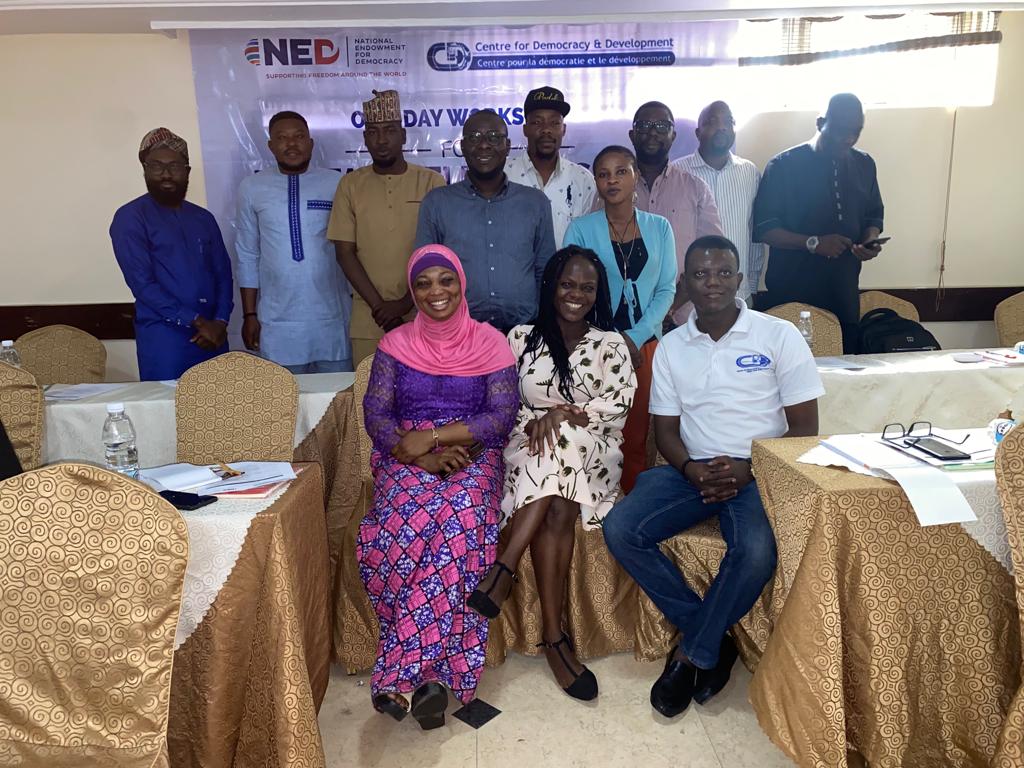
A lecturer in the Department of Mass Communication, Kano State Polytechnic, Mallam Aisar Fagge, made the submission during a one-day workshop organized by the popular online newspaper The Daily Reality.

The lecture themed “Fake News on Nigerian Cyber Space: The Role of an Ideal Journalist” afforded young journalists the opportunity to understand the challenges of contemporary journalism practice.

Mallam Fagge said, “It is said ‘seeing is believing’ but not anymore. With Deepfake [and other apps], people can easily manipulate videos, pictures, etc. Thus, we need to dissect pieces of information before sharing them,” he stated.

He also called on the general public to examine stories critically before believing or sharing them with other people.

He further noted that fake news could be countered by applying the “technological, journalistic and pedagogical approaches among others.”

He noted that the nature of social media has made journalism more tasking and placed more responsibility on journalists, which behooves them to protect the image of journalism and not allow quacks to run them out of business.

Journalism educators, practitioners from conventional media and online newspapers as well as the students of Mass Communication from Kano State Polytechnic and Bayero University, Kano attended the event that took place on Sunday, 6th November, 2022 at the Centre for Research in Nigerian Languages, Translation and Folklore, BUK New Site.

FUL students struggle with accomodation issues

By Ahmad Deedat Zakari

The students of Federal University, Lokoja, FUL, are not finding it easy as they are confronted with the accommodation problem.

Weeks after the university resumed academic activities, following the suspension of the Academic Staff Union of Universities, ASUU strike, many students are stranded. Many are yet to find a place to live.

The tenancies of most students had expired during the ASUU strike. However, the continuous stay of some students whose tenancies expired had led to quarrels between them and their landlords.

The problem of accommodation in Nigerian universities is not peculiar to FUL students. However, the students are devastated as the school has no functional hostel on the two campuses.

The Daily Reality spoke to many students of the institution who were mainly afraid and sought to speak only on the grounds of anonymity.

A student said many of the departments had been moved from the Adankolo Campus of the institution to the main campus at Felele, and students were asked to begin lectures there in January. According to her, the students can not afford accommodation on the two campuses and are still writing examinations on the Adankolo Campus. She also said landlords are unwilling to take part payments for the remaining months in Adankolo Campus.

Other students narrated their ordeals of living with friends and relatives pending when they get accommodation.

It was also gathered that the flood, which ravaged many parts of Lokoja, is another reason accommodation has become more complex and expensive.

Kaduna Gov’t rescinds decision on nominal fees collection in schools

By Sumayyah Auwal Usman

Amidst public outrage, the Kaduna State Executive Council, under Governor Nasir Ahmad El-Rufa’i, has rescinded its decision on the collection of nominal fees in senior secondary schools across the state.

In a statement signed by the Special Adviser to the Governor (Media & Communication), Mr Muyiwa Adekeye on Tuesday said, “the Council observed that the circular issued by the Ministry of Education to school principals on collection of nominal fees is not consistent with government policy, and is thus invalid. The circular from the Ministry of Education to the heads of schools, dated 1st November 2022, is therefore rescinded with immediate effect, and all monies that may have been collected should be refunded forthwith”.

Adekeye further reaffirmed the state government’s commitment to providing free primary, secondary and technical/vocational education to every child resident in the state.

It would be recalled that a memo emanated from the State Ministry of Education imposed the payment of nominal fees to all students of senior public secondary schools in the state.

The other side of Almajirai

By Sulaiman Maijama’a

Almajiri System, over the last few years, has come under intense pressure, greeted with mixed reactions by stakeholders, especially in northern Nigeria. Many people have written many pieces on the negative consequences of the system, ascribing it to be one of the underlying causes of poverty, hunger, and insecurity, among other social vices in northern Nigeria. For this reason, it has been a topic of debate. Some call for repositioning the system, and some agitate for its total abolishment. In contrast, others argue that it should remain as it is today.

Undoubtedly, the present-day Almajiri system is, to a greater extent, different from what was obtainable in the pre-colonial era, hence the need for a review. Before British colonisation, the system, aside from the authorities’  high recognition and promotion, had enjoyed the support of other major stakeholders, such as the community, the parents and the pupils. So also, the whole financial burden of the system was being taken by the authorities with public funds. These indicate that the Almajiri system in those days was somewhat formal and, therefore, more organised.

However, the magnitude of the attack the system has now come under has given it a distorted image. It has developed a stereotype in some people, so much so that on the mention of the word “Almajiri”, the first connotation that comes to mind is negativity – illiteracy, poverty, hunger, dishonesty, insecurity and all sorts of social vices.

The word “Almajiri” is a derivative of an Arabic word, “Al muhajirun”, which could be traced right from the migration of Prophet Muhammad (peace be upon him) from Makka to Madina. Those who migrated with the prophet to Madina were called ‘Al-Muhajirrun’, meaning migrants. In Nigeria, the word “Almajiri” refers to those, usually teenagers, who are sent by their parents from respective villages and settlements to urban centres in the quest for Qur’an knowledge.

2014 UNICEF report estimated the number of Almajiri conservatively to be 9.5 million in Nigeria, predominantly in the northern part. If all of them were a nuisance, as widely believed by some people, the situation of our region would be worse than we could imagine. 

There is no doubt that there are bad eggs among them, which applies to every category of people. But, as much as bad eggs, there are equally good ones among the Almajiris who have passed through the system and become successful in different facets of life.

Almajiris excelled

Adamu Garba, a former Nigerian presidential aspirant, in an interview with the Punch Newspaper, says the Almajiri system in northern Nigeria produced some of the wealthiest men, including Africa’s pride, Aliko Dangote and the founder of BUA Group, Abdul Samad Rabiu, amongst others. Garba said he was once an Almajiri before he acquired Western education.

When asked whether the Almajiri system promotes terrorism, Garba said Boko Haram has no connection with the Almajiri system because of the dichotomy between Islamic denominations in northern Nigeria. “So, it is very unlikely that you have an Almajiri man becoming a Boko Haram,” he told The Punch.

Garba also mentioned that many business giants are products of the Almajiri system. “Again, if you go to [the] Kano market, most of the rich people in the market are Almajiri. They came through Almajiri, they were able to get [the] necessary training in the Almajiri institutions, and they were able to get to where they are.”

Similarly, several renowned Islamic scholars were once Almajiris. A typical example is Sheik Muhammad Bin-Uthman.

Testimonies from people

Some people interviewed narrated how their encounters with some Almajiri lefts them with a memorable impression.

Abdullahi Muhammad, a resident of Kobi, an Almajiri-dominated area in Bauchi, narrated how an Almajiri once returned his valuable lost items.

“I once forgot my valuable properties around my house. I gave up finding them, but to my surprise, an Almajiri found and returned them to a nearby mosque. It was announced after a couple of days. I claimed ownership and recovered my items intact. I was surprised [at] how honest the boy was.”

In an interview, Aisha Abubakar, a housewife in the Kobi area in Bauchi, revealed that she had two little Almajis coming to help her with housework.

“Two little Almajis come daily to help me with some housework — they fetch me water, wash clothes, and sometimes I send them on an errand. I give them food and sew them clothing when they go home during holidays. For the past two years, they have been coming. They are honest”, she said.

Maryam Abdullahi, another housewife in the Gwallaga area, Bauchi, said she retained an Almajiri who, apart from helping her with housework, teaches her little children Arabic alphabets.

“I have an Almajiri that comes on Thursdays and Fridays to give Qur’an lessons to my children. I’m happy now that my children are good in the Arabic alphabet and Qur’an recitation, courtesy of the lesson they receive from this boy ( the Almajiri). I cannot thank him enough.”

When asked how honest and disciplined she finds the Almajiri, she said, “I send him uncountable times with money to buy foodstuff and other items, and I always find him unblemished.”

Murtala Aminu (Ɗankasuwa), a trader in an Almajiri-dominated area, when asked how he finds the Almajiris around him, he asserted that their stay in the area is a blessing.

“They recite the Qur’an every blessed day and night. This gives us tranquillity and peace of mind. In addition, we cite them as an example for our children to emulate their hard work searching for knowledge. Many of them memorised the Qur’an by heart. What could be more delightful?”.

We take good care of Almajiris under our watch — Almajiri teachers

When interviewed, some Almajiri teachers revealed to us how they strictly manage the Almajiris under their tutelage to be well brought up and face the realities of life early.

Mallam Muhammad Shafi’u Inuwa, an Almajiri teacher in Sabon Gida Tsangaya school, said, “under our school, we have about a  hundred Almajiris. We raise them early in the morning to take classes between 5:00 am and 10:00 pm. In the afternoon, we allow them to work to earn a living. At night, between 8:00 pm and 10:00 pm, is also time for classes. We ensure that all the Almajiris return to their apartments when it is time for sleeping.”

On his part, Mallam Khamisu Ali (Gwani), another Almajiri teacher, said, “we try in this Tsangaya (Almajiri school) to imbue in them (the Almajiris) the spirit of hard work. Moreover, we encourage them to be self-reliant because to work and earn a living is better than to beg; that is why we allow them on school-free days (Thursdays and Fridays) to acquire skills.”

When asked whether the parents of the Almajiris come to check on their wards, Mallam Gwani said, “we are in contact with their parents. We face some challenges regarding this, but plans are underway to make it necessary for every parent to come in person and check on their wards at certain intervals.”

Regarding learning efficiency, Mallam Gwani stated that they had produced brilliant reciters, some of whom memorised the Qur’an by heart as teenagers.

Some Almajiris do not beg nor chant for food

In their efforts to face the realities of life and actualise self-reliance, some Almajiris interviewed claimed to have never begged nor gone to houses chanting for food

In this interview, a teen Almajiri, Zaharadden  Manu, explained how he sustains his life by harnessing and utilising the skill he learned back home before he was taken to Almajiranci.

“Every day after school hours, I go around nearby communities to do shoe shining, and it earns me a living. Then, on Thursdays and Fridays, I fetch water to housewives for food or money”, he said.

Musa Aliyu is an ambitious Almajiri who reconciles Qur’an learning and hand work. When asked where he sees himself in the decade, he said, “I see myself in the future as an educated person and a business owner with employees under me. I pursue this dream to the best of my ability.”

It was observed that on school-free days, markets and commercial centres get populated with Almajiris who do different works to earn some money to live on.

Give Almajiris the atmosphere to harness their full potential – Educationist

Comrade Abdullahi Yalwa, an educationist lecturer with the Department of Crimes Management and Control, Abubakar Tatari Ali Polytechnic, Bauchi, opined, “I think that abolishing the system may not be realistic or so easily achieved. What should be done is to review and revise to align with realities. There is a correlation between nature and nurture, and the two must synchronise to give an effective and responsible person. If one is bound to succeed if given a better condition, he would be double or triple or would be in the book of record for the exceptional display of talent.”

Comrade Yalwa further said, “to maximise the benefits and reduce or eliminate the negative effects of the system. Parents need to be responsible by sponsoring their children when searching for knowledge. They should give them enough resources to manage themselves, visit them periodically, give them what they need in terms of their basic need and also appreciate the person taking care of them in order not for him to use them as slaves.”

On what the government and relevant authorities should do, Comrade Yalwa recommended that “the Almajiri teachers ought to be registered by the government, and a maximum number of students should be allotted to each, and they should have the basic necessities, especially accommodation facilities, where people have a responsible and decent life.”

Maijama’a is a student at the Faculty of Communication, Bayero University, Kano and wrote via  sulaimanmaija@gmail.com.

Why persons with disabilities need education

By Ibrahim Tukur

Persons with disability, otherwise known as differently-abled individuals, encounter immense challenges that leave them at the mercy of socioeconomic underdevelopment. Due to their disabilities, they often struggle to survive. Those with profound physical challenges, especially blindness, spinal cord, leprosy, and cerebral palsy, cannot but resort to financial dependency to survive.

Consequently, street begging, considered taboo in some societies, is rampant among persons with a disability thanks to the lack of governmental and societal support towards the welfare of persons with disability.

Apart from persons with hearing impairment, most persons with a disability depend on begging to survive as they are not physically fit to do some work. What is more worrisome, to say the least, is the fact that many persons with disability family men struggle to ensure end meets. Some would have to go to big cities where people are more charitable to do begging and return home as soon as they are financially well-off.

In some cities like Lagos and Abuja, where many persons with disability make substantial income, the ban on street begging has been imposed. Thus, the sources of livelihood of these people are adversely affected.

Although street begging is a condemnable offence, the imposition of such a ban without proffering any practical solution to the problem is seriously unfair, and almost cruel. 

Even though this lingering problem can be resolved by establishing Social Security Disability Benefits, the needs of persons with disability can not be totally satisfied, thanks to Nigeria’s economic feeble.

All persons with disabilities need education and skills to become financially, economically and intellectually independent. Disability is no longer a barrier to education since the inception of special education in Nigeria in the middle of the nineteenth century.

The government of all levels should do everything possible to make education accessible for all persons with disability. Many special schools should be constructed and well-equipped with special instruments and materials.

Parents with children with disabilty should do the needful by sending them to school where they will acquire sound knowledge that will enable them to turn their disabilities into abilities.

Education is compulsory for all persons with disability. When all persons with disability are educated, life will become easy for them. They won’t have to roam on the street begging. Even if they are unemployed, they can start their own business and get as much money as they like.

Ibrahim Tukur is a 400-level deaf student at Bayero University, Kano. He is a disability rights advocate and proponent of deaf childrens education. He wrote via inventorngw@gmail.com.

Insecurity weakens Nigerian education, increases number of school drop-out – Minister

By Uzair Adam Imam

The Minister of Education, Adamu Adamu, said the lingering security challenge in Nigeria had weakened the country’s education system.

The minister said the insecurity in the country also contributed to the rising number of out-of-school children today.

He disclosed this on Thursday in Abuja during the ministerial session of the 66th National Council on Education (NCE).

In the event themed ‘Strengthening of Security and Safety in Nigerian Schools for the Achievement of Education 2030 Agenda, Adamu said the issue would soon be addressed.

He added that President Buhari’s administration was working tirelessly to reduce the number of out-of-school children and the illiteracy level in the country.

He said, “I’d like to call on all states to rise up to their responsibilities and provide a safe and secure learning environment for both students and teachers.”

Furthermore, the education minister also said that all schools must be safe and secure at all costs.