Admin

Nigeria condemns military coup in Guinea-Bissau, demands return to civil rule

By Abdullahi Mukhtar Algasgaini

The Federal Government of Nigeria has strongly condemned the recent military coup in the Republic of Guinea-Bissau, labeling it a blatant violation of regional democratic principles and a threat to West African stability.

In a press release issued on Thursday, the Nigerian government expressed “profound dismay” over the military insurrection that led to an unconstitutional change of government.

It described the coup as an action that undermines democratic progress and constitutional order in Guinea-Bissau and the wider sub-region.

The statement called for the “immediate and unconditional restoration of constitutional order,” and demanded the safety and security of all detained persons.

It also urged respect for the country’s democratic institutions.

Nigeria specifically called on the new authorities in Guinea-Bissau to guarantee the safety of all election observers still in the country.

It advised all actors to exercise restraint, prioritize peaceful dialogue, and respect the will of the people as expressed through their votes and the official election results.

The warning was clear: those responsible for the coup “will be held accountable for their actions, which threaten to plunge the nation into chaos.”

As a key member of the Economic Community of West African States (ECOWAS) and the African Union, Nigeria pledged to work with regional and international partners to “take all necessary measures” to ensure a swift return to constitutional governance in Guinea-Bissau.

President Tinubu mourns renowned Islamic scholar, Sheikh Bauchi

By Abdullahi Mukhtar Algasgaini

President Bola Tinubu has expressed profound sadness over the death of the revered Islamic leader, Sheikh Dahiru Usman Bauchi, who passed away on Thursday at the age of 101.

In a statement released on Thursday, the President described the late leader of the Tijjaniyya Muslim Brotherhood as a “moral compass” who dedicated his life to teaching and preaching.

President Tinubu stated that Sheikh Bauchi’s loss is monumental not only to his family and followers but also to the entire nation. He recalled the blessings and moral support he received from the cleric during the 2023 presidential election campaign.

“Sheikh Dahiru Bauchi was a teacher, a father and a voice of moderation and reason. As both a preacher and a notable exegete of the Holy Quran, he was an advocate of peace and piety. His death has created a huge void,” the President was quoted as saying.

The President extended his condolences to the Sheikh’s multitude of followers across Nigeria and beyond, urging them to immortalise the late cleric by holding on to his teachings of peaceful coexistence, strengthening their relationship with God, and being kind to humanity.

Zohran Mamdani and the triumph of inclusion: A lesson for Nigeria

By Abdulhamid Abdullahi Aliyu

When Zohran Mamdani, an Ugandan-born politician of Indian descent who migrated to the United States, emerged victorious as the new Mayor of New York, it became more than just another electoral story from America. His triumph resonated across continents, sparking global conversations on representation, inclusion, and the reawakening of civic trust in politics. For many, Mamdani’s victory symbolised a powerful statement that character, vision, and authenticity still matter in the age of polarisation.

Mamdani’s path to City Hall was anything but easy. As an immigrant, a Muslim, and a progressive voice, he faced a storm of hostility from powerful circles. President Donald Trump and billionaire Elon Musk, among others, were said to have thrown their weight behind his opponents, amplifying fears that his immigrant roots and socialist ideals made him unfit for leadership. Yet, against all odds, Mamdani not only survived the onslaught but emerged stronger, armed with nothing but a clear message of hope, justice, and inclusiveness.

What made Mamdani’s campaign remarkable was not just his defiance of elite power, but his connection with ordinary people. His grassroots outreach, his emphasis on social housing, education, climate action, and racial justice found resonance among New York’s diverse electorate. He spoke to their realities, not to their fears. In doing so, he rekindled faith in participatory democracy, the belief that leadership should reflect the people’s shared struggles and aspirations, not the privilege of a few.

It is no coincidence that Mamdani’s rise echoes that of other reform-minded figures who emerged from outside political establishments. His campaign defied the dominance of corporate funding and media bias, relying instead on volunteerism, small donations, and community-based mobilisation. That model reminded the world that authenticity, not affluence, is what truly earns public trust.

Back home in Nigeria, Mamdani’s story holds profound lessons. Our political system remains heavily tilted in favour of the wealthy and the well-connected. Elections are often a contest of money, not merit. The idea of a young, visionary leader without financial backing or godfather support ascending to power still sounds utopian. Yet his victory invites reflection. What if Nigerian politics began to reward credibility over connections? What if the masses recognised their collective power to shape outcomes beyond inducements and ethnic sentiments?

Mamdani’s triumph also reinforces the value of civic enlightenment. His message cut through misinformation because citizens were engaged and aware. In Nigeria, the recurring crisis of leadership is not only about corrupt elites but also about the disempowered electorate that allows manipulation to thrive. Real change begins when citizens see themselves as active participants in governance, not passive observers of elite bargains.

Beyond politics, his story underscores the beauty of diversity as a source of strength. America, despite its contradictions, remains a land where the son of immigrants can become a city’s chief executive. In Nigeria, where diversity often fuels division, Mamdani’s ascent serves as a reminder that inclusion is not a weakness but a path to unity. The more our institutions reflect the country’s social mosaic, the more legitimacy they command.

The lesson from New York’s new Mayor is therefore clear: leadership that listens, represents, and uplifts will always triumph over propaganda, money, and prejudice. For Nigeria, it is not enough to envy its victory; we must internalise the principles that made it possible: sincerity, civic participation, and justice. Mamdani’s win is not just a political event; it is a mirror reflecting what genuine democracy could look like when people, not power, decide.

Abdulhamid Abdullahi Aliyu is a journalist and syndicate writer based in Abuja.

Three girls rescued as Hisbah intercepts human trafficking in Kano

By Uzair Adam

The Kano State Hisbah Board has successfully intercepted a suspected human trafficking operation involving three underaged girls and two alleged traffickers.

Deputy Commander-General of Hisbah, Dr. Mujahiddin Aminuddin, confirmed the incident in a statement he personally shared with journalists on Thursday.

one of the victims

According to Dr. Aminuddin, the suspects—Habibu Idris, 45, from Roni Local Government Area of Jigawa State, and Basirat Tijjani, 58, a Christian from Oyo State—were apprehended under the Fagge flyover following a dispute that attracted the attention of residents.

Eyewitnesses alerted Hisbah officers, who quickly moved to arrest the suspects.The rescued victims, all from Kazaure in Jigawa State, are three girls aged between 14 and 17 years: Kubariyya Amadu, 14; Rukayya Umar, 17; and Rashida Usaini, 14.

The Agent

Dr. Aminuddin explained that Habibu had been transporting children from Kano to Basirat for financial gain, previously charging N10,000 per child but recently increasing the fee to N15,000.

Basirat’s refusal to pay the higher amount reportedly triggered the dispute that exposed the operation.

“Neither the woman nor her agent knew the exact destination of the children. Their only concern was the money,” Dr. Aminuddin said, adding that the children themselves were unaware of where they were being taken.

The Hisbah chief also voiced concern over rising parental negligence, noting that some parents fail to prioritize their children’s education, health, and general wellbeing.

“Parents now see their own children as a burden, which is why some willingly hand them over without questioning their safety or future,” he lamented.

The suspects and victims have since been handed over to the National Agency for the Prohibition of Trafficking in Persons (NAPTIP) for further investigation.

Senate probes military withdrawal from Kebbi school ahead of bandit attack

By Uzair Adam

The Senate has mandated its joint committee on security to investigate the sudden withdrawal of military personnel from Government Girls Secondary School, Maga, Kebbi State, shortly before bandits attacked the school.

The committee is expected to report its findings within two weeks.

The upper chamber also tasked the joint committee to probe the circumstances surrounding the killing of Brig.-Gen. Musa Uba.

In addition, the Senate resolved to dissolve its standing committees on National Security and Intelligence, as well as the Air Force, with a view to reconstituting them.

The Senate leadership is also set to meet with President Bola Tinubu to brief him on the critical resolutions and views of the upper chamber.

These decisions followed a motion by Senate Deputy Leader Lola Ashiru titled, “Urgent Need to Address Escalating Insecurity in Kwara, Kebbi and Niger, Call for Immediate and Comprehensive Federal Intervention,” during Wednesday’s plenary.

Other resolutions included commending President Tinubu and security agencies for their rapid interventions and rescue of some kidnapped victims.

The Senate urged sustained coordinated operations until all abducted persons nationwide are rescued and perpetrators apprehended.

It also advised the federal government to strengthen local vigilance groups for swift responses to similar attacks and recommended a review of Nigeria’s firearm law to reflect current security challenges, similar to more than 175 countries where responsible citizens are permitted to own guns.

The Senate further resolved to pursue diplomatic engagement with the United States and other allied nations’ parliaments to strengthen intelligence sharing and counter-terrorism training to address Nigeria’s security challenges.

Members observed a one-minute silence in memory of the victims of recent attacks.In his contribution, Deputy Senate President Jibrin Barau highlighted the rise in insecurity across the country, linking it to international perceptions and the increased activities of terrorists.

“These heinous crimes show that those involved do not love our country. They move in convoys to commit atrocities. We should deploy technology to counter this menace,” he said.

Senate Leader Opeyemi Bamidele noted that many kidnapped persons from Kwara, Kebbi, and Niger have regained their freedom, emphasizing that government did not pay ransom but achieved successful rescues, a positive development amid ongoing security challenges.

When being a girl becomes a risk in Nigeria

By Ummi Umar

I write with a broken heart. A heart so bruised it feels shattered. There is no day I open Instagram, X, or WhatsApp without stumbling on another story that tears at the soul, another reminder that insecurity, banditry, and sheer lawlessness have become a constant shadow over this country. It almost never gets better for us.

For weeks now, it has been one tragedy after another. One kidnapping case replaced by the next. Little girls are taken from their schools. Families plunged into fear. We have reached a point where people whisper painful prayers like “may Nigeria never happen to me”, because we have watched the nation turn against its own.

Only last week, schoolgirls in Kebbi were abducted. And even though news has just broken that they have been freed, the joy of their return cannot erase the trauma of their ordeal or the deeper truth it exposes about our country. In that same week, more than three hundred students were taken from a Catholic school. These were girls who simply wanted to learn, to grow, to dream, to build a life. Their only “fault” was the desire to be educated. And then Nigeria happened to them.

There is no way to describe the agony of sending your child to school and then seeing on the news that she has been taken by ruthless, faceless men. You do not know whether she has eaten, whether she is being harmed, what fears she is battling, or what pain she is enduring. Is it a crime to be a girl child in this country? Why must she carry so much suffering on her small shoulders?

The rate of insecurity in Nigeria today is beyond alarming. And our leaders, what exactly are they doing? Must it be your daughter, your niece, your cousin, your wife before you feel any urgency? Must tragedy knock at your own door before you remember the weight of responsibility?

Those who lead us, those who hold authority, are meant to use every tool within their reach to protect citizens of the Federal Republic of Nigeria. Yet what do we see? Are they asleep? Is ordering schools to vacate the answer? When there is even a whisper of protest, government mobilises soldiers with unbelievable speed. But when children are carried away by bandits, the same urgency disappears as though the nation cannot see what is happening.

If you want to understand misplaced priorities, look no further than Nigerian leadership.

Sending students home is not a solution. It strips these girls of their fundamental right to education. And then what happens when they resume? Will the cycle of fear, evacuation and abduction continue? What truly is the way forward?

Our leaders must seek real, practical solutions to these recurring horrors. They must rise to their duties and be held accountable. Our girls are suffering. They are far too young to bear this kind of trauma. No girl, no child, no human being deserves this. No parent deserves the torment of knowing that their daughter is in the hands of men who may do only God knows what to her.

Our love, our prayers and our support remain with these girls and with their families. We thank God for the safe return of the abducted Kebbi schoolgirls, but we refuse to let that relief distract us from the painful truth that no child should ever have been taken in the first place. 

We continue to pray for every child still in captivity, and for the strength of the families waiting for their return. May our leaders finally be held accountable. May our girls be protected, truly and consistently. And may Nigeria never happen to any of us.

Rabi Ummi Umar is an intern at IMPR and can be reached via: rabiumar058@gmail.com.

Tinubu declares security emergency, orders mass recruitment into army, police

By Abdullahi Mukhtar Algasgaini

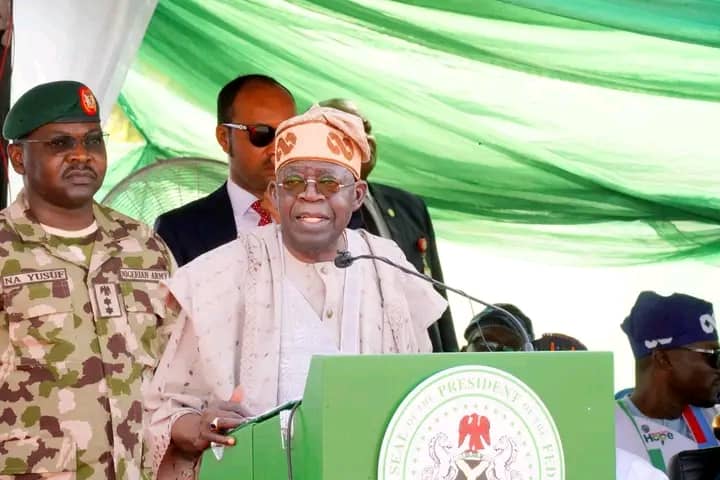
President Bola Tinubu has declared a nationwide security emergency and authorised the immediate recruitment of thousands of new personnel into the military and police force.

In a major address from the Statehouse on Tuesday, the President announced that the Nigeria Police Force is to recruit an additional 20,000 officers, a move that will bring the total number of new recruits to 50,000.

To accommodate the surge in trainees, the President has authorised the police to use various National Youth Service Corps (NYSC) camps as temporary training depots. He also directed that officers recently withdrawn from VIP guard duties undergo “crash training” before being redeployed to areas with high security challenges.

The announcement comes amid a wave of attacks and kidnappings across several states.

President Tinubu commended the security agencies for the recent release of abducted schoolgirls in Kebbi and worshippers in Kwara, but pledged to sustain efforts to rescue the remaining students of a Catholic school in Niger State and other hostages.

Outlining a multi-pronged strategy, the President also ordered the Department of State Services (DSS) to immediately deploy all trained forest guards to “flush out terrorists and bandits lurking in our forests.”

He declared, “There will be no more hiding places for agents of evil.”

In a significant political move, President Tinubu called on the National Assembly to review the nation’s laws to allow states to establish their own police forces.

He also advised state governments to reconsider the establishment of boarding schools in remote, insecure areas.

Addressing the farmer-herder crisis, the President urged herders to end open grazing, surrender illegal weapons, and embrace ranching, which he described as “the path forward for sustainable livestock farming and national harmony.”

He paid tribute to fallen soldiers, including Brigadier-General Musa Uba, and issued a stern warning to adversaries: “Those who want to test our resolve should never mistake our restraint for weakness.”

The President concluded by urging citizens to remain calm, vigilant, and to cooperate with security agencies, stating, “We are in this fight together, and together we shall win.”

Tinubu nominates ambassadors to US, UK, France

By Abdullahi Mukhtar Algasgaini

President Bola Tinubu has put forward the names of three non-career ambassadorial nominees for crucial postings in the United States, the United Kingdom, and France.

According to an announcement, the nominees are Ambassador Ayodele Oke, Retired Colonel Lateef Kayode Are, and Ambassador Amin Mohammed Dalhatu. Their specific country assignments will be finalized after they undergo a screening and confirmation process by the Nigerian Senate.

The nominees bring a wealth of experience in diplomacy and security to the roles.Ambassador Amin Mohammed Dalhatu is a familiar face in foreign service, having previously served as Nigeria’s Ambassador to South Korea.

He was first appointed to that position in 2016 under the administration of former President Muhammadu Buhari.

Ambassador Ayodele Oke, a graduate of Emory University in Atlanta, is a former Director General of the National Intelligence Agency (NIA).

He also has prior diplomatic experience from serving as Nigeria’s ambassador to the Secretariat of the Commonwealth of Nations in London.

Retired Colonel Lateef Kayode Are has a distinguished background in security and intelligence. He was the Director General of the State Security Service (SSS) from 1999 to 2007 and later served as the National Security Adviser in 2010.

His career also includes serving as an officer in the Directorate of Military Intelligence.

A highly educated officer, he graduated with First Class Honours in Psychology from the University of Ibadan in 1980.

The Senate is expected to schedule a screening date for the nominees in the coming weeks.

Customs board announces new appointments, promotions

By Abdullahi Mukhtar Algasgaini

The Nigeria Customs Service Board (NCSB) has announced the appointment of new top officials and approved special promotions for deserving officers.

The decisions were ratified during the board’s 64th Regular Meeting, held on Tuesday, November 25, 2025, and chaired by the Minister of Finance, Wale Edun.

The board confirmed the appointment of five new Deputy Comptroller-Generals (DCGs) and eight Assistant Comptroller-Generals (ACGs).

The new DCGs are Baba Imam (North-East), Isah Umar (North-West), Tijjani Abe (North-West), Timi Bomodi (South-South), and Oluyomi Adebakin (South-West).

The newly appointed ACGs are C.G. Ogbonna (South-East), I. Abba-Aji (North-East), G.M. Haruna (South-South), E.J. Edelduok (South-South), G. Gaura (North-West), I. Isyaku (North-West), M.S. Shuaibu (North-Central), and M.D. Malah (North-East).

According to the board, the appointments are intended to fill vacancies created by retirements and to strengthen strategic leadership across the service.

In a separate category, ten officers were granted special promotions for demonstrating “exceptional professionalism, leadership and outstanding service performance.”

Among those promoted are A.C. Fanyam and G.M. Shidali to Comptroller of Customs.

The board stated that these moves are part of ongoing efforts to boost morale, ensure leadership succession, and keep the service effective in tackling emerging trade and security challenges.