Admin

Military junta in Mali appoints general to replace removed civilian PM

By Anwar Usman

The military junta in mali has appointed a military officer Major General Abdoulaye Maiga on Thursday as the new prime minister, a day after sacking civilian premier Choguel Kokalla Maiga following his criticism of the military leadership.

Abdoulaye Maiga previously served as spokesperson yo the government.

The West African nation, plagued by jihadist and separatist violence, has been under military rule since successive coups in 2020 and 2021.

“Major General Abdoulaye Maiga is appointed prime minister,” read a decree issued by junta leader General Assimi Goïta and announced by the presidency’s secretary-general on the state television station ORTM.

Although Abdoulaye Maiga was not part of the initial group of colonels who overthrew the civilian president in August 2020, he quickly related himself with them and has since been promoted to general.

His appointment to replace the civilian prime minister appears to strengthen the military’s grip on power.On Saturday, Choguel Kokalla Maiga publicly criticised the lack of transparency regarding the transition to civilian rule.

In June 2022, the junta pledged to hold elections and transfer power to a civilian government by the end of March 2024.

However, elections have since been postponed indefinitely.

I can’t be sacked through press release, removed UNIZIK VC replies FG

By Anwar Usman

Prof. Bernard Odoh, the sacked Vice-Chancellor of the Nnamdi Azikiwe University, Awka, Anambra State, on Thursday, expressed concern over the method through which he was removed as the university’s VC, stating that it didn’t follow the due process.

Odoh’s concerns follow his sack and that of the university’s governing council over his purported “illegal” appointment.

In a statement issued on Wednesday by the Special Adviser on Information and Strategy to President Bola Tinubu, Bayo Onanuga, he stated that the Federal Government needed to wade in to address brewing tensions.

“The removal of the governing council and officials followed reports that the council illegally appointed an unqualified vice-chancellor without following due process.

“After the controversial appointment, the Federal Government stepped in to address tensions between the university’s Senate and the Governing Council of the 33-year-old institution.

“The government lamented over the council’s apparent disregard for the university’s governing laws in its selection process,” read the statement.

However, the removed VC, in an interview on Arise TV, maintained that he won’t accept his removal through a press release but rather after the recommendations of an investigating council.

He further stated that, “I’m not disobeying the President, but it is the governing council that will recommend my removal after investigating me,” adding that “Mr President could have been wrongly advised.”

“You can’t sack somebody you didn’t employ. The Visitor (Tinubu) appointed the council and the council followed due process to engage and give me a letter. He can’t remove me through a press release.

“There was no panel of inquiry. I was not appointed through a press release but rather by a constituted authority which followed a straightforward procedure,” he added.

The Academic Staff Union of Universities (ASUU) had accused the Governing Council of the institution of failing to follow due process in Odoh’s appointment and had demanded that the ministry dissolve the council over acts of illegality.

Simon Ekpa sentenced to prison in Finland for terror-related offences

By Abdullahi Muhammad

Simon Ekpa, a Finnish-Nigerian separatist and leader of a faction of the Indigenous People of Biafra (IPOB), has been sentenced to prison in Finland following his arrest for inciting violence and promoting terrorism. 

The Päijät-Häme District Court found Ekpa guilty of using his social media platforms to encourage terrorist activities, particularly in southeastern Nigeria, a region plagued by unrest.

Finnish authorities stated that Ekpa’s online rhetoric, including support for sit-at-home orders and calls for election boycotts in Nigeria, fueled violence that has disrupted communities in the region. 

Ekpa, who claims leadership of IPOB in exile, has been a controversial figure, previously linked to threats that led to his initial arrest in February 2023. Finnish police also detained four others for alleged involvement in financing terrorist activities.

Nigerian officials have long criticised Ekpa’s activities, accusing him of exacerbating instability. The Nigerian government has been in discussions with Finnish authorities regarding Ekpa’s influence, though legal hurdles and human rights concerns have complicated potential extradition efforts.

The case highlights increasing international cooperation to combat cross-border terrorism and raises questions about balancing free speech with accountability for incitement to violence.

BREAKING: Senate approves FG’s $2.2bn loan request

By Anwar Usman 

The Senate has approved President Bola Tinubu’s loan request of $2.2 billion to partially finance the ₦9.7 trillion budget deficit for the 2024 fiscal year. 

The approval followed the presentation of a report by the Chairman, Senate Committee on Local and Foreign Debts, Aliyu Wamakko, during plenary session. 

While leading the session, Deputy Senate President Jibrin Barau commended the committee for its swift action and thorough examination of the loan request. 

In a letter presented during the Senate and House of Representatives plenaries on Tuesday, Tinubu explained that the loan was integral to his administration’s fiscal strategy for the coming year. 

“The Presidential request for $2.2 billion, equivalent to ₦1.77 trillion, is already stated in the external borrowing plan for the 2024 fiscal year,” Senate President Godswill Akpabio stated while reading the letter. 

He further instructed the Senate Committee on Local and Foreign Debts to expedite its review of the request and present a report within 24 hours. 

“The Senate Committee on Local and Foreign Loans should, therefore, give the request expeditious consideration and report back within 24 hours,” Akpabio said.

Although the deadline was passed on Wednesday, the committee submitted its findings during Thursday’s plenary, leading to the loan’s approval. 

Details later…

One rotation, one strike

By Hussein Adoto Bello 

In the first rotation of my clinical training at a federal government university teaching hospital in North Central Nigeria, resident doctors went on strike to protest the kidnapping of their colleague in Kaduna. The government threatened “no work, no pay.” Students lost a week of clinical training. The victim wasn’t released until weeks later. 

When I reached the second rotation, I was greeted midway with a warning strike by consultants protesting the non-payment of their arrears. Classes came to a halt, and we, the students, had to hustle for an extension. 

Now, in the third rotation, the Medical and Dental Consultants Association of Nigeria (MDCAN) has declared another strike. Students will once again be the victims, but life will continue.

Medical students may be called the next generation of residents and consultants, but when push comes to shove, we are the first to be thrown under the bus. And then patients. Classes stop. Clinics and theatres become skeletal, attending only to critically ill patients and emergencies. 

For students, the situation becomes a matter of finding X, where X is the number of days, weeks, or months the “warning” strikes will go before they are suspended or transform into indefinite strains.

What can we do? Unlike Mour Ndiaye in The Beggars’ Strike, the people who put students in this limiting position don’t need us to survive. We don’t pull enough academic or professional weight to influence their advancements as doctors, consultants, and professors. They can resume whenever and however. 

Government officials know they can keep students at home for nearly a year without hurting their chances at the polls. The students may even fight tooth and nail for them. 

The never-seen-but-felt hands of the hospital and the university management don’t need student crutches to do as they please. Their appointment is not premised on how long students spend in school or patients’ satisfaction. Students and patients are all left to gnash their teeth in the Academic and Clinical Waiting Area while the royal rumble rages. 

It’s not easy, therefore, to try playing Nguirane Sarr. The clever blind beggar realised that beggars have services they can withhold in light of their harassment, which made a difference in The Beggars’ Strike

What do students have? Twitter/X hashtags and a lot of God abegs! Boycotting classes, clinics, and theatre may not help; it will only transform an acute case into a chronic one. 

Students in Algeria went on strike to demand more residency openings and accreditation of their diplomas. It’s been weeks, and the issue has yet to be resolved. 

Moroccan students revolted against the shortening of their programmes from seven years to six by declaring a strike in January. December is less than two weeks away.

Meanwhile, medical students here rarely face such massive blows at once. We adjust to the worsening learning difficulties until we graduate, leaving the next generation of students to endure the crucible. Resilience, after all, is an undeclared objective of medical training. 

We are not equally affected, either. A clinical student has a different worry than those still struggling with anatomy and biochemistry in preclinical classes. A strike by ASUU lecturers may not be felt in the clinics. Students in private schools are largely immune to what happens to their colleagues in government universities, and so on. 

For now, one can only hope—rather than expect—that the country establishes independent arbitration bodies for resolving labour issues promptly without sacrificing hapless students and patients at the altar. 

Such a body should include representatives from labour unions, the government, students, and neutral mediators to ensure impartial decisions are swiftly implemented. It should also be able to hold the government, employers, and labour unions accountable so that everyone can act with greater responsibility and not with the callous indifference that has come to characterise labour disputes in Nigeria. 

Besides, labour unions and student bodies should organise themselves into a powerful lobby force that can successfully push for policies that serve their interests instead of waiting to use strikes to protect them. 

More importantly, striking workers and the government should give students and patients an alternative to manage while they bicker. They should host virtual classes if they can’t come for physical ones. They should host clinics or virtual consultations if they can’t go for ward rounds and theatre sessions. 

Thankfully for students, the ṣégé (difficulty) of strikes comes in aliquots, so we build tolerance until the situation rankles less and resistance becomes pointless. We only have to survive in brooding silence until we can escape the system with our scars or embrace it—like Ramatoulayé in So Long a Letter.

Hussein Adoto writes via bellohussein210@gmail.com.

Apapa Customs Command sets new record with N2.014 trillion in revenue

By Sabiu Abdullahi

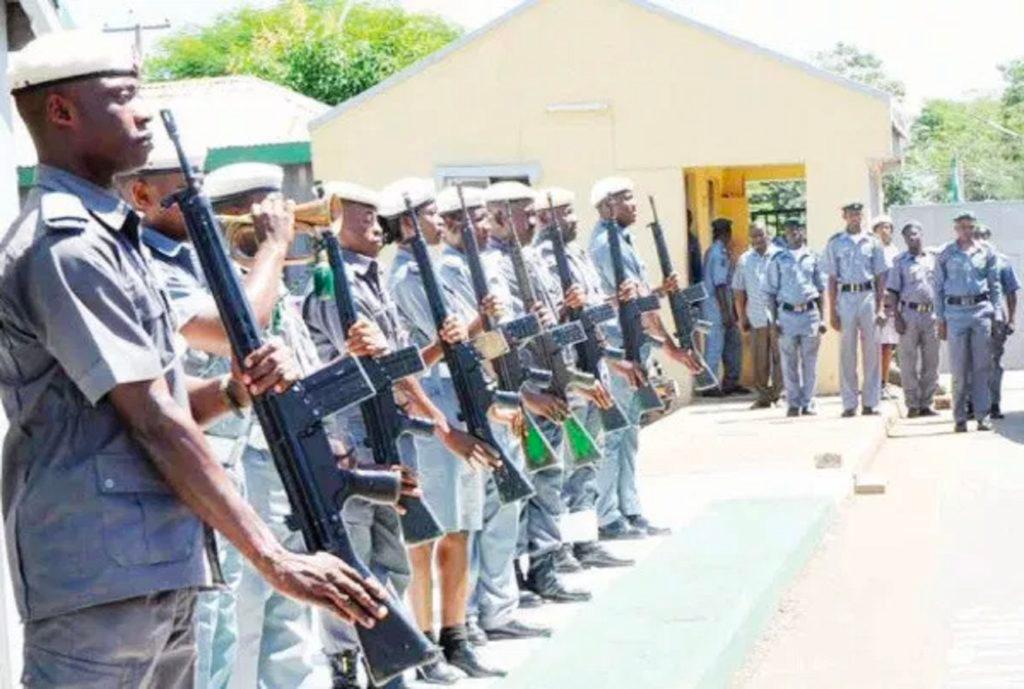
The Nigeria Customs Service (NCS) Apapa Area Command has collected N2.014 trillion in revenue as of November 19, 2024.

This feat was announced by Customs Area Controller (CAC), Comptroller Babatunde Olomu, during a routine parade at the command headquarters in Apapa. 

Comptroller Olomu praised officers for their dedication. He stated, “To meet this revenue target, despite economic challenges, reflects the sacrifice and commitment of our officers, men, and stakeholders.”

He stated the command’s aim to reach N2.2 trillion by year-end, citing the Comptroller-General of Customs’ (CGC) potential 10% target increase. 

The command’s revenue contribution represents 40% of the NCS’s total collection of N5.07 trillion. Olomu attributed the success to the CGC’s leadership in revenue collection, trade facilitation, and enforcement. 

Comptroller Olomu urged officers to maintain positive revenue and enforcement records, ensuring seizures are accompanied by arrests for effective anti-smuggling efforts.

The command will host an end-of-year gathering and award night to honour contributors to its 2024 success.

Prof Pate loses mother at 80

By Uzair Adam

The Vice-Chancellor of the Federal University Kashere in Gombe State, Prof. Umaru Pate, has lost his mother, Hajia Zainab Pate.

According to family sources, Hajia Zainab, aged 80, passed away in Yola, the Adamawa State capital, on Wednesday following a brief illness.

The Daily Reality gathered that she is survived by three children: Prof. Umar Pate, Amina, and Hamza.

The funeral prayer was said to have taken place this evening in Yola.

BREAKING: FG sacks varsity pro-chancellor over misconduct charges

By Anwar Usman

The Minister of Education, Dr Tunji Alausa, on Wednesday, announced the dismissal of the Pro-Chancellor and Chairman of the Governing Council, Federal University of Health Sciences, Otukpo, Benue State, Ohieku Salami, due to actions “unbecoming of his office and violations of established procedures.”

According to a statement by the Director of Press, Federal Ministry of Education, Folashade Boriowo, the decision followed a series of unprofessional actions by the pro-chancellor “including the suspension of the Vice-Chancellor without following the normal procedures.”

The statement stated that despite intervention by the ministry of education and formal requests to rescind the unlawful suspension, Salami refused to abide by the order, resorting to “abusive and threatening behaviour towards the ministry’s directors, including the Permanent Secretary.

“The Honourable Minister of Education, Dr Tunji Alausa, noted that such conduct undermines the ministry’s supervisory role over the university and jeopardises the institution’s stability and governance.

“In line with this decision, the minister has requested the appointment of a new Pro-Chancellor and Chairman of the Governing Council for the Federal University of Health Sciences, Otukpo, to restore proper governance and ensure the university operates in accordance with the principles of law, due process and accountability.”

Obasanjo calls for immediate action on abandoned National Library in Abuja

By Anwar Usman

Former President Olusegun Obasanjo, on Wednesday, said that the country must tackle the pressing issue of the National Library, which has been abandoned for over 18 years, by making sure it’s been completed.

Obasanjo, who delivered a goodwill message at the 60th anniversary of the National Library of Nigeria in Abuja, described the library as not only a symbol but also a critical necessity.

The Daily reality reports that the contract for the library, which stands incomplete on Plot 35, Cadastral Business District in the Federal Capital Territory, was awarded to Reynolds Construction Company in 2006 during Obasanjo’s administration.

The contract was worth N8.9 billion, with a stipulated completion period of four years.

However, the former president stated, “As we celebrate this remarkable milestone and embrace new directions, we must also address a pressing challenge: the completion of the National Library of Nigeria headquarters in Abuja.

“The vision for a purpose-built, state-of-the-art national library is not merely a symbolic aspiration; it is a critical necessity for our country. It represents a physical and functional commitment to our collective belief in the transformative power of knowledge in our lives and societies.

“I, therefore, call on all stakeholders – from the government to the private sector and international partners – to prioritise the completion of this vital infrastructure. A fully operational headquarters will serve as a beacon for literacy and learning, a hub for cultural preservation, and a global symbol of Nigeria’s commitment to education and innovation.”

On his part, the national librarian, Professor Veronica Anunobi, while highlighting the achievements of the library, said, “Since 1974, we have issued 1,000,574 International Standard Book Numbers, as well as 27,755 International Serials Numbers since its inception in 1976.

“A greater push was made this year to fulfil our responsibility in the issuance of International Standard Music Numbers, and we were able to issue numbers for published music scores.”

FG allocates N112 Billion to safeguard Nigerian schools

By Sabiu Abdullahi 

The Federal Government has earmarked N112 billion for the National Plan for Financing Safe Schools, which will aim to secure learning environments nationwide over the next three years.

Minister for Women Affairs Imaan Suleiman-Ibrahim made this announcement to commemorate Universal Children’s Day, themed “Advancing Children’s Rights for a Sustainable Future.” 

“Through the National Plan for Financing Safe Schools, over N112 billion has been allocated to safeguard learning environments over the next three years, ensuring that schools remain safe and inclusive spaces for all children,” she stated.

This initiative demonstrates the government’s commitment to protecting children’s rights and providing a secure environment for education. 

The government has made significant progress in advancing children’s rights through various initiatives.

All 36 states have adopted the Child Rights Act, marking a significant step in protecting children’s rights under the Nigerian Constitution.

Additionally, the implementation of the Violence Against Persons Prohibition Act has strengthened policies to shield children from abuse, violence, and exploitation.